On this date in 1965, Andrew Pixley was gassed in Wyoming for butchering the two young daughters of a vacationing Illinois judge.
A 21-year-old high school dropout with a few petty thefts to his name, Pixley on the night of August 5-6, 1964 broke into the Jackson hotel room occupied by 12-year-old Debbie McAuliffe, her 8-year-old sister Cindy, and 6-year-old Susan.
Their parents were relaxing in the hotel lounge at the time, but would return to a nightmare scene: Debbie dead in her bed, beaten to death with a rock; Cindy, strangled; and this slight stranger drunk or insensible lying on the floor of their room covered in their daughters’ gore. Both girls also appeared to have been sexually assaulted. (Somehow, the youngest daughter was not attacked.)
Judge Robert McAuliffe seized the stranger, while police — and soon behind them, an angry mob calling for Judge Lynch — followed his wife’s screams to the scene.
“It was the most horrible thing I’ve ever seen,” Teton County attorney Floyd King later said. Pixley claimed that the night’s events were a blank in his mind.
Remembered for this one night of madness as one of Wyoming’s most brutal criminals, Andrew Pixley reputedly still haunts Wyoming’s Old Frontier Prison, and gives tour guides at facility (it’s a museum now) the heebie-jeebies.
On this date in 1975, the wife of East Timor’s Prime Minister was publicly executed on the docks of her conquered country’s capital.
By the happenstances of colonial expansion, East Timor, a 15,000-square kilometer half-island in the Lesser Sundas, chanced to have the Portuguese flag planted on its soil instead of (as characterized the rest of its surrounding Indonesian archipelago) the Dutch.
Because of this, Timor-Leste did not walk the same path trod by Indonesia: it did not share in Indonesia’s 1945 revolution breaking away from the Netherlands, nor in the 1965 coup d’etat that put the Suharto military dictatorship in charge of that country.
While these years of living dangerously played out throughout the vast island chains, and even in West Timor, little East Timor remained Portuguese property into the 1970s.
But by that time, colonialism was wearing out its welcome in that onetime maritime empire. A long-running, and ever more unpopular, war against independence fighters in Portugal’s African colonies finally helped to trigger the mother country’s 1974-75 Carnation Revolution and a new regime interested in immediate decolonization.
Abruptly — arguably, too abruptly — Portugal began divesting herself of her onetime empire’s onetime jewels, including not only East Timor but Goa on the coast of India (oops), and the African states of Guinea, Mozambique, and Angola. These would immediately become contested violently by proxies backed by the United States and the Soviet Union.
Though easily the least lucrative and strategically essential of these forsaken colonies, Timor too felt the the Cold War’s hand.
Western-allied Suharto eyed warily the Timorese left-wing insurgent movement turned political party that went so far as to declared Timorese independence in November of 1975. In response, Indonesia gathered the main opposition parties under its own umbrella and had them produce a declaration calling for — wouldn’t you know it? — unification with Indonesia.
By that time, the fall of 1975, it was becoming apparent that such a unification would soon be a fait accompli. Indonesian commandos were penetrating East Timor, even making bold enough to murder western journalists. On December 7, 1975, Indonesia invaded East Timor with the blessing of Washington, D.C.*
The ensuing 24-year occupation was a notorious bloodbath, and Indonesian troops set the standard right from day one … or, in this case, day two.
On December 8, in the now-occupied capital city of Dili, dozens of Timorese elites were marched to the quay under the frightened gaze of their countrymen and -women, and there publicly shot into the harbor. Notable among them was Isobel Lobato, the wife of Nicolau Lobato, who had been the prime minister of Timor’s brief moment of independence in 1975.
Nicolau Lobato himself did not share his wife’s fate, however. He escaped into the bush where he helped lead a remarkably persistent anti-occupation guerrilla movement until he was finally killed in a firefight in 1978. Post-independence, Dili’s Presidente Nicolau Lobato International Airport was re-named in his honor.
* President Gerald Ford and his fell henchman Henry Kissinger flew out of Jakarta hours before the invasion, arriving in Hawaii where they would demur on reporters’ inquiries as to whether they had green-lighted the unfolding incursion. Daniel Patrick Moynihan, who was at that time America’s U.N. envoy, boasted in his memoirs that “The United States wished things to turn out as they did, and worked to bring this about. The Department of State desired that the United Nations prove utterly ineffective in whatever measures it undertook. This task was given to me, and I carried it forward with no inconsiderable success.”
On this date in 1985, serial killer Carroll Edward “Eddie” Cole was executed in Nevada.
A smart and troubled Iowa boy, Cole‘s earliest memories were of his mother’s thrashings to scare him into keeping quiet about the affairs she had while dad was away fighting World War II.
One never knows how trauma will work its way with this or that child. In Cole’s case, it twisted him early on: he nursed a deepening hatred for women and a callousness to his fellows that would one day be diagnosed as psychopathy. Cole’s final body count is not known for sure, but while in prison he would claim that the first of them was a bullying schoolmate named Duane whom he drowned. Duane’s death had been ruled by examiners as an accident.
Carroll tested with a genius-level I.Q., but his criminal career was not one of devious brilliance. Alcoholism and petty crime — soon not so petty at all — consumed him in his adolescence and put him on his way to a rootless, lonely life alternating dead end jobs, catastrophic relationships, jail terms, and mental institutions.
The latter two did not acquit themselves well for their frequent contact with the budding butcher. Over and over, Cole was discharged without the benefit of either treatment or restraint even though Cole himself sought help on several occasions. In 1963, a psychiatrist at Stockton State Hospital in California observed that Cole “seems to be afraid of the female figure and cannot have intercourse with her first but must kill her before he can do it.” Then, that doctor approved Cole’s release. It happened again in 1970 when he checked into a Reno facility begging doctors to help him control his fantasies of misogynist violence. The doctors didn’t buy his act and sent him on his way.
Self-medicating from the bottle, Cole drifted to Texas; he married an alcoholic stripper* there, then ended it by torching in a jealous rage the hotel where she resided. Then on to Missouri and a five-year sentence for trying to strangle a little girl there — then Nevada — then back to California. In San Diego in 1971 he finally embarked on his career in homicide, Duane notwithstanding. He picked up a woman in a bar and strangled her to death. Later he would explain that Essie Buck had proven herself faithless to her real partner: vicarious revenge against his adulterous mother.
Again, an institutional failure: Cole was questioned in this murder, but released uncharged.
And thanks to that police misstep, Eddie Cole drifted through the 1970s in a drunken fog, detained several times for the minor crimes he had been committing since his teens, but murdering often without repercussion. Soon enough he experimented with necrophilia and cannibalism, too. “In the case of a woman he murdered in Oklahoma City,” according to Charlotte Greig, “he claims he came out of an alcoholic blackout to find slices of his victim’s buttocks cooking on a skillet.”
Crime Library has a detailed biography of Cole and his murders. “Spree”, with its undertones of passion and energy, doesn’t feel like quite the right word to use for this man’s self-loathing crimes. Few serial killers better exemplify the ease with which one preys on people on the fringe, the police lethargy in investigating a suspicious death that nobody cares about.
In San Diego in 1979, he strangled one woman at his own workplace, then murdered his latest alcoholic wife Diana a few weeks later. Cole was arrested digging his wife’s grave: they still ruled the death accidental. How much simpler just to close the file on the “drunken tramp”?
Cole left California after that and returned to Dallas (pausing long enough in Las Vegas for one of the two murders that would supply him his death sentence). There he slaughtered three women in the span of 11 days and was once again on the verge of being cleared as a suspect when he simply confessed to the police. His existential scream was lost in America’s trackless underbelly; in the end, he had to beg for someone, anyone, to catch and kill him. He would claim to have killed about 35 women but even then investigators, ever skeptical, would chalk more than half that tally up to bravado.
Despite what one might think about Texas’s suitability for culminating a career in self-destruction, Cole caught only a life sentence there. Fortunately for him, his wandering ways made possible a bit of venue-shopping for the death sentence he sought.
In 1984, after his own mother died, he waived extradition and voluntarily went to face two murder charges in Nevada. There he simply pleaded guilty to capital murder.
The careworn killer rocketed from conviction in October 1984 to execution in a today-unthinkable 14 months, steadfastly repelling the attempts of outside advocates to intervene on his behalf or convince him to pick up his appeals. “I just messed up my life so bad that I just don’t care to go on,” he said.
At 1:43 a.m. this date, Cole entered Nevada’s brand-new lethal injection theater. He was not the first executed in Nevada’s (post-Gary Gilmore) “modern” era: Jesse Bishop had earned that distinction in 1979. But he was the first to die in Nevada by that modernized killing technology, lethal injection. Nevada had cribbed the idea from Texas after the Silver State’s lastcutting-edge killing apparatus, the gas chamber, started leaking.
It took Cole about five minutes to finally achieve his death wish … 47 years, six months, 27 days, and those five minutes.
Emerging from the spectacle, Cole’s Nevada prosecutor enthused, “It is enjoyable to see the system work.”
On this date in 1917, 24-year-old black farmhand Lation (or Ligon) Scott died a horrible death in Dyersburg, Tennessee.
For the two years prior to his extrajudicial “execution” by a lynch mob, Scott had worked as a farmhand for a white family, doing the farm chores while the husband worked at his job in Dyersburg.
He got on well with the family and was fond of the two children. He seemed like an ordinary enough man and a good worker, according to the NAACP journal The Crisis:
Accounts as to his intelligence vary widely. One report asserts that he was almost half-witted. Others attribute to him the intelligence of the average country Negro… He had the reputation of being a splendid hand at doing general housework, or “spring-cleaning,” and…had done this sort of work for a prominent woman of Dyersburg. She states that she was alone in the house with him for two days.
No trouble resulted.
In addition to farming and the doing of odd jobs, he was a preacher. On November 22, 1917, however, he allegedly raped the farmer’s wife while her husband was at work. He threatened to kill her if she reported what he had done. He then fled, leaving his victim bound and gagged inside the farmhouse.
The woman was able to free herself and identify her attacker, and the community took swift action, searching extensively for Scott and offering a $200 reward for his apprehension. Scott was able to elude capture for ten days, though, making his way fifty miles to Madison County. There, a railroad worker recognized him and he was arrested.
The sheriff’s deputy for Dyer County, along with some other men (including, presciently, an undertaker), picked up the accused man and started off back to Dyersburg by car in the wee hours of the morning. They didn’t bother taking an indirect route for the purpose of their journey.
Hundreds, perhaps thousands, of people gathered along the road and waited for their quarry.
And when he appeared, they forced the car off the road and made the officers turn over their prisoner.
These people were not typical of the average lynch mob: rather than stringing him up on the spot, they drew up a list of twelve “jurors” and, at noon, after church let out, drove Scott to the county courthouse for a “trial.”
Scott was ordered to stand up and asked, “Are you guilty or not guilty?”
Scott admitted he was guilty, and the “jury” voted for conviction.
Although one “prominent citizen” asked the people not to be barbaric, because it was Sunday and because “the reputation of the county was at stake,” both the rape victim and her husband wanted Scott to be burned alive rather than merely hanged.
The Crisis‘s description of what happened is not for the faint-hearted.
The Negro was seated on the ground and a buggy-axle driven into the ground between his legs. His feet were chained together, with logging chains, and he was tied with wire. A fire was built. Pokers and flat-irons were procured and heated in the fire… Reports of the torturing, which have been generally accepted and have not been contradicted, are that the Negro’s clothes and skin were ripped from his body simultaneously with a knife. His self-appointed executioners burned his eye-balls with red-hot irons. When he opened his mouth to cry for mercy a red-hot poker was rammed down his gullet. In the same subtle way he was robbed of his sexual organs. Red-hot irons were placed on his feet, back and body, until a hideous stench of burning flesh filled the Sabbath air of Dyersburg, Tenn.
Thousands of people witnessed this scene. They had to be pushed back from the stake to which the Negro was chained. Roof-tops, second-story windows, and porch-tops were filled with spectators. Children were lifted to shoulders, that they might behold the agony of the victim.
It took three and a half hours for the man to die.
This spectacle of horror took place in broad daylight, and no one in the mob wore masks.
Nevertheless, no one was ever prosecuted.
According to The Crisis,
Public opinion in Dyersburg and Dyer County seems to be divided into two groups. One group considers that the Negro got what he deserved. The other group feels that he should have had a “decent lynching.”
A “decent lynching” was defined as “a quick, quiet hanging, with no display or torturing.”
One local citizen remarked that he thought the people who tortured and killed Lation Scott were no better than the rapist himself. Another simply commented, “It was the biggest thing since the Ringling Brothers’ Circus came to town.”
Lation Scott’s was the last lynching in Dyer County history.
Wire report in the Salt Lake Telegram, Dec. 3, 1917.
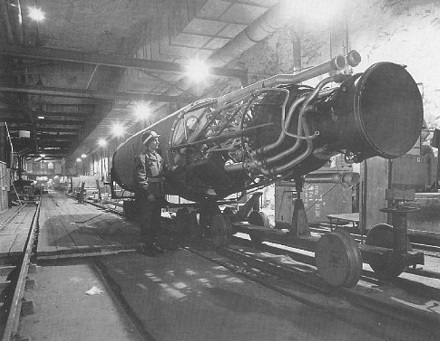
Casting about the Third Reich for a suitable spot to base the missile team, the rocketeers settled on the Kohnstein, a hill in Thuringia already hollowed out by gypsum mines. This tunnel network was readily adapted into a subterranean munitions factory called Mittelwerk — difficult for the Allies to find, and once they found it, difficult to bomb.
A U.S. Army soldier poses with a half-assembled V-2, one of about 250 such rockets found in the Mittelwerk labyrinth when the facility was captured.
With the facilities and the big brains in place, only one thing was missing: millions of man-hours of labor.
Nazi Germany had that in plentiful supply.
Beginning in late 1943, concentration camp inmates at Buchenwald began to be funneled out to a new facility, Mittelbau-Dora. Initially just a Buchenwald sub-camp, Dora grew over the course of 1944 into an immense facility holding 50,000 prisoners — a handful of German undesirables, but mostly captured foreign nationals: French, Dutch, Polish, Czech, and Russian. Short of food, sleep, and clothing for the 1944-1945 German winter, they were systematically worked to death in the Mittelwerk shafts to build a better bomb.
Our day’s principal, Hans Möser/Moeser (English Wikipedia entry | German) was an SS-Obersturmführer who made a living throughout the war years pulling guard detail in a number of concentration camps.
On May 1, 1944, Möser was transferred from Auschwitz to Mittelbau-Dora. It was the last job he would ever hold, but were Möser on the market today his C.V. would laud his team-player orientation and project management skills on a high-priority initiative. No doubt he was just the sort of reliable agent who understands how things are done that the world’s mad bombers need at their back.
“Ninety percent of the prisoners lived and worked in the tunnel of the mine,” testified one German who worked at Dora as a secretary and doctor’s aide.
As a result of the uninterrupted work in the mines and the absence of any installation for forced draft and ventilation, there prevailed a stuffy cold atmosphere, which made breathing difficult. The prisoners also slept in the subterranean tunnel in big chambers hewed out of the rocks, in five beds on top of each other. Already in 1944 3,500 prisoners used to sleep in such a room. In the tunnel of the mine there was no ater, the prisoners got absolutely insufficient quantities of tea for drinking purposes. But for weeks they were not able to wash themselves. As a result of the heavy work in the mines and of the bad food numerous prisoners died from exhaustion during their work.
According to that same testimony, the camp received a frightful order on Good Friday, which fell on March 30 in 1945: drive every last prisoner into those tunnels and bring down the caves around them. “No prisoner should be allowed to fall into Allied hands alive.”
The facilities themselves, too, were to be destroyed as part of Hitler’s scorched-earth “Nero Decree” intended to deny the benefit of German industry and infrastructure to the arriving conquerors. But Hitler’s War Production Minister Albert Speer was intentionally ignoring that order, a decision that might well have helped him avoid hanging at the Nuremberg trials.
Mittelwerk was a valuable capture indeed for the Allies. The Americans who first occupied it, and then the Russians who took it over a few months later, ransacked it for parts and technical specifications. The V-2 was the first man-made object to reach space, blasting at the speed of sound to the edge of orbit before plummeting back with its payload into the heart of London or wherever. It’s the ancestor of the long-range, intercontinental ballistic missiles that would come later, as well as the space programs of the countries who could build such missiles.
And of course, it wasn’t just the parts.
Wernher von Braun himself was the top prize of all — the young genius (he was just 33 when World War II ended) with the weapons of the future in his skull. As Germany collapsed in 1945, von Braun and his team of engineers had resolved to surrender themselves to the Americans rather than the Russians, but they too were subject to an order given the SS to execute the scientists if their capture appeared imminent. The Fuhrerbunker knew as well as the Allies how valuable this asset was.
In the event, von Braun managed to give himself up to a surprised American private. He disappeared into American custody, the crown jewel of “Operation Paperclip” that grabbed some 1,500 scientists from Germany and helpfully whitewashed their past misdeeds — misdeeds like Nazi party affiliation, and participating in slave labor camps.
Firing guided rockets into space was one thing. Unfortunately for our man Möser, his own skill set of bullying subordinates was not in short supply for either of the Cold War antagonists.
Möser was the one defendant (among 15) condemned to death at the resulting trial of Dora camp personnel. Rocket scientists, naturally, were not present for the occasion; Wernher von Braun and his team were hard at work at this time at Fort Bliss, Texas adapting the V-2 to the American Hermes program.
But at Dora, it had been Möser’s job to oversee camp discipline and labor strength for the slaves doing the grunt work manufacturing von Braun’s brainchild. Testimony convinced the court that the SS man had done this far too brutally, and perhaps with sadistic pleasure.
Several witnesses testified Möser frequently beat prisoners and participated in executions, often shooting at the men who were hanged for camp infractions — while they were hanging, or after they were taken off the gallows. (And of the latter, some already dead and some still alive.) “The accused told the twelfth witness that it was a pleasure to give the mercy shots, like shooting a deer.”
Möser for his part countered that he took no joy himself in the beatings and killings that he had to conduct as part of his job — and that the camp commandant had early on reprimanded him for leniency, threatening that “in view of the importance of the V-weapons operation, this could be interpreted as sabotage because it reduced the work efficiency.” How’s that for a hostile work environment?
(There’s a large .pdf of the entire trial summary here. Möser’s section begins on page 36 of the pdf (page 68 per the numbering in the scanned book pages).)
His presence on this here site betrays the outcome. On this date in 1948, Hans Möser was hanged at Landsberg Prison along with several other (unrelated) convicted war criminals.
On this date in 1964, Glen Sabre Valance became the last person hanged in South Australia.
Born Paul Fraser, he jazzed up the handle by cribbing the surname of the title outlaw from the 1962 John Ford Western The Man Who Shot Liberty Valance.
Like that Lee Marvin cutthroat, “Glen Valance” was destined to live a brutal life with a violent end.
In the early morning of 16 June 1964, the 21-year-old Valance broke into the home of his former employer, Richard Strang. He had a standing dispute with the Bordertown farmer over wages but his real grudge ran deeper than that. Strang had bemusedly read the sensitive youth’s diary to other farmhands weeks before, resulting in an altercation — and, after Valance drove off with some of his effects, a police report and an arrest.
Valance nursed “bad thoughts” against his tormenter, he muttered to his family. They turned out worse than anyone could have expected: bad enough to justify his adopted alias.
As Strang and his wife dozed in bed, Valance leveled his rifle at the hated ex-boss, and leveled the score. Then he seized the waking Suzanne Strang and raped her there in the bed sodden with the gore of her husband’s warm corpse.
As Valance hightailed it out of Kooroon Station, Suzanne Strang phoned police — and the resulting roadblocks snared the murderer that very day, with the murder weapon right there in the passenger seat … actually riding shotgun. Valance mounted an unsuccessful insanity defense.
In it, a Clavell still affectionate for her big brother points to their savagely abusive mother as the root cause of the adult Paul/Glen’s horrific crime. (Lillian says that her father shielded her from the worst of any domestic violence, but Paul had no father in his life and no such protection.)
I know she burnt his hands on the stove. I know she put his face through a window. Once she held a knife to his throat and said she’d kill him if he ever stole anything from the cupboard again. I believe that (abuse) led very much to his crime.
Valance was hanged in an unused guard tower (the “Hanging Tower”) of Adelaide Gaol. The facility is unused today, but the date November 24, 1964 and the letters GSV still remain printed on the brick wall.
On this date in 1936, the Spanish Republicans shot Don José Antonio Primo de Rivera y Sáenz de Heredia, 1st Duke of Primo de Rivera, 3rd Marquis of Estella, Grandee of Spain.
The son of Spain’s 1920s dictator, Primo de Rivera founded in 1933 the Falange, Spain’s native fascist movement.
At the October 29 founding convention that year at Madrid’s Theatre of Comedy, Primo de Rivera scathingly pilloried the wan democratic rituals that coming years’ conflict would sweep aside. “The most ruinous system of wasted energy,” he jeered at liberal democracy, where men with leadership waste their talents in hollow electoral hustling and parliamentary rigmarole while the nonsensical ephemeral whims of a formless plurality pass for the vision he attributed to the time before Rousseau ruined everything. “What alone mattered to the liberal state was that a certain number of gentlemen be sitting at the polling station, that the voting start at eight o’clock and end at four, that the ballot boxes not get smashed — when being smashed is the noblest aspiration of all ballot boxes.” (The full speech is available in Spanish here.)
Primo de Rivera espoused for Falangismo the same impulses — of unity, of destiny, of national rebirth, of the triumphant collective — that animated Europe’s similar extreme right stirrings in those years. Only 35 years before, Spain had lost her empire, near enough in memory to inform an acute ache of loss.
In a poetic sweep we will raise this fervent devotion to Spain; we will make sacrifices, we will renounce the easy life and we will triumph, a triumph that — you know this well — we shall not obtain in the upcoming elections. In these elections vote the lesser evil. But your Spain will not be born out of them, nor does our frame for action reside there. That is a murky atmosphere, spent, like a tavern’s after a night of dissipation. Our station is not there. I am a candidate, yes, but I take part in these elections without faith or respect. And I say this now, when so doing may cost me every vote. I couldn’t care less. We are not going to squabble with the establishment over the unsavory left-overs of a soiled banquet. Our station is outside though we may provisionally pass by the other one. Our place is out in the clear air, beneath a moonlit sky, cradling a rifle, and the stars overhead. Let the others party on. We stand outside vigilant; earnest and self-confident we divine the sunrise in the joy of our hearts.
Unlike the Naziism in Germany or Fascism in Italy, Falangism never grew into a force capable of conquering state power itself. Just thirty-three months after Primo de Rivera’s founding address, the Spanish Civil War erupted. The Falangists’ alliance with Francisco Franco — after the war, they would be combined with the Carlists into the only legal political association* in Francoist Spain — spelled great gains for their membership rolls but it was still the General who called the shots.**
Primo de Rivera’s share in this alliance was a voluptuous cult of personality as Spain’s preeminent right-wing martyr, fine posthumous work if you can get it mitigated only by the necessity of undergoing the martyrdom. The fascist prophet was already in prison at the time Franco struck the first blow of the war: he’d been arrested in Madrid on weapons charges. From his cell he carried on a brazen correspondence with Nationalists conniving to subvert the hated Spanish Republic, and when his activities were discovered and prosecuted that autumn in light of Franco’s July revolt they could scarcely have been better framed to incur the utmost measure of judicial wrath.
In consequence of his martyrdom, November 20 remains down to the present a hallowed day for the far right in Spain.
“Cara al Sol” (“Facing the Sun”) is the Falangist anthem; the lyrics are generally credited to Primo de Rivera.
* The Falange Española Tradicionalista y de las Juntas de Ofensiva Nacional-Sindicalista, or “Spanish Traditionalist Phalanx of the Assemblies of National-Syndicalist Offensive” (FET y de las JONS) — or less exhaustingly, the Movimiento Nacional (National Movement).
** Primo de Rivera and Franco didn’t like each other much personally, either.
On this date in 1964, the last two members of a noble and doomed rebel movement against Papa Doc Duvalier were shot in a repellent carnival outside the Haitian capital’s national cemetery.
Thirteen young Haitian expatriates had alit from sea, Granma-like, early that August of 1964, weeks after Duvalier was “elected” President-for-Life with an entirely plausible 99.9% of the vote.*
Taking to heart Machiavelli‘s maxim that it is better for a sovereign to be feared than loved, Papa Doc buttressed his rule with a vicious paramilitary force. Some 30,000 Haitians are thought to have been murdered during his 14-year reign, and many thousands of others fled into exile.
The Cuban example — a few plucky armed men in the mountain somehow toppling the ancien regime — must have inspired the U.S. exiles of the so-called Jeune Haiti. Certainly they did not want for the guerrilla’s raw courage and hardiness. In some alternate history their tramping through southern Haiti’s hills under the barrage of Hurricane Cleo is the stuff schoolchildren recite.
But in our world the rising Jeune Haiti hoped to spark did not materialize. Port-au-Prince brandished horrific reprisals against the rebels’ non-combatant family members in the city of Jeremie, and the men themselves were simply picked off in ones and twos in the bush. The last Jeune Haiti members still at liberty were killed in late October, leaving only the two whom the government had managed to capture. Papa Doc had evil plans for Marcel Numa and Louis Drouin.**
On November 12, a Thursday, government offices shuttered for the grotesque holiday, and schools were ordered to bring their pupils to this special lesson of the dictatorship. “No force will stop the invincible march of the Duvalierist revolution,” read a leaflet distributed at the execution. “It carries the strength of a torrent.” (Source)
Under the eyes of this curious throng and the whirr of cameras, Numa and Drouin were lashed to pine poles by the Tonton Macoutes. Un-blindfolded, they received the whispered last rites of a Catholic priest, and then were shot dead by a firing detail.
When the men’s bodies slide down the poles, Numa’s arms end up slightly above his shoulders and Drouin’s below his. Their heads return to an upright position above their kneeling bodies, until a soldier in camouflage walks over and delivers the final coup de grace, after which their heads slump forward and their bodies slide further toward the bottom of the pole. Blood spills out of Numa’s mouth. Drouin’s glasses fall to the ground, pieces of blood and brain matter clouding the cracked lenses.
The next day, Le Matin, the country’s national newspaper, described the stunned-looking crowd as “feverish, communicating in a mutual patriotic exaltation to curse adventurism and brigandage.”
“The government pamphlets circulating in Port-au-Prince last week left little to the imagination,” reported the November 27, 1964, edition of the American newsweekly Time. “‘Dr. Francois Duvalier will fulfill his sacrosanct mission. He has crushed and will always crush the attempts of the opposition. Think well, renegades. Here is the fate awaiting you and your kind.'”
* Actually a bit of a setback for Duvalier after winning every single vote (finaly tally of 1,320,748 to 0) in his 1961 “re-election”.
** Drouin, who was wounded in a battle and captured for that reason, openly lamented at his execution his failure to commit suicide.
On this date in 1939, Nelson Charles hanged for stabbing his mother-in-law to death in a drunken altercation.
Charles, an indigenous man and World War I veteran, was described by a retired U.S. Marshal who knew him as ” quiet, peaceful and polite person and I have never known him to even have an argument or get into trouble of any kind” — that is, when not drinking. Alas, both he and the victim, 58-year-old Cecilia Johnson, had an affinity for the stuff.
Though Charles committed this murder in “Indian Town” of segregated Ketchikan, Alaska, he hanged in the territorial capital of Juneau.
This was Juneau’s very first execution (previous Alaskan executions had occurred in Nome, Sitka, and Fairbanks), and the improvised gallows arrangement tucked into a stairwell pit under the outside staircase of the town prison is something to read about. One can do that in this here article of the Alaska Justice Forum.
The University of Alaska Anchorage also has a very moving essay written by the then-21-year-old cub reporter who was one of the dozen official witnesses:
Men have been stricken with fatal diseases and we have known they would die. We have held our buddies in our arms at the front and watched the last breaths spend themselves. But even then there had been hope, and when not hope, the awareness that death might stay away awhile. But none of that now; nothing less than a miracle could save this fellow and there are no miracles in this life. Soon he would be a stone.
From under his vest the marshal brought out the black hood. With the deputy standing on the other side, assisting him, he began to draw the thing onto the man’s head. I had not felt too bad until the priest had appeared in his long, black robes; I had seen those robes and tears had come. Nothing like tears came now, but still I hated the black, hated the hood. Take it easy now, you fool, I thought to myself. Look away for a few seconds. So I dropped my eyes and looked into the pit; then up again. They were having trouble with the hood. It was too small. Halfway on, its edge caught onto the man’s right ear.
“Fix my ear,” he said quietly. His last words. Like a small boy who is about to be punished and, with a half-sob, begs his parent to be careful not to break the toy in his pocket.
On this date in 1964, anti-apartheid fighters Vuyisile Mini, Zinakile Mkaba and Wilson Khayingo went to the gallows of Pretoria Central Prison — the first three members of the African National Congress’s military arm to be executed by apartheid South Africa.
In 1960, on the 21st of March — a date still kept as South Africa’s Human Rights Day, and worldwide as the International Day for the Elimination of Racial Discrimination — white police gunned down 69 black civilians protesting the color line.
After the Sharpeville Massacre the struggle over racial apartheid in South Africa escalated to a much more violent plane.
Shortly thereafter, on December 16, Umkhonto we Sizwe (“Spear of the Nation” in Zulu, but better known simply as “MK”) announced its advent with placards in city streets.
The time comes in the life of any people when there remain two choices: to submit or fight. That time has now come to South Africa. We will not submit but will fight back with all means at our disposal in defence of our rights, our people and our freedom.
MK conducted its first dynamite attacks that very evening in Port Elizabeth; over the ensuing 18 months, it carried out more than 200 bombings and other acts of sabotage against the facilities of the apartheid state: train tracks, power stations, telephone wires, offices.
A security crackdown naturally ensued.* By 1963, the white government had managed to expose and arrest three-quarters of MK’s regional Eastern Cape High Command. Vuyisile Mini, Wilson Khayingo, and Zinakile Mkaba were all swiftly condemned on multiple counts of sabotage plus one of murdering a police informant. International appeals for clemency fell on deaf ears; one fellow-traveler later remembered the men taking leave of their fellow-prisoners in a haunting song.**
“The last evening was devastatingly sad as the heroic occupants of the death cells communicated to the prison in gentle melancholy song that their end was near … It was late at night when the singing ceased, and the prison fell into uneasy silence. I was already awake when the singing began again in the early morning. Once again the excruciatingly beautiful music floated through the barred windows, echoing round the brick exercise yard, losing itself in the vast prison yards. And then, unexpectedly, the voice of Vuyisile Mini came roaring down the hushed passages. Evidently standing on a stool, with his face reaching up to a barred vent in his cell, his unmistakable bass voice was enunciating his final message in Xhosa to the world he was leaving. In a voice charged with emotion but stubbornly defiant he spoke of the struggle waged by the African National Congress and of his absolute conviction of the victory to come. And then it was Khayinga’s turn, followed by Mkaba, as they too defied all prison rules to shout out their valedictions. Soon after, I heard the door of their cell being opened. Murmuring voices reached my straining ears, and then the three martyrs broke into a final poignant melody which seemed to fill the whole prison with sound and then gradually faded away into the distant depths of the condemned section.
* It was during this crackdown that future president Nelson Mandela was rolled up. Mandela had helped to found MK.
** According to The Road to Democracy in South Africa, 1960-1970, the song was Mini’s own composition titled “Pasop — nants’in-dod’inyama, Verwoerd” (“Watch out, here is the African man, Verwoerd!”). If it is available online, I have not been able to find it.

 A 21-year-old high school dropout with a few petty thefts to his name, Pixley on the night of August 5-6, 1964 broke into the Jackson hotel room occupied by 12-year-old Debbie McAuliffe, her 8-year-old sister Cindy, and 6-year-old Susan.
 By the happenstances of colonial expansion,
  A smart and troubled Iowa boy,

 Our day’s principal, Hans Möser/Moeser (
 Like that Lee Marvin cutthroat, “Glen Valance” was destined to live a brutal life with a violent end.


 Confrontations throughout South Africa following Sharpeville led the white government to declare a