1944: Zinaida Portnova, Komsomol hero

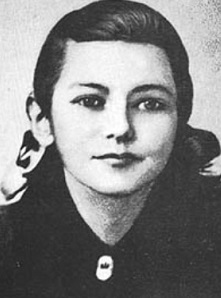
On this date in 1944, Soviet partisan Zinaida Portnova was executed by the Germans occupying Belarus.

The youngest-ever female Hero of the Soviet Union (she was posthumously decorated in 1958), the Leningrad-born Portnova had a rude start in insurgency when the German blitz swept past her summer camp in Belarus and trapped her behind lines.

Said to have been radicalized when occupying soldiers struck her grandmother, the girl joined the youth arm of the local resistance, dubbed the “Young Avengers”.

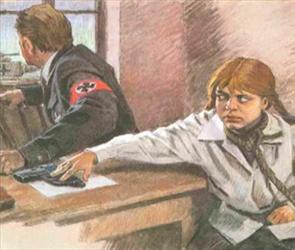
From surveilling enemy troop deployments and assembling weapons caches, Zinaida Portnova graduated to sabotage and ambushes … and capture. Even then she pulled off an action hero escape by snatching a gun and shooting her way out of custody, only to be re-arrested shortly thereafter.

She was shot a month shy of her 18th birthday.

A large number of Pioneer youth groups were subsequently dedicated to Zinaida Portnova, as was a museum of the Komsomol underground and a public monument in Minsk. She remains to this day an honored martyr of the Great Patriotic War.

On this day..

1945: Karolina Juszczykowska, who couldn’t say no

(Thanks to Meaghan Good of the Charley Project for the guest post. -ed.)

On this date in 1945, Polish Gentile Karolina Juszczykowska was executed at the prison in Frankfurt am Main for her attempt to save two Jewish men in Tomaschow, Poland, the previous year. She was 46 years old.

The people she tried to rescue have never been identified; only their first names, Paul and Janek, are known. According to Karolina, she met them on the street and they offered her 300 zloty a week to hide them. She kept them in her home and locked them inside when she went off to work during the day; they slept on the floor at night.

The arrangement lasted only about six weeks before they were betrayed.

The Gestapo raided Karolina’s home on July 23, 1944 and found Janek and Paul hiding in the cellar. Karolina was arrested and the two men were summarily executed.

Karolina emphasized that she only took them in because she needed the money to support herself. The judges who presided over her case seemed to believe her and, although they issued the mandatory death sentence, recommended clemency, writing, “The accused is in a difficult financial situation and succumbed to the temptation to improve her life.”

Karolina was indeed poor. “I have no assets,” she said in her statement to the police, “and don’t expect to have any in the future.” She’d worked menial jobs her whole life: farm work, construction, domestic service, and most recently in the kitchens of Organization Todt, the Third Reich’s civil and military engineering division. She had never been to school and was completely illiterate; she signed her police statement with three crosses.

But, as Yad Vashem points out when writing of her case, no matter what she said, it’s highly unlikely that Karolina Juszczykowska’s reasons for hiding Jews were primarily mercenary.

The wartime Polish economy had shattered, inflation had soared, and 300 zlotys wouldn’t have even been enough to cover the costs of feeding two extra people. No rational person would risk her life for that — the sentence for a Pole caught helping Jews was nearly always death.

What, then, motivated our Gentile rescuer?

Psychologist and filmmaker Eva Fogelman wrote a book called Conscience and Courage: Rescuers of Jews During the Holocaust, wherein she examines the many and various motivations of rescuers. “Many rescuers,” she writes,

found it impossible to explain to anyone who did not live through those times why they acted as they did. In war, there were no rules. The familiar seemed strange, and the bizarre seemed normal. In retrospect, rescuers’ behavior, in some instances, was not understandable even to them. How could they have endangered their families? How could they have done what they did or said what they said?

In Fogelman’s estimation, many rescuers were motivated by simple morality, either of a religious or purely personal kind.

Moral rescuers had a strong sense of who they were and what they were about. Their values were self-sustaining, not dependent on the approval of others. To them, what mattered most was behaving in a way that maintained their integrity. The bystanders who ultimately became rescuers knew that unless they took action, people would die …moral rescuers typically launched their rescuing activity only after being asked to help or after an encounter with suffering and death that awakened their consciences. Scenes of Nazi brutality touched their inner core and activated their moral values … For the most part, when asked for help, moral rescuers could not say no.

We will never know for sure, but it could have happened like this: In 1943, Karolina, while working for Todt, either witnessed or heard about the liquidation of the Tomaschow Ghetto and the accompanying violence and brutality. Most of the ghetto’s Jews were sent to Treblinka in January 1943; the last few hundred were taken away in May. Janek and Paul went into hiding and managed to stay off the radar for a year or so, but by the time they met Karolina they’d been run to ground and were desperate. They asked for her help. She couldn’t say no.

Although Karolina’s judges recommended she be pardoned, the death sentence was carried out anyway. There were no survivors and all we know about this case comes from court documents. But her sacrifice did not go unnoticed.

On May 17, 2011, over 65 years after her death, Israel recognized Karolina Juszczykowska as Righteous Among the Nations, its official honorific for Gentiles who aided Jews during the Holocaust.

On this day..

1945: An unfortunate woman, name and nationality unknown


AP caption: “The expression on the face of this Hun posing for the camera standing by the gallows from which a woman is hanging, Jan. 3, 1945 shows a lack of concern. The name and nationality of the unfortunate woman is unknown. One of the many victims of Nazi terror. The German soldiers seem to be quite used to this kind of sights for them a picture like this is just a souvenir.” (Via)

On this day..

1926: Melton Carr

In contemporary America, it would be next to unthinkable to schedule an execution for New Year’s Day — and asking the associated team of wardens, guards, executioners, witnesses, lawyers, and journalists to ditch New Year’s Rockin’ Eve and do a ball drop to a lethal chemical injection would be a complete nonstarter.

But the First of January, especially prior to the age of widespread telecommunication, was not always so sentimentally held. The Espy File of historical American executions records none whatsoever for Christmas Day, but several have occurred on New Year’s. We’ve previously profiled some of them in these grim annals, like Sylvester Henry Bell and Archilla Smith.

January 1 of 1926, “just 15 minutes after the arrival of the New Year” in the words of the Associated Press report, was the occasion in Huntsville, Texas for electrocuting African-American Melton Carr for raping a white woman in Walker County.

I have found hardly any information pertaining to this case online, but the detail that Carr was reprieved from an earlier execution date “on a petition from officials and citizens of Walker county” — implicitly, white citizens — might be a suggestive indicator for a crime so incendiary under other circumstances. We have seen that detail before in the case of Tom Joyner’s ancestors, who had broad clemency support because the racial politics of the time made an open judicial exploration of their actual innocence impossible.

Hours later, the first-ever radio broadcast of the Rose Bowl introduced another New Year’s Day tradition to the national consciousness — and just by the by, changed the South forever.

After that game, there would be only more January 1 execution date in American history: the 1943 double gassing of Rosanna and Daniel Phillips.

On this day..

1905: A.I. Volioshnikov, police spy

On this date in 1905,* the druzhinniki (militia) of Moscow’s insurrectionary Red Presnia district barged into the apartment of 37-year-old police detective A.I. Volioshnikov.

In front of his shrieking children, “they read the verdict of the Revolutionary Committee, according to which Volioshnikov had to be shot” — as a police spy surveilling rebels, according to Trotsky — then taken outside and executed directly at the Prokhorovka textile factory.**

The tsar’s artillery began barraging Red Presnia the very next day, and had overrun it — complete with summary executions of their own — before the calendar turned over to 1906.

* December 28 per the Gregorian calendar; it was December 15 per the Julian calendar still in use at the time in Russia.

** There’s a “Druzhinniki Street” in Moscow near the Krasnopresnenskaya metro station — and the Prokhorovka factory (dating to 1799) still stands nearby.

On this day..

1960: Anthony Miller, the last hanged at Barlinnie

On this date in 1960, 19-year-old Anthony Miller became the 10th and last person executed at Scotland’s Barlinnie Prison.*

Miller worked in a team with a 16-year-old accomplice in a “queer-rolling” racket: the younger James Denovan would lure a mark with the promise of an assignation, then Miller would jump him and turn a 2-against-1 robbery. Artless, but effective.

With such a crude m.o., it’s no wonder Miller and Denovan beat a man all the way to death in the course of one of their shake-downs. Since he was a minor, Denovan drew a prison term. Miller … not so lucky. His plaintive last words, “Please, Mister …” form the title of a play about his life written by Patrick Harkins.

Tour Barlinnie’s capital punishment environs with one of its old death-watch officers in this David Graham Scott short film, “Hanging With Frank”:

David Graham Scott was good enough to share some firsthand recollections of the film’s title character Frank McKue, and the process of producing “Hanging With Frank”.

Frank McKue was an extremely likeable chap with a very dark sense of humour. Definitely my type of guy. Used to have a drink with him at his local pub in Edinburgh called ‘The Diggers Arms’ (called as such because local gravediggers would drink there) . The sound of the trapdoor swinging open that you hear in the film is actually the door to the beer cellar crashing open in the pub which I recorded as a foley. Frank said it was almost the exact sound! Since the trapdoor in the execution chamber at Barlinnie Prison was shored up and unable to open when we visited it seemed a logical idea to use this nice little soundbite.

Incidentally, the prison that we were filming was still (and still is) very much in operation. There are some shots where you can see prisoners moving about in the upper galleries. It’s Barlinnie Prison in Glasgow, Scotland and dates from the Victorian era. Frank worked there in the 50s as a prison officer who occasionally did deathwatch details. That involved sitting with the condemned man on his last nights and drinking tea, engaging him in conversation and playing draughts [checkers in the U.S.].

Frank showed how the prison officer’s escorting the condemned man would walk a few paces across the gallery and through the doors into the execution chamber.

They’d stand on planks placed over the trapdoors …

… and hold onto safety ropes dangling from the ceiling to stop them from falling down with the prisoner. There had been various instances in the past of prison guards and assistant executioners falling through the trapdoors with the condemned man.

The deathwatch officers would sit with the condemned prisoner at all times after sentence was pronounced. Cups of tea, mingled with small-talk and endless games of draughts and they just chatted away about everything ‘except the obvious’! Their job on the morning of the execution was to escort the condemned man out of his cell (which was actually two normal sized cells knocked into one) and into the execution chamber just a few paces across the gallery in D-Hall of the prison. They steadied the man as the executioner led the way onto the scaffold and the assistant helped buckle his wrists and feet with leather straps when they reached the correct position on the trapdoors. A signal from the assistant to the executioner sent the man on his downward journey to the basement below where the mortuary slab awaited.

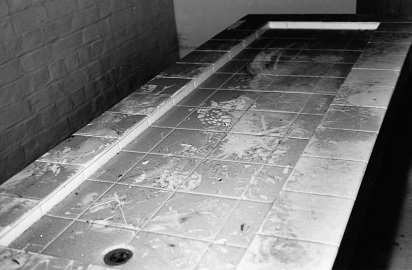
The positioning of the noose was crucial for a clean break between the 2nd and 3rd vertebrae The rope always did a quarter turn to throw back the head and cleanly sever the spinal column at those points and the hangman treated the affair with diligence and extreme reverence. Frank would then often sit with the executioner and assistants as they had their breakfast and left the executed man dangling for a full hour. The prisoner was then pulled back up, the noose removed and then he was lowered back down with other ropes to the basement room again where he was stripped and laid on the mortuary slab. The body ‘belonged to the state so it was buried within the prison grounds’ and no relative was allowed to visit the grave site or send flowers.

I storyboarded much of the film due to the restrictions of time, the nature of the equipment we were using and, of course, the mood I was trying to evoke. I also used black and white, grainy, light-sensitive film stock to try and get the feel of the execution facility in its heyday of the 1950s. If I had more money and time I would have made this film about 10 minutes longer but alas it was not to be. There was always the odd event that we shot spur-of-the-moment. Like when I noticed a butterfly trying to escape from the window of the execution chamber. In this space it took on quite a metaphorical aspect as it struggled desperately and futilely against the glass. Strangely, there was a large group of them roosting on the ceiling. I’ve never seen such a thing in my life and have no idea why they were acting like this. There were also mounds of pigeon droppings too which we tried to avoid as best we could (it can be quite toxic when breathed in). There’s a very brief shot in the film of two pigeon chicks which were nested snugly within a cavity of the execution beam … another bizarre metaphor about death and resurrection, I guess.

When we visited there were major renovations taking place within D-Hall and, as we see in the film, the condemned cell and execution chamber were torn apart. Even the grave sites were not spared. Drainage for the new toilets being built (this was the end of the notorious slop-out era) actually passed through the graves of the executed men. Indignity upon indignity heaped upon these pathetic corpses with each flush of the toilet. The graves had been marked with initials to denote where each of the murderers lay but these had been removed at some point as if to completely erase any trace of them. Frank knew exactly where each lay though and reeled them off one by one. He told me about the way the coffins were designed with a hinged flap over the face of the dead man. Once sealed in the coffin with quicklime scattered over him, Frank would open the flap and add water over the face of the executed prisoner to hasten the destruction of the body. The grave was then filled back in. One of the graves was forever sinking and had to be refilled with ashes from the boiler house on a regular basis. It was the grave of James Robertson, a former policeman who had run over and killed his lover in 1950. He was duly executed for the cold-blooded murder but it was as if his body was restless in the grave the way the tarmac kept on sinking down. In refilling the grave Frank told me that the body seemed to be miraculously well preserved and that somehow the quicklime designed to dissolve it had had the very opposite effect! The prisoners on that grave-filling detail were often terrified and were offered extra perks like cigarettes to make it a bit easier for them. To this very day that same grave is still sinking for some odd reason … the depression in the tarmac can be clearly seen in the film.

There were many stories that Frank related to me about his good friend Albert Pierrepoint, who he befriended during his time at Barlinnie Prison. Pierrepoint was the famous British state executioner at that time and conducted various executions throughout the entire United Kingdom. Frank kept up his friendship with Albert way after capital punishment was abolished and used to visit his pub in Manchester called ‘Help the Poor Struggler’. At his home in the west side of Edinburgh, Frank proudly showed me his various bits of execution related paraphernalia.

One of the prize exhibits was an engraved glass from the Albert’s pub. There was also an amazingly detailed scaled down model of the Delaware gallows which his retired carpenter friend and fellow execution enthusiast, Sudsy, had made for him. Frank showed me with great relish how this unique hanging apparatus would operate. It was obvious that he wanted more than mere models to play with and his real ambition was to be the British state executioner. He had contacted the British Home Office to put his name down as one of the persons willing to train as a state executioner should capital punishment come back. There was no way he’d be getting that job at the time I met him though as he’d already undergone a major operation and had a pig’s heart valve sewn into him. I felt guilty asking Frank to climb the rungs of the ladder into the beam room for a third take, I recall. He was happy to do it but breathless by the end! I thought how awful it would have been, and ironic, if he’d died within this space he loved so much.

But it seems that within the film Frank does fulfill the dual role of hangman and condemned man. The two aspects merged into one at the crowning moment as he puts the bag over his own head — a touch that I thought might be ridiculous at first but somehow does work quite well in the finished film.

Alas for Frank the calling to be a state executioner never came to happen and he died in 2008 from heart complications. Hanging with Frank will remain his legacy, however. A film as much a character study as it is a piece of history. [See more movie stills here -ed.]

I made this film with very little funding indeed and despite its receiving various accolades over the years the government funded film agency in Scotland at the time, The Scottish Film Council, refused to send it to film festivals as it was deemed distasteful. My work has frequently led me to being despised by the powers that be in the largely straight-laced documentary scene … I must be doing something right I suppose!

* Not to be confused with the last executed in Scotland full stop. Miller was the second-last in Scotland.

On this day..

1939: Fifty-six Poles shot in retaliation at Bochnia

We owe this discomfiting executioner’s-eye view from the ranks of German soldiers as they gun down Poles in the town of Bochnia on December 18, 1939 to a partisan attack two days prior by a Polish underground organization called White Eagle. Fifty-six civilians were executed in retaliation.

On this day..

1954: Eugen Turcanu, torturer

On this date in 1954, Eugen Turcanu and 16 other Romanian political prisoners were executed at Jilava prison.

Turcanu et al were noted as the truncheon arm of one of 20th century’s more blood-chilling torture programs, the Pitesti experiment. (Named for the facility where it began, Pitesti prison.)

As if taking Orwell’s 1984 as a paragon instead of a grim dystopian warning, the Pitesti experiment subjected several thousand political and religious dissidents to a savage course of ideological re-engineering. The object was to beat and brainwash undesirables into model Communists.

“Power is in inflicting pain and humiliation,” Orwell’s torturer-apparatchik O’Brien remarks in the novel. “Power is in tearing human minds to pieces and putting them together again in new shapes of your own choosing.”

Turcanu knew from the inside just what that sort of transformation entailed. He was by all appearances a proper Communist and a member of the right clubs thereto when, on the cusp of his 23rd birthday in 1948, he was arrested for a youthful prewar affiliation with the fascist Legionary movement.

He caught a harsh seven-year sentence but found his (short) life’s work in prison. His wheedling convinced wardens of his ideological suitability, and his Herculean physique suggested tasks that could only be entrusted to a co-founder of the Organization of Convinced Communist Detainees.

From late 1949 into 1952, Turcanu and a team of fellow goons were employed dishing out near-lethal thrashings on a wholesale scale to wrongthinkers. One thousand to five thousand souls are thought to have passed through the hands of Turcanu’s team; Soviet gulag survivor Aleksandr Solzhenitsyn called Pitesti “the most terrible act of barbarism in the contemporary world.”

As is customary with torturers, the ordeals extended far beyond brute force to invasive ritual debasement: people forced to eat shit, sexually humiliated, and manipulated into themselves turning torturer on their fellow prisoners and former friends. There’s a video documentary about this program (forcusing especially on its religious persecutions) embedded in its entirety here.

Obviously such practices, enacted on a nigh-industrial scale, were not the freelance initiatives of a few bad apples in the prison system. But no reader of the 21st century will be surprised that it was only the kapos like Turcanu who were punished for it once Stalin’s death relaxed the oppressive ideological terror in eastern Europe. While 22 prisoners were condemned (and 17 ultimately shot), the officers of Romania’s state police who had overseen them “suffered” things like reprimands and amnestied misdemeanor convictions.

On this day..

1937: Titsian Tabidze, poet

On this date in 1937, the Georgian poet Titsian Tabidze was executed in Stalin’s purges.

“Titsiani”, who co-founded the “Blue Horns” symbolist circle in 1916, is the addressee of fellow dissident litterateur Boris Pasternak’s Letters to a Georgian Friend.

“There is as much soul in his poetry as there was in him, a reserved and complicated soul, wholly attracted to the good and capable of clairvoyance and self-sacrifice,” Pasternak would remember of his comrade. “The memory of Tabidze puts me in mind of the country; landscapes rise in my imagination, the waves of the sea and a vast flowering plain; clouds drifting in a row and, behind them in the distance, mountains rising to the same level.”

The problem was their decidedly less sentimental countryman in the Kremlin.

Georgian security chief Lavrenty Beria put the screws to the Georgian writers’ association, driving fellow Blue Horns alum Paolo Yashvili to suicide when he was pressured to denounce Tabidze.

But of course the only difference that made was for Yashvili’s soul.

Arrested as a traitor a bare two months before his death, Tabidze defiantly betrayed to his interrogators the name of only a single fellow-traveler: 18th century Georgian poet Besiki.

On this day..

1949: John Wilson and Benjamin Roberts, Syd Dernley’s first(s)

On this date in 1949, two young miners from northern England were hanged together at Durham prison for unrelated crimes of passion: one had ravaged and strangled another man’s wife when his attempts to seduce her were met with a demand for money; the other had murdered a local girl (and then botched his suicide) when he found himself on the third point of a love triangle.

Both crimes happened on the same weekend, just a few miles apart — so they were tried at the same assizes and advanced through the process from murder to hanging-date together. Double executions were already quite rare at this point: this date’s affair was among the last such events in UK history.*

However, it was the very first execution in which Syd Dernley participated.

Dernley was an assistant executioner for 20-odd hangings, and while he’s far from the most noteworthy man to tread the scaffold, his 1989-90 The Hangman’s Tale: Memoirs of a Public Executioner might interest the person who takes up the pen for a labor history of the modern death penalty.

Dernley, a Nottinghamshire pit welder by day, gives an inside look at the recruitment process and on-the-job operations for a minor-league hangman. Bored with his job, he wrote the Prison Commission cold in January 1947 offering his services (“I feel sure that I could do the job”), got a generic polite dismissal, and then was one of several rookie volunteers summoned in October 1948 for a training course — a rationalization of the qualification process to go with the rationalization of hangings themselves.

Dernley had to wait a full year and then some to actually get into the act.** The basic hanging protocol featured a lead executioner and an assistant who would together escort their man to the gallows platform and perform the hanging; since this was a double execution, there are two such pairs involved. Dernley here is the assistant of veteran hangman Steve Wade. The other pair has Henry Kirk as the lead hangman, assisted by Harry Allen.†

Britain didn’t have the volume of executions for anyone to be a full-time hangman, although some hangmen, like Kirk, were also prison officers.

Jobs were farmed out by the Prison Commission among its small roster of active executioners, and would begin for the hangman with the receipt of a package from the Commission with two copies of a Memorandum of Conditions for executioners’ employment — one for the executioner’s records, and one to return to the Commission when formally accepting the assignment.

The day before the hanging, the executioners traveled to the prison where the sentence was to be carried out. The hanging team would not leave the prison’s walls until the execution was complete: after their prep work on execution’s eve, they slept in the jail.

Although prisoners rarely realized this until the last moment, the gallows platform stood just steps outside the condemned cells, the better for the instant performance of the actual hanging. They waited until Wilson and Roberts were safely out of earshot at chapel or in the exercise yard to set up the ropes.

The lead executioner Wade “controlled and double-checked everything from the moment he opened the execution boxes and took out the three ropes. He examined each of them minutely before rejecting one of them which was immediately coiled up and returned to the box. He measured the drop along the rope and marked it with chalk. I was allowed to shackle the rope to one of the chains hanging down from the beam and I had to go up the steps to adjust the chain as we got the chalk mark to the height of the man’s head, but [Wade] went up the steps to check both the shackling and the chain when I had finished.”

Once both ropes had been prepped, they noosed two sandbags approximating the respective weights of the prisoners, summoned the prison governor, and performed an actual test hanging. Everything went off without a hitch.

They dined that night, and breakfasted the next morning, on prison mash — it was invariably eggs and bacon for breakfast, Dernley remembered later in his career. After stealing silently back into the execution chamber, practically in the shadow of the last devotions of their unwitting prey, they repositioned the ropes which had been (intentionally) stretched out by half an inch from being left dangling their sandbags overnight. The ropes, and their supporting chains, needed to be positioned such that the noose dangled at convenient head height — again, the efficiency of the actual hanging was paramount — and so that, when the trap was released, the rope provided a drop of the precise length necessary to break the neck.

The next forty-five minutes as we waited in our quarters for the call were about the worst of my life. Everything that needed to be said had been said and it was clearly no time for social chit-chat, so we sat there and waited. There was fear afoot in the prison; you could almost smell it. The whole place was silent, waiting.

The butterflies in my stomach, which had disappeared when we went to the execution chamber and had something to do, were back with a vengeance. A jumble of thoughts flitted through my mind. Questions: Would we do a good job? Would I put up a good showing? Would we be quick? There were fears too: Will he fight? How will I handle it if he does?

The door opened and a warder took a step into the room. Wade got to his feet. “It’s time,” he said simply. “Are you ready?” I nodded. I don’t think I could have said anything. Kirky looked across at me and smiled. “Make it a good job, young ‘un,” he said quietly.

In those last few moments I was most conscious of faces, faces turned towards us … screws standing quite still at strategic points, all staring at us … the people standing near the doors of the condemned cells watching us approach … the faces of the official party as they glanced over their shoulders … but above all the face of the clock hanging on the wall at the end of the wing. It was a gigantic thing, about three feet across, and the minute hand was now just a fraction away from nine o’clock.

We were halfway to the condemned cells when the silence was broken and my blood froze. The sound was faint to begin with but it rapidly swelled — singing!

I could not believe my ears. “Jesu … lover … of my soul,” croaked the quavering voice.

Another stronger voice joined in: “Let me to thy bosom fly.”

“Who the hell is that?” I asked one of the screws who was walking along beside me.

He looked shattered but he was not going to admit it. “It’s one of them you’re going to top in a minute,” he replied, trying to sound cool.

With that eerie sound ringing round the wing, we arrived outside the condemned cells. The singing was coming from number two cell, and for the next thirty seconds we stood listening to the doomed man and his priest singing in harmony. In other circumstances it might have been lovely. Here, now, it was weird and unreal.

Everyone was in position as the hands of the huge clock moved the last fraction of an inch to nine o’clock: Wade and I outside the number one cell; Harry and Kirky a few steps away across the landing outside the number two cell …

From the instant the cell door cracked open, the prisoner should have just a few seconds left to live — although the prisoner wouldn’t realize that fact since his guards were under strict orders to brush off the doomed fellow’s inevitable questions about procedure. The two executioners would walk to the center of the cell, stand the prisoner up, and each taking an arm, efficiently pinion them behind his back. Then they whisked him out a secondary door which opened directly to the execution chamber, where they’d glide right into the waiting head-height noose. The name of the game for the hangmen was calm and firmness: don’t scare the man unnecessarily, just enter with professional inevitability and have the man on his noose in less time than it would take him to find the wit for panic or swoon or fight.

The double job complicated matters, but only slightly. The plan was for Wade and Dernley to enter cell number one only moments before Kirky and Allen entered cell number two. That way, both Wilson and Roberts would enter the scaffold singly and the respective hanging teams wouldn’t be in one another’s way — but it would only entail an extra second or two on the traps for the dead men as they were positioned in rapid sequence. It didn’t quite work out that way.

Wade moved straight through the door and I followed him into the cell. It seemed quite crowded with the two warders backing clear and the white-faced priest sitting on the other side of the table looking up at us. The condemned man was positioned as per the book, sitting at the table with his back to the door.

By the time I got to him, he was on his feet and Wade was bringing his left arm behind his back. There was no resistance as I caught hold of his right arm. He just let me bring it behind his back and Wade was waiting for it.

Things were moving incredibly quickly, there was hardly time to take anything in. Wade was walking through the yellow doors. Our man had turned to watch him but had not moved so I just put my hand on his shoulder and, with only the gentlest of pressure, he started to follow. A warder either side of him, we walked through and on to the trap. Wade stopped him and I slipped the legstrap out of my pocket, bobbed down and fastened it round his ankles.‡ I doubt I had ever done it so quickly but by the time I stood up and took a pace off the trap, Wade had finished and the man was standing with his head hidden under the bag and the noose round his neck.

Just the way they drew it up … except the Kirky-Allen team was nowhere to be found.

They should have been on the trap by now and there was no sign of them!

They were having some sort of trouble, but what? As the seconds ticked away, I strained to hear what was going on, but there was not a sound coming from the other side of the landing. That at least was reassuring because whatever was going wrong it was not some massive fight. We would have heard that.

I looked around the cell. Wade was staring through the open door, brow creased in a frown, with wide, worried eyes. By God, he looked worried. The governor and the under-sheriff looked as white as a pair of sheets.

In the centre of all this, the hooded and noosed figure of our man — who should have been dead by now — stood waiting patiently without a sound.

I looked back through the door. Still nothing. I felt so helpless; I wanted to run through and help or do something, but I knew I had to stand just where I was.

A double hanging should take around fifteen seconds from start to finish; we had now been standing with our man ready to go for at least forty-five seconds, although it felt like hours.

A sound to my right brought my eyes back from the door into the execution chamber. One of the screws seemed about to take a pace towards our man, a look almost of horror on his face. The hooded figure was starting to sway. He was going to faint!

At that moment Kirky rushed through the door followed by the lover and Harry. Kirky, looking red-faced and flustered, immediately peeled off to the left and Wade in a blur of motion was stopping the man on the chalk T. In what seemed almost one motion, he whipped the white hood over the man’s head and flicked the noose on. I didn’t even see Harry get the legstrap on before Wade was hurling himself off the trap. The lever went over and away the whole lot went with that massive boom.

Allen later told Dernley that their man, the singing one, “just wasn’t ready” and while he didn’t fight the executioners he also didn’t comply with them as they tried to get his arms into their straps. “In the end we just had to force him.”

His nerves none the worse for the off-script debut, Dernley would remain an assistant executioner — he was never the head man — until another one of his hobbies came embarrassingly to light.


From the April 28, 1954 London Times.

Dernley published his book in 1989, by which time the British hangman was almost as archaic as the smut bust. (The poor lech died in 1994, just short of the Internet revolution.) But Dernley, unlike Pierrepoint, never evinced any second thoughts about his career on the gallows and had an unabashed pro-capital punishment position.§

“I have no regrets about what I did and I sleep pretty soundly in my bed,” he sums up. “I do not believe that my career as a hangman has had any ill-effect on me. Not that you ever get away from it so far as people are concerned — once a hangman always a hangman, it seems. Even after all these years I am still pointed out to people and I have a little chuckle to myself when I find somebody in a pub staring at me in that familiar way and I wonder who has been talking to them.” The inference from his lines, and the photos of Dernley jovially showing off his private model gallows, is that the old hangman made it a point to keep the talk going.

* Per the extremely useful Capital Punishment UK page, there was a double execution in 1950, another in 1951, another in 1952, and the last in 1954.

** Dernley did avail himself of an opportunity to witness personally the March 29, 1949, hanging of James Farrell.

† A man named Harry Allen, from Manchester, would one day be dignified Britain’s Last Executioner. In the 1960s, Allen literally did conduct one of the two simultaneous last hangings in England, as well as the last in Scotland and the last in Northern Ireland. However, Dernley’s counterpart in this execution is a different Harry (Herbert) Allen, from Birmingham.

‡ “As assistant your job will be to strap [the prisoner’s] ankles and get yourself off the trap; the number one will do everything else,” Dernley had been told at his training the year before. “If you’re still mucking about when he’s ready, the number one will tap you on the shoulder and then you don’t bugger about … you get off or go down — and it’s a nasty drop even if you haven’t got a rope round your neck.”

§ Dernley was Pierrepoint’s assistant for the hanging of Timothy Evans, for a murder that, three years later, would be imputed to a serial killer living in his building. Dernley’s autobiography credulously backs the government’s whitewash conclusion that Evans was probably guilty too, citing the weak grounds that Evans failed to declare his innocence at his hanging.

On this day..