Feast Day of St. Cecilia, patron of music

This is the feast day of the early Christian saint Cecilia.

There’s more than serendipity in that name’s pop culture connection: Cecilia is the patron saint of music for the rather slight reason that her heart sung only for God even when she was forced to marry the pagan Valerian. Seriously, Christianity didn’t have any early martyr with a stronger biographical context for a portfolio as significant as music?*

Being the go-to divine intermediary for something this big made Cece a popular saint centuries after her martyrdom, supposed to be either later in the 2nd century or early in the 3rd. (As with many other martyrs’ legends, Cecilia survives several executions before the Romans finally manage to cut her head off.)

Musician and songwriter Paul Simon knew enough St. Cecilia lore to explicitly use her in her musical-patronage role in a different song, “The Coast” (lyrics). The song “Cecilia” deepens immensely if it’s understood as mixed frustration and exaltation with the minstrel’s inconstant artistic muse.

Nor would that be the only 20th century musical homage for this accessible saint. In a more traditional vein, Benjamin Britten set to music a W.H. Auden poem about Cecilia, creating the Hymn to St. Cecilia.

Blessed Cecilia, appear in visions
To all musicians, appear and inspire:
Translated Daughter, come down and startle
Composing mortals with immortal fire.

Fans of classical music should hit YouTube for Handel’s Ode for St. Cecilia’s Day, which appropriately premiered on this date in 1739. Here’s a nibble:

* So far as we know, blogging remains a niche of divine patronage as-yet unfilled. We propose to accept the protection of the patron saint of lost causes.

On this day..

Feast Day of the Holy Maccabees

This is the feast date, in both the Orthodox and Catholic traditions, of the Woman with Seven Sons — each of whom is supposed to have been put to death for refusing to break the Mosaic law by eating pork.

Although they are Jewish martyrs more than a century before Christ, they are revered most especially by the Christian faith that elbowed Judaism aside. Their story comes from 2 Maccabees, a “deuterocanonical” text that is part of the Old Testament but not part of the Hebrew Bible — for reasons having to do with the contingent process of formulating the canon.* (Short explanation | Long explanation)

Whether sent from the Lord or not, this story features the righteous resistance of the faithful family against Antiochus IV Epiphanes, ruler of the Seleucid Empire, which was one of the successor Hellenistic states to Alexander the Great’s conquests.

In 2 Maccabees (and also in 1 Maccabees, which covers the same period, though not this specific martyrdom), Antiochus IV is making an unwelcome pro-heathen intervention in a Jewish civil war on the side of the hellenizers as against the hidebound traditionalists. This comes to attempting “to compel the Jews to depart from the laws of their fathers, and not to live after the laws of God: And to pollute also the temple in Jerusalem, and to call it the temple of Jupiter Olympius.” (2 Maccabees 6:1-2; this chapter features a Whitman’s sampler of other faithful traditionalists slaughtered for various forms of adherence to the Law.)

Same deal with the dietary laws, whose countermanding edict Antiochus (being a wicked heathen king) is pleased to enforce by the most ghastly tortures.

Here’s the description of the martyrdom from 2 Maccabees chapter 7:

Das Martyrium der sieben Makkabaer, by Antonio Ciseri, in an aptly classical setting.

1: It came to pass also, that seven brethren with their mother were taken, and compelled by the king against the law to taste swine’s flesh, and were tormented with scourges and whips.
2: But one of them that spake first said thus, What wouldest thou ask or learn of us? we are ready to die, rather than to transgress the laws of our fathers.
3: Then the king, being in a rage, commanded pans and caldrons to be made hot:
4: Which forthwith being heated, he commanded to cut out the tongue of him that spake first, and to cut off the utmost parts of his body, the rest of his brethren and his mother looking on.
5: Now when he was thus maimed in all his members, he commanded him being yet alive to be brought to the fire, and to be fried in the pan: and as the vapour of the pan was for a good space dispersed, they exhorted one another with the mother to die manfully, saying thus,
6: The Lord God looketh upon us, and in truth hath comfort in us, as Moses in his song, which witnessed to their faces, declared, saying, And he shall be comforted in his servants.
7: So when the first was dead after this number, they brought the second to make him a mocking stock: and when they had pulled off the skin of his head with the hair, they asked him, Wilt thou eat, before thou be punished throughout every member of thy body?
8: But he answered in his own language, and said, No. Wherefore he also received the next torment in order, as the former did.
9: And when he was at the last gasp, he said, Thou like a fury takest us out of this present life, but the King of the world shall raise us up, who have died for his laws, unto everlasting life.
10: After him was the third made a mocking stock: and when he was required, he put out his tongue, and that right soon, holding forth his hands manfully.
11: And said courageously, These I had from heaven; and for his laws I despise them; and from him I hope to receive them again.
12: Insomuch that the king, and they that were with him, marvelled at the young man’s courage, for that he nothing regarded the pains.
13: Now when this man was dead also, they tormented and mangled the fourth in like manner.
14: So when he was ready to die he said thus, It is good, being put to death by men, to look for hope from God to be raised up again by him: as for thee, thou shalt have no resurrection to life.
15: Afterward they brought the fifth also, and mangled him.
16: Then looked he unto the king, and said, Thou hast power over men, thou art corruptible, thou doest what thou wilt; yet think not that our nation is forsaken of God;
17: But abide a while, and behold his great power, how he will torment thee and thy seed.
18: After him also they brought the sixth, who being ready to die said, Be not deceived without cause: for we suffer these things for ourselves, having sinned against our God: therefore marvellous things are done unto us.
19: But think not thou, that takest in hand to strive against God, that thou shalt escape unpunished.
20: But the mother was marvellous above all, and worthy of honourable memory: for when she saw her seven sons slain within the space of one day, she bare it with a good courage, because of the hope that she had in the Lord.
21: Yea, she exhorted every one of them in her own language, filled with courageous spirits; and stirring up her womanish thoughts with a manly stomach, she said unto them,
22: I cannot tell how ye came into my womb: for I neither gave you breath nor life, neither was it I that formed the members of every one of you;
23: But doubtless the Creator of the world, who formed the generation of man, and found out the beginning of all things, will also of his own mercy give you breath and life again, as ye now regard not your own selves for his laws’ sake.
24: Now Antiochus, thinking himself despised, and suspecting it to be a reproachful speech, whilst the youngest was yet alive, did not only exhort him by words, but also assured him with oaths, that he would make him both a rich and a happy man, if he would turn from the laws of his fathers; and that also he would take him for his friend, and trust him with affairs.
25: But when the young man would in no case hearken unto him, the king called his mother, and exhorted her that she would counsel the young man to save his life.
26: And when he had exhorted her with many words, she promised him that she would counsel her son.
27: But she bowing herself toward him, laughing the cruel tyrant to scorn, spake in her country language on this manner; O my son, have pity upon me that bare thee nine months in my womb, and gave thee such three years, and nourished thee, and brought thee up unto this age, and endured the troubles of education.
28: I beseech thee, my son, look upon the heaven and the earth, and all that is therein, and consider that God made them of things that were not; and so was mankind made likewise.
29: Fear not this tormentor, but, being worthy of thy brethren, take thy death that I may receive thee again in mercy with thy brethren.
30: Whiles she was yet speaking these words, the young man said, Whom wait ye for? I will not obey the king’s commandment: but I will obey the commandment of the law that was given unto our fathers by Moses.
31: And thou, that hast been the author of all mischief against the Hebrews, shalt not escape the hands of God.
32: For we suffer because of our sins.
33: And though the living Lord be angry with us a little while for our chastening and correction, yet shall he be at one again with his servants.
34: But thou, O godless man, and of all other most wicked, be not lifted up without a cause, nor puffed up with uncertain hopes, lifting up thy hand against the servants of God:
35: For thou hast not yet escaped the judgment of Almighty God, who seeth all things.
36: For our brethren, who now have suffered a short pain, are dead under God’s covenant of everlasting life: but thou, through the judgment of God, shalt receive just punishment for thy pride.
37: But I, as my brethren, offer up my body and life for the laws of our fathers, beseeching God that he would speedily be merciful unto our nation; and that thou by torments and plagues mayest confess, that he alone is God;
38: And that in me and my brethren the wrath of the Almighty, which is justly brought upon our nation, may cease.
39: Than the king’ being in a rage, handed him worse than all the rest, and took it grievously that he was mocked.
40: So this man died undefiled, and put his whole trust in the Lord.
41: Last of all after the sons the mother died.
42: Let this be enough now to have spoken concerning the idolatrous feasts, and the extreme tortures.

The upshot of the Maccabees texts is the revolt of Judas Maccabeus against the Seleucids, the episode that gives us Hanukkah, when that “temple of Jupiter Olympius” was rededicated back to YHWH.

And though not specifically because of the Holy Maccabees, the start of that revolt is the very next thing to occur in the text,** at the start of chapter 8:

1: Then Judas Maccabeus, and they that were with him, went privily into the towns, and called their kinsfolks together, and took unto them all such as continued in the Jews’ religion, and assembled about six thousand men.
2: And they called upon the Lord, that he would look upon the people that was trodden down of all; and also pity the temple profaned of ungodly men.
3: And that he would have compassion upon the city, sore defaced, and ready to be made even with the ground; and hear the blood that cried unto him,
4: And remember the wicked slaughter of harmless infants, and the blasphemies committed against his name; and that he would shew his hatred against the wicked.

And then, of course, it’s the good guys’ turn to start killing.

* It is worth noting that deuterocanonical books aren’t part of the Old Testament for most Protestants; Martin Luther declared himself “so great an enemy to the second book of the Maccabees, and to Esther, that I wish they had not come to us at all, for they have too many heathen unnaturalities.”

** The book’s chronology is scarcely rigorous, but if the episode is considered historical, it would have occurred in 167 B.C.E. (the year the Maccabean revolt began) or the few years before, reaching back to Antiochus’s anti-Mosaic injunctions c. 175 B.C.E.

On this day..

193: Didius Julianus, who bought the purple from the Praetorians

On this date in 193, Didius Julianus lost the rulership of Rome for which he had paid so dearly.

And his life.

Julianus‘s path to these doleful pages begins with the assassination of the notorious Emperor Commodus at the end of 192.

That man’s successor, Pertinax, was a notable bust with the Praetorian Guard, the elite imperial bodyguard whose status as the only military unit in Rome made it potential — and here, actual — kingmakers.

The Praetorians expected the payoff that had become customary for new executives, and when Pertinax proved less than liberal on that particular budget item, they turned right around and overthrew him.

To see that there would be no mistake the next time around, the Praetorians dispensed with the pretense and brazenly auctioned the purple.

Roman aristocrat and historian Cassius Dio was a witness to this hot mess.

Didius Julianus, at once an insatiate money-getter and a wanton spendthrift, who was always eager for revolution and hence had been exiled by Commodus to his native city of Mediolanum, now, when he heard of the death of Pertinax, hastily made his way to the camp, and, standing at the gates of the enclosure, made bids to the soldiers for the rule over the Romans. Then ensued a most disgraceful business and one unworthy of Rome. For, just as if it had been in some market or auction-room, both the City and its entire empire were auctioned off. The sellers were the ones who had slain their emperor, and the would-be buyers were Sulpicianus and Julianus, who vied to outbid each other, one from the inside, the other from the outside. They gradually raised their bids up to twenty thousand sesterces per soldier. Some of the soldiers would carry word to Julianus, “Sulpicianus offers so much; how much more do you make it?” And to Sulpicianus in turn, “Julianus promises so much; how much do you raise him?” Sulpicianus would have won the day, being inside and being prefect of the city and also the first to name the figure twenty thousand, had not Julianus raised his bid no longer by a small amount but by five thousand at one time, both shouting it in a loud voice and also indicating the amount with his fingers. So the soldiers, captivated by this excessive bid and at the same time fearing that Sulpicianus might avenge Pertinax (an idea that Julianus put into their heads), received Julianus inside and declared him emperor.

Cassius Dio, Book 74

The ignoble achievement is the only thing Didius Julianus is now remembered for.

While Julianus and the Praetorian guard were conducting their damnable business in the capital, three Roman generals in the provinces claimed the throne for themselves.

For centuries the Roman legions had been scattered beyond the Italian peninsula as a hedge against military coups. But after decades of relative stability at the top,* Rome was about to get a bracing reminder of what civil war looked like.

Praetorians — a few cohorts worth of men not in fighting trim — were fine for bullying Senators, but in an outright civil war, they were no match for the legions. The Praetorian Guard’s power to arbitrate the succession was contingent upon the beneficiary’s capacity to cement his own legitimacy by commanding the loyalty of (most of) the state apparatus.

And it turned out that buying the sceptre on spqrBay was not the way to get folks to bend their knees to it.

Septimius Severus, the imperial claimant nearest to the capital, commenced a relentless and virtually unresisted march on Rome, co-opting the troop garrisons and towns as he swept down the peninsula and spurning Julianus’s desperate diplomatic entreaties.

Cassius Dio’s record of Julianus scrambling to defend Rome against Severus is full of black humor.

Julianus … caused the senate to declare Severus a public enemy, and proceeded to prepare against him. In the suburbs he constructed a rampart, provided with gates, so that he might take up a position out there and fight from that base. The city during these days became nothing more nor less than a camp, in the enemy’s country, as it were. Great was the turmoil on the part of the various forces that were encamped and drilling, — men, horses, and elephants, — and great, also, was the fear inspired in the rest of the population by the armed troops, because the latter hated them. Yet at times we would be overcome by laughter; for the Praetorians did nothing worthy of their name and of their promise, for they had learned to live delicately;** the sailors summoned from the fleet stationed at Misenum did not even know how to drill; and the elephants found their towers burdensome and would not even carry their drivers any longer, but threw them off, too. But what caused us the greatest amusement was his fortifying of the palace with latticed gates and strong doors. For, inasmuch as it seemed probable that the soldiers would never have slain Pertinax so easily if the doors had been securely locked, Julianus believed that in case of defeat he would be able to shut himself up there and survive.

In the end, Severus took Rome without striking a blow: the Praetorians switched sides again, and the Eternal City delivered itself from the one usurper to the other. Cassius Dio, again, in media res

the soldiers, convinced by letters of Severus that if they surrendered the slayers of Pertinax and themselves kept the peace they would suffer no harm, arrested the men who had killed Pertinax … We [the Senate] thereupon sentenced Julianus to death, named Severus emperor, and bestowed divine honours on Pertinax. And so it came about that Julianus was slain as he was reclining in the palace itself; his only words were, “But what evil have I done? Whom have I killed?” He had lived sixty years, four months, and the same number of days, out of which he had reigned sixty-six days.

(Actually, Julianus had killed someone: foreseeing that the Praetorians were liable to turn coat yet again, Julianus had the Praetorian prefect who sold him this lemon of an empire put to death for trying to cut a deal with Severus. Despite this negative feedback, the transaction took place on a strict no-refunds, no-exchanges basis.)

A harsh deal for Didius Julianus was a pretty good one for the Roman Empire. Septimius Severus cleaned up his other rival claimants, and ran the empire capably for the next generation.

Kick back with this review of the the dreadful interlude of Didius Julianus with episodes 98 and 99 of the enjoyable History of Rome podcast.

* “The period in the history of the world during which the condition of the human race was most happy and prosperous,” in the judgment of Edward Gibbon.

** The Praetorians were also de-motivated because their promised donative had not been forthcoming.

On this day..

71 B.C.E.: The followers of Spartacus

… a Thracian of Nomadic stock, possessed not only of great courage and strength, but also in sagacity and culture superior to his fortune, and more Hellenic than Thracian. It is said that when he was first brought to Rome to be sold, a serpent was seen coiled about his face as he slept, and his wife, who was of the same tribe as Spartacus, a prophetess, and subject to visitations of the Dionysiac frenzy, declared it the sign of a great and formidable power which would attend him to a fortunate issue.

-Plutarch, The Life of Crassus

On an uncertain date roughly around this time in 71 B.C.E., some 6,000 survivors of the shattered rebel slave army of Spartacus in Rome’s Third Servile War were crucified along the Appian Way.

The specific chronology of this legendary warrior, leader of the last major slave revolt against Rome, is necessarily foggy, but in fine, he broke out of a gladiators’ camp in 73 B.C.E. and went on to lead a slave army some 100,000 strong up and down the Italian peninsula for two solid years, repeatedly stomping Roman forces sent to suppress him.

His motivations remain mysterious; if one likes, one can project back on him an anachronistic anti-slavery project, but it’s more likely he was just trying to get by day by day as the greatest empire* on the planet harried his every move and internal divisions tore at the rebel camp.

Nevertheless, Spartacus and army prospered, and plundered, in the very heart of that empire, and gave Senators reason to fret the security of their capital even as their legions carried Roman arms from Spain to Palestine.

The army (for the gladiators organized it with military discipline, realizing a mob would be easy prey for Rome) was trapped, at last, at the toe of the Italian boot by Roman plutocrat Crassus, later to become a patron of, and fellow triumvir with, Julius Caesar. Abandoned by pirates with whom the slave army attempted to negotiate passage, it was a desperate situation. Spartacus, writes Appian, “crucified a Roman prisoner in no-man’s land to demonstrate to his own troops the fate awaiting them if they were defeated.”

Duly inspired, Spartacus and his army broke out of the Roman circumvallation around February of 71 B.C.E. Hemmed in by a second Roman force, the slaves turned to fight their pursuer, Spartacus dramatically sticking a blade into his own warhorse before the fight as another one of those conquer-or-die pregame speeches.

In The Spartacus War, Barry Strauss estimates April of 71 B.C.E. for that decisive battle. The slaves lost it; Spartacus died in combat, and his ancient calumniators vied to sing his heroism on the field.

But 6,000 survivors did not go down fighting to the death. These, Crassus staked out along one of Rome’s principal highways, the carcasses left to disintegrate there for months or years.

He’s easy to admire now,** but slave revolts scare the bejeezus out of slave societies, and the Spartacus rising would keep generations — centuries — of Romans sweating about a potential repeat. (At least, elite Romans, the ones whose voices remain for us.)

Their pejorative take on Spartacus (aside from his personal valor and martial excellence, for which even hostile writers gave him credit) was long the received wisdom on this upsetter of divinely established social order. “From a small and contemptible band of robbers,” sniffed Saint Augustine of the gladiators, “they attained to a kingdom.” They “enjoyed whatever pleasures they wished, and did what their lust suggested.”

The present-day reader’s readiest association is likely the much more admiring — and famously homoerotic, which is now yet another connotation for the gladiator’s name — Stanley Kubrick classic Spartacus, which turns 50 this year and gave to the cinematic canon the stirring “I’m Spartacus!” scene as the captured slave army defiantly embraces death.

This episode is completely ahistorical, but so what? One of the wildest things about this sword-and-sandal production is how much of it isn’t made-up. Like the premise: in the lifetime of Julius Caesar, a few guys busting out of gladiator school using nothing but kitchen utensils threatened for two years to turn the Eternal City and its far-flung realms upside-down.

* Okay, still a republic, if you like. But those days were fast coming to a close.

** Especially for modern leftist radicals; Marx and Che Guevara were both big fans; German communists Rosa Luxemburg and Karl Liebknecht named their movement for Spartacus, and it was during Berlin’s “Spartacus Week” that they were murdered.

A number of sports clubs in the former Soviet bloc also carry the Spartacus name, including Russian football power Spartak Moscow as well as several clubs in Bulgaria, which currently governs most of the rebel slave’s ancestral homeland of Thrace.

A few books about Spartacus

On this day..

Jesus of Nazareth, King of the Jews

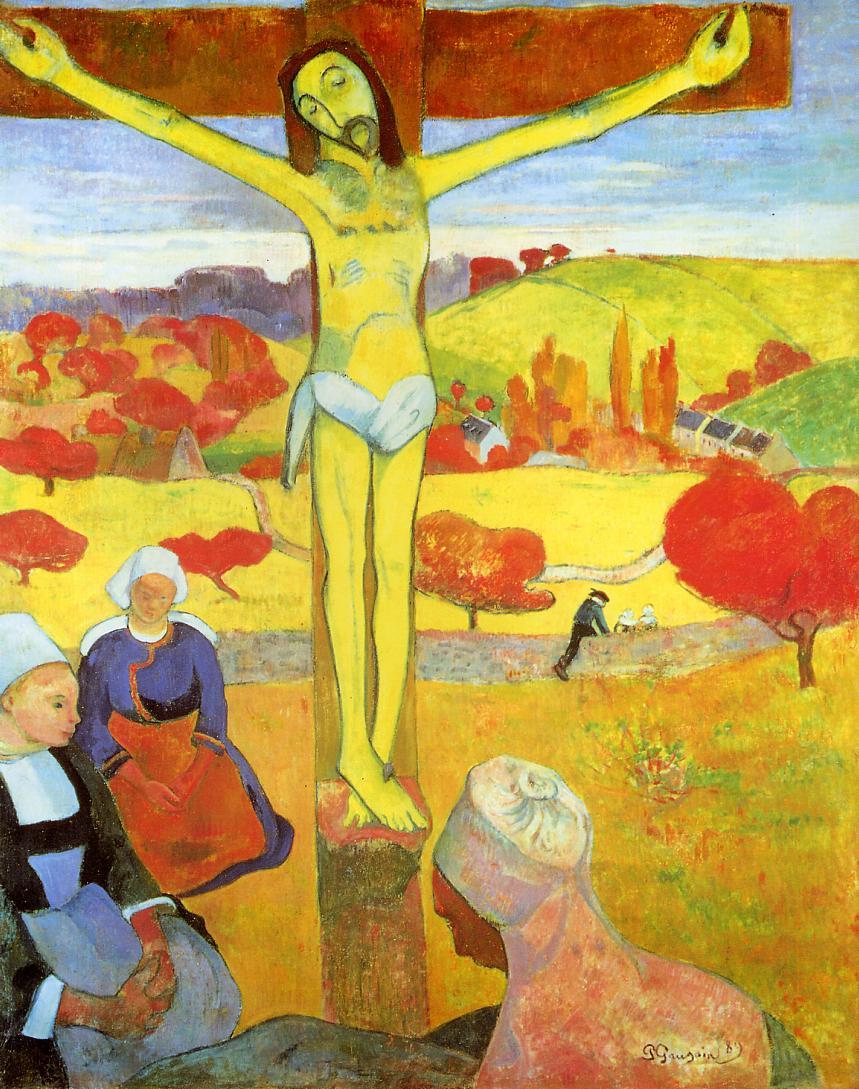
Images of the Crucifixion


(Thanks to Jeffrey Fisher [jeffreyfisher at me.com] for the guest post.)

On Good Friday every year,* Christians around the world commemorate the death by crucifixion of Jesus of Nazareth, rabbi, prophet, Son of God, Son of Man, messiah, and all-around trouble-maker.

The truth is that very little is known of Jesus’ life and teachings from verifiable accounts, but this has not stopped generation after generation of Christians from telling his story, beginning with Jesus’ semi-official biographers, the evangelists of the New Testament. Almost everything we know about the life and teachings of the physical human being Jesus are in those writings, which do not portray him always in compatible ways, and which are almost entirely unconfirmed by any external source. The Roman historian Tacitus mentions (with disdain if not disgust) Jesus’ cult following, as does the Jewish historian and philosopher Josephus, but neither gives us anything to work with as historians (or, for that matter, as theologians). For the record, Suetonius and Pliny also talk about Christians, but these piecemeal sources tell us much more about Roman perceptions of Christians than about Christ and his teachings, or even necessarily Christian beliefs and practices.

What, then, can we reasonably say about Jesus?

It is almost impossible to find universal agreement around anything more than a few basics, including most importantly Jesus’ crucifixion. The Gospels narrate it; Paul the Apostle (who never met Jesus in the flesh, as it were) hangs his theology on it, together with the equally important resurrection; and no contemporary sources (Christian or otherwise) dispute it.

But it’s when we ask why Jesus was crucified that things start to get interesting.

What did he do? The two men he is traditionally said to have been crucified with are commonly understood to be “robbers,” but that they were common criminals is highly unlikely. Crucifixion is a horrible death designed to make a very public statement about the crucified, the sort of thing you use on gladiator-slave rebels like Spartacus, not on pickpockets and roustabouts. The Greek term used for these two men (lestai) is consistent with the description of the released Barabbas as one who had participated in rebellious activities, whose “criminality” was related to his revolutionary business. Moreover, the name “Barabbas” means literally “son of the father,” a purely symbolic and surely entirely fictional name, and that the people choose to have him released indicates their affinity for him as a thorn in the side of the Romans. He is thus contrasted with Jesus, the other son of the father, the peaceful (apocalyptic) revolutionary.

So Jesus would have been crucified as a political criminal, a rebel. This would make sense of accounts of his having been identified by the Romans as “Iesus Nazarenus Rex Iudaeorum”: “Jesus of Nazareth, King of the Jews.” Anyone claiming to be king (and “son of God” was a Jewish way of talking about the king of Israel recorded clearly in Psalm 2), would, if taken seriously, be understood as challenging Roman authority.

Insofar as Jesus seems to have been deliberately poking the Romans’ local running dogs, the Sadducees and the Temple priests, his seizure and termination were surely inevitable. If his teaching is as opposed to violence and unconcerned with “politics” as it seems to have been, it’s hard to believe the Romans would have noticed him without some prodding, this coming not from the “crowd,” but from the leadership (who in Mark and Matthew incite the crowd). Indeed, the priests and scribes look for ways to arrest him when the crowds are not around, because they fear a riot.

If we take the Gospel of Mark at all seriously, Jesus was preaching a new kingdom of God, an apocalyptic redemption of the people of the earth by God’s direct intervention (and with Jesus as the sacrificial pesach lamb). If we take the Gospel of Luke seriously, Jesus spoke in a classic prophetic mode, calling people — Jew and Gentile both — to care for the oppressed of the earth, the poor and the hungry and the helpless. Both Jesuses called for people to be better to each other, to love each other, and indeed to love each other when love was, according to common sense, the foolish thing.

Why would this get you executed?

Well, in itself, it wouldn’t. But the Gospel of Mark tells us of Jesus speaking with a man who realizes that all the animal sacrifices in the world don’t amount to a hill of beans (in that crazy world). When love counts more than sacrifice, we are undermining the Temple. When we go into the Temple, start knocking things over, and say it’s become about robbing the poor and not about loving God and one’s neighbor, we are undermining the Temple. And to undermine the Temple’s authority is also to undermine Rome’s authority, and Rome’s cash flow.

Jesus, like the Essenes he may or may not have associated with, was a purist.

The Temple was full of collaborators and exploiters, the kind seen before in the history of Israel (and berated by prophets like Isaiah and Amos), the kind hated also by the Dead Sea community of apocalyptic purists awaiting a final showdown between God and evil (i.e., the Roman Empire and their local potentates, the Temple authorities).

Jesus, like other Jewish prophets before him, thought that Judaism was about something. That it was somehow about justice and not just about following rules or waiting around for things to get better: that it was about our making the world a better place, and not just making our own lives better.

Start talking that way and get people on your side, and you’re fairly likely to get killed, even twenty centuries later.

* Though the actual date (even the year) of the execution marked by the movable feast of Good Friday is fundamentally unknowable, there are some present-day astronomer types who’d like to sell you April 3, 33 A.D.

On this day..

37: Some poor wretches, despite the death of Tiberius

The Roman Emperor Tiberius expired at Misenum on this date in 37 A.D.


The Death of Tiberius, by Jean-Paul Laurens. Tacitus records that the aged princeps was thought to have expired, to the great relief of all, when word came that he was reviving. “[Praetorian prefect] Macro, nothing daunted, ordered the old emperor to be smothered under a huge heap of clothes.”

As Tiberius had been spending his last years terrifyingly purging Rome of alleged “traitors,” his death was met with some considerable relief. Great news: charismatic young prince Caligula is in charge now!

Anyway, despite the old man’s unpopularity and the manifest injustice of his treason trials, Tiberius’s death did not quite halt momentum of political butchery. Ever thus with bureaucracies.

According to Suetonius,

The people were so glad of his death, that at the first news of it some ran about shouting, “Tiberius to the Tiber,” while others prayed to Mother Earth and the Manes to allow the dead man no abode except among the damned. Still others threatened his body with the hook and the Stairs of Mourning, especially embittered by a recent outrage, added to the memory of his former cruelty. It had been provided by decree of the senate that the execution of the condemned should in all cases be put off for ten days, and it chanced that the punishment of some fell due on the day when the news came about Tiberius. The poor wretches begged the public for protection; but since in the continued absence of Gaius [Caligula] there was no one who could be approached and appealed to, the jailers, fearing to act contrary to the law, strangled them and cast out their bodies on the Stairs of Mourning. Therefore hatred of the tyrant waxed greater, since his cruelty endured even after his death.

But Tiberius’s cruelty didn’t endure too long after his death. Pretty soon, Caligula’s cruelty would have the stage all to itself and Tiberius survivors would be yearning for the good old days.

The History of Rome podcast covers Tiberius’s crazy years and the transition to Caligula here.

* It’s not completely explicit that it was on this same March 16 that news of the emperor’s death hit Rome; therefore, it’s conceivable that the drama described here played out on a subsequent date.

On this day..

104 B.C.E.: Jugurtha

(Thanks to Daily Kos diarist “emperorhadrian” for licensing this guest post, originally published on that site June 24, 2007. -ed.)

The Jugurthine War was a key war in the final century of the Roman Republic.

Like the Americans in Iraq, Rome assumed that their war against Jugurtha, King of Numidia (a nation in north Africa), would be a cakewalk. They believed that Numidia was a nation of savages with a bizarre religion. They assumed that their own “shock and awe” attacks by the superior legions would decapitate and destroy the “evil doer” Jugurtha. They believed that in order to liberate the Numidians of their primitive ways, they had to impose the civilized will of the Roman state on this backward nation. Rome never expected that the Numidians would wage an insurgent war against their Roman occupiers. This war ended up dragging on for almost a decade. And in the end, it showed the depravity of the ruling party (the ultra-conservative republican Optimate party), which was sending the Roman Republic on its way to tyranny, empire and ruin.

In 148 BC, the King of Numidia, Masinissa, died. The Roman proconsul, Publius Cornelius Scipio Aemilianus, had been given authority by Masinissa to divide Masinissa’s estate. He divided it between Masinissa’s three sons, Micipsa, Gulussa, and Mastarnable. Soon after, Gulussa and Mastarnable died, leaving Micipsa as the sole King of Numidia. Around the year 134 BC, Micipsa sent Jugurtha (who was Masinissa’s grandson, but the son of another Numidian) to Spain with Scipio Aemilianius. Scipio was fighting the Celtiberians, who lived in a part of what is now Spain. Jugurtha was able to raise an army to help Scipio. Because of the valor of Jugurtha and his army at the Siege of Numantia, Scipio was able to win his war against the Celtiberians.

While fighting for Rome, Jugurtha worked alongside his future enemy, Gaius Marius. Jugurtha not only learned the superior Roman style of fighting, but he also learned of Rome’s weakness for money and thus bribery. Jugurtha described Rome as “urbem venalem et mature perituram, si emptorem invenerit” (“a city for sale and doomed to quick destruction, if it should ever find a buyer”). When Jugurtha returned to Numidia, Micipsa adopted Jugurtha, and decided to include Jugurtha in his will.

After the fall of Numantia, Jugurtha returned home with a letter from Scipio addressed to his uncle; in it, the commander praised Jugurtha’s exploits and congratulated Micipsa for having “a kinsman worthy of yourself, and of his grandfather Masinissa” (Sallust Iug. 9). On this recommendation the king formally adopted Jugurtha and made him co-heir with his own children

In 118, Micipsa died. He left his kingdom to Jugurtha and his two natural sons, Hiempsal and Adherbal. Shortly after Micipsa’s death, Jugurtha had Hiempsal killed. Adherbal fled to Rome. The Roman Senate sent a commission to Numidia to make peace. Jugurtha bribed the Romans on the commission, and thus the commission gave the better regions of the kingdom to Jugurtha.

In 113 BC, Jugurtha took his army and cornered Adherbal in his capital city of Citra. According to Sallust, Adherbal had the support of the people, but Jugurtha had the support of the best soldiers. A Roman Commission was sent to Numidia to forge a new peace. Jugurtha then bribed the Romans on this commission. The Romans thus allowed Jugurtha to storm Citra, and slaughter Adherbal and his supporters. Because Jugurtha slaughtered a number of Italian business people (including Roman Equites, or “Knights“), the Roman senate declared war on Jugurtha.

The Roman Senate sent an army under the command of the consul Lucius Calpurnius Bestia to fight Jugurtha. Bestia decisively defeated Jugurtha. But Jugurtha bribed Bestia, and thus was given unusually favorable terms. The Roman Senate viewed the favorable terms with suspicion, so it summoned Jugurtha to Rome. When Jugurtha arrived in Rome, he bribed two Tribunes, who thus prevented him from testifying. While in Rome, Jugurtha attempted to have his cousin and rival Massiva assassinated. Because of this, he was expelled from the city and returned to Numidia.

In 110 BC, the Roman Senate sent the praetor Aulus Postumus Albinus (who was the cousin of a consul for that year) to defeat Jugurtha. Because Jugurtha bribed key Romans involved in Albinus’ army (who then betrayed Albinus), Albinus was defeated.

The Roman Senate then sent the consul Quintus Caecilius Metellus to fight Jugurtha. At the Battle of the Muthul, a young Roman officer named Gaius Marius helped to reorganize Metellus’ legions, which then defeated Jugurtha. But Jugurtha was defeated because he forced his army to retreat before it could suffer heavy losses. The Romans did suffer their own heavy losses. Jugurtha disbanded his army, and had his soliders mount an insurgency to fight the Roman occupiers.

Marius returned to Rome. Dissatisfied with the slow pace of the war under Metellus, the Roman Military Assembly (one of the two Roman legislative assemblies, similar to the US Senate) appointed Marius consul (the Military Assembly, not the senate, appointed consuls). The Roman consuls had similar powers as the US President. The consulship was the highest constitutional office, and the consuls had imperium powers, which allowed them to command armies and conduct wars. The senate didn’t want Marius to be consul, because at this time it was dominated by an ultra-conservative republican party of aristocratic elites known as the Optimates. Marius belonged to the party that opposed the Optimates, the Populares. Partly because the senate didn’t like Marius, and partly because of the increasing difficulty Rome was having in recruiting armies, Marius was forced to raise his own army.

The capture of Jugurtha, from this French history of the Jugurthine War.

Marius took his army to Numidia to fight Jugurtha. But while Marius had been raising his army, Jugurtha allied with his father-in-law, Bocchus, the King of Mauretania. Marius defeated Jugurtha and Bocchus in several key battles. But much like with the American occupation in Iraq, Jugurtha’s strategy of insurgency warfare against the occupiers rendered all conventional victories irrelevant. Marius was playing a game of whack-a-mole. No matter how many times the Numidians were defeated, Jugurtha’s insurgents would regroup and keep fighting. It became clear that because of this, Rome could not defeat Jugurtha.

Marius sent his young Quaestor, Lucius Cornelius Sulla, to Bocchus. Sulla bribed Bocchus, and told him that Bocchus would be given a part of Numidia if he would betray Jugurtha. Bocchus then decided to give Jugurtha to Sulla. Sulla took Jugurtha to Rome, where Jugurtha was strangled in the Tullianum in Rome after marching in Marius’ January 1, 104 B.C. Triumph.


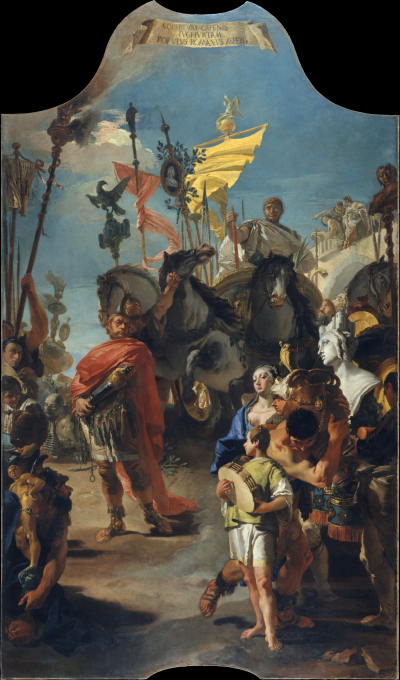
The Triumph of Marius (1729) by Giovanni Battista Tiepolo. The inscription in Latin reads “The Roman people behold Jugurtha laden with chains”.

The Jugurthine War was over. But in the process, several problems were exposed that would cause Rome serious pain in the future. Republicans in this country love to tell us that money in politics is harmless free speech. But as we saw in the Roman Republic during the Jugurthine War, money can be very corrupting. Rome almost lost the war because of money in politics, and the susceptibility of public officials to bribery.

In addition, this war saw the rise of two Romans who would play a key role in the events that directly preceded the fall of the Roman Republic. The first Roman made famous through this war was Gaius Marius. Gaius Marius would later hold the Roman Consulship an unconstitutional 7 times in 21 years (constitutionally, a Roman had to wait 10 years before being reelected consul).

The second Roman made famous through this war was Lucius Cornelius Sulla. Sulla and Marius would fight an unconstitutional civil war with each other several years after this war had ended. Sulla would illegally march his troops on Rome, and unconstitutionally legalize the mass killing of Marius’ supporters. Marius’ supporters in the senate would unconstitutionally prevent Sulla from fighting a war during one of Sulla’s consulships. Sulla would eventually seize absolute power for himself. Sulla would be the first Roman to be Dictator in almost 150 years. He would also be the first Roman in history to hold the dictatorship without the traditional six month term limit.

As dictator, Sulla would illegally change the Roman constitution to make himself and his party (the ultra-conservative republican Optimates) even more powerful. And most importantly, Sulla would set the example (of civil war on Romans, and then the seizing of absolute power) that the future tyrant Gaius Julius Caesar would follow.

In the end, the actions taken by key players in the war against Jugurtha would be repeated in the final destruction of the Roman Republic. The future triumvir Pompey would unconstitutionally hold multiple consulships in a short period of time. Crassus, another future triumvir, would illegally bribe politicians to get his way. And the future tyrant Julius Caesar would bribe, unconstitutionally hold the consulship, and become dictator for life (as Sulla had done). It was Caesar’s actions in this regard, as well as the similar actions of his adopted son and heir, Gaius Octavius (later Gaius Julius Caesar Octavianus, the Emperor Augustus) that would once and for all destroy the Roman Republic, and create the Roman Empire.

1. When when, and whenever death closes our eyelids,
2. Moving naked over Acheron
3. Upon the one raft, victor and conquered together,
4. Marius and Jugurtha together,
5. one tangle of shadows.

6. Caesar plots against India,
7. Tigris and Euphrates shall, from now on, flow at his bidding,
8. Tibet shall be full of Roman policemen,
9. And the Parthians shall get used to our statuary
10. and acquire a Roman religion;

11. One raft on the veiled flood of Acheron,
12. Marius and Jagurtha together.
13. Nor at my funeral either will there be any long trail,
14. bearing ancestral lares and images;
15. No trumpets filled with my emptiness,
16. Nor shall it be on an Atalic bed;
17. The perfumed cloths shall be absent.
18. A small plebeian procession.
19. Enough, enough and in plenty
20. There will be three books at my obsequies
21. Which I take, my not unworthy gift, to Persephone.

From Homage to Sextus Propertius, Canto VI by Ezra Pound

On this day..

c. 560 B.C.E.: Aesop, fabulist

On an unknown date around the 560s B.C.E., the storyteller Aesop is supposed to have been executed in Delphi by being hurled from the Hyampeia rock.

The semi-legendary fable-fashioner is not quite so irretrievable to history as, say, Homer, although assuredly many or all of the tales that have accrued under the heading “Aesop’s Fables” trace to origins other than this man.

Supposed to have lived from the late 7th to mid 6th centuries B.C.E., Aesop is first referenced by history’s first historian, Herodotus.

But by way of summation, we cannot improve upon Plutarch‘s succinct description of Aesop’s fate in his essay, “On God’s Slowness to Punish Evil”. (Available here; a different translation is free online here.)

I’m sure you know the story of how Aesop came here bringing gold from Croesus. He meant to make a magnificent offering to the god,* and also to give every inhabitant of Delphi four minas, but apparently he got angry and fell out with the locals; so he made the ritual offering, but sent the money back to Sardis, because he didn’t think that the people deserved a windfall. They then engineered a charge against him of temple robbery and executed him by pushing him from the famous cliff called Hyampeia.** Subsequently, the story goes on, divine wrath afflicted them with failed harvests and with all kinds of strange diseases, and as a result they used to visit all the festivals where Greeks were assembled and make an announcement inviting anyone who so wished to claim compensation from them for Aesop. Two generations later Idmon of Samos arrived at Delphi; not only was he not a relative of Aesop, but he was in fact a descendant of the people who had bought Aesop as a slave in Samos.† It was only when the Delphians had compensated him that their troubles ceased.‡ (We are also told that this incident was the reason for moving the place of punishment for temple robbers from Hyampeia to Aulia.)

There are many books and media under the Aesop’s Fables branding available for purchase, but you can also find the same content in the public domain at Gutenberg.org and elsewhere.

In any format, they’re timeless. “The Mischievous Dog”, for instance, could have been written especially for bloggers.

[audio:http://www.gutenberg.org/files/19616/mp3/19616-04.mp3]

* Referring to the sacred shrine occupied by the Oracle of Delphi, of course.

** When visiting Delphi, look for Hyampeia marked on your tourist map as “Phleboukos”, one of the Phaedriades surrounding the sacred site. Hyampeia/Phleboukos towers above the Castalian spring. It’s high.

† Besides being a slave, Aesop (at least, the Aesop as legend accumulated) was afflicted with other disadvantages suitable to elevate his mythological wisdom. According to The Life of Aesop:

AESOP (according to Planudes, Cameraius and others) was by Birth, of Ammorius, a Town in the greater Phrygia; (though some will have him to be a Thracian, others a Samian) of a mean Condition, and his Person deformed, to the highest degree: Flat-nos’d, hunch-back’d, blobber-lipp’d; a long mishapen Head; his Body crooked all over, big-belly’d, badger-legg’d, and his Complexion so swarthy, that he took his very Name from’t; for Aesop is the same with Aethiop. And he was not only unhappy in the most scandalous Figure of a Man, that ever was heard of; but he was in a manner Tongue-ty’d too, by such an Impediment in his Speech, that People could very hardly understand what he said.

Be sure to check The Life‘s account of Aesop’s demise, with the undiplomatic Aesop having enraged his hosts with his poor opinion of their digs … and the fables he tells in his defense falling very flat: “He was speaking on, but they pushed him off headlong from the Rock, and he was dashed to pieces with the Fall.”

‡ The Delphians’ search for compensation is directly described by Herodotus’ Histories, written little more than a century after Aesop’s death. Though the execution story itself could be apocryphal, its presence in Herodotus at least makes Greeks’ belief in the event as a real one of their recent past about as credibly documented as anything from 2500+ years ago.

That Aesop belonged to Iadmon is proved by many facts — among others, by this. When the Delphians, in obedience to the command of the oracle, made proclamation that if any one claimed compensation for the murder of Aesop he should receive it, the person who at last came forward was Iadmon, grandson of the former Iadmon, and he received the compensation. Aesop therefore must certainly have been the former Iadmon’s slave.

Evidently, Aesop’s reputation for sagacious wit was well-established in the 5th century B.C. Aristophanes makes respectful references to Aesop in his plays The Wasps, Peace and The Birds — in the latter, the birds’ ignorance is underscored because they haven’t read their Aesop.

On this day..

Feast Day of St. Stephen

The day after Christmas — or the second day of the twelve days of Christmas, in a more traditional coinage — is the feast of St. Stephen.*

St. Stephen is well-known as the “protomartyr”, the first Christian to die for his faith. (Jesus doesn’t count.) There’s a St. Stephen’s Gate in Jerusalem so named for its supposed proximity to the site of the protomartyrdom.

We get the Stephen story from the New Testament Acts of the Apostles, as given in this from the Tyndale-derived King James Version (Acts 6:8 – 8:3)

And Stephen, full of faith and power, did great wonders and miracles among the people. Then there arose certain of the synagogue, which is called the synagogue of the Libertines, and Cyrenians, and Alexandrians, and of them of Cilicia and of Asia, disputing with Stephen. And they were not able to resist the wisdom and the spirit by which he spake.

Then they suborned men, which said, We have heard him speak blasphemous words against Moses, and against God. And they stirred up the people, and the elders, and the scribes, and came upon him, and caught him, and brought him to the council, and set up false witnesses, which said, This man ceaseth not to speak blasphemous words against this holy place, and the law: For we have heard him say, that this Jesus of Nazareth shall destroy this place, and shall change the customs which Moses delivered us. And all that sat in the council, looking stedfastly on him, saw his face as it had been the face of an angel.

Then said the high priest, Are these things so? … [elided; Stephen preaches on at great length before he comes to the point]

Howbeit the most High dwelleth not in temples made with hands; as saith the prophet, Heaven is my throne, and earth is my footstool: what house will ye build me? saith the Lord: or what is the place of my rest? Hath not my hand made all these things?

Ye stiffnecked and uncircumcised in heart and ears, ye do always resist the Holy Ghost: as your fathers did, so do ye. Which of the prophets have not your fathers persecuted? and they have slain them which shewed before of the coming of the Just One; of whom ye have been now the betrayers and murderers: Who have received the law by the disposition of angels, and have not kept it.

When they heard these things, they were cut to the heart, and they gnashed on him with their teeth.

But he, being full of the Holy Ghost, looked up stedfastly into heaven, and saw the glory of God, and Jesus standing on the right hand of God, and said, Behold, I see the heavens opened, and the Son of man standing on the right hand of God.

Then they cried out with a loud voice, and stopped their ears, and ran upon him with one accord, and cast him out of the city, and stoned him: and the witnesses laid down their clothes at a young man’s feet, whose name was Saul.

And they stoned Stephen, calling upon God, and saying, Lord Jesus, receive my spirit. And he kneeled down, and cried with a loud voice, Lord, lay not this sin to their charge. And when he had said this, he fell asleep.

And Saul was consenting unto his death. And at that time there was a great persecution against the church which was at Jerusalem; and they were all scattered abroad throughout the regions of Judaea and Samaria, except the apostles. And devout men carried Stephen to his burial, and made great lamentation over him.

As for Saul, he made havock of the church, entering into every house, and haling men and women committed them to prison.

The persecuting “Saul” at the end of this text is, of course, Saul of Tarsus, the future St. Paul.

Here’s a set of Catholic devotionals for the day, and here’s a more secular vibe on the day’s various quirky Anglo traditions.

As for that song …

Good King Wencesla(u)s, a tenth-century Bohemian ruler, is himself a saint — the patron saint of the Czechs, as a matter of fact.

Wenceslas was murdered in a palace coup, supposedly leading his servant Podevin to avenge that death, for which said Podevin was in turn executed. The lyrics of the song “Good King Wenceslas” celebrate the king and his loyal page undertaking together the charitable works they were famous for.

“Mark my footsteps, my good page
Tread thou in them boldly
Thou shalt find the winter’s rage
Freeze thy blood less coldly.”

In his master’s steps he trod
Where the snow lay dinted
Heat was in the very sod
Which the Saint had printed
Therefore, Christian men, be sure
Wealth or rank possessing
Ye who now will bless the poor
Shall yourselves find blessing.

* At least, it’s the Feast of St. Stephen in the Latin rite. The occasion is observed on Dec. 27 in the Orthodox tradition.

On this day..

39: Gnaeus Cornelius Lentulus Gaetulicus, erotic poet

On an uncertain date likely around early October* in 39 A.D., former Roman Consul Gnaeus Cornelius Lentulus Gaetulicus (not to be confused with Publius Cornelius Lentulus) was executed at the order of Caligula for his part in some sort of plot long lost to history.

In his public life, Gaetulicus was a Machiavellian politician connected to the fallen Praetorian Guard captain Sejanus (their kids were at one point engaged to be married). He evidently survived the post-Sejanus purge with an adroit bit of written diplomacy to the Praetorian’s patron-cum-executioner the Emperor Tiberius, tactfully pointing out that the Emperor had made the same errant choice of alliance. Thus did Gaetulicus retain both his head and his career.

After a decade milking his German province, and Tiberius shuffled off the mortal coil and young Caligula now ruling the empire, Gaetulicus seemingly** involved himself in something treasonable with Marcus Aemilius Lepidus, the latter a recent fave of Caligula and briefly his designated heir.

Or, if you credit scandal-mongering Roman historian Cassius Dio‘s description of the Emperor’s deadly northward road trip, he did it out of some whim of rivalry or opportunity for pecuniary advantage.

Gaius had now spent practically all the money in Rome and the rest of Italy, gathered from every source from which he could in any way get it, and as no source of revenue in considerable amount or practicable to collect could be found there, and his expenses were pressing him hard, he set out for Gaul, ostensibly because the hostile Germans were stirring up trouble, but in reality with the purpose of exploiting both Gaul with its abounding wealth and Spain also. However, he did not openly announce his expedition beforehand, but went first to one of the suburbs and then suddenly set out on the journey, taking with him many actors, many gladiators, horses, women, and all the other trappings of luxury. When he reached his destination, he did no harm to any of the enemy — in fact, as soon as he had proceeded a short distance beyond the Rhine, he returned, and then set out as if to conduct a campaign against Britain, but turned back from the ocean’s edge, showing no little vexation at his lieutenants who won some slight success — but upon the subject peoples, the allies, and the citizens he inflicted vast and innumerable ills. In the first place, he despoiled those who possessed anything, on any and every excuse; and secondly, both private citizens and cities brought him large gifts voluntarily, as it was made to appear. He murdered some men on the ground that they were rebelling, and others on the ground that they were conspiring against him; but the real complaint was one and the same for the whole people — the fact that they were rich. By selling their possessions himself, he realized far greater sums than would otherwise have been the case; for everybody was compelled to buy them at any price and for much more than their value, for the reasons I have mentioned. Accordingly, he sent also for the finest and most precious heirlooms of the monarchy and sold them off by auction, selling with them the fame of the persons who had once used them. Thus he would make some comment on each one, such as, “this belonged to my father,” “this to my mother,” “this to my grandfather,”, “this to my great-grandfather,” “this Egyptian piece was Antony’s, the prize of victory for Augustus.” At the same time he also explained the necessity of selling them, so that no one could persist in pretending to be poor; and thus he made them buy the reputation of each article along with the thing itself.

In spite of all this he did not secure any surplus, but kept up his customary expenditures, not only for other objects that interested him — exhibiting, for example, some games at Lugdunum — but especially for the legions. For he had gathered together two hundred thousand troops, or, as some say, two hundred and fifty thousand. He was acclaimed imperator by them seven times, as his whim directed, though he had won no battle and slain no enemy. To be sure, he did once by a ruse seize and bind a few of the foe, whereas he used up a large part of his own force, striking some of them down one at a time and butchering others then masse. Thus, on one occasion, when he saw a crowd of prisoners or some other persons, he gave orders in the famous phrase, that they should all be slain “from baldhead to baldhead.” At another time he was playing at dice, and finding that he had no money, he called for the census lists of the Gauls and ordered the wealthiest of them to be put to death; then, returning to his fellow-gamesters, he said: “Here you are playing for a few denarii, while I have taken in a good one hundred and fifty millions.” So these men perished without any consideration. Indeed, one of them, Julius Sacerdos, who was fairly well off, yet not so extremely wealthy as to become the object of attack on that account, was slain simply because of a similarity of names. This shows how carelessly everything was done. As for the others who perished, there is no need of my naming over most of them, but I will mention those of whom history requires some record. In the first place, then, he put to death Lentulus Gaetulicus, who had an excellent reputation in every way and had been governor of Germany for ten years, for the reason that he was endeared to the soldiers. Another of his victims was Lepidus, that lover and favourite of his, the husband of Drusilla, the man who had together with Gaius maintained improper relations with the emperor’s other sisters, Agrippina and Julia, the man whom he had allowed to stand for office five years earlier than was permitted by law and whom he kept declaring he would leave as his successor to the throne. To celebrate this man’s death he gave the soldiers money, as though he had defeated some enemies, and sent three daggers to Mars Ultor in Rome. He deported his sisters to the Pontian Islands because of their relations with Lepidus, having first accused them in a communication to the senate of many impious and immoral actions. Agrippina was given Lepidus’ bones in an urn and bidden to carry it back to Rome, keeping it in her bosom during the whole journey.

It’s a pity that the details of this affair, whatever they were, have been lost to history. The History of Rome podcast treats this episode among a review of Caligula’s gnarly reign

According to Post-Augustan Poetry, Gaetulicus

was consul in 26 A.D., and for ten years was legatus in Upper Germany, where his combination of firmness and clemency won him great popularity. He conspired against Caligula while holding this command, and was put to death. Pliny the younger speaks of him as the writer of sportive and lascivious erotic verse, and Martial writes of him in very similar terms. His mistress was named Caesennia, and was herself a poetess.

Only a fragment (which I have not been able to locate online) of a Latin verse describing Britain remains affirmatively attributed to this poet, though he is sometimes speculatively identified with the “Gaetulicus” to whom some epigrams in the Greek Anthology (or “Palatine Anthology”) are attributed e.g.

TO APHRODITE EUPLOIA

Guardian of the seabeach, to thee I send these cakes, and the gifts of
a scanty sacrifice; for to-morrow I shall cross the broad wave of the
Ionian sea, hastening to our Eidothea’s arms. But shine thou
favourably on my love as on my mast, O Cyprian, mistress of the bride-
chamber and the beach.

* Date ballparked by public sacrifices offered in Rome on October 27 “to mark the exposure of the evil plots of Gnaeus Lentulus Gaetulicus against Gaius Germanicus.” (Agrippina: Sex, Power, and Politics in the Early Empire, which speculates at some length on what the dimensions of a Gaetulicus plot might have been.)

** Though Lepidus was executed at about the same time, and Cassius Dio suggests a connection, it’s not completely clear that they conspired together. Since Cassius Dio (and Suetonius, who also connects them in Life of Claudius), wrote generations after the events themselves, we want for dependable information.

On this day..