41 B.C.E.: Arsinoe IV, Cleopatra’s sister

On an unknown date late in 41 B.C.E., Cleopatra’s younger sister and rival Arsinoe was put to death in Asia Minor as the famous queen cemented her fatal alliance with Mark Antony.

Like Cleopatra herself, Arsinoe lived her short life in the internecine maelstrom of Ptolemaic politics under the sway of a Roman Empire itself immersed in civil strife. Violent death was something of an occupational hazard.

Nevertheless, had some flash of prescient irony visited her when Antony’s legionaries unsheathed their blades, she might well have wondered at the small happenstances of fate that left her a nigh-forgotten footnote in her sister’s story, rather than the other way around.

Three siblings had grasped at the Egyptian throne during the Alexandrian War, and whether it was charm or cold calculation won Caesar’s backing for Cleopatra, Arsinoe and her brother Ptolemy XIII still pressed the Roman garrison of Alexandria with a vastly superior force in a battle that was said to have set the Library of Alexandria aflame.

Timely Roman reinforcements decided the matter, and Arsinoe was marched in chains at Caesar’s sumptuous quadruple Triumph of 46 B.C.E. — though she was spared the execution that typically concluded such an ignominy and instead packed off to a temple on the coast of modern-day Turkey.*

In Margaret George’s historical novel The Memoirs of Cleopatra, the danger of maintaining an enemy who has styled herself Queen is neatly summarized in a conversation between Caesar and Cleopatra set after the Triumph:

“I have spared Arsinoe.” [said Caesar]

My [Cleopatra’s] first feeling was a rush of relief. My second was worry. Arsinoe the proud would not retire quietly.

“Where is she to go?”

“She has requested sanctuary at the great Temple of Diana in Ephesus,” he said. “And I will grant it, if you agree.”

Ephesus! Too close to Egypt! Better send her to Britain! Yet … I would gamble, and be merciful. Perhaps I was not enough of a Ptolemy after all. Arsinoe would not have granted it.

“Yes, I will allow it.”

That very perception of her potential danger hung over Arsinoe like the sword of Damocles.

The sword fell — figuratively and literally — five years later after Cleopatra seduced Mark Antony at Tarsus in the autumn of 41. Her terms for Egypt’s alliance supposedly included elimination of this lingering rival — though if Arsinoe had made common cause with Caesar’s Republican assassins, Antony may well have had his own reasons to dispatch the young woman.

Arsinoe’s death helped seal a pact that was itself destined for a bloody end. Distracted by his foreign paramour, Antony steadily lost political ground to his adversary Octavian. In another decade’s time, open war broke out again.

The Egyptian fleet would gather at Ephesus, not far from Arsinoe’s final resting place, bound for the catastrophic Battle of Actium whose outcome added Cleopatra’s and Antony’s blood to the soil from which sprung the long reign of Octavian — soon to be styled Augustus Caesar, the first emperor of Rome.

* A Temple of Artemis — either in Miletus (as Appian has it), or the wonder of the world in Ephesus (as Josephus has it). She met her death at the temple — whichever it was — dragged to its steps and put to the sword. Ephesus seems to be the more generally accepted locale, and an octagonal tomb there has been speculatively identified as Arsinoe’s.

Part of the Themed Set: The Fall of the Roman Republic.

On this day..

63 B.C.E.: Publius Cornelius Lentulus

On this date in 63 B.C.E., Publius Cornelius Lentulus was executed by strangulation in Rome’s Tullianum for conspiring to overthrow the Roman Republic.

He was one of the key figures in the Catiline conspiracy, a political intrigue set against a ruinous social crisis that pushed the country to the precipice of civil war.

Roman had fought Roman intermittently over much of the preceding 70 years in episodes underpinned by a class conflict pitting wealthy landowners (politically represented by the Senate) against the growing populations of plantation slaves who tilled their fields and urban plebeians displaced from independent farming on the other. Debt was choking the Roman economy.

Catiline, an ambitious politician from a fading patrician family, had sought the consulship on a populist platform of debt forgiveness; failing to win the office through legal channels, he maneuvered to take it by force. The affair is known mostly through the testimony of its enemies, so it is difficult to gauge the true mixture of opportunism and conviction that informed the conspirators.

A cliffhanger sequence of moves and countermoves against the consul Cicero ensued, highlighted most spectacularly by one of Cicero’s famous orations driving every Senator to seat himself away from Catiline — who nevertheless rose passionately in his own defense.

Catiline left Rome to raise an army in the countryside, leaving Lentulus (himself a former consul) to manage the intrigue within Rome.

Lentulus made the least of the moment, dilating when he could have acted and exposing the plot by dint of a ham-handed attempt to involve visiting Gauls with grievances of their own.

The arrested conspirators’ fate was debated in the Senate this very morning. The young Gaius Julius Caesar, then conducting an affair with Cicero’s Cato’s [correction] sister, stood against (illegal) summary execution, but the victories he would enjoy over Cicero yet lay some years into the future; fearing an attempted rescue, the Senate’s grim sentence was carried out immediately. Cicero personally escorted Lentulus to his death.

Lentulus’ failure likewise doomed Catiline, whose army shrunk from desertions before its commander hurled it into martyrdom with a stirring speech that recalled in passing “how severe a penalty the inactivity and cowardice of Lentulus has brought upon himself and us.”

Part of the Themed Set: The Fall of the Roman Republic.

On this day..

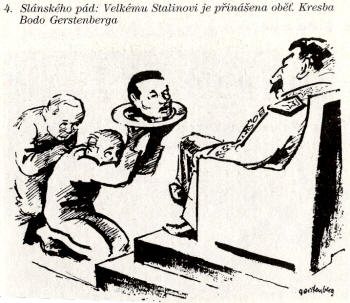
1952: Rudolf Slansky and 10 “conspirators”

On this date in 1952, eleven high-ranking Czechoslovakian politicians were hanged at Prague’s Pankrac Prison two weeks after a show trial purging unreliable elements from the Communist party.

One of the most infamous show trials in Czechoslovakia saw 14 high-ranking Communists — eleven of them Jews — railroaded for a “Trotskyite-Titoist-Zionist activities in the service of American imperialism”. Three received life sentences. The other eleven went to the gallows.

While the roots of the persecution, especially the undertones of anti-Semitism, sink into the id of the Stalinist Eastern bloc, the most evident proximate cause was the USSR’s assertion of control over its satellite states at a time when Josip Tito was successfully charting a course of independent communism. Purges in Poland, Bulgaria and Hungary had taken place in the years before.

The Soviet agents rounding up suspects for Stalin did not trifle with small game. Rudolf Slansky was General Secretary of the Communist Party and therefore the second-most powerful man in the country; by the time he was tried, after a year in prison under torture, he was publicly denouncing himself.

Otto Sling, whose name became synonymous with forbidden heterodoxy, did likewise — “I was a treacherous enemy within the Communist Party … I am justly an object of contempt and deserve the maximum and the hardest punishment.”

And Vladimir Clementis, the Slovak Minister of Foreign Affairs, was erased from a photo taken with the Czechoslovakian President, a circumstance Milan Kundera reflected upon in The Book of Laughter and Forgetting:

In February 1948, the Communist leader Klement Gottwald stepped out on the balcony of a Baroque palace to harangue hundreds of thousands of citizens massed in Old Town Square … Gottwald was flanked by his comrades, with Clementis standing close to him.

…

The propaganda section made hundreds of thousands of copies of the photograph taken on the balcony where Gottwald, in a fur hat and surrounded by his comrades, spoke to the people. On that balcony the history of Communist Bohemia began. Every child knew that photograph, from seeing it on posters and in schoolbooks and museums.

Four years later, Clementis was charged with treason and hanged. The propaganda section immediately made him vanish from history and, of course, from all photographs. Ever since, Gottwald has been alone on the balcony. Where Clementis stood, there is only the bare palace wall.

The hanged were rehabilitated in 1963.

Artur London, who received a life sentence and was released after rehabilitation, wrote about his experiences in The Confession, subsequently a 1970 Costa-Gavras film. The wife and son of Deputy Minister of Foreign Trade (and Auschwitz survivor) Rudolf Margolius have also both written memoirs covering the trial.

The younger Margolius in particular, who has staunchly defended his father as an essentially apolitical man and not a Communist apparatchik, has been in the thick of present-day disputes in Czechoslovakia’s successor states over whom is due sympathy and recognition for bygone political crimes.

On this day..

2005: Van Tuong Nguyen

On this date in 2005, Australian national Van Tuong Nguyen was hanged* in Singapore’s Changi Prison for smuggling heroin.

Three years before, in dire financial straits, Nguyen had agreed to act as a drug courier and been caught attempting to carry 396.2 grams — less than a pound — of heroin through the airport of the notoriously execution-happy city-state. He had no criminal history and cooperated with the authorities, but the quantity of contraband on his person incurred an automatic death sentence.

Nguyen became an international cause celebre and the Australian government appealed for clemency — though some detected tepid public notice for the young man of Vietnamese extraction in comparison with white Australians in similar situations.

His family’s two-year campaign mobilizing worldwide pressure to save him was the profile of a 2006 documentary that laid bare the continuing grief left to Nguyen’s family and friends … and their continuing work against the death penalty in his remembrance. This personal tribute of unidentified provenance captures both:

* By Darshan Singh, whose identity as Singapore’s hangman was exposed on the occasion.

On this day..

1581: Edmund Campion, Ralph Sherwin and Alexander Briant

On this date in 1581, three English Catholic martyrs were hanged, drawn and quartered at Tyburn, casualties of the bloody confrontation between religious and secular power of the English Reformation.

Edmund Campion — later sainted — was the towering figure among them and the great attraction for those that thronged the Tyburn scaffold on a rain-drenched Friday.

A brilliant Oxford scholar once tipped as a possible future Archibishop of Canterbury, Campion abjured his Anglican holy orders in favor of Rome — a mortal peril in Elizabethan England.

He slipped away to Ireland, then to the continent and safety. But at age 40, after nearly a decade abroad, the missionary zeal of the converted called him back to Albion as part of a secret Jesuit mission. Hunted from the day he set foot back in Britain, he survived a year on the run, an underground minister to an illicit faith.

Though priestly investiture alone technically made him capitally liable, a government with millions of Catholic citizens grappled for some firmer ground upon which to condemn the renowned intellectual. Since Campion succumbed neither to torture nor to blandishments, nor to the surreal interludes when he was hauled out of his dungeon and made to debate with the Crown’s theologians, he was finally convicted on the strength of made-to-order witness testimony to the effect that his mission had some vague upshot of undermining Queen Elizabeth’s hold on her subjects.

In effect, it was very much like convicting him for his faith: the Anglican-Catholic conflict had crystallized, and dozens of priests would follow the route of Campion in the years to come. Between a mutually implacable state and church, either flesh or soul must burn.

Not a few of those who trod the martyr’s path would take inspiration from the beatific Jesuit — as young Henry Walpole, whose own route to Calvary is said to have begun when he was spattered by Campion’s blood this day and come full circle to his own execution 15 years later. Walpole’s embrace of martyrdom fairly glows from his proscribed tribute to Campion:

Hys fare was hard, yet mylde & sweete his cheere,
his pryson close, yet free & loose his mynde,
his torture great, yet small or none his feare,
his offers lardge, yet nothing coulde him blynde.
O constant man, oh mynde, oh vyrtue straunge,
whome want, nor woe, nor feare, nor hope coulde chaunge.

…

Yee thought perhapps, when learned Campion dyes,
his pen must cease, his sugred townge be still.
But yow forget how lowd his deathe yt cryes,
how farre beyond the sownd of tounge or quill.
yow did not know how rare and great a good
yt was to write those precious guiftes in bloode.

That famous eloquence was Campion’s legacy, so overwhelmingly so that he presents in the lineup of men who might have written Shakespeare.

His best-know work was “Campion’s Brag”, the scornful nickname his foes gave to an apologia he produced while underground in England … and to whose steady words Edmund Campion proved true this day:

[B]e it known to you that we have made a league — all the Jesuits in the world, whose succession and multitude must overreach all the practices of England — cheerfully to carry the cross you shall lay upon us, and never to despair your recovery [to Catholicism], while we have a man left to enjoy your Tyburn, or to be racked with your torments, or consumed with your prisons. The expense is reckoned, the enterprise is begun; it is of God, it cannot be withstood. So the Faith was planted: so it must be restored.

But Protestant England did withstand the enterprise. The generation to come saw Catholic ideas and writing put to withering siege, Campion’s not least among them. For all the tribute of history to the man of Christlike fortitude, it is by no means apparent that the enjoyments of Tyburn and the kindred “practices of England” did not, after all, lay a cross heavier than English Catholics could bear.

On this day..

1944: Lilo Gloeden, Erich Gloeden and Elisabeth Kuznitzky

On this date in 1944, Berlin housewife Elisabeth “Lilo” Gloeden was beheaded with an axe in Plotzensee Prison, along with her husband and mother.

They had been sentenced — and intentionally made an example of — just three days before for hiding a fugitive from the July 20 Plot to assassinate Hitler.

As Martin Gilbert observes in The Second World War: A Complete History, the fury of Hitler’s domestic crackdown came in inverse proportion to Germany’s fortunes in war.

[The family’s] fate was then publicized, as a warning to anyone else who might try to shelter the enemies of the Third Reich.

The fate of that Reich could not, however, be seriously in doubt. On the day of Lilo Gloeden’s execution, American troops drove the Germans from Mackwiller, in the Saar, inside Germany’s pre-war frontier. In Hungary, the Red Army entered Eger, less than twenty-five miles from the central Slovak frontier.

Part of the Themed Set: Women Against Fascism.

On this day..

1941: Zoya Kosmodemyanskaya

On this date in 1941, Soviet partisan Zoya Kosmodemyanskaya was hanged by the Wehrmacht for sabotaging buildings behind German lines near Moscow.

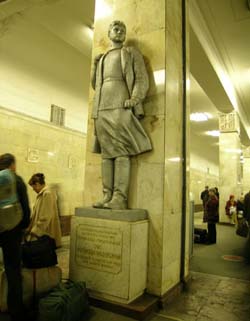
A statue of Zoya Kosmodemyanskaya stands vigil over Moscow’s World War II-era Partizanskaya metro station. Image used with permission.

One of the most famous Soviet war heroines and the first woman decorated as Hero of the Soviet Union during World War II, the 18-year-old had quit school to volunteer for a partisan unit only a few weeks before her hanging as Russia mobilized against Hitler’s race towards Moscow.

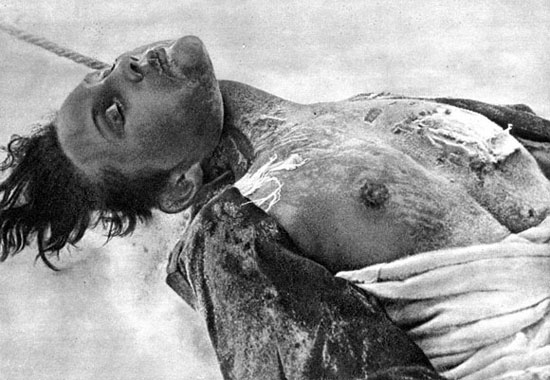
Known simply as “Tanya”, the nom de guerre which was the only information she volunteered during two days of torture, the power of the press offered her apotheosis into a propaganda coup for the Kremlin, and a symbol of courage that would long outlive Stalin. Before the public execution, the Nazis paused to photograph the scene; Kosmodemyanskaya availed the lull to harangue the Germans — “you can’t hang all 190 million of us!” — and call on the Russian villagers present to resist occupation.

Her bayoneted, mutilated body hung on the gibbet until the Red Army recaptured the village; witnesses related the tale of her dying heroism to a newsman.

It was only after the story of “Tanya” hit the press in January 1942 that her identity was established … and then promulgated widely. Anonymous and obscure in death, Zoya Kosmodemyanskaya would inspire millions and become the heroic emblem of other women partisans.


Soviet propaganda poster unabashedly modeled on the already-iconic image of Zoya Kosmodemyanskaya’s abused corpse.

Zoya, a 1944 Soviet film, was scored by Dmitri Shostakovich.

Part of the Themed Set: Women Against Fascism.

On this day..

1919: Felipe Angeles

On this date in 1919, Mexican hero General Felipe Angeles was shot at dawn in Chihuahua, hours after a military tribunal condemned him for rebellion.

Angeles, a humane and cosmopolitan socialist, had tacked a unique course through the dangerous Mexican Revolution. The career artillerist’s military counsel was a high card in the hands of the revolutionaries, and helped to make the coruscating career of Pancho Villa. Crucially, Angeles advised Villa to seize the mines of Zacatecas, dealing a mortal blow to the putschist Huerta government by throttling its currency at the source.

But that brilliant maneuver countermanded an order of the Revolution’s moderate political face, Venustiano Carranza, and both personality conflicts and support for more radically redistributionist measures soon sundered the Villa factions’ alliance with Carranza.

Angeles hitched his destiny to Pancho Villa and is historically recalled as the “angelic” opposite number to the famed guerrilla’s other top military henchman, the murderous Roberto Fierro. The three lend themselves almost implausibly to allegorical literature — “the decisive biographical proof of Villa’s duality … found in the two men closest to him, equidistant and extreme extensions of his nature.” (Enrique Krauze)

Angeles aimed, perhaps, at a statesmanship that might have remembered him the father of his country.

‘It was the recurrent dream of the impotent revolutionary intellectual: to play Plato to some powerful but pliant popular caudillo.’ This may well be an accurate analysis of Angeles, who probably had ambitions to be president of Mexico, with Villa as the power behind the throne but based in Chihuahua, allowing Angeles free rein to implement radical reforms in the capital

… Angeles probably saw Villa as a tabula rasa on which he could imprint his ideology. The problem was that Villa had no taste for abstract thought; as [John] Reed remarked ironically: ‘You had to be a philosopher to explain anything to Villa.’

To the grief of both, Villa neglected Angeles’ expertise when the Villists faced Carranzo at arms. Against advice, Villa abandoned Mexico City, failed to attack when the constitutionalists were tenuous, then spurned guerrilla operations for a frontal assault into the teeth of a foe with numerical superiority and lethal tactical advances culled from the slaughterhouse of World War I.

All was postscript after the Battle of Celaya — Villa maintaining for a few years as a bandit force and famously raiding New Mexico while his strategist drifted into exile in Texas before returning to Mexico on a quixotic peacemaking mission that led him instead to a show trial.

Angeles’ end came with the all the dignity of his romantic age. Before his judges — before all the world — he gave “full and clear expositions of his history and his ideas about everything from politics to ontology. It was clear that he knew this was his end, and he seems to have written a kind of intellectual memoir in the protracted answers … he was not defeated morally so much as physically.”

Angeles himself arranged particulars of his own execution with the Carranza men detailed to shoot him. He enjoys posthumous esteem commensurate with his qualities in life:

On this day..

Feast Day of St. Catherine of the Wheel

This date annually is the feast of iconic — perhaps mythological — Christian martyr Saint Catherine, said to have been put to death in the 4th century for her faith.

St. Catherine in a 700-year-old stained glass at St. Mary’s Church of Deerhurst. Image courtesy of the Sacred Destinations Travel Guide.

One of the most popular Catholic saints, St. Catherine was reputed to have been a beautiful young maiden of Alexandria — so wise as to convert every pagan scholar sent to dispute her, so devoted as to be mystically betrothed to Christ.

Catherine was condemned by one of the last pagan rulers of Rome to torture on a breaking wheel, which shattered when it touched her — so she was simply beheaded. (The story is related in didactic iconography in this triptych.)

Despite this inauspicious debut, the breaking wheel was Catherine’s iconic attribute, by which her frequent appearances in devotional art can be recognized.

This gruesome instrument of torture was also known as the “Catherine wheel” in medieval Europe, from which English derives the deceptively winsome-sounding name of a firework.

The saint became the patron of those condemned to this horrific death as well as a diverse swath of the wider society: wheelwrights, mechanics, and other laborers who worked with wheels for apparent reasons; teachers, philosophers and scribes for her learning; girls, virgins and young maids for her purity. Single women seeking husbands still offer her supplication:

St. Catherine, St. Catherine, O lend me thine aid
And grant that I never may die an old maid.
A husband, St. Catherine.
A handsome one, St. Catherine.
A rich one, St. Catherine.
A nice one, St. Catherine.
And soon, St. Catherine.

Catholic recountings of the saint’s legend can be read here and here. More St. Catherine’s Day customs are enumerated here.

On this day..

1740: Not William Duell

On this date in 1740, five criminals were hanged at Tyburn.

Sixteen-year-old William Duell was among them. He was hanged — but he did not die. As recounted in The Newgate Calendar:

WILLIAM DUELL was convicted of occasioning the death of Sarah Griffin, at Acton, by robbing and ill-treating her. Having suffered, 24th of November, 1740, at Tyburn, with Thomas Clock, William Meers, Margery Stanton and Eleanor Munoman (who had been convicted of several burglaries and felonies), his body was brought to Surgeons’ Hall to be anatomised; but after it was stripped and laid on the board, and one of the servants was washing it, in order to be cut, he perceived life in him, and found his breath to come quicker and quicker, on which a surgeon took some ounces of blood from him; in two hours he was able to sit up in his chair, and in the evening was again committed to Newgate, and his sentence, which might be again inflicted, was changed to transportation.

Failed hangings were not unheard-of at this time … and if transportation was no mean sentence, the young criminal must have reflected that matters certainly could have gone much worse for him.

On this day..