1340: Nicholas Behuchet, Battle of Sluys naval commander

On this date in 1340, the English and French fought an early naval engagement of the Hundred Years’ War: the Battle of Sluys.

The English won the battle … and the French admiral wound up hanging from a mast.

At the outset of the Hundred Years’ War in 1337, the French bossed the Channel and inflicted devastating sea raids on the English coast. In the long war’s first major battle at sea, a French fleet in September 1338 overwhelmed an English flotilla carrying valuable English wool to the Low Countries.

Nicholas Behuchet, one of the French commanders at this earlier battle, did not hesitate to massacre his prisoners.

Thus conquering did these said mariners of the king of France in this winter take great pillage, and especially they conquered the handsome great nef called the Christophe, all charged with the goods and wool that the English were sending to Flanders, which nef had cost the English king much to build: but its crew were lost to these Normans, and were put to death.

England’s allies were in the Low Countries, so too many battles like this stood to strangle the English cause in the crib. For near two years, French privateers had leave to ravage the English coast, while French troops overran Flanders and made the English Queen Philippa* hostage.

Seeking a breakout, King Edward III requisitioned English merchant cogs — there was no standing navy at the time — into a fleet of perhaps 160 or 200 vessels, heavy with soldiers to invade Flanders.

On June 24, two days after setting out from the Orwell estuary at Ipswich, Edward’s armada boldly fell upon a larger French fleet anchored at the Flanders port of Sluys.

The medieval chronicler Froissart’s account makes for riveting reading.** This was no stately ballet of seamanship but a gory close-quarters melee: as was characteristic for the time, the “sea” battle was mostly just about coming together for the respective fleets’ marines to board one another’s ships and murder anyone on board who wasn’t worth a ransom. The French admiral Behuchet lashed his ships together across the mouth of the harbor, a sort of floating breastwork that would enable the French soldiery to shimmy up and down the entire line no matter where the English focused their attack.

To the sound of “scores of trumpets, horns and other instruments,”

Fierce fighting broke out on every side, archers and crossbowmen shooting arrows and bolts at each other pell-mell, and men-at-arms struggling and striking in hand-to-hand combat. In order to come to closer quarters, they had great iron grappling-hooks fixed to chains, and these they hurled into each others’ ships to draw them together and hold them fast while the men engaged. Many deadly blows were struck and gallant deeds performed, ships and men were battered, captured and recaptured. The great ship Christopher [a large English cog previously captured by the French and situated in the French front row -ed.] was recovered by the English at the beginning of the battle and all those on board were killed or taken prisoner …


An illustration of the Battle of Sluys from Froissart’s chronicle. Note the mast of the ship at far left: it displays the English arms quartered with the French, Edward III’s heraldic assertion of sovereignty over both realms.

It was indeed a bloody and murderous battle. Sea-fights are always fiercer than fights on land, because retreat and flight are impossible. Every man is obliged to hazard his life and hope for success, relying on his own personal bravery and skill … [it] rage[d] furiously from early morning until afternoon, during which time there were many notable feats of arms and the English were hard put to it to hold their own, since they were opposed by hardened soldiers and seamen, who outnumbered them by four to one.

Edward III took an arrow or crossbow bolt to the leg — great-man historical legend has it that it was fired by Nicholas Behuchet himself — but captained his flotilla to an overwhelming victory, capturing most of the French ships and destroying the French, their Genoese allies, “and all who were with them … [they were] killed or drowned, not a single one escaping in the general slaughter.” Poetic license aside, it was a spectacular triumph for the English — and a crushing defeat for the French.†

In the 1596 play Edward III, which might have been co-written by Shakespeare, imagined the scene in the report of an escaped mariner:

Purple the sea, whose channel filled as fast
With streaming gore that from the maimed fell
As did the gushing moisture break into
The crannied cleftures of the through-shot planks.
Here flew a head dissevered from the trunk,
There mangled arms and legs were tossed aloft
As when a whirlwind takes the summer dust
And scatters it in middle of the air.
Then might ye see the reeling vessels split
And tottering sink into the ruthless flood,
Until their lofty tops were seen no more.

Let it not be said that in this instance the commander escaped the consequences of his folly. Behuchet, who insisted against advice on lashing the boats together and thereby sacrificed all maneuverability, didn’t have much room for maneuver himself when the victorious English hanged him at battle’s end from the mast of his own ship.

* Seen elsewhere in these pages successfully begging her husband’s pardon of the famed Six Burghers of Calais later in the war. Philippa was a homegrown native of the Low Countries, and her marriage to Edward III reflects the alliance between their respective regions.

** For a snappy modern gloss on the battle, check this excerpt of Dan Jones’s The Plantagenets: The Warrior Kings and Queens Who Made England.

It is said that no courtier dared give King Philip VI of France the horrifying news until a jester availing his station’s license for cheek informed him that “Our knights are much braver than the English.” Asked why, the fool replied, “The English do not dare jump into the sea in full armour.”

On this day..

1977: Jerome Carrein, the second-last in France

At dawn this date in 1977, child murderer Jerome Carrein was guillotined in the courtyard of Douai prison. He was the second-last person executed in France’s history.*

He was a vagabond ex-convict who slept most nights in the slough of rural Arleux, cadging food enough off relatives and a pitying local barkeep.


The Marsh at Arleux by Jean-Baptiste-Camille Corot (1871)

It was a more bestial appetite that saw him into the guillotine’s annals: on October 27, he pursuaded an eight-year-old schoolgirl, the daughter of his benefactor publican, to come along with him. Once he had her in the swamps, Carrein attempted to ravish little Cathy Petit. As Cathy struggled, Carrein later explained — he confessed almost immediately — “I saw red. I felt lost in the idea that she would denounce me, so I threw her in the pond.”

Her drowned corpse was discovered the next day.

The growing reluctance of the French state to slice off heads in the 1970s did not express itself in interminable wait times on death row. Carrein was condemned to death on July 12, 1976, during the run-up to Christian Ranucci‘s execution for a similar abduction/child murder.

That conviction was vacated a few months later for a trial irregularity, but the retrial took place in the wake of another high-profile trial: anti-death penalty crusader Robert Badinter had successfully defended a man named Patrick Henry from the guillotine in yet another nationally known child murder case, winning a life sentence instead. There was no small public outcry over this outcome, and Carrein’s prosecutor explicitly called on the jury in his second case to avenge with severity to Carrein the “rape of public conscience” perpetrated by leniency to Henry. (London Times, June 24, 1977)

Pierre Lefrance, speaking for Carrein’s defense, ventured his own appeal to the jurors’ wider sensibilities — in this case, of the growing likelihood that capital punishment was nearing the end of the line in France: “Were the death penalty to be abolished at last in the next year or two, would you wish that Carrein was the last man guillotined in France?”

The invaluable French-language guillotine.cultureforum.net has a forum thread on this case; be sure to note the appearance on page 3 of a poster claiming to be the daughter of Jerome Carrein’s first wife.

* It was also the first execution of France’s last official chief executioner, Marcel Chevalier.

On this day..

1310: Badoer Badoer, Venetian rebel

A Venetian rebel was beheaded on this date in 1310.

Our grim tale actually tacks back to an altogether different death: the sudden January 31, 1308 demise of Azzo VIII d’Este, lord of Venice’s neighbor Ferrara.*

The resulting power vacuum saw Venice under the Doge Pietro Gradenigo tangle for influence in Ferrara with the Papal States of Pope Clement V.

This controversial intervention briefly put a Venetian puppet ruler in charge of Ferrara, but it also led Clement to excommunicate Gradenigo and place La Serenissima under a papal interdict.

The moral force which the condition of society lent to such a measure was immense … It paralyzed trade; it dried up the sources of industrial wealth; it laid a country under every civil and religiou disability; it shed over society an atmosphere of gloom; it affected every relation of life … At home it fomented agitation, gave colour and pretext to the worst motives, and evoked all the latent distempers of the public mind. Abroad, it legitimized rebellion, imparted to moribund antipathies a new vitality, and transformed wavering allies into open enemies. (From History of the Venetian Republic, vol. II, whose detailed narrative of the events relevant to this post continues in Volume III)

Clement also had more temporal weapons to fight with, and he used them to ruthless effect.

In August 1309, papal troops overran the Venetian garrison at the Ferrara fortress of Tedaldo and handled the prisoners like they had the Dolcinians, choking the Po with Venetian corpses.

Conditions were ripe for some disturbances in La Serenissima. The Ferrara thing was a complete debacle, and not only was the same guy still in charge, but his previous foreign policy resume basically consisted of being repeatedly outmaneuvered by Genoa.

Hotheads of three leading families of the Venetian opposition who had vainly counseled neutrality in the Ferrara affair, the Quirini, the Badoer, and the Tieopolo, embarked an audacious plot to mount a coup d’etat toppling the Doge and the whole Ground Council of noblemen by whom he ruled. The conspirators were to act on the morning of June 15 — but hours before that, a vacillating confederate had betrayed them. As a result, when the ferocious Marco Quirini arrived at the Piazza San Marco that morning with his men-at-arms, the Doge had a surprise force waiting to rout him under a furious downpour.

Quirini at least had the honor of dying in hopeless battle for his cause. His son-in-law and co-conspirator Bajamonte Tiepolo, who was to arrive at the same square via the Mercerie, dithered and showed up only when Quirini was already defeated and dead. Legend has it that a woman named Giustina Rosso killed Tiepolo’s standard-bearer dead by hurling (or just accidentally dropping) a mortar upon the rebels as they advanced up the street. (Present-day tourists traversing this upscale shopping street can catch a small bas-relief commemorating this character near the clock tower where the Mercerie opens onto St. Mark’s.)

Tiepolo belatedly charged the square, and was like Quirini repulsed; however, he was able to fall back across the Grand Canal, cutting the bridge against his pursuers, and holed up in a makeshift fortress hoping for reinforcements from the last-arriving of their fellows, Badoer Badoer.

The latter, however, was intercepted on his way to reinforcing the revolutionaries’ position and taken prisoner, which defeat of his hopes led Tiepolo and Doge alike to prefer a negotiated surrender to the charnel house that would have resulted from storming the redoubt. His followers were amnestied and Tiepolo himself sent into exile.

But Badoer Badoer was not covered by this deal. The Council he had proposed to overturn instead tried him for treason, and voted his condemnation on June 22 — a sentence put into immediate effect.

The exiled Tiepolo’s home was razed to the ground and replaced with a column eternally damning his memory:

This land belonged to Bajamonte
And now, for his iniquitous betrayal,
This has been placed to frighten others
And to show these words to everyone forever.

That column today has been removed to a museum — evidently one needs special permission to find it — but a worn stone outside a souvenir shop labeled “Loc. Col. Bai. The. MCCCX” marks the spot where it stood for four centuries.

The plot’s other legacy to Venice was the Council of Ten, a sort of inner secretariat of the Grand Council. Introduced in July 1310 as an emergency measure, the Ten soon became a permanent feature of the state, and an increasingly powerful one into the 17th century. The “temporary” council ended up lasting until the Napoleon finally toppled a by-then tottering Venetian Republic in 1797.

* In the Inferno, Dante accuses Azzo of assassinating his father.

On this day..

1962: Gottfried Strympe, purported terrorist

The novel East German polity was coming in the late 1950s to a crossroads that saw security paranoia ratchet up dramatically.

Emigration to West Germany accelerated considerably as the 1960s began, eventually giving rise to the infamous Berlin Wall.

In the countryside, forced collectivization implemented in 1960 produced resistance all its own. Agricultural output plummeted (the knock-on effects of a 1959 drought helped too); according to Patrick Major’s Behind the Berlin Wall: East Germany and the Frontiers of Power, groceries and everyday household items became markedly more difficult to procure in the early 1960s, sapping productivity throughout the economy as city workers queued for hours and black-market exchanges proliferated.

Following the Soviet Union’s great tradition of attributing economic trouble to running-dog wreckers, East Germany introduced the death penalty for politically motivated economic sabotage* — for example, the 206 cases of arson it attributed among 862 rural fires in 1960. (Figures as per Major.)

Our figure today, Gottfried Strympe, fell foul of these laws. In reality, he was no cackling secret agent but a disturbed loner.

He lurked about the eastern city of Bautzen opportunistically by turns the petty thief or the peeping tom.

Unfortunately for Strympe, who did some spells in psychiatric wards, his deviance extended past the titillation of spying a Hausfrau in her bustier to the much more menacing diversions of pyromania.

The poor man needed a social worker; what he got was the executioner. The charge sheet dramatically attributed his 28 acts of arson (crimes that each caused only minor property damage, and no human casualties) to the inspiration of “West German and American imperialists.”

Strympe, you see, had often visited a father (deceased in 1958) in West Berlin, back before the Wall sealed that city. Of course on those trips, Strympe picked over a Whitman’s sampler of western decadences, from pornography to Social Democracy. On this basis, the Stasi attributed his incendiarism to “terrorism” rooted in “an antisocial attitude strengthened by his stays in West Berlin.”

Strympe had a public show trial, the better that “the population of Bautzen will recognize the danger of communication and travel to West Berlin” (with props of said population — workers’ and civic groups — obligingly supplying the requisite demands for the traitor’s execution).

He was beheaded by Fallbeil at Leipzig on June 21, 1962.

* See Politische Strafjustiz in der Ära Ulbricht: Vom bekennenden Terror zur verdeckten Repression by Falco Werkentin.

On this day..

1936: Arthur Gooch, the only execution under the Lindbergh Law

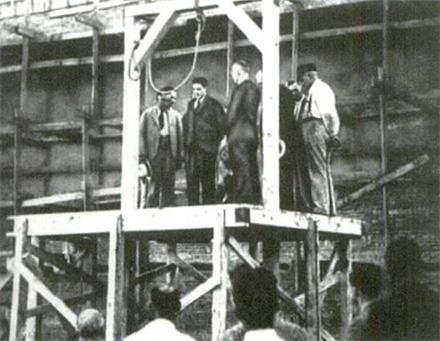
This date in 1936 marks the first and only occasion that the federal government hanged a (non-murdering) kidnapper under the Lindbergh Law.

Even before the notorious Lindbergh baby kidnapping case, the “snatch racket” of kidnappings for ransom had claimed a firm foothold among Depression-era America’s moral panics. The bill that would become known as the Lindbergh Law was actually introduced in Congress three months before little Charles Lindbergh, Jr. disappeared out the window of his New Jersey nursery. Its sponsors were Missouri lawmakers concerned that gang-ridden St. Louis was becoming a kidnapping hub, like the high-profile 1931 abduction of Dr. Isaac Kelley.*

The theory behind the bill — and this was particularly relevant to St. Louis, a border port right across from Illinois and accessible via the Mississippi River to the whole Midwest — was that kidnappers could more easily ply their nefarious trade by carrying their hostages over a convenient border and exploiting the respective states’ inability to coordinate with one another. By elevating interstate kidnapping to a federal felony, the idea was to put manhunts into the hands of the FBI, whose jurisdiction was the entire United States.

The Lindbergh case provided just the right impetus for Congress to advance into law a bill that might otherwise have died quietly in committee. There’s just something to be said for being the one with a plan at the right time … even though the Lindbergh baby was found dead four miles away from the house he was plucked out of, and probably never crossed a state line himself.

At any rate, the Lindbergh Law also made kidnapping alone a capital crime, even if the abductee was not harmed. And it is for this that Arthur Gooch ascended into barstool trivia.
Gooch’s life and case are the focus of this 125-page Master’s thesis (pdf), but the long and short of it is that Gooch and a buddy named Ambrose Nix were on the lam after busting out of the Holdenville, Okla., jail, and ended up heading south to Texas.

They committed a robbery in Tyler, Texas on November 25, 1934. The next day, while stopped with a flat at a service station in Paris, Texas — close by the Texas-Oklahoma border — two policemen approached the suspicious vehicle. In the ensuing struggle, Nix managed to pull a gun on everyone and force the subdued cops into the back of their own patrol car, which the fugitives then requisitioned to high-tail it over the Oklahoma border. There they released their captives unharmed. There had never been a ransom attempt.

A month later, Gooch was arrested in Oklahoma — while Nix died in the shootout, leaving his partner alone to face the music.

Arthur Gooch was a career criminal, and the fact that he violated the Lindbergh Law was easy to see, but his crime also wasn’t exactly the scenario that legislation’s drafters had foremost in mind. In fact, Gooch also underscores one of the oft-unseen dimensions of the death penalty in practice: the discretionary power of prosecutors and judges at the intake end of the whole process.

Gooch attempted to plead guilty to his charge sheet, but his judge, former Oklahoma governor Robert Lee Williams, refused to accept it. Williams was explicit that his reason was that the Lindbergh Law’s language required a jury verdict to impose a death sentence.

By contrast, in October of 1934 — a month before the legally fateful confrontation at the Paris service station — a black farmhand named Claude Neal suspected of the rape-murder of a white girl was dragged out of protective custody in Alabama and taken across the adjacent Florida state line, where an angry mob lynched him. Despite the urging of the NAACP, FDR’s Attorney General Homer Stille Cummings completely refused to interpret Neal’s abduction as a Lindbergh Law kidnapping. The two cases even turned on the same phrase of the Lindbergh statute: interstate kidnapping “for ransom or otherwise.” While Cummings decided pre-emptively that “or otherwise” didn’t cover lynch law, one of his U.S. attorneys would go to the Supreme Court in January 1936 to argue for a broad interpretation of that phrase in the context of Gooch’s appeal.

But even without a comparison to Claude Neal’s murder, the justice of executing Arthur Gooch was hotly disputed by a vigorous clemency campaign. The chance intercession of a state line had elevated a small-time crime committed further to avoiding arrest into a capital offense, basically on a technicality. “It would be a rotten shame to hang that boy when a short jail term is his desert,” one Oklahoma City society woman argued to the Jeffersonian Club. “Gooch was given an application of the poor man’s law.” It seems clear that for Judge Williams as for President Roosevelt (who denied Gooch’s clemency appeal) the result was heavily influenced by the political exigencies of pushing a tough-on-crime standard, and by Gooch’s previous history as a crook. (He’d broken out of jail in the first place because he was a member of a group of local hoods in Okmulgee that committed several armed robberies.)

Gooch was philosophical at the end. “It’s kind of funny — dying,” he mused. “I think I know what it will be like. I’ll be standing there, and all of a sudden everything will be black, then there’ll be a light again. There’s got to be a light again — there’s got to be.” We can’t speak to what Gooch saw after everything went black, but it definitely wasn’t “all of a sudden”: Oklahoma’s executioner, Richard Earnest Owen, was an old hand with his state’s electric chair, but the federal execution method was hanging, which Owen had never before performed (and never would again). Gooch took 15 minutes to strangle at the end of the rope.


Arthur Gooch on the gallows

* The Kelley kidnapping, unsolved for several years, eventually traced to the strange character Nellie Muench. Readers (at least stateside ones) who follow that trailhead should be sure to keep an eye out for the cameo appearance of Missouri judge Rush Limbaugh, Sr. — grandfather of the present-day talk radio blowhard.

On this day..

1800: Suleiman al-Halabi, assassin of General Kleber

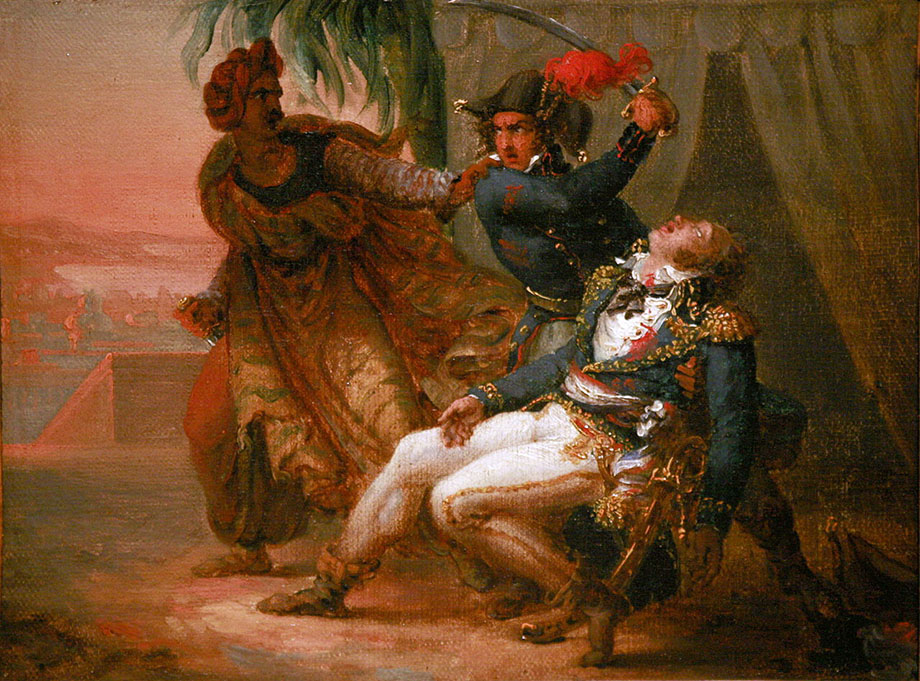
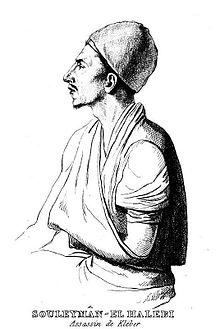
On this date in 1800 — which was the same date they buried his victim — the 23-year-old student Suleiman al-Halabi was put to death in Cairo for assassinating French General Jean Baptiste Kleber.

Casualty of the brief Napoleonic adventure in Egypt, Kleber had received supreme command of the expedition when Napoleon himself returned to France the previous year — a mission which involved running the English naval blockade that trapped the Armee d’Orient.

Kleber, a product of the French Revolution’s military meritocracy who had attained his rank capably suppressing the Vendee royalists, was certainly up to the martial tasks at hand. He routed a larger Ottoman-English-Mamluk force in March of 1800, and then smashed a revolt in Cairo.

But the Napoleonic invasion often figures as a periodization marker for this region: the germ of liberalism and nationalism that would tear apart the Ottoman Empire and set the scene for a recognizably modern Middle East. So it’s somewhat fitting that Kleber would be undone by a figure who could be lifted from the evening news,* the anti-occupation insurgent.

Suleiman al-Halabi (English Wikipedia entry | French) was a Syrian Kurd hailing from Aleppo. (“al-Halabi” means “of Aleppo”)

He had been in Cairo to study, but after a return visit home was induced by the Turks to attend himself to punishing the invader instead. He then made his way back to to Egypt where, disguising himself as a beggar, where he was able to approach the general innocuously and dagger him to death.

The French, of course, had just a few years before this point introduced its most distinctive execution device in place of the ghastly old methods, and employed it with egalite for commoner and king alike. Nor was France, as an imperial power, reluctant about exporting its invention to the every corner of earth.

But in this particular instance, the French decided to prioritize, er, cultural sensitivity.

The committee, after carrying through the trial with all due solemnity and process, thought it necessary to follow Egyptian customs in its application of punishment; it condemned the assassin to be impaled after having his right hand burned; and three of the guilty sheikhs to be beheaded and their bodies burned.

The “guilty sheikhs” in question were men to whom the killer had confided — not his plan, exactly, but the fact that he was on a jihad mission. Hey, close enough.

As for Suleiman al-Halabi himself,

The executioner Barthèlemy sat down on Suleiman’s belly, drew a knife from his pocket, and made a large incision to widen the rectum, then hammered the point of the stake into it with his mallet. Then he bound the patient’s arms and legs, raised the stake the air and mounted it in a prepared hole. Suleiman lived for four hours, and he had lived longer save that, during the absence of Barthèlemy, a soldier gave him a drink which caused his immediate death.

(Impaling victims could live for agonizing days, but the water caused Suleiman, mercifully, to quickly bleed out.)

Not content with going all Vlad the Impaler, the French then paid homage to the invasion’s scientific sub-theme** by shipping Suleiman’s remains back to France for use as an anthropological exhibit.† His skull still remains at the Musee de l’Homme to this day. What’s left in his homeland(s) is a martyr’s memory.

According to the scholar al-Jabarti, whose chronicle is one of the principal sources on this episode, the investigation indicated that Suleiman undertook his mission for no ideology save his family’s desperate need of the purse the Porte was willing to offer. But in the ensuing decades’ growth of nationalism and, eventually, anti-colonialism, the brave young Muslim dying on a spike to slay the French commander could not help but be viewed in an exalted light. (Notably, at the acme of Arab nationalism, the Egyptian writer Alfred Farag celebrated Suleiman as an avatar of resistance in a 1965 play. “I do not kill for revenge,” Farag’s Suleiman avers — and when pressed for the reason, he has a one-word reply: “Justice.”)

* Indeed, the name has been in the news: there’s a Suleiman al-Halabi neighborhood in Aleppo that has seen fighting during the ongoing Syrian civil war. Since it’s even a Kurdish neighborhood one can’t but suspect that it’s named for the man featured in this post; however, I haven’t been able to establish that with certainty. If any reader knows, a comment would be most welcome.

** Napoleon brought a corps of scientists and intellectuals along on his invasion, kicking off the modern Egyptology craze. His mission also uncovered the Rosetta Stone — although that artifact now resides in the British Museum because of the aforementioned naval blockade.

† According to Dark Trophies: Hunting and the Enemy Body in Modern War, phrenologists hailed Suleiman’s skull as an outstanding exemplar of criminality and fanaticism.

On this day..

1578: Ivan Pidkova, Cossack hetman

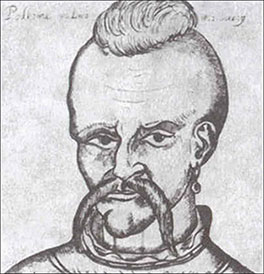
On this date in 1578, Cossack hetman Ivan Pidkova lost his head in Lviv.

Pidkova* — the name means “horseshoe” and alludes to the horsemanship that would be de rigueur for a Cossack leader — had risen by his aptitude to leadership of the Zaporozhian Cossacks in present-day Ukraine.

His death was a bid to promote himself from the steppe to power over neighboring Moldavia, and in fairness to Ivan Moldavia was worth a go.

Its throne was held at that time by a new guy named Peter the Lame, and although the nickname just referred to Peter’s physical deformity, he was a creature of the Ottoman court who scarcely knew Moldavia before he became its vassal ruler in 1574. He was twice temporarily deposed before finally voluntarily resigning in 1591 so that he could retire to the comforts of Italy.

The first deposition came courtesy of our man Pidkova.

Claiming kinship with Peter’s late predecessor Ivan III,** Pidkova seized Iasi and proclaimed himself hospodar of Moldavia until the arrival of Ottoman reinforcements refuted the conceit.

This whole border region between the Polish-Lithuanian Empire to the north and the Ottomans to the south was a perennial trouble spot. Putatively subjects of the Polish crown, the refractory Cossacks were known to raid Ottoman territory illicitly and provoke diplomatic headaches on both sides of the border.

At this particular moment — 1578, that is — the Polish king Stephen Batory had only just concluded a truce with the Ottomans. As Batory had war with Russia to worry about, he was more than keen to keep his southern frontier calm; Polish troops captured the Cossack pretender and had him put to an exemplary death.


Monument to Ivan Pidkova in present-day Lviv. Image (c) stacy2005ua, a prolific photographer of Lviv’s environs whose work can be enjoyed at FaceAndHeart.com or on Flickr, and used with permission.

Ukraine’s national bard Taras Shevchenko celebrated Ivan Pidkova in an eponymous 1839 poem:

There was a time in our Ukraine
 When cannon roared with glee,
A time when Zaporozhian men
 Excelled in mastery!
They lived as masters — freedom’s joy
 And glory were their gain:
All that has passed, and what is left
 Is grave-mounds on the plain!
High are those ancient tumuli
 In which were laid to rest
The Cossacks’ fair white bodies
 In silken cerements dressed.
High are those mounds, serene and dark
 Like mountains they appear,
Their gentle whispers in the wind
 Of freedom’s fate we hear.
These witnesses of ancient fame
 Hold converse with the breeze;
The Cossacks’ grandson reaps the grass
 And sings old memories.
There was a time when in ukraine
 Even distress would dance,
And sorrow in a tavern drank
 In honeyed brandy’s trance.
There was a time when life was good
 In that Ukraine of ours …
Recall it then — perhaps the heart
 May briefly bathe in flowers.

II.

A murky cloud from Liman’s shore
 Covers the sun from sight;
The sea is like an angry beast
 That groans and howls with might.
It floods the mighty Danube’s mouth.
 “My fellows, come with me
Within our barks! The waves are wild.
 Let’s have a merry spree!”
The Zaporozhians rushed out;
 The stream with ships was roiled.
“Roar on, O sea!” they all sang out,
 As waves beneath them boiled.
Billows like mountains round them surged,
 They saw no land, no sky.
Yet not a Cossack heart grew faint,
 Their eagerness ran high.
A bold kingfisher flies o’erhead
 As on they sail and sing;
The brave otaman in the van
 Leads on their mustering.
He strides the deck, and in his mouth
 His pipe grows cold from thought;
He casts his glances here and there
 Where exploits may be wrought.
He curled his long black whiskers,
 He twirled his forelock free,
Then raised his cap — the vessels stopped:
&nbsp:”Death to the enemy!
Not to Sinope, comrades,
 Brave lads beyond all doubt!
We’ll drive on full to Istanbul
 To seek the Sultan out!”
“Well spoken, our fine chieftain!”
 They roared in chorus back.
“I thank you, lads!” He donned his cap.
 Again the seaward track
Beneath their keels began to boil;
 And once more thoughtfully
He paced the deck in mute content
 And gazed upon the sea.

That translation is via The Poetical Works of Taras Shevchenko; the original in Ukrainian can be enjoyed here. The exact text of that poem also comprises the lyrics of this jam:

* Or Ioan Potcoava, as Ivan came from Romanian stock.

** Moldavia’s own “Ivan the Terrible” — no relation to his Russian contemporary, of course.

On this day..

1972: Sanong Phobang, Thanoochai Montriwat, and Jumnian Jantra

On this date in 1972, three hardened criminals were shot at Bangkok for a savage stabbing murder.

We turn for the particulars here to The Last Executioner, the memoirs of Thailand’s last prison executioner, Chavoret Jaruboon. We’ve posted about him before.

Our setting in 1972 finds Thailand under martial law, an especially nasty interlude during the “three tyrants” era when the dictatorial government had been overthrown from within and was ruling by decree.

One of those decrees came down for Sanong Phobang, Thanoochai Montriwat, and Jumnian Jantra just days after they were arrested for a shocking crime: in the course of trying to pick a woman’s pocket at a bus stop, they’d turned on a bystander who noticed the crime and shouted at the woman to look sharp. The infuriated trio boarded the departing bus, trapped the good Samaritan, and stabbed him to death.

Upon determining that the guys were violent career criminals, the authorities just sent an order to have them summarily shot. Snap executions on executive authority were common in this year.

The criminals heard the execution order read only immediately before the sentence was carried out, although by that time they had inferred their fate from the fact that they had been driven to the death house. (And been given a few moments to write their families. We’re not dealing with monsters here!)

We join our executioner’s narrative, noting that at this early stage in his career he was not yet the man who shot the prisoners, but an “escort” on the execution team who readied the prisoners for the executioner.

Suddenly it hit the three of them that this was it. Thanoochai fell out of his chair and screamed for mercy.

“Please don’t kill me sir. Let me see my mother first, she knows people, let her help me, please let me see her!”

The prisoners hugged each other and cried like children.

… at 5.25pm the other escort and myself led Jumnian out of the tower and over to the execution room. Nobody spoke. I think I half expected him to faint but he didn’t. He had resigned himself to his fate and was like ‘a dead man walking’. We had blindfolded him at the gazebo and when we reached the room we firmly secured him to the cross … Mui [the executioner] readied himself over the Bergmann [MP 34/1] and waited for the flag to drop. He fired one shot, which sent eight bullets into Jumnian’s back. He died instantly.

I headed back with the other escort to collect Thanoochai. He blanched when he saw us but didn’t try to resist as we brought him out of the tower. However, all hell broke out at the execution room. He shocked me by suddenly tearing off the blindfold and shouting out for his mother. He kept insisting that his mother be allowed to see him as she could save him because of who she knows, and implored us not to kill him. All the time he was shouting his pleas his eyes roved around wildly searching for his mother but of course she wasn’t there. She was probably in her kitchen praying for him. The staff just stood there staring at him in horror. He really seemed to think his mother was going to appear and save him.

Then he remembered his friend who had gone before him and began to call out for Jumnian.

“Nian! Are you in there? Answer me man. Do you hear me? Answer me you asshole. Are you dead? Why don’t you answer me?”

The silence was almost cruel, as if he was being taunted in his madness on top of everything else … Thanoochai realised that Jumnian would never reply to his shouts, followed by the realisation that it was also too late for him. He crumpled to the floor in front of the execution room, surrounded by staff, and began to cry quietly. … All his fight had gone now, but he still had not lost hope. As we half dragged, half carried him into the room, he still called out for his mother;

“Please help me Mom, please help me.”

… It took four of us to get him standing in front of the cross … I pushed my knee into his back to force him against the cross so that we could bind him to it. One guy tied his hands up around the cross; another guy tied his weight while the other escort and I tried to stop his squirming. Only when he was completely secure did he finally shut up.

At 5.40pm Mui fired 12 bullets into Thanoochai.

… [after the third, more routine, execution] the room stank of blood, sweat and gun powder. There was a lot of blood from each of the men all over the floor and the sand bags. Unfortunately the floor is never cleaned immediately after a shooting. Sand is just thrown down to blot up the puddles and left there overnight for the inmates, who are in charge of the room, to tidy up the following morning.

At this point, Chavoret Jaruboon muses on the spookiness of the execution cell and the belief among some members of the team that the spirits of the shot haunt the place.

The next morning, he tells of being visited by the mother of the panicked Thanoochai Montriwat, who related a dream:

I dreamt about my son last night. He was crying and when I asked him why he didn’t answer. He just stood there and then blood started to ooze out of every part of his body … He told me he lost his shoes and asked me to get them back. He just kept repeating that. I don’t really understand but I’m afraid he won’t be able to rest in peace, which is why I need your help.

Sure enough, one of the prisoners tasked with tidying up the bodies for delivery to the Buddhist temple had taken Thanoochai’s shoes for himself. Thailand’s future last executioner had them retrieved and delivered to the grieving mother.

She was a good woman and kept begging her son’s victims to see into their hearts if they could forgive her son. She was going to cremate the body and wanted Thanoochai to feel in the consuming flames, the goodness and forgiveness emanating from everyone he had hurt which would fill him with regret and sorrow for his criminal ways. A parent’s love can be the purest love there is; no matter what a child does he is forgiven and still fiercely loved.

On this day..

1535: Elisabeth Wandscherer, wife of Jan van Leiden

On this date in 1535, in the doomed Anabaptist commune of Münster, the dictator Jan van Leiden personally beheaded one of his 16 wives.

If it seems unfathomable from the standpoint of the 21st century to picture the famously pacific Anabaptists as millenarian theocratic polygamists, that’s in no small measure due to Leiden himself.

His kingdom of Münster lasted only a year, but its wreckage at the end led the successive strains of this Reformation movement towards very different forms of radicalism than Leiden’s sword-arm exercised.

The background preceding Anabaptist Münster was municipal conflict among Catholics, Lutherans, and Anabaptists. Small wonder that when the Anabaptists — the wild-eyed radicals among these groups — got control of the place,* the Catholic Prince-Bishop put Münster under siege.

That cordon of enemy troops strangling the city shaped much that followed.

Münster’s leading Anabaptist theologian, Bernhard Rothmann, defended polygamy thus:

God has restored the true practice of holy matrimony amongst us. Marriage is the union of man and wife — “one” has now been removed — for the honor of God and to fulfill his will, so that children might be brought up in the fear of God …

Freedom in marriage for the man consists in the possibility for him to have more than one wife … This was true of the biblical fathers until the time of the Apostles, nor has polygamy been forbidden by God. (Source)

In the first place, it killed the Anabaptists’ original leader Jan Matthys when Matthys trusted his theology so far as to believe an Easter Sunday (1534) sortie against the Prince-Bishop’s men would enjoy divine favor. Instead, Matthys’s head wound up on a pike.

This decapitation — literal and figurative — dropped leadership onto the head of our man Jan, which got very big indeed over the subsequent 14 months. Or at least, so say Jan’s foes and eventual killers; as observed by the Communist intellectual Karl Kautsky, who mounted a late 19th century defense of the Anabaptists, we know these Münster rebels almost exclusively through the dark glass of their mortal enemies’ lurid propaganda.

The Anabaptist city council (which Jan soon dissolved) had already expelled all citizens who refused adult re-baptism, the movement’s signature (and namesake) tenet. Citizens, however, meant men: the wives didn’t get run off with their husbands and evidently were often left behind to tend households and property that the men expected to resume soon enough.

As a result, the gender imbalance in besieged Münster reportedly ran to 3:1, and Jan goggled at his good fortune like a 25-year-old would do. (He was actually only 25 years old, a former barkeep. He was also already on a bigamous second marriage.)

Having already declared himself king and basically the divine intercessor, and gotten the city to go along with it, Jan van Leiden promulgated polygamy on July 23 — directing men to seek out second and third brides as their first and second ones got pregnant. Barefoot and pregnant, ladies! Maybe it would have been a great plan for explosive population growth, if only that Catholic army under the walls had consented to just hunker down for a generation or two.(Introduction of polygamy triggered an immediate internal revolt led by a blacksmith named Möllenbeck, which Jan’s team crushed.)

There’s always been the assumption, though, that this move so alien to any other strand of the Reformation throughout Europe was more personal than political. Jan took sixteen wives. One was Matthys’s former wife, soon elevated to Queen; most of the rest were in their teenage years.

Many — who can say just how many? — were probably content to indulge his reputedly (reputed by his enemies!) voracious libido because

  1. the besieged city soon began starving; and,
  2. the guy didn’t take to dissension

In its last months, Münster’s people, faint with hunger, were fed dozens of public executions, of the morally corrupt or the politically unreliable. Considering that the withering city sheltered a mere 9,000 souls at the outset,** it was a positively Stalinesque pace, surely exacerbated by the fast-deteriorating strategic situation.

Elisabeth Wandscherer, one of those 16 wives, is supposed to have been beheaded in the market on June 12, 1535, by the very hand of her husband for her “disobedience.” By the account of a hostile Catholic chronicler, said disobedience consisted in remonstrating with Jan van Leiden over the luxury of his own household vis-a-vis the suffering city, and seeking leave to desert Münster.

Whatever added measure of loyalty, vigilance, or zeal might have been anticipated from such a scene was by this point far too little to preserve the city. Before the month was out, the Prince-Bishop had overrun Münster and held Jan van Leiden in chains — now bound in his own turn for the executioner.

Even to this day, Münster’s town hall has a slipper said to have once belonged to Elisabeth Wandscherer.

* By means of an entirely legal municipal election.

** Population figure per this biography of Jan van Leiden.

On this day..

1948: Kiralyfalvi Miklos, Hungarian Catholic

London Times, June 9, 1948:

SCHOOLS DISPUTE IN HUNGARY
CARDINAL’S REPLY TO MINISTER
CATHOLICS’ CONCERN

BUDAPEST, June 8
The village priest and other persons held responsible for the murder of a policeman and the wounding of two others in a village in north-east Hungary last Sunday will be tried in Budapest on Thursday.

The letter of protest from the Minister of Education to the Primate, Cardinal Mindszenthy, says that the villagers had clearly been aroused to violence by the priest’s sermon, in which he spoke against the projected nationalization of the schools. They went straight from church to the mayor’s house and the municipal buildings, where the council had voted by a majority in favour of the nationalization, and the policeman was killed while trying to protect the mayor. The Minister asked the Cardinal to put an end “by central decree” to this pulpit agitation, adding: “If not, the responsibility will be shifted where it belongs, and the law will be evoked upon all who continue it or direct it.”

The Cardinal, in his reply, says that he knows no more of the incident than is contained in the Minister’s letter, and therefore can take no stand upon it. He adds that the idea of nationalization is still causing great excitement among Catholics all over the country, an that the only way to end the excitement is to abandon nationalization. He denies that the agitation is directed centrally (that is, by himself), and puts the responsibility on those who “insist on putting forward such provocative measures.”

Church’s Divine Right

The Primate has already refused to follow the example of the Protestant churches, which have agreed with the State that nationalization shall go through, but that their ancient seminaries shall be excluded and the teaching of religion in the schools continued, and that the State shall grant them a large annual payment, gradually decreasing, for 25 years. On the contrary, in his third pastoral letter, which was read in all Catholic churches on Sunday, the Cardinal said that nationalization violated natural law and the Church’s divine right.

People were saying, the pastoral letter continued, that it was now time for the State to take over; but certain principles, among them the ten Commandments, were timeless. It called upon the faithful “to pray for strength to resist with all their might this violation of the immortal soul.” Never had the shameful misleading of the people been so great in Hungary as now. The faithful must refuse to allow their families to read the newspapers of those who opposed their faith, and must offer a Novena to God that the “Satan prowling among us like a roving lion may be driven away.”

It is in this guise that the Cardinal sees the Communists. They see him as an inflexible survivor of the Middle Ages.

It was in the village of Pocspetri that all the trouble went down: a march to the local municipal building to protest school nationalization. For years after, Pocspetri would be shorthand (Hungarian link, as is the next) in the official press for any clerical backlash — something right out of the Middle Ages.

Kiralyfalvi, at his trial

At the end of this march, a policeman was dead. It’s alleged now — in anti-communist post-Cold War Hungary — that what really happened was that one of the policemen deployed for crowd control accidentally triggered his own gun and killed himself with it.

Whatever occurred in the march, it was a productive incident for Hungarian communists then executing their political takeover of Hungary. The resulting show trial (more Hungarian) is sometimes seen as one of the signal events in a concomitant crackdown on organized religion — a potential pole of opposition to the Soviet-backed state. The victim, of course, enjoyed the fallen cop’s prerogative, a fast-track beatification by the propaganda ministry. (No need for Hungarian to get the point of the pictures in this pdf.) Miklos Kiralyfalvi got the death sentence, but the prerogatives the church was focused on — those were the real prize.

London Times, June 12, 1948:

MURDERED HUNGARIAN POLICEMAN
PRIEST SENTENCED TO DEATH

BUDAPEST,June 11
Janos Astezlos, the priest whose trial on a charge of inciting his villagers to the murder of a policeman began here yesterday, was sentenced to death this afternoon. The villager who actually killed the policeman was also condemned to death, and of the other four who took part one received life imprisonment and the other three 12 years.

Such, five days after it happened, is the end of this affair, though not of the dispute that lies behind it. In this week’s edition of the Catholic weekly Hazank Mr. Barankovics, head of the Catholic Party in Parliament, which has at least 16 per cent of the country’s votes, writes that a true Christian is bound to defend the right of the Catholic Church to keep the schools, because once they were lost the Church would have nothing left to do but celebrate Mass, and its whole cultural influence would be gone. “Whoever is our leader,” he says, referring to rumours that he disagrees with the Cardinal, “we are bound to act in the same way.” Of the murder the newspaper writes that the Church never counselled violence and regrets deeply what happened.


BUDAPEST, June 11. — The villager accused of killing the policeman was hanged here tonight. -Reuter.

(The priest’s sentence was commuted to a prison term. Only Kiralyfalvi was executed for the Pocspetri murder.)

On St. Stephen‘s Day 1948, Cardinal Mindszenty himself was arrested for treason. This was old hat for the cardinal; he’d been arrested for opposing Bela Kun‘s interwar people’s republic, and arrested again by the Nazi collaborationist government in 1944.

This time, he copped a life sentence.

Briefly released during the 1956 Hungarian Revolution, Mindszenty fled to the American embassy as Soviet tanks subdued the country. He would live on the embassy grounds for the next 15 years, a potent symbol of living martyrdom against communism until he was finally released to Vienna.

If your Magyar is up to snuff, this documentary on the Pocspetri incident might be enjoyable.

On this day..