1781: Isaac Hayne, paroled prisoner of war

On this date in 1781, South Carolina patriot Isaac Hayne was hanged for breaking his conditional British parole and re-enlisting in the American Revolution.

Though Hayne is not, to us, the most famous revolutionary executed by the British, he might have been considered by his contemporaries as the most prominent individual to go to the scaffold for the cause.

A wealthy planter (lots of slaves!) whose home and grave can still be toured in Jacksonboro, Hayne was among 5,000 to surrender to the British when the latter captured Charleston in 1780.

These prisoners were required to swear an oath of allegiance to the crown in exchange for their parole, which Hayne reluctantly agreed to do because his family had been hit with smallpox.

He declared to a friend that,

as they [the British] allow no other alternative than submission, or confinement in the capital, at a distance from my wife and family, at a time when they are in the most pressing need of my presence and support, I must, for the present, yield to the demands of the conquerors. I request you to bear in mind, that previous to my taking this step, I declare that it is contrary to my inclination, and forced on me by hard necessity. I will never bear arms against my country … I do not mean to desert the cause of America.

But as the British southern campaign foundered over the year ahead, the mother country eventually attempted to call him up to do just that: bear arms against his country.

Hayne thought his parole terms protected him from ever having to serve against the colonies, so he simply got back into the fight on the revolutionary side instead. He was captured in that capacity.

The British commander Francis Rawdon handled his relapsed prisoner with uncommon severity, putting him to a drumhead military tribunal with a preordained outcome and refusing the many public pleas for leniency.

The irregular and vengeful nature of these proceedings, and Hayne’s seemingly honorable conduct, raised hackles on both sides of the Atlantic; shortly after hanging Hayne, Rawdon returned to the British Isles to find a good deal of pointed criticism of his behavior. (Parliament quashed any damaging official inquiry, and Lord Rawdon actually extracted an apology from the peer who had the temerity to motion the investigation — an intolerable impeachment on Rawdon’s honor.)

The Hayne incident was widely understood to have been conditioned by British frustration at its failing fortunes in the war. By the time of the execution, the redcoats held nothing of South Carolina save Charleston itself. General Cornwallis had recently marched north from the Palmetto State; in a few weeks’ time, he would surrender his sword and the British cause alike after the decisive British defeat at Yorktown, Virginia.

And though the commandants at Charleston scarcely anticipated that stunning reversal, they had only a few months before suffered the upsetting (but more legally tenable) hanging of the honorable British Major John Andre as a result of the Benedict Arnold affair. British forces were reputedly on the lookout for any opportunity to trade tit for tat.

Continental Gen. Nathaniel Greene alleged that the British officer who received the petition for Hayne’s life simply wrote on it John Andre — and sent it back.


Isaac Hayne was the great-uncle of South Carolina pol Robert Y. Hayne, best remembered for a hot sectional debate with Massachusetts Sen. Daniel Webster. (Read it all here, if you must.)

It was during this exchange of Senatorial disquisitions that Webster delivered one of the noted orations of the antebellum era, the aptly-named Second Reply to Hayne:

I have not allowed myself, Sir, to look beyond the Union, to see what might lie hidden in the dark recess behind. I have not coolly weighed the chances of preserving liberty when the bonds that unite us together shall be broken asunder. I have not accustomed myself to hang over the precipice of disunion, to see whether, with my short sight, I can fathom the depth of the abyss below; nor could I regard him as a safe counselor in the affairs of this government, whose thoughts should be mainly bent on considering, not how the Union may be best preserved, but how tolerable might be the condition of the people when it should be broken up and destroyed. While the Union lasts, we have high, exciting, gratifying prospects spread out before us and our children. Beyond that I seek not to penetrate the veil. God grant that in my day, at least, that curtain may not rise! God grant that on my vision never may be opened what lies behind! When my eyes shall be turned to behold for the last time the sun in heaven, may I not see him shine on the broken and dishonored fragments of a once glorious Union; on States dissevered, discordant, belligerent; on a land rent with civil feuds, or drenched, it may be, in fraternal blood! Let their last feeble and lingering glance rather behold the gorgeous ensign of the republic, now known and honored throughout the earth, still full high advanced, its arms and trophies streaming in their original lustre, not a stripe erased or polluted, not a single star obscured, bearing for its motto, no such miserable interrogatory as “What is all this worth?” nor those other words of delusion and folly, “Liberty first and Union afterwards”; but everywhere, spread all over in characters of living light, blazing on all it sample folds, as they float over the sea and over the land, and in every wind under the whole heavens, that other sentiment, dear to every true American heart, – Liberty and Union, now and for ever, one and inseperable!

When not being rhetorically posterized by New England gasbags, Robert Hayne made time to pen a justification for his famous forebear’s conduct for the Southern Review in 1828 — comparing the British behavior of executing rather than detaining a prisoner who broke parole to the massacre at Jaffa Napoleon notoriously ordered in 1799.

(Actually, Isaac Hayne’s old nemesis Francis Rawdon had only died in 1826; Robert Hayne wrote his piece to confute a vindication of himself that Lord Rawdon — also recognized by his subsequent titles, Earl of Moira and Marquess of Hastings — had authored, decades after the fact, of his conduct in the Hayne matter.)

Though this 37-page slog of Robert Hayne’s is obviously in the public domain by now, it appears it is not yet freely available online. However, it’s the source of the otherwise unattributed quotes in this article.

Part of the Themed Set: The Empire Strikes Back.

On this day..

1953: John Christie, a little late in the day

On this date in 1953, English serial killer John Christie was hanged by Albert Pierrepoint for the murders of six women.

The sex-killer is most infamous, though, for a different death: that of Timothy Evans, a neighbor and fellow client of Pierrepoint whom Christie had stitched up three years before for strangling Evans’s wife and child.

Back then, the respectable Christie was the star witness against Evans. Evans tried in vain to blame Christie (“this perfectly innocent man,” Evans’s prosecutors scoffed) for the murders.

Nobody knew then that Christie had strangled an Austrian prostitute during sex back in 1943, nor that he had done a gassing-strangulation-rape job the following year.

Both their bodies were both buried in the garden at 10 Rillington Place: the first inhabitants of what would be the British Isles’ most notorious corpse hotel.

Strangulation sex killings would become the definitive Christie m.o. after Evans hanged. He got himself a no-fault divorce by throttling his wife in bed late in 1952, then raped and strangled at least three other women whom he had invited back to his pad. The remains of each were secreted in the apartment’s nooks and crannies.

This is Richard Attenborough as Christie doing his thing to Evans’s wife (he’d later confess to that crime) in the 1971 flick 10 Rillington Place.

Christie seemingly could’ve gotten away with it all, if it weren’t for his penny-wise and pound-foolish decision to move out of the charnel house early in 1953 and let someone else stumble upon the remains. (Christie had quit his job the previous December, and hocked his strangled wife’s stuff to make ends meet for a while. He was homeless when the subsequent manhunt tracked him down.) There was even a human femur being used to prop a fence.

Having quite a lot of damning evidence, and Christie’s confession besides, his lawyer went for a hail-Mary insanity defense, but Christie didn’t even bother with an appeal when that didn’t take.

But there was the small matter of that other gentleman hanged back in the day for a strangulation murder, all the while unsuccessfully accusing his then-respectable neighbor Christie.

An inquiry launched by the government very conveniently concluded that (Christie’s confession notwithstanding) Evans was indeed guilty of killing his wife. Two stranglers in the same place at the same time, and the one had just happened to try to blame the other one when he was accused.

For obvious reasons, this whitewash was greeted skeptically and — though the two-killers theory does still have its defenders — officially reversed when Evans was posthumously exonerated in 1966.

On this day..

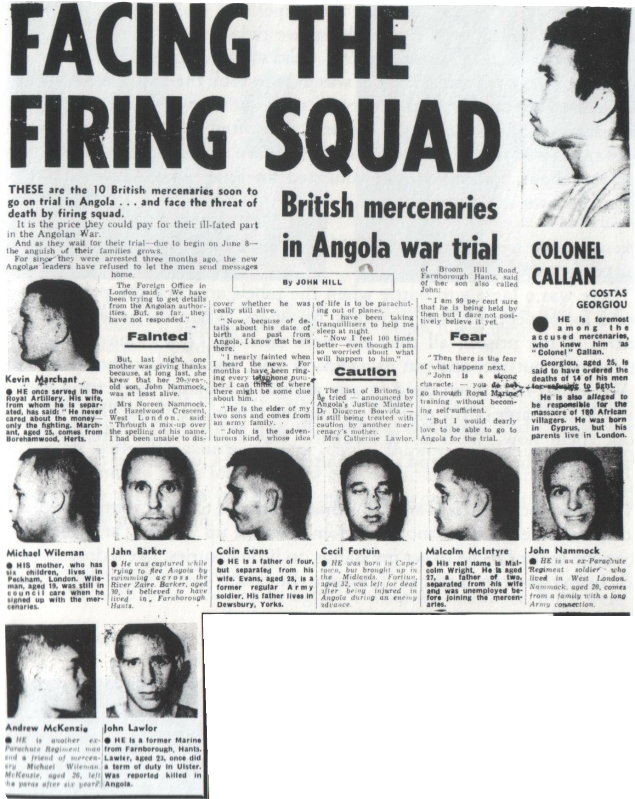
1976: Costas Georgiou and three other mercenaries in Angola

On this date in 1976, three Britons and one American were shot in Angola by a military police squad for murders committed as mercenaries earlier during the year.

Costas Georgiou.

They were among 13 foreigners sentenced at the Luanda Trial, which occurred on the pivot of Angola’s transition from generation-long anti-colonial insurrection on towards generation(s)-long civil war. Between them, more than half a million Angolans died, but this date belonged to a couple of unrepresentative Anglos.

Long story short, the immediate aftermath of Angolan independence in late 1975 was a scramble for control among the several factions who had been fighting the Portuguese … along with a scramble among interested outside states to line up their allies in this resource-rich Cold War prize.

Small wonder that foreign soldiers of fortune soon found their way into the chaotic scene.

Over the course of the first few months of independence, the Popular Movement for the Liberation of Angola (MPLA) more or less consolidated state power, and it proceeded to prosecute supporters of a rival guerrilla movement for their part in the conflict immediately after independence.

Thirteen foreign mercenaries who were captured by MPLA-supporting Cuban troops — the other nine drew long prison sentences — were charged in a show trial with war crimes for their conduct in the field in a case that made the western gun-for-hire an emblem of colonial depravity.

The most notorious of the bunch was Costas Georgiou. A Greek Cypriot emigre to Britain, he had gone to Angola as “Colonel Callan” and was wanted by Scotland Yard for there ordering a mass execution of other British mercenaries — an act he admitted at trial. Even the inevitable London Times editorial against the trial (June 29, 1976) agreed “the proceedings against Callan, if not the rigours of the sentence may be conceded.”

The others looked much less culpable, almost arbitrarily selected for death from among the ranks of unprepossessing, sometimes barely-there mercs. American Daniel Gearhart, a Vietnam veteran drowning in debt, had apparently been in the field for a mere three days and never so much as fired a shot; that he had advertised in Soldier of Fortune magazine was held to aggravate the charges against him, and in vain did the father of four insist that being tried for his life was enough to scare him straight out of the business.

Angolan defense attorneys, while also appealing against the legality of the trial on grounds of both international and domestic law, spoke that revolutionary language of decolonization in defending their charges. Georgiou, according to Maria Teresinha Lopes, was

“a colonized man … [treated in England as] a sub-human, just a Greek, just a ‘boy’.”

Another Angolan defense attorney argued against the death penalty because

“To condemn them to death while ignoring their social origin in terms of revolutionary justice would deny the theory which guided our revolution. My clients are an integral part of the exploited class.” (Both comments from London Times, June 19, 1976)

The era of decolonization was a time for idealism, but not the sort that would shrink from bloodshed.

In denying the doomed men clemency, Angola’s first independent president Agostinho Neto denounced

Mercenarism, instrument of the aggressive designs of imperialism … a scourge of the African continent and a grave threat to the peace, freedom and independence of the peoples …

It is imperative that the practice of mercenarism be banished once and for all from our planet. It is urgent that all states and peace-loving forces fight it most energetically.

We are applying justice in Angola not only in the name of our martyred people but also for the good of the brother peoples of Namibia, Zimbabwe and all the peoples of the world against whom imperialism is already getting ready to prepare new mercenary aggressions.

(Text dated July 9, and reprinted in the July 10 London Times)

You could just about substitute the word “terrorism” for “mercenarism” and read it on today’s campaign trail.

Juridically, Angola pursued these warriors as peoples who had fought unlawfully and could therefore be placed outside the protections conferred on soldiers by the Geneva Conventions — and subjected to the liberating power of revolutionary violence.

That this ad hoc concept of “mercenarism” could be exploited to license an outrage upon humanity was a notion relentlessly denounced by British and American officials,* who had not yet fully explored the utility of the “unlawful combatant” construct in extending the reach of their own security states.

As for all that peace-loving, brother-peoples stuff in the execution order?

What actually happened after the mercenaries were shot was that the two biggest former anti-colonial guerrilla movements in Angola morphed into Cold War proxies — the MPLA of the Warsaw Pact, supported by its control of the country’s oil; UNITA of NATO, supported by its control of the country’s diamonds — and bled the country dry in a horrific civil war.

* Henry Kissinger, then President Gerald Ford’s Secretary of State, complained that Angola’s decision

to ignore both the law and the facts … cannot help but affect adversely the development of relations between the United States and Angola.

On this day..

1533: John Frith and Andrew Hewet, Protestants

Life is all about timing.

Death too.

This date in 1533 saw John Frith and Andrew Hewet burned to ashes at Smithfield for Protestantism … just a week before Henry VIII himself was excommunicated from the Catholic Church.

A Cambridge man who’d picked up some heresy in Lutheran Germany, Frith was a friend of William Tyndale and did a couple of turns in English prisons for his various transgressions of orthodoxy.

He was finally nabbed by a warrant of then-Chancellor Thomas More before he could escape to the continent, and hailed before a doctrinal court for sacramentarianism.

During his examination by the bishops, Frith stated that he could not agree with them that it was an article of faith that he must believe, under pain of damnation, that when a priest prayed during the mass, the substance of the bread and wine were changed into the actual body and blood of our Savior Jesus Christ, even though their appearance remained the same. And even if this was so, which he did not believe it was, it should not be an article of faith.

–Foxe’s Book of Martyrs

(Said transubstantiation hypothesis remains Catholic doctrine to this day, but at least it’s no longer worth your life to dispute it.)

All the pieces were in place for this radical theology to become orthodoxy over the succeeding generation. The newly-designated Archbishop of Canterbury — still for the moment within the Catholic fold — was reformer Thomas Cranmer. Despite his sympathy for a shared evangelical cause, Cranmer passed a guilty verdict after trying to talk Frith out of his belief. In the event, however, it was the Inquisitor who was converted: Cranmer over the course of the 1530s adopted Frith’s own view. He would eventually enshrine it in the Book of Common Prayer.

All of which, of course, was made possible by Henry’s insistence on ditching his first wife in favor of Anne Boleyn, and Cranmer’s support for that action. On July 11, both the king and his pliant prelate were excommunicated by Pope Clement VII.

Still, it must be allowed that this fact scarcely gave carte blanche to Protestant reformers in England. Maybe Frith was made for the flames regardless: as timing goes, the 1530s were great for religious martyrdom.

Andrew Hewet, our poor footnote, had no part in these august affairs save the victim’s. Hewet was a tailor’s apprentice who was just caught up with an anti-heretical accusation at the wrong time. In prison, he too refused to acknowledge transubstantiation — saying, “I believe as John Frith believes.” For so believing, he burned as Frith burned.

On this day..

1704: John Quelch, pirate

On this date in 1704, John Quelch was hanged on a Boston wharf for piracy.

Quelch had re-appeared in New England less than a year after hastily absconding with a new privateering vessel while the owners tried to sort out the captain’s sickness.

(The captain suspected his crew were up to no good, but the mutineers locked him in his cabin and set sail before the investors could act on the information. The ill captain died at sea and was pitched overboard — in what order, no one can say.)

The privateer Charles had been tricked out and licensed to raid French shipping off Newfoundland, but the avaricious mutineers saw much better buccaneering prospects preying on the gold-laden Portuguese possessions in South America.

One small problem: Portugal had formed an alliance with England.

So when the Charles re-appeared, heavy with the sort of mineral wealth not to be found in North America, authorities could not fail to notice that its crew

Have lately Imported a considerable Quantity of Gold dust, and some Bar and coin’d Gold, which they are Violently Suspected to have gotten & obtained by Felony and Piracy, from some of Her Majesties Friends and Allies …*

This all looks very neat on the legal docket (and it certainly did to the jury-less Admiralty court, the first time this instrument had been used outside of England), except that pirates and piracy were far more integrated into the fabric of the colonial frontiers than their desperado reputation might suggest. Pirates shifted in and out of their outlaw careers; even the strictly law-abiding colonists traded knowingly with these freebooters. Certainly some momentary mutual convenience between London and Lisbon for reasons of continental politics was very far from most colonists’ scope of care.

John Quelch seems to be among those operating in the grey economy, and in this case bringing “gold and silver to specie-starved colonial economies.”**

Hunger for hard currency in an environment of wartime depreciation of various sketchy paper notes helps explain why Quelch’s trial raised hackles in New England. Here were men who had by dint of enterprise and adventure plucked nearly 1,000 pounds of gold from faraway Brazil and hauled it back home to New England, honestly paid out the shares to the crew and gone to settle up with the privateering syndicate’s financiers.

And the high-handed English governor Joseph Dudley responded by clapping them in irons and trying them for their lives, using a dubiously legal and heretofore unprecedent drumhead military tribunal at which Dudley himself presided while his son† prosecuted.

It’s a nice setup for winning convictions, which is exactly what happened.

In the process, Dudley blew through a good portion of the pirates’ confiscated booty, making it rain for “Stephen North, who kept the Star Tavern in which the trial was held, for entertainment of the Commissioners during the sitting of the Court of Admiralty” and that sort of thing. If a later denunciation circulated by Cotton Mather is to be believed, the Dudleys did not scruple to wet their own beaks, either.

There have been odd Collusions with the Pyrates of Quelch’s Company, of which one instance is, That there was extorted the sum of about Thirty Pounds from some of the crew for liberty to walk at certain times in the prison yard. And this liberty having been allowed for two or three days unto them, they, were again confined to their former wretched circumstances.

(The rest of the cash went neither to the privateer’s investors nor back to the aggrieved Portuguese, but was shipped to English mints under the capable administration of Isaac Newton.)

Little wonder at the unrepentant Quelch’s parting shot on this date.

Sarcastically interrupting one of his five fellow-sufferers’ bog-standard scaffold injunction against running with a bad crowd, Quelch urged the throng of onlookers to better “take care how they brought Money into New-England, to be Hanged for it!”

Their bodies remained gibbeted in the harbor.

In Quelch’s Gold: Piracy, Greed, and Betrayal in Colonial New England, Clifford Beal argues that Quelch’s trial marked the onset of an official crackdown on pirates that would drive these formerly semi-legitimate operators further underground and therefore into greater violence. He even suggests, at a bit more of a stretch, that Quelch’s case presaged the colonial resistance to the mother country’s political and economic dictates that would later blossom into the American Revolution.

As for the gold, much of it was not recovered in 1704. Legends to the effect that it remains stashed on New Hampshire’s Star Island continue to attract treasure hunters.

* From the proclamation of Quelch and his crew‘s arrest, quoted in Pirates of the New England Coast, 1630-1730.

** Villains of All Nations: Atlantic Pirates in the Golden Age, by Marcus Rediker.

† That son, Paul Dudley, later endowed a still-extant lecture series at Harvard University — the oldest endowed lectureship, even though (or rather because) the donor’s intention that it be directed “for the purpose of detecting and convicting and exposing the Idolatry of the Romish church” was eventually neglected.

On this day..

1541: Thomas Fiennes, 9th Baron Dacre

On this date in 1541, an English peer hanged (!) at Tyburn for an unpremeditated murder.

Thomas Fiennes, scion of an ancient title still* extant today, was more accustomed to doling out the death sentences.

Dacre sat on the jury of peers that condemned Anne Boleyn, and also helped doom plotters in the Pilgrimage of Grace and the Exeter Conspiracy.

This well-favored but evidently unrefined young rowdy had a penchant for the illicit hobby of poaching game, just becoming in this period a conflict zone in the proto-capitalist enclosure movement.

We may suppose that a callow youth of privilege didn’t have the means of production on his mind, just an overweening sense of entitlement about the forests of the next lord over. In any event, a 1537 letter to Thomas Cromwell testifies to the young Fiennes’ vice.

I have received your lordship’s letters wherein I perceive your benevolence towards the frailness of my yoyth in considering that I was rather led by instigation of my accusers than of my mere mind to those unlawful acts, which I have long detested in secret. I perceive your lordship is desirous to have knowledge of all riotous hunters, and shall exert myself to do you service therein. I beg you give credence to Mr. Awdeley, with whom I send some of my servants to be brought before you; he can inform you of others who have hunted in my little park of Bukholt.’

We don’t have the particulars of this situation, but secret detestation notwithstanding, four years’ time finds Fiennes up to similar shenanigans.

In this later, fatal case, our sportsman and a group of retainers went out to hunt deer on the lands of his neighbor, Sir Nicholas Pelham. There, they encountered some men of Pelham’s, and in the ensuing melee, one of the latter party was beaten to death. Pelham pressed the issue aggressively.

“Overpersuaded by the courtiers, who gaped after his estate,” Fiennes tried the dangerous gambit of pleading guilty and casting himself on the king’s mercy. The fact that testimony indicated that Fiennes himself had not participated in the fight might have meant an acquittal, though a guilty plea also positioned Fiennes to exculpate his mates.

Gaping courtiers may have realized better than their prey that the king’s mood this summer tended towards severity. Spurning a recommendation of clemency from the peers of the realm, Henry VIII insisted on Dacre’s execution.

The affairs of the luckless baron’s last day — which was only four days after his trial — remain a bit mysterious. Hopes for a clemency were raised by a last-minute reprieve from a scheduled morning beheading, only to have the noble led out that afternoon to the beneath-his-class death by hanging at Tyburn.

Oh, and the mates Dacre was (possibly) trying to protect? Three of them hanged this date as well, at St. Thomas a Watering on the Old Kent Road.

* It hasn’t been continuously extant, strictly speaking — in fact, it was terminated along with Thomas Fiennes, only restored in 1558 to the hanged man’s son.

These Tudor toffs are distant relations of actor Ralph Fiennes, whose turn as a hanged Nazi war criminal has already been noted in these pages.

On this day..

1497: Michael An Gof and Thomas Flamank, leaders of the Cornish Rebellion

On this date* in 1497, two commoners who led an uprising against the Tudor dynasty were hanged at Tyburn.

Sore about a tax hike imposed to fight a Scots army supporting pretender Perkin Warbeck, Cornwall rose against Henry VII early in 1497.

“Henry Tudor’s” legitimacy on an English throne he had recently conquered was still a bit shaky, which is why he had to worry about pretenders to begin with (and also why his son would become so infamous looking for heirs).

Despite disappointingly finding no help for their cause in oft-rebellious Kent, the Cornish men decided to go it alone.


A statue of Michael Joseph An Gof and Thomas Flamank. Image (c) John Durrant and used with permission.

Under the leadership of blacksmith Michael Joseph (or Michael An Gof; An Gof simply translates as the man’s profession) and barrister Thomas Flamank (or Flammock) — injudiciously joined by one Lord Audley** — 15,000 or so marched to the outskirts of London, where they were trounced in the Battle of Deptford Bridge.

As commoners, Joseph and Flamank were condemned to the barbarous hanging-drawing-quartering death, but Henry commuted it to simple hanging with posthumous dismembering lest the popular leaders’ public torture spark fresh trouble in their native stomping-grounds. (Michael Joseph prophesied that posterity would confer upon these martyrs “a name perpetual and a fame permanent and immortal.” The authorities still did the dismembering bits, only posthumously, and put the heads up on pikes.)

After all, the fact that these troublemakers had marched right up to London before anyone had opposed them underscored Henry’s own potential vulnerability. Even the noble that Henry sent out to whip the marchers might have had one finger to the wind before deciding which side would be the winner.

As events would prove, the king was right to worry.

First as tragedy, then as farce

Seeing how much latent disaffection had been readily converted to action in Cornwall, Perkin Warbeck decided to make his big move later that same year in 1497 by landing there near Land’s End.

A few thousand joined the ensuing Second Cornish Uprising, but it came to much the same end — and resulted, this time, in Warbeck’s own capture and eventual execution.

* Some Wikipedia articles assert June 24, but June 27 seems attested by better authorities. I have not been able to pin down primary documentation proving either date, but the maintenance of June 27th as “An Gof Day” disposes the case. (There was a big 500th anniversary march for the occasion in 1997.) Claims that all three were executed on June 28 appear to be simply mistaken.

** As a peer, Audley got the chop instead of the hemp: he was beheaded on June 28. The rank-and-file were generally pardoned.

On this day..

1312: Piers Gaveston

On this date in 1312, Edward II’s dearest friend Piers Gaveston was “executed” by the English nobility that had long despised him.

The “notorious royal favourite” had initially been welcomed by Edward I around 1300 as a royal companion for the crown prince.

By the end of Longshanks’ life, the old king was so irate at their relationship (the prince had had the temerity to request a title and castles for Gaveston) that Gaveston was booted out of the country.

(But at least he wasn’t defenestrated, the fate of the fictional Gaveston stand-in “Phillip” in Braveheart.)

Ah, the gay-baiting.

The younger Edward immediately recalled his friend when death came for Longshanks, and Gaveston was resented both by English peers and the young Queen Isabella for the favor the new king held him in.

The purported homosexual relationship between Edward II and Piers Gaveston is commonly believed* though ultimately speculative, reading between the lines of chroniclers who are sometimes bitterly hostile towards these two. “The King loved an evil male sorcerer more than he did his wife,” for instance, is a bit of propaganda — we obviously don’t believe the “sorcery” bit — and even that’s not completely explicit.

There’s a strong circumstantial interpretation to made, but since the particulars of Edward’s behavior with his favorite behind drawn tapestries are permanently unavailable to us, it will suffice us to say that this interpretation has conditioned the “Piers Gaveston” who comes to us in later centuries as a widely-credited cultural artifact.

Whether as calumny or commendation, homosexuality is the first thing everyone “knows” about Piers Gaveston, the emblem of his life and the doomed reign of his sovereign. We meet him from the other side of Stonewall, even when we meet him in Renaissance poetry or Renaissance drama.

The historical, flesh-and-blood Piers — and there’s a very thorough biography of him here** — was certainly defined by more than gay identity, real or imputed.

The personal resentment he inspired in the likes of Lancaster and Beauchamp was political, mapped onto the timeless power struggle between nobles and crown, and within the nobility itself.

The king trusted Gaveston, who was himself just the son of a knight, with plum royal assignments like governing Ireland, and Gaveston executed them effectively; with an immoderate confidence in his own considerable talents, the favorite was not above tweaking his rivals with derisive nicknames.

The Lancaster faction progressively got the upper hand on Edward and Gaveston, and with civil war brewing, they captured the hated Gascon at Scarborough Castle while Edward scrambled unavailingly to raise an army of his own.

He was held privately for nine days before Lancaster — “a sulky, quarrelsome, and vindictive man … quick to resort to violence,” by Alison Weir’s reckoning — decided he had to go. Gaveston was beheaded without color of law at Blacklow Hill near Warwick. A monument to his memory still stands there today.

Thou executioner of foule bloodie rage,
To act the will of lame decrepit age.

The grief-stricken monarch would serve his revenge upon the Earl of Lancaster ten years’ cold, beheading him for treason in 1322 upon the verdict of the man who had by then slid into Gaveston’s place in the king’s favor, Hugh Despenser.

* Not universally accepted, however.

** Bonus: Nineteen things you never knew about Piers Gaveston.

On this day..

1683: James Smith and John Wharry, Covenanter bystanders

Inscription on a marker on the road from Kirkintilloch to Kilsyth* in Scotland:

In this field lies the corpse of John Wharry and James Smith, who suffered in Glasgow, 13 June 1683, for their adherence to the Word of God, and Scotland’s Covenanted Work of Reformation: ‘And they overcame them by the blood of the Lamb, and by the word of their testimony; and they loved not their lives unto the death'” (Rev. xii. 11)

Halt, courteous passenger, and look on
Our bodies dead, & lying under this stone.
Altho’ we did commit no deed,** nor fact
That was against the Bridegroom’s contract,
Yet we to Glasgow were as prisoners brought,
And against us false witness they sought.
Their sentence cruel and unjust they past,
And then our corps on scaffold they did cast.
There we our lives and right hands also lost.
From Glasgow we were brought unto this place
In chains of iron hung up for certain space.
Then taken down interred here we ly–
From ‘neath this stone our blood to heaven doth cry.
Had foreign foes, Turks, or Mahometans,
Had Scythians, Tartars, Arabian Caravans,
Had cruel Spaniards, the Pope’s blood seed,
Commenced the same, less strange had been the deed;
But Protestants, profest our Covenants to,
Our countrymen, this bloody deed could do.
Yet notwithstanding of their hellish rage
The noble Wharry stepping on the stage
With courage bold and with a heart not faint,
Exclaims, This blood now seals our covenant–
Ending, They who would follow Christ should take
Their cross upon their back, the world forsake.


Image (c) Maria ‘Mia’ Gaellman | http://www.mariaphoto.co.uk/

The epitaph above is from this Victorian text, which further observes:

The probability is, that what is called on the new stone “the old tombstone” is not much older than this [the 19th] century, and that it is the successor of an older one on which may have been inscribed the following epitaph:

Halt, passenger, read here upon this stone
A tragedy, our bodies done upon.
At Glasgow Cross we lost both our right hands,
To fright beholders, th’ enemy so commands;
Then put to death, and that most cruelly.
Yet where we’re slain, even there we must not lie,
From Glasgow town we’re brought unto this place,
On Gallow tree hung up for certain space.
Yet thence ta’en down, interred here we lie
Beneath this stone; our blood to heaven doth cry.
Had foreign foes, Turks or Mahometans,
Had Scythian Tartars, Arabian caravans,
Had cruel Spaniards, the Pope’s bloody seed,
Commenc’d the same, had been less strange their deed.
But Protestants, once Covenanters too,
Our countrymen, this cruel deed could do:
Yet, notwithstanding this, their hellish rage,
The noble Wharrie leapt upon the stage.
With courage bold, he said, and heart not faint,
‘This blood shall now seal up our covenant,’
Ending, ‘they who would follow Christ, should take
‘Their cross upon their back, the world forsake.'”

* Kilsyth lays claim to be the birthplace of curling.

** Smith and Wharrie, apparently uninvolved civilians, were seized as the nearest available guys to punish after a Covenanter guerrilla attack near Inchbelly Bridge.

On this day..

1916: Robert Digby in Villeret

On this date in 1916, Private Robert Digby was shot by a German firing squad in the tiny northern France village of Villeret.

Digby was the last of a quartet of English soldiers who had been part of the British Expeditionary Force who met the Hun’s first foray into France in 1914.

Digby and his mates, Thomas Donohoe, David Martin and William Thorpe, were stranded behind lines.

Villeret took them in and changed their uniforms for peasant clothes while they worked the fields and tried to keep their heads down.

“Every inhabitant of Villeret knew of the British soldiers in their midst but none breathed a word, although the Germans had threatened to execute anyone harbouring enemy fugitives,” writes Ben McIntyre, who wrote the book on these men. “Even when food ran low and German troops were billeted on every house, the secret was kept safe. It was an astonishing act of collective bravery.”

To the west, in trenches the men could not pass, the war ground uncounted souls into horsemeat.

Digby became the lover of a village girl, and fathered a daughter by her.

This perilous idyll under the very bowers of hell could not last long. The Brits were mysteriously betrayed, and arrested by the Germans in May 1916 — all save Digby, who escaped out the window of a barn.

Donohoe, Martin and Thorpe were shot as spies on May 27.

After a week on the run in the nearby woods, the mayor of Villeret found Digby, and told him that the Germans were threatening to execute the villagers unless he turned himself in to face his comrades’ fate. Digby did so.

McIntyre’s book, A Foreign Field: A True Story of Love and Betrayal in the Great War, explored the village of Villeret and the life of Digby’s daughter Hélène Cornaille-Digby — an infant when her father was shot; an octogenarian when McIntyre met her.

The enduring mystery of the place, at least to McIntyre as an outsider, was the unanswered question of who betrayed the English. Was it a jealous lover? A disapproving family? A fearful neighbor?

Years after the publication of the book, McIntyre (so he thinks) accidentally solved the mystery.

On this day..