Feast Day of Saint Bartholomew

August 24 is the feast day* of Saint Bartholomew the Apostle, an original companion of Christ who is silent as the grave when it comes to the Gospels** but holds a distinguished place in artistic history as Christianity’s best-known flayed martyr.

(And of course, a distinguished place in sectarian bloodshed history thanks to the St. Bartholomew’s Day Massacre during the French Wars of Religion.)


A fierce Bartholomew brandishing his flayed skin in Michelangelo’s Last Judgment.


Marco d’Agrate shows off his anatomical expertise in this sculpture at the Milan Cathedral, which he arrogantly signed “I was not made by Praxiteles but by Marco d’Agrate.” (cc) image by Latente Flickr.


This flinchingly realistic depiction of the skin being cut off the muscle comes from Caravaggio disciple Valentin de Boulogne. (cc) image by livioandronico2013.


This late 16th century fresco by (speculatively) Niccolo Circignani in Rome’s Basilica of Santi Nereo e Achilleo perhaps alludes to the Ottomans’ 1571 flaying execution of a Venetian commander.

* Per the Catholic tradition. For Orthodox Christians, the feast is observed on June 11; in the Coptic church, it occurs on the first day of Thout which currently corresponds to September 11 or 12.

** Bartholomew’s name does go on several apocryphal texts.

On this day..

2012: Nine in Gambia

On this date in 2012, the small west African country of Gambia suddenly shot nine.

Effectively abolitionist, Gambia had not exercised capital punishment since 1981, when an attempted coup led to one (1) execution.

But it did have a (seemingly) latent death row of close to 50 souls* and in August 2012 autocratic president Yahya Jammeh used that stockpile to suddenly break the death penalty moratorium with a shock mass execution.

Those executed included one woman, at least two Senegalese nationals, and several soldiers involved in anti-Jammeh mutinies. The nine were identified as

  • Dawda Bojang
  • Malang Sonko
  • Lamin Jarjou
  • Alieu Bah
  • Lamin F. Jammeh
  • Buba YarboeLamin B.S Darboe
  • Gebe Bah (Senegalese)
  • Tabara Samba (Senegalese, female)

As might be expected for such an impetuous deed, several of these individuals so suddenly killed were not even at the end of their legal journeys through the state’s regular channels. Buba Yarboe’s family had been fighting for recognition of his mental illness as a mitigating condition; Yarboe and Malang Sonko both had judicial appeals remaining that had not yet been heard; Lamin Darboe’s sentence had been irregularly vacated and then reinstated. No matter.

Jammeh backed off his threats of follow-up executions to purge the entirety of its death row, and Gambia has conducted no further executions since that one dark day. His successor Adama Barrow officially re-imposed a moratorium and in 2019 commuted all remaining death sentences with an avowed intention to abolish capital punishment altogether.

* Reports on the size of Gambia’s death row at this time varied. The UN Special Rapporteur on Extrajudicial, Summary or Arbitrary Executions named 39 still-living condemned individuals in a letter to President Jammeh days after the nine were killed.

On this day..

1946: Döme Sztójay, former Prime Minister

On this date in 1946, the former wartime fascist Prime Minister of Hungary was shot for being the former wartime fascist Prime Minister of Hungary.

Dimitrije Stojakovic by birth, the Vojvodina-born ethnic Serb Magyarized his name to Döme Sztójay as he rose up the ranks in the intelligence services in independent, post-Habsburg Hungary.

He had for many years been the Hungarian ambassador to Berlin and a noted pro-Third Reich figure when in 1944 Nazi Germany took over its erstwhile Axis junior partner upon catching wind of Budapest’s interest in cutting a peace deal with the Allies to exit a fast-deteriorating war. Given a choice between outright German occupation and selecting a suitable local quisling, Regent Miklos Horthy appointed our guy Döme Sztójay.

He only held the office for five months before ill health and shifting political tectonics pushed him out, but he made his sinister mark in that time as an instrument of the Holocaust in Hungary. Hungarian Jewry had of course been afflicted prior to then by anti-Semitic laws and various outrages, but it had been spared wholesale deportation and extermination thanks to the resistance of Regent Horthy and others — the very domestic elite strata which Germany was here sidelining.

Now that the place was under Berlin’s management, Adolf Eichmann arrived to coordinate a terrifyingly swift mass slaughter, which in the span of a few months in the spring-summer 1944 took over 400,000 Hungarian Jews (from a prewar population of about 825,000) off to death camps. The special effort given to this particular extermination at a juncture in the war when the men and materiel involved were so obviously needed elsewhere has made it an event of special interest to Holocaust scholars.

As hostilities wrapped up, Sztójay managed a preferential-to-war-criminals surrender to the American army instead of the Red Army, but he had nothing of any unique value to offer the West that would have entitled him to special consideration — and so he was extradited back to Hungary to face the music.

On this day..

1497: Lorenzo Tornabuoni, Florentine nobleman

On this date in 1497, five Florentines were beheaded for a seditious conspiracy, headlined by the scion of one of the city’s leading families.

Our scene is the Italian city-state of Florence, during the 20-year intrregnum with the Medici family out of power. Lorenzo the Magnificent had died in 1492; his much less magnificent son and successor Piero the Unfortunate was expelled in 1494. For the time being the Dominican cleric Savonarola holds sway; after his fall a few months hence, it would briefly be Machiavelli’s humanist republic.

For these years the Medici schemed from exile, and Florentines guarded warily against their prospective restoration … the circumstance that will bring five heads to the block here. Earlier that same month of August 1497, the Florentine apothecary Luca Landucci noted the arrest of a man who “when flogged … confessed to a certain plot with Piero de’ Medici, and accused many, who were sent for and detained n the Palagio and the Bargello, and put to the rack. Amongst these were Lorenzo Tornabuoni, Gianozzo Pucci, Bernardo Del Nero, Niccolo Ridolfi, and others who fled.”

Landucci’s diary records the speedy progress of this investigation.

6th August. Signore Rinuccio and other leaders were sent for, and soldiers were hired in the Piazza.

10th August. There was much talk in the city as to what would be done with them (these prisoners); some said they were not guilty, and some said they were.

13th August. It was said that the Tornabuoni had despatched an estafette to the King of France, to beg that he should request the liberation of Lorenzo.

This Tornabuoni family were powerful bankers and their name is preserved to this day on one of Florence’s major city streets. The elderly patriarch Giovanni Tornabuoni was Piero de’ Medici’s great-uncle and had long been tight with that family — and it’s due to their prominence as well as the unexpected extremity of political execution that we’re drawn to gawk in particular here at Giovanni’s son Lorenzo.

As a matter of fact, art lovers can still gawk at him thanks to his doting wealthy dad.

Look for Lorenzo mugging for the viewer as he beholds the expulsion of Joachim in a Domenico Ghirlandaio fresco at the Tornabuoni Chapel at the church of Santa Maria Novella.


Detail view; click for the full image

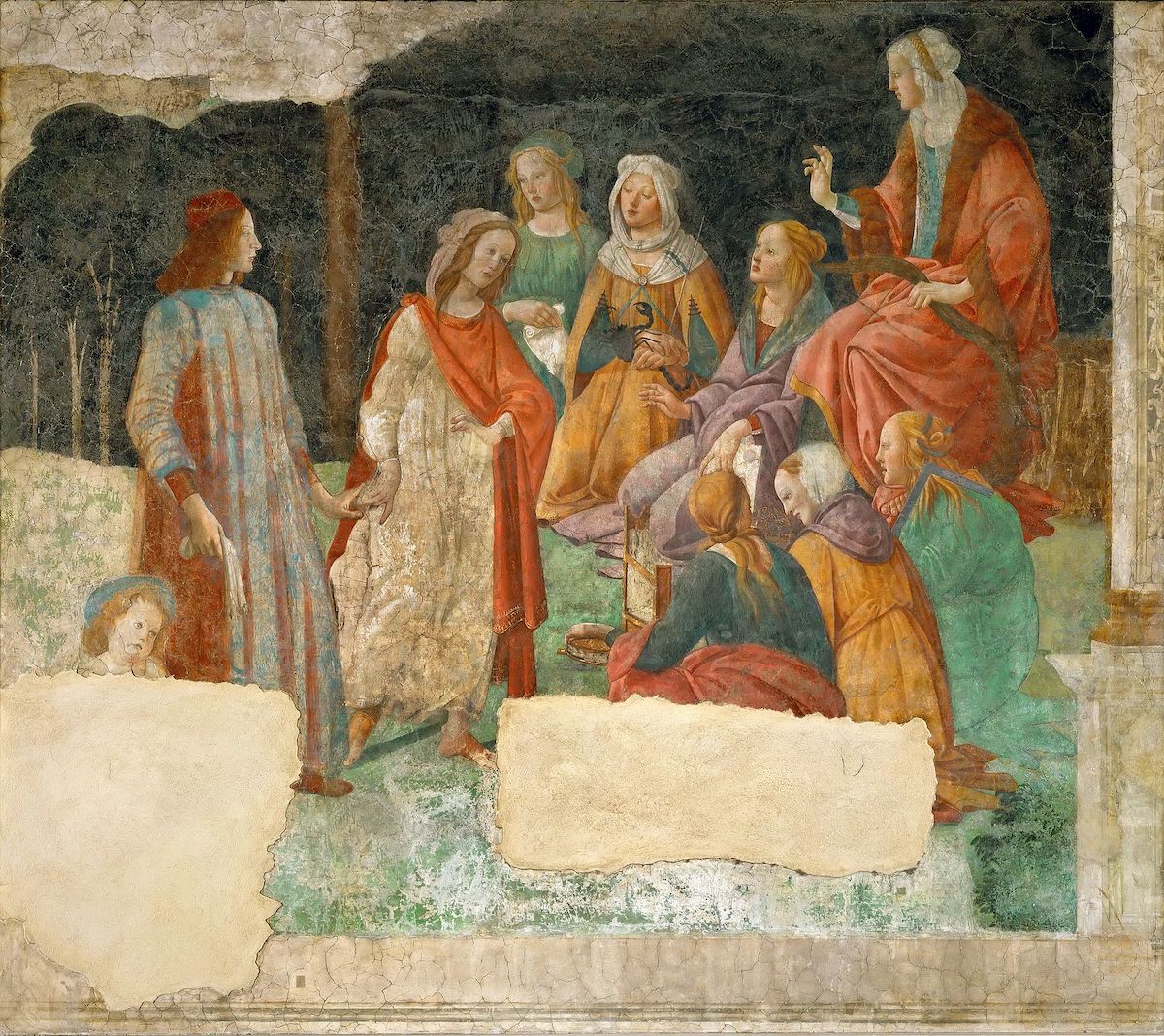
And a pair of Botticelli frescos now held at the Louvre are thought to model bride and groom on the occasion of Lorenzo’s sensational marriage to the beautiful daughter of a rival noble house, Giovanna degli Albizzi.


A Young Man Being Introduced to the Seven Liberal Arts (likely modeled on Lorenzo Tornabuoni)


Venus and the Three Graces Presenting Gifts to a Young Woman (likely modeled on Giovanna degli Albizzi)

All the brushwork in the world couldn’t save even this strapling oligarch when events tied him to a prospective Medici restoration, even though it broke soft republican hearts. Our apothecary Luca Landucci “could not refrain from weeping when I saw that young Lorenzo carried past the Canto d’ Tornaquinci on a bier” and if his diary is to be believed the dry eyes were few and far between.

17th August. The Practica [Court] met and sat in the Palagio from the morning till midnight. There were more than 180 men. And the five prisoners were condemned by word of mouth to be put to death and their property to be confiscated according to law. The five men condemned were Bernardo Del Nero, Niccolo Ridolfi, Giovanni Canbi, Gianozzo Pucci, and Lorenzo Tornabuoni, for whom all Florence was sorry.

On this day..

2005: Abdul Islam Siddiqui

On this date in 2005, Pakistani soldier Abdul Islam Siddiqui was hanged for an assassination attempt against President Pervez Musharraf.

In the December 2003 near-miss, jammed remote control triggers detonated C4 explosives that brought down the Jhanda Chichi Bridge in Rawalpindi … but it was moments after Musharraf’s convoy had already crossed it. “There was an explosion just half-a-minute after we crossed (the bridge),” Musharraf told a television interviewer. “I felt the explosion in my car.”

That gentleman spent the 2000s riding the tiger of Pakistan’s treacherous internal politics after deposing the elected Prime Minister Nawaz Sharif in a bloodless coup. He survived several assassination attempts, often originating — as this one did — from Islamist factions of the powerful Pakistani military aggrieved by Musharraf’s efforts to curb their influence, and with his post-9/11 collaboration with the U.S. War on Terror.

But in a rush to strike back against such actors, did Pakistan get the wrong guy? Siddiqui claimed innocence up until his hanging, and years afterward some of his alleged co-conspirators claimed that they’d been tortured for weeks on end to extract their denunciations.

Several other death sentences were imposed in this affair, although none were executed for many years after, when a 2014 terrorism incident caused Pakistan to discard an execution moratorium and initiate a hanging binge.

Musharraf himself, who stepped down in 2008 and now lives in exile in Dubai, was controversially condemned to death in absentia in December 2019. It’s vanishingly unlikely the sentence will ever be executed.

On this day..

1830: Cornelius Burley

(Thanks to Cornelius Burley for the guest post, which was originally his “confession” on the scaffold at the first-ever hanging in London, Ontario, on August 19, 1830. “Poor, ignorant, weak-minded and almost an idiot,” he’s an unlikely author for the erudite tract — so it’s a fair bet that it was wrung out of him/ghost-written by his minister, who published the dang thing afterwards. More serious than the style is the content: many people to the present day have suspected Burley innocent of the crime to which he here “confesses” and that the real killer of the constable might have been one of the Ribble family with whom he was hiding out. -ed.)

As I am on this day to be executed as the just reward of my crimes, and the only satisfaction which can be made to meet the penalty of the civil law which I have violated, I feel it to be my duty to all those who stand here as spectators of my disgrace, and also to God, who has been justly offended with me on account of my transgressions, to make the following humble confession before I die; and I sincerely pray that it may be acceptable in the sight of the Almighty God, and have a tendency to check the progress of evil, and prevent others from doing as I have done.

I have always been wicked and thoughtless from my youth, having been brought up under the tuition of my parents who were tender and kind in many respects, but never appreciated the benefits arising from education of religion therefore I never was instructed to read or write, nor did they ever attempt to impress my mind with religious sentiments; having no attachments to any system of religious instruction themselves, I was left to wander through the world under the influence of depravity, with out the advantages of education or religious instruction to counter-balance the influences of my natural propensities of evil of various kinds, particularly that of frequenting places of profane resort. I was often found in the merry dance, and lost no opportunity of inducing thoughtless and unguarded females to leaves the paths of innocence and virtue. I lived in constant neglect of the holy Sabbath, and considered it as a day of profane amusement and I entirely neglected the worship of God; and daring profaneness employed my tongue, which ought to have been employed n the service of God, and in imploring his pardoning mercy.

I was married at the age of 21 to a respectable young woman by the name of Sally King; but soon found pretext to forsake her, as jealousy arose in my mind (perhaps without any just causes) that she was guilty of the same crime that my propensities led to. Some time after this, perhaps in June 1829, I married a second, (the first being still alive) — her name was Margaret Beemer, of Waterloo.

The unfortunate circumstances which led to my untimely end were as follows: A misunderstanding took place between Mr. Lamb and myself, in which I considered that the said Mr. Lamb defrauded me; and I could get no legal redress for the fraud, and being influenced partly with a spirit of revenge and partly with a desire to get redress, I took the law into my own hands and shot a steer belonging to the said Mr. Lamb for which transgression a warrant was issued, and I was pursued and taken; but by a stratagem I escaped from the constable, and fled to the township of Bayham in London district, whither I was pursued by Mr. Pomeroy, the unfortunate victim of my rashness.

I made use of various means to escape from him and those who were aiding him in pursuit of me, until the dark and unhappy night of the 15th September, 1829, when the heart appalling deed was committed, the thoughts of which produce the keenest remorse.

That evening I took the fatal instrument of death and after close examination that it was in order to do execution, I fled to avoid them, but in my flight I came near meeting them before I was aware of my danger; but as soon as I saw them I stepped behind a tree to avoid being seen by them, but Mr. Pomeroy at this moment altered his course and came toward the tree behind which I stood. I then supposed that he saw me, and was determined to take me; I then under the impression at the moment, concluded that my escape could not be effected without taking the life of Mr. Pomeroy; I accordingly presented my rifle, and ordered him to stand back, but gave him no time to escape till I fired on him, which shot was instrumental in bringing him to an untimely grave, and me to this disgraceful end. Yes! O yes! It was I who did this murderous deed; it was I alone who was guilty of this horrid and bloody crime, and none but I was guilty of shedding the blood of that trusty man, Mr. Pomeroy, who was faithfully performing his duty to his King and country.

As an act of justice due to Anthony Ribble, I am constrained to say that he had no hand in the crime whatever. Neither had any other person. It was altogether my own act for which I now feel to abhor myself and feel deeply humbled in the sight of God. O that I could recall that most shocking and dreadful deed! But as I cannot, I wish to warn all others nor to do as I have done. And I further say, that now considering myself as a dying man, I attach no blame to his Lordship the Chief Justice, nor his assistant on the Bench, the Sheriff, the Jurors, or Witnesses in my conviction and execution, as I believe they all acted from pure motives, and did their duty with punctuality in obedience to the laws of the country; and I only suffer the penalty that is justly due my crimes. I feel grateful for, and desire to acknowledge the favour of being visited by the ministers of the different denominations, whose instructions have been instrumental in leading me to my last refuge, which is Christ alone; and in my great extremity I have gained a confidence that through the merits of Christ alone I will be saved, although the chief of sinners.

I now big farewell to the world, and to all earthy things at the age of twenty six; and I sincerely hope that all you who behold my disgrace, will take a warning by my untimely end, and avoid the snares into which I have run. I freely forgive all that have injured me, and I sincerely ask forgiveness of all whom I have injured, but particularly God, whose righteous laws I have violated, but who has become the reconciled through Jesus Christ, and had given me as evidence of his love. O praise the Lord! I now leave this world with the fullest confidence that my sins are washed away in the Blood of the Lamb, and with sincere desire for the happiness of all I leave behind, I say again FAREWELL.


After his hanging — and his second hanging, when the rope broke on the first try — Burley’s skull was removed and sawed open by a phrenologist. It took a circuitous route through private collections and museums and was only buried in 2001.

On this day..

2015: Khaled al-Asaad, Palmyra archaeologist

Syrian archaeologist Khaled al-Asaad was beheaded by the Islamic State on this date in 2015 for refusing them the ancient artifacts of his native Palmyra.

Eighty-two years old — Palmyra was still a French colony at the time of this birth — Al-Asaad was involved in excavations around that city throughout his adult life. He became the custodian of the archaeological site in 1963 and held the post for 40 years.

When the Salafist militant army rolled up on his oasis city that spring.* he helped to evacuate the town’s museum and Daesh put him to torture to extract the whereabouts of the priceless cultural treasures he’d concealed from them. He made himself a hero to Syrians and antiquarians alike by denying his captors any satisfaction save his death — which was accomplished by a public beheading.

At least one other scholar, Qassem Abdullah Yehya, the Deputy Director of DGAM Laboratories, was also killed by ISIS/ISIL for protecting the dig site.

after Khaled al-Asaad

bonepole bonepole since you died
there’s been dying everywhere
do you see it slivered where you are
between a crown and a tongue     the question still
more god or less     I am all tangled
in the smoke you left     the swampy herbs
the paper crows     horror leans in and brings
its own light     this life so often inadequately
lit     your skin peels away     your bones soften
your rich unbecoming     a kind of apology

when you were alive your cheekbones
dropped shadows across your jaw     I saw a picture
I want to dive into that darkness     smell
the rosewater     the sand     irreplaceable
jewel how much of the map did you leave
unfinished     there were so many spiders
your mouth a moonless system
of caves filling with dust
the dust thickened to tar
your mouth opened and tar spilled out

“Palmyra”, by Kaveh Akbar

* The modern city of Palmyra (also called Tadmur) is adjacent to but not synonymous with the ancient city/archaeological site of Palmyra.

On this day..

1849: Georg Böhning

On this date in 1849, Georg Böhning was shot at Rastatt for his involvement in the failed 1848 revolutions.

This lesser hero of those dramatic times was 61 at his death, years that carried him across the entire age of revolution dating back to the senescence of Europe’s ancien regimes.

By trade a watchmaker (and later in life, a printer of radical tracts) he got his first taste of soldiering volunteering for an international division fighting in the Greek War of Independence.

When revolutions broke out in 1848, Böhning took the lead of a Wiesbaden citizens’ militia and for his trouble had to flee to Switzerland when the insurrection was defeated. He ventured one more bite at the apple, however, by gathering a legion of German exiles in support of the May 1849 Dresden rising — unfortunately arriving right in time to endure the victorious Prussian counterattack and surrender the Rastatt fortress. A court martial declared his death thereafter, a fate shared by 18 other revolutionists.

On this day..

1820: Rebecca Worlock, arsenic poisoner


From a 2017 film treatment of the case.

Thirty-seven-year-old Rebecca Worlock was hanged at Gloucester on this date in 1820 for poisoning her husband.

She’d mixed in a lethal dose of arsenic into a jug of beer from Oldland‘s the Chequers Inn that Thomas Worlock had thirstily quaffed at the end of a long journey. She did this, according to her confession (see p. 19) due to “jealousy on the part of her husband, who had repeatedly called her the most opprobrious epithets, which she declared was without foundation.”

According to Penny Deverill, a descendant of this unfortunate couple who wrote a book about the case, this was a euphemism on Rebecca’s part for her husband’s violent drunken rages.

She certainly was no master criminal. Instead of obtaining the beer herself, she sent her 13-year-old daughter Mary Ann to get it which positioned the kid to testify that, yup, mom intercepted the drink and might have tampered with it. In fact, according to Mary Ann the victim immediately realized what had been done to him.

Father was drinking the last of the beer. He said there was something at the bottom of the cup; and then said to mother you have done for me … I went to call Mrs. Butler; my mother then had the cup and was throwing away what was in it. Mrs. Butler lives next door but one. Mrs. Butler came with me immediately. After I came back mother had the cup in her hands; father was by the fire, and mother by him. Afterwards she threw the stuff out and swilled it. Mother took the cup out of the kitchen into the cellar adjoining the kitchen; could see from the kitchen into the cellar; no steps down. I saw her then empty it into water in a bucket; she swilled the cup out and brought it into the kitchen. My father said he wanted to show the stuff to some one, and was unwilling that she should throw it away.

Still worse, Rebecca to purchase this putative rat poison had been required by regulation to buy in the company of a second person — owing to its very popularity as an expedient for domestic homicide.

To accomplish this, she had fast-talked an obliging passerby outside the apothecary to act as her impromptu aide … and then on leaving the store with her deadly draught in hand, spontaneously blabbed about its real purpose to this total stranger.

On this day..

1905: Thomas Tattersall, taking the hangman with him

Thomas Tattersall was hanged at Armley Prison in Leeds on this date in 1905.

An alcoholic plasterer, Tattersall had a going reputation for home violence already when he got into his cups and fatally slashed his wife’s throat on July 3.

A terrible tragedy for the families involved, this crime at a century’s distance scarcely stands out from the common run of homicides. What attracts our notice is a third fatality, after the murdered victim and the executed killer: the clumsy hangman.

That man, John Billington, came by nooses as a family trade, albeit not of very great vintage: his father, a colorful* Lancashireman called James Billington, had transitioned his amateur personal interest in hanging into a calling as one of the realm’s official executioners after the great William Marwood died in 1883.

This elder Billington passed away in 1901 with 146 hangings under his belt. All three of his sons followed his footsteps into what proved a truly star-crossed vocation.

Eldest son Thomas Billington died of pneumonia at the age of 29, mere days after his father’s passing; he had been only an occasional assistant hangman — never the lead guy.

Second son William Billington was the real maven and succeeded his father as the lead executioner in the realm. He conducted most of the hangings in England between 1902 and his 1905 jailing for failing to pay alimony to his wife.

And that turned out to be the end of a career that appeared to haunt William later in life, because while he was incarcerated his youngest brother John Billington, commissioned to execute our man Thomas Tattersall, plunged through the trap while setting up the gear ahead of time. He was able to perform the execution, but the cracked ribs that he suffered from the fall caused an attack of pleurisy that claimed the hangman’s life that October.

* Apart from treading the scaffolds, James Billington was also a pugilist and wrestler, and other descendants in the Billington family have pursued those trades. Notable exemplars include World Wrestling Federation great Tom Billington, aka the Dynamite Kid and present-day WWE grappler Davey Boy Smith Jr.

On this day..