At dawn this date in 1954, the last Foreign Minister of democratic Iran was shot in Tehran.
It was a year since the dramatic events of 1953, when a CIA-backed coup d’etat overthrew Iranian Prime Minister Mohammed Mossadegh (or Mosaddegh, or Mossadeq, or Mosaddeq) for contemplating oil nationalization.
Over several chaotic days of “Operation Ajax” (or TPAJAX), the Mossadegh government repulsed a first coup attempt, then succumbed to another.
After Mossadegh initially appeared to have maintained his hold on power, the autocratic Shah Mohammad Reza Pahlavi fled for his life to Iraq and thence to Rome. Fatemi, Mossadegh’s forceful young foreign minister, excoriated the Shah in words that themselves raised the specter of execution.
A traitor is afraid. The day when you, O traitor, heard by the voice of Teheran that your foreign plot had been defeated you made your way to the nearest country where Britain has an embassy. (Quoted in the New York Times.)
Either way, it was high stakes for all concerned in oil country. There’s been contentious debate over the extent to which the affair was also a Cold War proxy conflict — or whether the involvement of the country’s Communist party was incidental, a smokescreen, or an outright stalking-horse for the west.
The coup against Mossadegh has emerged as a major historical turning point — and after the Shah was himself dramaticallyoverthrown in the 1979 Iranian Revolution, not necessarily so successful for American foreign policy goals as it seemed at the time.
Appropriately — in fact, with eerie prescience given the events that then lay a generation in the future — a recently declassified 1954 CIA report on the coup made the first known use of a neologism that has since grown increasingly familiar: blowback.
Possibilities of blowback against the United States should always be in the back of the minds of all CIA officers involved in this type of operation. Few, if any, operations are as explosive as this type.
Maybe those possibilities should be in the front of the mind.
Today, there’s a street named for Fatemi in Tehran, and — strange to say — still some number of Americans who anticipate the greeting due liberators should they ever manage to roll a tank down it.
On this date in 1941, Finnish pacifist Arndt Pekurinen was executed at the front for refusing to fight.
Initially conscripted in the 1920’s, Pekurinen had refused to serve under arms and spent 1929-31 in prison for his troubles. He was a minor cause celebre; British MPs and big international names like Einstein and H.G. Wells pressed for his release.
A change in the Finnish conscription law — the bill was called the “Lex Pekurinen” — finally saw him freed to civilian life, but he was drafted anew to fight the Soviet Union in the “Continuation War”. When he again refused, he was shot at Suomussalmi without trial — though two men refused to do it before someone finally agreed to be the executioner.
“Kun ihmisiä ei syödä, on niitä turha teurastaa.” (“As people are not eaten, butchering them is of no use.”)
A neglected figure during the Cold War, he’s enjoyed a latter-day rediscovery since the 1998 Erno Paasilinna book Courage: The life and execution of Arndt Pekurinen. In the decade since, Pekurinen has become a household name and a widely-admired figure. (The link is in Finnish.) A park in Helsinki was recently named for him. (Finnish again.)
Tangentially, the Nordic stock of our day’s victim and his era of militarism call to mind the hero of e.e. cummings’ “i sing of Olaf glad and big”. The allusions of this poem are American, and there’s no reason to associate it directly with Pekurinen — but it so happens that it was published in 1931, the year international pressure forced the end of Pekunin’s first prison stint:
i sing of Olaf glad and big
whose warmest heart recoiled at war:
a conscientious object-or
his wellbelovéd colonel(trig
westpointer most succinctly bred)
took erring Olaf soon in hand;
but–though an host of overjoyed
noncoms(first knocking on the head
him)do through icy waters roll
that helplessness which others stroke
with brushes recently employed
anent this muddy toiletbowl,
while kindred intellects evoke
allegiance per blunt instruments–
Olaf(being to all intents
a corpse and wanting any rag
upon what God unto him gave)
responds,without getting annoyed
“I will not kiss your fucking flag”
straightway the silver bird looked grave
(departing hurriedly to shave)
but–though all kinds of officers
(a yearning nation’s blueeyed pride)
their passive prey did kick and curse
until for wear their clarion
voices and boots were much the worse,
and egged the firstclassprivates on
his rectum wickedly to tease
by means of skilfully applied
bayonets roasted hot with heat–
Olaf(upon what were once knees)
does almost ceaselessly repeat
“there is some shit I will not eat”
our president,being of which
assertions duly notified
threw the yellowsonofabitch
into a dungeon,where he died
Christ(of His mercy infinite)
i pray to see;and Olaf,too
preponderatingly because
unless statistics lie he was
more brave than me:more blond than you.
Fully engaged with the liberal intellectual currents of the Enlightenment, de Gouges spent the 1770’s and 1780’s in Parisian salon circles cranking out plays (over 40) and petitions, pamphlets and manifestos on animal welfare, poverty, the treatment of orphans, and ending slavery.
The latter issue, and not women’s rights, was the cause her contemporaries would have most associated with her.
But the natural-born gadfly didn’t pick her battles with injustice, and the Terror was a bad period to be indiscriminate. Like some of her Girondist associates, she risked the Paris mob’s wrath by openly opposing Louis XVI‘s execution — right in character, Olympe was down on the whole idea of the death penalty — and she carried principle into foolhardiness by printing broadsides savaging Robespierre.
There can be no mistaking the perfidious intentions of this criminal woman, and her hidden motives … calumniating and spewing out bile in large doses against the warmest friends of the people, their most intrepid defender.
Olympe de Gouges, born with an exalted imagination, mistook her delirium for an inspiration of nature. She wanted to be a man of state. She took up the projects of the perfidious people who want to divide France. It seems the law has punished this conspirator for having forgotten the virtues that belong to her sex.
And strange to say, that condescension outlived Robespierre by centuries.
Only recently, as mainstream thought has (sort of) caught up with de Gouges, has the scope of her work (French link) attracted renewed appreciation, and Olympe been acknowledged an Olympian herself.
* Article 10: “Woman has the right to mount the scaffold; she must equally have the right to mount the rostrum.” The work was dedicated to Marie Antoinette.
On this date in 1793, in a revolutionary Paris where the machinery of the Terror was clattering to life, five tumbrils bore to the guillotine twenty former Girondist ministers to the National Convention — plus the corpse of their late colleague Dufriche de Valazé, who had cheated the executioner by killing himself.
Named for the region of Aquitaine from which their leading lights hailed, the Girondists (or Girondins) had in the compressed history of the Revolution ascended from fringe democratic party to governing party even as the political facts shifted under their feet. Finding themselves the conservative party in an assembly increasingly dominated by radical Montagnards and the Paris mob, the Girondists’ tactlessness and stubborn refusal to deal with Georges Danton after his (still historically murky) involvement in the riotous slaughter of prisoners during the September Massacre eroded their position.
As the terrible year of 1793 unfolded, the Girondins discovered themselves successively overthrown, expelled from the Convention, proscribed, and hunted. Though many more — Girondists and others — were to follow in their steps, the trial of these 21 before the Revolutionary Tribunal and subsequent guillotining, the first notable mass-execution of the Revolution, raised the curtain on the Terror.
L’ultime adieu des Girondins le 31 Octobre 1793, by Paul Delaroche
Decades later, the English historian Lord Acton remembered the faction’s doomed heroism.
[The Girondins] stood four months before their fall. During that memorable struggle, the question was whether France should be ruled by violence and blood, or by men who knew the passion for freedom. The Girondins at once raised the real issue by demanding inquiry into the massacres of September. It was a valid but a perilous weapon. There could be no doubt as to what those who had committed a thousand murders to obtain power would be capable of doing in their own defence.
…
Almost to the last moment Danton wished to avoid the conflict. Again and again they rejected his offers. Open war, said Vergniaud, is better than a hollow truce. Their rejection of the hand that bore the crimson stain is the cause of their ruin, but also of their renown. They were always impolitic, disunited, and undecided; but they rose, at times, to the level of honest men.
…
They were easily beaten and mercilessly destroyed, and no man stirred to save them. At their fall liberty perished; but it had become a feeble remnant in their hands, and a spark almost extinguished. Although they were not only weak but bad, no nation ever suffered a greater misfortune than that which befell France in their defeat and destruction.
That Pierre Vergniaud who scorned the hollow truce was the last to mount the scaffold this day — a shining orator of the Revolution who captured the calamity engulfing his nation in another well-remembered aphorism, “the Revolution devours its own children.”
On this date in 1618, schemer, explorer, and lover Walter Raleigh fell permanently out of favor.
One of the biggest wheels of Elizabethan England, Raleigh (who also rendered his name Rawleigh, Rawley, and most commonly, Ralegh) charmed his way into the Queen’s inner circle, and possibly her pants, and was even thought to be a contender for her hand.
In between gorging on royal monopolies, scribbling poetry, popularizing tobacco, and introducing the potato to Ireland [allegedly], Raleigh got his New World on by attempting to colonize Virginia,* helping fund it with privateering operations against England’s rivals in the land-grab game. The city of Raleigh, North Carolina — present-day North Carolina was part of the Virginia Colony back in the day — is named for him.
Proud, powerful, and the queenie’s pet. Just the sort of courtier other noble suckups loved to hate.
When the palace fave secretly dallied with one of the Queen’s ladies-in-waiting, he went on the royal outs and got real familiar with the Tower of London. Though he managed to patch up with Elizabeth, things were never quite the same for Sir Walter. Elizabeth’s successor James I put him back in prison (suspending a death sentence) for supposedly participating in the Main Plot.
Raleigh passed the time under lock and key burnishing his Renaissance man rep by writing various poetry and treatises, including an account of his voyage to Guyana. Convinced the legendary city of El Dorado was in the vicinity, Raleigh eventually prevailed upon James to release him to make another run at it.
But a dust-up with a Spanish outpost in South America left his son dead, and the Spanish ambassador hopping mad. Raleigh was arrested upon his return, and the death sentence reinstated.
At 66 years of age or so, Walter Raleigh had had a pretty good run.
He took his punishment with equanimity, writing tenderly to his wife, and examining the blade that would take off his head on the scaffold with the observation,
“This is a sharp Medicine, but it is a Physician for all Diseases.”
His wife creepily kept the severed head for the remaining 29 years of her life.
There’s a more detailed tour of Raleigh’s life here, and a site linking many works by and about Raleigh here.
* As Governor of Virginia, Raleigh forbade injuring Indians on pain of death, according to Giles Milton’s Big Chief Elizabeth. Raleigh’s “imperialism with a human face” policy had exchange programs of Indians visiting England, most notably Pocahontas.
On this date in 1553, Calvinist Geneva showed it could keep up with the Inquisition by burning the theologian Michael Servetus as a heretic.
A generation or two into the Protestant Reformation, and the ministers of Rome were in full-throated I-told-you-so. The splintered religious authority had set all manner of alien doctrine afoot in the land. Adult baptism! No original sin!
Servetus believed all this queer stuff. He also believed in a unitarian — that is, not trinitarian — deity.
Catholics and Protestants both hunted him from pillar to post for heresy.
After busting out of the Inquisition’s clutches in France, Servetus fled towards Italy, but made an unaccountable stopover in John Calvin’s Geneva. He well knew that capture here would be fatal: he had had an acrimonious correspondence with Calvin. Was he seeking thrills? Martyrdom? A place in this blog?
“I will burn, but this is a mere event. We shall continue our discussion in eternity.”
He quaffed all those bitter cups when he was recognized hanging out at a church service and condemned to death for sundry heresies after a sensational trial heavy with theological artillery, personal vituperation, and municipal politics. Calvin, gracious in victory, requested beheading rather than burning. He was scorned as needlessly merciful.
Of course, all manner of Christian fauna were being martyred by other Christians in the 16th century. Still, the Spanish physician is an interesting dude.
Besides all that stuff, in his day-job capacity as doctor, Servetus was apparently the first European to understand pulmonary respiration. Nobody even noticed that until decades after his death.
“To kill a man is not to defend a doctrine, but to kill a man.”*
The execution of this smart, odd duck for non-violent heresy is not generally considered the highlight of Mr. Predestination’s career, but you can get some of Calvin’s side of the story in this collection of his letters. It’s worth allowing that heretics were being burned by the thousand elsewhere in Europe at this time; Servetus is noticeable in part because what was routine in England or Spain was exceptional in Geneva.
Servetus’ ashes will cry out against [Calvin] as long as the names of these two men are known in the world. –Walter Nigg
* This observation, sometimes attributed to Servetus himself, was in fact uttered by Sebastian Castellio.
On this date in 1864, five Tsilhqot’in warriors were hanged as common criminals in Quesnel, British Columbia, for resisting white incursion during the Chilcotin War.
The only possibly authentic image of Klatsassin extant. (From this image archive.)
An indigenous nation in northern B.C., the Tsilhqot’in or Chilcotin* had been relatively insulated — though not completely isolated; they had well-established fur-trading contacts from the early 19th century — from the colonization that had swept the continent over the preceding centuries.
In 1862, two cataclysms turned that world upside down.
First, a smallpox epidemic sweeping out of mining camps decimated the Tsilhqot’in population.
Second, gold was discovered in the adjacent inland Cariboo region — and the ensuing gold rush to the inaccessible vein saw whites laying multiple roads through Tsilhqot’in territory. At least one of the entrepreneurs racing to complete the first road might have exploited tribal labor and forced women into prostitution.
The specific internal mechanisms and deliberations that triggered the response are lost to us, but the community must have felt itself under siege — and certainly the building projects, unchecked, would serve to project crown authority into the tribal land. The roads, too, are a specific trigger in the European encounter with North American natives. If it had not been gold, it would have been something else, and soon.
The Chilcotin War or Chilcotin Uprising erupted in April 1864 when a Tsilhqot’in party slew a civilian road-building crew. Bloodthirsty rumors (sometimes unreliable) of Indian atrocities quickly set abroad in the colonial capitals.
Despite almost limitless land to disappear into, the leader, Klatsassin (or Klattasine, or Klatsassan), was captured that August with seven of his followers by the expedient of luring him under assurance that they would be treated as prisoners of war.
Instead, they were tried as common murderers. Five were condemned — including both Klatsassin and his son. (Two others were arrested the following year, and one of them hanged as well.)
In 1993, the government of British Columbia apologized for the executions.
And “Canadian Mysteries” is the apt title. “Klatsassin,” in the native tongue, simply means, “we do not know his name.”
The peak in the center of this photograph is “Mount Klattasine,” and the glacier stretching towards the upper right is also named for the hanged war chief.
* Many other transliterations are possible: e.g., Tsilqut’in, T?inlhqot’in, Chilkhodin, Tsilkótin, Tsilkotin.
(Thanks to Jeffrey Fisher [jeffreyfisher at me.com] for the guest post.)
Today is the feast day of Neoplatonic philosopher and Christian theologian Boethius (Anicius Manlius Severinus Boethius), author of The Consolation of Philosophy, and according to tradition martyred in 524 or 525, or possibly 526, by the Ostrogothic king Theodoric.
Well, maybe.
We know roughly as much about why Boethius was killed as when or how. We do know that he came from a line of prominent Romans (including a couple of popes back there, depending on who you count as “pope”), was himself consul in 510, and his sons were rather astonishingly joint consuls in 522. At that time he moved up to Ravenna accepting an appointment at Theodoric’s court as the Master of Offices, something like the equivalent of chief of staff, managing the work of Theodoric’s officers.
But then things went horribly wrong.
There is a long tradition, going back at least to the eighth century, regarding Boethius as having been executed for maintaining the Catholic faith against the Arian Theodoric. While Theodoric was probably paranoid about spies representing the Catholic eastern emperor-in-waiting Justinian (who would, in fact, later “reconquer” the Italian peninsula), and Boethius claims in the Consolation that he was hated for being smarter than everyone else, the truth is probably that he was caught up in the usual machinations of an imperial court.
A member of the Senate was accused of treasonably conspiring with Justinian’s predecessor Justin I against Theodoric. Boethius defended the accused (apparently the only person to do so, although the charges were surely trumped up), and in the Consolation, Boethius says he was only defending the Senate (implying that the accusations were meant to undermine the authority of the Senate by challenging its loyalty to the king).
In any event, the sources we have say that Boethius was condemned by the Senate (who appear to have thrown him under the bus) without being able to speak in his own defense. After an indeterminate time of imprisonment, he was executed.
It was while he awaited death that he wrote his most famous and arguably most influential work, The Consolation of Philosophy.
A few of the many editions of The Consolation of Philosophy available. Others are available free at Project Gutenberg (here, here and a Latin one here), as is a podcast version.
Boethius’ translations of and commentaries on ancient Greek philosophy were the only such texts available in Europe for much of the Middle Ages, but the Consolation was translated and widely read even outside of the philosophical circles in which his other work was so important.
Written in the form of Menippean satire (alternating verse and prose) as a dialog between Boethius and Philosophy, the Consolation is Boethius’s attempt to think through and make sense of the sad state of his affairs.
Ultimately, it was both the universal nature of the problem (why are these horrible things happening to me?) and the compelling way in which he tackled the problem (a combination of Plato, Aristotle, and Stoicism) that have made this text so widely read and imitated.
There is no way in this space to do justice to the Consolation, which addresses the very idea of philosophical discourse (“would you like us to clash together our arguments, for perhaps out of a conflict of this kind some beautiful spark of truth my fly out?”), the nature of time and God’s perspective outside of time, the difference between providence and fate, and the nature of and way to the Good itself.
But the gist of Boethius’s argument about the sufferings of the good person maybe be quickly summarized. In short, Boethius has forgotten his true nature, which never changes, and gotten caught up in the things of this world, which come and go. If he but remembers himself, he will have something no injustice, no turning of the wheel of fortune, can take away from him. And as for the unjust and the evil, they also have their “reward”:
But since goodness confers on each man his reward, he will only lack it when he has ceased to be good. [ . . . Now] since the good itself is happiness, it is clear that all good men are made happy for this reason, that they are good. But those that are happy, it is agreed, are gods; and therefore that is the reward of good men, which no time can lessen, no man’s power diminish, no man’s wickedness obscure, to become gods. These things being so for good men, no wise man can doubt either of the punishment inseparable from evil men; for since good and evil, and also punishment and reward, are directly opposite to one another, what we see added in the case of the good man’s reward must necessarily be reflected in an opposite manner in the evil man’s punishment. As therefore goodness itself is the reward for good men, so for wicked men wickedness is itself the punishment.
This afternoon in Paris, 1793, the French Revolution devoured the Queen.
Thirteen-year-old Madame Antoine — a year before marriage, and rebranding as Marie Antoinette. A vast gallery of her portraiture awaits here.
Among the most emblematic death penalty victims in history, Marie Antoinette — the “widow Capet,” as she was styled in egalite, after the guillotine shortened her husband — had the bad luck to personify the decadence of the ancien regime under the hegemony of the sans-culotte.
(And, of course, the good luck to be born heir to all the perks of absolutism she enjoyed for the first thirty-plus years of life. So, you know: a mixed bag.)
Those infamous excesses — and her infamous alleged bon mot, “let them eat cake” — are said to have been greatly exaggerated, nothing that everyone wasn’t doing, nothing that wasn’t understandable under the circumstances.
She had a gift, it seems, for accumulating to her personal reputation the outrage incurred by every gross and petty indulgence of the old order. And she had a popular press, the libelles, ready to embroider them salaciously.
Jacques-Louis David sketched this portrait of a haggard Marie Antoinette en route to the guillotine.
Cruel, wanton, senseless … her death was all of these, but then many others in the Terror suffered the same, as many others had under the Bourbons.
As royal dynastic pairings go, she’d been dealt a bad hand.
Her mere presence in France was fruit of the controversial policy of alliance with the Austrian Habsburgs from the Seven Years’ War, and she was trundled off with her dowry and her teenage wiles to the foreign snakepit of Versailles just as the minister advancing that policy fell. Distrusted by the French as an Austrian catspaw, castigated by her family for her inadequacies thereto, socially expected to display conspicuous regal largesse during a budget crisis not of her making, and unable for the longest time to get a successful coition from her indifferent and/or impotent husband, it must have seemed to her some days like every play was a losing one.
She struggled to gain traction at court. But she would lose much more than influence.
I was a queen, and you took away my crown; a wife, and you killed my husband; a mother, and you deprived me of my children. My blood alone remains: take it, but do not make me suffer long. (WikiQuote)
Her bearing she kept forever: in a kangaroo court with a foreordained outcome where her imperious dignity still managed to turn aside an accusation of sexual abuse her son had been cajoled into supplying; on the scaffold, when she did not neglect courtesy to the executioner whose foot she trod:
“Monsieur, je vous demande pardon. Je ne l’ai pas fait exprès.”
For much more queenliness, Marie-Antoinette.org delivers what the url promises, in quantity. If this figure or this period appeals, be sure to browse its forums.
Naturally, the doomed queen has had plenty of attention from printed word as well:
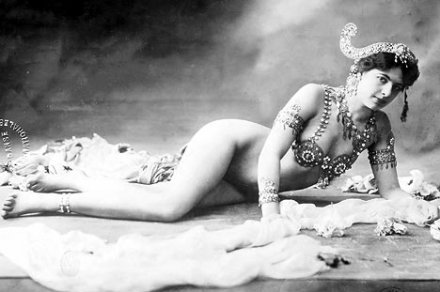
At 5 a.m. this date in 1917, Margaretha Geertruida Zelle — better known as Mata Hari — was awoken at Saint-Lazare Prison to news that it was her last day on earth.
She died in a muddy drill field outside Paris, facing a firing squad as she had lived: self-possessed, mysterious, her eyes (she refused a blindfold) open.
For the oldest profession, it may be there is nothing truly original, nothing new under the sun. But Mata Hari — thanks in no small part to her genuinely fatale end — redefined it for the dawning age of mass visual media and tapped the power of sexual allure for a commercial century.
She was already pushing 30 when she got into the exotic dance game, with a failed May-December marriage behind her from what a wag might call her first sexual bargain, to get out from under the thumb of her family and see the world. In Paris in the belle epoque, there were assuredly dancers younger, prettier. Margaretha, who here debuted the show name by which history would know here, surpassed them with showmanship.
She exploited her exotic olive-toned looks — there were rumors of Javanese or Jewish blood even in her childhood — and claimed to be an Indian princess; her talent for repackaging oriental exoticism with just the right amount of otherness combined with her willingness to push boundaries of eroticism made her an instant sensation. Naturally gregarious and unprudish, she segued into the courtesan biz on the side with dashing officers and wealthy industrialists.
Not bad for a thirty-something mother of two.
She comes at the start of our own era: sensual postcards and posed photos of Mata Hari were at once her pitch and her product; celluloid was just coming online, and 14 years after her death, she’d be portrayed by silver screen femme fatale Greta Garbo:
That’s her with the last object of her affections, a Russian aviator young enough to be her son, and a reminder that the birth of Greta Garbo’s era was also the death of Mata Hari’s own.
She was aging, for one thing. For another, of course, war shattered Europe. Famous, decadent, polyglot … those things that had been her passport suddenly became her liabilities. Globetrotting travel? Payoffs from a multinational cast of officers for her companionship?
There’s no take here on whether she was really, as convicted, a German spy of any variety at all — she seems to have been approached, to have tried her hand clumsily or to have been set up by either French or German intelligence, or simply to have behaved indiscreetly. Once she was caught up against events, her maneating reputation did her no favors.
Spying, she was terrible at. Commanding men’s attention? As a British correspondent reported, Margaretha Zelle owned her role to the very last.
The first intimation she received that her plea had been denied was when she was led at daybreak from her cell in the Saint-Lazare prison to a waiting automobile and then rushed to the barracks where the firing squad awaited her.
Never once had the iron will of the beautiful woman failed her. Father Arbaux, accompanied by two sisters of charity, Captain Bouchardon, and Maitre Clunet, her lawyer, entered her cell, where she was still sleeping – a calm, untroubled sleep, it was remarked by the turnkeys and trusties.
The sisters gently shook her. She arose and was told that her hour had come.
‘May I write two letters?’ was all she asked.
Consent was given immediately by Captain Bouchardon, and pen, ink, paper, and envelopes were given to her.
She seated herself at the edge of the bed and wrote the letters with feverish haste. She handed them over to the custody of her lawyer.
Then she drew on her stockings, black, silken, filmy things, grotesque in the circumstances. She placed her high-heeled slippers on her feet and tied the silken ribbons over her insteps.
She arose and took the long black velvet cloak, edged around the bottom with fur and with a huge square fur collar hanging down the back, from a hook over the head of her bed. She placed this cloak over the heavy silk kimono which she had been wearing over her nightdress.
Her wealth of black hair was still coiled about her head in braids. She put on a large, flapping black felt hat with a black silk ribbon and bow. Slowly and indifferently, it seemed, she pulled on a pair of black kid gloves. Then she said calmly:
‘I am ready.’
The party slowly filed out of her cell to the waiting automobile.
The car sped through the heart of the sleeping city. It was scarcely half-past five in the morning and the sun was not yet fully up.
Clear across Paris the car whirled to the Caserne de Vincennes, the barracks of the old fort which the Germans stormed in 1870.
The troops were already drawn up for the execution. The twelve Zouaves, forming the firing squad, stood in line, their rifles at ease. A subofficer stood behind them, sword drawn.
The automobile stopped, and the party descended, Mata Hari last. The party walked straight to the spot, where a little hummock of earth reared itself seven or eight feet high and afforded a background for such bullets as might miss the human target.
As Father Arbaux spoke with the condemned woman, a French officer approached, carrying a white cloth.
‘The blindfold,’ he whispered to the nuns who stood there and handed it to them.
‘Must I wear that?’ asked Mata Hari, turning to her lawyer, as her eyes glimpsed the blindfold.
Maitre Clunet turned interrogatively to the French officer.
‘If Madame prefers not, it makes no difference,’ replied the officer, hurriedly turning away. .
Mata Hari was not bound and she was not blindfolded. She stood gazing steadfastly at her executioners, when the priest, the nuns, and her lawyer stepped away from her.*
The officer in command of the firing squad, who had been watching his men like a hawk that none might examine his rifle and try to find out whether he was destined to fire the blank cartridge which was in the breech of one rifle, seemed relieved that the business would soon be over.
A sharp, crackling command and the file of twelve men assumed rigid positions at attention. Another command, and their rifles were at their shoulders; each man gazed down his barrel at the breast of the women which was the target.
She did not move a muscle.
The underofficer in charge had moved to a position where from the corners of their eyes they could see him. His sword was extended in the air.
It dropped. The sun – by this time up – flashed on the burnished blade as it described an arc in falling. Simultaneously the sound of the volley rang out. Flame and a tiny puff of greyish smoke issued from the muzzle of each rifle. Automatically the men dropped their arms.
At the report Mata Hari fell. She did not die as actors and moving picture stars would have us believe that people die when they are shot. She did not throw up her hands nor did she plunge straight forward or straight back.
Instead she seemed to collapse. Slowly, inertly, she settled to her knees, her head up always, and without the slightest change of expression on her face. For the fraction of a second it seemed she tottered there, on her knees, gazing directly at those who had taken her life. Then she fell backward, bending at the waist, with her legs doubled up beneath her. She lay prone, motionless, with her face turned towards the sky.
A non-commissioned officer, who accompanied a lieutenant, drew his revolver from the big, black holster strapped about his waist. Bending over, he placed the muzzle of the revolver almost – but not quite – against the left temple of the spy. He pulled the trigger, and the bullet tore into the brain of the woman.
Mata Hari was surely dead.
* Inevitably, a story got around that she’d opened her funereal coat to the firing squad, revealing no clothing beneath it.

 Over several chaotic days of “Operation Ajax” (or TPAJAX), the Mossadegh government repulsed a first coup attempt, then succumbed to another.
 Initially conscripted in the 1920’s,
 Most recognizable today for her


 A generation or two into the Protestant Reformation, and the ministers of Rome were in full-throated I-told-you-so. The splintered religious authority had set all manner of alien doctrine afoot in the land. Adult baptism! No original sin!


 Well, maybe.