1973: Victor Jara, among thousands in Chile’s September 11

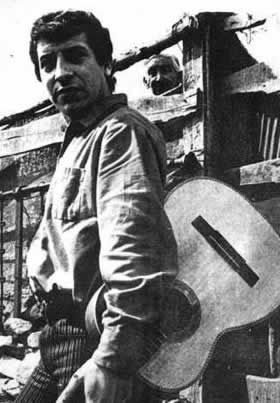
At an unknown time on this evening in 1973, or else the early hours of the following day, Chilean putschists ushering in the Pinochet dictatorship machine-gunned folk singer Victor Jara near the Santiago stadium that today bears his name.

“I don’t see why we need to stand idly by and let a country go communist due to the irresponsibility of its own people,” said Henry Kissinger of Allende’s election. Victor Jara had another idea.

Four days before, Chile’s September 11 had seen General Augusto Pinochet topple the elected leftist government of Salvador Allende, murdering the president in his palace. (Or, go some accounts, Allende committed suicide — “pausing only twice to reload.”)

A long pall of evil settled over the country, with all the accustomed chilling familiars: “disappeared” people, mirrored shades, Jeane Kirkpatrick.

The day after the CIA-backed coup, popular folk singer and activist Victor Jara, a pioneer of the Nueva Cancion (“New Song” movement) then teaching at Santiago’s Technical University, was among thousands of undesirables rounded up and packed off to a makeshift prison camp at the city’s Chile Stadium — a stadium Jara had performed at.*

Left there to the tender mercies of a thuggish Chilean officer, Jara was beaten and tortured over the intervening days — evocative but possibly undependable tradition holds that the guitarist’s hands were cut off, shattered or otherwise destroyed. According to the U.S.-based United States Institute of Peace,

[t]he the last day Víctor Jara was seen alive was September 15. During the afternoon he was taken out of a line of prisoners who were being transferred to the National Stadium. In the early morning of the next day, September 16, shantytown dwellers found his body, along with five others, including that of Littré Quiroga Carvajal, near the Metropolitan Cemetery. As the autopsy report states, Víctor Jara died as a result of multiple bullet wounds (44 entry wounds and 32 exit wounds).

The Commission came to the conviction that he was executed without due process of law by government agents, and hence in violation of his fundamental human rights.

To say the least.

And as the text implies, Jara was only the most recognizable name among unknown hundreds killed as the military cemented its control of the country.

Jara remains larger-than-life martyr figure in Latin America and liberation movements worldwide, but he’s almost unknown north of the Rio Grande. Pinochet was our bastard; in the weird way history writes its own geography, Jara became a political emblem behind the Iron Curtain for the perfidy of the capitalist powers: obscure in Peoria, but a household name in Potsdam, as the credit roll from this 1978 East German film suggests.**

That’s Jara himself on the soundtrack, of course. The pat conclusion for such a figure is that his art is his legacy, and that Jara’s body of work as against Pinochet’s will be a walkover in posterity. Is that enough? Pinochet died in his bed at age 91; earlier this year, the Jara case was closed in underwhelming fashion. Thirty-five years down the road, most authors of Pinochet’s human rights depredations are dead or lost or decrepit. Justice delayed is justice denied.

Victor’s widow, Joan Jara — today director of the Fundacion Victor Jara (it’s a Spanish-only site); you can hear her interviewed on Democracy Now! for the 25th anniversary of her husband’s death in 1998 — managed to leave the country with some of his works.

Her publication of a poem he wrote while imprisoned, an untitled, unfinished work generally known as “Estadio Chile,” made it a signature cry of hope amid desperation. Here it is in the Spanish rough-hewn under the shadow of death; there’s an English translation here.

Somos cinco mil
en esta pequena parte de la ciudad.
Somos cinco mil
¿Cuantos seremos en total
en las ciudades de todo el pais?
Solo aqui, diez mil manos que sembran
y hacen andar las fabricas.

¡Cuanta humanidad
con hambre, frio, panico, dolor
presion moral, terror y locura!

…¡Y Mexico, Cuba y el mundo?
¡Que gritan esta ignomonia!

Somos diez mil manos menos
que no producen.
¿Cuanto somos en toda la Patria?
La sangre del companero Presidente
golpea mas fuerte que bombas y metrallas.
Asi golpeara nuestro puno nuevamente.

¡Canto que mal me sales
cuando tengo que cantar espanto!
Espanto como el que vivo
como el que muero, espanto.

De verme entre tanto y tantos
momentos de infinito
en que el silencio y el grito
son las metas de este canto.
Lo que veo nunca vi,
lo que he sentido y lo que siento
hara brotar el momento…

Whether or not it’s enough, his work is his legacy after all.

* Some 7,000 people were held at Chile Stadium in the days after the coup, most later moved in with other detainees at the larger Estadio Nacional. The USIP excerpt alludes to Jara being pulled out for execution during such a move.

** In a similar vein, Stanford has a small online exhibit of Jara-themed East German propaganda art. Not to be outdone, there’s a Soviet rock opera about Jara, and an asteroid discovered by a Soviet astronomer was named in Jara’s honor within a week of his execution.

On this day..

1599: Beatrice Cenci and her family, for parricide

On the morning this day in 1599, the Cenci family — mother Lucrezia, son Giacomo, and immortal tragic heartthrob Beatrice — were put to death at Sant’Angelo Bridge for murdering the clan’s tyrannous father.

Francesco Cenci, the victim, was more accustomed to making victims of his own: detested around the Eternal City, he indulged his violent temper and fleshy lusts with the impunity of a wealthy cardinal’s son. By all accounts, he enjoyed pushing around his family, too.

This much is stipulated. What lies beyond is legend.

But the legend is why we’re dallying with Beatrice today, so we might as well begin there: in fear that her father would rape her, it goes, Beatrice tried to turn to the authorities, who let mean old dad walk on account of his connections. Desperate to protect herself from incest, Beatrice and family arrange to batter his gulliver and toss him over a balcony to make it look like suicide.

Slight problem: it didn’t look very much like suicide.

So the family was hauled in and tortured, and eventually Lucrezia and Beatrice (both beheaded) and Giacomo (quartered after suffering the mazzolatura of an incapacitating hammer blow to the head followed by gory lethal knifework by the executioner) all paid the price while the youngest child watched, spared death but condemned to life in the galleys.

(The papacy gobbled up the patricides’ estate, which puts a fine point on the ironically-named Pope Clement VIII‘s law-and-order stance on the appeal for mercy, and his subsequent edicts to quash public comment on the affair.)

Then Beatrice’s body — the part below the neck — contrived to disrobe when fumbled by the brethren taking it away for burial.

You’ve got to admit it’s pretty romantic. Some versions even hold that the responsible executioners died violently themselves within a month, or that a ghostly Beatrice returns to the scene of her demise on this anniversary.

And not a word of Italian fluency will be necessary to catch the gist of this excerpt from this 1969 Lucio Fulci film:

It’s a little too Romantic, as in capital-R.

While the case was a true sensation Rome at the turn of the 17th century, the legend as we know it was heavily constructed in the 19th century … and specifically Percy Bysshe Shelley, who heard the story in Italy* where it had persevered as local folklore. A girl who killed her despot-father, executed by the despotic agents of the Divine Father? You don’t get into the canon without knowing what to do with that kind of material.

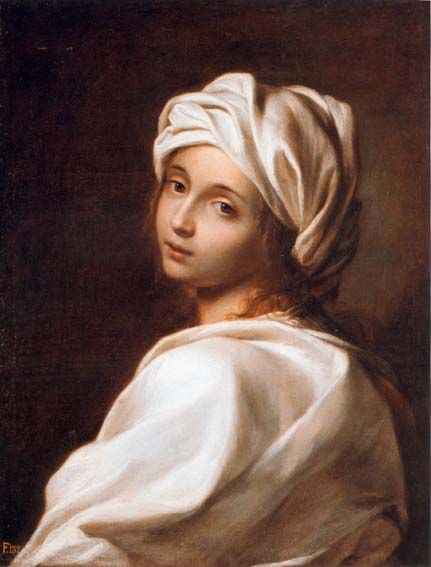
And he had this charming painting of her to boot:

Shelley amped up the menaced-virginal-purity theme, made the bloodshed a lot more demure, and turned it into a long poem, “The Cenci” (available on Google Books, and on Bartleby.com) which in Melville’s description proceeds from putting its protagonist between the “two most horrible crimes possible to civilized humanity — incest and parricide.”

This doesn’t all actually turn out to be well supported: at a minimum, Shelley inflated an incest allegation of doubtful lineage into accomplished fact. Beatrice’s camp did not raise this claim until just before her execution, when it needed a high card for clemency. The loutish victim eventually got his own biographer, who strongly disputed the incest charges. (Francesco also sports his own Italian Wikipedia page.)

From Shelley’s influential quill** into the DNA of western literature: Stendahl tapped the vein, as did Artaud, and risorgimento figure Francesco Domenico Guerrazzi; both Melville and Hawthorne used that painting so captivating to Shelley as plot devices (Dickens loved the painting, too). American sculptor Harriet Hosmer worked Cenci’s complex sensuality in marble.

Remarkable how the tradition in its modern incarnation proceeds root and branch from Shelley’s apprehension of a single painting, and how his reading stamped itself upon the canvas for later observers — like Hawthorne, writing in his journal:

It is the very saddest picture that ever was painted, or conceived; there is an unfathomable depth and sorrow in the eyes; the sense of it comes to you by a sort of intuition. … It is the most profoundly wrought picture in the world; no artist did it, or could do it again. Guido may have held the brush, but he painted better than he knew. I wish, however, it were possible for some spectator, of deep sensibility, to see the picture without knowing anything of the subject or history; for no doubt we bring all our knowledge of the Cenci tragedy to the interpretation of the picture.

He wrote better than he knew: the painting is no longer attributed to Guido Reni, and it’s doubtful whether it’s a portrait of Beatrice at all. One wonders if it would retain its place in Hawthorne’s estimation as a local washer-woman modeling for an allegory.

* Apparently you can still crash at the same place Shelley first got hep to Cenci.

** Kick back with some polysyllabic literary analysis of Shelley’s Cenci stuff.

On this day..

1990: Samuel K. Doe

On this date in 1990, deposed Liberian strongman Samuel Kanyon Doe was tortured and summarily executed in Monrovia by the putschists that overthrew him … and gruesomely filmed in the process.

Doe had come to power killing his predecessors — personally murdering, some sources say, President William Tolbert in 1980, then executing his chief aides.

That coup toppled civilian authority in the west African country now permanently prefixed with the adjective “troubled.” “The first of the monsters,” the War Nerd called him: Doe’s murderous rule through the 1980’s set up the succession of current war crimes prisoner Charles Taylor.

Samuel Doe’s turn in the obituaries arrived in particularly grisly fashion, with Taylor rival/semi-ally* Prince Johnson swilling beer as he interrogated — and ordered the ear sliced off — the groveling former head of state before having him executed. (Or if you like, just plain murdered.) The video shot of Doe’s ordeal became an international sensation … so it’s a little surprising that only this paltry excerpt seems to be readily available online:

* And current Liberian Senator! He feels just awful about the whole torturing-the-President-to-death thing.

On this day..

2003: Paul Hill, anti-abortion martyr

Five years ago today, minister Paul Hill was put to death by lethal injection for murdering an abortion provider and a clinic escort nine years before.

Hill rose to prominence in the early 1990’s as a fire-eating abortion foe, who openly preached the righteousness of defending unborn life by force — a divisive position among anti-abortion activists that got him excommunicated from the Presbyterian church.

On July 29, 1994, in the abortion conflict’s ground-zero of Pensacola, Fla., Hill put his theology into action by gunning down Dr. John Britton and his septuagenarian escort, along with Britton’s wife (who survived the shooting).

Creepy. It sure looks like the song and image pairings were done in earnest, not in irony.

He never betrayed the least scruple about his act, hoping only to use his trial to present a “justifiable homicide” defense; the judge’s suppression of this line was and remains a grievance of Hill’s fellow-travelers against the judiciary.

Nor did Hill betray the least concern to die for his beliefs; if anything, in dropping appeals that would at the least have prolonged his life, he cut a figure thirsty for the martyrdom he attained this day.

To what end?

Hill left a plentiful documentary record — like this manifesto, among the pro-Hill documents collected on the Army of God website:

I knew that [killing an abortion provider] would uphold the truths of the gospel at the precise point of Satan’s current attack (the abortionist’s knife). While most Christians firmly profess the duty to defend born children with force (which is not yet being disputed by the government) most of these professors have neglected the duty to similarly defend the unborn. They are steady all along the battleline except at the point where the enemy has broken through. I was certain that if I took my stand at this point, others would join with me, and the Lord would eventually bring about a great victory.

One can question whether this proved to be the case or not. The infamy (in most circles) of the killing arguably dampened enthusiasm for the cause, at least as measured by the sulfur level on clinic sidewalks. At the same time, Hill’s was only the most spectacular instance of a campaign to terrorize abortion providers that drove many out of business and made some areas of the country virtual abortion-free zones.

Whatever may have surprised him about the way the issue played out over the 1990’s, he was serene about his choices when interviewed the day before his execution.

To some in the movement, he’s a holy martyr, the John Brown of slavery’s modern-day parallel.

And even if Paul Hill’s name is taboo in the respectable public discourse of abortion today, with four relatively young rock-ribbed anti-Roe v. Wade votes now entrenched at the Supreme Court, it’s far from obvious that Hill won’t get what he was after all along … even if he didn’t live to see it.

Part of the Themed Set: Judging Abortion.

On this day..

1966: Sayyid Qutb

On this date in 1966, author and intellectual Sayyid Qutb was hanged for plotting to overthrow the Egyptian state.

Qutb — whose names can be transliterated many ways (Saïd, Syed, Seyyid, Sayid, or Sayed; Koteb, Kotb, Qutub or Kutb) — was one of the most influential Islamist thinkers of the 20th century, and helped shape the ideas of Osama bin Laden.

A traditionally-minded Muslim civil servant in a westernizing Egypt, Qutb’s journey to radicalism is traditionally dated to his late 1940’s study abroad in the U.S. at what is now the University of Northern Colorado, where the decadence, materialism, and lax morality of the global hegemon saw him seeing existential evil in the everyday all around him:

The American girl is well acquainted with her body’s seductive capacity. She knows it lies in the face, and in expressive eyes, and thirsty lips. She knows seductiveness lies in the round breasts, the full buttocks, and in the shapely thighs, sleek legs — and she shows all this and does not hide it.

Qutb left Greeley, Colo., in 1950 with a master’s degree and an intention to mount an Islamic revolution in his home country that would implement sharia and keep shapely thighs safely under wraps. (Qutb never married, bemoaning the scanty pickings of pure fish in the sea. He may have faced the gallows a virgin.)

He hooked up with the outlawed Muslim Brotherhood, landed in Egypt’s famously savage prisons (future president Anwar Sadat was one of his judges), and the experience of torture hardened his commitment to a vanguard-led revolution. He kept up his prolific writing output, penning perhaps his most notable work, Milestones (the text was later used against him at his capital trial).

Qutb’s release in 1964 was only for a few months, before Egyptian security got wind of a new Muslim Brotherhood plot to overthrow the government and rounded up Qutb as the supposed ringleader — or just railroaded him because it didn’t like where he was going with passages like

there are many practical obstacles in establishing God’s rule on earth, such as the power of the state, the social system and traditions and, in general, the whole human environment. Islam uses force only to remove these obstacles so that there may not remain any wall between Islam and individual human beings.

With the benefit of hindsight, one can readily imagine that his martyr’s death did not squelch his movement, but greatened his stature to admiring eyes.

But it was hardly a direct path into an un-critiqued hall of martyrs in an undifferentiated “radical Islam”. While Qutb had his own influence in Egypt, Cairo has managed to keep the lid on the Muslim Brotherhood. Qutbism, however, was exported to Saudi Arabia — which intentionally imported it for various practical and geopolitical reasons — where it flourished, often in a fractious relationship with official Saudi Wahhabism.

One of Qutb’s students was the uncle of Ayman al-Zawahiri, and the hanged intellectual greatly influenced Zawahiri’s own path into radicalism and to al-Qaeda. Since September 11, of course, the path Qutb himself followed has become of much more pressing interest to the West as well as within the Muslim world.

Some noteworthy works by Sayyid Qutb

On this day..

1305: William Wallace, Braveheart

On this date in 1305, Scottish knight Mel Gibson — er, William Wallace — was hanged, drawn and quartered at Smithfield for treason to a British crown he refused to recognize.

Just like so:

Well, close enough. Some wags have alleged one or two historical liberties in Braveheart.

Among the lesser (but more pertinent here): that they weren’t — you knew this already — offering the former Guardian of Scotland the opportunity to reduce his suffering with a public submission, or use the stage for theatrical defiance. Hanging, drawing and quartering was a brand new execution Edward I was experimenting with for emasculating, disemboweling, and (so the idea went) utterly cowing the rebellious hinterlands of the British Isles. Wallace may have been just the second person to suffer it.

But only a pointy-headed blogger could possibly care when the main point is that back before Christendom succumbed to nancy decadences like Vatican II, men wore woad, defenestrated queers, and tapped top-shelf babes.


Among the few things known for certain about William Wallace is that he did not score with Isabella of France. Or with Sophie Marceau.

Facts? This is show business!

Mel’s bloodbath only riffs the already-fantastic 15th century epic of “the Wallace” by Scottish minstrel Blind Harry, which in turn got a lyrical call-out in Robert Burns’ 18th century Scottish patriotic tune Scots Wha Hae.

National martyrs — and, sure, it helps to die at the right time, as Wallace did just before Robert the Bruce secured Scottish independence — feed a train of hungry authors and ready audiences in every time, place and medium.

However genuinely flesh-and-blood the limbs that wrought his feats and were torn apart on this day, Wallace returns to his generations of interlocutors half-shrouded in mythology. Seven centuries on, his contested (and sometimes absurd) use as precedent or metaphor stakes a claim to his Truth at least as compelling as battlefield tactics at Stirling Bridge. What does he “really” have to tell us? No matter how grisly his end, William Wallace doesn’t get to decide: it’s between you, me, Mel, and a few billion other folks.

Only a character really worth remembering is worth that kind of fictionalizing.

On this day..

1848: Camila O’Gorman and Father Ladislao Gutierrez, for traditional family values

On this date in 1848, a pregnant 20-year-old socialite and her forbidden lover were shot at the order of an Argentine dictator.

Virtually a lens for the contradictory currents of gender, class and power in her time, Camila O’Gorman was the daughter of an elite family of (as her name suggests) Irish extraction, and a bosom friend of the daughter of her future executioner, dictator Juan Manuel de Rosas.

She fell into a torrid affair with Gutierrez, the family priest, and in 1847 eloped with him, a grand gesture of romanticism that brought a government warrant for their capture to “satisfy religion and the law and to prevent further cases of immorality and disorder.”

A scandal, as one might suppose — there was much chatter over who seduced whom, and whether it was a kidnapping — but a manhunt (and womanhunt)? Rosas appears psychotically enraged by two young people crazy in love, and still more so for summarily decreeing their death when he had them in his clutches. Another priest, it turned out, handed them over — more in sadness than in anger, in the manner of such folk, but understanding deep down that the arbitrary law is the law and immorality and disorder don’t go about preventing themselves.

O’Gorman was the first woman executed in independent Argentina, and she was eight months pregnant: the better to “satisfy religion” (though not the law, which forbade the execution of a pregnant woman), O’Gorman’s unborn child was baptized … by making her mother drink holy water.

The lovers were then shot together at the town of General San Martín, then known as Santos Lugares de Rosas.

The pregnant O’Gorman, borne to her firing squad. The image comes from this Argentinian page (in Spanish) about the heroine.

According to this effusively pro-elopers essay,

Camila and Uladislao’s brave sense of freedom upset the structured norms of a society used to obeying through fear. Their only way of facing the tyrannical power was escaping from a society which would never understand. They did not give up on their love to please the Restorer [Rosas], as was expected in those days. They never showed signs of repentment, [sic] on the contrary their peaceful minds reflected their clean consciences.

…

And among the many questions this tragic true story might raise, there’s one that particularly appals [sic] us: why did Rosas shoot Camila knowing the law stated a pregnant woman could not be murdered? Was that baby guilty of his parents’ “crime”?

He evidently was, since by being born he would symbolise the testimony not only of the criminal act, but also the evidence of “disobedience” of a moral code imposed by a fearful dictator.

Such Shakespearean drama ripped from recent history has not failed to inspire literary treatment — such as Enrique Molina’s Una Sombra Donde Suena Camila O’Gorman, (“A Shadow Where Camila O’Gorman Dreams”) and this 19th century Spanish text.

On the screen, O’Gorman and Gutierrez’s doomed love was the topic of one of the first Argentine feature films (a century-old silent film now thought lost), and an Academy Award-nominated 1984 film with plenty of talking:

On this day..

1916: Sir Roger Casement

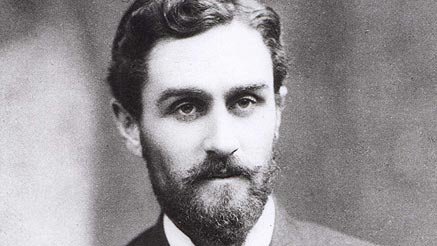
On this date in 1916, Roger Casement was hanged for treason by the British crown that had knighted him only a few years before.

Casement died for his part in the Easter Rising, but this Irish nationalist hero’s layered story has long made him a very different sort of cultural marker than, say, James Connolly.

Casement came to public prominence for his damning report on Belgium’s atrocious treatment of natives in its Congo colony, e.g.:

[T]he great decrease in population, the dirty and ill-kept towns, and the complete absence of goats, sheep, or fowls — once very plentiful in this country — were to be attributed above all else to the continued effort made during many years to compel the natives to work india-rubber. Large bodies of native troops had formerly been quartered in the district, and the punitive measures undertaken to his end had endured for a considerable period. During the course of these operations there had been much loss of life, accompanied, I fear, by a somewhat general mutilation of the dead, as proof that the soldiers had done their duty.

. . . Two cases (of mutilation) came to my actual notice while I was in the lake district. One, a young man, both of whose hands had been beaten off with the butt ends of rifles against a tree; the other a young lad of 11 or 12 years of age, whose right hand was cut off at the wrist. . . . I both these cases the Government soldiers had been accompanied by white officers whose names were given to me. Of six natives (one a girl, three little boys, one youth, and one old woman) who had been mutilated in this way during the rubber regime, all except one were dead at the date of my visit.

[A sentry in the employ of one of the concessionary private companies] said he had caught and was detaining as prisoners (eleven women) to compel their husbands to bring in the right amount of rubber required of them on the next market day. . . . When I asked what would become of these women if their husbands failed to bring in the right quantity of rubber . . , he said at once that then they would be kept there until their husbands had redeemed them.

Casement’s is an honorable name in the campaign for the Congo, an early human rights and anti-colonial struggle; in this 92-minute BBC documentary on the notorious depredations in the Congo, the Casement report’s creation and impact are treated from about 1:15:15 through the end:

A similar investigation undertaken in Peru — where the lens focused on British employers, rather than strictly the malfeasance of foreign states — earned him knighthood in 1911, but Casement’s personal evolution from loyal Protestant* imperial operative with a sympathy for the Irish cause to revolutionary nationalist was already underway. “This journey into the depths of the Congo has been useful in helping me discover my own country and understand her situation, her destiny, her reality,” he wrote his sister. “I’ve also found my true self: the incorrigible Irishman.”

He resigned from the consular service and began recruiting for the Irish Volunteers.

As World War I opened, Casement identified British aggression as its cause, an extension of the violent imperial hegemony he chronicled in The Crime Against Europe:

The British Empire was not founded in peace; how, then can it be kept by peace, or ensured by peace-treaties? It was born of pillage and blood-shed, and has been maintained by both; and it cannot now be secured by a common language any more than a common Bible. The lands called the British Empire belong to many races, and it is only by the sword and not by the Book of Peace or any pact of peace that those races can be kept from the ownership of their own countries.

While any Irish Republican would have agreed with that sentiment, the resulting moral and tactical calculus for the Irish cause to ally with the German was not universally embraced — and was certainly anathema to the British.

“In the Streets of Catania”
by Roger Casement

All that was beautiful and just,
All that was pure and sad
Went in one little, moving plot of dust
The world called bad.

Came like a highwayman, and went,
One who was bold and gay,
Left when his lightly loving mood was spent
Thy heart to pay.

By-word of little street and men,
Narrower theirs the shame,
Tread thou the lava loving leaves, and then
Turn whence it came.

Ætna, all wonderful, whose heart
Glows as thine throbbing glows,
Almond and citron bloom quivering at start,
Ends in pure snows.

Casement spent the first two years of the Great War in Germany itself, and arranged a shipment of guns that would have supported the Easter Rising, but thought the aid too little and too late. He had a German U-boat drop him at Ireland, trying to get word to the Republican leadership to postpone the revolt.** Instead, he was picked up three days before the doomed rising and hanged after a sensational trial.†

His “treason” — and of course, the very crime of which he was convicted imports a British legitimacy in Ireland that Casement explicitly rejected — shocked many old associates, but he still had friends in high places. To dampen the international clemency campaign, England circulated the notorious “Black Diaries,” photographs of supposed Casement diary pages detailing the author’s homosexuality.

This dirty (and successful) trick brings a personal-is-political quality to Casement’s legacy as well as an enduring debate over the diaries’ authenticity. Since Irish nationalism gained mainstream acceptance well before homosexuality, right-thinking folk long held the Black Diaries a forgery, and time was you solicited a black eye by saying otherwise in the wrong company.

The gay rights movement has seen a posthumous redefinition of Casement; although homosexuality was not on the indictment against him, one could argue that it was the reason he hanged. Given recent handwriting forensics that support the diaries’ authenticity, the general‡ consensus about the Black Diaries has inverted with the effect of only heightening sympathy for their alleged author, albeit at the expense of some tension over how to situate that characteristic within the whole of Casement’s life and thought.

And that is only one aspect of the shifting place of Casement in the firmament of Republican martyrs since his death. His hagiography waxed in the interwar years, with Yeats among those calling for the return of Casement’s remains in The Ghost of Roger Casement”.

But the humanitarian’s German ties were an inconvenience as World War II raged, and not until afterward was that cause renewed. When his body was finally returned in 1965, an Irish state funeral elided the matter of the diaries.

Even Casement himself, who would be the last to die for the Easter Rising, had a hand in the myth-making. His last mission’s purpose to avert the Easter Rising fit neither the government’s interest in maximizing his perfidy nor Casement’s own in identifying with the Irish cause; he himself therefore owned the Rising fully in his defense which made him fine fodder for Republican hymns like “Lonely Banna Strand”:

RTE radio’s What If? series recently explored Casement’s complex legacy:

[audio:http://www.rte.ie/podcasts/2008/pc/pod-v-240208-27m06-whatif.mp3]

As Casement put it in his voluminous personal writing, “It is a cruel thing to die with all men misunderstanding — misapprehending — and to be silent forever.”

* Casement’s father was Protestant and his mother was Catholic; he lived with a somewhat split identity between the two faiths, but formally converted to Catholicism while awaiting execution (which surely did not hurt his memory to the Irish cause) and his last meal was simply the Host.

** The guns themselves were interdicted by the British navy and ended up scuttled to the ocean floor.

† Since Casement’s incitements to rebellion had occurred on foreign soil, there was some fine legal parsing over whether he could be tried for “treason.” The dispute resolved to the placement of a comma in a medieval law — leading to the epigram/-taph that Casement was “hanged by a comma.” In the midst of war and before an English jury, however, punctuation was an even weaker defense than it sounds.

‡ But still not universal.

On this day..

1811: Miguel Hidalgo y Costilla, for Mexican independence

On this date in 1811, Mexican independence icon Miguel Hidalgo was shot for treason at the government palace in Chihuahua.

The subversive priest had set the spark to the Mexican War of Independence in the hours before sunrise of September 16, 1810. There, he rang the parish bell in the small town of Dolores and issued his “Grito de Dolores” — “Cry of Dolores” — summoning native Amerindians and mestizos to throw off the Spanish.

The movement got added juice from the fact that the Spanish jackboot was then being worn by Napoleon, who had installed his brother as king.*

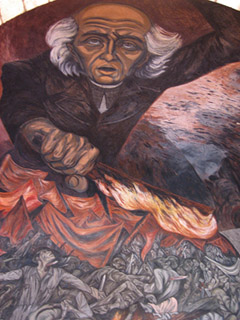
Hidalgo tributes are a mainstay of every Mexican town. This Orozco mural is in a government building in Guadalajara.

Hidalgo’s fired-up downtrodden mob slaughtered the local garrison and gathered numbers on a march towards Mexico City before the professional Spanish soldiery rallied to stop it. But the priest wouldn’t make his father-of-the-country credentials in generalship: he’d been relieved of command after repeated combat debacles by the time the insurrection’s leaders were betrayed in March.**

While his comrades Ignacio Allende, Jose Mariano Jimenez and Juan Aldama were shot on June 26, Hidalgo got an old-school detour through the ecclesiastical arm for defrocking (and a highly suspect alleged retraction).

When he was shot this day, he directed the firing squad to aim for the hand he placed over his heart.

Then, his head was cut off and stuck on a pike as a warning.

The struggle lived on, long past Hidalgo’s execution and Bonaparte’s fall, and finally resulted in Mexican independence in 1820. Today, the padre whose call to action not only started the revolt but made it a mass movement is the face on the 1,000-peso note, and his Grito de Dolores is repeated every Diez y Seis de Septiembre as an independence day tribute by Mexican authorities — as in this from 2006:

* Inspiring this blog’s banner in the process.

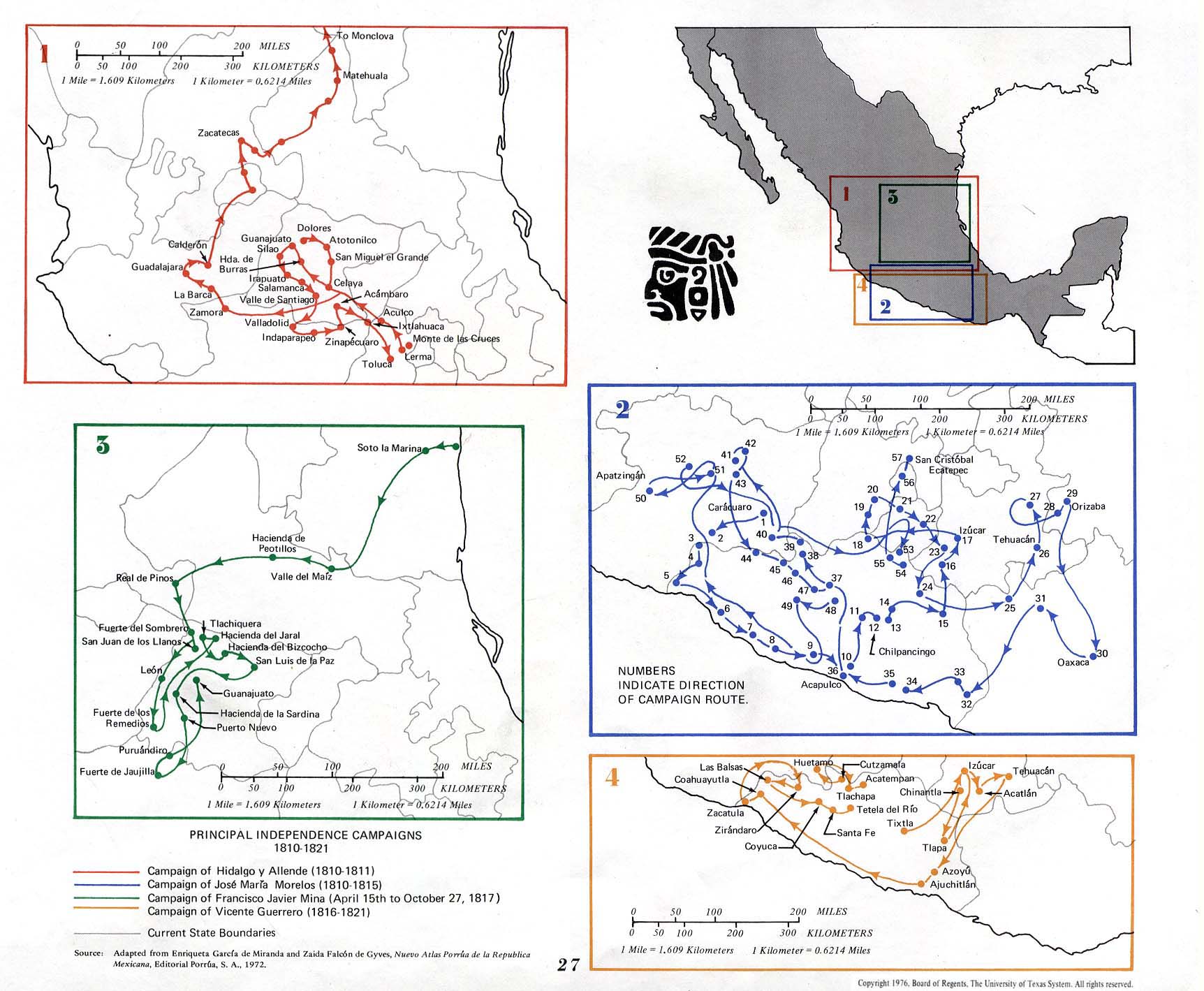
** There’s a map of Hidalgo and Allende’s army’s movements — and subsequent campaigns in the war — here.

On this day..

1794: Maximilien Robespierre, Saint-Just and the Jacobin leadership

On this date in 1794, the curtain — and the blade — fell on the Terror.

Maximilien Robespierre, who had breakfasted the previous day as master of France, was guillotined this evening with his chief lieutenants and partisans.

His fall came as sudden and inevitable as his rise had been unpredictable.

Five years before, Robespierre was an unprosperous Arras attorney of fashionably liberal philosophies, and you wouldn’t have given a sou for the prospects of his being remembered five minutes after he died. Yet it would come that his inseparable lieutenant Saint-Just would remark with understatement, “The words we have spoken will never be forgotten on earth.”

The historic convocation of the Estates-General thrust him onto the political stage where he would make the dread name that follows him, starting off in the Revolution’s inception as a far-left deputy. He took a notable early stand against the death penalty, with several arguments that are quite familiar by our day:

The first obligation of a legislator is to form and preserve public morals, the source of all freedom, source of all social happiness. When in running to a particular goal he turns away from this general and essential goal he commits the most vulgar and dire of errors. The king must thus present to the people the purest model of justice and reason. If in place of this powerful, calm and moderate severity that should characterize it they place anger and vengeance; if they spill human blood that they could spare and that they have no right to spread; if they spread out before the people cruel scenes and cadavers wounded by torture, it then alters in the hearts of citizens the ideas of the just and the unjust; they plant the seed in the midst of society of ferocious prejudices that will produce others in their turn. Man is no longer for man so sacred an object: we have a less grand idea of his dignity when public authority puts his life at risk. The idea of murder inspires less fear when the law itself gives the example and the spectacle. The horror of crime is diminished when it is punished by another crime. Do not confuse the effectiveness of a penalty with the excess of severity: the one is absolutely opposed to the other. Everything seconds moderate laws; everything conspires against cruel laws.

For Robespierre, it was an abomination for the nation to deal out death within its community, but his Rousseauan elevation of the collective and abstract People made extirpating existential threats to the community itself an altogether different matter.

The future tyrant’s anti-death penalty case for executing the deposed Louis XVI, flowing directly from those principles, makes interesting reading and is excerpted at length (all emphases added) here for its topicality:

When a nation has been forced to resort to the right of insurrection it returns to a state of nature as regards its tyrant. How can the latter invoke the social compact? He has annihilated it. The nation can preserve it still, if it thinks fit, in whatever concerns the interrelations of its citizens: but the effect of tyranny and insurrection is to break it entirely as regards the tyrant; it is to throw them into mutual war; the tribunals, the judiciary procedures, are made for the members of the city. … The right to punish the tyrant and that to dethrone him are the same thing. The one does not admit of different forms from the other. The tyrant’s trial is insurrection; his judgment is the fall of his power; his penalty, whatever the liberty of the people demands.

Peoples do not judge like judiciary courts. They pass no sentences; they hurl the thunderbolt. They do not condemn kings: they thrust them back into oblivion; and this justice is not inferior to that of courts. If they arm themselves against their oppressors for their own safety, why should they be bound to adopt a mode of punishing them which would be a new danger to themselves?

…

As for me, I abhor the penalty of death so lavish in your laws, and I have neither love nor hatred for Louis. Crimes only I hate. I have asked the Assembly, which you still call Constituent, for the abolition of the death penalty, and it is not my fault if the first principles of reason seem to it moral and political heresies. But if you never bethought yourselves to invoke them in favor of so many unfortunates whose offenses are less their own than those of the government, by what fatality do you remember them only to plead the cause of the greatest of all criminals? You ask an exception to the death penalty for him alone against whom it can be legitimate! Yes, the penalty of death generally is a crime, and for that reason alone, according to the indestructible principles of nature, it can be justified only in cases when it is necessary for the safety of individuals or the social body. Public safety never demands it against ordinary offenses, because society can always guard against them by other means and make the offender powerless to harm it. But a dethroned king in the bosom of a revolution which is anything but cemented by laws, a king whose name suffices to draw the scourge of war on the agitated nation, neither prison nor exile can render his existence immaterial to the public welfare: and this cruel exception to ordinary laws which justice approves can be imputed only to the nature of his crimes.

It is with regret that I utter this fatal truth. But Louis must die, because the country must live.

“Pity is treason.”

Months later, as head of the Committee of Public Safety — the Orwellian name harkens to the body’s power to judge who lay inside the community and who, lying outside, made war upon it — he would find an inexhaustible fifth column of kindred threats to the Revolution.

But Revolutionary France really was in a war for its survival, against external and internal foes alike. The monarchist for whom crime multiplied upon crime every day after the Tennis Court Oath has the easiest time of this period, for every step brings a new monstrosity. And it is well enough to call Robespierre illiberal, to shudder at his prim and icy persona.

But if the French Revolution’s liberte, egalite, fraternite is a legacy for celebration — as it is to much of the west, and much of the world — one must grapple with the place of this man and his methods.

Merely because they are the paths not taken, one hardly seems entitled to assume that at that tumultuous moment the rule of a constitutional monarchy heir to all the monstrosity of the ancien regime, the government of the Girondins who had launched the nearly fatal war against Austria, or that of Danton‘s haute bourgeoisie would necessarily have delivered France to a better place, or even a different one.

For a Dickens, Robespierre’s Terror is simply the appalling wrong turn of a high-minded movement. For Trotsky, “the Incorruptible”* is the admirable sword of France’s bourgeois revolution who effects the needful task of annihilating the feudal nobility, who presses fearlessly forward seeing that the only alternative is the slide into Bonaparte. Between the two lie many readings of the man.

Whether an aberration, a visionary, or a necessity, he waded a sea of blood for his frightening twins Virtue and Terror.

The fall of 9 Thermidor preceded Robespierre’s execution by a full — and very eventful — day. Arrested by the Convention, he was promptly liberated by his base in the Paris Commune which came within a whisker of overthrowing the Convention at that very moment. Instead, a frantic few hours of marshaling the armed power of the Revolution’s rival claimants to leadership ensued ending in a fray which saw the Robespierrists overpowered.

Robespierre was shot through the jaw in the process of signing an appeal to arms — some say a botched suicide, but a wound from the invading national guard is more generally believed; at any rate, the bloodied document with his signature begun “R-o-” is one of the age’s most arresting historical artifacts.

Horrifically injured, he lay most of the following day exposed for public derision before he was hauled with his party to the guillotine, re-erected in the Place de la Revolution for this most memorable execution. In Carlyle’s florid (and free) narration:
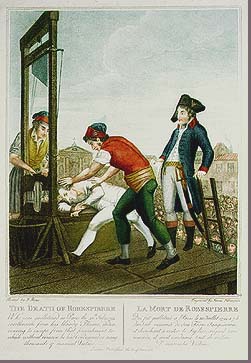
Robespierre lay in an anteroom of the Convention hall, while his Prison-escort was getting ready; the mangled jaw bound up rudely with bloody linen: a spectacle to men. He lies stretched on a table, a deal box his pillow; the sheath of the pistol is still clenched convulsively in his hand. Men bully him, insult him: his eyes still indicate intelligence; he speaks no word. … -O reader, can thy hard heart hold out against that? His trousers were nankeen; the stockings had fallen down over the ankles. He spake no more word in this world.

…

Fouquier had but to identify; his Prisoners being already Out of Law.** At four in the afternoon, never before were the streets of Paris seen so crowded. From the Palais de Justice to the Place de la Revolution … it is one dense stirring mass; all windows crammed; the very roofs and ridge-tiles budding forth human Curiosity, in strange gladness. … All eyes are on Robespierre’s Tumbril, where he, his jaw bound in dirty linen, with his half-dead Brother, and half-dead Henriot, lie shattered; their “seventeen hours” of agony about to end. The Gendarmes point their swords at him, to show the people which is he. A woman springs on the Tumbril; clutching the side of it with one hand; waving the other Sibyl-like; and exclaims: “The death of thee gladdens my very heart, m’enivre de joie;” Robespierre opened his eyes; “Scelerat, go down to Hell, with the curses of all wives and mothers!” — At the foot of the scaffold, they stretched him on the ground till his turn came. Lifted aloft, his eyes again opened; caught the bloody axe. Samson wrenched the coat off him; wrenched the dirty linen from his jaw: the jaw fell powerless, there burst from him a cry; — hideous to hear and see. Samson, thou canst not be too quick!

Samson’s work done, there bursts forth shout on shout of applause. Shout, which prolongs itself not only over Paris, but over France, but over Europe, and down to this generation. Deservedly, and also undeservedly. O unhappiest Advocate of Arras, wert thou worse than other Advocates? Stricter man, according to his Formula, to his Credo and his Cant, of probities, benevolences, pleasures-of-virtue, and such like, lived not in that age. A man fitted, in some luckier settled age, to have become one of those incorruptible barren Pattern-Figures, and have had marble-tablets and funeral-sermons. His poor landlord, the Cabinet-maker in the Rue Saint-Honore, loved him; his Brother died for him. May God be merciful to him, and to us!

Part of the Themed Set: Thermidor.

* Even his enemies agreed — sometimes adding it to the bill of particulars against him — that Robespierre lived a life of personal moderation; he lived as a boarder with a working-class family, and disdained to avail the politician’s typical harvest of political graft.

** The Convention had decreed Robespierre’s outlawry when he escaped custody; his immediate execution was, of course, akin to the logic he had once turned against the king.

On this day..