1868: Eleven samurai, for the Sakai Incident

On this date in 1868,* eleven samurai committed seppuku before the French consul in Japan spared their nine comrades.

The affair was stunning punishment for what’s known as the Sakai Incident — an offense eight days prior that occurred during Japan’s Boshin War, a last rearguard battle of loyalists to the (now officially ended) Tokugawa Shogunate against the rising imperial party of the Meiji Restoration.

What’s noteworthy for our purposes in this period is that the Meiji espoused an anti-foreigner policy — one that was not the less intently felt by the Meiji base for being entirely insincere on the part of elites.

It was in this tense context that a boat full of French sailors from the corvette Dupleix called on March 8 at Sakai — a port city whose shogunate forces had routed. It had been recently occupied by imperial troops.

Japan had only been opened to the west 15 years before, and access was still quite restricted; there might have been a misunderstanding between the French sailors and Sakai’s Tosa clan occupiers over whether this city was open at all. There was definitely a misunderstanding once the tourists ran into samurai on shore, and before you know it high words and suspicious glares turned into a street skirmish that left eleven Frenchmen dead.


Illustration from Le Monde Diplomatique (1868)

This Sakai Incident (English Wikipedia entry | French) incensed western powers, and not only the French: the British, Dutch, Prussians, Italians, and Americans all pulled down their embassy colors in solidarity pending adequate satisfaction for the French. Japan at this moment was not at all in a position to take a stand against foreign gunships over this dust-up, and it met the conditions — which consisted of some personal groveling by a state minister, the payment of a 150,000-piastres indemnity, and the execution of the officers and soldiers involed. The punishment would be self-administered by seppuku at a Sakai shrine. This set the scene for a powerful climax, in which the soldiers one by one tore out their own guts in a ceremony that must have played as defiance no less than submission.

Quoting the Moniteur, the London Morning Post of May 19, 1868 (news was slow in those days) describes the operatic punishment.

On the 15th [a Japanese] high functionary brought a written reply from his Government conceding all the satisfaction required. On the following day Captain du Petit-Thouars, commander of the Dupleix, landed at Sakai to witness the execution of two officers, a subaltern, and 17 Japanese soldiers, condemned to death as the principal authors of the aggression. The two chiefs were the first put to death, after which nine others perished successively. Captain du Petit-Thouars then seeing that the Japanese Government was decided on carrying out its engagements to the end, and ceding to a feeling of humanity, stayed the execution, declaring that he considered the reparation sufficient, and that he proposed to ask the Minister of France to intercede for a commutation of punishment in favour of the other condemned.

The last nine beneficiaries of the captain’s clemency were sent into internal exile instead.

The Japanese writer Mori Ogai wrote a short story about this affair, Sakai Jiken. (See Suicidal Honor: General Nogi and the Writings of Mori Ogai and Natsume Soseki.)

* There are some citations that give the date as the 23rd. The original reporting I have located unambiguously asserts that the execution occurred on the 16th.

On this day..

1562: The Massacre of Vassy

March 1 was the date in 1562 of the Massacre of Vassy.

This horror supplies to historical periodization the opening date of the Wars of Religion that would ravage France for the balance of the century.

After the shock jousting death of Henri II, sectarian tensions spun out of control under the unsteady succession of sons still in their minority — and the power behind the oft-transferred throne, Catherine de’ Medici.

But Catherine was a foreigner and the royal authority rested uncertainly on her children’s wee heads. Tense as matters already stood between Catholics and Huguenots, the realm’s shaky sovereignty disinhibited both confessions when it came to ever more irksome provocations.

Seeking to steer past the looming civil war, Catherine promulgated a decree of limited toleration for Huguenots, who were now to be permitted to worship publicly outside of towns. This is called the Edict of Saint-German or the Edict of January — as in, January of 1562, two months before our massacre. It is not taught in politics classes as a triumph of governance.

Whether this right even had force of law at the moment of our story is unclear, inasmuch as Catholic parlements whose ratification was required dragged their feet when it came to reading the edict into the statutes. But some incident like this was looming no matter where things stood from a scriptorium proceduralist’s standpoint.

At Vassy (or Wassy) on our date arrived the retinue of Francis, Duke of Guise. The Guises were a proverbial more-Catholic-than-the-Pope house, and Francis was not the sort of man to pass with equanimity the spectacle of Vassy’s Huguenots openly holding heretical services in a barn. His retainers tried to barge in. High words were exchanged. Scuffles gave way to brickbats and when something struck the duke’s own person a vengeful slaughter of the Calvinists ensued.

Warfare followed fast upon the publication of this atrocity. The chief Protestant lord, the Prince of Conde, openly mobilized for hostilities, seizing and fortifying Protestant towns — and the Catholic faction likewise. Inside of a year, Guise himself would be slain during a siege: one of the first wave of casualties amid 36 years of civil war.

On this day..

1553: Pedro de Valdivia, founder of Santiago

On Christmas Day of 1553, the Spanish conquistador Pedro de Valdivia, noted as the founder of Santiago, Chile,* was executed by Mapuche Indians who had captured him in battle.

Valdivia got his start in New World bloodsport in the train of the Pizarro brothers, and cashed in with mining concessions as a reward for his able service in the Pizarros’ campaign against yet another conquistador, Diego de Almagro.

Not content to wax fat on Incan silver, Valdivia secured permission to pick up Almagro’s aborted mission: the conquest of Chile. With a force of about 150 Spaniards and many times that number of native allies, he successfully crossed the Atacama desert (bypassing Andean tribes that had proven hostile to Almagro) and attained the Mapocho river valley. There he created Santiago** on February 12, 1541, and almost immediately established the Spanish colony — distinct from Peru — whose headquarters it would be.

It didn’t take long for these interlopers to incur native resistance which would long slow the imperial development of Chile. Later in 1541, an Indian attack razed Santiago, although its Spanish defenders just managed to hold on to the rubble and begin a laborious process of vigilant rebuilding.

While the future metropolis, which lies about the north-south midpoint of the present-day state, grew stone by stone, Valdivia endeavored to carry his conquest to the south. This would soon provoke the furious resistance of the Mapuche people and become the Arauco War, which simmered for decades. (Or centuries, depending on the degree of continuity one might attribute to various rebellions.)

Having seen the Spanish throw up a chain of forts in their territory the better to control new gold mines, the Mapuche counterattacked and overran the fort at Tucapel — led by a bold young commander named Lautaro, who had only recently fled from the personal service of Valdivia himself. Grievously underestimating the vigor of his foe, Valdivia set out to pacify the rebels with a mere 40 Spanish soldiers “because at that time the Indians were but lightly esteemed.” (Marmolejo; see below) Approaching an eerily empty Fort Tucapel on Christmas Day, his token force was suddenly engulfed by thousands of ambushing Mapuche and massacred to a man.

Almost to a man.

Valdivia had the misfortune of being taken alive.

The conquistador was put to death shortly after the battle. The chronicler Jeronimo de Vivar simply said that the commander Caupolican ordered him speared to death — but others went in for more frightful descriptions of an event they surely did not witness.

Alonso de Gongora Marmolejo, who like Vivar was a contemporary to the death of the governor, claimed (Spanish link) that “the Indians kindled a fire before him, and cut off his arms from the elbow to the wrist with their blades; they took care not to permit him his death, and so devoured his roasted flash before his eyes.”

As a founding figure in Chilean history, Valdivia has enjoyed frequent literary treatment, as has his impressive mistress Ines de Suarez. (Isabel Allende’s Ines of my Soul is a recent example.) It is likely that none will ever surpass in literary importance the 16th century epic of of the conquest of Chile La Araucana. Although its author, Alonso de Ercilla, did not sail for America until several years after Valdivia’s death, he — naturally — made the late conqueror one of his principal subjects.

* And the namesake of Valdivia, Chile.

** The name pays tribute to Saint James.

On this day..

1986: The Moiwana Massacre

On this date in 1986, during the opening months of a guerrilla war that would last until 1992, a 70-man detachment of Suriname soldiers raided the village of Moiwana, home of the rebel leader Ronnie Brunswijk, and massacred dozens of people.


Drawing made c. 1990 by an eight-year-old refugee of Moiwana. Image from Richard Price’s “The Killings in Suriname”, Cultural Anthropology, November 1995.

Sealing the roads, the team went house to house for four hours, torching houses and slaughtering any of the Ndyuka civilians who couldn’t escape into the surrounding jungle.

“Everyone was shot — the unarmed women, pregnant women, a baby barely seven months old,” goes the account in Memre Moiwana, a publication of the NGO Moiwana ’86. “No distinctions were made.” Some were mowed down with automatic weapons; others slashed to death with machetes. At least 38 people died, though various sources posit estimates running to upwards of 50.

In the weeks following, nearby Ndjuka villages in eastern Suriname shared a like fate, often bombarded by helicopters and finished off with bulldozers while death squads hunted suspected guerrillas. The U.S. State Department reported 244 Ndyuka people killed that December. A United Nations investigator entering the area months later reported that “no human being or living creature was seen apart from starving dogs in [one such town] Albina. The jungle vegetation had taken over the destroyed buildings.”

A police inspector named Herman Eddy Gooding who had the temerity to investigate these massacres while the guerrilla war was still ongoing was found mysteriously shot dead in 1990. (See Rainforest Warriors: Human Rights on Trial) In 2005, however, survivors of Moiwana won a suit against the army of Suriname before the Inter American Court of Human Rights.

On this day..

1567: The Michelade of Nimes

On this date in 1567, Huguenots in revolt in Nimes put to death dozens of Catholics in a courtyard butchery to climax a massacre remembered as La Michelade (English Wikipedia entry | the much more detailed French)

This name of sinister memory derives from one of the church calendar’s great autumnal feast, Michaelmas — and the sword-arm of its titular archangel would have been required to keep the peace between the rival religionists in the Languedoc.

Nimes went heavily for the Protestants, with the region’s royal governors unable to restrain the conquest of Catholic neighborhoods and churches by the predominant Huguenots through the 1560s: “the very wind which blew upon Nimes breathed heresy,” in the words of Dumas.

The years running up to our events of 1567 feature one of the numerous rancorous truces pocking France’s intractable Wars of Religion: this one is known as the “Armed Peace”, which gives you an idea where everyone’s heads were at. And in Nimes, the heresy in the wind was not such as to prevent the restoration of Catholic authorities to control of the civic institutions — to the undoubted irritation of the Huguenot grandees who endured the indignity of displacement alongside the sure knowledge of the popular weight that supported them.

This ripening conflict appropriately came to fruition via a vegetable market at a city fair on Michaelmas — September 29, 1567 — where an altercation turned into a sectarian riot and soon transformed into a municipal Protestant insurrection.

Huguenots still maintaining the preponderance of force in Nimes, they perpetrated the expected outrages during the excitement: sacking the cathedral, murdering some particularly hated Catholics. But the overall organization of the Huguenots and the organized participation of the city’s Huguenot elites suggests a good deal of advance orchestration, and perhaps coordination with the Huguenot attempt to kidnap the king just days before.

In the disturbance, Nimes’s first consul Guy Rochette — Catholic, naturally — sought refuge in the palace of Bishop Bernard d’Elbene; a Huguenot captain forced the door and arrested them, confiscating from Rochette the keys to the city. Though the bishop managed to escape, other prominent Catholics were systematically detained, too. According to Allan Tulchin’s That Men Would Praise the Lord: The Triumph of Protestantism in Nimes, 1530-1570, “[i]t seems clear that the Protestant leadership intended to conduct a general roundup of Catholic lay and clerical leadership. Protestant forces targeted at least half of the sixteen men who had served as consul between 1564 and 1567 … of the nine Catholic members of the presidial, only two did not appear among the victims.”

Captive Catholics were detained in several buildings around the city, notably in the city hall. It is not known to what extent the kill lists to cull from these unfortunates were preordained and to what extent they were improvised in the moment, but on the night of September 30, summons for specific victims went out, and Protestant squads complied by dragging them out of the city hall basement or wherever else they were held to the courtyard of the bishop’s palace. This would be the makeshift abattoir.

In the narration of Dumas,

when night came the large number of prisoners so imprudently taken began to be felt as an encumbrance by the insurgent chiefs, who therefore resolved to take advantage of the darkness to get rid of them without causing too much excitement in the city. They were therefore gathered together from the various houses in which they had been confined, and were brought to a large hall in the Hotel de Ville, capable of containing from four to five hundred persons, and which was soon full. An irregular tribunal arrogating to itself powers of life and death was formed, and a clerk was appointed to register its decrees. A list of all the prisoners was given him, a cross placed before a name indicating that its bearer was condemned to death, and, list in hand, he went from group to group calling out the names distinguished by the fatal sign. Those thus sorted out were then conducted to a spot which had been chosen beforehand as the place of execution.

This was the palace courtyard in the middle of which yawned a well twenty-four feet in circumference and fifty deep. The fanatics thus found a grave ready-digged as it were to their hand, and to save time, made use of it.

The unfortunate Catholics, led thither in groups, were either stabbed with daggers or mutilated with axes, and the bodies thrown down the well. Guy-Rochette was one of the first to be dragged up. For himself he asked neither mercy nor favour, but he begged that the life of his young brother might be spared, whose only crime was the bond of blood which united them; but the assassins, paying no heed to his prayers, struck down both man and boy and flung them into the well. The corpse of the vicar-general, who had been killed the day before, was in its turn dragged thither by a rope and added to the others. All night the massacre went on, the crimsoned water rising in the well as corpse after corpse was thrown in, till, at break of day, it overflowed, one hundred and twenty bodies being then hidden in its depths.

Dumas is indulging poetic exaggeration of the scene, and later estimations of the number of victims range well below 120 — but Tulchin quotes a leather worker who saw the courtyard on the following day and described it as “all covered with blood and the water of the well all red.” Even “merely” twenty or thirty victims slashed to death would have been a gory work.

In the days following, Huguenots would cement their control of Nimes with the systematic pillage of churches and (after a six-week siege) the capture of the city’s royal garrison. There was no general massacre after the Michelade; in the main, Catholics were forced into submission or exile instead of the grave.

But the effusion, combined with Huguenot attacks further north, helped to trigger the (very brief) “Second War” within the Wars of Religion which gave way after a short truce to the much bloodier “Third War” of 1568-1570 … whose peace would be broken by a Catholic sectarian massacre much better remembered to history than the Michelade.

On this day..

1561: 88 Calabrian Waldensians, like the slaughter of so many sheep

A horrible intra-Christian auto de fe in the Calabrian town Montalto marred this date in 1561.

The pre-Reformation Waldensian sect, dating back to the 12th century, managed to survive Catholic persecution in the hills and valleys of northwest Italy’s Piedmont — but not only there. Waldensians partook of the spiritual movements that emerged throughout Europe in this period challenging Church domination.

The Waldensians are named for Peter Waldo, a Lyons merchant who translated the Bible into the vernacular so that common people could better adhere to it; one of their first appellations, alluding to their creed of voluntary poverty, was “the Poor of Lyons”. Others professed like notions, and Rome viewed them as part of a common heresy — as Pope Lucius III decreed in anathematizing the whole lot in 1184:

In order to eradicate the wickedness of various heresies that have begun to manifest themselves in many countries throughout the whole world, the power of ecclesiastical discipline must be called into requisition. Therefore … [we] set ourselves against the heretics, who from various errors have received various names, and by apostolical authority, through this our constitution, have condemned all heresies by whatever name they may be called. First, the Catharists, and the Patarini, and those who falsely and fictitiously call themselves Humiliati or Poor Men of Lyons; as well as the Passaginians, Josephists, Arnoldists; all these we lay under an everlasting curse.

As heavily as these movements and their cousins, offshoots, imitators, and successors were pressed by the authorities in the subsequent years, they were never fully extirpated. The Waldensians, in the end, survived by keeping their heads down: in their defensible mountainous haven in the Piedmont, and in an offshoot community of Piedmont refugees that settled in Calabria, the rural toe of Italy’s boot where towns like Guardia Piemontese still reflect in their names the cross-regional influence.* For generations before Luther, these exiles made their way with security by obscurity, participating superficially as Catholics while privately maintaining their outlaw doctrine.

With the onset of the Protestant Reformation, these heretical enclaves could no longer be ignored and drew renewed persecution. Conversely (and this surely cemented the end of the look-the-other-way policy) reformers and Waldensians recognized common identity and common interests between the dissident communities; the Calabrian Waldenses sought and received missionaries from Calvinist Geneva.

Taking a very dim view of a hellbound heresiarch establising a toehold in its very own boot, Rome — and specifically the cardinal who would soon become the Counter-Reformation stalwart Pope Pius V — dispatched inquisitors backed by armed men to uproot these Poor of Lyons. As their targets were isolated from any store of aid or support, Rome’s agents had a wide latitude to treat them all with heedless brutality. After all, how many divisions did the Calabrian Waldensians have?

In June of 1561, after the heretics had defied an order to start attending mass daily, troops began invading the Waldensian villages. Guardia Piemontese, mentioned earlier, was assaled on June 5; one of the town’s entrances is still named Porta del Sangue, Gate of Blood, for the gore that was supposed to have flowed through it on this infamous day.

Waldensian prisoners from Guardia and elsewhere were hauled to nearby Montalto Uffugo to undergo the rough hospitality of the Inquisition. A Catholic servant to one of the lords tasked with effecting this persecution wrote with horror about watching the culmination of that Passion for 88 Waldensians on June 11.

Most illustrious sir, I have now to inform you of the dreadful justice which began to be executed on these Lutherans early this morning, being the 11th of June.

And, to tell you the truth, I can compare it to nothing but the slaughter of so many sheep. They were all shut up in one house as in a sheep-fold.

The executioner went, and bringing out one of them, covered his face with a napkin, or benda, as we call it, led him out to a field near the house, and causing him to kneel down, cut his throat with a knife. Then, taking off the bloody napkin, he went and brought out another, whom he put to death after the same manner.

In this way the whole number, amounting to eighty-eight men, were butchered. I leave you to figure to yourself the lamentable spectacle, for I can scarcely refrain from tears while I write; nor was there any person, after witnessing the execution of one, could stand to look on a second.

The meekness and patience with which they went to martyrdom and death are incredible.

Some of them at their death professed themselves of the same faith with us, but the greater part died in their cursed obstinacy. All the old met their death with cheerfulness, but the young exhibited symptoms of fear.

I still shudder while I think of the executioner with the bloody knife in his teeth, the dripping napkin in his hand, and his arms besmeared with gore, going to the house, and taking out one victim after another, just as a butcher does the sheep which he means to kill.

This was not the end of it. The Archbishop of Reggio reported deploying the hacked-up remains like Spartacus’s crucified followers, “hanged on the road from Murano to Cosenza, along 46 miles, to make a frightening spectacle to all who pass by.” (Source) Over the months to come, numerous others would go to the stake, or if “lucky” the galleys.

Whatever remnant survived was laid under heavy communal punishment: “that all should wear the yellow habitello with the red cross; that all should hear mass every day … that for twenty-five years there should be no intermarriage between [Waldensians]; that all communication with Piedmont and Geneva should cease.” One can still find in Guardia the inward-looking spioncini, peepholes, that Waldensians were forced to install on their doors for the more convenient monitoring of their behavior behind closed doors.

* The emigre Waldensians brought their tongue, Occitan, with them, and a linguistic enclave of Occitan still perseveres in Calabria. (The language primarily persists in the belt from Catalonia through southern France to northwest Italy, known as Occitania.)

Here’s a Guardia Piemontese Occitan speaker describing the slaughter of the Waldensians:

On this day..

1730: Patrona Halil, Ottoman rebel

On this date in 1730, Patrona Halil, the virtual ruler of the Ottoman capital at the head of a popular rabble, was lured to Istanbul’s Topkapi Palace on the pretext of receiving an imperial honorific — and there seized by the sultan’s guards and put to summary death.

An Albanian shopkeep and Janissary, Halil (English Wikipedia entry | Turkish) had been at the fore of an extraordinarily successful rebellion that bears his name in Turkish histories.

Very recently the mortal terror of Europe, the Ottoman Empire was into its midlife crisis by the early 18th century — a long transition, as it would transpire, into its terminal “sick man of Europe” stage.

Incensed at the splendor of the grandees during the so-called “Tulip Period” — elites’ 1720s fad for that flower, which accompanied years of decadent, and perhaps impious, openness towards Europe — struggling* Istanbul artisan guilds revolted in 1730 over taxes imposed to pay for war with Persia.

Not for the last time, the impositions of the taxman only served to catalyze wider grievances that had already been mounting. Janissaries cast a gimlet eye on the sultan’s dalliances with European military innovations — which those feudal infantrymen rightly perceived as an existential threat. Everyday Turks and the ulama alike resented the cultural inroads of the West. In the paroxysm of 1730, these factions combined with the petite bourgeois guilds to shake the Porte far more deeply than some riot ought.

There had been many rebellions in Istanbul before, but this was the first to show a syndrome that was thereafter often repeated: an effort to Westernize military and administrative organization propounded by a section of the official elite, accompanied by some aping of Western manners, and used by another interest group to mobilize the masses against Westernization.*


Jean-Baptiste van Mour, a Flemish painter residing in Istanbul at the time. He’s notable for numerous paintings of the Tulip Era Ottoman Empire, including that of the sword-brandishing Patrona Halil further up this post.

The rebellion forced the execution of the grand vizier, and the abdication of Sultan Ahmed III in favor of his nephew Mahmud. Rioters sacked the estates of the wealthy and put a definitive end to the Tulip Period by trashing the delicate gardens emblematic of their sybaritic lords.

For nearly two months, the impertinent Halil was virtually the master of the capital. He rode with the new sultan to the ceremony investing him with Osman’s sword; he dictated appointments for his rude associates, like a Greek butcher named Yanaki who was to become Hospodar of Moldavia. At Halil’s whim, Mahmud was forced to order mansions put to the torch and (of course) that hated war tax rescinded.

Halil probably ought to have been better on his guard against the maneuver the sultan executed this date — and was always likely to attempt in some form. Then again, what he had already achieved, however briefly, was outlandish, and pointed to weaknesses in the Ottoman state far more durable than Halil himself. By slaying the insurgent chief, Mahmud got himself some breathing space: popular dissatisfaction, however, was too widely rooted to be destroyed at a single stroke, and would resume again with intermittent disturbances and purges well into 1731, with a successor revolt in 1740.†

And over a still longer arc, the parties of the Halil revolt would guard their prerogatives so jealously and effectively over the generations to come as to fatally compromise the capacity of the sultanate to compel the modernization that the Empire required. Patrona Halil’s revenge was two centuries in coming … but it was worth the wait.

* According to Robert W. Olson’s “The Esnaf and the Patrona Halil Rebellion of 1730: A Realignment in Ottoman Politics?”, Journal of the Economic and Social History of the Orient, September 1974, the major beefs of the esnaf (guilds) were a spiral of inflation brought by the devaluing Ottoman currency, the influx of immigrants to the capital, and taxes.

** Serif Mardin, “Center-Periphery Relations: A Key to Turkish Politics?”, Daedalus, Winter 1973.

† See Olson, “Jews, Janissaries, Esnaf and the Revolt of 1740 in Istanbul: Social Upheaval and Political Realignment in the Ottoman Empire”, Journal of the Economic and Social History of the Orient, May 1977.

On this day..

1621: Rodrigo Calderon, ambitious

On this date in 1621, Spain’s once-powerful Marquis of the Seven Churches fell as far as tragedy can drop a man.

Still to this day a Spanish emblem of the perils of ambition, Rodrigo Calderon hailed from the minor nobility in the rebellious Low Countries breaking away from Hapsburg rule.

Displaced to Spain, Calderon had a meteoric rise as the trusted henchman of the Duke of Lerma — who was himself the trusted (some say over-trusted) favorite of the Spanish King Philip III from the moment the latter came to the throne at age 20 in 1598. It’s not what you know, it’s who you know.

Calderon’s who became perhaps Spain’s most powerful figure, and surely its most resented. By Philip’s own decree, nothing came to the royal quill but through his valido Lerma. Lerma dominated access to Philip and to a great extent, Calderon dominated access to Lerma. Both men prospered accordingly.

Calderon cut an operatic character — he’s one of those characters awaiting a suitably coruscating literary treatment, although Bulwer-Lytton gave it a shot — of zealotry mixed with greed. His family was the aristocratic equivalent of “new money”; his father had not been born to the nobility at all, and Calderon hustled to climb so high as he did. He did not mean to forego the emoluments of office, like the flattering Rubens portrait that illustrates this post.*

Inevitably, such a figure attracted the resentment of other courtiers, and not only courtiers.

Calderon almost fell in 1607 for extracting bribes far in excess of what acceptable corruption permitted. But he had by then the open enmity of the queen herself. It’s testimony to Lerma’s power that his patronage sufficed for Calderon to maintain his station in the face of such a powerful foe.

Queen Margaret died in 1611. The cause was complications from childbirth, but rumors, like this anonymous pamphlet, hinted at other hands in her death.

moved by the outcries of the people and the advice of wise and virtuous persons … felt obliged to confront the ill intentions of those who without doubt have caused her death. Her goal was to serve our Lord by promoting justice in the distribution of favors, appointments of good ministers, and the elimination of bribes, simonies, the sale of offices, and the promotion of unworthy and inept persons.

While not daring such an accusation, a friar preaching Margaret’s funeral sermon directly to Philip made bold that

a king has two wives, the queen and the community … the offspring of the first marrriage should be children. The offspring of the second marriage should be prudent laws, the appointment of good ministers, mercies to those who deserve them, the punishment of criminals, audiences to all your subjects, dedication to affairs of state, and the consolation of the afflicted. To repay God for the abundant offspring from the first marriage Your Majesty has to comply with your duties towards your second wife. (Both quotes via Kingship and Favoritism in the Spain of Philip III.)

Nothing troubled, Calderon had become a marquis by 1614.

But the rumor mill played the long game. Calderon’s patron Lerma was displaced by his son in 1618, leaving his longtime crony vulnerable to the next turn of fortune. That turn was the 1621 death of Philip III himself and the succession of a 16-year-old son, Philip IV.

It is said that when Calderon heard the bells tolling the elder Philip’s passing he remarked, “the king is dead, and I am dead.”

Determined to rein in the perceived decadences of the last era — this period was the peak, and the very start of the decline, of Spain’s wealth and global power — the younger Philip’s Lerma figure the Duke of Olivares had Calderon arrested. Regicide and witchcraft were right there on the charge sheet, but it was the murder of a different man in 1614 allegedly killed to keep him silent about Calderon’s misdeeds that sustained the sentence. A bit more exotic than regular beheading, Calderon had his throat slashed, then was left to bleed out on the scaffold.

As Calderon had come to personify courtly corruption, the new regime anticipated a salutary effect from making an example of him. To their surprise, the pitiless and obviously politically-motivated handling of the fellow — who bore his fate with lauded stoicism — made the late grasping aristocrat the subject of no small sympathy.

Calderon’s mummy, the executioner’s gash through its neck still gruesomely visible, is still preserved in Valladolid. (Link in Spanish, but more importantly, with pictures.)

* Calderon was himself a great collector of art.

On this day..

1526: 2,000 Hungarian prisoners after the Battle of Mohacs

The Sultan, seated on a golden throne, receives the homage of the viziers and the beys, massacre of 2,000 prisoners, the rain falls in torrents.

-Sultain Suleiman the Magnificent (writing of himself in the third person), diary, 31 August 1526

On this date in 1526, two days after the pivotal Battle of Mohács, the Ottomans executed all their Hungarian captives from that battle.

After the 1490 death of Hungary’s greatest king Matthias Corvinus, the Hungarian kingdom began to crumble. Ottoman incursions ate away at that realm’s Balkan possessions.

Squeezed between two stronger empires, Hungary’s King Lajos II put a ring on the non-Turkish one by marrying a Habsburg princess. Fair enough.

Less successful statecraft was his decision not to cut a deal for peace with the Turks and instead force a decisive confrontation … especially since that battle was a tactical debacle. Eschewing a coy retreat towards nearby friendly forces, the belligerent Hungarian nobles hurled their heavy cavalry straight at the numerically superior Turks, basically duplicating the gameplan that the West’s last Crusaders had used when they got their lances handed to them by the Ottomans a century before at Nicopolis.

And those who did not learn from history were here doomed to repeat it. “The Hungarian nation will have twenty thousand martyrs on the day of the battle, and it would be well to have them canonized by the Pope,” a priest is reported to have said when he heard about the decision. By sundown, the Hungarians were routing in disarray, the wounded Lajos himself falling into the Danube in the disorder and drowning in his heavy armor.


Well, we’re boned. The Battle of Mohacs, by Hungarian painter Mor Than (1856).

“May Allah be merciful to him, and punish those who misled his inexperience,” said Suleiman of his 20-year-old opposite number. “It was not my wish that he should thus be cut off, while he had scarcely tasted the sweets of life and royalty.”

Not so tender were Suleiman’s pities for those 2,000 anonymous prisoners of war … and, for that matter, for anyone in the surrounding countryside unfortunate enough to find him- or herself in the path of the now-unchecked Ottoman force.

The cavalry, knowing no mercy, dispersed into the provinces of the wicked one like a stream overflowing its banks and, with the fiery meteors of its sparkling sabers, burned every home to the ground, sparing not a single one…. The contemptible ones were slain, their goods and families destroyed…. Not a stone of the churches and monasteries remained.

Within the fortnight the Turks were sacking defenseless Buda(pest); they would take it for good in 1541 and hold it for 145 years, pressing the Ottoman frontier deep into Europe. It wouldn’t be a Hungarian polity that recaptured it, but the Habsburg empire into which the Magyar wreckage was subsumed — retaking Buda in 1686 in the counterattack after the failed Ottoman Siege of Vienna.

On this day..

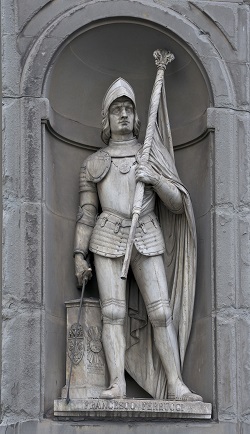
1530: Francesco Ferruccio, victim of Maramaldo

On this date in 1530, Francesco Ferruccio (or just Ferrucci) and his executioner Fabrizio Maramaldo clinched their immortality at the Battle of Gavinana.

The battle was the tragic final scene of the War of the League of Cognac, in which an alliance of Italian city-states tried to expel the Habsburg Holy Roman Emperor Charles V from the peninsula. Charles had already in effect decided matters by forcing the French out of the fight, which also brought about the capitulation of the Vatican.

Left alone in the fray, doughty Florence — ever so briefly at this moment restored as a Republic, having given the Medici the boot — continued to hold out against impossible odds. A vast imperial army swollen by landsknechts whose mercenary arms were now unnecessary elsewhere in Italy besieged Florence on October 24, 1529.


The Siege of Florence, by Tuscan Renaissance Man Giorgio Vasari.

The intrepid Florentine commander Francesco Ferruccio (English Wikipedia entry | Italian) strove to take his hopeless fight to the enemy. After a plan to coerce papal support by striking Rome was vetoed, Ferruccio mounted a march through the Apennines to threaten the Imperials’ rear.

He was intercepted at Gavinana, a battle decided by the arrival of landsknecht reinforcements under the command of the notoriously cruel condottiere Fabrizio Maramaldo.

Maramaldo would elevate himself for posterity out of the ranks of his merely brutal brethren by finding Ferruccio, badly wounded, his prisoner, and putting him to immediate death by his own hand — an execution that resulted in Florentine capitulation one week later, and the installation of Alessandro de’ Medici as Duke of the now ex-Republic.*

While admittedly borderline as an “execution” suitable for this here site, Ferruccio’s defiance in the face of his killer and his last denunciation of Maramaldo — “Coward, you kill a dead man!” — became the stuff of legend in a later Italy. (It also helped Ferruccio’s case for the nationalist pantheon that he died fighting against the Germans, not against the next city-state over.)

The romantic novelist Francesco Domenico Guerrazzi** made Ferruccio the subject of his magnum opus L’Assedio di Firenze, and before you knew it the name was on the lips of every risorgimento Tom, Dick and Francesco. Garibaldi invoked him in speech; Goffredo Mameli wrote him into the national anthem.


Every man has the heart
and hand of Ferruccio …

Under the Italian state those men helped to make, Ferruccio was appropriated as the name of a battleship; fascist Italy especially found Ferruccio congenial to the national-pride project and valorized the martyr relentlessly.


1930 Fascist Italy stamp depicting — for the 400th anniversary of the occasion — Fabrizio Maramaldo murdering his prisoner Francesco Ferruccio. Other Februccio stamps from the same period can be found on the man’s Italian Wikipedia page.

For Maramaldo, a less flattering but possibly more durable legacy: Italian gained the noun maramaldo, the adjective maramaldesco, and the verb maramaldeggiare to signify bullying or cruel domineering.

* Alessandro had a reputation for despotism, and was assassinated a few years later by his cousin Lorenzino de’ Medici in a tyrannicide that was Brutus-like in both its motivation and effect. That later affair is the subject of the 19th century play Lorenzaccio.

** Guerrazzi also did his bit for the legend of Beatrice Cenci.

On this day..