1616: “A gentellwoeman” by exposure, for a eunuch liaison

The English diplomat Sir Thomas Roe, envoy to the Mughal Empire from 1615 to 1619 during the reign of Jahangir, recorded in his journal* the unfortunate fate this date of a nameless woman for being caught rendezvousing with a palace eunuch.

This day a gentellwoeman of Normalls was taken in the kings house in some action with an Eunuch. Another Capon that loved her kylld him. The Poore Woeman was sett up to the Arme pitts in the Earth hard ramed, her feete tyde to a stake, to abyde 3 dayes and 2 nights without any sustenance, her head and armes bare, exposed to the sunns violence: if shee died not in that tyme she should bee pardoned. The Eunuch was Condemned to the Eliphantes. This damsell yeelded in Pearle, Jewelles, and ready mony 160,000 rupias.

That this bit character who does not even merit a name here left such a fortune surely testifies to the Mughal Empire’s famously astounding trade wealth.

Roe does not disclose how long the condemned woman managed to survive, but the separate memoir of Roe’s chaplain Edward Terry confirms that she succumbed to exposure well before the elapse of the pardonable three days. (The two seem to have received differing intelligence on the execution method of the eunuch, despite Terry’s indication that it transpired practically in the English mission’s backyard.)

Now for the disposition of that King, it ever seemed unto me to be composed of extremes; for sometimes he was barbarously cruel, and at other times he would seem to be exceedingly fair and gentle.

For his cruelties, he put one of his women to a miserable death; one of his women he had formerly touched and kept company with, but now she was superannuated; for neither himself nor nobles (as they say) come near their wives or women, after they exceed the age of thirty years. The fault of that woman was this; the Mogul upon a time found her and one of his eunuchs kissing one another; and for this very thing, the King presently gave command that a round hole should be made in the earth, and that her body should be put into that hole, where she should stnad with her head only above ground, and the earth to be put in again unto her close round about her, that so she might stand in the parching sun ’till the extreme hot beams thereof did kill her; in which torment she lived one whole day, and the night following, and almost ’till the next noon, crying out most lamentably, while she was able to speak, in her language, as the Shumanite’s child did in his, 2 King. 4. “Ah my head, my head!” which horrid execution, or rather murder, was acted near our house; where the eunuch, by the command of the said King, was brought very near the place where this poor creature was thus buried alive, and there in her sight cut all into pieces.

* Published as The embassy of Sir Thomas Roe to the court of the Great Mogul, 1615-1619, as narrated in his journal and correspondence. This vignette is from volume 1; there is also a volume 2

On this day..

1914?: K., in Kafka’s The Trial

This date, the second of July, would in 1914 have been the eve of the thirty-first birthday of Franz Kafka, so it seems a fit occasion — shall we call it the centennial? — to mark the death of the the character “Josef K.” in Kafka’s great novel The Trial. In this captivating work — it does not feel sufficient to call it a dystopia of the emerging bureaucratic state, although this story surely helped as much as any other to put the word Kafkaesque in the dictionary — K. has spent the whole novel since his arrest on his 30th birthday grappling with an absurd trial on charges he is never told and upon evidence he cannot know.

In the last, two insipid functionaries arrive at K.’s apartment to whisk him away to his death.

Historically, Kafka began this book in August 1914, a few weeks yet from our spurious dating. It was only published in 1925 — posthumously.


Chapter Ten: End

The evening before K.’s thirty-first birthday — it was about nine o’clock in the evening, the time when the streets were quiet — two men came to where he lived. In frock coats, pale and fat, wearing top hats that looked like they could not be taken off their heads. After some brief formalities at the door of the flat when they first arrived, the same formalities were repeated at greater length at K.’s door. He had not been notified they would be coming, but K. sat in a chair near the door, dressed in black as they were, and slowly put on new gloves which stretched tightly over his fingers and behaved as if he were expecting visitors. He immediately stood up and looked at the gentlemen inquisitively. “You’ve come for me then, have you?” he asked. The gentlemen nodded, one of them indicated the other with the top hand now in his hand. K. told them he had been expecting a different visitor. He went to the window and looked once more down at the dark street. Most of the windows on the other side of the street were also dark already, many of them had the curtains closed. In one of the windows on the same floor where there was a light on, two small children could be seen playing with each other inside a playpen, unable to move from where they were, reaching out for each other with their little hands. “Some ancient, unimportant actors — that’s what they’ve sent for me,” said K. to himself, and looked round once again to confirm this to himself. “They want to sort me out as cheaply as they can.” K. suddenly turned round to face the two men and asked, “What theatre do you play in?” “Theatre?” asked one of the gentlemen, turning to the other for assistance and pulling in the corners of his mouth. The other made a gesture like someone who was dumb, as if he were struggling with some organism causing him trouble. “You’re not properly prepared to answer questions,” said K. and went to fetch his hat.

As soon as they were on the stairs the gentlemen wanted to take K.’s arms, but K. said “Wait till we’re in the street, I’m not ill.” But they waited only until the front door before they took his arms in a way that K. had never experienced before. They kept their shoulders close behind his, did not turn their arms in but twisted them around the entire length of K.’s arms and took hold of his hands with a grasp that was formal, experienced and could not be resisted. K. was held stiff and upright between them, they formed now a single unit so that if any one of them had been knocked down all of them must have fallen. They formed a unit of the sort that normally can be formed only by matter that is lifeless.

Whenever they passed under a lamp K. tried to see his companions more clearly, as far as was possible when they were pressed so close together, as in the dim light of his room this had been hardly possible. “Maybe they’re tenors,” he thought as he saw their big double chins. The cleanliness of their faces disgusted him. He could see the hands that cleaned them, passing over the corners of their eyes, rubbing at their upper lips, scratching out the creases on those chins.

When K. noticed that, he stopped, which meant the others had to stop too; they were at the edge of an open square, devoid of people but decorated with flower beds. “Why did they send you, of all people!” he cried out, more a shout than a question. The two gentleman clearly knew no answer to give, they waited, their free arms hanging down, like nurses when the patient needs to rest. “I will go no further,” said K. as if to see what would happen. The gentlemen did not need to make any answer, it was enough that they did not loosen their grip on K. and tried to move him on, but K. resisted them. “I’ll soon have no need of much strength, I’ll use all of it now,” he thought. He thought of the flies that tear their legs off struggling to get free of the flypaper. “These gentleman will have some hard work to do”.

Just then, Miss Bürstner came up into the square in front of them from the steps leading from a small street at a lower level. It was not certain that it was her, although the similarity was, of course, great. But it did not matter to K. whether it was certainly her anyway, he just became suddenly aware that there was no point in his resistance. There would be nothing heroic about it if he resisted, if he now caused trouble for these gentlemen, if in defending himself he sought to enjoy his last glimmer of life. He started walking, which pleased the gentlemen and some of their pleasure conveyed itself to him. Now they permitted him to decide which direction they took, and he decided to take the direction that followed the young woman in front of them, not so much because he wanted to catch up with her, nor even because he wanted to keep her in sight for as long as possible, but only so that he would not forget the reproach she represented for him. “The only thing I can do now,” he said to himself, and his thought was confirmed by the equal length of his own steps with the steps of the two others, “the only thing I can do now is keep my common sense and do what’s needed right till the end. I always wanted to go at the world and try and do too much, and even to do it for something that was not too cheap. That was wrong of me. Should I now show them I learned nothing from facing trial for a year? Should I go out like someone stupid? Should I let anyone say, after I’m gone, that at the start of the proceedings I wanted to end them, and that now that they’ve ended I want to start them again? I don’t want anyone to say that. I’m grateful they sent these unspeaking, uncomprehending men to go with me on this journey, and that it’s been left up to me to say what’s necessary”.

Meanwhile, the young woman had turned off into a side street, but K. could do without her now and let his companions lead him. All three of them now, in complete agreement, went over a bridge in the light of the moon, the two gentlemen were willing to yield to each little movement made by K. as he moved slightly towards the edge and directed the group in that direction as a single unit. The moonlight glittered and quivered in the water, which divided itself around a small island covered in a densely-piled mass of foliage and trees and bushes. Beneath them, now invisible, there were gravel paths with comfortable benches where K. had stretched himself out on many summer’s days. “I didn’t actually want to stop here,” he said to his companions, shamed by their compliance with his wishes. Behind K.’s back one of them seemed to quietly criticise the other for the misunderstanding about stopping, and then they went on. The went on up through several streets where policemen were walking or standing here and there; some in the distance and then some very close. One of them with a bushy moustache, his hand on the grip of his sword, seemed to have some purpose in approaching the group, which was hardly unsuspicious. The two gentlemen stopped, the policeman seemed about to open his mouth, and then K. drove his group forcefully forward. Several times he looked back cautiously to see if the policeman was following; but when they had a corner between themselves and the policeman K. began to run, and the two gentlemen, despite being seriously short of breath, had to run with him.

In this way they quickly left the built up area and found themselves in the fields which, in this part of town, began almost without any transition zone. There was a quarry, empty and abandoned, near a building which was still like those in the city. Here the men stopped, perhaps because this had always been their destination or perhaps because they were too exhausted to run any further. Here they released their hold on K., who just waited in silence, and took their top hats off while they looked round the quarry and wiped the sweat off their brows with their handkerchiefs. The moonlight lay everywhere with the natural peace that is granted to no other light.

After exchanging a few courtesies about who was to carry out the next tasks — the gentlemen did not seem to have been allocated specific functions — one of them went to K. and took his coat, his waistcoat, and finally his shirt off him. K. made an involuntary shiver, at which the gentleman gave him a gentle, reassuring tap on the back. Then he carefully folded the things up as if they would still be needed, even if not in the near future. He did not want to expose K. to the chilly night air without moving though, so he took him under the arm and walked up and down with him a little way while the other gentleman looked round the quarry for a suitable place. When he had found it he made a sign and the other gentleman escorted him there. It was near the rockface, there was a stone lying there that had broken loose. The gentlemen sat K. down on the ground, leant him against the stone and settled his head down on the top of it. Despite all the effort they went to, and despite all the co-operation shown by K., his demeanour seemed very forced and hard to believe. So one of the gentlemen asked the other to grant him a short time while he put K. in position by himself, but even that did nothing to make it better. In the end they left K. in a position that was far from the best of the ones they had tried so far. Then one of the gentlemen opened his frock coat and from a sheath hanging on a belt stretched across his waistcoat he withdrew a long, thin, double-edged butcher’s knife which he held up in the light to test its sharpness. The repulsive courtesies began once again, one of them passed the knife over K. to the other, who then passed it back over K. to the first. K. now knew it would be his duty to take the knife as it passed from hand to hand above him and thrust it into himself. But he did not do it, instead he twisted his neck, which was still free, and looked around. He was not able to show his full worth, was not able to take all the work from the official bodies, he lacked the rest of the strength he needed and this final shortcoming was the fault of whoever had denied it to him. As he looked round, he saw the top floor of the building next to the quarry. He saw how a light flickered on and the two halves of a window opened out, somebody, made weak and thin by the height and the distance, leant suddenly far out from it and stretched his arms out even further. Who was that? A friend? A good person? Somebody who was taking part? Somebody who wanted to help? Was he alone? Was it everyone? Would anyone help? Were there objections that had been forgotten? There must have been some. The logic cannot be refuted, but someone who wants to live will not resist it. Where was the judge he’d never seen? Where was the high court he had never reached? He raised both hands and spread out all his fingers.

But the hands of one of the gentleman were laid on K.’s throat, while the other pushed the knife deep into his heart and twisted it there, twice. As his eyesight failed, K. saw the two gentlemen cheek by cheek, close in front of his face, watching the result. “Like a dog!” he said, it was as if the shame of it should outlive him.

The Trial can be enjoyed (if that’s the right word) in a public domain English translation here.

On this day..

1905: An unknown spy in the Russo-Japanese War

In the late 1890s and early 1900s, Russia’s imperial ambitions in the east drew it inexorably towards conflict with Japan. This was the period when Russia began constructing the continent-spanning Trans-Siberian Railway linking Moscow to the Pacific port of Vladivostok.

Russian troops came right along with the rails.

On the pretext of protecting its construction gangs, Russian troops occupied Manchuria — and the weakened Chinese Qing dynasy couldn’t do much about it.

But the Japanese could.

Manchuria and Korea (which Russia’s presence also threatened) Tokyo conceived as her sphere of influence. The rising hegemon in East Asia would serve notice in the 1904-1905 Russo-Japanese War that it had now to be reckoned among the world’s great powers.

The decisive land battle in this conflict was the Battle of Mukden, February 20 through March 10, 1905 — a gigantic engagement involving more than 600,000 troops.

In it, Japan cleaned the Russian clock.

The defeat sent a shattered Russian army on a disordered retreat north, to the city of Tieling. The Japanese followed in hot pursuit, so defensive regrouping became impossible and within a couple of days the Russians abandoned Tieling, too.

We are everywhere driving the Russians before us to Kaiyuan,” gloated an official Japanese telegram of Thursday, March 16.

The underwhelming Russian general Aleksey Kuropatkin was there just long enough to get word that Moscow had relieved him of command. By Saturday, March 18, Kaiyuan too was in Japanese hands.*

So it was likely on or about this date in 1905 that a handful of those Japanese forces harrying the Russian flight paused on the outskirts of Kaiyuan to behead an alleged spy.

If this individual’s name is known, I have not been able to locate it — but small wonder. In the charnel house of Russia’s catastrophic defeat, the dead were too numerous to bury.

After Mukden, there would not be many more. It was the last major land battle, and after Japan followed it up with a crushing naval victory that May, hostilities came to a close.


“On the Hills of Manchuria”, a mournful 1906 waltz by Ilya Shatrov.

* The pursuit didn’t last much longer; Japanese forces were themselves too battered and exhausted from the Battle of Mukden.

On this day..

c. 415 B.C.E.: The men of Melos

On an uncertain date in the winter of 416-415 B.C.E., the island of Melos surrendered to an Athenian siege during the ruinous Peloponnesian War.

Athens put all of Melos’s adult men to death, selling its women and children into slavery.

This ghastly event is covered by ThucydidesHistory. Thucydides’ account of the diplomatic negotiation between the mighty Athenians and the hopelessly outmuscled Melians is the subject of the Melian dialogue — a timeless classic of philosophy and statecraft.

The Athenians’ coldly realistic position — and their ultimate disposition of their conquest — is summed up in the wonderful epigraph, “the strong do what they will, and the weak suffer what they must.” (And numerous variations of this translation.)

As the reigning naval power, Athens (at war with a league led by its rival, the land power Sparta) had decided that an independent and neutral Melos would no longer be in the offing. The Melian dialogue pits Athens’ ultimatum to Melos to submit and save itself, against the Melians’ vain attempt to assert the justice of their cause; likewise, it is the dialogue of an imperial order against a holdover independent city-state from a fading era.

It’s a riveting read. The excerpts below are from this public-domain translation; there are others here and here.

Athenians: Well, then, we Athenians will use no flue words; we will not go out of our way to prove at length that we have a right to rule, because we overthrew the Persians; or that we attack you now because we are suffering any injury at your hands. We should not convince you if we did; nor must you expect to convince us by arguing that, although a colony of the Lacedaemonians, you have taken no part in their expeditions, or that you have never done us any wrong. But you and we should say what we really think, and aim only at what is possible, for we both alike know that into the discussion of human affairs the question of justice only enters where the pressure of necessity is equal, and that the powerful exact what they can, and the weak grant what they must.

Melians: Well, then, since you set aside justice and invite us to speak of expediency, in our judgment it is certainly expedient that you should respect a principle which is for the common good; and that to every man when in peril a reasonable claim should be accounted a claim of right, and any plea which he is disposed to urge, even if failing of the point a little, should help his cause. Your interest in this principle is quite as great as ours, inasmuch as you, if you fall, will incur the heaviest vengeance, and will be the most terrible example to mankind.

Athenians: The fall of our empire, if it should fall, is not an event to which we look forward with dismay; for ruling states such as Lacedaemon are not cruel to their vanquished enemies. And we are fighting not so much against the Lacedaemonians, as against our own subjects who may some day rise up and overcome their former masters. But this is a danger which you may leave to us. And we will now endeavour to show that we have come in the interests of our empire, and that in what we are about to say we are only seeking the preservation of your city. For we want to make you ours with the least trouble to ourselves, and it is for the interests of us both that you should not be destroyed.

Melians: It may be your interest to be our masters, but how can it be ours to be your slaves?

Athenians: To you the gain will be that by submission you will avert the worst; and we shall be all the richer for your preservation.

Melians: But must we be your enemies? Will you not receive us as friends if we are neutral and remain at peace with you?

Athenians: No, your enmity is not half so mischievous to us as your friendship; for the one is in the eyes of our subjects an argument of our power, the other of our weakness.

Over and over the Melian envoy is dismayed by his visitors’ indifference to the moral high ground. Frustrated of any concession, he resolves his embattled city to embark upon the remote hope of resistance in preference to voluntary servitude — leading the Athenians to part with this chilly sentiment:

You told us that the safety of your city would be your first care, but we remark that, in this long discussion, not a word has been uttered by you which would give a reasonable man expectation of deliverance. Your strongest grounds are hopes deferred, and what power you have is not to be compared with that which is already arrayed against you. Unless after we have withdrawn you mean to come, as even now you may, to a wiser conclusion, you are showing a great want of sense. For surely you cannot dream of flying to that false sense of honour which has been the ruin of so many when danger and dishonour were staring them in the face. Many men with their eyes still open to the consequences have found the word honour too much for them, and have suffered a mere name to lure them on, until it has drawn down upon them real and irretrievable calamities; through their own folly they have incurred a worse dishonour than fortune would have inflicted upon them. If you are wise you will not run this risk; you ought to see that there can be no disgrace in yielding to a great city which invites you to become her ally on reasonable terms, keeping your own land, and merely paying tribute; and that you will certainly gain no honour if, having to choose between two alternatives, safety and war, you obstinately prefer the worse. To maintain our rights against equals, to be politic with superiors, and to be moderate towards inferiors is the path of safety. Reflect once more when we have withdrawn, and say to yourselves over and over again that you are deliberating about your one and only country, which may be saved or may be destroyed by a single decision,

Athens wasn’t kidding.

Finding no traction with the Melian delegation, the greater power immediately besieged Melos. Thucydides recounts the Melians’ subsequent fate:

So the summer ended.

In the following winter the Lacedaemonians had intended to make an expedition into the Argive territory, but finding that the sacrifices which they offered at the frontier were unfavourable they returned home … About the same time the Melians took another part of the Athenian wall; for the fortifications were insufficiently guarded. Whereupon the Athenians sent fresh troops, under the command of Philocrates the son of Demeas. The place was now closely invested, and there was treachery among the citizens themselves. So the Melians were induced to surrender at discretion. The Athenians thereupon put to death all who were of military age, and made slaves of the women and children. They then colonised the island, sending thither 500 settlers of their own.


On top of everything else, the Athenian sack put an end to the production of Melian reliefs. (The island still had the glory of the Venus de Milo to look forward to, however.)

If there was a consolation for the scattered remains of the ruined Melian polis, it was that Athens’ cruel imperial hubris led it just months later to launch a catastrophic invasion of Sicily.

That defeat helped turn the Peloponnesian War decisively against Athens. Just eleven years after overrunning Melos, haughty Athens itself surrendered to a Spartan siege.

Thucydides, an exiled former Athenian general, deploys the classical dialogue form to great effect; his own perspective on the various arguments advanced in the Melian debate is difficult to discern with confidence. Clearly, however, it’s a topic of great interest to Thucydides, as his account dwells repeatedly on the conundrums touching justice and international relations: he’s one of the first intellectuals to explore what’s now thought of as the “realist” view of foreign policy. Compare the Melian Dialogue, for instance, to the Athenian demos‘s Mytilenian Debate; or, to the Plataean speech making a Melos-like appeal to the powerful Spartans.* And in one early passage, private Athenians appeal to Sparta and Corinth not to commence on war against the hegemony of Athens with words similar to those later used at Melos: “It has always been a rule that the weak should be subject to the strong; and besides, we consider that we are worthy of our power. Up till the present moment you, too, used to think that we were; but now, after calculating your own interest, you are beginning to talk in terms of right and wrong. Considerations of this kind have never yet turned people aside from the opportunities of aggrandizement offered by superior strength.”

At any rate, Thucydides’ proud city-empire would never recover from the inglorious fall inflicted by this war. The result was a fourth-century power vacuum which the Macedonia of Philip II and Alexander the Great eventually rose to fill.

* Thucydides also reports the Athenians hoisted by their own realpolitik when, in the Sicilian invasion, they attempt to appeal to Camarina for support. That city spurns the appeal, fearing subjugation should expansionist Athens prevail, and the revenge of their overwhelmingly powerful neighbor Syracuse otherwise.

On this day..

1943: “Native parachutists” in Morocco

LONDON, Jan. 4 (U.P.) — The Morocco radio tonight quoted an announcement from General Henri Honore Giraud’s headquarters that an unspecified number of “native” parachutists, dropped in North Africa from German planes, had been executed for trying to swing local populations to the Axis cause. [Vichy North Africa had only recently gone over to the Allies -ed.]

The “fifth column” chutists found “only rare complicity,” the announcement said.

“The natives and their accomplices have all been arrested and executed immediately after court-martial,” it continued. “Military authorities contributed efficiently to the arrest of these enemy agents.

“Large rewards have been distributed to all those who helped capture the culprits.”

(Source: New York Times, Jan. 5, 1943.)

On this day..

1941: The massacre at Skede in Liepaja

The World War II occupation of the Latvian town of Liepaja (Libau, to the Germans) produced mass executions throughout 1941.

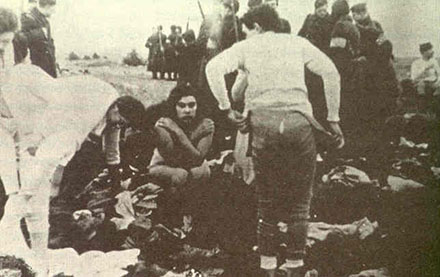
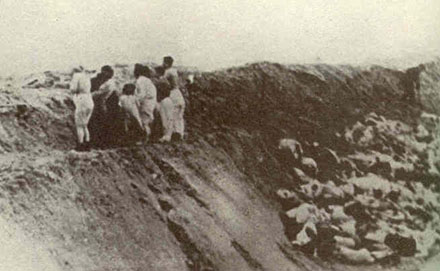
This date in 1941 commenced one of the largest such actions: over 2,700 Jews as well as 23 Communists forced over the course of two-plus days to strip on the freezing Skede dunes overlooking the Baltic and there shot by German and Latvian teams into a vast pit. It’s one of the most recognizable Holocaust atrocities because it was extensively photographed.*

As one can see from the pictures, the victims here were mostly women.


Some of the women in this photographs can be identified by name (pdf). Left to right: (1) Sorella Epstein; (2) presumably Rosa Epstein, her mother; (3) unknown; (4) Mia Epstein; (5) unknown. Alternate identification makes Mia Epstein (5) instead of (4), and (2) Pauline Goldman.

Almost all of Liepaja’s Jews perished during the war.

* Germany’s Bundesarchiv (search on Libau 1941) confirms the precise December 15 dating for these images; it also has some other photographs of atrocities in Liepaja/Libau on other occasions.

On this day..

1904: Herero prisoners, at the command of Lothar von Trotha

My initial plan for the operation, which I always adhered to, was to encircle the masses of Hereros at Waterberg, and to annihilate these masses with a simultaneous blow, then to establish various stations to hunt down and disarm the splinter groups who escaped, later to lay hands on the captains by putting prize money on their heads and finally to sentence them to death.

-German General Lothar von Trotha (pdf source)

On this date in 1904, von Trotha did a little of that executing bit, further to doing a whole lot of genocide. It was the very day after von Trotha’s Vernichtungsbefehl, or extermination order, against the Herero people.

We give the narrative here to Jan-Bart Gewald’s “Colonization, Genocide and Resurgence: The Herero of Namibia 1890-1933”, from a collection of papers at a German symposium. Gewald’s complete text is available in scanned pdf form here.

Gewald:


Pocketed by the desert and the German patrols the Herero chiefs and their followers congregated along the Eiseb river. Around the first of October 1904, General Lothar von Trotha, who was actively taking part in the pursuit, and his retinue had reached the waterhole Osombo-Windimbe. During the afternoon of the following day, Sunday 2 October 1904, after the holding of a field service, General von Trotha, addressed his officers. In his address Trotha declared that the war against the Herero would be continued in all earnestness, and read out the following proclamation:

I the great General of the German troops send this letter to the Herero people.

The Herero are no longer German subjects. They have murdered and stolen, they have cut off the ears, noses and other bodyparts of wounded soldiers, now out of cowardice they no longer wish to fight. I say to the people anyone who delivers a captain will receive 1000 Mark, whoever delivers Samuel will receive 5000 Mark. The Herero people must however leave the land. If the populace does not do this I will force them with the Groot Rohr [cannon]. Within the German borders everyHerero, with or without a gun, with or without cattle, will be shot. I will no longer accept women and children, I will drive them back to their people or I will let them be shot at.* These are my words to the Herero people.

The great General of the mighty German Kaiser.

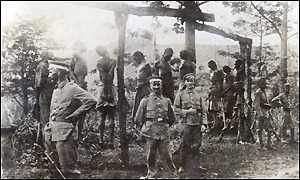
At dawn the following morning, Herero prisoners, who had been sentenced to death by a field court-martial, were hung in the presence of about 30 Herero prisoners, women and children amongst them. After the hanging, Trotha’s proclamation was read out to the prisoners in Otjiherero. Printed copies of the text in Otjiherero were distributed amongst the Herero prisoners. The prisoners were then turned loose and driven out into the Omaheke. [i.e., the western Kalahari desert -ed.]


In a letter the next day, Oct. 4, to the general staff, von Trotha reported on his order the day’s executions, in the context of a detailed tactical and philosophical justification of destroying the entire Herero nation. It’s quoted at length in Absolute Destruction: Military Culture and the Practices of War in Imperial Germany:

For me, it is merely a question of how to end the war with the Herero. My opinion is completely opposite to that of the governor and some “old Africans.” They have wanted to negotiate for a long time and describe the Herero nation as a necessary labor force for the future use of the colony. I am of an entirely different opinion. I believe that the nation mustbe destroyed as such, or since this was not possible using tactical blows, it must be expelled from the land operatively …

Because I neither can treat with these people, nor do I want to, without the express direction of His Majesty, a certain rigorous treatment of all parts of the nation is absolutely necessary, a treatment that I have for the present taken and executed on my own responsibility, and from which, as long as I have command, I shall not detour without a direct order. My detailed knowledge of many Central African tribes, Bantu and others, has taught me the convincing certainty that Negroes never submit to a contract but only to raw force. Yesterday before my departure, I had the warriors who were captured in the last several days [and who were] condemned by court-martial, hanged, and I have chased all the women and children who had gathered here back into the desert, taking with them the proclamation to the Herero people. This proclamation (enclosed), which will unavoidably bcome known, will be attacked … accepting women and children, who are mostly ill, is an eminent danger to the troops, and taking care of them is impossible. Therefore, I think it better that the nation perish rather than infect our troops and affect our water and food. In addition, the Herero would interpret any kindness on my side as weakness.They must now die in the desert or try to cross the Bechuanaland border. This uprising is and remains he beginning of a race war, which I already predicted in 1897 in my reports to the chancellor on East Africa … Whether this uprising was caused by poor treatment [of the Africans] remains irrelevant to its suppression.


It should be added that this explicitly genocidal policy was neither unique to German colonies, nor, as von Trotha himself notes, uncontested within Germany itself.

German Christian missionaries logged a piteous catalog of horrors, “skeletons with hollow eyes, powerless and hopeless,” and their reports of same to their home offices led to church pressure to brake the atrocities.

Gewald also quotes one of von Trotha’s subalterns, undisguisedly revolted at what he was involved in.

Cattle which had died of thirst lay scattered around the wells. These cattle had reached the wells but there had not been enough time to water them. The Herero led ahead of us into the Sandveld. Again and again this terrible scene kept repeating itself … the water became ever sparser, and wells evermore rare. They fled from one well to the next and lost virtually all their cattle and a large number of their people. The people shrunk into small remnants who continually fell into our hands, sections of the people escaped now and later throug the Sandveld into English territory. It was a policy which was equally gruesome as senseless, to hammer the people so much, we could have still saved many of them and their rich herds, if we had pardoned and taken them up again, they had been punished enough. I suggested this to General von Trotha but he wanted their total extermination.

Technically, complete destruction of the Herero was reversed as German policy a few months after von Trotha began implementing it, and the general himself recalled from South West Africa before the end of 1905 — leaving only a “softer” genocide of disease-ridden concentration camps through 1908. Although firm numbers are hard to come by, it’s thought that well over half the Herero population died during this period.

Yet neither was von Trotha a lone butcher. Diary entries of settlers and regular soldiers well before the extermination order record many instances (pdf) of the most cavalier slaying of Herero prisoners and noncombatants, abuses which continued long after von Trotha’s departure.

It’s difficult not to see in the racial ideology and the eliminationist military doctrine prefiguring (pdf) later and better-publicized brutalities. Indeed, even some of the personnel are the same:

  • Hermann Goering‘s father Heinrich was Germany’s first Reichskommissar in South West Africa, plopping his home down right on a Herero burial site.
  • Eugen Fischer, a eugenicist who availed the Namibian concentration camps’ ready supply of subjects to produce career-making research that would influence German race law and make Fischer a big brain in Nazi intellectual circles
  • Franz Ritter von Epp, one of von Trotha’s officers, formed in the aftermath of World War I one of the far-right Freikorps paramilitaries, with many subsequently-influential Nazis among its membership, including Ernst Roehm (who may have cribbed the SA “brown shirt” look from colonial Schutztruppe khakis) and Adolf Hitler himself

* He meant, shooting over their heads to run them off. “I assume absolutely that this proclamation will result in taking no more male prisoners, but will not degenerate into atrocities against women and children,” Lothar explained. “The latter will run away if one shoots at them a couple of times. The troops will remain conscious of the good reputation of the German soldier.”

On this day..

1480: The Martyrs of Otranto

On this date in 1480, Ottomans invading Otranto, Italy conducted a mass execution of prisoners.

Landing at the southern Italian city on July 28, the Ottoman force quickly overwhelmed Otranto. (Otranto rashly slew the messenger come to offer a merciful capitulation, only to find that its garrison began deserting within days.) On August 11, the Turks took the city by storm. Thousands died on that day’s bloodbath, including the Archbishop of Otranto.

Surviving women and children were sold into slavery. Men over age 15 had the choice of conversion — or death.

“Now it is time for us to fight to save our souls for the Lord!” a Christian shoemaker is said to have exhorted his 800 fellow prisoners. “And since he died on the cross for us, it is fitting that we should die for him.”

The acclaim greeting this call signaled inflammation ahead for the Turkish headsmen’s rotator cuffs. They had 800 faithful souls to dispatch to their eternal reward this date at the place still known as the Hill of Martyrs. (When in Otranto, visit it by taking the via Ottocento Martiri, just off via Antonio Primaldo — that’s the name of the militant shoemaker.)


The remains of the Otranto martyrs, arrayed as relics in the Otranto cathedral. (cc) image from Laurent Massoptier.

Historical novel set during these vents.

This, at least, is the most pious version of the story. The mass execution certainly did occur, but some latter-day historians like Francesco Tateo have argued that martyrdom is not attested by any of the contemporaneous sources, and the specifically religious understanding of events was only read in after the fact.

On whatever grounds one likes, Italy’s fractious city-states were deeply alarmed by the appearance on their shores of the all-conquering Turks. “It will always seem as if the funeral cross is borne before me while these barbarians remain in the boundaries of Italy,” wrote the Florentine humanist Poliziano.* (Source, a nonfiction book which covers Otranto in some detail.)

In the ensuing months, they rallied together vowing to expel the invaders.

Fortunately for this coalition, the Ottoman sultan Mehmed the Conqueror died in May 1481, and a brief period of internal conflict within the Ottoman empire over the succession perhaps led it to allow its Otranto outpost to wither on the vine. The Turks made peace and withdrew from their potential beachhead not long after, having held the city for just over a year. The bodies of the martyrs were said to have been found uncorrupted by decay.

The Catholic church beatified the 800 martyrs in 1771, but their final elevation to sainthood occurred only in 2013, just three months ago as I write this. They were in the very first group canonized by the new Pope Francis — although the canonization was approved by his predecessor Benedict XVI on the same day that Benedict resigned his pontificate. Considering current relations between the respective faiths, it was seen as a potentially impolitic move.

“By venerating the martyrs of Otranto, we ask God to protect the many Christians who in these times, and in many parts of the world, are still victims of violence,” Pope Francis said at the canonization Mass, diplomatically not naming any of those parts of the world.

* At the same time, Florence (in common with other Italian polities) had trade and diplomatic relations with the Ottomans.

On this day..

1917: “John Nelson”, mystery man


(Salt Lake (Utah) Telegram, Dec. 31, 1916)

On this date in 1917, someone was electrocuted in Rockview, Pennsylvania.

“John Nelson”, the cipher alias by which authorities were eventually content to call him, was 5′ 8″ tall and 165 pounds, and looked like an African-American. (“Nelson” himself said that neither white men nor black were of his race.) Papers put this about quizzically because he was also utterly steadfast in refusing to identify himself or his background.

He eventually allowed that he came from Canton, Ohio (but who knows if that’s true). “He reads Shakespeare and seeks high grade newspapers and magazines,” ran news-of-the-weird wire copy all around the country. He boasts “long hair which bears the appearance of having been done up in kids to give a ‘Sis Hopkins’* effect” as well as “long gray whiskers, sideburns and a heavy mustache.” He looked maybe 60 years old.

Anyone?

Aw, heck.


The Scranton Times sent 5,000 of these postcards around the country hoping to scare up information about their mysterious murderer.

Tips poured in from all over — but nothing definitive. An upstate New York sheriff reported discharging a guy named John Nelson from jail a couple of years before. A woman in Butte, Montana recognized the picture and thought it might be her vanished father. The prisoner also resembled a missionary from Ohio and a bank president from Richmond, Va., also both missing; a Scranton woman thought he maybe used to be her gardener. (All but the last of these indefinite tips via Cheryl Kashuba’s two-part series on this case in the March 17 and March 24, 2013, issues of the Scranton Times-Tribune.)

Although nobody could figure out who he was, everyone was pretty sure what he’d done.

On the evening of Oct. 30, 1915, he’d trudged into Mill City, a Wyoming County township outside of Scranton, and made an unexplained sudden attack on three men lolling about a barbershop porch.

According to those three men’s story — and they’re all we have to work with since Nelson kept mum on this, too — a little white boy running down the darkened street bumped into the mystery pedestrian. At that, “Nelson” suddenly produced a knife and charged at the trio of nearby men, bellowing “White people in a tank town like this can’t run over me!”

J.M. Sickler, a prosperous local farmer, bravely intercepted the attacker before he reached Judge Robert Westlake, and suffered mortal stab wounds for his trouble. The attacker fled, but other locals roused by the commotion overpowered him as he escaped; Sickler lived long enough to give a deathbed positive identification.

Of course, it wasn’t really “positive” — that’s the whole point. And “John Nelson”, whoever he might have been, kept his nose in his Shakespeare and his lips enigmatically sealed on the crime and its causes; on his background and biography; on everything whatsoever. “I just wouldn’t care to talk about that,” he would reply when questioned, or similar versions of that polite deflection.

He kept his queer peace all the way to the electric chair.

* Maybe Mr. “Nelson” was just taking Sis Hopkins’ good advice: “There ain’t no sense in doin’ nothin’ for nobody what won’t do nothin’ for you.” As Nelson blithely put it (and who could contradict him?) any name at all would do for his circumstances.

On this day..

1780: Colonel Hamilton Ballendine, if that was his real name

According to some newspaper accounts deemed credible enough by almanacs and registers of the time, a British officer named Hamilton Ballendine was hanged by the Americans during the Siege of Charleston. The good colonel had thought he was approaching his own British sentries after a reconnoiter of Charleston’s defenses, and when hailed he provided this name.

His name, or his alias, or his password — whatever it was, it was not recognized by the sentries, who turned out in fact to be the colonial pickets. At that point, he was a spy caught red-handed, and these folks tended to get short shrift during the American Revolution.

This event has struck some observers as conspicuous by its absence from any of the numerous firsthand diarists’ accounts within the besieged city. The account in this footnote, recopied in its entirety below, appears to be the sum of the information on the matter. Judge accordingly, gentle reader.


In the Siege of Charlestown (Munsell), 68, we find the following: —

EXECUTION OF COLONEL HAMILTON BALLENDINE.

(From Dunlop’s Packet of April, 1780.)

WILLIAMSBURG IN VIRGINIA, APRIL 18.

On the 5th Ult. was hanged at Charlestown, South Carolina, Colonel Hamilton Ballendine, for drawing Draughts of the town and Fortifications. He was taken by a Picquet Guard, which General Lincoln sent out that Night to Stono, as he was making his Way to the enemy; and when he was hailed by the Guard his Answer was, ‘Colonel Hamilton Ballendine.’ The Guard told him that would not do, and carried him to the commander of the Picquet, upon which he pulled out of his pocket the Draughts. The Officer told him he was mistaken, and carried him to General Lincoln, who ordered him for Execution.” —New York Royal Gazette, April 16.

See, also, Moore’s Diary of the Revolution, vol. II, 260. The story is also incorporated in the text of the Annual Register for 1780 (London), vol. XXIII, 222, in which it is said that Ballendine suffered “the unpitied death of a traitor.” Both Simms (So. Ca. in the Revolutionary War, 177) and Draper (King’s Mountain and its Heroes, 22, note) call attention to the fact that the story is mentioned by none of the South Carolina historians, nor any of the Charlestown diarists or letter writers. Draper seems to doubt if there was any such person. In the So. Ca. and Am. Gen. Gazette, June 9, 1775, Hamilton Ballentine advertises a power of attorney to receive a legacy due and collect the assets of an estate. There was therefore doubtless such a person, but what became of him is not further known. His name is not on the list of those whose estates were confiscated (Statutes of So. Ca., vol. VI), where it probably would be found had the story been true. It is scarcely possible that such an event would have been overlooked by all the writers and diarists of the time, and not have been preserved by local tradition; and yet the particularity of the statement, and its acceptance by the Annual Register at the time, would suggest that there must have been some foundation for the statement.

On this day..