1927: Father Miguel Pro, “Viva Cristo Rey!”

On this date in 1927, the anti-clerical Mexican government made the emblematic martyr of the Cristero War.

This video is in Spanish, but the storyline is pretty easy to follow — young man finds faith, lives faith, dies faith.

Miguel Pro‘s dying cry, “Viva Cristo Rey!” — “Long live Christ the King!” — was a refrain of Cristeros, anti-government guerrillas who in the late 1920’s fought the revolutionary Mexican government’s attempts to forcibly restrict the power of the Catholic Church.

That conflict had been brewing for years, an outgrowth of Mexico’s own complex history of colonization and development — measures to restrict the church’s size, wealth, and social reach had been mooted and sometimes implemented well back to the middle of the 19th century.

Early in the 20th, the confrontation was merely a twist on its classic form: liberal state-builders and the Catholic hierarchy were (or increasingly saw themselves as) diametrically opposed in their vision for Mexico.

That conflict came to a head under president Plutarco Elias Calles, an irreligious northerner with a project of national capital development for whom the church’s intransigence from its agrarian strongholds was most unwelcome … and who seemed to delight in provoking Rome with sport like mandatory physicals for priests, not neglecting to publicize the incidence of venereal disease thereby revealed.

Liberals had already brought about drastically reduced clerical privileges in the Mexican Constitution of 1917; its somewhat draconian measures were neither fully enforced nor fully resisted, but initiated a period where the two hostile institutions rudely grappled for their respective spheres of influence on the ground.

Calles was the rudest grappler of all, and his 1926 Calles Law pushed for anti-clericalism stricter than the letter of the constitution … and sparked armed resistance.

It was an exceptionally dirty war with routine summary executions on both sides and thousands of Catholic refugees — a dangerous environment for any priest with legal sanctions against basically every practice of the vocation. (Photos of Cristeros, some in heroic resistance and others in grisly martyrdom, can be eyeballed here.)

Pro, a Jesuit who like many was forced underground, was under state surveillance and got picked up in the aftermath of an assassination attempt against a prominent politician. He was chosen to make an example of — without an actual trial, possibly because there’s no actual reason to think he was involved in the bombing.

Looking at these pictures of Pro’s last moments, it’s hard to believe that they were taken and circulated at government direction to cow the Cristero movement. Fail.


Led out to execution in a police courtyard. The place of his death today is (bizarrely) Calle Loteria Nacional.


Calmly at prayer before his death, under the eye of the firing squad commander.


Pro himself refused a blindfold. But why state authorities carrying out the execution with an eye towards public relations would allow him to die in this pose is anyone’s guess.
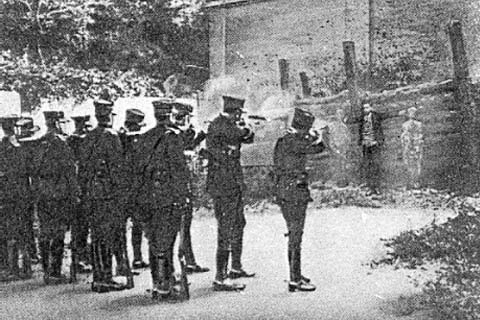

He blessed and forgave the firing squad, of course.


Just beginning to topple at the moment the bullets struck him.


Like many firing squad executions, this one failed to kill its victim with the ceremonial volley. Pro was finished off with a coup de grace.

Calles was simultaneously — the key measures were also enacted in 1926 — involved in a confrontation with the United States over oil rights, a situation that came to the brink of war, with Washington saber-rattling about “Soviet Mexico”. It’s tempting to wonder whether the two situations weren’t related, especially since the new American ambassador* who had arrived only the month before Pro’s execution would ultimately negotiate both situations’ resolutions.

While the natural resource politics went their separate way, the Mexican Revolution’s anti-clerical strain didn’t so much disappear by negotiation as fade away over decades, with regular new outbreaks.

One thinks of Mexico today as such so staunch a Catholic country that it’s hard to imagine that some of these provisions were only officially repealed in 1998.

As for Pro, he’s welcome in Mexico by now — celebrated by Pope John Paul II who ultimately beatified him, and the inspirational source of this hymn whose refrain is his famous last cry.

There’s a faithful site in his honor here, and apparently a shrine to him in Houston, Texas run by a group pushing for his canonization.

* The American ambassador in question, Dwight Morrow, invited Charles Lindbergh on a goodwill tour to Mexico, where the aviator would meet the diplomat’s daughter not long after Miguel Pro’s martyrdom. Little could Lindbergh and Anne Morrow suspect that their love match would set them on the path to their own famous encounter with capital punishment.

On this day..

1538: John Lambert, “none but Christ”

On this date 470 years ago, John Lambert was burned to death at London’s Smithfield market for heresy.

One possible way to read the early progress of the English Reformation is as an initial flowering of Protestantism followed — after the execution of Anne Boleyn — by a reactionary crackdown by the monarch.

In this telling, John Lambert (born John Nicolson or Nicholson) marks the turning point, the man in whose blood Henry VIII etched his warning against doctrinal liberality.

John Lambert cooked his goose by picking a theological dispute with a pastor in London. He didn’t buy into transubstantiation, the Catholic doctrine (still extant today) that the bread blessed on the altar became the literal body of Christ.

Though the Anglican church would ditch this belief soon thereafter, it came down hard on Lambert in a show trial attended by Thomas Cromwell, Thomas Cranmer, and all the Tudor big wheels whose heads were at that point attached to their shoulders.

The king himself — who here reminds one of the the stout defense of the sacraments that in his early Catholic period had earned him the papal honorific “defender of the faith” — debated theology with the accused, though mostly he left it to his august councilors.


John Lambert disputing before Henry VIII. Early 19th c. illustration.

But the crowned head made his doctrine as plain to the audience as the consequences of crossing it.

The pro-Lambert account from which this extract is drawn is available free on Google books:

At length [Lambert] was worn out with fatigue, having been kept five hours standing …

Night coming on, the King being desirous to break up this pretended disputation, said to Lambert, “What sayest thou now, after all this pains taken with thee, and all the reasons and instructions of these learned men? Art thou not yet satisfied? Wilt thou live or die? What sayest thou? Thou has yet free choice.” Lambert answered, “I yield and submit myself wholly unto the will of your Majesty.” Then said the King, “Commit thyself into the hands of God, and not unto mine.” Lambert replied, “I commend my soul unto the hands of God, but my body I wholly yield and submit unto your clemency.” Then said the King, “If you do commit yourself unto my judgment, you must die, for I will not be a Patron unto heretics.” And then turning to Lord Cromwell he said, “Cromwell, read the sentence of condemnation against him:” which was accordingly done.

A few months later, Henry induced Parliament to pass the Act of the Six Articles, essentially establishing Catholic doctrine — sans Pope, obviously — as the basis for the Church of England and criminalizing dissent.

What to make of this trial and the policy it represented is open to dispute. In a simple telling, Henry realizes his Reformation is running away from him, or becomes wise to discomfiting reforms that Cranmer or Cromwell are pushing. Too, the ebb and flow of Henry’s “Reformation” has sometimes been seen as a product of the shifting balance between reformers and conservatives advising the crown; Protestant martyrologist John Foxe favored this approach since it enabled him to celebrate a John Lambert without indicting the monarch by blaming advisors.

Lambert’s death is also sometimes interpreted in light of the international situation, as the Catholic powers of France and the Holy Roman Empire had made peace, potentially (along with Scotland) encircling England with Popish foes who might conceivably be less belligerent with a move towards traditional doctrine.*

But maybe that’s all a good deal more explanation than is needed for the old defender of the faith. G.W. Bernard’s consideration of The King’s Reformation argues that Lambert isn’t so pivotal after all:

[H]istorians who see … the trial of Lambert as some sort of turning point are greatly mistaken. There was absolutely nothing new in Henry’s policy in November 1538. Ever since radical — Zwinglian — notions on the mass had come to influence some within England, Henry had reacted firmly and boldly. This was not something that only came late in the 1530s, when he supposedly woke up to what Cromwell and Cranmer had been doing in his name but without his knowledge. It was there from the start. As early as March 1535 a proclamation fiercely denounced strangers who had presumptuously rebaptised themselves and who denied that the blessed and most holy sacrament of the altar was really the body of Christ. If there was a novelty in autumn 1538, it was the perception that such heresies were spreading through the realm and that heretics with a high profile, such as Lambert, needed to be dealt with publicly so that others might learn from their unhappy example. … Henry surely blasted against sacramentarians for the straightforward reason that he sincerely believed them to be wicked.

As for Lambert himself, he met an especially cruel version of the none-too-pleasant sentence of burning alive, allegedly being lifted by pikestaffs from the flame when his legs were burned off to prolong his suffering. He is said to have continued to call out the inspirational last words, “None but Christ! None but Christ!”

* It was against this alliance that Cromwell would arrange the king’s ill-fated marriage to German princess Anne of Cleves, a debacle that helped Cromwell lose his own head.

On this day..

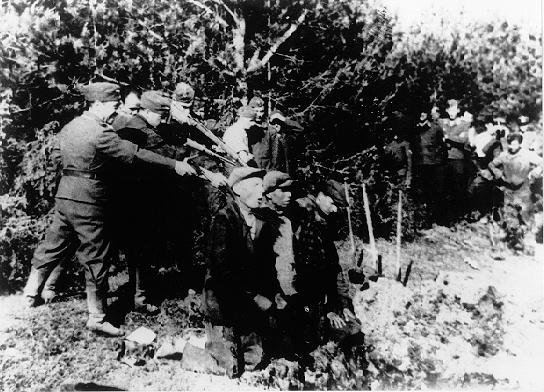
1942: Partisans by the Sonderbataillon Dirlewanger

On an uncertain date in November 1942, this photograph of an SS unit executing anti-Nazi partisans in Belarus was taken.

Behind this striking but all too typical image of brutal field executions on the eastern front lies the sordid story of one of the strangest military formations in the Nazi service.

The Dirlewanger brigade was formed under a man whose fortuitous early enrollment in the NSDAP had enabled him to pull strings to get himself out of Dachau, where he had been sent after his second molestation conviction, and where unfolding events could have easily seen him on the other end of the firing squad.

Instead, Oskar Dirlewanger formed a unit of criminals and reprobates: poachers at first, and eventually, as it grew into the SS-Sonderbatallion Dirlewanger, men culled from the camps or soldiers condemned by the army, some literally trading the likelihood of execution themselves for service under one of the most disreputable commanders in the field.

Oh, and, just incidentally — it stuck them into a lawless environment where they could probably practice and refine their pathologies unchecked. Some “rehabilitation.”

As of this relatively early date, the convict floodgates weren’t yet entirely open, and the existing German volunteers were supplemented by a goodly portion of Soviet citizens recruited in the occupied territories. From 1942 to 1944, they hung around Belarus hunting guerrillas and doing to them — well, you know. (The original notion of using poachers was to exploit their ranger-like woodsman talents for anti-partisan warfare.)

Oh, and civilians. Tens of thousands of civilians. That almost goes without saying.

Sadly for Dr. Dirlewanger, events further south were undoing all his bloody work, for it was also in the November 1942 that the Red Army decisively turned the tide of the war with its counterattack at Stalingrad — in fact, it was this very date in 1942 that it completed its encirclement, stranding a quarter-million freezing Wehrmacht regulars on the banks of the Volga, only a handful ever to see Germany again.

The Dirlewanger brigade would have its own turn being minced by the Soviet war machine, though not before it had a notorious hand in drowning the Warsaw Uprising in blood.

Dirlewanger himself was tortured to death by Polish guards a few weeks after the war ended.

Part of the Themed Set: The “Ex” Stands For “Extrajudicial”.

On this day..

284: Aper, by Diocletian

On this date* in 284, one of Rome’s greatest emperors claimed the purple by summarily executing his rival before the approving army in Anatolia.

The Emperor Diocletian christened his reign with a bit of scaffold theatricality, but he might have been the real perp.

For half a century, the Roman Empire had waded through crisis. In its political manifestation, a parade of forgettable emperors had marched through the throne room, each to be assassinated, overthrown, or otherwise disposed of by some equally forgettable aspirant en route to a similarly unenviable end.

At length, out of this unpropitious bunch, rose one Diocles, a low-born Dalmatian of classical education whose martial gifts saw him rise through the legions. His opportunity came when the emperor Carus, barely a year on from succeeding his assassinated predecessor, died on campaign against Persia allegedly struck by lightning (quite possibly a euphemism for something more dagger-like), leaving his son Numerian in charge.

As the army meandered back to the friendly confines, Numerian secluded himself in his litter. And after a while, the litter started to stink.

Sometime on the journey, he’d been secretly killed — but by whom?

The principals this day are our leading suspects. (And it’s a little mystifying in either case just what was gained by leaving the body hidden so long.) We turn to Gibbon to narrate what must have been a riveting — not to mention definitive — proceeding adjudicating between them a few kilometers past Nicomedia (moder Izmit, Turkey) towards Chalcedon (now the Kadikoy district of Istanbul).

A general assembly of the army was appointed to be held at Chalcedon, whither Aper was transported in chains, as a prisoner and a criminal. A vacant tribunal was erected in the midst of the camp, and the generals and tribunes formed a great military council. They soon announced to the multitude that their choice had fallen on Diocletian, commander of the domestics or body-guards, as the person the most capable of revenging and succeeding their beloved emperor. The future fortunes of the candidate depended on the chance or conduct of the present hour. Conscious that the station which he had filled exposed him to some suspicions, Diocletian ascended the tribunal, and raising his eyes towards the Sun, made a solemn profession of his own innocence, in the presence of that all-seeing Deity. Then, assuming the tone of a sovereign and a judge, he commanded that Aper should be brought in chains to the foot of the tribunal. “This man,” said he, “is the murderer of Numerian;” and without giving him time to enter on a dangerous justification, drew his sword, and buried it in the breast of the unfortunate praefect.** A charge supported by such decisive proof was admitted without contradiction, and the legions, with repeated acclamations, acknowledged the justice and authority of the emperor Diocletian.

Though there isn’t any direct evidence of it, posterity is entitled to suspect on grounds of means, motive and opportunity, that the eventual beneficiary of Numerian’s demise — the emperor henceforth known as Diocletian — was its true author.

Whether obtained by fair means or foul, Diocletian put the laurels of state to good use, stabilizing government by introducing the “Tetrarchy” — the rule of the empire’s eastern and western halves by two emperors (“Augusti”) each aided by a “Caesar” who was also the heir apparent.

Diocletian’s two decades in power before his anomalous voluntary retirement constitute a watershed in the late history of Rome, and not only because the cycle of imperial assassinations and civil war took a welcome generation-long hiatus.

Although he’s also remembered for initiating the last major persecution of Christians, his administration set the stage for the rise of Constantine the Great, the Galilean’s first imperial champion. Constantine’s father was one of the original tetrarchs, the Caesar of the west.

And in the longer term, Diocletian’s division of the empire between east and west would sow the seed of the later separation of Byzantium and Rome, and the corresponding division in the Christian world. No surprise, then, that the first ruler profiled in Lars Brownworth’s 12 Byzantine Rulers podcast is this date’s executioner:

[audio:http://www.12byzantinerulers.com/audio/02-Diocletian.mp3]

More audiophilia about Diocletian and the tetrarchs in this lecture from Isabelle Pafford’s UC-Berkeley course on Roman history. (The first 6:45 or so consists of class business and carryover from previous lectures.)

[audio:http://webcast.berkeley.edu/media/s2008/hist106b/hist106b_20080425.mp3]

* As with much in the ancient world, sourcing is tenuous, and there is some scholarly debate over whether the events in this post should be ascribed to November 20, or to November 17, or to September 17, or to some other date. Since this blog, notwithstanding its title, embraces the occasional execution whose date is uncertain, I am prepared to wave aside textual uncertainty in the interest of a ripping good story.

** According to the Historia Augusta, Diocletian had a superstitious reason to carry out this bloodthirsty act personally.

This story my grandfather related to me, having heard it from Diocletian himself. “When Diocletian,” he said, “while still serving in a minor post, was stopping at a certain tavern in the land of the Tungri in Gaul, and was making up his daily reckoning with a woman, who was a Druidess, she said to him, ‘Diocletian, you are far too greedy and far too stingy,’ to which Diocletian replied, it is said, not in earnest, but only in jest, ‘I shall be generous enough when I become emperor.’ At this the Druidess said, so he related, ‘Do not jest, Diocletian, for you will become emperor when you have slain a Boar (Latin: Aper).’ ” … It is now well known and a common story that when he had killed Aper, the prefect of the guard, he declared, it is said, “At last I have killed my fated Boar.” My grandfather also used to say that Diocletian himself declared that he had no other reason for killing him with his own hand than to fulfill the Druidess’ prophecy and to ensure his own rule. For he would not have wished to become known for such cruelty, especially in the first few days of his power, if Fate had not impelled him to this brutal act of murder.

Part of the Themed Set: The “Ex” Stands For “Extrajudicial”.

On this day..

1939: Nine Czech students

Today is International Students’ Day and a public holiday in the Czech Republic and in Slovakia thanks to the martyrdom of nine at the hands of the Nazi occupation forces this day in 1939.

The previous fall, Hitler had cowed the allied powers into ceding the mountainous Czechoslovakian Sudetenland to the Third Reich in order to avert war — leading to Neville Chamberlain‘s famously mistaken “peace in our time” speech.

In March 1939, Germany reneged its part of the bargain and gobbled up Bohemia and Moravia, essentially the modern Czech Republic.

That this would collapse Chamberlain’s vision of peace and set Europe’s powers on the road to war with Berlin was cold comfort to the occupied Czechs. They had their own problems.

On October 28, youth demonstrations in Prague against the occupation resulted in the shooting of Charles University medical student Jan Opletal

Two weeks later he succumbed to the injury, and his funeral turned into an anti-occupation riot forcibly quashed by German arms. According to the London Times account:

On November 17 at 3 a.m., the Gestapo entered all students’ colleges, men’s and women’s, without allowing them to dress, tied the students in groups of three, and dragged them away … Between 3 o’clock and 8 o’clock in the morning the Gestapo visited students’ homes and lodgings. Those opposing arrests and parents who withheld information were immediately shot at, and the wounded were refused attention. The Gestapo broke into high schools as well as into the university …

The prisoners were taken to the Ruzyn barracks and to the Sparta football stadium, where cold water was flung over them and were made to wait until the evening. Then, in the barrack yard, 124 students and teachers* were shot before their fellow-students, the first nine being presidents of students’ associations, including the brilliant young sociologist Dr. Matoushek [English Wikipedia entry | Czech], son of a former Minister of Commerce.

Universities in the cities were declared closed for three years; they would not in fact re-open until after the war.

The day, subsequently memorialized as den boje studentu za svobodu a demokracii (Day of the Students’ Fight for Freedom and Democracy), entered Czech history a second time a half-century later. A student protest at Opletal’s grave on this date in 1989 helped catalyze the Velvet Revolution that toppled Czechoslovakia’s Communist government.

* The larger figure was circulated in the days following by Czech sources. It is not clear to me whether that number proved unfounded, or whether subsequent memorials simply came to focus on the leading nine — whose executions are certain, and were even announced by German communique.

On this day..

1817: Policarpa Salavarrieta, Colombian independence heroine

This morning in 1817, a Colombian seamstress was shot in Bogota for spying on the Spanish forces fighting to quell South America’s Bolivarian independence movements.

Policarpa Salavarrieta — it was the name her brother used for her; her legal given name and origin are romantically lost — was infiltrated into Bogota during the reconquista, when a Spain recovering from Napoleon’s intrusion deployed in force to quash the separatist aspirations of its New World colonies.

It was the day of Simon Bolivar, but Spain had completed its apparent pacification of New Granada* in 1816, and established a stronghold in Bogota. Subversives had to mind their P’s and Q’s.

Although she was a known agitator in the city of Guadas, “La Pola” could slip into Bogota without drawing attention.

There, she used her skills as a domestic to hang around royalist households, sewing up clothes while snooping around, and helping revolutionaries recruit soldiers.

She was arrested when the Spanish busted the network, (the link is in Spanish) and shot publicly with her lover, Alejo Sabarain, and a number** of others — all men, none of them half so well-remembered or beloved as Salavarrieta. She was supposed to have ignored the priests murmuring te deums in her ear on the scaffold in order to exhort the onlookers to resistance.

Over the years to come, she would become an emblematic martyr of independence; just see how many times her theme is visited in this history of Colombian painting (Spanish again). She’s also the only historical (not mythological/allegorical) woman ever used on Colombian currency.

As will be readily surmised, of course, she merits her tribute because the movement in whose service she died soon rallied and carried the day.

* The Spanish territory of New Granada encompassed most of the ice cream of the South American cone.

** Various numbers are given for the day’s total execution count. This site (Spanish) says a total of nine — Policarpa Salavarrieta and eight men, including Alejo Sabarain — and persuasively names all of them.

On this day..

1887: Parsons, Spies, Fischer and Engel, the Haymarket Martyrs

On this date in 1887, the Chicago political machine hanged four at Cook County Jail to defend civilization from the eight-hour day.

The Haymarket martyrs, as they would be remembered ere the hysterical atmosphere of their sentencing had passed, were four from a group of eight anarchist agitators rounded up when a never-identified person threw a bomb at Chicago police breaking up a peaceful rally. The bomb killed one cop; the indiscriminate police shooting that followed killed several more in friendly fire, plus an uncertain number of civilians.

The incident occurred just days after nationwide strikes began on May 1, 1886, in support of the eight-hour day. Nowhere were the tensions greater than Chicago, an epicenter of militant organizing. When tens of thousands poured into the streets on May 1, the Chicago Mail darkly said of high-profile radicals Albert Parsons and August Spies,

Mark them for today. Hold them responsible for any trouble that occurs. Make an example of them if trouble does occur.

Sure enough …

Most of the eight hadn’t even been present at the time the bomb was thrown, but the state put anarchism itself on trial under the capacious umbrella of “conspiracy,” in a proceeding so absurdly rigged that a relative of a slain cop was on the jury. Quoth the prosecutor,

Law is upon trial. Anarchy is on trial. These men have been selected, picked out by the grand jury and indicted because they were leaders. They are no more guilty than the thousand who follow them. Gentlemen of the jury; convict these men, make examples of them, hang them and save our institutions, our society.

That was the argument for hanging them. And right-thinking burghers applauded it.

Seven of the eight were condemned to die; two had their sentences commuted, but the other five refused to ask for clemency on the grounds that, innocent, they would “demand either liberty or death.” One of those five, Louis Lingg, painfully cheated the hangman by setting off a blasting cap in his mouth the night before his execution. (Lingg might have made, though seemingly not thrown, the mysterious bomb.)

The others — Parsons and Spies, along with Adolph Fischer and George Engel — hanged together, with their epitaphs upon their lips — literally so for Parsons, whose parting remark is at the base of the Haymarket Martyrs Monument*

“The time will come when our silence will be more powerful than the voices you are throttling today.”

“Throttle” was right, as the Chicago Tribune reported the next day, taking up when the trap was sprung:

Then begins a scene of horror that freezes the blood. The loosely-adjusted nooses remain behind the left ear and do not slip to the back of the neck. Not a single neck is broken, and the horrors of a death by strangulation begin.

Six years later, Illinois Gov. John Altgeld granted the free pardon the hanged men had demanded to the three surviving Haymarket anarchists. There is no institutional mechanism to determine erroneous executions in American jurisprudence — a fact that occasionally leads to smugly circular avowals that nobody recently executed has ever been “proven” innocent — and death penalty researchers Michael Radelet and Hugo Bedau believed as of this 1998 paper (pdf) that Altgeld’s executive statement flatly asserting the injustice of the Haymarket convictions was the most recent official acknowledgment of a wrongful execution in U.S. history. If true, its uniqueness would be understandable: the gesture cost Altgeld his political career.

Long gone as all these principals are, the legacy of Haymarket remains very much with us, and not just as a magnet for digital archives like this, this and this (don’t miss the brass gallows pin).

May 1, now rich with the symbolism of the Haymarket Passion, was soon selected by the international labor movement as the date to resume the eight-hour-day push — thus becoming the global workers’ holiday it remains to this day.

* Opposing interpretations of the Haymarket affair — which can be the “Haymarket riot” or the “Haymarket massacre,” depending on where you line up — were marked by opposing memorials. The police memorial was itself eventually bombed by the Weather Underground, and subsequently squirreled away from easy public view. Paradoxically, the Haymarket Martyrs Monument has been federally dignified as a National Historic Landmark.

On this day..

1730: Hans Hermann von Katte, Frederick the Great’s lover

On this date in 1730, Prussia’s greatest king watched his boyhood lover put to death at his father’s order.

Happy families are all alike; every unhappy family is unhappy in its own way. Most of those ways were explored at some point by a Hohenzollern.

The 18-year-old prince Frederick had a thoroughly frosty relationship with the old man. Surly Frederick William I — “the soldier king” — didn’t have much use for his sensitive, music-loving son. An “effeminate fool,” dad thought the boy, and did not scruple to beat him publicly as he forcibly molded the unwilling heir into a military man.

Now, blue bloods have often had rocky relationships with their sires, but running away is not the usual option for a prince of the realm.

But Frederick contrived to hit the bricks, and 26-year-old officer Hans Hermann von Katte had the bad luck to be his best friend (and presumed homosexual lover). When Frederick turned to him for help, they started plotting flight.

Both were apprehended and imprisoned, and Frederick was himself in some danger of being executed by command of his own father. Dad softened up enough to keep his son’s head attached to his shoulders.

Von Katte wasn’t so lucky: sentenced only to imprisonment, the verdict was upgraded by the vindictive monarch — and as part of Frederick William’s ongoing project to break his son, he made the kid watch his friend’s beheading from close enough proximity to beg (and receive) von Katte’s forgiveness.

Here’s a melodramatic interpretation from a short film called Der Tod des Hans Hermann von Katte:

Frederick spent the next decade under the father’s thumb, chafing but bending himself to the austere demands of Prussian statecraft.

Well did he absorb them, for upon succeeding in 1740, he far surpassed his father in the martial pursuits, and for the half-century span of his reign was Europe’s acknowledged battlefield master. Known to posterity as Frederich the Great — and more familiarly as der alte Fritz, “old Fritz” — his augmentation of the empire vaulted Prussia into Europe’s great powers club and set the stage for German unification.

[flv:http://play-mcvideos.howstuffworks.com/2008-07/31/12211.flv 425 344]

Frederick scarcely ever spoke again of von Katte, but neither did he lose his native intelligence, and he kept up a long-running correspondence with Voltaire.

It gives an achingly tragic cast to the boy who suffered the horrible loss of his intimate this day — who dutifully delivered to his country genius as a commander and statesman, at the uncomplaining sacrifice of the life he yearned to lead.

UC-Berkeley professor Margaret Anderson’s wonderful “Rise and Fall of the Second Reich” course podcast situates Frederick in the arc of Prussia’s development out of the Middle Ages —

[audio:http://webcast.berkeley.edu/media/f2007/hist167b/hist167b_20070904.mp3]

— and treats his adroit foreign policy and active mind in the age of the Enlightenment.

[audio:http://webcast.berkeley.edu/media/f2007/hist167b/hist167b_20070906.mp3]

On this day..

1841: Hermano Pule and his surviving followers

On this date in 1841, Apolinario de la Cruz was shot at Tayabas for leading a revolt against Spanish occupation of the Philippines.

Known to history as Hermano Pule, the young de la Cruz had dreamt of entering the priesthood — but finding that most barred native Filipinos, he founded the Cofradia de San José (Confraternity of St. Joseph).

Organizing secretly and outside of the approved channels, it gained the enmity of both civilian and religious authorities, though it doesn’t on the surface look like a seditious entity; rather, it attracted Filipinos (and Filipinas) excluded from the official organs. Suddenly, that looked like trouble to Spain.

Condemnation helped the Confradia’s numbers burgeon, and forced its programme towards radicalism: where freedom of religion was forbidden, worship was a revolutionary act.

Matters came to a head when a government raid precipitated armed resistance by Pule and his followers, with the inevitable closing act postponed by an inspiring but short-lived rebel victory at arms. Pule and his followers were overrun on Nov. 1, rounded up as fugitives by the next day, and put to death outside the Tayabas courthouse — with Pule’s head, hands and feet cut off for salutary public display in his adjacent hometown of Lucban (or Lukban).

On this day..

1793: The Girondists

On this date in 1793, in a revolutionary Paris where the machinery of the Terror was clattering to life, five tumbrils bore to the guillotine twenty former Girondist ministers to the National Convention — plus the corpse of their late colleague Dufriche de Valazé, who had cheated the executioner by killing himself.

Named for the region of Aquitaine from which their leading lights hailed, the Girondists (or Girondins) had in the compressed history of the Revolution ascended from fringe democratic party to governing party even as the political facts shifted under their feet. Finding themselves the conservative party in an assembly increasingly dominated by radical Montagnards and the Paris mob, the Girondists’ tactlessness and stubborn refusal to deal with Georges Danton after his (still historically murky) involvement in the riotous slaughter of prisoners during the September Massacre eroded their position.

As the terrible year of 1793 unfolded, the Girondins discovered themselves successively overthrown, expelled from the Convention, proscribed, and hunted. Though many more — Girondists and others — were to follow in their steps, the trial of these 21 before the Revolutionary Tribunal and subsequent guillotining, the first notable mass-execution of the Revolution, raised the curtain on the Terror.


L’ultime adieu des Girondins le 31 Octobre 1793, by Paul Delaroche

Decades later, the English historian Lord Acton remembered the faction’s doomed heroism.

[The Girondins] stood four months before their fall. During that memorable struggle, the question was whether France should be ruled by violence and blood, or by men who knew the passion for freedom. The Girondins at once raised the real issue by demanding inquiry into the massacres of September. It was a valid but a perilous weapon. There could be no doubt as to what those who had committed a thousand murders to obtain power would be capable of doing in their own defence.

Almost to the last moment Danton wished to avoid the conflict. Again and again they rejected his offers. Open war, said Vergniaud, is better than a hollow truce. Their rejection of the hand that bore the crimson stain is the cause of their ruin, but also of their renown. They were always impolitic, disunited, and undecided; but they rose, at times, to the level of honest men.

They were easily beaten and mercilessly destroyed, and no man stirred to save them. At their fall liberty perished; but it had become a feeble remnant in their hands, and a spark almost extinguished. Although they were not only weak but bad, no nation ever suffered a greater misfortune than that which befell France in their defeat and destruction.

That Pierre Vergniaud who scorned the hollow truce was the last to mount the scaffold this day — a shining orator of the Revolution who captured the calamity engulfing his nation in another well-remembered aphorism, “the Revolution devours its own children.”

On this day..