1930: Carl Panzram, rage personified

On this date in 1930, one of the most nihilistic criminals in American history was hanged for murder at Leavenworth Federal Penitentiary — in character to his last breath, a sneer at the hangman about to put him to death:

“Hurry it up, you Hoosier bastard! I could hang 10 men while you’re fooling around!”

Panzram — according, at least, to an autobiography which is largely unverifiable — had the chops to back up his taunt.

A Minnesota-born son of German immigrants, Panzram was into the juvenile detention system by adolescence, and at 14 hopped a freight train bound for a life of vagrancy. In Panzram’s recounting, his boyhood was a hellscape — even knowing what he became, it’s possible to feel compassion for the the killer’s remembrance, “Everybody thought it was all right to deceive me, lie to me and kick me around whenever they felt like it, and they felt like it pretty regular.”

Worse was to come for Carl — sexual molestation, a gang-rape by fellow hobos — and much worse by Carl.

The rape may have shattered the restraints on his conscience … or maybe they was already gone by then. “Might makes right” became his credo; to alcoholic and thief he added a portfolio of rape and enthusiastic homicide, crisscrossing the country (with a side trip to Africa), escaping or wheedling out of jails when he was picked up for something, and finding it amazingly easy to slay his fellow men.

A full narrative of Panzram’s grisly career is available at trutv.com. Much of this is, again, sourced only to Panzram himself, so the possibility of bloodthirsty braggadocio cannot be dismissed; even at a fraction of its alleged scope and brutality, his career was a triumph in horror.

While I was sitting there, a little kid about eleven or twelve years old came bumming around. He was looking for something. He found it, too. I took him out to a gravel pit about one-quarter mile away. I left him there, but first I committed sodomy on him and then killed him. His brains were coming out of his ears when I left him, and he will never be any deader.

It was the murder of a fellow inmate at the federal prison in Leavenworth, Ks., that sealed his fate. Panzram was in his late 30’s by this time, facing a long prison sentence. Something between the fury that fueled him and the desperate reality of not seeing the outside again until he was an old man may have impelled him to check out intentionally: he had warned that he would murder an inmate, and he responded to anti-death penalty campaigners’ attempts to save him by threatening to kill them, too.

In my lifetime I have murdered 21 human beings, I have committed thousands of burglaries, robberies, larcenies, arsons and last but not least I have committed sodomy on more than 1,000 male human beings. For all these things I am not in the least bit sorry.

It seems the fate of common criminals, even those as prolific and infernal as Panzram, to shuffle into obscurity in fairly short order. Among devotees of the dark underbelly, Panzram may be well-known; to the larger public, he’s long forgotten.

Panzram’s memoirs, released as Killer: A Journal of Murder, were turned into a 1996 James Woods vehicle of the same title:

Interestingly, Panzram is also name-checked in another more famous literary artifact: In the Belly of the Beast, the tour de force of Norman Mailer protege Jack Abbott, who had conned the litterateur into backing his bid for parole, was rather boldly dedicated to Carl Panzram.* It will not surprise the reader to learn that Abbott, upon his release, killed again.

But a new generation is waiting to rediscover its butchers … and a new documentary, Panzram, is in production to bring the story back to silver screens and Netflix queues of the 21st century.

* Abbott was writing to Mailer while the latter was banging out his book about notable executee Gary Gilmore.

On this day..

1807: James McLean, twice

On this date in 1807, James McLean survived one hanging but not a second at Batavia, N.Y.

Subject of the first public execution in Genesee County, the drunken Scottish immigrant had axed to death a fellow squatter in an argument … and then a second man who ran to his victim’s aid … and then almost a third who was saved by flight.

This minor execution is the subject of an extensive historical inquiry* by a descendant of one of the victims full of period color: the defendant claiming the (then-recognized) right to a jury consisting of half non-citizen aliens as a “jury of his peers”; the billing receipts for the manhunt and the gallows construction (including gallons of brandy for the guards); and the indeterminate legends about what happened when the rope broke the first time.

The story has been told and retold that during the hanging the rope broke and McLean fell to the ground, shaken and stunned but alive. While another rope was being secured, McLean was reputed to remark, “As I killed two men, I deserve two hangings.” Another version has McLean protesting a second hanging since he had been convicted of only the one murder and had already been hung for that.

However, a historian’s recounting of the era’s newspaper accounts claims

that when the weight fell, the rope broke and McClean fell to the ground. He soon recovered from the shock and rising to his feet, expressed a strong desire not to be “hung again.” Some insisted that one hanging was a fulfillment of the law. Others, however, thought differently and informed McClean that “as he had killed two men, he ought to be hung twice.”

* The writer’s use of “gibbet” to mean an apparatus for a “sudden suspension” hanging, where the prisoner is not dropped but jerked into the air by a countervailing weight, is non-standard; “gibbet” means a gallows (or certain types of gallows structures, if you’re persnickety about it), and became a verb signifying the salutary posthumous display upon such a structure of an executed prisoner’s remains.

On this day..

1305: William Wallace, Braveheart

On this date in 1305, Scottish knight Mel Gibson — er, William Wallace — was hanged, drawn and quartered at Smithfield for treason to a British crown he refused to recognize.

Just like so:

Well, close enough. Some wags have alleged one or two historical liberties in Braveheart.

Among the lesser (but more pertinent here): that they weren’t — you knew this already — offering the former Guardian of Scotland the opportunity to reduce his suffering with a public submission, or use the stage for theatrical defiance. Hanging, drawing and quartering was a brand new execution Edward I was experimenting with for emasculating, disemboweling, and (so the idea went) utterly cowing the rebellious hinterlands of the British Isles. Wallace may have been just the second person to suffer it.

But only a pointy-headed blogger could possibly care when the main point is that back before Christendom succumbed to nancy decadences like Vatican II, men wore woad, defenestrated queers, and tapped top-shelf babes.


Among the few things known for certain about William Wallace is that he did not score with Isabella of France. Or with Sophie Marceau.

Facts? This is show business!

Mel’s bloodbath only riffs the already-fantastic 15th century epic of “the Wallace” by Scottish minstrel Blind Harry, which in turn got a lyrical call-out in Robert Burns’ 18th century Scottish patriotic tune Scots Wha Hae.

National martyrs — and, sure, it helps to die at the right time, as Wallace did just before Robert the Bruce secured Scottish independence — feed a train of hungry authors and ready audiences in every time, place and medium.

However genuinely flesh-and-blood the limbs that wrought his feats and were torn apart on this day, Wallace returns to his generations of interlocutors half-shrouded in mythology. Seven centuries on, his contested (and sometimes absurd) use as precedent or metaphor stakes a claim to his Truth at least as compelling as battlefield tactics at Stirling Bridge. What does he “really” have to tell us? No matter how grisly his end, William Wallace doesn’t get to decide: it’s between you, me, Mel, and a few billion other folks.

Only a character really worth remembering is worth that kind of fictionalizing.

On this day..

1894: Sante Geronimo Caserio, anarchist assassin

On this date in 1894, Sante Geronimo Caserio was guillotined in Lyon, where he had assassinated the president of France two months before.

In the day when the terror stalking European order brandished the black flag of anarchy, the Italian immigrant Caserio (his first name can be rendered either Sante or Santo, and his middle name alternately as Jeronimo, Ironimo or Heironymus) escalated the “propaganda of the deed” into the nightmares of Europe’s executives.

Retaliating for the executions of two previous anarchists, August Vaillant and Emile Henry, Caserio (English Wikipedia entry | Italian | French) stepped up to the carriage of Marie Francois Sadi Carnot on the night of June 24-25 and efficiently planted a dagger in his heart.

Before the decade was out, the Prime Minister of Spain, the King of Italy and the Empress of Austria-Hungary would all likewise be murdered by Italian anarchists.

As one might imagine, Caserio played the role of cocksure martyr to the hilt: asked whether he repented, he vowed to kill another president if given a few minutes; he refused to pursue a mental illness defense or inform on comrades; and at the guillotine, he exhorted the onlookers, “Forza, compagni! Viva l’anarchia!” (The New York Times account of the beheading recounts Caserio’s background, from an obviously hostile class position.)

By the time Caserio lost his head, the propaganda of his deed had already provoked mass arrests of Italians, and a tightening of the lois scelerates (“villainous laws”) cracking down on dissidents.

But as always, one person’s evildoer is another’s hero, and Caserio has his online monuments — like this Italian page, or this blog entry, or this rendition of one of the several songs in his honor:

In an artsier vein, one can also follow the thread of the story to Les Bal des Innocents, a downloadable French production billing itself as “The first feature film under Creative Commons Licence.”

On this day..

1676: Malin Matsdotter and Anna Simonsdotter, ending a witch hunt

On this date in 1676, two starkly contrasting women were executed for sorcery in Stockholm.

Anna Simonsdotter Hack — also known as “Tysk-Annika” — is the forgotten one of the pair, who played the expected role of a condemned witch and meekly gave herself over to the judgment. There were rewards for good behavior: Tysk-Annika had her head cleanly lopped off.

Malin Matsdotter, however, did not plan any reciprocal back-scratching with the men who came to kill her.

Accused by her own daughters of carrying their children — Malin’s grandchildren — to Satanic masses, “Rumpare-Malin” obstinately refused to cop to the charge. (Naturally, not confessing was a further indicator to the court that Satan was fortifying her defiance.) Without a confession, the authorities couldn’t assuage themselves by giving her the easy-ish death of decapitation; the law required burning at the stake.* A sack of gunpowder around the neck to speed things up was the best they could offer her.

Matsdotter maintained her innocence to the stake, frustrating the confessors, and when one of her daughters called on her to admit the crime, “she gave her daughter into the hands of the devil and cursed her for eternity.”

And maybe it worked. Judges may well have been wearying of the eight-year-old witch craze, but Matsdotter’s discomfiting end was the turning point; the cases dried up, existing sentences were overturned, and the clergy was summoned to draw a line under the proceedings by announcing from the pulpits that witches had been driven out of Sweden for good. Only one more witchcraft execution ever took place in Sweden — and that in 1704.

By the end of 1676, several of the most notorious accusers in the witch trials were being hunted for perjury by those very same courtrooms. Reportedly, Matsdotter’s daughter was herself executed for her fatal accusation.

* Previously, the law had not allowed a witchcraft execution without a confession, and in a notable case a few years before Matsdotter’s burning, two other women had escaped death by refusing to confess. Evidently, they closed that loophole.

On this day..

1747: Alexander Blackwell, who left them smiling

On this date in 1747,* the Swedes beheaded Scottish-born adventurer Alexander Blackwell for meddling with their line of succession.

Blackwell, “a man of mercurial and adventurous temperament,” had his printing business busted in England for having failed to precede it with the required apprenticeship, and was thrown in jail as a debtor.

To extricate the family from poverty, Blackwell’s wife Elizabeth thereupon launched an amazing career as an herbal limner, drawing, engraving, and hand-coloring editions with hundreds of plants that became a standard reference in the field in the late 1730’s, and whose revenues managed to liberate her spouse. (Elizabeth is still remembered on a plaque at the Chelsea Old Church, in her old neighborhood.)

That mercurial ex-deadbeat might have done better to stick close by his now highly esteemed wife (or possibly his brother, a bloviating classicist), but the wanderlust sent Alex abroad to wash ashore in Stockholm as physician to King Frederick I, where he was soon convicted (on evidence uncertain, apart from the torture-extracted confession) of having intrigued to alter the royal line of succession further to enmeshing Sweden in an alliance with Britain.

He protested his innocence on the scaffold. More memorably, perhaps, he laid his head the wrong way upon the chopping block, requiring the executioner to correct him — whereupon Blackwell cracked wise that he, after all, lacked experience at the art of being beheaded.

Mental Floss mined this outstanding exemplar of gallows humor in a cartoon about memorable exits. (Via History News Network.)

* Some sources, like this Google Books biography, offer August 9 as Blackwell’s execution date. The 11-day discrepancy is due to the still-pending adoption of the Gregorian calendar: July 29 was the date on the Julian calendar still in use in the realms both of Blackwell’s birth and death; in 1752 and 1753, respectively, Britain and Sweden would adopt the Gregorian system.

On this day..

1794: The last cart of the Terror, not including the Marquis de Sade

July 27th, 1794 — the 9th of Thermidor, year II — is inscribed in history as the day Robespierre fell, when a parliamentary coup d’etat between the right and the remnants of the parties he had destroyed shouted him down as he readied the National Convention for his next purge.

This scene from the multinational bicentennial epic La Revolution Francaise conflates the events of 8 Thermidor — when Robespierre delivered a menacing two-hour address but provoked outcries by failing to name the deputies he implicated in “conspiracy” — and 9 Thermidor, when Robespierre’s lieutenant Saint-Just was shouted down from the podium and Robespierre ended up staggering through the benches appealing against the imprecations of his colleagues as his arrest is decreed.

Even as the month of Thermidor’s eponymous epochal event was unfolding, the daily gears of Revolutionary justice were turning: the usual haul of unfortunates condemned, including seven women from the previous day’s batch of Saint Lazare prison conspirators who had pled their bellies to buy a day.

That day was one day too little.

Stanley Loomis is overtly hostile to the Revolution, but his middlebrow sensibilities are well-tuned for the pathos of the scene:

Indifferent to the storms that were raging in the Convention, the Revolutionary Tribunal continued to go about its implacable business with cold efficiency. The arrest of its President [the Robespierrist Rene-Francois Dumas (the link is French), who was taken in the courtroom] startled no one. Since its inception that court had been witness to too many dramas to be astonished any further. Dumas quietly departed; the trials continued. Forty-two prisoners were sentenced to death. By four o’clock their hair had been cut and they were ready to be sent on their way. But Samson, aware of disturbances in the St. Antoine quarter of the city, suggested to [prosecutor] Fouquier[-Tinville] that the executions be deferred until the morrow.*

“Justice must take its course,” snapped the Public Prosecutor. “Do your work.”

And so the last “batch” lumbered off in the direction of the Faubourg St. Antoine and the Place de la Nation. With the exception of the Princesse de Monaco, they were nearly all obscure and humble members of the petite bourgeoisie. Hanriot, waving his sabre, conducted the procession to the place of execution. By seven o’clock that evening, as the minutes of the military escort poignantly show, the unfortunate victims, who had been so close to deliverance, had all been executed.

Henriot proceeded directly from his escort service to the Convention to liberate Robespierre for the night’s brief pitched battle against the Convention, and here we take our leave of them, for now. We shall meet both of them on the scaffold tomorrow.

Not on the wagon** with the Princess of Monaco was a man whom Loomis would have pitied rather less.

The bloated, penniless 54-year-old fruit of an ancient noble house, Donatien Alphonse François de Sade, Marquis de Sade had, in the most recent chapter of his astounding career, navigated the Revolution in the improbable guise of a proletarian section head and revolutionary tribunal judge, until his own arrest late the previous year.

This day, de Sade’s name was on a list of prisoners to be seized from Madelonnettes Prison — “Sade, former count, captain of Capet’s guards in 1792, has corresponded with enemies of the republic,” it said — which he had occupied until a recent transfer to Picpus, a monastery converted into a prison adjacent to the guillotine’s place at the Place de la Nation. Whether the result of another of the many bureaucratic snafus we’ve witnessed this week or a well-placed bribe from his friend and/or mistress Marie-Constance Quesnet, the guards were in the wrong place, didn’t find him, and didn’t care to dig any further.

Three months later, he was — for the last time in his life — a free man.

One could hardly say that the Revolution made the author of Justine the man he so (in)famously was — but having lived within sight of the blade that might any day be called upon to chop off his own head, and the entire tableau of the years preceding, left their impression. Hundreds of bodies from the Terror were stuffed in the unpropitious clay of the makeshift jail’s yards under de Sade’s cell. “Those few months in the shadow of the guillotine did me more harm than all the years of my incarceration under the King,” he wrote a friend.

According to Writing the Orgy: Power and Parody in Sade, Revolutionary France would inexorably influence his subsequent work,

strangely mixing real memories with very Sadean embellishments … Plots, betrayals, denunciations, beheadings: these fictional motifs and Sadean phantasies are linked with the reality and the imaginary of the Revolution.

Good for what ails you.

* Sanson’s diaries — a memoir of the family business constructed by the famous executioner’s grandson — leave off before the events of Thermidor and suggest that the hecatombs of the Terror were taking their toll on the aging headsman. Other accounts of this day have the tumbrils stopped in the streets by clemency-inclined onlookers, only to be forcibly extricated by Henriot.

** Also not (really) on the cart: the fictional occultist Zanoni, who is beheaded in this batch in the novel of the same title by legendary awful writer Edward George “it was a dark and stormy night” Bulwer-Lytton.

Part of the Themed Set: Thermidor.

On this day..

1514: György Dózsa, Transylvanian Braveheart

On this date in 1514, the leader of a Hungarian peasant uprising that scared the ermine robes off the feudal nobles met a punishment from the unspeakable depths of their medieval imaginations.

While Marki Sandor’s 1913 biographical treatment of this character — also rendered Georghe Doja or Dosa, or as György Székely for his native soil — is available online, it seems to be available only in Hungarian.

Since readily-accessible non-Magyar sources such as Dozsa’s Wikipedia page all appear to spring root and branch from the public domain edition of the 1911 Encyclopedia Britannica … well, who is Executed Today to buck the trend? (Some paragraph breaks added for readability.)

GYORGY DOZSA (d. 1514), Hungarian revolutionist, was a Szekler squire and soldier of fortune, who won such a reputation for valour in the Turkish wars that the Hungarian chancellor, Tamas Bakocz, on his return from Rome in 1514 with a papal bull preaching a holy war in Hungary against the Moslems, appointed him to organize and direct the movement.

In a few weeks he collected thousands of so-called Kuruczok (a corruption of Cruciati), consisting for the most part of small yeomen, peasants, wandering students, friars and parish priests, the humblest and most oppressed portion of the community, to whom alone a crusade against the Turk could have the slightest attraction.

They assembled in their counties, and by the time Dozsa had drilled them into some sort of discipline and self-confidence, they began to air the grievances of their class. No measures had been taken to supply these voluntary crusaders with food or clothing; as harvest-time approached, the landlords commanded them to return to reap the fields, and on their refusing to do so, proceeded to maltreat their wives and families and set their armed retainers upon the half-starved multitudes. Instantly the movement was diverted from its original object, and the peasants and their leaders began a war of extermination against the landlords.

By this time Dozsa was losing control of the rabble, which had fallen under the influence of the socialist parson of Czegled, Lorincz Meszaros. The rebellion was the more dangerous as the town rabble was on the side of the peasants, and in Buda and other places the cavalry sent against the Kuruczok were unhorsed as they passed through the gates. The rebellion spread like lightning, principally in the central or purely Magyar provinces, where hundreds of manor-houses and castles were burnt and thousands of the gentry done to death by impalement, crucifixion and other unspeakable methods.

Dozsa’s camp at Czegled was the centre of the jacquerie, and from thence he sent out his bands in every direction, pillaging and burning. In vain the papal bull was revoked, in vain the king issued a proclamation commanding the peasantry to return to their homes under pain of death. By this time the rising had attained the dimensions of a revolution; all the feudal levies of the kingdom were called out against it; and mercenaries were hired in haste from Venice, Bohemia and the emperor.

Meanwhile Dozsa had captured the city and fortress of Csanad, and signalized his victory by impaling the bishop and the castellan. Subsequently, at Arad, the lord treasurer, Istvan Telegdy, was seized and tortured to death with satanic ingenuity. It should, however, in fairness be added that only notorious bloodsuckers, or obstinately resisting noblemen, were destroyed in this way. Those who freely submitted were always released on parole, and Dozsa not only never broke his given word, but frequently assisted the escape of fugitives. But he could not always control his followers when their blood was up, and infinite damage was done before he could stop it.

At first, too, it seemed as if the government were incapable of coping with him.

In the course of the summer he took the fortresses of Arad, Lippa and Vilagos; provided himself with guns and trained gunners; and one of his bands advanced to within five leagues of the capital. But his halfnaked, ill-armed ploughboys were at last overmatched by the mailclad chivalry of the nobles. Dozsa, too, had become demoralized by success. After Csánad, he issued proclamations which can only be described as nihilistic. His suppression had become a political necessity.

He was finally routed at Temesvar* by the combined forces of Janos Zapolya and Istvan Bathory.

The radicalism of this revolt is not to be downplayed; Friedrich Engels’ The Peasant War in Germany, reports that Dozsa declared a republic and abolished nobility.

As with his French predecessor Guillaume Cale, his punishment would demarcate the feudal order by horrifically mocking its victim’s pretension to political authority. This description of Dozsa’s unenviable end comes from The History of Hungary and the Magyars, a 19th century text available free at Google Books, beginning with :

[After hearing his sentence, Dozsa] exclaimed — addressing the crowd whom he saw shuddering at his approaching doom — “Come back tomorrow, you miserable slaves, and see if I shrink in the midst of my sufferings! If a single groan escapes my lips, may my name be covered with eternal infamy!”
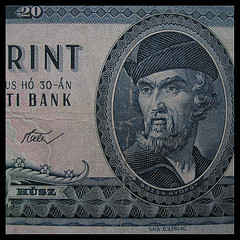
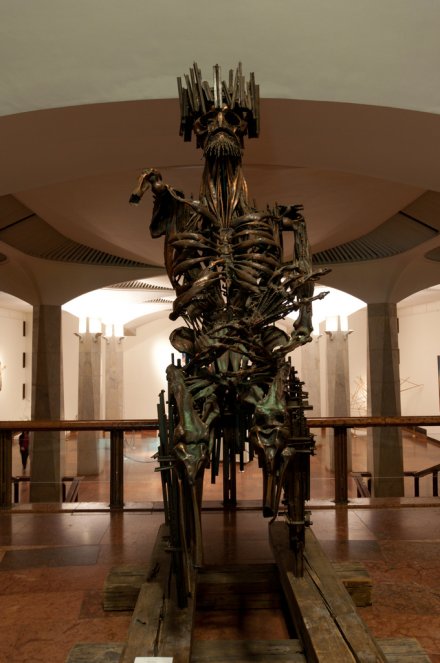
On the following day, he was placed almost naked on a burning throne, and his head was encircled by a crown of red-hot iron. Fourteen of his followers had been kept without food for several days, and were then brought into his presence, and while he was yet living the flesh was torn from his bones and cast to them that they might satiate their hunger. “To it hounds!” was his bitter exclamation, “ye are of my own rearing!”

This insurrectionist’s confrontation with backward power structures would offer plentiful fodder for those lands’ now-fallen Communist regimes; his name adorns many streets and monuments in Hungary and Romania.

However, Dozsa was well on his way into the nationalist pantheon before Communist ascendancy. Nineteenth-century composer Ferenc Erkel, for instance,** wrote an opera about him, and poet/nationalist revolutionary Petofi Sandor saluted him in verse in 1847.

The latter text is available in Hungarian on Dozsa’s Hungarian Wikipedia page, which also attributes at least two plays about him to the Interwar period.

* aka Timisoara — in modern-day Romania, where the execution actually took place.

** Dozsa was actually captured in a fortress constructed by John Hunyadi, whose executed son is a fellow nationalist martyr (playing for the traditional-authority team), and the subject of one of Erkel’s more famous operas.


Sculpture of Gyorgy Dozsa burned on his throne, from Budapest’s Hungarian National Museum. (cc) image from redteam.

On this day..

1685: James Scott, Duke of Monmouth

On this date in 1685, the haughty Duke of Monmouth mounted the scaffold at London’s Tower Hill to suffer beheading for treason, and tipped the headsman with the words, “Here are six guineas for you and do not hack me as you did my Lord Russell. I have heard you struck him four or five times; If you strike me twice, I cannot promise you not to stir.”*

Upon this tart public reminder of his recent and infamous failure of craft, the eponymous executioner Jack Ketch quite came apart.

Monmouth, certainly, would have appreciated the advance that would bring the guillotine. Beheading by a free-swinging axe was a ghoulishly inexact procedure: bad aim, insufficient force, an untimely flinch, or the tough neck muscles of a grizzled campaigner regularly complicated the process, often to the fury of spectators. Jack Ketch is sometimes reported a sadist, and sometimes a professional hangman so rarely summoned to give a nobleman the chop that he simply lacked proficiency. Either way, he’d been on the job for a generation by this time: his reputation for infelicity with the blade preceded him.

Historical fiction from the perspective of the Duke of Monmouth.

Monmouth, an illegitimate son of King Charles II, had cause to dread Ketch’s offices for the rebellious culmination of a long power struggle with his uncle, the future King James II.

The personal contest between these men for the throne of England was the echo of the decades-old struggles straining the English polity — the Reformation and the reach of royal authority.

As it became known that the king’s brother James had gone from Catholic sympathizer to Catholic convert, Protestants began maneuvering to keep him from inheriting the crown. For three years, Parliament pushed the Exclusion Bill, which would have excluded James from succession.**

Favor among the bill’s supporters settled on the Protestant playboy Monmouth — politically convenient rumors that he was actually a legitimate child began circulating. “Weak, bad, and beautiful,” this unfriendly-to-Monmouth free book has him; whatever he was, his allies in the House of Commons were handily outmaneuvered. The Exclusion measures failed, and in 1685, James II began his reign as England’s last Roman Catholic monarch.

Monmouth’s hopes had been raised, however, and he proceeded to invade England at Dorset with a somewhat ragtag army that was routed by the Protestant royal troops who remained loyal to James at the Battle of Sedgemoor — not quite the last battle fought on English soil, but the last consequential one (the last fought with pitchforks makes a livelier distinction). Monmouth was caught trying to get away in a shepherd’s disguise. Other fugitives of his cause were hunted mercilessly.

The defeated duke was reputedly not above begging the sovereign for his life; obviously, that didn’t work out. But his cause was a popular one, nearing reverence among some commoners. Jack Ketch may have had a case of the butterflies even before the duke undressed him … and as it turns out, Ketch almost left the scaffold worse than his victim.

Here is the scene in Macaulay’s words:

The hangman addressed himself to his office. But he had been disconcerted by what the Duke had said. The first blow inflicted only a slight wound. The Duke struggled, rose from the block, and looked reproachfully at the executioner. The head sank down once more. The stroke was repeated again and again; but still the neck was not severed, and the body continued to move. Yells of rage and horror rose from the crowd. Ketch flung down the axe with a curse. ‘I cannot do it,’ he said; ‘my heart fails me.’ ‘Take up the axe, man,’ cried the sheriff. ‘Fling him over the rails,’ roared the mob. At length the axe was taken up. Two more blows extinguished the last remains of life; but a knife was used to separate the head from the shoulders. The crowd was wrought up to such an ecstasy of rage that the executioner was in danger of being torn in pieces, and was conveyed away under a strong guard.

In the meantime many handkerchiefs were dipped in the Duke’s blood; for, by a large part of the multitude he was regarded as a martyr who had died for the Protestant religion.

Just the sort of soil for posthumous tall tales — that his execution was bogus and he was in hiding to return again, or had been packed off to France to become the Man in the Iron Mask. One possibly better-founded legend is that his head was set back upon its stump to sit him for what must have been a pungent portrait.

Protestant opponents of James were much thicker on the ground than the Duke’s own person, of course. They soon succeeded where Monmouth had failed.

* Slightly different versions of this address from the Duke to the executioner are recorded. Macaulay omits the “if you strike me twice” clause but adds “My servant will give you some more gold if you do the work well”; a more polite (barely) construction suggests “Do not serve me as you did my Lord Russell.”

** The factions in this dispute — the “Petitioners” (supporting the bill) and the “Abhorrers” (supporting the king) — evolved into the Whig and Tory political parties.

Part of the Themed Set: Embarrassed Executioners.

On this day..

1726: William Fly, unrepentant pirate

On this date in 1726, an obscure boatswain who had mutinied for the liberty of piracy succumbed but did not submit on the gallows in Boston.

Fly overthrew (figuratively and literally — they both ended up in the drink) a tyrannous captain and first mate on a British slave ship in May, reconstituting it Fame’s Revenge, and in a northward journey from North Carolina to New England captured a few less-than-lucrative ships in a month and change.

A minor character in the annals of seaborne pillage. So why should historian Marcus Rediker devote the opening chapter to his Villains of All Nations: Atlantic Pirates in the Golden Age (review) to this man?

[T]he early-eighteenth-century pirate ship was a world turned upside down, made so by the articles of agreement that established the rules and customs of the pirates’ alternative social order. Pirates “distributed justice,” elected their officers, divided their loot equally, and established a different discipline. They limited the authority of the captain, resisted many of the practices of capitalist merchant shipping industry, and maintained a multicultural, multiracial, and multinational social order. They demonstrated quite clearly — and subversively — that ships did not have to be run in the brutal and oppressive ways of the merchant service and the Royal Navy.

Rediker’s sympathetic but unromantic work treats the radical, doomed sphere of resistance pirates offered to the enormous cruelty of the developing Atlantic economy: grinding exploitation of white sailors in the service of the black slave trade under the iron hand of the empire (British, in this case, but hardly exclusive to Old Blighty.)

It bears the trace of Hakim Bey‘s treatment of Temporary Autonomous Zones:

Fleeing from hideous “benefits” of Imperialism such as slavery, serfdom, racism and intolerance, from the tortures of impressment and the living death of the plantations, the Buccaneers adopted Indian ways, intermarried with Caribs, accepted blacks and Spaniards as equals, rejected all nationality, elected their captains democratically, and reverted to the “state of Nature.” Having declared themselves “at war with all the world,” they sailed forth to plunder under mutual contracts called “Articles” which were so egalitarian that every member received a full share and the Captain usually only 1 1/4 or 1 1/2 shares. Flogging and punishments were forbidden — quarrels were settled by vote or by the code duello.

Certainly many men (and women) turned to piracy for many different reasons. Rediker’s work on the systematic brutality in the guts of the imperial economy and the pressures of resistance and coercion they spawned finds an outstanding individual exponent in this day’s victim.

Fly walked indifferently to the gallows; to the astonishment of the spectators, he upbraided the hangman’s poor knot and remade with his own hands the instrument for his own neck — one last use of his seaman’s proficiency with ropes.

On Fly’s turn upon that fatal stage, he would not read from the classics — not cower before his executioners, not salute the majesty of the crown that hung him, not enjoin the mob to straighten up and sail right, and certainly not be cowed on the cusp of the eternal by officious colonial holy roller Cotton Mather’s vain personal bid to convert the corsair:

When the time came for last words on that awful occasion, Mather wanted Fly and his fellow pirates to act as preachers — that is, he wanted them to provide examples and warnings to those who were assembled to watch the execution. They all complied. Samuel Cole, Henry Greenville, and George Condick [three of Fly’s crew], perhaps hoping for a last-minute pardon, stood penitently before the crowd and warned all to obey their parents and superiors and not to curse, drink, whore, or profane the Lord’s day. These three pirates acknowledged the justice of the proceedings against them, and they thanked the ministers for their assistance. Fly, however, did not ask for forgiveness, did not praise the authorities, and did not affirm the values of Christianity, as he was supposed to do, but he did issue a warning. Addressing the port-city crowd thick with ship captains and sailors, he proclaimed his final, fondest wish: that “all Masters of Vessels might take Warning by the Fate of the Captain (meaning Captain Green) that he had murder’d, and to pay Sailors their Wages when due, and to treat them better; saying, that their Barbarity to them made so many turn Pyrates.” Fly thus used his last breath to protest the conditions of work at sea, what he called “Bad Usage.” He would be launched into eternity with the brash threat of mutiny on his lips.

“Bad Usage.” Rediker later defines it as “the violent disciplinary regime of the eighteenth-century deep-sea sailing ship, the ordinary and pervasive violence of labor discipline as practiced by the ship captain as he moved the commodities that were the lifeblood of the capitalist world economy.”

The resistance to a pattern of savage floggings, cheated wages, and the whole spectrum of rough and arbitrary authority on a shipboard dictatorship might be spontaneous and individual in the instant … but it was thick with the stuff of solidarity, and the fraternity of outlawry could make people equal across the boundaries of national rivalry and institutional racism — “Villains of all Nations,” as the title goes.

And the obdurate, like Fly, could every now and then move the pastors who were sent to thunder hellfire at them rather than the other way around.

As it happened, the “stupid” and “impenitent” pirate [Mather uses these words to describe Fly elsewhere] was able to convince the self-righteous minister of at least one primary cause of piracy. During his execution sermon, Mather made it a point to address the ship captains in the crowd, telling them in no uncertain terms that they must hereafter avoid being “too like the Devil in their Barbarous Usage of the Men that are under them and lay them under Tempations to do Desperate Things.”

After the hanging, William Fly’s body was gibbeted as a warning on Nixes Mate, a barely-there speck of an island at the mouth of Boston Harbor. For Rediker, this date marks the end of the Golden Age of Piracy.

Although the full book is worth the buy, a paper Rediker wrote on the subject prior the book’s publication is available free online.

Part of the Themed Set: Embarrassed Executioners.

On this day..