1850: The Bab, Prophet of Baha’i

On this date in 1850, a Persian merchant who claimed to be the Islamic messiah was shot in Tabriz for apostasy.

The Bab — the handle means “Gate”; he was born Siyyid `Alí Muhammad — started preaching as a young man in 1844 and attracted a following unwelcome to the orthodox Shi’a clergy and the powers that were.

The Bab would claim to be “that person you have been awaiting for one thousand years”: the Mahdi. And in a John the Baptist-like pose, he would also pledge to be preparing the way for another, “He whom God shall make manifest,” to follow his footsteps.

Authorities cracked down on this subversive faith and its heretical claim to have a divine messenger, hailing the Bab before a clerical tribunal that found him a blasphemer and an apostate. After dawdling a couple of years, the government finally ordered him shot … to which punishment a young disciplie submitted himself voluntarily as well.

Reputedly, the public execution by firing squad was quite a fiasco for the government, and/or a miracle for the Bab. It is said that the entire sizable regiment deployed to volley at the Bab and his devotee managed to miss everything, but to shoot through the rope that was holding the prophet suspended a few meters above the ground. In the Baha’i version, he miraculously disappears from the first execution attempt and is found later calmly conversing with a secretary in his prison cell, at which point he’s (successfully) executed a second time.

A less pious version of the story commencing from the same starting point of unmarksmanlike executioners has the Bab shot out of his rope and availing the smoke of the discharge to scramble out of the courtyard, only to be detained before he could make good an escape.

Inevitable disputes about the succession to this charismatic figure ensued his death, and several claimed to be the Bab’s Promised One. The main current of the tradition evolved into the Baha’i faith, accepting the claim of Baha’u’llah to this position. (A tiny remnant of Babism still persists who dispute Baha’u’llah’s legitimacy and still await the Promised One.)

July 9 is a major holiday for Baha’i, for whom the Bab is a revered figure.

On this day..

1535: Thomas More, the king’s good servant but God’s first

On this date in 1535, Sir — later Saint — Thomas More kept his conscience at the expense of his head on Tower Hill.

For all More‘s greatness — as intellectual, polemicist, lawyer, statesman, father — none of his many gifts at the end could avail him beside his commitment to Catholicism at the dawn of the English Reformation.

Yet it is for those gifts that he cut such a commanding presence in his times, for those very reasons that his sovereign hounded his first citizen to assent to the divorce and remarriage he was fixed upon.

A devotee and friend of Erasmus from years before, More was in Henry’s more orthodox youth the king’s very scourge of Protestantism. His scatological invective against Martin Luther in Responsio ad Lutherum — much in the impolite tenor of Catholic-Protestant rhetoric continent-wide, it should be noted — is of the sort to crimson the cheeks of the milquetoast modern:

Since he has written that he already has a prior right to bespatter and besmirch the royal crown with shit, will we not have the posterior right to proclaim the beshitted tongue of this practitioner of posterioristics most fit to lick with his anterior the very posterior of a pissing she-mule until he shall have learned more correctly to infer posterior conclusions from prior premises?

Over that hairshirt, he wore the robes of state. But his engagement with the world had a selective bent that must have exasperated his colleague and predecessor as Lord Chancellor, Cardinal Wolsey. Orson Welles and Paul Scofield spar here in the definitive More hagiography A Man for All Seasons over the intellectual’s delicate refusal to dirty his gloves with the great matter of state before them — the annulment the king demanded of his marriage to the Queen (and More’s friend) Catherine of Aragon:

Peas in a pod, these two: Wolsey, the cleric grounded in realpolitik; More, the barrister who trusts to God. (More considered holy orders as a young man.)

Our man’s reputation for honesty in a den of hypocrites has certainly outrun Wolsey’s. Still, all More’s disdain for the deal-making that invests the sovereign majesty and all his foreboding for the relationship he had with his dangerous king were not quite enough to stop him accepting the Chancellorship and the opportunity to stamp out Lutheranism … knowing perfectly well the simultaneous thrust of Henry’s boudoir policy.

It all cuts quite a contrast to More’s (barely) pre-Reformation text, Utopia (available free from Project Gutenberg), which named a literary genre and described an imagined society of tolerant primitive communism that surely would have blanched at its inventor’s coming role in the state’s machinations:

I can have no other notion of all the other governments that I see or know, than that they are a conspiracy of the rich, who, on pretence of managing the public, only pursue their private ends, and devise all the ways and arts they can find out; first, that they may, without danger, preserve all that they have so ill-acquired, and then, that they may engage the poor to toil and labour for them at as low rates as possible, and oppress them as much as they please

[E]very man might be of what religion he pleased, and might endeavour to draw others to it by the force of argument and by amicable and modest ways, but without bitterness against those of other opinions; but that he ought to use no other force but that of persuasion, and was neither to mix with it reproaches nor violence* …

It’s not a given that More himself agrees with every (or even any) sentiment expressed in Utopia, but his most famous work’s criticism of the death penalty too liberally applied makes interesting reading.

[E]xtreme justice is an extreme injury: for we ought not to approve of those terrible laws that make the smallest offences capital … God has commanded us not to kill, and shall we kill so easily for a little money [i.e., execute petty thieves]? But if one shall say, that by that law we are only forbid to kill any except when the laws of the land allow of it, upon the same grounds, laws may be made, in some cases, to allow of adultery and perjury: for God having taken from us the right of disposing either of our own or of other people’s lives, if it is pretended that the mutual consent of men in making laws can authorise man-slaughter in cases in which God has given us no example, that it frees people from the obligation of the divine law, and so makes murder a lawful action, what is this, but to give a preference to human laws before the divine? and, if this is once admitted, by the same rule men may, in all other things, put what restrictions they please upon the laws of God.

This insistence on the supremacy of divine law over human institutions forms the basis of his objection to parliament’s overthrowing the papacy — which he expressed openly only after he was convicted by obviously perjured “jailhouse snitch” testimony

[Y]ou have no authority, without the common consent of all Christians, to make a law or Act of Parliament or Council against the union of Christendom.

Paul Scofield bears enjoying in the role in A Man for All Seasons:

More is sometimes suspected of desiring martyrdom since he marched so unerringly into it, but he also made every attempt to survive Henry’s demand the he affirm the royal remarriage and the king’s ecclesiastical supremacy by withdrawing silently from the public sphere rather than openly opposing it. More had by every account an enviable, downright happy life at his own hearth, and a tender and intellectual relationship with his favorite daughter Meg. (Meg corresponded with her father in prison, collected his works, and retrieved his head from London Bridge.)

But by his way of thinking — Meg tried to talk him out of it — he couldn’t swear to the Act of Succession acknowledging the king’s right to divorce Queen Catherine and disinherit her daughter Mary if Henry decided to force the choice. And in the king’s eyes, there was no middle ground for someone of the ex-Chancellor’s stature.

Henry could see to it, though, to cut his old friend a break and commute the sentence from drawing and quartering to “mere” beheading, here depicted in the past season of the Showtime series The Tudors.

More’s last moments as rendered here — the ironic remark at the foot of the scaffold, “See me safe up: for my coming down, I can shift for myself”;** his generous answer to the headsman’s plea for forgiveness — are well-documented. Undoubtedly, his sturdy martyr’s bearing, the extension of a life of joyful piety, helped cement for posterity the fame he held in life.

And that dying address — “I die the King’s good servant, but God’s first” — gathers in one sentiment free of bombast or self-pity the irreconcilable demands of conscience that would lead many thousands besides More to Henry VIII’s scaffolds, and rings equally true to less lethal challenges to the conscience in every land and time since.

Anne Boleyn, who caused More’s fate, shared it less than a year afterwards.

Thomas More was canonized by the Catholic Church in 1935 — the patron saint of politicians. Rather bizarrely, July 6 is also his feast day on the Anglican calendar, a tribute to the nearly universal regard his memory enjoys.

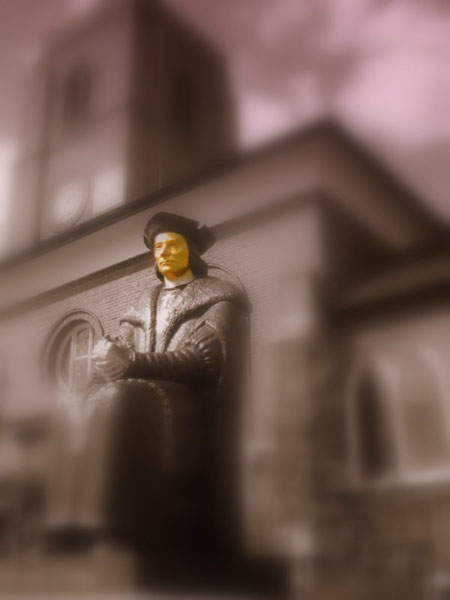
Thomas More's statue at the Chelsea Old Church

Chelsea resident Thomas More’s statue at the (Anglican) Chelsea Old Church.

* Despite its religious tolerance, More’s Utopia — anticipating Dostoyevsky — maintains:

a solemn and severe law against such as should so far degenerate from the dignity of human nature, as to think that our souls died with our bodies, or that the world was governed by chance, without a wise overruling Providence … since a man of such principles must needs, as oft as he dares do it, despise all their laws and customs: for there is no doubt to be made, that a man who is afraid of nothing but the law, and apprehends nothing after death, will not scruple to break through all the laws of his country, either by fraud or force, when by this means he may satisfy his appetites.

** According to the biography published by More’s son-in-law — who married More’s favorite, Margaret — the jest was occasioned by the rickety look of the scaffold. The Mirrour of Vertue in Worldly Greatness; Or, The Life of Sir Thomas More is available free on Google Books.

On this day..

1882: Charles Guiteau, James Garfield’s colorful assassin

On this date in 1882, America’s weirdest assassin recited fourteen verses of the Gospel of Matthew and (sans requested orchestral accompaniment) a poem of his own composition entitled “I am Going to the Lordy,” and was hanged in the District of Columbia jail for shooting forgettable Gilded Age president James Garfield.

Mad as a march hare, Charles Julius Guiteau had irritated the obscure reaches of the Republic near four decades, trying his hand at free love, law, newspapering* and evangelism. A contemporary account of his religious flimflammery survives:

Charles J. Guiteau (if such really is his name), has fraud and imbecility plainly stamped upon his (face). (After) the impudent scoundrel talked only 15 minutes, he suddenly (thanked) the audience for their attention and (bid) them goodnight. Before the astounded 50 had recovered from their amazement…(he had taken their money and) fled from the building and escaped.

Having failed at each characteristic American monkeyshine more comprehensively than the last, he naturally gravitated to politics; while today Guiteau might tilt with his psychoses on some vituperative blog, in 1880 he published and delivered as a speech a widely-ignored crackpot encomium** for his eventual victim. Guiteau reckoned the GOP carried the 1880 elections on the strength of such rhetorical thunderbolts as “some people say he [Garfield] got badly soiled in that Credit Mobilier transaction but I guess he is clean-handed.”

Stunned that his contributions did not earn him a diplomatic posting to France, Guiteau stepped out of obscurity and into this blog’s pages by shooting the ungrateful (and unguarded) executive in the back at a Washington, D.C. train station (since demolished, and today occupied by the National Gallery of Art).

“To General Sherman: I have just shot the President. I shot him several times as I wished him to go as easily as possible. His death was a political necessity. I am a lawyer, theologian, and politician. I am a stalwart of the Stalwarts. I was with Gen. Grant, and the rest of our men in New York during the canvass. I am going to the Jail. Please order out your troops and take possession of the Jail at once. Very respectfully, Charles Guiteau.” (Click for the full image.) From the Georgetown Charles Guiteau collection.

Thoughtfully, he had already hired a cab to take him to jail, where he expected to be liberated by General William Sherman.

Malpractice

The bugger of Garfield’s assassination is that Guiteau was no better at killing presidents than he was at electing them. Despite his exultation “Arthur is President now!”, he actually inflicted what could have been a non-fatal flesh wound that through ten-thumbed medical intervention became an agonizing eighty-day Calvary for the miserable Garfield.

Doctors jabbed unwashed hands into the the wound, failing to dig out the bullet they were looking for but successfully turning the three-inch wound into a crater, puncturing Garfield’s liver, and passing him Streptococcus. Alexander Graham Bell invented a metal detector to find the missile, but the damn thing gave a bad reading … because Garfield was lying on a bed with metal springs. His doctors, feuding with one another and with the press, instituted a regimen of rectal feeding — “Nutritive enemas — consisting of beef bouillon, egg yolks, milk, whiskey, and several drops of opium … Garfield’s flatulence became intolerable,” according to one biographer — that “basically starved him to death.”† He lost 100 pounds before succumbing; the autopsy concluded that Garfield probably would have lived if not for the medical attention, which didn’t stop the doctors from submitting a sizable invoice to the feds for services rendered.

(In a moment of lucidity, Guiteau defended himself with the observation “The doctors killed Garfield; I just shot him.”)

Not Ha-Ha Funny

Horribly hilarious, this American Absurdistan. “Except for the dead-serious details of his assassinating President Garfield and being in all likelihood clinically insane, Charles Guiteau might be the funniest man in American History,” Sarah Vowell put it.

Guiteau’s circus trial — with the defendant constantly interrupting to harangue participants, object to his own attorneys or converse with the spectators, plus the macabre appearance of the late Garfield’s actual vertebrae (now at Washington D.C.’s National Museum of Health and Medicine) as an exhibit — was for all that a landmark test of evolving law around criminal insanity.

Just as Garfield probably would have survived his injury had he been treated by the next generation’s medical norms, Guiteau probably would have survived his brush with the law if treated by the next generation’s legal norms.

Against an almost-too-strict-to-achieve earlier bar for legal insanity, a more accommodating jurisprudential norm called the M’Naghten Rules or M’Naghten Test was even then being adopted from English courts: essentially, did the “criminal” realize his act was wrong? Still the basis for legal insanity claims in much of the U.S. today, the first trial of a presidential assassin would be the M’Naghten standard’s trial by fire.

While the judge gave ample leeway for the defense to use M’Naghten, the legal standards it implied were still not widely understood and the medical testimony about Guiteau’s mental condition was (embarrassingly, for the profession) wildly contradictory. Ultimately, the judge cued the jury that “the law requires a very slight degree of intelligence indeed” on Guiteau’s part to impute him with sufficient criminal culpability to hang. There were cheers in the courthouse when the jury took an hour to decide that Guiteau had that very slight degree of intelligence indeed.

In the final analysis, as Charles Rosenberg observes in The Trial of the Assassin Guiteau: Psychiatry and the Law in the Gilded Age, the jurors’ prompt conviction of the widely hated, barking-mad defendant underscored the real-life constraints of dry legal theory as applied by an outraged community to a notorious offender:

[T]he Guiteau case demonstrated anew that the circumstances of a particular case had ordinarily as much to do with its disposition as the precise injunctions of rules of law … Many observers agreed after the trial that if an individual of Guiteau’s marked eccentricity had killed an ordinary man … he would almost certainly not have been convicted; very likely he would not even have been brought to trial. Similarly, while Garfield lay on his sickbed, it was commonly assumed that his assailant would be institutionalized if the President should survive. But if not, then not.

Reckoning the gesture could cost him the 1884 Republican nomination, Chester A. Arthur declined to spare his “benefactor” (“Arthur has sealed his own doom and the doom of this nation,” was Guiteau’s reaction, picturing fire and brimstone) and left Guiteau to his strange and lonely fate. The latter was talked out of an early plan to go to the gallows in the Christlike garb of only his undergarments, but did insist upon delivering his incoherent parting ramble in a high-pitched childlike tone (“the idea is that of a child babbling to his mama and his papa”).

Wrapping up this surreal historical episode in a neat little bow, Charles Guiteau got his own bluegrass tune:‡

For more adventures through Guiteau’s looking glass, there’s a fine page at the University of Missouri-Kansas City.

* One of Guiteau’s failed newspaper ventures was to exploit the telegraph to reprint original content from other outlets. That one looks a lot less harebrained in retrospect: it’s a primitive model of the wire service, and latterly of RSS-based distributors like Google News.

** Scans of Guiteau’s apologia for Garfield — via Georgetown’s Charles Guiteau collection — are here: cover, pages 1-2, page 3.

† You really want to know more about the South Park-esque practice of rectal feeding? Garfield’s quack physician published this pamphlet in 1882.

‡ The “Charles Guiteau” ditty is actually a rather shameless knock-off of a murder ballad for James Rodgers, an Irish immigrant hanged in New York in 1858.

On this day..

1856: Dr. William Palmer, the Rugeley Poisoner

On this date in 1856, the Victorian poisoner William Palmer stepped on the scaffold at Stafford prison, eyed the trap suspiciously, and asked, “are you sure it’s safe?”

It wasn’t.

One of the more notorious characters of 19th century crime, Palmer hanged for poisoning a gambling buddy with strychnine, but he was widely thought to have left many more bodies in the ground. The philandering physician certainly had a knack for having people turn up suddenly dead around him:

  • The last four of his five legitimate children;
  • His illegitimate child;
  • Two people to whom he owed money;
  • His mother-in-law;
  • His wife (after Palmer took out insurance on her);
  • His brother (ditto);
  • And John Parsons Cook, whom Palmer was finally convicted of killing.

Evidence against Palmer was completely circumstantial, the public mood was completely prejudicial, and the case was completely sensational. It didn’t help Palmer’s cause that future Lord Chief Justice Sir Alexander Cockburn was on the case, inflicting a withering cross on the defendant. Neither did it help his cause as much as one might think having the victim’s body come up negative for any lethal dose of poison. Robert Graves wrote a book about the case, and reckoned it a likely frame-up. Most other popular recollections — like Madame Tussaud’s, where Palmer stood until 1979 — have figured him for the same cold-blooded poisoner his public thought him. Gambling debts on the verge of burying him afforded him very plausible motivation (Cook was supposedly killed because Palmer had fraudulently borrowed a few hundred pounds against his name and was about to be found out).

How quickly “crimes of the decade” fade away. Palmer was the O.J. Simpson of the 1850’s, although his spell in the public eye was only a few months. Parliament had to intervene to move his case from Staffordshire to London for want of an unprejudiced jury; 35,000 people crammed the streets overnight in the rain to watch him swing; and time was you could get yourself the Unabridged Edition of The Times‘ minute-by-minute report on the Palmer trial or bone up on the case in the 19th century’s legal tomes, to say nothing of the requisite (and in this case, poetic) broadsheet and enough cultural ejecta to stock a museum exhibit.

Palmer earned a passing name check in Sherlock Holmes — “When a doctor does go wrong he is the first of criminals. He has nerve and he has knowledge.” His case is supposed to be the source of the pub idiom “what’s your poison?”

Legend — scurrilous, of course — has it that his hometown of Rugeley even petitioned the government to change its name for fear of never escaping its association, but that the change would only be permitted if the town named itself after the Prime Minister: Lord Palmerston. Rugeley it remains.

* Notably, Palmer was convicted of poisoning in the face of exculpatory toxicology evidence. He denied the poisoning to the end.

On this day..

1798: Rigas Feraios, Greek poet

On this date in 1798, the Greek revolutionary Rigas Feraios and five co-conspirators were strangled by their Ottoman captors on the Danube River en route to Constantinople to prevent their rescue.

A Vlach by blood, Feraios was a hero — and ultimately a martyr — of Greek independence years before the revolution against Ottoman rule that would deliver it.

A Renaissance man for the Greek Enlightenment, Feraios had a variegated youthful career knocking about the Ottomans’ Balkan possessions and absorbing the revolutionary Zeitgeist abroad in Europe.

Settling in Vienna in his mid-thirties, he brandished his pen in the service of an imagined pan-Balkan, pan-Hellenic uprising to shake off the Turkish yoke. He edited the first Greek newspaper, published a map* and constitution for the imagined realm of the “Inhabitants of Rumeli, Asia Minor, the Islands of the Aegean, and the principalities of Moldavia and Wallachia”, and churned out blood-stirring poetry in Demotic, the vernacular tongue — most memorably, the Thourio, i.e., “War Hymn”.

… and a little taste of the gist, in English:

How long, my heroes, shall we live in bondage,
alone,like lions on ridges, on peaks?
Living in caves, seeing our children turned
from the land to bitter enslavement?
Losing our land, brothers, and parents,
our friends, our children, and all our relations?
Better an hour of life that is free
than forty years in slavery.

This sort of fire-breather is not the sort of man the Ottomans were keen on seeing involve himself with Bonaparte, most especially now that the French kingpin had started outfitting Oriental adventures. The Turks’ Austrian allies nabbed Feraios in Trieste en route to confer with Napoleon’s Italian subalterns about interfering in the Balkans.

Shipped to the governor of Belgrade, Feraios was to be sent to Constantinople for adjudication by Sultan Selim III. A Turkish buddy of the poet’s, however, happened to be blocking the way with a sizable force of his own who’d been administering a rebel statelet carved out of Ottoman territory. Tipped that this gentleman was keen to liberate the Turks’ unwelcome prisoners if they tried to pass, the local authorities had them summarily strangled and their bodies dumped in the Danube.


A Rigas Feraois monument in Belgrade. (Author’s photograph, in terrible light.)

* Including Constantinople. The dream of “Greater Greece” would persist long, and die hard.

On this day..

1594: Rodrigo Lopez, Shylock inspiration?

On this date in 1594, a 70-year-old Portuguese physician was torn apart at Tyburn before a jeering London mob for attempting to poison Queen Elizabeth I.

Born around 1525 to a family of conversos — Jewish converts forcibly converted to Christianity — Rodrigo Lopez (alternatively, Lopes) went abroad because the Spanish Inquisition menacingly suspected him of secretly maintaining the faith of Abraham.*

For us, the man’s true doctrines might be a matter for his god. In the 16th century, Lopez never could outrun his Jewishness.

Establishing himself in London in 1559, nearly the precise midpoint of his life, Lopez built a thriving medical practice, eventually rising in 1586 to the attendance of Her Majesty herself. England in those days was scrapping with the mighty Spanish empire, one front of which was endlessly byzantine diplomatic intrigue. It happened that Elizabeth gave harbor to a Portuguese pretender (Lopez had attended him, too), whose circles the Spanish were naturally endeavoring to infiltrate.

Some nefarious machinations in this ambit that came to light in 1593 opened an investigation characteristically heavy on the torture, and Lopez’s name came up. Allegedly, the doctor was negotiating to take Spanish gold for slipping the Queen a mickey.

Lopez doesn’t seem to be any less capable of greed or intrigue than anyone else at court, but poison? It was doubted at the time, the prosecution itself a product of the courtly rivalry between Essex and Cecil.** Despite a confession (extracted by torture, like the accusations), even Elizabeth never seems to have really bought the charge: she held Lopez more than three months after his sentence before finally permitting the punishment to go forward, and pensioned his family when the treason conviction entitled her to confiscate their property.

The London mob entertained no such nuance. When Lopez was hauled to the scaffold this day for his public butchery — still protesting that he “loved the Queen as he loved Jesus Christ,” derisively taken as a backhanded confession by spectators who didn’t doubt the practicing Protestant was really a Jew — it elevated popular anti-Semitism to fever pitch.

Hath not a Jew eyes?

Lopez, or at least the popular mood of Jew-baiting current after his trial, is thought to have helped inspire William Shakespeare’s use of the Shylock character in The Merchant of Venice — one of the most controversial and captivating of all the Bard’s creations, a villain far more compelling (and sympathetic) than the play’s lightweight good guys and one whose place in the Shakespeare canon and the fabric of Elizabethan England is still vigorously debated.

Is Shylock a vicious caricature? A sublimely three-dimensional human? Both? Wherever the “real” William Shakespeare stood on the matter of religious equality, he put one of literature’s great apologias for it in Shylock’s mouth:

* Insincerely converted Muslims and Jews were a choice target of the Inquisition in the 16th century; many thousands were driven to emigrate. For the fate of some other crypto-Jews who fled to Spain’s possessions in the New World, see here.

** Lopez’s Javert, the Earl of Essex, lost the power struggle a few years later … and with it, his own head.

On this day..

1962: Adolf Eichmann

On this date in 1962, the architect of the Final Solution received such justice as could be meted to him on earth at Israel’s Ramla Prison.

Adolf Eichmann, the vacuum cleaner salesman turned SS Obersturnbannfuhrer, remains the only person judicially executed in the history of modern Israel, whose intelligence services kidnapped him from Argentina where he had settled after the war.

Other Nazis had used the “only following orders” defense with little success in the Nuremberg Trials shortly after World War II. On trial years later (and at the hands a Jewish state) Eichmann — a bookish, unmenacing man who invoked Kant — posed the questions of individual responsibility and human psychology in starker terms.

To be sure, he was no anonymous functionary. Neither, however, had he dirtied his nails at the stomach-churning business end of the Holocaust: rather, he had engineered the stupendous logistical project of deporting Eastern Europe’s Jews for extermination, an (impressive) accomplishment worth exponentially more lives than any Einsatzgruppe could ever account for, yet simultaneously abstract from the upshot.

Eichmann said he did it without ill-will towards its subjects — simply to obey and to achieve.

The Banality of Evil

[I]f it was of small legal relevance, it was of great political interest to know how long it takes for an average person to overcome his innate repugnance of crime, and what exactly happens to him once he has reached that point. To this question, the case of Adolf Eichmann supplied an answer that could not have been clearer or more precise.
-Hannah Arendt

Hannah Arendt took him at his word* and saw in Eichmann the abyss gazing back into us, into his judges — not a monster but a man unsettling in his normalcy, whose job was not TPS reports or quarterly sales results but turning humans into ash.

The company man. The career man. Every man, standing in for countless thousands more who pushed the papers that drove the trains to Auschwitz.

What for Eichmann was a job, with its daily routine, its ups and downs, was for the Jews quite literally the end of the world.

Not everyone accepts her conclusions, but Arendt’s characterization of “the banality of evil” has become the man’s epigraph. And Eichmann disturbs us precisely because we seem to be able to meet him on his terms, even sympathize with him when the horror of his crimes begs for a monster like Streicher or Goebbels we could safely consign to the Other.

Arendt’s turn of phrase has a certain breezy (hackneyed, even) life in the public discourse, but her analysis of Eichmann’s careerism remains a challenging and deeply relevant one for we heirs of the world that hanged him.

The complete transcript of Eichmann’s trial is available online here. Video of his trial has been posted online here (in English) and here (original languages).

* Albeit with some reservations; others have argued that Eichmann was considerably more personally invested in his mass-murder project than his demeanor at trial admitted. Certainly he had an interest in showing the mellower Eichmann when he was on trial for his life.

On this day..

1979: John Spenkelink, the harbinger

On this date in 1979, John Spenkelink was electrocuted in Florida — the first man executed involuntarily in the U.S. since 1967.

A series of court decisions in the 1970’s had scrapped the country’s old death penalty institutions and obliged legislators to restructure the process. Now, the new architecture was in place and the decade-long hiatus in actual executions was drawing to a close.

Gary Gilmore had earned trivia-question notoriety as the first put to death under the new regime two years before, but Gilmore was always an outlier, a bizarrely active exponent of his own death who greased the skids for himself.

Spenkelink was the true harbinger. For six years, a span which seemed long then but would today rate on the speedy side, Spenkelink resisted death with every tool at his disposal. Florida officials fought just as stubbornly to kill him.

An itinerant parolee, he had in 1973 shot a fellow drifter named Joseph J. Szymankiewicz.

Spenkelink claimed that Szymankiewicz had stolen his money, forced him to play Russian roulette, and sexually assaulted him, all of which seemed within the vicious character attested of the victim. But the killing itself was clearly not a moment of passion or immediate self-defense: Spenkelink had left their shared hotel room, returned with a gun, and shot his man in the back.

In the new Court-mandated balancing act between “aggravating” and “mitigating” factors whose intent was to harmonize unfair application of the death penalty, this evident premeditation is what doomed Spenkelink. (The fact that Spenkelink committed the crime for pecuniary gain — that is, to get back his own money — also militated against him. The Clark County (Ind.) Prosecutor’s site has some legal briefs in addition to media reports on the case.)

In the larger reality not circumscribed by legal briefs, the defendant wasn’t exactly Charles Manson. More considerable than the act itself was where it occurred (North Florida) and the rootless, friendless character of its author — a “white nigger”. As Florida Supreme Court Justice Richard Ervin put it:

As usual under “discretion,’ it is left to sentencing judges to determine in particular cases who will get death. We know intuitively who will: the poor, the underprivileged, the public defender clients, the blacks and other minority people, the mentally incompetent or those holding unpopular or unorthodox ideologies. The affluent usually escape the death penalty.

The result here is an old story, often repeated in this jurisdiction where the subconscious prejudices and local mores outweigh humane, civilized understanding when certain segments of the population are up for sentencing for murder.

Or in Spenkelink’s epigram, which he often signed to prison correspondence, “capital punishment means those without capital get the punishment.”

The last of his 22 appeals* was rejected by the Supreme Court this very day. Ten minutes later, trussed hand and foot with each of his orifices stopped up and two shots of whiskey for the ride, Spenkelink was presented in Old Sparky to the event’s official witnesses.** It had been 15 years since the chair’s last use; prison officials didn’t remember how to operate it — but they managed to pull it off with no more than the electric chair’s average ration of gruesomeness.

Five minutes later, Spenkelink was declared dead — and the death penalty was back in America.†

* Filed by David Kendall, later to gain a measure of fame as Bill Clinton’s personal attorney during his impeachment.

** Spenkelink was gagged when the blinds were opened to the witnesses, and denied a final statement (his famous bon mot about those without the capital is sometimes mistakenly reported as his last words). Since the witnesses had not seen the prisoner brought in, rumors spread that he had fought the guards, even that his neck had been broken in the altercation and that he was dead or dying by the time the first 2,250-volt jolt hit him. This rumor in turn caused the state not only to exhume and autopsy Spenkelink, but to institute a policy of autopsying all executed prisoners … and the documentary trail created by this policy contributed to the Sunshine State’s later legal and public relations headaches with its execution protocols.

† Executions would remain freak events — one or two a year — until the mid-1980’s when they finally resumed taking place with regularity sufficient to return them to the everyday fabric of American life.

On this day..

1536: Anne Boleyn

On this date in 1536, Anne Boleyn lost her head.

Any queen decapitated by her king would of course rate an entry in these grim pages. But this does not quite explain Anne Boleyn‘s enduring appeal, relevance and recognizability for the most casual of modern observers, and her concomitant footprint in popular culture, even with the “Greek tragedy” quality of her life.

Anne stands at the fulcrum of England’s epochal leap into modernity. Whether she was that fulcrum might depend on the reader’s sympathy for the Great Man theory of history, but little more do we injure our headless queen to regard her as the woman for her time and place — the accidental hero (or villain) raised up and thrown down by the tectonic forces of her milieu.

Through Anne was born — for reasons of momentary political arrangements of long-forgotten dynasts, which seems a shockingly parochial proximate cause — the English Reformation, and through the Reformation was born the crown’s decisive triumph over the nobility, the broad middle class nurtured on the spoils of Catholic monasteries, the rising Britannia fit to rule. Most would take as an epitaph historical accidents of such magnitude.

Of course, by those same accidents, Anne was the instrument of thousands of deaths herself, and little did she appear troubled in life by the corpses upon which she ascended the throne.

Her own family maps the change wrought on England. An ancestor was beheaded in the Wars of the Roses, medieval England’s last great breakdown; her uncle Thomas Howard was one of the throwback scheming Dukes, mastered by his sovereign to the extent of issuing Anne’s capital sentence from his own lips;* the beheaded woman’s daughter, Queen Elizabeth I, set a recognizably centralized English state on the path of empire.

Fitting tribute that, from the Tower where she met her end** to lands undreamt-of in her time, people still, like Henry, find her captivating.

[audio:http://www.bl.uk/whatson/podcasts/podcast95533.mp3]

* Anne’s father also declared for her guilt. Unprincipled as these men undoubtedly were, it cannot have been a pleasant responsibility; the question of whether she was actually guilty of adultery-cum-treason, the fatal charge extracted from a supposed lover by torture, has been hotly and inconclusively disputed by posterity.

** With a solemn speech submissive to Henry but not admitting any guilt — in an earlier moment of levity, she had famously remarked of the French swordsman hired to do the job, “I heard say the executioner was very good, and I have a little neck.”

On this day..

2004: Case Study: Kelsey Patterson

The case of Kelsey Patterson, who was executed in 2004, is one of the most compelling examples of what can happen when the mental health system fails to provide adequate care and in doing so, puts the public at risk. For more than two decades, Patterson struggled with paranoid schizophrenia. His severe delusions and elaborate conspiracy theories led him to commit several irrational and motiveless assaults. Yet instead of investing resources in a long-term treatment plan, the state of Texas largely left Patterson to his own devices, until one day his mental illness pushed him to the point of no return.

A Cycle of Illness, Violence, and Neglect

Kelsey Patterson spent much of the 1980s in and out of two state mental hospitals. His condition would be stabilized, but would deteriorate once he was removed from psychiatric care. According to a Houston Chronicle from 11 August 2002 (“Mentally Ill Killer’s Life on the Line”), when he stopped taking his medication, he would become belligerent. An earlier article in the same newspaper (“Is Mentally Ill Death Row Inmate Sane Enough to Die?”, Houston Chronicle, 14 November 1999) noted he was “left half-treated and unsupervised by the state for years despite a history of psychotically inspired, near-fatal assaults.”

Kelsey Patterson: Not all there.

In 1980, Patterson shot and wounded Richard Lane, a Dallas co-worker who he believed was conspiring against him and attempting to poison his food (it was Lane’s first day on the job). Lane survived and Patterson was sent to the maximum security unit at Rusk State Hospital, where he was found incompetent to stand trial and diagnosed with schizophrenia. Although restored to competency through treatment, doctors determined that he had been unable to conform his conduct to the law, a key provision of Texas’ insanity statute at the time. Prosecutors dismissed the charges, deeming him insane at the time of the crime.

In 1983, Patterson shot and wounded a co-worker in his hometown of Palestine in another motiveless, delusional assault. Again he spent months at Rusk State Hospital before being restored to competency. Once again he was found unable to conform his behavior to the law, and the attempted murder charge was dismissed.

Back in Dallas in 1986, he assaulted yet another co-worker and was sent to Terrell State Hospital. As with the previous incidents, no charges were filed because of his mental health status. He was hospitalized once more in 1988 after reportedly threatening family members and complaining that people were trying to poison him. That hospital stay lasted only 34 days.

Throughout this period, Patterson denied that he was mentally ill, would stop taking his medications, and refused to comply with treatment plans. His delusions continued to worsen, and he believed that everyone was out to get him, particularly “the authorities.” According to his brother, he sometimes would tape the edges of his windows and doors to determine if anyone had come in the room. He also heard voices talking to him through the walls and over the loudspeakers during his time in jail.

On September 25, 1992, just days after his brother once again tried to have him committed to a psychiatric facility, Patterson walked a short distance from his home to a local oil supply business in Palestine, where he shot and killed both the owner, Louis Oates, and his secretary, Dorothy Kay Harris, at whom he screamed “You ain’t going to get away with it.” After the shooting, he put down the gun, stripped to his socks, and paced, shouting incomprehensibly until the police arrived. As with his previous assaults, there seemed to be no real motive or explanation for the crime – Patterson had only a casual acquaintance with the victims. Yet in this instance, the state not only decided to pursue charges but also to seek the death penalty, arguing that Patterson met the new legal standard of sanity, which merely required the defendant to know that his conduct was wrong. The ability to conform one’s conduct to the law was no longer part of the insanity defense in Texas. By all accounts, however, Patterson’s delusional beliefs were the same as always.

Excerpt from a 13-page letter from Kelsey Patterson to the Texas Court of Criminal Appeals. (Image owned by author.)


Patterson’s Competency Hearing and Capital Trial

At his competency hearing, two physicians did not dispute his mental illness but declared Patterson to be competent to stand trial. Dr. James Grigson – who had diagnosed Patterson with schizophrenia 12 years earlier – reversed course and testified that in this latest assault, Patterson had been sane at the time of the crime. He had spoken with Patterson for less than five minutes and had not conducted a comprehensive evaluation, yet was absolutely confident in his assessment.*

Against the advice of his attorneys, Patterson took the witness stand during the hearing and rambled about the conspiracies against him. He offered this explanation for his behavior:

They have some type of implant devices that they used on me in the military, which I receive. Like the device that they put in the inner ear in which they can send subliminal message and make a person act beyond their controllability to know you have taken an action.”

The jury found him competent to stand trial, in spite of the clear evidence that he did not possess a rational or factual understanding of the proceedings against him and was unable to consult with his attorneys, whom he believed were plotting against him. Patterson was constantly removed from the courtroom during his trial because of his disruptive behavior and outbursts about the devices implanted in his body. The jury rejected his insanity defense, found him guilty of capital murder, and sentenced him to death.

A Permanent Stay of Execution

During his time on death row, Patterson consistently maintained that he was the victim of an elaborate conspiracy, and he wrote rambling, incoherent letters to court officials, his family, politicians, and others. He refused to meet with mental health professionals or his lawyers, which made it impossible to formally assess his competence. Both state and federal courts upheld his conviction and found him competent to be executed. In November 2003, the U.S. Supreme Court refused to hear his appeal and the state set his execution for the following May.

Upon learning of his execution date, Patterson’s letters referred to a “permanent stay of execution” that he said he had received on grounds of innocence. Competency for execution requires an inmate to be aware of the impending execution and the reason for it.

On May 17, 2004, the Texas Board of Pardons and Paroles issued an extremely rare recommendation of clemency for Kelsey Patterson because of his mental illness; the vote was 5-1 and was only the second such recommendation in the board’s history. Governor Rick Perry rejected the recommendation, however, “in the interests of justice and public safety.” Kelsey Patterson was executed on May 18, 2004, delusional until the very end, as evidenced by his incoherent last statement:

Statement to what? State what? I am not guilty of the charge of capital murder. Steal me and my family’s money. My truth will always be my truth. There is no kin and no friend; no fear what you do to me. No kin to you undertaker. Murderer. … Get my money. Give me my rights. Give me my rights. Give me my rights. Give me my life back.

For more information on death penalty cases involving mental illness, go to http://www.tcadp.org/index.php?page=mental-illness or visit http://preventionnotpunishment.blogspot.com

* Dr. Grigson was known as “Dr. Death” because his testimony was instrumental in sending so many people to death row. He later was expelled from the American Psychiatric Association and Texas Society of Psychiatric Physicians because of his unethical, unscientific testimony in such cases.

Kristin Houle is a 2007 Soros Justice Fellow based in Austin, Texas.

On this day..