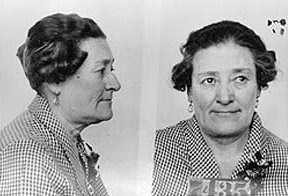
1918: Emile Ferfaille, the last in Belgium

On this date in 1918, Belgium carried out its last execution for ordinary crimes — in fact, its only one since 1863.

Now, that figure excludes a reported 242 people executed from 1944 to 1947, in revenge for the Nazi occupation. (To say nothing of those conducted by the Nazis themselves.) But that’s quite a stunning run, considering that death penalty statutes were on the books until 1996: it’s just that the sentences were routinely commuted.

According to the information in this thread on the lively Francophone guillotine.cultureforum.net (it does what it says in the url), Ferfaille murdered his pregnant girlfriend to further his career tomcatting with his other not-yet-pregnant girls. (This being the fourth year of the Great War, a lot of his competition was fertilizing no-man’s lands.)

And as disreputable as hammering one’s lover to death and stuffing her in the vegetable garden is, we’re comfortable averring that it was probably not the single most villainous act to transpire in Belgium the whole of this past century and a half.

Farfaille’s exceptional fate was a consequence of his committing his particular atrocity during that same Great War that gave him such great odds with Flemish females.

Ferfaille was executed in Veurne, just up the road from Dunkirk in the tiny corner of Belgium not occupied by Germany … and he was executed during Germany’s Spring Offensive on the Western Front, its last desperate (and ultimately unsuccessful) gamble* to secure battlefield victory before the recently-committed Americans threw their corn-fed thumbs on the scale.

Despite the conventionality of the crime, Ferfaille’s capital punishment was decreed by military court, since the perp was a soldier. With shells kerploding in the distance, the rakish junior officer was set up to face a tribunal with a particular shortage of patience for his shenanigans. (Belgium also carried out military executions in World War I — it’s just that the others were for military crimes, like desertion.)

Although what remained of Belgium was not jumpy in the execution of its sentence. Quite the opposite.

Actually conducting this beheading** required requisitioning from France prolific belle epoque headsman Anatole Deibler (French Wikipedia entry), and his assistants, and their portable guillotine. (Belgium had a guillotine of its own, but it would have had to cross the front to get to Emile Ferfaille. War is hell that way.)

This party of death made a hazardous journey skirting the charnel house of the Western front, protected by all the might of two nations’ armies for their mission to kill one man in a season where thousands died namelessly day by day … sort of a Bizarro World Saving Private Ryan.

The train took these rather small-time ministers of doom to Dunkirk, where they transferred to a truck for Veurne, then under direct German bombardment. The execution crew stood in only a little less danger than its client, but it carried out the sentence, “publicly” in the town’s all-but-empty square. Due to German shelling, barely anyone in the public witnessed this milestone event.

* The manpower for a western push was facilitated by the recent removal of Germany’s eastern enemy consequent upon the Russian Revolution.

** The penalty demanded by law. Post-World War II executions all seem to have been firing squad affairs even though the letter of Belgian law still apparently prescribed beheading even then.

On this day..

1999: Andrew Kokoraleis, the last ever in Illinois?

There was certainly no cause when killer Andrew Kokoraleis suffered lethal injection at 12:34 this afternoon to suppose that his would be the last execution in the illustrious history of Illinois.

Against all odds, however, it was the last.

Illinois has had plenty of poster boys for death penalty foes — Rolando Cruz; the Ford Heights Four — but Andrew Kokoraleis was hardly among them.

As a member of a satanic murder cult branded the Ripper Crew, he’d participated in abducting, raping, mutilating, murdering, and cannibalizing prostitutes under the charismatic sway of one Robin Gecht.*

The exploits of Gecht, Edward Spreitzer, and brothers Andrew and Thomas Kokoraleis in the Dark Lord’s services are nauseatingly recounted at trutv.com and the spellbinding true-crime book Deadly Thrills.

By the time Andrew Kokoraleis’s appeals had wended their way through the courts, it was high tide for capital punishment in the United States: a modern record 98 executions were carried out in 1999; a Texas governor best-known to the general public for his prodigious execution output was lining up the White House bid that would hurl America into much deadlier pastimes; a law stripping condemned prisoners of federal appellate avenues had just been passed with overwhelming support. Even liberal Democrats dared not touch the divisive issue of capital punishment for fear of appearing soft on crime.

Though sub-Texan in its gurney output, the Land of Lincoln was cranking out a consistent 1 to 2 executions per year in the late 1990’s. It had just inaugurated a Republican governor who as a lawmaker had voted to reinstitute that state’s death penalty statute. Illinois held well over 100 death row prisoners, including one of Kokoraleis’s own confederates from the Ripper Crew.

So the 21st century figured to present an ample harvest for the Illinois death chamber.

Even as Ryan’s graft-plagued term was beginning, however, the executioner’s swan song was underway.

Just days into Ryan’s term, a man named Anthony Porter, who had avoided execution by the narrowest of margins the year before, walked out of Illinois death row a free man — exonerated by the efforts of a Northwestern University journalism class.

“I turned to my wife, and I said, how the hell does that happen? How does an innocent man sit on death row for 15 years and gets no relief? And that piqued my interest, Anthony Porter.”

-George Ryan

Ryan okayed the execution of Kokoraleis six weeks later, but the piqued governor would soon impose an executive moratorium on further executions.

Ryan’s personal journey on the death penalty during his four years in the governor’s office, as linked to his state’s journey over the past decades, must be one of the rare operatic sagas in modern American political life.

Days before he left office (bound for trial on federal corruption charges, and thence to prison), George Ryan emptied death row in Illinois — including a commutation to Ripper Crew member Edward Spreitzer.

Because our three year study has found only more questions about the fairness of the sentencing; because of the spectacular failure to reform the system; because we have seen justice delayed for countless death row inmates with potentially meritorious claims; because the Illinois death penalty system is arbitrary and capricious – and therefore immoral – I no longer shall tinker with the machinery of death.

I cannot say it more eloquently than Justice Blackmun.

The legislature couldn’t reform it.

Lawmakers won’t repeal it.

But I will not stand for it.

I must act.

Our capital system is haunted by the demon of error, error in determining guilt, and error in determining who among the guilty deserves to die.

This move drew plenty of criticism, but the George Ryan death penalty moratorium persisted through the terms of his successors.

Finally, legislators did repeal it.

Early in 2011, longstanding efforts to push that moratorium into formal abolition finally bore fruit in the state legislature. After a protracted silence on the matter, Gov. Pat Quinn** finally — just eight days ago as of this posting — signed that legislation into law, simultaneously commuting all the state’s then-existing death sentences.

Naturally, no government can bind its successors, and laws eliminated today might be reinstated tomorrow. But for now and for the foreseeable future, this date in 1999 marks the final destination not just for Andrew Kokoraleis — but for the Illinois executioner.

* To magnify this troupe’s outsized crime-tabloid appeal, Gecht, the leader, had actually worked for legendary serial sex-killer John Wayne Gacy.

** In earlier years, Quinn was a political rival of George Ryan.

On this day..

1968: Three blacks in Rhodesia, notwithstanding Queen Elizabeth II

On this date in 1968, Rhodesia earned global opprobrium with a triple hanging in Salisbury (today known as Harare).

Labour M.P. Anne Kerr lays a wreath at the Rhodesian embassy to protest this date’s hangings. A few months later, Kerr would be the one in the world’s headlines … when she was roughed up by Chicago police at the 1968 Democratic Convention.

This was the first “Rhodesian” execution, three years on into the white-supremacist (pdf) breakaway state — which had bucked orderly majority-rule decolonization by declaring independence under its settler government.

So it was hardly a matter of whether James Dhlamini, Victor Mlambo and Duly Shadrack were or were not “guilty”: springing the trap on the gallows was an act fraught with racial hostility within Rhodesia (today, Zimbabwe) and throughout a decolonizing world.

Queen Elizabeth II issued a royal reprieve and the British government warned of the “gravest personal responsibility” attaching to anyone who involved himself in the proposed hanging. Rhodesia royally ignored it.

I have been hanging people for years, but I have never had all this fuss before.

(white) executioner Ted “Lofty” Milton (n.b. seemingly pictured here)

“This fuss” would encompass cross-partisan fury in the British House of Commons as well as a moment of silence in the Indian parliament, denunciations by both America and the Soviet Union … basically everybody. Tanzanian-born British M.P. Andrew Faulds called for criminal sanctions “not excluding the death penalty”. (London Times, , Mar. 7 1968)

There were even demands for humanitarian intervention — amounting to a British military occupation — to protect the other hundred-plus blacks then awaiting the gallows. Needless to say, that wasn’t about to happen, so in the face of Salisbury’s intransigence, was it all just sound and fury?

Does the Secretary of State recall that it was Winston Churchill who said: “Grass grows quickly over the battlefield; over the scaffold, never.”?

-Still-sitting Conservative M.P. Peter Tapsell — then a pup of 38, now the Father of the House — during Parliament’s emotional March 6 debate

Rhodesia insisted on the point by hanging two more Africans five days afterwards … but it also announced 35 reprieves.

In its fifteen years, Rhodesia never did get itself clear of the fuss over white rule; it remained a global pariah and eventually succumbed to its long-running Bush War.

On this day..

1629: John Dean, boy arsonist

(Thanks to Meaghan Good of the Charley Project for the guest post. -ed.)

On or about this day in 1629, one John Dean, described in court documents as “an infant between eight and nine years,” was hanged in Abingdon, England for setting fire to two barns in the nearby town of Windsor.

According to Historia placitorum corone: The history of the pleas of the crown, Volume 1 by William Axton Stokes and Edward Ingersoll, this juvenile felon was indicted, arraigned and found guilty all on the same day, February 23, “and was hanged accordingly.” The actual date of his execution is not known, but it can’t have been long afterward. The wheels of British justice ground very quickly in those days, though not so fine.

The age of criminal responsibility in England at the time was seven years old. (It was later raised to eight, and in 1963 to ten, where it remains; there have been calls to raise it again.) Accordingly, anyone seven years or older could be charged with a crime and face the same penalties as someone seventeen or forty-seven — including the death sentence.

This does not mean that vast numbers of children were executed, however; quite the contrary. As Capital Punishment U.K. notes, “Death sentences were certainly routinely passed on 7 -13 year olds but equally routinely commuted. Girls were only typically hanged for the most serious crimes whereas teenage boys were executed for a wide range of felonies.”

The same source notes that little John Dean was probably the youngest child ever executed in England.

For reasons lost to history, he was not given the usual commutation: although there is no mention that anyone was hurt or killed in the fires, the judge found that John had “malice, revenge, craft and cunning,” and refused to recommend a reprieve. Perhaps the boy had a prior criminal record.

Thus did John Dean secure a footnote in history; were it not for his death no one would remember him today. Somehow, I doubt he would have thought it was worth it.

On this day..

1930: Eva Dugan, her head jerked clean off

On this date in 1930, Eva Dugan was badly hanged.

A former Alaskan cabaret performer, Dugan relocated to warmer climes, took a job keeping house for a to New York.

A mysterious teenage accessory, “Jack”, was never found. Eva was picked up and extradited after the missing rancher’s remains turned up in a shallow grave.

The grizzled former frontierswoman — she followed the Klondike gold rush in her youth — took her fate nonchalantly.

“Wal, I’ll die with my boots on, an’ in full health,” she scolded her jurors. “An’ that’s more’n most of you old coots’ll be able to boast on.”

Eva Dugan’s health may have been full — though she bid unsuccessfully for clemency claiming mental illness — but her body was halved.

At 5 a.m. this date, wearing a homemade silk shroud, a composed Dugan mounted the gallows at the state prison in Florence.

Her death was instantaneous, for the rope, when it snapped at the end of the drop, severed her head from her body.

Five witnesses, two women, fainted. Altogether there were five women in the chamber at the time of the execution. It was the first time in the history of Arizona that an execution was witnessed by women.

Thanks in part to this ghastly scene, Arizona in 1934 replaced the gallows with the western states’ hot new killing technology, the gas chamber … leaving Dugan the last female client of that state’s hangman.

(Another woman, Ruth Judd, narrowly missed swiping Dugan’s distinction; Judd’s hanging sentence was commuted for insanity just days short of her scheduled 1933 hanging.)

On this day..

1790: Thomas de Mahy, Marquis de Favras

On this date in 1790, Thomas de Mahy, Marquis de Favras, became a penal milestone: the first French noble executed without class distinction from commoners.

At least he made history.

The scion of an ancient and penurious noble line, Favras was trying to make a different kind of history: he’d hitched onto a plot of the future Louis XVIII to reverse the still-infant French Revolution and rescue the king and queen from captivity in the Tuileries.

The royal couple were ultimately destined to escape this palatial dungeon only to the guillotine.

But in Mahy’s day, it was possible to dream of counterrevolution. And that terrifying machine of the revolution hadn’t even been invented.

For that matter, the machinery of revolutionary justice had also not been born; this was Lafayette‘s year, the revolution in its moderate phase.

It was ancien regime jurists of the Chatelet who were here appointed to judge the enemies of the nation. Having just acquitted the guy who commanded monarchist forces in Paris on Bastille Day, these establishment magistrates proceeded to throw the revolutionary left a bone by condemning Favras to the democratic capital expiration of … hanging. (Back in the good old days, he would have had the right to a beheading. Plus ça change.)

The crowd was said to be quite enthusiastic.


“Thomas de Mahy, Marquis of Favras Making Honourable Amends before Notre-Dame,” engraving by Pierre-Gabriel Berthault (French link).

Little less interested in Favras’s elimination — he was executed the day after sentence — were his fellow conspirators and other sympathetic members of the royalist party. (Future-Louis XVIII hurriedly washed his hands of the scheme.) These were quite pleased to suppress any wider exploration of

the project that this lost child of royalist enthusiasm had formed in the interest of the royal family. Among those participating in this project, but with a cowardice that is well known, were persons that an important consideration prevented from naming at the time.*

You’ve got to look forward, not back.

Despite the mob scene surrounding him as he carried his damning information to the grave, Favras had the sang-froid to remark upon being handed a copy of the order for his execution, “I see that you have made three spelling mistakes.”

“It can be said,” wrote Camille Desmoulins, “that all the aristocrats have been hung through him.”

And since they did such a metaphorically comprehensive job through this single unfortunate, it’s no wonder that Favras was the only aristocrat executed for counterrevolutionary activity during the entire first three years of the Revolution.*

* Barry Shapiro, “Revolutionary Justice in 1789-1790: The Comité des Recherches, the Châtelet, and the Fayettist Coalition,” French Historical Studies, Spring 1992.

On this day..

1957: Walter James Bolton, the last hanged in New Zealand

New Zealand got itself permanently out of the execution business after hanging Walter Bolton this date in 1957 for the murder of his wife.

The 68-year-old farmer was condemned after his wife finally succumbed to a year-long bout with some mysterious recurring ailment — and the post-mortem revealed long-term arsenic poisoning. Since Bolton turned out to have been having an affair with his wife’s sister, the pieces just fell right into place.

Jurors found these circumstances credible enough to stretch Bolton’s neck, but there’s the small problem that Walter Bolton himself also tested for arsenic poisoning.

The defense argued that the farm’s wells must have soaked up the poison from sheep dip.

But if you like your wrongful executions more sinister than dunderheaded, you might turn a wary eye to that adulterous sister-in-law, Florence Doherty, who committed suicide a year after Bolton hanged. This 2001 Investigate magazine argues (beginning on p. 24 of the pdf) that Doherty may have been a serial arsenic poisoner.

(Bolton’s hanging was also botched, to complete the official dog’s breakfast.)

Whether or not Bolton was rightly accused, nothing along the lines of a public scandal over the case triggered death penalty abolition in New Zealand.

It was rather the First World’s collctive mid-20th century move away from capital punishment. Various abolition efforts building in the 1950’s finally led to a 1961 free vote on the matter, in which ten members of the conservative National Party broke party ranks to eliminate the death penalty for all ordinary crimes. (Decades later, a Labour government also eliminated the death penalty for treason; New Zealand has only ever hanged one person for that crime.)

On this day..

1688: Philip Standsfield

Oh Gentlemen, see, see dead Henrys wounds,
Open their congeal’d mouthes, and bleed afresh.
Blush, blush, thou lumpe of fowle Deformitie:
For ’tis thy presence that exhales this blood
From cold and empty Veines where no blood dwels.
Thy Deeds inhumane and unnaturall,
Provokes this Deluge most unnaturall.

Lady Anne Neville in Shakespeare’s Richard III

There long persisted superstition* of ancient vintage that the wounds of a murder victim will bleed in the presence of the murderer.**

This date in 1688 saw the execution in Edinburgh of one Philip Standsfield (sometimes Stansfield or even Standfield) for parricide, his conviction being secured in part by the supposed accusation of his father’s corpse.

The prodigal firstborn of James Standsfield was an incorrigible scoundrel, and the state had a considerable circumstantial case to the effect that said scoundrel finally popped the old man to prevent disinheritance. (It also appeared that he’d tried to do it other times over the years.)

Circumstantial evidence is nice.

But how about some forensic evidence to really cinch a conviction? No DNA evidence here in the 17th century, so maybe something a little more … supernatural?


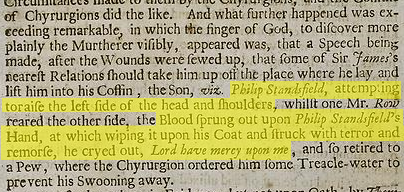
From A True Relation of a Barbarous Bloody Murther etc., available here.

The King’s Advocate insisted — over the objections of a defense attorney that “it was a superstitious observation, founded neither upon law nor reason” — that the corpse’s having bled on Philip Standsfield but none of the others in his party simultaneously attempting to move it “he must ascribe … to the wonderful Providence of God, who in this manner discovers murder.”

Divine forensics. That’s even better than the arson evidence Texas used to kill Cameron Willingham.

And it had the same result, to wit,

the said Philip Standsfield to be taken upon Wednesday next, being the 15th of February instant, to the Market-cross of Edinbrugh, and there, betwixt two and four o’clock in the afternoon, to be hanged on a gibbet till he be dead, and his tongue to be cut out and burnt upon a scaffold, and his right hand to be cut off and affixed to the east port of Haddingtoun, and his body to be carried to the Gallowlie betwixt Leith and Edinburgh, and there to be hanged up in chains; and ordains his name, fame, memory, and honours to be extinct, his arms to be riven forth and delete out of the books of arms …†

Well, you get the idea. Executed Today would like to apologize to the dempster of Edinburgh for keeping Philip Standsfield’s name, fame, and memory alive.

In our defense, we are hardly the only ones: this is thought to be the last time that Scottish law employed the bleeding-corpse “test”.

* Some other instances of purported “bleeding at the touch” may be perused here.

** In a 1927 piece in the Journal of the American Institute of Criminal Law and Criminology, Canadian jurist William Renwick Riddell says this folk belief “was wide spread and is not dead yet” and offers in a footnote (perhaps by way of explaining his interest) that “when at the Bar, I was once offered such evidence by my client; but I declined to use it.”

† The execution was botched, and the gibbeted body illicitly pulled down and tossed in a ditch — which is where the elder Standsfield’s had been discovered.

On this day..

1924: The first electrocutions in Texas

There is sweeping over Texas, as never before in her history, a wave of crime. Murder, theft, robbery and holdups are hourly occurrences that fill the daily press. The spirit of lawlessness has become alarming. Our loose method of dealing with violators of the law is in a large degree responsible for the conditions that today confront us.

-Texas Gov. Pat Neff, in a 1921 message to the state legislature.

It was just after midnight on this date in 1924 that the state of Texas first used its new electric chair, supplanting public hangings with a regime of private executions administered by the state.

Five men, all black, died in rapid succession on the new contraption. (Although witnesses, “sickened by the odor of burning flesh that filled the room, were given a brief respite” between the fourth and the fifth executions.) It was a half-year’s worth of backlog built up while the new death chamber had been constructed for the transition from county-level hangings.

Robert Perkinson’s Texas Tough: The Rise of America’s Prison Empire chronicles the evolution of that state’s prison regime after the Civil War in lucid, page-turning prose. We’re very grateful that he’s allowed Executed Today to mark the Lone Star State’s era of electrocutions with this brief excerpt from that book.


Although elected as a progressive, Pat Neff was the first Texas governor to make hard-fisted, no-nonsense crime fighting a central part of his political identity.

… Neff proposed tougher penalties for bootleggers, an expansion of the Texas Rangers, and the abolition of the state’s suspended sentencing law, an innovation enacted at the end of leasing. He also radically curtailed executive clemency. …

Walter Boyd, aka Leadbelly, was … caught in Neff’s clutches. “‘Dat man ain’ gonna tu’n you loose, ol’ Walter,'” his fellow convicts told him. “‘He wouldn’ tu’n his own mammy loose.'” … Leadbelly had tried everything but running to regain his freedom. Through hard work on the line, he had convinced a captain to request that his escape record be expunged, which under a different governor would have enhanced his chances of parole. About a year after his arrival at Sugar Land, Leadbelly’s father showed up carrying a “fat roll of bills.” He had sold the family’s last parcel of land and tried, rather brazenly, to buy his only son’s freedom, but the warden turned him down …

[Leadbelly] was well known as a musician. When he heard that Governor Neff was planning a personal inspection, he composed a special song. Neff was “a big, fine-lookin’ man,” he recalled, and “sho was crazy about my singin’ an’ dancin’. Ev’y time I’d sing a new song or cut a few steps he’d roll me a bran-new silver dollar ‘cross the flo'” Once his audience warmed, Leadbelly presented his unusual appeal.

Please, Governor Neff, be good and kind,
Have mercy on my great, long time.

With his boot tapping and strings blazing, the musician hit all the conventional clemency notes. He called himself Neff’s “servant,” pleaded on behalf of his wife Mary (in reality his girlfriend), lamented his thirty-year sentence, and even offered an oblique critique.

Some folks say it’s a sin,
Got too many women and too many men.
… In de pen.

Neff himself remembered the encounter almost as vividly. In his autobiography, The Battles of Peace, he painted the singer as a happy minstrel and himself as the benevolent master. “On one of the farms … was a negro as black as a stack of black cats at midnight,” he wrote. “This negro would pick his banjo, pat his foot, roll his eyes, and show his big white teeth as he caroled forth in negro melody his musical application for a pardon.” In his paternalistic way, the governor was moved, or at least amused. He announced that he would grant the supplicant’s request but in his own time. “Walter, I’m gonna give you a pardon,” Leadbelly remembered Neff telling him, “but I ain’ gonna give it to you now. I’m gonna keep you down here to play for me when I come, but when I get out of office I’m gonna turn you loose.” True to his word, the governor enjoyed Leadbelly’s high-spirited performances on command whenever he visited the lower farms, then set him free on his last day in office.


Lead Belly singing the prison blues song “Midnight Special”.

Few other convicts were as fortunate. Despite the costs to taxpayers, almost a thousand more convicts entered Texas prisons than were allowed to leave during Neff’s four-year reign. Inmates sentenced to death, most of them African Americans and Hispanics convicted of rape or murder, found especially little sympathy. Largely in response to lynching, which the governor condemned, Texas centralized the death penalty in 1923. Previously, every county had carried out its own executions, usually in the form of public hangings. Progressives hoped that by sequestering such events at the Walls, they would discourage mob sentiment and encourage reverence for “the majesty of the law.” But the site and method of execution did not alter its racial dynamics.

Following the lead of New York and other states, lawmakers also ordered prison officials to carry out executions by a new technique, one they perceived as “more modern and humane,” the electric chair. Huntsville officials thus built a new death house, the very same in use today, and by the end of the year a squat, straight-backed throne — soon christened Ol’ Sparky — was ready for operation. Governor Neff wasted little time in authorizing its use.

On a visit to the Walls in January, the governor stopped in to visit with five men he would soon send to their deaths. “A queer feeling creeps over you as you pass the death cell and pause,” he wrote. “They knew, and I realized, that I held within my hand the power to save them from the electric chair. How feeble were words, both theirs and mine, at such a time.” Not long after the governor departed, the men, all of them African American, ranging in age from twenty to thirty-nine, were approved for elimination.

In a dramatic gesture of conscience, Huntsville’s warden, R.F. Coleman, resigned his post only days before. “It just couldn’t be done,” he told reporters. “The penitentiary is a place to reform a man, not to kill him.” But a replacement was quickly found, and the Walls’ inaugural electrocutions went forward as scheduled. At nine minutes after midnight, the first condemned man, Charlie Reynolds, was escorted by two guards into the brightly lit death chamber. He blinked rapidly, reported a witness, was speedily strapped in the chair, and then stiffened violently when the new warden threw the switch. Within the hour, four other men met the same fate.

On this day..

1879: Takahashi Oden, dokufu and she-demon

On this date in 1879, Takahashi Oden was put to death for murder at Tokyo’s execution grounds — the last woman beheaded in Japanese history.

Oden confessed to slaying her lover, and was also suspected of poisoning off her husband.

This made her perhaps the most infamous of Japan’s dokufu, poison-women — a perceived epidemic of the early Meiji period. Oden’s infamy thrust her into the crime genre’s characteristic harvest pulp literature, like Takahashi Oden yasha monogatari. (Takahashi Oden, the She-Demon’s Tale)

“Oden’s body became part of a scientific discourse that worked to produce ‘knowledge’ about feminine norms based on determinist biological differences,” Sharon Chalmers observes. “Deviancy was also characterised in terms of ‘masculine’ traits … [and] female transgression was read as sexual excess.”

And the feeding frenzy of the popular press around each new dokufu only exaggerated the effect: the sexual rapacity angle moved media.*

Since Japan was all about divining the secrets of the human form from the condemned, Oden was dissected after her death.

According to Murder Most Modern: Detective Fiction and Japanese Culture, the anatomizing team was especially keen on delineating that scientific discourse of feminine deviance. And, of course, the pamphleteers were keen on publicizing it. In this case, standing as we do today outside the surgeons’ intellectual framework, we can readily discern the corpse’s role for these men as grist for the ideological mill.

Immediately following her execution, her body was taken to the hospital affiliated with the Metropolitan Police Office (Keishicho) and dissected by an army surgeon and three regular doctors. Some accounts of this autopsy reveal that these doctors focused their attention on Oden’s genitalia during the procedure. Her bizarre autopsy is said to have been prompted by a newly emerging field of study called zokaki ron, roughly “the study of (re)productive organs.” A cross between sheer superstition and legitimate study of anatomy, zokaki ron was getting much scholarly as well as popular attention as one of the branches of science recently introduced from the West. After the autopsy, the primary operating surgeon, Osanai ken (1848-85), made the following report on Oden: “Abnormal thickness and swelling of the labia minor. Over-development of clitoris. Enlargement of vagina.” For Osanai — a skilled physician who is credited with having performed the first operation in Japan with chloroform and even makes an appearance in Shibue Chusai (1916), a novel by Mori Ogai (1862-1922) about a doctor of Chinese medicine in late Edo period Japan — such physical abnormalities explained Oden’s violent nature: after all, she ruthlessly slit her victim’s throat and left him in a pool of his own blood, and it took several blows for the authorities to execute her as she kicked and screamed in resistance.


Autopsy of Takahashi Oden, from Takahashi Oden yasha monogatari.

Though a lot of water has passed under the bridge since Oden’s day, she was the subject of a 1958 Nobuo Nakagawa film, Dokufu Takahashi Oden.


Katsuko Wakasugi as the title character in Dokufu Takahashi Oden.

* For more on the Oden story as crime literature, see Mark Silver’s “The Lies and Connivances of an Evil Woman: Early Meiji Realism and ‘The Tale of Takahashi Oden the She-Devil'” in Harvard Journal of Asiatic Studies, June 2003 — or, his book Purloined Letters: Cultural Borrowing and Japanese Crime Literature, 1868-1937.

On this day..