1911: Sugako Kanno, radical feminist

On this date in 1911, Japanese anarchist writer Sugako (“Suga”) Kanno was executed for the High Treason Incident — the only woman ever hanged for treason in Japan.

Radicalized by suffering rape in her teens, Kanno was known for her discomfiting engagement with Japan’s unsettled “woman question.”

More to the point, she was one of the handful of the treason trial subjects who was directly involved in the actual plot to assassinate the emperor. (Her diaries are full of anguish for those tried with her who were merely guiltly by association.)

Kanno is often subsumed in retrospective accounts by Shusui Kotoku, the more famous male anarchist who was also her lover.

But Kanno was also one of her country’s first female journalists, first notable feminists … a prolific writer of fiction and nonfiction, and a radical intellectual in her own right.

Her voluminous diaries in the run-up to her hanging are reprinted in Reflections on the Way to the Gallows: Rebel Women in Prewar Japan.

[E]ven among anarchists I was among the more radical thinkers [she told her interrogators]. When I was imprisoned in June 1908 in connection with the Red Flag incident I was outraged at the brutal behavior of the police. I concluded that a peaceful propagation of our principles could not be conducted under these circumstances. It was necessary to arouse the people’s awareness by staging riots or a revolution or by undertaking assassinations … Emperor Mutsuhito, compared with other emperors in history, seems to be popular with the people and is a good individual. Although I feel sorry for him personally, he is, as emperor, the chief person responsible for the exploitation of the people economically. Politically he is at the root of all the crimes being committed, and intellectually he is the fundamental cause of superstitious belief. A person in such a position, I concluded, must be killed.

Succinct. Little wonder she admired Russian assassin Sophia Perovskaya … and that she shared Perovskaya’s fate.

She mounted the scaffold escorted by guards on both sides. Her face was covered quickly by a white cloth … She was then ordered to sit upright on the floor. Two thin cords were placed around her neck. The floor-board was removed. In twelve minutes she was dead.

-newspaper account

Sugako Kanno is profiled more extensively in Treacherous Women of Imperial Japan: Patriarchal Fictions, Patricidal Fantasies.

She was back in the news in 2010 when a long-hidden secret message of hers surfaced, corroborating the orthodox historical take that while Kanno was up to her eyeballs in a real plot to murder the emperor, Shusui Kotoku was not part of it.

On this day..

2000: Kasongo, child soldier

(Thanks to Meaghan Good of the Charley Project for the guest post. -ed.)

On this day in 2000, a 14-year-old boy from the Democratic Republic of the Congo was executed by firing squad only thirty minutes after his conviction by the Congolese Cour D’ordre Militaire, or Military Order Court. The teen, a child soldier known only as Kasongo, was found guilty with four other soldiers for the murder of a driver.

Amnesty International noted (pdf) that the DRC imposed the sentence in spite of the fact that it signed the International Covenant on Civil and Political Rights and the United Nations Convention on the Rights of the Child, both of which prohibit the death penalty for persons under the age of 18, and in spite of the fact that the DRC’s Minister for Human Rights had in 1999 promised a moratorium on executions.

Under Congolese law, those convicted by the Cour D’ordre Militaire can appeal to the President for clemency. Since Kasongo’s sentence was carried out so quickly, however, it’s doubtful the President heard his appeal.

In 2001, the DRC told the United Nations that all other child soldiers sentenced to death have been pardoned. Why Kasongo was excepted from this rule, no one knows. The military courts that convicted him were abolished in 2003.

On this day..

1640: Bishop John Atherton, buggerer

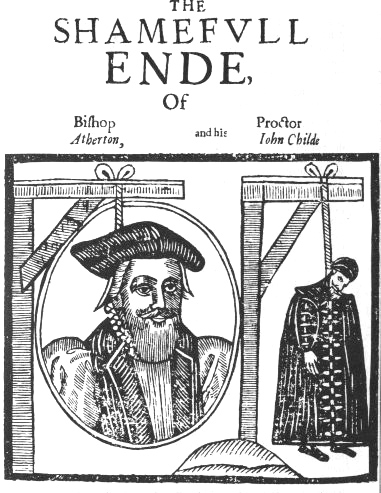
On this date in 1640, John Atherton achieved the unenviable distinction of being the only Anglican bishop hanged for buggery.* (His proctor, and alleged lover, John Childe, got the same treatment a few months later.)


Suppose a Devill from th’infernall Pit,
More Monsterlike, then ere was Devill yet,
Contrary to course, taking a male fiend
To Sodomize with him, such was the mind
Of this Lord Bishop, he did take a Childe
By name, not years, acting a sinne so vilde
-From the text of the pamphlet this image decorates

The Oxford-educated Englishman was appointed Lord Bishop of Waterford and Lismore by King Charles‘s hated governor Thomas Wentworth.

It may well have been the internecine politics of the day that claimed Atherton’s life, just as the civil wars they engendered in the ensuing decades claimed the original trial records.

While posterity is left to speculation, Atherton was defended in print in those years as well. (Defended as no homo, that is — not defended on principle against ubiquitous anti-gay laws.) If it wasn’t really a voracious sexual appetite (not exclusively same-sex**), goes this argument, it was intra-Protestant infighting, with Atherton’s successful clawback of land for the weak Irish Anglican church stepping on the toes of the local land barons who had recently expropriated it.

This politics outside the boudoir argument gets compelling treatment in Mother Leakey and the Bishop, a historical investigative thriller that links Atherton to a weird ghost story† in his native Somerset — that of “Old Mother Leakey,” the Minehead ghost.

Mother Leakey was Atherton’s mother-in-law, and Somerset family members claimed she haunted them — including with a message for the bishop that one of his sisters-in-law actually went to deliver in Ireland. The message isn’t known; in legend, this was a warning from beyond against the prelate’s ungodly behavior; in reality, it was more probably a family shakedown.‡

Despite the skepticism of the Leakey family’s own contemporaries, the facts, allegations, suppositions, and pure flights of fancy somehow managed to blend and recombine into a lasting tale of the paranormal that Minehead still retails to this day.

And it goes right back to the public opprobrium Bishop Atherton endured — as described in that 1641 hanging pamphlet:

“demonstrates the link between the stories of Mother Leakey and Bishop John Atherton … in a highly readable and often entertaining fashion”

… through pride, high fare, and lustfull life,
Incest committed with the Sister of his wife,
For which he sued his pardon, and then fled
To Ireland, where a worser life he led

He surely warned was to mend his life,
By his own Sister Master Leakies wife,
Which Master Leakies Mother being dead,
And in her life-time conscious how he led
His lustfull life, her Ghoast in gastful wise
Did oft appeare before her Sisters Eyes,
But she feare-strucken durst not speak unto it,
Till oft appearing forced her to doe it:
Then thus she spake, Mother in Law what cause
You from your rest, to my unrest thus drawes?
Who answered, daughter tis the wicked life
Your Brother leads, warne him to mend his life;
If not, then plainely tell him tis decreed,
He shall be hangd, bid him repent with speede:
Then shall my restless spirit be at rest,
And not till then; Thus vanisht. She addrest
Herselfe for travaile, Into Ireland went
With this sad message unto him was sent:
Which how he tooke to heart may plaine appeare
By the slight answer he returned her,
What must be, shalbe: If I must, I must dye,
Mariage, and hanging, come by destiny.
Thus scoft her counsell, sent her back, and when
Shee was returnd, he grew farre viler then
He was before, if Viler man may be,
For one bad Act before, committed three.

* According to Who’s Who in Gay and Lesbian History, Atherton and Childe were the second pair of alleged homosexual lovers executed in the British Isles. The first was the Earl of Castlehaven in 1631, along with his manservants.

** “[O]ne should note the compound sexual nature of the ‘sodomy’ charge in this context, a portmanteau omnibus of non-procreative sex, which is what ’sodomy’ was widely held to be.”

† Walter Scott footnotes this legend in Rokeby: “Mrs Leakey … dispatched her [daughter-in-law] to an Irish prelate, famous for his crimes and misfortunes, to exhort him to repentance, and to apprize him that otherwise he would be hanged; and how the bishop was satisfied with replying, that if he was born to be hanged, he should not be drowned.”

‡ Archbishop William Laud dispatched a team of ghost-whisperers to investigate the Leakey story well before the ectoplasm hit the fan for Atherton, and they weren’t buying: “certainly it is a fiction and a practice … it may be some money business.” Bishop Atherton had left home under a cloud with the suspicion that he’d had an affair with his wife’s sister, and this was part of the eventual Irish complaint against the horny goat.

On this day..

1896: Fred Behme, evangelical Methodist

On this date in 1896, McLeansboro, Ill. hosted its only hanging.

German emigre Fred Behme was settled into married life when he converted from Catholicism to Methodism.

Unfortunately — so Behme saw it — his wife Mary didn’t hew to the old cuius region, eius religio principle where the man of the house was concerned, and stuck with the bishop of Rome for the salvation of her immortal soul.

And there’s just something about the zeal of a convert.

Fred Behme’s domestic missionary work grew more violent (pdf), and eventually his battered spouse moved out; when Fred coaxed her back, and found out that she’d baptized their infant son into idolatrous Catholicism while living apart from him, he chose Easter Sunday to commit what one newspaper called “one of the most hideous and blood-thirsty crimes that ever stained the good name and honor of McLeansboro”: Fred got the other kids out of the house, he attacked Mary with an axe,

drug her by the hair into the yard, and beat in the side of her head. He covered the body with corn fodder. He then took the little boy [whom Mary had baptized] to the barn and hanged him by the neck until he died. (Source)

Though the hanging was invitation-only, it was visible from McLeansboro’s public square and large crowds gathered to witness the hirsute Protestant check out with a short speech in German.

Wikipedia alleges (without a clear source indication) that one G. Phil Hanna was among this multitude, and that seeing Behme strangle to death on an inexpertly deployed rope launched a lifelong interest in the hangman’s craft that would culminate when Hanna pinch-hit on the execution team that carried out America’s last public hanging 40 years later. Others of less august accomplishment no less vividly recalled their (and their town’s) one-time walk through the valley of death.


The family that prays together … (The perp is the bearded man; the victims are the woman seated next to him, and the child in her lap.)

On this day..

1977: Larry Tacklyn and Erskine Burrows, for the murder of Richard Sharples

On this date in 1977, Black Berets Larry Tacklyn and Erskine “Buck” Burrows were hanged in Bermuda for assassinating the islands’ police chief and governor.

“During the 1970s, a black power organization in Bermuda conspired to bring about social change ‘by any means necessary,’ including assassination. This is the first full account of the murders and the Black Beret Cadre, the revolutionary group whose activities resulted in mayhem throughout the island.”
Book’s advance publicity

A revolutionary black nationalist organization, the Black Beret cadre took its name from that Che Guevara photograph and its model from the Black Panthers.

The cadres’ agenda for early-1970s Bermuda

was ‘freedom by any means necessary’ which included assassination. Taking their cue from the Black Panthers, whose primary aim was to bait the ‘racist cops’, the Black Berets exhorted its members and all Bermudian youth to confront the ‘English racist police’ as frequently as possible and prepare for the coming conflict between blacks and whites …

Its purpose was to indoctrinate young black Bermudians in communist revolution and the ideology of Black Power.

Cadres Tacklyn and Burrows were one part liberators of their oppressed brothers, one part common criminals.

In 1972, they gunned down white police commissioner (a veteran of Britain’s colonies) George Duckett; in 1973, they ambushed governor (and former Tory M.P.) Richard Sharples and slew him, along with his aide-de-camp.

Neither perp was apprehended, which meant they went on to kill a couple of supermarket executives before someone I.D.’d Tacklyn. Burrows stayed on the lam long enough to rob a bank of $28,000.

The trials were a sensation — apt for the involvement of sensational Bermudian lawyer and politician Julian Hall — with Burrows convicted all around. He openly avowed the political murders.

Erskine Burrows

The motive for killing the Governor (his ADC was not our objective, he was shot only because he happened to be with the Governor at the time) was to seek to make the people, black people in particular, become aware of the evilness and wickedness of the colonialist system in the Island of Bermuda.

Secondly, the motive was to show that these colonialists were just ordinary people like ourselves who eat, sleep and die just like anybody else and that we need not stand in fear or awe of them.

Finally, the motive was to reveal to black people unto themselves.

This refers to the revealed reactions of many black people during the Governor’s funeral, when black people were seen to be standing with tears in their eyes, crying for a man who when he was alive didn’t care if they lived or died and here they were crying for a white Governor and yet when many of their own people pass away there is sometimes hardly a tear shed for them.

This shows clearly the evil effects that the colonialist propaganda has had over the long years they have ruled over this little Island.

Tacklyn managed to win acquittals over Duckett and Sharples but was condemned for killing the grocers. With “only” the two murder raps, Tacklyn’s appeals against execution might have stood a chance in other circumstances. But his affiliation with Burrows, who so openly avowed the other crimes and declined to mitigate them in court, “hung like an albatross around Tacklyn’s neck.”

That wasn’t the only thing that was hanging.

Massive riots rocked Bermuda after it became known that eleventh-hour clemency bids were rejected; “Fires erupted across Bermuda,” Reuters report, “causing millions of dollars in damage as a dusk-to-dawn curfew failed to halt the racial violence.” (Per Chicago Tribune, Dec. 3, 1977) British troops were deployed to help quell the riots.

Tacklyn and Burrows were the first people executed in Bermuda in 34 years, and remain the last executed there to this date.

Because all Britain’s overseas territories in the Caribbean subsequently abolished the death penalty (Bermuda in a contentious 1999 parliamentary dispute decided by a single tiebreaking vote), Tacklyn and Burrows also hold the distinction of being the last people put to death anywhere under British law. (As distinct from the last executed in Britain.)

On this day..

1539: Don Carlos Ometochtzin, Aztec heretic

On this date in 1539, the Spanish Inquisition had Aztec noble Don Carlos Ometochtzin (or Don Carlos Chichimecatecuhi, or Don Carlos Ahuachpitzactzin) burned at the stake for reverting to the pre-Columbian indigenous religion.

Just another Mesoamerican depredation?

Surprisingly, this execution stands out as an exception in the first generations of its conquest. It even cost the first bishop of Mexico, Juan de Zumarraga, a reprimand for his excess severity. Why?

Certainly any European Christian would have had trouble with the Inquisition if, like Don Carlos (Spanish Wikipedia entry | English), he had been caught with idols of Xipe Totec in his place.

But it was precisely the point that these weren’t Europeans. In 16th century “New Spain,” syncretisms of Christianity and the native Mexican cults still in living memory were the norm, a scenario recalling early Christianity co-opting the pagan rites it supplanted.*


Respect Xipe Totec’s authoritah!

And that created for the Spanish a problem: how stringently to insist upon an alien orthodoxy for its new subjects? The problem was pragmatic at least as much as it was theological, because the business of winning converts for Christ had to coexist with the business of running an empire. No sense provoking civil war just because the newest souls in the fold don’t have the Te Deum down; Cortes himself, in his initial conquest, had prohibited human sacrifice but not risked closing native temples.* That wasn’t done until 1525.

Over the 1530’s, a campaign unfolded to pare down the many holdover native behaviors — polygamy, idolatry — and cement Christianity. Of particular concern were the “converted” elites who had both means (their social position) and motive (privileges lost to the Spanish) to use nostalgia for the old ways to make trouble.

So, a powerful indigenous priest who “converted” and then went about preaching heretically was investigated by Zumarraga, wielding the Inquisitorial authority, in 1536.

But even that didn’t draw a death sentence.

In Zumarraga’s 19 Inquisitorial trials involving at least 75 suspects, the one and only instance of an Indian being “relaxed” to the secular authorities for execution came in 1539, when Zumarraga was tipped that the hereditary ruler of one of the Aztec Triple Alliance‘s principal city-states was a secret idolator, and a public declaimer of treasonable utterances like this:

Who are those that undo us and disturb us and live on us and we have them on our backs and they subjugate us? … no one shall equal us, that this is our land, and our treasure and our jewel, and our possession, and the Dominion is ours and belongs to us.

Don Carlos was ultimately acquitted of the idolatry stuff, but convicted of heretical dogmatizing.

So far, so good, right? Executions for heresy might be horrible in general, but if you live in a world where they’re routine, surely having your colonial satrap out there calling the empire parasitical, and telling the unwashed masses to go ahead and take multiple wives (Aztec elites seem to have been especially piqued by the lifestyle austerity preached by Franciscan missionaries) is the sort of thing that’ll get you burned at the stake.** And there were plenty more like him out there.

But though the Christianizing campaign of the 1530’s would continue in many forms for decades still to come, the bloodletting which Don Carlos figured to presage was abruptly canceled.

According to Patricia Lopes Don’s “Franciscans, Indian Sorcerers, and the Inquisition in New Spain, 1536–1543,” in Journal of World History, Vol. 17, No. 1,

[a] holocaust was most probably at hand in the spring of 1540. However, when the Council of the Indies in Spain learned of Don Carlos’s execution, they reprimanded Zumárraga, sent a visitador, an inspector-auditor, to New Spain to take away the bishop’s inquisitorial powers, and left him in a state of some humiliation until his death in 1548. All indications were that they feared further such executions would lead to widespread indigenous rebellion in New Spain. As was the case with the Muslims in the Old World, although orthodox Christianity was central to the concept of Spain and the monarchy, when the imperial Spanish needed to choose between religious orthodoxy and the security of the state, they could learn very quickly to be flexible and politique, yet express their concerns in judicious language. In a letter of 22 November 1540, Francisco de Nava, bishop of Seville, explained to Zumárraga that while he understood that he had executed Don Carlos “in the belief that burning would put fear into others and make an example of him,” the Indians, he suggested, “might be more persuaded with love than with rigor.”

When the Inquisition was formally instituted in New Spain in 1571, the native populace was explicitly outside its jurisdiction: its job was to monitor the European population for covert Protestants, Muslims, and Jews.

Although this development has to count as a break for the locals, it’s interesting to note that the theological superstructure of the Spanish policy tension between religious conformity and practical colonialism turned at least in part on a condescending dispute over the “capacity” of Indians to truly become Christian. In that dispute, Zumarraga and his Franciscan order were the ones who thought more highly of the indigenous “capacity”, as against the more skeptical Dominicans; the logical consequence of the Franciscan position was to impose upon those capacious natives the fullest severity of God’s law.

* Though not to be underestimated is the persistence within the citadel of Christendom of everyday folk beliefs, and occasional social movements, at odds with ecclesiastical dogma.

** Treasonous quote and details about the investigation and trial from Richard E. Greenleaf, “Persistence of Native Values: The Inquisition and the Indians of Colonial Mexico”, The Americas, Vol. 50, No. 3 (Jan., 1994)

On this day..

1903: Tom Horn

On this date in 1903, Tom Horn hanged in Cheyenne — a frontier legend lost in the post-frontier world.

Tom Horn passed the months between trial and execution braiding rope. Legend obviously holds that he made the noose that hanged him.

Horn‘s forty-three colorful years traced the waning days of the Wild West: he was a cavalry scout who helped capture Apache warrior Geronimo, a Pinkerton agent, a hired gun in the murderous Wyoming cattle wars. (He made a side trip to Florida during the Spanish-American War to organize Teddy Roosevelt’s supply train before the Battle of San Juan Hill.)

He had hunted many rustlers to their deaths, though he may have swung for a killing he didn’t do; the verdict against him in the murder of 14-year-old Willie Nickell is still hotly disputed to this day. It turned on a dubious liquor-induced “confession” as recorded by the lawmen who wanted to arrest him.

Horn’s death, to the hymn of “Life’s Railway to Heaven”, is a milestone in the passing of the frontier West; too, it was a milestone in a weird experimental cul-de-sac for modern America’s fascination with technological innovation on the scaffold. A contraption called the “Julian gallows,” named for the man who designed it, used the prisoner’s weight on the trap to open a water valve that filled a barrel that knocked over a post supporting the trap, causing the prisoner to eventually drop without any hangman’s hand on a lever.

A steady,* solitary man, Horn took it all in with equanimity. Maybe it was written: not for this rugged plains gunslinger to lurk on as a relic into the age of flight, cubism, trench warfare. Already in his lifetime the frontier had disappeared into kitsch.

Tom Horn lives on in Wyoming lore, and the tale has no greater curator than Wyoming’s Chip Carlson. Carlson manages www.tom-horn.com and is the author of Tom Horn: Blood on the Moon; he was good enough to chat with Executed Today about our day’s subject.

First things first — did Tom Horn actually do the crime for which he hanged?

Tom Horn was convicted because of social pressure (the fact that he represented the cattle barons) and the political ambitions of the prosecutor and presiding judge.

So what was different in Wyoming after Horn’s execution?

The cattle barons and other big business entities (e.g., mining barons, railroad barons, etc.) had much less influence on public affairs.

He seems like an almost self-consciously inscrutable character. What drove him?

He was a faithful and reliable employee, but seemed to thrive on adrenaline.

Was he just, at the end, a man who couldn’t change as his world changed around him?

Yes, he was out of date and out of the times.

Did people of his own time also see him as a part of the frontier West that was no more?

Yes.

How did you become so interested in Tom Horn? As the go-to expert on his life, what do you find draws others to him, and what sorts of lessons do people draw from his story?

He is the number one Name in Wyoming history, because of the controversies about whether he killed 14-year-old Willie Nickell (tom-horn.com page) and how his trial was conducted. (tom-horn.com page)

I had read every book published about him up till the time I started researching him, and when contrasting the various testimonies in the inquest with the trial, puzzled, how the hell could they have ever convicted him? All this is laid out in my book, Tom Horn: Blood on the Moon.

Two films about Tom Horn — Mr. Horn, starring David Carradine, and Tom Horn, starring Steve McQueen — were released within months of each other in 1979-80.

* His reported last words were coolly directed at one of his executioners who showed anxiety — “Ain’t losing your nerve, are you, Joe?”

On this day..

1999: Zarmeena

On this date in 1999,* a burka-clad woman known only as Zarmeena (alternatively, Zarmina … or in some early reports, Zareena) was executed by gunshot in Kabul’s Ghazi Sports Stadium.

This first public execution of a woman under the Taliban — ordered because she had supposedly killed her husband** — was secretly filmed by a Revolutionary Association of the Woman of Afghanistan activist smuggling a camera under her own burka.

Caution: This video is (in)famous enough, thanks to its inclusion in the documentary Beneath the Veil, that you’ve probably already seen it. But it’s still a graphic image of a woman shot through the head at point-blank range. (From around 2:20)

The book With All Our Strength: The Revolutionary Association of the Women of Afghanistan expands somewhat on RAWA’s calculations on this occasion, on the young activist who pulled off the risky filming, and on the purportedly hostile-to-the-Taliban crowd reaction.

* Some web resources give Nov. 17 as the date, but all the (admittedly limited) primary documentation available appears to me to point definitively to Nov. 16. RAWA, which shot the video, posts it with this date; wire copy that ran in western papers on Nov. 16 (here) and Nov. 17 (here) attributed the execution to Nov. 16.

** It’s not clear to me how dependable the information about the executee is; it’s said that she had been in prison well over a year but was rather suddenly executed for the Taliban’s exigent reasons of public intimidation. It’s also said that her husband’s family forgave her — which, under sharia as practiced by, e.g., Saudi Arabia, ought to have spared her life — and that Zarmeena herself may not have understood or believed that she was actually going to be executed until the very last moment.

On this day..

1676: Col. Thomas Hansford, the first American independence martyr

Col. Thomas Hansford was hanged “a loyal subject and a lover of my country” on this date in 1676 — America’s first executed political martyr, since that “country” was not England, but Virginia.

Robert Beverly‘s 1705 History of Virginia recalls the genesis of that milestone dispute between settlers and mother England.

The occasion of this rebellion is not easy to be discovered: but ’tis certain there were many things that concurred towards it. For it cannot be imagined, that upon the instigation of two or three traders only, who aimed at a monopoly of the Indian trade, as some pretend to say, the whole country would have fallen into so much distraction; in which people did not only hazard their necks by rebellion, but endeavored to ruin a governor, whom they all entirely loved, and had unanimously chosen; a gentleman who had devoted his whole life and estate to the service of the country, and against whom in thirty-five years experience there had never been one single complaint. Neither can it be supposed, that upon so slight grounds, they would make choice of a leader they hardly knew, to oppose a gentleman that had been so long and so deservedly the darling of the people. So that in all probability there was something else in the wind, without which the body of the country had never been engaged in that insurrection.

Four things may be reckoned to have been the main ingredients towards this intestine commotion, viz., First, The extreme low price of tobacco, and the ill usage of the planters in the exchange of goods for it, which the country, with all their earnest endeavors, could not remedy. Secondly, The splitting the colony into proprieties, contrary to the original charters; and the extravagant taxes they were forced to undergo, to relieve themselves from those grants. Thirdly, The heavy restraints and burdens laid upon their trade by act of Parliament in England. Fourthly, The disturbance given by the Indians.

Tobacco aside, these are grievances straight from the next century’s Declaration of Independence at the outset of the (more successful) American Revolution:

cutting off our Trade with all parts of the world:

… imposing Taxes on us without our Consent:

endeavoured to bring on the inhabitants of our frontiers, the merciless Indian Savages whose known rule of warfare, is an undistinguished destruction of all ages, sexes and conditions.

So, tax revolt + political self-determination + impatience about arrangements with Indians who could be wiped out instead. Eventually, this would germinate a mighty empire.

In 1676, it germinated a colonial rebellion against the mighty empire — Bacon’s Rebellion, an unsuccessful rising that is easily read in retrospect as a prototype for the more illustrious revolt one century later.

The suppression of Bacon’s Rebellion also involved a rash of executions, which we’ve touched on before. King Charles II would complain that his Virginia governor’s severity “has taken more lives in that naked country than I have taken for the murder of my father.”

The man dignified to be the first of these executions — and therefore, if you like, the first man put to death in the service of American liberty — was actually nabbed by our historian’s father, also named Robert Beverly, “a parson calculated to the Lattitude of the Servis, which required descretion, Curage, & Celerity, as qualetys wholly subservant to military affares.” (source)

snapt up one Coll: Hansford, and his party … It is saide that Hansford, at (or a little before) the onslaut, had forsaken the Capitole of Marss, to pay his oblations in the Temple of Venus; which made him the easere preay to his enemies; but this I have onely upon report, and must not aver it upon my historicall reputation: But if it was soe, it was the last Sacryfize he ever after offered at the Shrine of that Luxurious Diety, for presently after that he came to Accomack, he had the ill luck to be the first Berginian borne that dyed upon a paire of Gallows. When that he came to the place of Execution (which was about a Mile removed from his prisson) he seemed very well resalved to undergo the utmost mallize of his not over kinde Destinie, onely Complaineing of the manner of his death: Being observed neather at the time of his tryall (which was by a Court Martiall) nor afterwards, to suplicate any other faviour, then that he might be shot like a Soulder, and not to be hang’d like a Dog. But it was tould him, that whwat he so passionately petitioned for could not be granted, in that he was not condem’d as he was merely a Soulder, but as a Rebell, taken in Arms against the King, whose Laws had ordained him that death. Dureing the short time he had to live, after his sentance, he approved to his best advantage for the well fare of his soule, by repentance and contrition for all his Sinns, in generall, excepting his Rebelellion, which he would not acknowledg; desireing the People, at the place of execution, to take notis that he dyed a Loyall Subject, and a lover of his Countrey; and that he had never taken up arms, but for the destruction of the Indians, who had murthered so many Christians.

(A modernized, and less atmospheric, version of the same passage can be read here.)

Hansford’s story and the larger one of Bacon’s Rebellion are treated at second hand in several public-domain histories available online — see here, here, and here.

It also seems that, besides being the first martyr to American liberty, Hansford also had the distinction of being the first native-born Virginian (white Virginian, we presume) ever executed.

On this day..

1865: Henry Wirz, for detainee abuse

On this date in 1865, Henry Wirz was hanged in Washington, D.C. for running a notorious Confederate prison camp.

A Swiss-born doctor (“Henrich” was the real handle) whom time and tide found practicing in Louisiana at the onset of the Civil War, Wirz apparently got into the prison-guarding ranks when a war injury left him unfit for the front lines.

But it was front-line fitness in the northern army that would set the scene for his controversial hanging.

The North’s advantage in men and materiel shaped Union strategy as the war progressed, and it eventually caused the Union to halt prisoner exchanges. Exchanging casualty for casualty was a winning strategy on the battlefield, so why return to your enemy a man for a man? Besides,

[Grant] said that I would agree with him that by the exchange of prisoners we get no men fit to go into our army, and every soldier we gave the Confederates went immediately into theirs, so that the exchange was virtually so much aid to them and none to us.

Benjamin Butler (we’ve met him before)

As designed, then, the South began piling up more and more POWs to maintain with its ever-straitened resources late in the war. And if exchange was out, that really only left one form of “release”.


Andersonville Prison survivor John L. Ransom’s view of the prison, from the Library of Congress.

Andersonville — officially, Camp Sumter, located near the tiny Georgia town of Andersonville — was only established in 1864, but acquired considerable notoriety in northern propaganda for the year and change that Wirz ran it. The prisoners didn’t enjoy it much, either.

Wuld that I was an artist & had the material to paint this camp & all its horors or the tounge of some eloquent Statesman and had the privleage of expresing my mind to our hon. rulers at Washington, I should gloery to describe this hell on earth where it takes 7 of its ocupiants to make a shadow.

Union prisoner diary, July 1864. Note the prisoner’s anger at Washington — whose refusal to exchange naturally infuriated its stranded POWs

Out of some 45,000 prisoners held at Andersonville during its existence (not all at one time), nearly 13,000 succumbed to disease and malnutrition.* After the war, photos of wasted survivors inflamed (northern) public opinion, already tetchy over Abraham Lincoln’s assassination. Walt Whitman wrote of Andersonville,

There are deeds, crimes that may be forgiven but this is not among them. It steeps its perpetrators in blackest, escapeless, endless damnation.

Damnation is up to higher powers, of course, but the North wanted somebody to answer for Andersonville on this mortal coil. Lincoln’s successor Andrew Johnson overruled mooted charges against Confederate President Jefferson Davis and his Secretary of War James Seddon, leaving — in that great American tradition — Heinrich Wirz holding the bag.**

Shatner sighting!

The trial had an undeniable aspect of victor’s justice.† Even at the gallows, the Union guards chanted, “Wirz, remember Andersonville!” as the condemned man was readied for the noose, and then dropped. The hanging failed to break the man’s neck, and he strangled as the chant continued.

Southern efforts to reshape the story of Andersonville began in the lifetimes of Wirz’s contemporaries; this fulsome volume supporting the charges answered Jefferson Davis in terms that sound strikingly contemporary:

So long as Southern leaders continue to distort history (and rekindle embers in order to make the opportunity for distorting it), so long will there rise up defenders of the truth of history … To deny the horrors of Andersonville is to deny there was a rebellion. Both are historic facts placed beyond the realm of doubt.

But of course, it does not require denying the horrors of Andersonville to notice the circumstances — the privation of the entire South late in the war — and to wonder that Wirz and Wirz alone was held to account. Plenty of people think he got a bum rap.


Daughters of the Confederacy monument to Wirz. (cc) image from divemasterking2000.


Pro-Wirz marker in Andersonville, Ga. (Click for easier-on-the-eyes version, reading in part, “Had he been an angel from heaven, he could not have changed the pitiful tale of privation and hunger unless he had possessed the power to repeat the miracle of the loaves and fishes”). (cc) image from Mark D L.

Recommended for general reading: the UMKC Famous Trials page on this case, several of whose pages have been linked in this entry. A number of nineteenth-century texts by (or citing) Andersonville survivors are available from Google books, including:

Since this is a controversy of the Civil War — and one that can be engaged without having to get into that whole slavery thing — there have been thousands of published pages written about it, with many more sure to come in future years.

A few books about Henry Wirz and Andersonville

As an interesting aside, Civil War POW camps including Andersonville (but not only Andersonville) gave us the term “deadline,” which had a more startlingly literal definition in the 1860s — a perimeter beyond which prisoners would be shot on sight, which policy could make a handy stand-in for walls. Gratuitously killing an insane prisoner who crossed Camp Sumter’s “dead line” was one of the atrocities laid to Wirz, who we take it would not have been at home to the word’s decreasingly urgent appropriation in the wider culture.

* Wirz’s defense showed, to no avail, that the prisoners and the guards received the same rations, with similarly deleterious effects among both, and that the commandant was on record pleading with his superiors for more.

** Wirz’s attorney claimed that his man was offered (and refused to take) a last-minute pardon on November 9 in exchange for implicating Jefferson Davis.

† Wirz and borderlands guerrilla Champ Ferguson were the only Confederates executed for their “war crimes”. There was at least one other prison guard who faced similar charges of prisoner maltreatment, John Henry Gee; Gee was acquitted and released in 1866. (For more on the latter, see “A Little-known Case from the American Civil War: The War Crimes Trial of Major General John H. Gee” by Guénaël Mettraux in the Journal of International Criminal Justice, 2010.)

On this day..