On this date in 1848, a pregnant 20-year-old socialite and her forbidden lover were shot at the order of an Argentine dictator.
Virtually a lens for the contradictory currents of gender, class and power in her time, Camila O’Gorman was the daughter of an elite family of (as her name suggests) Irish extraction, and a bosom friend of the daughter of her future executioner, dictator Juan Manuel de Rosas.
She fell into a torrid affair with Gutierrez, the family priest, and in 1847 eloped with him, a grand gesture of romanticism that brought a government warrant for their capture to “satisfy religion and the law and to prevent further cases of immorality and disorder.”
A scandal, as one might suppose — there was much chatter over who seduced whom, and whether it was a kidnapping — but a manhunt (and womanhunt)? Rosas appears psychotically enraged by two young people crazy in love, and still more so for summarily decreeing their death when he had them in his clutches. Another priest, it turned out, handed them over — more in sadness than in anger, in the manner of such folk, but understanding deep down that the arbitrary law is the law and immorality and disorder don’t go about preventing themselves.
O’Gorman was the first woman executed in independent Argentina, and she was eight months pregnant: the better to “satisfy religion” (though not the law, which forbade the execution of a pregnant woman), O’Gorman’s unborn child was baptized … by making her mother drink holy water.
The lovers were then shot together at the town of General San Martín, then known as Santos Lugares de Rosas.
The pregnant O’Gorman, borne to her firing squad. The image comes from this Argentinian page (in Spanish) about the heroine.
Camila and Uladislao’s brave sense of freedom upset the structured norms of a society used to obeying through fear. Their only way of facing the tyrannical power was escaping from a society which would never understand. They did not give up on their love to please the Restorer [Rosas], as was expected in those days. They never showed signs of repentment, [sic] on the contrary their peaceful minds reflected their clean consciences.
…
And among the many questions this tragic true story might raise, there’s one that particularly appals [sic] us: why did Rosas shoot Camila knowing the law stated a pregnant woman could not be murdered? Was that baby guilty of his parents’ “crime”?
He evidently was, since by being born he would symbolise the testimony not only of the criminal act, but also the evidence of “disobedience” of a moral code imposed by a fearful dictator.
On the screen, O’Gorman and Gutierrez’s doomed love was the topic of one of the first Argentine feature films (a century-old silent film now thought lost), and an Academy Award-nominated 1984 film with plenty of talking:
On this date in 1963, the executioner paid his last call to Scotland with the hanging of Henry John Burnett for the murder of a rival-in-love seaman.
The type whom parents hope their daughter never dates, Burnett liked to keep his squeeze Margaret May Guyan under lock and key to keep her stepping out on him.
It’s an old, old tale. Boy meets girl, boy makes girl his prisoner, girl gets creeped out and returns to estranged hubby Thomas Guyan at 14 Jackson Terrace in Aberdeen, boy blasts Guyan in the face with a shotgun. How many times have we heard it told?
Even though the noose was on its way out — this is not only the last execution in Scotland, but the only hanging in Aberdeen in the past century and a half — there wasn’t much pussyfooting around when they’d made up their mind to use it: Burnett outlived his victim by only eleven weeks — notwithstanding an insanity plea and clemency petitions from both his own and the victim’s families — before hanging at Craiginches Prison, a facility that surely ought to be somebody’s porn name.
It’s got pride of place in a book about Aberdeen crime history, Blood and Granite. Because you can find anything on YouTube, there’s also this fine teaser for a forthcoming animation project of some kind:
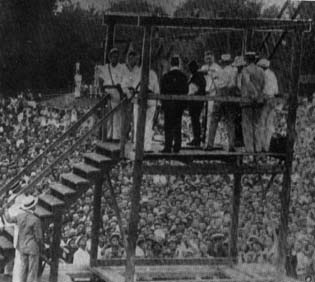
On this date in 1936, thousands thronged Owensboro, Kentucky, for a glimpse of what would prove to be the last public hanging in the United States.
The U.S. followed the trend of its onetime mother country, England, in moving the formerly iconic public hanging increasingly behind closed doors, but its federalist structure made that change uneven. In Kentucky itself at this time, the law displayed sedimentary layers of death penalty history.
Caught up for killing a 70-year-old woman — done in the midst of a drunken burglary, he had left a telltale ring at the scene; fingerprint analysis also helped establish his guilt — Rainey Bethea was on the hook for murder, robbery and rape. The former two indictments would have subjected him to (private) electrocution at the state penitentiary. The latter charge still carried the punishment of public hanging in the local county seat.
Bethea was charged only with rape.
While the explicit sentencing disparity between the crimes bears the clear marks of racism and patriarchy that made purported black-on-white sexual crimes such live fodder for lynch law, and the four-and-a-half-minute jury deliberation doesn’t have the look of solemnity, Bethea’s actual guilt seems fairly well-established.
But the case attracted a nationwide media swarm not for any exceptional quality of the crime or the anachronistic nature of the punishment, but for the involvement of a female sheriff. The “matronly” (virtually all descriptions of her gravitate to this adjective) Florence Thompson had inherited the top law enforcement post upon the death of her husband … and that meant she had inherited the responsibility of hanging Rainey Bethea, which would make her the first American woman to supervise an execution.
Would she or wouldn’t she? The press descended on Owensboro to cover the edifying spectacle of a plump mother stringing up a rapist, or else maneuvering her way out of the job. Thompson played cagey until the very last moment, when the ringers she had secretly hired appeared on the scaffold while she watched from a nearby vehicle.
In this photo, Bethea — almost totally obscured between his escorts — has just begun ascending the gallows.
The man who threw the trap showed up drunk and performed appallingly, but press reports subsequently focused on the beastly behavior of the “jeering” crowd rushing the gallows to tear souvenirs from the corpse. (For instance, Time and the New York Times.)
But according to Perry T. Ryan’s 1992 review of the case — including interviews with surviving witnesses — little to nothing of the kind occurred. Ryan claims Bethea faced about the most dignified hanging mob imaginable.
Maybe hyped-up atrocities in the hinterlands were part of what distant editors demanded after H.L. Mencken at the Scopes trial. Certainly, the local Messenger-Inquirer painted a sharply different picture from more prominent outlets in this August 16 editorial (titled “Panderers Galore”) whose themes could have stepped fresh from a modern cable TV gabfest:
Ambitious and irresponsible reporters and photographers who swarmed into Owensboro for the Bethea hanging dipped their ready hands into the cloaca of evil designs and plastered over the name of this fair city the dirty results of their pandering.
Those who saw the dawn kindling in the east and ushering in the last sunrise of the despicable creature about to die, did not expect all of the watchers to be in reverent mood, but a calm, quiet demeanor characterized their behavior, as a group, throughout their long wait, surprisingly moderate for an occasion on which the law was exacting the supreme penalty.
Considering the size of the throng that witnessed the hanging Friday morning and that it was composed largely of people, who journeyed to Owensboro from distant places, the wonder is that there was no demonstration, no emotional outburst. There was not the semblance of ‘mob impulse’ or ‘eagerness for the kill.’ For the sensation seeking star scribes of quacks of American journalism, it was entirely too tame an affair. This is the reason that some of them reported it as they wanted it to be — not as it was.
They heard a very few people on the outskirts of the crowd call out at different times: ‘Hurry up,’ ‘Get it over’ or ‘hang him.’ To give screaming bulletins to the yellow press and to ruthless radio commentators, they magnified and colored it into a scene of ‘great disorder’ though there was never a general outcry of any kind.
When a priest held up his hand from the scaffold for silence, as Bethea was about to go to his death, there was no ‘blood thirst’ mob ‘shouting and yelling.’ Present were several thousand, who came from near and far to see a man legally hanged for the most heinous crime ever committed in Daviess county, and several thousand more, who turned out to see how the rest would act. When that hand went up in a gesture for silence, the buzz of the multitude’s conversations died down till the fall of the proverbial pin could have been heard.
The smart scribes and sob sisters looked on. All they saw was a black man standing on a scaffold with a rope around his neck and a mass of people peering up at him. That was too tame, they would call it a ‘jeering’ throng. All they heard was the click of the trap door. That would not do. There would have to be ‘cheering.’ So they said there was. Then they heard cameramen from cities where nothing is cared about the horrible crime Bethea committed. They were bawling at officials to ‘move out of the way,’ to ‘give us a break.’ They had to have their souvenirs to show the half civilized readers of their yellow sheets. The boys and girls who had to tell the story needed more color to regale them with atrocious accounts of how the people behaved. They found a few individuals who had gone in the bizarre which inspired thundering headlines about ‘gayety’ and ‘carnival’ spirit.
In administering the last sacrament, the Rev. H. J. Lammers, of Louisville, made an opening in the hood. When the doctors pronounced Bethea dead, one of the attendants at the scaffold took a tag off the hood. Another then took a fragment and others, who were at arms length from the dead man, followed suit. The blunder of tearing off that tag gave the high powered thrill-writers their big opening. They pictured the crowd as tearing Bethea’s clothes from his body. The crowd was never in disorder and Bethea’s clothes were never torn.
The ‘souvenir hunting mob’ did not even pick up the sox [sic] and shoes the doomed man left at the foot of the gallows. It did not so much as touch the basket in which Agnew and Wheatley, colored undertakers, placed the body, clothes and all, or molest it or them in the slightest as they bore it away.
The scavenger writers who came to depict a ‘jolly holiday’ and ‘gala occasion’ had both, but they never saw a more orderly throng at a baseball game.
The public hanging of Bethea was not a disgrace to Kentucky. But, a disgrace to Illinois, Missouri, Tennessee, and some other states, was the spectacle made of it in their scandal monger press. Owensboro should not be surprised at the scurrilous attack upon it by lurid writers and glib tongued talkers in northern and eastern states for they delight to distort any news from Kentucky into weird barbaric tales. We have learned how best to protect our women from rapists-murderers, white or colored. The only way, it seems, that we will ever be able to protect them from the cruelties of a sordid section of the press, will be by softening the state’s anti-rape law, which makes public hanging mandatory. So many as favor that will please tell the legislature.
Vendors of news occupy an important place in the nation, and their purpose should always be to maintain unquestioned exactness of facts. Where the subject matter is susceptible to coloring there should be no sacrifice of truth. To pervert the high honor of the profession for the paltry reward of more readers is a dangerous venture and one that should be curbed.
Owensboro’s citizenry, than which no finer representatives of high-bred Americans can be found anywhere, regrets that it was necessary to invoke the Mosaic law, but a sobered regret and a more solemn memory is that the hanging was eagerly seized upon and transformed into a picturization of the exhibition of low passions loosed.
We are proud of our city, and justly so, for no people are of finer fiber. The putrid pens of those who wore the garb of the news profession painted in lurid colors purported happenings, and it is sad but true that such distorted reports are accepted while the plain statement of facts is discarded as an attempted apology.
Thousands of those who witnessed the Bethea hanging came from outside the county. They belonged to good families in their communities, temporarily bereft of their better judgment and bent on viewing a scene which ordinarily would be extremely repugnant to them. And the out-of-town reporters found in the visitors elements to embody in their sordid stories.
A thoughtless word here and there, expressed without cognizance of its probability of misuse, and the staid citizen away from home becomes to the wild-eyed correspondent a Kentuckian gunning for human game. There should be available means of calling to account the writer who for a few filthy shekels diverts his sense of justice into the recording of things that never were.
As the editorial intimates, regardless of what actually happened in Owensboro, the circus atmosphere quickly brought the matter of public hangings into question. In 1938, the Kentucky legislature moved all executions behind prison walls … and Bethea secured an indefinite claim to the status of last person publicly executed in the United States.
At 8 o’clock in the morning this date in 1964, two gallows traps 50 kilometers apart opened simultaneously — dropping the last two men England ever hanged.
The two twentysomethings had dropped by Evans’s former coworker’s place in the aptly-named port Workington to borrow money. Since the call was at 3 a.m. and the petitioners were armed, it might appear that they had in mind an offer that John Alan West couldn’t refuse. The reader is invited to fill in the rest: a quarrel, a murder, a stolen watch, a medallion dropped at the crime scene with one of the perps’ own names on it …
Three months later, they were on trial for their lives; a month after that, hanged by the neck until dead. If there is tragedy in these hapless thugs, it may be that either could possibly have saved the other by claiming sole responsibility for the murder; since each blamed the other, the jury ended up finding them equally culpable.
While the last hangings in Canada featured two unconnected men hanged together, the last in England had partners in crime hanged separately. Allen died at Liverpool’s Walton Prison; Evans was dropped at Manchester’s Strangeways Prison.*
And unlike the Canadian case, Evans and Allen didn’t die knowing they were likely the last.
Although hangings had slowed to a crawl in Britain — there were just two in 1963, and none in 1964 before this day — death sentences continued to be handed down. But the trend was toward abolition: the British Parliament suspended the death penalty for ordinary crimes late in 1965, and made the suspension permanent in 1969. The handful of exceptional crimes for which the gallows remained nominally available — treason, piracy, espionage — were never enforced as such before those statutes too were removed from the hangman’s jurisdiction by 1998.
On this date in 1978, a young Soviet girl’s desperate collaboration with the Wehrmacht caught up with a 55-year-old mother.
A village girl and the first in her family to go to school, young Antonina Parfenova was dubbed “Makarova” (after her father, Makar) by a teacher when the girl forgot or was too shy to say her surname. This childhood switcheroo would follow her into adulthood and ultimately buy her half a lifetime and a family to mourn her.
At 19, she had moved to Moscow when the German onslaught against the Soviet Union erupted, and like many young people in similar straits, she volunteered to help fight the Nazis. But as the front swept past her, she found herself in enemy territory, and was nabbed by the SS and persuaded to become the Germans’ executioner of Russians at Lokot, a village near the Ukrainian and Belarussian borders for which a short-lived Nazi-controlled “republic” was named.
A 2005 Pravda article (with a somewhat prurient concern over the young woman’s sexual incontinence) delves into her activities:
Usually Antonina Makarova was ordered to execute a group of 27 people, the number of partisans which a local prison could house. Death sentences were carried out on the edge of a pit half a kilometer from the prison. She never knew people whom she executed and they had no notion who the executioner was either. Antonina executed the first group of partisans being absolutely drunk and the girl could hardly realize what she was doing. She often kept clothes of those whom she killed if the things were good; she carefully washed them and heaped them in her room.
In the evenings after work Antonina loved to dress up and enjoy her time dancing with German officers together with other girls who came there as prostitutes. Antonina boasted she used to live in Moscow that is why other girls kept aloof from her.
At dawn, Antonina often came to the prison and peered into the faces of people whom she was to execute in the morning. The woman just did her job when executing people and believed that the war would write her crimes off.*
“Antonina Makarova” was implicated in some 1,500 executions, and formally charged in around 200 cases with identifiable victims. The KGB turned up scores of women of the right age with the right name, but none of them fit the bill: the real Makarova’s passport said “Parfenova.”
Not until 1976 did the case break, when a relative applying for a travel visa named her in a routine list of relatives. Now named Antonina Ginsburg — she had married a veteran and taken his name — she was living quietly in Belarus, but hardly in hiding: the pair attended parades and town functions in the honor accorded World War II survivors.
Viktor Ginsburg would be in for a bit of a shock.
Even 35 years after her spell with the Germans ended, the wounds of the Great Patriotic War were raw enough to spell her death in very quick order in Briansk, the capital of Lokot’s district. She was the last World War II traitor of any note executed in the Soviet Union, and according to this page, the only Soviet woman ever judicially executed by shooting. (I’d take that claim cautiously without more corroboration.)
The Pravda article cited above is about the only original English source readily available online; Russian speakers (or people prepared to grapple with an online translator’s inelegance) can read much more at her Russian Wikipedia page as well as here, here and here.
Update: Courtesy of Executed Today’s own Sonechka, a translation from this Russian story of Makarova’s daughter’s heartbreaking remembrance of a woman she only knew as a mother:
Pain, pain, pain … She spoiled the life of four generations … You would like to know whether I would take her back if she returned? I would. She is my mother after all… I really don’t know how to remember her — as if she’s alive or dead. According to the tacit law, women were not shot. Maybe she’s alive somewhere? And if not, tell me — I’ll finally light a candle for her soul.
(Candles in Orthodox churches are lit for “zdravie” — literally “good health, well being” — or “upokoi” — “peace of a soul.” The former is intended for living beings, the latter for dead ones.)
* This, at least, is what she told her interrogators.
On this date in 1993, the police chief of Casablanca was shot in Kenitra Central Prison for abuse of power.
Mohamed Mustafa Tabet (or Tabit) wasn’t exactly Captain Renault.
While Morocco still has prisoners on death row, Tabet’s was the first execution actually carried out in 11 years, and it’s the last execution in Morocco to date. He went on the rocket docket, just five months from his arrest to standing up against a wall.
To earn that rare distinction, Tabet exploited his official power to rape or sexually exploit hundreds of women. Tabet confessed to some 1,500 victims over 13 years; the minimum figure matches the 518 personal identity cards found in his apartment. (Also found: 118 video cassettes — many of them violent — and a computer list of his crimes.)
The “Tabet Affair” — actually called “Tabetgate,” proving that the United States retains the power of exporting ideas — opened a discomfiting window on gender and power in Morocco.
Webster University Prof. Don Conway-Long was in Morocco at the time researching gender and masculinity for his dissertation. His paper “Sexism and Rape Culture in Moroccan Social Discourse” (pdf) is probably the most illuminating readily-available English* document on the affair — and the many contradictory reactions it drew from contemporaries, and the pressure it put on the government to contain the fallout as “a morals case, instead of looking further into overall police corruption.”
Prof. Conway-Long was good enough to spare Executed Today a few minutes to explore power and gender in Morocco, then and now.
ET: The scale of the crime spree seems just unimaginable, that he could get away with victimizing hundreds upon hundreds of women.
DCL: And not that many came forward! It was just a couple of women. If it’s difficult to talk to rape and sexual assault survivors here [in the U.S.], it’s exponentially harder in Morocco.
You were in Morocco in the years leading up to this trial. What was the country like in terms of its gender outlook?
It’s more like our 1950’s in terms of the attitudes towards women. Some educated professors at one point were laughing at the idea that a man could be charged with raping his wife in the West. In some ways, attitudes in Morocco are maybe 20 years behind what we see in the West. We had that same conception in the 1950’s — Missouri actually finally changed that law in 1993. [See here and here -ed.]
Morocco was also probably one of the most liberal countries of the Muslim world in the sense of being more closely connected to the West. Morocco has had more openness, more tourism.
How did the Tabet case impact women’s position?
[In 1995,] about a year after I left, a battered women’s shelter was set up in Casablanca, the first one in Morocco. By comparison, our first shelters in the U.S. and U.K. were set up in 1971, 1972.
In 2004, they passed a new family law that changed a lot of the freedoms that women have — e.g., women can ask for divorce, and don’t have to obey their husbands.
But I have no idea if you can claim there’s any causal relationship between the discovery of Tabet’s crimes and these later events. At the time, some men thought he was this great sexual hero, very virile.
So what lies ahead?
The old king died in 1999; his son Mohammed VI is in there now and he’s young and more aware and one of the rising stars of the monarchs of the middle east, like the king of Jordan. His [Mohammed’s] head is on the right way, but running a country like this with so much variation — there’s 50% illiteracy, the Western Sahara conflict, a certain level of Islamist opposition, and around twenty political parties all the way out to the Communists.
So there’s no certain future, absolutely not.
As far as cases like Tabet’s — let’s hope it’s not happening still, but Morocco when I was there was a place where you pass six different kinds of uniforms walking down the street with Uzis that would be pointed at your body as you passed.
On this date in 1890 the iconic symbol of the American death penalty made its grisly debut upon the person of William Kemmler at New York’s Auburn Prison.
The long New World tradition of hanging condemned prisoners came under fire as a barbarism in the late 19th century, leading reformers to look for killing procedures less likely to result in a horrendously protracted strangulation or a midair decapitation. As Empire State Governor David Hill put it,
The present mode of executing criminals by hanging has come down to us from the dark ages, and it may well be questioned whether the science of the present day cannot provide a means for taking the life of such as are condemned to die in a less barbarous manner.
On this stage, Executed Today presents a rogues’ gallery of homo Americanus, the salesmen and swindlers who would help the U.S.A. ride the lightning.
The Dentist
A true renaissance man, Buffalo dentist Dr. Alfred Southwick, applied his active mind to the need to better kill a fellow, and soon hit upon an inspiration — that is to say, a town drunk hit upon an electrical generator and died instantaneously, and the observant Southwick said “eureka!”
Without the subsequent industry of this neglected gentleman, who added to his repertoire scientifically-minded electrical butchery of animals alongside political gladhandings to bring a flutter to a busybody’s heart, the Chair’s entire oeuvre of machismo-sadism might have missed the country altogether. Just imagine living in a world where New York had pioneered its other leading reform alternative: lethal injection.
(This, incidentally, is why the chair is a chair, and not a bed or a stake or a St. Andrew’s Cross: because the guy who thought of it spent all day administering his own tender mercies to seated penitents.)
The Plutocrats
As Southwick nagged his senator and shocked stray cats into the great hereafter, the gears of commerce strove relentlessly ever-onward. The business of America was ever business, and never more so than the Gilded Age.
And the business of killing people was about to become the biggest business there was.
The age of electricity was buzzing into incandescence, and two rival standards were at currents amped over eventual dominance of this stupendous industry. Thomas Edison’s earlier Direct Current (DC) standard was being challenged by Nikolai Tesla’s Alternating Current (AC), backed by the financial muscle of George Westinghouse.
Cheaper and more efficient, AC tilted the playing field against Edison. Seeing his days numbered, the Wizard of Menlo Park fought back the way any dinosaur industry would: dirty.
This clip of the electric demise of a circus elephant — don’t hit “play” if you’re not up for animal cruelty — is from some years later (Edison kept tilting at windmills and megafauna carcasses as his DC empire disappeared), but it’ll give a sense of the horrifying spectacle.
With the New York legislature’s embrace of Southwick’s seated voltage people-eater, Edison turned his PR gears on the state, demanding they adopt his competitor’s “deadlier” current for the contraption. And they did, reflecting a widespread belief inculcated by Edison’s experiments — as this New York Times article on an Edison crony’s public livestock-killing show in the days leading up to the advent of the electrocution law indicates:
The experiments proved the alternating current to be the most deadly force known to science, and that less than half the pressure used in this city for electric lighting by this system is sufficient to cause instant death.
After Jan. 1 the alternating current will undoubtedly drive the hangmen out of business in this State.
Too bad for Edison that the business he was really trying to kill was made of sturdier stuff.
The Alcoholic Vegetable Merchant
As the 1880’s wane, we come at last to our subject — in several senses of the term — an illiterate nobody of German stock who chanced to kill his common-law wife with just the right timing to join in a new kind of experiment.
William Kemmler mounted a “cruel and unusual punishment” appeal against his sentence funded by Westinghouse himself: no dice. Perhaps appreciating the odd foothold on history he was about to attain, he showed little worry as he entered the execution room and sat himself — “undoubtedly the coolest man in the room,” a journalist present reported.
The End of the Beginning
That reporter’s description for the New York Herald graphically captures humanity’s first horrible encounter with this “humanitarian” machine, beginning with the prisoner’s parting remarks.*
Doubtless he knew that his words will go down in history and he had his lesson well learned. He addressed his audience [in] a commonplace way and without hesitation.
…
“Well, gentleman, I wish everyone good luck in this world, and I think I am going to a good place, and the papers have been sa[yi]ng a lot of stuff that isn’t so. That’s all I have to say.”
And so with a parting shot at what he was good enough to refer to not long ago as “those d—d reporters,” William Kemmler took his leave of earth. The quiet demeanor of the man as he entered had made a strong impression on those in the room. His self-possession after his oratorical effort simply amazed them. He got up out of his chair as though he were anxious to try the experiment, not as though he courted death, but as though he was thoroughly prepared for it. …
There was no delay. Kemmler constantly encouraged the workers at the straps with “Take your time; don’t be in a hurry; do it well; be sure everything is all right.” He did not speak with any nervous apprehension.
Warden Durston leaned over, drawing the buckle of the straps about the arm. “It won’t hurt you, Bill,” he said, “I’ll be with you all the time.”
A minute later Kemmler said, “There’s plenty of time.” He said it as calmly as the conductor of a streetcar might have encouraged a passenger not to hurry.
…
Kemmler was pinioned so close that he could hardly have moved a muscle except those of his mouth.
The Warden took a last look at the straps. “This is all right,” he said.
“All right,” said Dr. Spitzka, and then bent over and said, “God bless you, Kemmler.”
“Thank you,” said the little man, quietly.
“Ready?” Said the Warden.
“Ready,” answered the doctors.
“Goodbye,” said the Warden to Kemmler. There was no response.
GAVE THE SIGNAL.
The Warden stepped to the door leading into the next room. It was then forty-three and one-half minutes past six o’clock by the prison clock. “Everything is ready,” said the Warden to some one hidden from view in the next room.
The answer came like a flash in the sudden convulsion that went over the frame of the chair. If it seemed rigid before under the influence of the straps, [it] was doubly so now has it strained against them.
The seconds ticked off. Dr. McDonald, who was holding the stopwatch, said “Stop.”
Two voices near him echoed, “Stop.”
The Warden stepped to the door of the next room and repeated the word “Stop.”
As the syllable [passed] his lips the forehead of the man in the chair [grew] dark [in] color, while his nose, or so much of it as was exposed, appeared a dark red.
There was very little apparent relaxation of the body, however. [A] fly lighted on the nose and walked about unconcernedly. The witnesses drew nearer to the chair.
“He’s dead,” said Spitzka, authoritatively.
“Oh, yes, he’s dead,” said McDonald.
“You’ll notice,” said Spitzka, “the post-mortem appearance of the nose immediately. There is that remarkable change that cannot be mistaken for anything else, that remarkable appearance of the nose.”
The other doctors nodded [assent]. They looked at the body critically for a minute and then Spitzka said, [“]oh, undo that now. The body can be taken to the hospital.”
“Well, I can’t let you gentlemen out of here until I have your certificates,” said the Warden.
FOUND SIGNS OF LIFE.
It was while this businesslike conversation was going on that Dr. Balch made a discovery.
“McDonald,” he cried, “McDonald, look at that rupture,” he pointed at the abrasion of the skin on Kemmler’s right thumb. In the contraction of the muscles the figurehead[?] scraped against it and removed the skin, and from that little [wound] blood was flowing-[an] almost certain indication of life.
A low cry of horror went through the assemblage.
“[Turn] on the current,” excitedly cried Dr. Spitzka. “This man is not dead.”
The crowd fell back from the chair, as though they were in danger. The Warden sprang into the closed door and pounded on it with his hand.
“Start the current!” he cried. As he spoke of fluid began to drop from Kemmler’s mouth and to run down his beard; a groaning sound came from his lips, repeated and growing louder each time.
It seemed [an] age before the card was again turned on. In fact it was just seventy-three seconds from the end of the first contact when the first sound was heard to issue from Kemmler’s lips, and it was not more than a half [minute] before the card was again turned on.
RECOVERING CONSCIOUSNESS.
But every second to that time the horrible sound from those groaning lips was becoming more distinct, [a straining] of the chest against the leather harness stronger and more evident.
The man was coming to life. The spectators grew faint and sick. [Men] who had stood over dead and dying [men] and had cut [men] to pieces without an emotion [grew] pale and turned their heads away.
One witness was forced to lie down while one of the doctors fanned him.
But [the end] came at last. There was another convulsion of the body, and … it became rigid with the rigidity of iron.
“That man wasn’t dead,” cried Spitzka excitedly. As he spoke the body twitched again. The electrician had given the current gain new alternation and now 2,000 volts [were] playing in short, successive shocks down Kemmler spine. The sound ceased with the first convulsion, but the fluid continued to trip from the mouth and down the beard, making the body a sickening spectacle.
“Keep it on now until he’s killed,” said one of the doctors. …
“Keep it on! Keep it on!” Cried Warden Durston through the door.
Silence reigned for a moment. A bell without began to [toll] solemnly. …
BURNED BY THE CURRENT.
Then from the chair came a sizzling sound, as of [meat] cooking on hand. Following it immediately a billow of smoke came from the body and filled the air of the room with the odor of burning hair.
There was a cry from all the members of the little group, and Warden Durston cried through the door leading to the next room to [turn] the current off.
More shocking — so to speak — papers ran the next day’s headline “Kemmler Westinghoused,” the verb “to Westinghouse” being another shameless Edisonian bid to stamp his marketing project onto the Queen’s English. This fine, rounded, archaic neologism the right sports anchor could resuscitate as a fresh synonym for thrashing, horsewhipping, poleaxing, or else (in greater justice) for moderation and decency as the only principal in the sordid affair that rejected death-dealing by electricity.
(Officially, Edison also opposed the death penalty. Like Dr. Guillotin, he was doing his part for humanity in the meantime … just with a little skin in the game. Did we mention the business of America is business?)
Official reviews for the “art of killing by electricity” were, ahem, mixed.
“They could have done better with an axe.”**
-George Westinghouse
“Strong men fainted and fell like logs on the floor.”
-New York Herald
“Revolting … a disgrace to civilization.”
-New York Times
“We live in a higher civilization from this day on.”
-Alfred Southwick
Books (remarkably numerous!) about the creation of the electric chair
It should, in fairness, be noted that the U.S. was not the only country (pdf) to mull an electrocution chair in the 19th century … but it was (and for a long time remained) the only one to actually use one.
* The Herald excerpt, along with several other articles from the same paper about the Kemmler execution, is here, but the text has obviously been generated from a scan with uneven results. As I do not have access to the originals, [bracketed] remarks in the excerpt indicate this author’s own interpretations or interpolations of seemingly mistaken transcriptions.
** Some sources make it “would have done better with an axe.”
On this date in 1676, two starkly contrasting women were executed for sorcery in Stockholm.
Anna Simonsdotter Hack — also known as “Tysk-Annika” — is the forgotten one of the pair, who played the expected role of a condemned witch and meekly gave herself over to the judgment. There were rewards for good behavior: Tysk-Annika had her head cleanly lopped off.
Malin Matsdotter, however, did not plan any reciprocal back-scratching with the men who came to kill her.
Accused by her own daughters of carrying their children — Malin’s grandchildren — to Satanic masses, “Rumpare-Malin” obstinately refused to cop to the charge. (Naturally, not confessing was a further indicator to the court that Satan was fortifying her defiance.) Without a confession, the authorities couldn’t assuage themselves by giving her the easy-ish death of decapitation; the law required burning at the stake.* A sack of gunpowder around the neck to speed things up was the best they could offer her.
Matsdotter maintained her innocence to the stake, frustrating the confessors, and when one of her daughters called on her to admit the crime, “she gave her daughter into the hands of the devil and cursed her for eternity.”
And maybe it worked. Judges may well have been wearying of the eight-year-old witch craze, but Matsdotter’s discomfiting end was the turning point; the cases dried up, existing sentences were overturned, and the clergy was summoned to draw a line under the proceedings by announcing from the pulpits that witches had been driven out of Sweden for good. Only one more witchcraft execution ever took place in Sweden — and that in 1704.
By the end of 1676, several of the most notorious accusers in the witch trials were being hunted for perjury by those very same courtrooms. Reportedly, Matsdotter’s daughter was herself executed for her fatal accusation.
* Previously, the law had not allowed a witchcraft execution without a confession, and in a notable case a few years before Matsdotter’s burning, two other women had escaped death by refusing to confess. Evidently, they closed that loophole.
On this date in 1794, the curtain — and the blade — fell on the Terror.
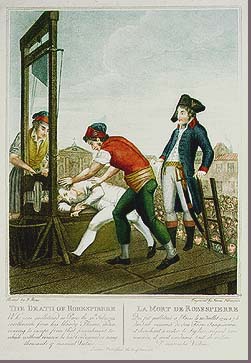
Maximilien Robespierre, who had breakfasted the previous day as master of France, was guillotined this evening with his chief lieutenants and partisans.
His fall came as sudden and inevitable as his rise had been unpredictable.
Five years before, Robespierre was an unprosperous Arras attorney of fashionably liberal philosophies, and you wouldn’t have given a sou for the prospects of his being remembered five minutes after he died. Yet it would come that his inseparable lieutenant Saint-Just would remark with understatement, “The words we have spoken will never be forgotten on earth.”
The historic convocation of the Estates-General thrust him onto the political stage where he would make the dread name that follows him, starting off in the Revolution’s inception as a far-left deputy. He took a notable early stand against the death penalty, with several arguments that are quite familiar by our day:
The first obligation of a legislator is to form and preserve public morals, the source of all freedom, source of all social happiness. When in running to a particular goal he turns away from this general and essential goal he commits the most vulgar and dire of errors. The king must thus present to the people the purest model of justice and reason. If in place of this powerful, calm and moderate severity that should characterize it they place anger and vengeance; if they spill human blood that they could spare and that they have no right to spread; if they spread out before the people cruel scenes and cadavers wounded by torture, it then alters in the hearts of citizens the ideas of the just and the unjust; they plant the seed in the midst of society of ferocious prejudices that will produce others in their turn. Man is no longer for man so sacred an object: we have a less grand idea of his dignity when public authority puts his life at risk. The idea of murder inspires less fear when the law itself gives the example and the spectacle. The horror of crime is diminished when it is punished by another crime. Do not confuse the effectiveness of a penalty with the excess of severity: the one is absolutely opposed to the other. Everything seconds moderate laws; everything conspires against cruel laws.
For Robespierre, it was an abomination for the nation to deal out death within its community, but his Rousseauan elevation of the collective and abstract People made extirpating existential threats to the community itself an altogether different matter.
The future tyrant’s anti-death penalty case for executing the deposed Louis XVI, flowing directly from those principles, makes interesting reading and is excerpted at length (all emphases added) here for its topicality:
When a nation has been forced to resort to the right of insurrection it returns to a state of nature as regards its tyrant. How can the latter invoke the social compact? He has annihilated it. The nation can preserve it still, if it thinks fit, in whatever concerns the interrelations of its citizens: but the effect of tyranny and insurrection is to break it entirely as regards the tyrant; it is to throw them into mutual war; the tribunals, the judiciary procedures, are made for the members of the city. … The right to punish the tyrant and that to dethrone him are the same thing. The one does not admit of different forms from the other. The tyrant’s trial is insurrection; his judgment is the fall of his power; his penalty, whatever the liberty of the people demands.
Peoples do not judge like judiciary courts. They pass no sentences; they hurl the thunderbolt. They do not condemn kings: they thrust them back into oblivion; and this justice is not inferior to that of courts. If they arm themselves against their oppressors for their own safety, why should they be bound to adopt a mode of punishing them which would be a new danger to themselves?
…
As for me, I abhor the penalty of death so lavish in your laws, and I have neither love nor hatred for Louis. Crimes only I hate. I have asked the Assembly, which you still call Constituent, for the abolition of the death penalty, and it is not my fault if the first principles of reason seem to it moral and political heresies. But if you never bethought yourselves to invoke them in favor of so many unfortunates whose offenses are less their own than those of the government, by what fatality do you remember them only to plead the cause of the greatest of all criminals? You ask an exception to the death penalty for him alone against whom it can be legitimate! Yes, the penalty of death generally is a crime, and for that reason alone, according to the indestructible principles of nature, it can be justified only in cases when it is necessary for the safety of individuals or the social body. Public safety never demands it against ordinary offenses, because society can always guard against them by other means and make the offender powerless to harm it. But a dethroned king in the bosom of a revolution which is anything but cemented by laws, a king whose name suffices to draw the scourge of war on the agitated nation, neither prison nor exile can render his existence immaterial to the public welfare: and this cruel exception to ordinary laws which justice approves can be imputed only to the nature of his crimes.
It is with regret that I utter this fatal truth. But Louis must die, because the country must live.
“Pity is treason.”
Months later, as head of the Committee of Public Safety — the Orwellian name harkens to the body’s power to judge who lay inside the community and who, lying outside, made war upon it — he would find an inexhaustible fifth column of kindred threats to the Revolution.
But Revolutionary France really was in a war for its survival, against external and internal foes alike. The monarchist for whom crime multiplied upon crime every day after the Tennis Court Oath has the easiest time of this period, for every step brings a new monstrosity. And it is well enough to call Robespierre illiberal, to shudder at his prim and icy persona.
But if the French Revolution’s liberte, egalite, fraternite is a legacy for celebration — as it is to much of the west, and much of the world — one must grapple with the place of this man and his methods.
Merely because they are the paths not taken, one hardly seems entitled to assume that at that tumultuous moment the rule of a constitutional monarchy heir to all the monstrosity of the ancien regime, the government of the Girondins who had launched the nearly fatal war against Austria, or that of Danton‘s haute bourgeoisie would necessarily have delivered France to a better place, or even a different one.
For a Dickens, Robespierre’s Terror is simply the appalling wrong turn of a high-minded movement. For Trotsky, “the Incorruptible”* is the admirable sword of France’s bourgeois revolution who effects the needful task of annihilating the feudal nobility, who presses fearlessly forward seeing that the only alternative is the slide into Bonaparte. Between the two lie many readings of the man.
Whether an aberration, a visionary, or a necessity, he waded a sea of blood for his frightening twins Virtue and Terror.
The fall of 9 Thermidor preceded Robespierre’s execution by a full — and very eventful — day. Arrested by the Convention, he was promptly liberated by his base in the Paris Commune which came within a whisker of overthrowing the Convention at that very moment. Instead, a frantic few hours of marshaling the armed power of the Revolution’s rival claimants to leadership ensued ending in a fray which saw the Robespierrists overpowered.
Robespierre was shot through the jaw in the process of signing an appeal to arms — some say a botched suicide, but a wound from the invading national guard is more generally believed; at any rate, the bloodied document with his signature begun “R-o-” is one of the age’s most arresting historical artifacts.
Horrifically injured, he lay most of the following day exposed for public derision before he was hauled with his party to the guillotine, re-erected in the Place de la Revolution for this most memorable execution. In Carlyle’s florid (and free) narration:
Robespierre lay in an anteroom of the Convention hall, while his Prison-escort was getting ready; the mangled jaw bound up rudely with bloody linen: a spectacle to men. He lies stretched on a table, a deal box his pillow; the sheath of the pistol is still clenched convulsively in his hand. Men bully him, insult him: his eyes still indicate intelligence; he speaks no word. … -O reader, can thy hard heart hold out against that? His trousers were nankeen; the stockings had fallen down over the ankles. He spake no more word in this world.
…
Fouquier had but to identify; his Prisoners being already Out of Law.** At four in the afternoon, never before were the streets of Paris seen so crowded. From the Palais de Justice to the Place de la Revolution … it is one dense stirring mass; all windows crammed; the very roofs and ridge-tiles budding forth human Curiosity, in strange gladness. … All eyes are on Robespierre’s Tumbril, where he, his jaw bound in dirty linen, with his half-dead Brother, and half-dead Henriot, lie shattered; their “seventeen hours” of agony about to end. The Gendarmes point their swords at him, to show the people which is he. A woman springs on the Tumbril; clutching the side of it with one hand; waving the other Sibyl-like; and exclaims: “The death of thee gladdens my very heart, m’enivre de joie;” Robespierre opened his eyes; “Scelerat, go down to Hell, with the curses of all wives and mothers!” — At the foot of the scaffold, they stretched him on the ground till his turn came. Lifted aloft, his eyes again opened; caught the bloody axe. Samson wrenched the coat off him; wrenched the dirty linen from his jaw: the jaw fell powerless, there burst from him a cry; — hideous to hear and see. Samson, thou canst not be too quick!
Samson’s work done, there bursts forth shout on shout of applause. Shout, which prolongs itself not only over Paris, but over France, but over Europe, and down to this generation. Deservedly, and also undeservedly. O unhappiest Advocate of Arras, wert thou worse than other Advocates? Stricter man, according to his Formula, to his Credo and his Cant, of probities, benevolences, pleasures-of-virtue, and such like, lived not in that age. A man fitted, in some luckier settled age, to have become one of those incorruptible barren Pattern-Figures, and have had marble-tablets and funeral-sermons. His poor landlord, the Cabinet-maker in the Rue Saint-Honore, loved him; his Brother died for him. May God be merciful to him, and to us!
* Even his enemies agreed — sometimes adding it to the bill of particulars against him — that Robespierre lived a life of personal moderation; he lived as a boarder with a working-class family, and disdained to avail the politician’s typical harvest of political graft.
** The Convention had decreed Robespierre’s outlawry when he escaped custody; his immediate execution was, of course, akin to the logic he had once turned against the king.
July 27th, 1794 — the 9th of Thermidor, year II — is inscribed in history as the day Robespierre fell, when a parliamentary coup d’etat between the right and the remnants of the parties he had destroyed shouted him down as he readied the National Convention for his next purge.
This scene from the multinational bicentennial epic La Revolution Francaise conflates the events of 8 Thermidor — when Robespierre delivered a menacing two-hour address but provoked outcries by failing to name the deputies he implicated in “conspiracy” — and 9 Thermidor, when Robespierre’s lieutenant Saint-Just was shouted down from the podium and Robespierre ended up staggering through the benches appealing against the imprecations of his colleagues as his arrest is decreed.
Even as the month of Thermidor’s eponymous epochal event was unfolding, the daily gears of Revolutionary justice were turning: the usual haul of unfortunates condemned, including seven women from the previous day’s batch of Saint Lazare prison conspirators who had pled their bellies to buy a day.
That day was one day too little.
Stanley Loomis is overtly hostile to the Revolution, but his middlebrow sensibilities are well-tuned for the pathos of the scene:
Indifferent to the storms that were raging in the Convention, the Revolutionary Tribunal continued to go about its implacable business with cold efficiency. The arrest of its President [the Robespierrist Rene-Francois Dumas (the link is French), who was taken in the courtroom] startled no one. Since its inception that court had been witness to too many dramas to be astonished any further. Dumas quietly departed; the trials continued. Forty-two prisoners were sentenced to death. By four o’clock their hair had been cut and they were ready to be sent on their way. But Samson, aware of disturbances in the St. Antoine quarter of the city, suggested to [prosecutor] Fouquier[-Tinville] that the executions be deferred until the morrow.*
“Justice must take its course,” snapped the Public Prosecutor. “Do your work.”
And so the last “batch” lumbered off in the direction of the Faubourg St. Antoine and the Place de la Nation. With the exception of the Princesse de Monaco, they were nearly all obscure and humble members of the petite bourgeoisie. Hanriot, waving his sabre, conducted the procession to the place of execution. By seven o’clock that evening, as the minutes of the military escort poignantly show, the unfortunate victims, who had been so close to deliverance, had all been executed.
Henriot proceeded directly from his escort service to the Convention to liberate Robespierre for the night’s brief pitched battle against the Convention, and here we take our leave of them, for now. We shall meet both of them on the scaffold tomorrow.
Not on the wagon** with the Princess of Monaco was a man whom Loomis would have pitied rather less.
The bloated, penniless 54-year-old fruit of an ancient noble house, Donatien Alphonse François de Sade, Marquis de Sade had, in the most recent chapter of his astounding career, navigated the Revolution in the improbable guise of a proletarian section head and revolutionary tribunal judge, until his own arrest late the previous year.
This day, de Sade’s name was on a list of prisoners to be seized from Madelonnettes Prison — “Sade, former count, captain of Capet’s guards in 1792, has corresponded with enemies of the republic,” it said — which he had occupied until a recent transfer to Picpus, a monastery converted into a prison adjacent to the guillotine’s place at the Place de la Nation. Whether the result of another of the many bureaucratic snafus we’ve witnessed this week or a well-placed bribe from his friend and/or mistress Marie-Constance Quesnet, the guards were in the wrong place, didn’t find him, and didn’t care to dig any further.
Three months later, he was — for the last time in his life — a free man.
One could hardly say that the Revolution made the author of Justine the man he so (in)famously was — but having lived within sight of the blade that might any day be called upon to chop off his own head, and the entire tableau of the years preceding, left their impression. Hundreds of bodies from the Terror were stuffed in the unpropitious clay of the makeshift jail’s yards under de Sade’s cell. “Those few months in the shadow of the guillotine did me more harm than all the years of my incarceration under the King,” he wrote a friend.
strangely mixing real memories with very Sadean embellishments … Plots, betrayals, denunciations, beheadings: these fictional motifs and Sadean phantasies are linked with the reality and the imaginary of the Revolution.
Good for what ails you.
* Sanson’s diaries — a memoir of the family business constructed by the famous executioner’s grandson — leave off before the events of Thermidor and suggest that the hecatombs of the Terror were taking their toll on the aging headsman. Other accounts of this day have the tumbrils stopped in the streets by clemency-inclined onlookers, only to be forcibly extricated by Henriot.

 Virtually a lens for the contradictory currents of gender, class and power in her time, Camila O’Gorman was the daughter of an elite family of (as her name suggests) Irish extraction, and a bosom friend of the daughter of her future executioner, dictator Juan Manuel de Rosas.



 A village girl and the first in her family to go to school, young Antonina Parfenova was dubbed “Makarova” (after her father, Makar) by a teacher when the girl forgot or was too shy to say her surname. This childhood switcheroo would follow her into adulthood and ultimately buy her half a lifetime and a family to mourn her.


 Robespierre lay in an anteroom of the Convention hall, while his Prison-escort was getting ready; the mangled jaw bound up rudely with bloody linen: a spectacle to men. He lies stretched on a table, a deal box his pillow; the sheath of the pistol is still clenched convulsively in his hand. Men bully him, insult him: his eyes still indicate intelligence; he speaks no word. … -O reader, can thy hard heart hold out against that? His trousers were nankeen; the stockings had fallen down over the ankles. He spake no more word in this world.