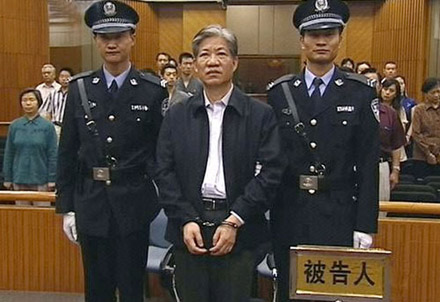
One year ago today, China made to clean up its image — with public health advocates, if not with human rights advocates — by executing* its former Food and Drugs minister for economic crimes.
Zheng Xiaoyu, China’s drug regulation capo from 1994 to 2005 and only (“only”?) the fourth minister-level official to be put to death in China since the immediate aftermath of Mao Zedong’s reign, was sentenced for extracting bribes from pharmaceutical companies he nominally regulated in exchange for approving their worthless and/or unsafe products.
One bogus antibiotic he rubber-stamped killed ten in China before it was pulled from the market, but it was dangerous Chinese products exported abroad — including lethal pet food ingredients to the United States and a cough syrup that killed dozens in Panama — that lit a fire under the export-driven colossus. The court that rejected his appeal explicitly referenced Zheng’s danger to China’s international reputation — simultaneously shifting focus from structural weaknesses by individualizing them to Zheng’s personal failings.
On this same day it announced Zheng’s death, China anxiously unveiled plans to safeguard the food supply for its upcoming turn under the Olympic klieg lights. That acid test is now upon it: opening ceremonies are mere weeks away as of this writing.
It may have been a politically-driven execution and an unusually heavy sentence, but Zheng’s passing was exulted in China. Someone even tried to put his name on a rat poison — rejected for that most distinguished reason of modern capitalism, Zheng’s own intellectual property in his name.
For an interesting dive into the social and legal currents surrounding this case, check out this .pdf edition of Criminal Bar Quarterly.
* The method of execution was not announced, and to my knowledge has not been conclusively documented. Gunshot was the longtime standby for Chinese executions, but China has shifted heavily towards lethal injection in recent years; it’s generally assumed that Zheng suffered the latter fate.
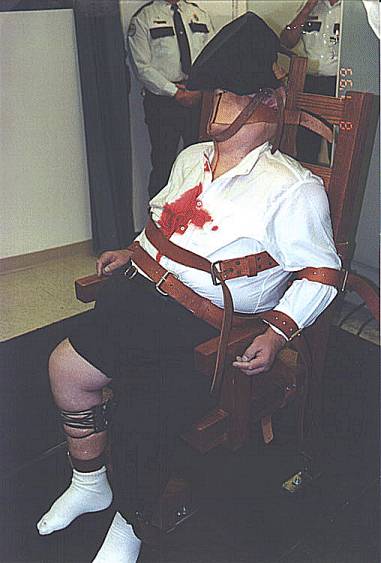
On this date in 1999, America’s obesity epidemic met Florida’s death penalty politics in the ugly electrocution of Allen Lee “Tiny” Davis.
The reader will discern that Tiny earned his nickname ironically. Reportedly 159 kg (350 pounds) at his death, he’d put his ample heft to work bludgeoning a pregnant mother of two beyond recognition with a revolver handle back in 1982 … and then shooting to death the now-motherless two.
As his appeals meandered through the courts, Davis got fatter — and got high blood pressure, arthritis, hypertension and a wheelchair. Meanwhile, the death penalty was meandering its own way across the weird political chessboard of the Sunshine State.
For the American death penalty nowadays, it’s Texas and then everyone else … but time was that Florida was the capital of capital punishment.
It conducted the first “modern” involuntary execution in 1979. It had carried out three executions before anyone else had more than one. And when the the drip-drip-drip pace of one or two execution nationwide per year in the early 1980’s finally burst into a torrent, Florida led the way with eight of the 21 executions in 1984.
Not until late in 1986 did Texas overtake Florida in the body count sweepstakes.
Law-and-order Tampa mayor Bob Martinez won the governorship in 1986 on the promise that “Florida’s electric bill will go up.” There was a high-profile botch in 1990, and another in 1997 — flames shooting from the inmates’ heads. What was the state’s Attorney General going to do about it? “People who wish to commit murder, they’d better not do it in the state of Florida because we may have a problem with the electric chair.” Under pressure to move to lethal injection — the chair’s unsightly malfunctions were spawning legal and public relations nightmares that were gumming up the gears — the legislature voted nearly unanimously to keep Old Sparky.
And then along came a giant.
After three-quarters of a century and 266 jobs, Old Sparky was “falling apart” … and that was going to be a problem for a man of Davis’ carriage.
The killer’s lawyers argued that Davis was so fat he couldn’t conduct electricity efficiently and would be slowly cooked to death. According to Slate, Florida authorities were nervous that he’d break the chair during his electrocution and send a disconnected live cable scything into someone else in the room.
And it worked, in that it killed Tiny. But what a mess — especially when an ensuing Florida Supreme Court opinion once again upheld the constitutionality of electrocution, and a dissenting judge attached the photos on this page to his opinions. Naturally, they became a grisly Internet sensation.
Old Sparky’s custom-built successor would only manage this single execution before Florida finally got on the lethal injection bandgurney.
Or at least, it’s only managed one so far. Old electric chairs don’t die, they just fade away … and in Florida, Tiny Davis’s chair remains available for condemned prisoners who choose it. Since this date in 1999, none have.
On a sweltering July 7, 1865, a mere 12 weeks after Abraham Lincoln was shot at Ford’s Theater, four of his assassin’s accomplices were hanged in the courtyard of the District of Columbia’s Washington Arsenal — present-day Fort McNair, and specifically its tennis courts.
Booth, on the far left, playing Marc Antony in Julius Caesar opposite his brothers. He had Brutus’ example in mind, as he wrote in his diary while on the run: “with every man’s hand against me, I am here in despair. And why? For doing what Brutus was honored for.”
The exact nature of the conspiracy against the man who had seen the North to victory in the Civil War has been debated ever since actor John Wilkes Booth lodged a ball from his one-shot Derringer behind Honest Abe’s ear. But it was a conspiracy — an astoundingly bold one.
Simultaneous with Booth’s successful attack upon Lincoln, there was an unsuccessful attempt to kill Secretary of State William Seward; it would emerge in the investigation that another man had been detailed to murder Vice President Andrew Johnson, but got drunk and chickened out. The apparent upshot: with the President and Vice President dead, new national elections would be required to replace the Senator who would become acting president — and with the Secretary of State dead too, there’d be nobody to implement them. Booth was trying to paralyze the North with its own constitutional machinery in some desperate hope of reviving the defeated South.
Ten Against D.C.
Hundreds were detained in the stunning assassination’s immediate aftermath, but ten would ultimately be the federals’ targets. A massive manhunt pursued Booth through southern Maryland and into Virginia, where he was killed in a shootout. John Surratt, who had conspired with Booth in an earlier plot to kidnap the president — that failed plot had been reconfigured into the assassination — escaped from the country.
The other eight were rounded up and stashed at the Arsenal to face a military tribunal. It was a highly controversial arrangement: the war had entered a gray area — Robert E. Lee’s surrender just days before the murder had effectively ended the war, but when the trial opened in May Confederate President Jefferson Davis was still at large, and the last Southern general wouldn’t lay down his arms until late June. The District of Columbia was still technically under martial law … so would it do to use a military court?
Military Tribunal
So the government asked itself: government, would you rather have looser evidentiary rules and a lower bar of conviction than you would have in civil court? The government duly produced for the government an opinion that the military characteristic of the assassination — that is, to help whatever southern war effort still obtained — licensed the government to use the military courts.
That didn’t sit well with everyone. One former Attorney General griped:
If the offenders are done to death by that tribunal, however truly guilty, they will pass for martyrs with half the world.
Indeed, a year later, the Supreme Court’s landmark ex parte Milligan ruling would forbid the use of military courts where civilian courts are open — which they were in Washington, D.C.
That, of course, was too late to help Booth’s comrades. It would be a military trial, with a majority vote needed for conviction and no right of appeal but to the president for the most infamous crime of the Republic. Everyone had a pretty good idea what the results would be.
Rogues’ Gallery
Two of the four today were doomed from the outset under any juridical arrangement imaginable: Lewis Powell (also known as Lewis Paine or Lewis Payne) had made the attempt on Secretary of State Seward; David Herold had guided him there with the getaway horse, and later escaped along with Booth. They were in way past their eyeballs. George Atzerodt, the schmo who couldn’t rise to the occasion of popping Andrew Johnson, looks a bit more peripheral from the distance of a century and a half, but in the weeks following the assassination he was much too close to the action to have any hope. All received death sentences.
Two others — Michael O’Laughlen and Samuel Arnold — had been involved in Booth’s earlier scheme to kidnap the president, but didn’t seem to have much to do with the murder. Still another two — Ned Spangler and Dr. Samuel Mudd* — were lesser participants. They all received long prison sentences for their pains, and the three of them still surviving were pardoned by Andrew Johnson as he left the presidency in 1869.
That left Mary Surratt, mother of the fugitive John and the only woman in the dock, the focus of attention and controversy. The 42-year-old widow owned a downtown boardinghouse, plus a tavern of sufficient importance at a Prince George’s County, Maryland, crossroads, that its community was called Surrattsville.**
The conspirators met frequently in her lodgings; Surratt maintained her innocence beyond that, but evidence and witness testimony began to pile up heavily against her … especially when Seward assailant Lewis Powell wandered into her place looking for refuge right while the police were questioning her. Booth and Herold turned out to have made a pit stop at her Surrattsville tavern to pick up a package of guns that Mary had prepared for them.
Though Surratt’s avowal of ignorance was not widely believed, a gesture of presidential mercy was anticipated — many thought (and think) she went on trial as a virtual hostage for her absconded son, who declined to take the bait. Strangely, five members of the nine-judge panel who condemned Mary Surratt turned around and asked President Johnson for clemency. Johnson claimed never to have seen the memo, but his mind seemed pretty made up — when Surratt won a habeas corpus stay on the morning of her scheduled hanging, he promptly “specially-suspended” the writ specifically to hang her:
I, Andrew Johnson, President of the United States do hereby declare that the writ of habeas corpus had been heretofore suspended in such cases as this; and I do hereby specially-suspend this writ, and direct that you proceed to execute the order heretofore given upon the judgment of the Military Commission.
Harsh treatment, and possibly well-deserved, for the first woman executed by the U.S. government. Even so, it does seem a curious thing when all is said and done that the mother of “the nest that hatched the egg” was worth a special suspension of the Great Writ, and even the stagehand who just held Booth’s horse for him caught six years, but old Jeff Davis — who apart from having figureheaded a treasonous four-year insurrection was implicated for giving Booth’s kidnapping plot official Confederate sanction — got to retire to write his memoirs.
The Surratt houses, by the way, are still standing. The Maryland tavern is kept as the Surratt House Museum by the Surratt Society. The downtown boarding house is a Chinese restaurant … marked with a plaque remembering more momentous doings than bubble tea.
* The panel voted 5-4 to hang Mudd, a Maryland doctor who not only set the leg Booth broke when he leaped onto the stage after shooting Lincoln, but then misdirected Booth’s pursuers. However, the rules for the trial said a two-thirds majority was required for execution.
** They changed the name after the unpleasantness. Today, it’s Clinton, Maryland.
On this date in 1535, Sir — later Saint — Thomas More kept his conscience at the expense of his head on Tower Hill.
For all More‘s greatness — as intellectual, polemicist, lawyer, statesman, father — none of his many gifts at the end could avail him beside his commitment to Catholicism at the dawn of the English Reformation.
Yet it is for those gifts that he cut such a commanding presence in his times, for those very reasons that his sovereign hounded his first citizen to assent to the divorce and remarriage he was fixed upon.
A devotee and friend of Erasmus from years before, More was in Henry’s more orthodox youth the king’s very scourge of Protestantism. His scatological invective against Martin Luther in Responsio ad Lutherum — much in the impolite tenor of Catholic-Protestant rhetoric continent-wide, it should be noted — is of the sort to crimson the cheeks of the milquetoast modern:
Since he has written that he already has a prior right to bespatter and besmirch the royal crown with shit, will we not have the posterior right to proclaim the beshitted tongue of this practitioner of posterioristics most fit to lick with his anterior the very posterior of a pissing she-mule until he shall have learned more correctly to infer posterior conclusions from prior premises?
Over that hairshirt, he wore the robes of state. But his engagement with the world had a selective bent that must have exasperated his colleague and predecessor as Lord Chancellor, Cardinal Wolsey. Orson Welles and Paul Scofield spar here in the definitive More hagiography A Man for All Seasons over the intellectual’s delicate refusal to dirty his gloves with the great matter of state before them — the annulment the king demanded of his marriage to the Queen (and More’s friend) Catherine of Aragon:
Peas in a pod, these two: Wolsey, the cleric grounded in realpolitik; More, the barrister who trusts to God. (More considered holy orders as a young man.)
Our man’s reputation for honesty in a den of hypocrites has certainly outrun Wolsey’s. Still, all More’s disdain for the deal-making that invests the sovereign majesty and all his foreboding for the relationship he had with his dangerous king were not quite enough to stop him accepting the Chancellorship and the opportunity to stamp out Lutheranism … knowing perfectly well the simultaneous thrust of Henry’s boudoir policy.
It all cuts quite a contrast to More’s (barely) pre-Reformation text, Utopia (available free from Project Gutenberg), which named a literary genre and described an imagined society of tolerant primitive communism that surely would have blanched at its inventor’s coming role in the state’s machinations:
I can have no other notion of all the other governments that I see or know, than that they are a conspiracy of the rich, who, on pretence of managing the public, only pursue their private ends, and devise all the ways and arts they can find out; first, that they may, without danger, preserve all that they have so ill-acquired, and then, that they may engage the poor to toil and labour for them at as low rates as possible, and oppress them as much as they please
…
[E]very man might be of what religion he pleased, and might endeavour to draw others to it by the force of argument and by amicable and modest ways, but without bitterness against those of other opinions; but that he ought to use no other force but that of persuasion, and was neither to mix with it reproaches nor violence* …
It’s not a given that More himself agrees with every (or even any) sentiment expressed in Utopia, but his most famous work’s criticism of the death penalty too liberally applied makes interesting reading.
[E]xtreme justice is an extreme injury: for we ought not to approve of those terrible laws that make the smallest offences capital … God has commanded us not to kill, and shall we kill so easily for a little money [i.e., execute petty thieves]? But if one shall say, that by that law we are only forbid to kill any except when the laws of the land allow of it, upon the same grounds, laws may be made, in some cases, to allow of adultery and perjury: for God having taken from us the right of disposing either of our own or of other people’s lives, if it is pretended that the mutual consent of men in making laws can authorise man-slaughter in cases in which God has given us no example, that it frees people from the obligation of the divine law, and so makes murder a lawful action, what is this, but to give a preference to human laws before the divine? and, if this is once admitted, by the same rule men may, in all other things, put what restrictions they please upon the laws of God.
This insistence on the supremacy of divine law over human institutions forms the basis of his objection to parliament’s overthrowing the papacy — which he expressed openly only after he was convicted by obviously perjured “jailhouse snitch” testimony
[Y]ou have no authority, without the common consent of all Christians, to make a law or Act of Parliament or Council against the union of Christendom.
Paul Scofield bears enjoying in the role in A Man for All Seasons:
More is sometimes suspected of desiring martyrdom since he marched so unerringly into it, but he also made every attempt to survive Henry’s demand the he affirm the royal remarriage and the king’s ecclesiastical supremacy by withdrawing silently from the public sphere rather than openly opposing it. More had by every account an enviable, downright happy life at his own hearth, and a tender and intellectual relationship with his favorite daughter Meg. (Meg corresponded with her father in prison, collected his works, and retrieved his head from London Bridge.)
But by his way of thinking — Meg tried to talk him out of it — he couldn’t swear to the Act of Succession acknowledging the king’s right to divorce Queen Catherine and disinherit her daughter Mary if Henry decided to force the choice. And in the king’s eyes, there was no middle ground for someone of the ex-Chancellor’s stature.
Henry could see to it, though, to cut his old friend a break and commute the sentence from drawing and quartering to “mere” beheading, here depicted in the past season of the Showtime series The Tudors.
More’s last moments as rendered here — the ironic remark at the foot of the scaffold, “See me safe up: for my coming down, I can shift for myself”;** his generous answer to the headsman’s plea for forgiveness — are well-documented. Undoubtedly, his sturdy martyr’s bearing, the extension of a life of joyful piety, helped cement for posterity the fame he held in life.
And that dying address — “I die the King’s good servant, but God’s first” — gathers in one sentiment free of bombast or self-pity the irreconcilable demands of conscience that would lead many thousands besides More to Henry VIII’s scaffolds, and rings equally true to less lethal challenges to the conscience in every land and time since.
Anne Boleyn, who caused More’s fate, shared it less than a year afterwards.
Thomas More was canonized by the Catholic Church in 1935 — the patron saint of politicians. Rather bizarrely, July 6 is also his feast day on the Anglican calendar, a tribute to the nearly universal regard his memory enjoys.
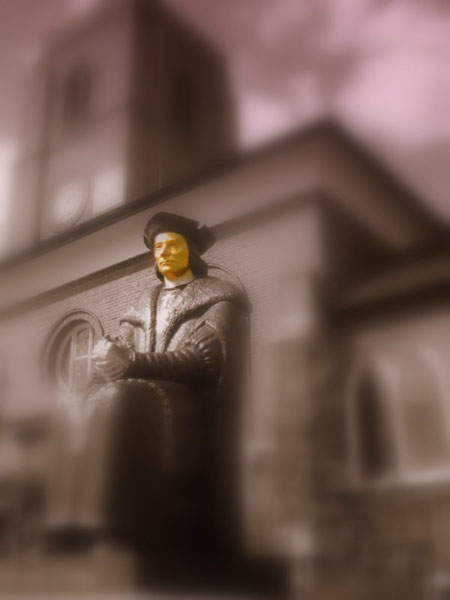
Chelsea resident Thomas More’s statue at the (Anglican) Chelsea Old Church.
* Despite its religious tolerance, More’s Utopia — anticipating Dostoyevsky — maintains:
a solemn and severe law against such as should so far degenerate from the dignity of human nature, as to think that our souls died with our bodies, or that the world was governed by chance, without a wise overruling Providence … since a man of such principles must needs, as oft as he dares do it, despise all their laws and customs: for there is no doubt to be made, that a man who is afraid of nothing but the law, and apprehends nothing after death, will not scruple to break through all the laws of his country, either by fraud or force, when by this means he may satisfy his appetites.
On this date in 1766, a 20-year-old French chevalier’s freethinking proclivities got him beheaded and burned for impiety in one of Bourbon France’s most notorious episodes of religious chauvanism.
it was the epoch of belief, it was the epoch of incredulity,
it was the season of Light, it was the season of Darkness
The luckless youth and a couple of friends had pissed off a local judge, which got ugly for them when the unexplained vandalism of a town crucifix availed the opportunity for the magistrate to wield a sledgehammer against a fly.
De la Barre’s volume of Voltaire was tossed onto the pyre with him. That Enlightenment colossus made a measured posthumous effort at having the boy rehabilitated* — primarily for the benefit of his more judicious friend, who had fled the country and required his death sentence in absentia be lifted in order to inherit the family estate — but the verdict was not set aside until the French Revolution, a few months after the end of the Terror.
France’s overall secular trajectory since has rendered this date a sort of national freethinkers’ holiday, Chevalier de la Barre Day. A statue of its namesake stands in Paris’ Montmarte:
* Voltaire’s writings on the case in the original French are collected by the Association Le Chevalier de la Barre here.
On this date in 1882, America’s weirdest assassin recited fourteen verses of the Gospel of Matthew and (sans requested orchestral accompaniment) a poem of his own composition entitled “I am Going to the Lordy,” and was hanged in the District of Columbia jail for shooting forgettable Gilded Age president James Garfield.
Mad as a march hare, Charles Julius Guiteau had irritated the obscure reaches of the Republic near four decades, trying his hand at free love, law, newspapering* and evangelism. A contemporary account of his religious flimflammery survives:
Charles J. Guiteau (if such really is his name), has fraud and imbecility plainly stamped upon his (face). (After) the impudent scoundrel talked only 15 minutes, he suddenly (thanked) the audience for their attention and (bid) them goodnight. Before the astounded 50 had recovered from their amazement…(he had taken their money and) fled from the building and escaped.
Having failed at each characteristic American monkeyshine more comprehensively than the last, he naturally gravitated to politics; while today Guiteau might tilt with his psychoses on some vituperative blog, in 1880 he published and delivered as a speech a widely-ignored crackpot encomium** for his eventual victim. Guiteau reckoned the GOP carried the 1880 elections on the strength of such rhetorical thunderbolts as “some people say he [Garfield] got badly soiled in that Credit Mobilier transaction but I guess he is clean-handed.”
Stunned that his contributions did not earn him a diplomatic posting to France, Guiteau stepped out of obscurity and into this blog’s pages by shooting the ungrateful (and unguarded) executive in the back at a Washington, D.C. train station (since demolished, and today occupied by the National Gallery of Art).
“To General Sherman: I have just shot the President. I shot him several times as I wished him to go as easily as possible. His death was a political necessity. I am a lawyer, theologian, and politician. I am a stalwart of the Stalwarts. I was with Gen. Grant, and the rest of our men in New York during the canvass. I am going to the Jail. Please order out your troops and take possession of the Jail at once. Very respectfully, Charles Guiteau.” (Click for the full image.) From the Georgetown Charles Guiteau collection.
Thoughtfully, he had already hired a cab to take him to jail, where he expected to be liberated by General William Sherman.
Malpractice
The bugger of Garfield’s assassination is that Guiteau was no better at killing presidents than he was at electing them. Despite his exultation “Arthur is President now!”, he actually inflicted what could have been a non-fatal flesh wound that through ten-thumbed medical intervention became an agonizing eighty-day Calvary for the miserable Garfield.
Doctors jabbed unwashed hands into the the wound, failing to dig out the bullet they were looking for but successfully turning the three-inch wound into a crater, puncturing Garfield’s liver, and passing him Streptococcus. Alexander Graham Bell invented a metal detector to find the missile, but the damn thing gave a bad reading … because Garfield was lying on a bed with metal springs. His doctors, feuding with one another and with the press, instituted a regimen of rectal feeding — “Nutritive enemas — consisting of beef bouillon, egg yolks, milk, whiskey, and several drops of opium … Garfield’s flatulence became intolerable,” according to one biographer — that “basically starved him to death.”† He lost 100 pounds before succumbing; the autopsy concluded that Garfield probably would have lived if not for the medical attention, which didn’t stop the doctors from submitting a sizable invoice to the feds for services rendered.
Horribly hilarious, this American Absurdistan. “Except for the dead-serious details of his assassinating President Garfield and being in all likelihood clinically insane, Charles Guiteau might be the funniest man in American History,” Sarah Vowell put it.
Guiteau’s circus trial — with the defendant constantly interrupting to harangue participants, object to his own attorneys or converse with the spectators, plus the macabre appearance of the late Garfield’s actual vertebrae (now at Washington D.C.’s National Museum of Health and Medicine) as an exhibit — was for all that a landmark test of evolving law around criminal insanity.
Just as Garfield probably would have survived his injury had he been treated by the next generation’s medical norms, Guiteau probably would have survived his brush with the law if treated by the next generation’s legal norms.
Against an almost-too-strict-to-achieve earlier bar for legal insanity, a more accommodating jurisprudential norm called the M’Naghten Rules or M’Naghten Test was even then being adopted from English courts: essentially, did the “criminal” realize his act was wrong? Still the basis for legal insanity claims in much of the U.S. today, the first trial of a presidential assassin would be the M’Naghten standard’s trial by fire.
While the judge gave ample leeway for the defense to use M’Naghten, the legal standards it implied were still not widely understood and the medical testimony about Guiteau’s mental condition was (embarrassingly, for the profession) wildly contradictory. Ultimately, the judge cued the jury that “the law requires a very slight degree of intelligence indeed” on Guiteau’s part to impute him with sufficient criminal culpability to hang. There were cheers in the courthouse when the jury took an hour to decide that Guiteau had that very slight degree of intelligence indeed.
In the final analysis, as Charles Rosenberg observes in The Trial of the Assassin Guiteau: Psychiatry and the Law in the Gilded Age, the jurors’ prompt conviction of the widely hated, barking-mad defendant underscored the real-life constraints of dry legal theory as applied by an outraged community to a notorious offender:
[T]he Guiteau case demonstrated anew that the circumstances of a particular case had ordinarily as much to do with its disposition as the precise injunctions of rules of law … Many observers agreed after the trial that if an individual of Guiteau’s marked eccentricity had killed an ordinary man … he would almost certainly not have been convicted; very likely he would not even have been brought to trial. Similarly, while Garfield lay on his sickbed, it was commonly assumed that his assailant would be institutionalized if the President should survive. But if not, then not.
Reckoning the gesture could cost him the 1884 Republican nomination, Chester A. Arthur declined to spare his “benefactor” (“Arthur has sealed his own doom and the doom of this nation,” was Guiteau’s reaction, picturing fire and brimstone) and left Guiteau to his strange and lonely fate. The latter was talked out of an early plan to go to the gallows in the Christlike garb of only his undergarments, but did insist upon delivering his incoherent parting ramble in a high-pitched childlike tone (“the idea is that of a child babbling to his mama and his papa”).
Wrapping up this surreal historical episode in a neat little bow, Charles Guiteau got his own bluegrass tune:‡
* One of Guiteau’s failed newspaper ventures was to exploit the telegraph to reprint original content from other outlets. That one looks a lot less harebrained in retrospect: it’s a primitive model of the wire service, and latterly of RSS-based distributors like Google News.
‡ The “Charles Guiteau” ditty is actually a rather shameless knock-off of a murder ballad for James Rodgers, an Irish immigrant hanged in New York in 1858.
On this date in 1950, Milada Horakova was hanged with three others in Prague’s Pankrac Prison as a spy and traitor to the Communist Czechoslovakian government.
Not (yet) as internationally recognizable as Rudolf Slansky,* the Communist General Secretary in Horakova’s time who would run afoul of Stalin and die on the same gallows two years later, Horakova (English Wikipedia page | Czech | the detailed French) is a potent symbol domestically of her country’s Cold War nightmare.
Lawyer, social democrat, and a prominent feminist in the interwar and postwar periods — her life’s work, rather overshadowed by an end that was memorable for different reasons — Horakova survived Nazi imprisonment and was a member of parliament when the Communists seized power in 1948.
She spurned counsel to flee the country, and found herself the headline attraction at a show trial for a supposed plot to overthrow the government. In a hopeless scenario, she distinguished herself with off-script defiance despite having broken under torture and signed a confession; Albert Einstein, Winston Churchill and Eleanor Roosevelt all pleaded in vain for clemency.
Horakova left the world clear in her purpose. In a letter to her teenage daughter awaiting execution, she justified her own dangerous choices:
The reason was not that I loved you little; I love you just as purely and fervently as other mothers love their children. But I understood that my task here in the world was to do you good … by seeing to it that life becomes better, and that all children can live well. … Don’t be frightened and sad because I am not coming back any more. Learn, my child, to look at life early as a serious matter. Life is hard, it does not pamper anybody, and for every time it strokes you it gives you ten blows. Become accustomed to that soon, but don’t let it defeat you. Decide to fight.
Hours before her hanging, she wrote a few last words for her loved ones:
I go with my head held high. One also has to know how to lose. That is no disgrace. An enemy also does not lose honor if he is truthful and honorable. One falls in battle; what is life other than struggle? (Both excerpts cited here)
The only woman among Czechoslovakia’s postwar political executions was abortively rehabilitated during the 1968 Prague Spring. Since the fall of the Iron Curtain, her resistance to both Naziism and Communism — worthy of an opera (topical interview) and a forthcoming film — have elevated her into her country’s official pantheon.
As a result, this date is “Commemoration day for the victims of the Communist regime” in the Czech Republic.
Meanwhile, Horakova’s now-octogenerian prosecutor Ludmila Brozova-Polednova, whose repulsive legal barbs at trial (“Don’t break her neck on the noose. Suffocate the bitch — and the others too.”) were probably the consequence of the foregone conclusion more than the cause, was convicted late last year for her role in the trial. That verdict has kept in the news these past several months — most recently, the Czech Supreme Court returned it for retrial after an appeals court overturned the sentence — a tangible symbol of the challenges inherent to confronting the past. (Brozova-Polednova, for her part, is unapologetic.)
* One of the goons who tortured confessions out of the conspirators in Horakova’s “terrorist center,” Karel Svab, was among those later hanged with Slansky.
On this date in 1864, the Union army in the American Civil War hanged a black deserter outside Petersburg, Va., for — in the delicate words of the army dispatch — “an attempt to outrage the person of a young lady at the New-Kent Court-house.”
The Union army was just taking up position for the coming monthslong siege of the Confederate capital, Richmond. Johnson, who confessed to deserting another unit, offered savvy blue commanders a win-hearts-and-minds opportunity: a public reassurance that the Old Dominion’s dim view of Negro outrages upon young ladies would be honored by its soon-to-be occupiers.
Not bad in theory. The execution left something to be desired.
The field of public relations being very much in its infancy, the upshot of this salutary demonstration seems not to have been conveyed to its target audience; so, when a defending Confederate battery caught sight of the gallows being thrown up in brazen view of its own lines, it jumped to the not-unreasonable conclusion that the Yanks were about to make an example of a southern spy. Rebel guns promptly made the Union detachment their “target audience.” An artillery shot struck one Sgt. Maj. G. F. Polley (or Polly) and “tore him all to pieces” before
[a] flag of truce was sent out to inform the enemy that a negro was to be hung who had insulted a white woman the day before; they stopped firing. We then marched back and saw the negro hung.
The return on investment for the souls of Johnson and the misfortunate NCO was altogether unsatisfactory:
The incident was cleverly turned to advantage by the Confederates, who had been losing hundreds of Negro laborers by desertion. The Rebels marched Negroes past the spot, pointing out to them the perils of fleeing their lines, saying that the Yankees hanged all ‘Contrabands.’ For weeks nocturnal escapes of Negroes ceased on that front. (Source)
It wasn’t a total loss, however. The Library of Congress ended up with some striking archival photos.
(There’s a better touch-up of this last photograph of Johnson’s body being cut down here.)
On this date in 1953, Julius and Ethel Rosenberg were put to death in Sing Sing’s electric chair as Soviet spies.
Divisive since it was handed down — or more precisely, since a famous article in London’s Guardian challenged the verdict and helped elevate it into a latter-day Dreyfus case — the Rosenbergs‘ sentence has inspired so much acrimony over several generations that merely to observe the date is to invite a debate capable of eminently more heat than light.
Where to begin with a case so towering in the recent cultural milieu?
A textbook might say that Julius and Ethel were convicted of passing atomic secrets to the Russians, that they maintained their innocence and their defenders carried that flame years after their deaths, and that intelligence files opened after the Cold War — notably the Venona project — apparently confirmed that Julius was a spy after all, though Ethel seems to have been little more than an approving bystander and Julius, come to think of it, never had anything so worthwhile as atomic secrets to share with Moscow. This information (which does have its own skeptics, albeit a small minority) undermines the maximal “absolute innocence” position that this day’s victims always asserted, but it’s a curious leap to take it as vindicating the legal outcome.
“My husband and I must be vindicated by history; we are the first victims of American fascism.”
Half a century on, juridical guilt or innocence seems distinctly secondary in the lasting importance of the Rosenberg trial, the two-year battle to save them, and their potent symbolic afterlives.
The Rosenbergs are the only stateside judicial executions for espionage since the Civil War.* That is a remarkable distinction, after all; so, how comes it that it is held by — to state the case against them in its strongest imaginable terms — two enthusiastic but bush-league players, and not by the likes of Aldrich Ames? How was it that a judge with a largely center-liberal career on the bench would read them a sentence of death hysterically accusing these Lower East Siders of causing the Korean War?
[Y]our conduct in putting into the hands of the Russians the A-bomb years before our best scientists predicted Russia would perfect the bomb has already caused, in my opinion, the Communist aggression in Korea, with the resultant casualties exceeding 50,000 and who knows but that millions more of innocent people may pay the price of your treason.
…
I feel that I must pass such sentence upon the principals in this diabolical conspiracy to destroy a God-fearing nation, which will demonstrate with finality that this nation’s security must remain inviolate; that traffic in military secrets, whether promoted by slavish devotion to a foreign ideology or by a desire for monetary gains must cease.
It is here in the age of McCarthyism, in the shadow of the USSR’s balance-altering A-bomb test in 1949, that the Rosenbergs stand in sharpest relief — not because of “guilt” or “innocence”, but as the ne plus ultra of that era’s range of social discipline.
A few years before, the United States and the Soviet Union had made common cause against Hitler in World War II, the United States pumping war materiel to Russians bearing the brunt of the fighting.
No longer operative.
The Communist Party USA enjoyed membership rolls pushing six figures; other socialist parties and movements had found niches in American life in the interwar years.
As the Great War gave way to the Cold War, the great powers remained nominal allies (that’s the reason the Rosenbergs weren’t tried for treason), but shifted rapidly into conflict. The American polity organized to expel the red menace by rendering it foreign and criminal — ideological rigging for the forty years’ imperial contest ahead. Loyalty oaths, blacklists, the House Un-American Activities Committee … in the whole of the self-conscious construction of communism as “contagion”, the power and willingness of the state to kill Julius and Ethel Rosenberg formed the tip of the spear, and an ugly contrast to that same state’s solicitous handling of Nazi scientists then developing the vehicles to deliver atomic technology to Moscow in mushroom cloud form.
Though different in many particulars, the thrust will be familiar to any sentient denizen of post-9/11 America: the extreme penalty enforces a wall between the suspect and abject (but tolerated) loyal liberal and the enemy left. Depend upon Ann Coulter for the most brutal articulation:
We need to execute people like John Walker [the American-born soldier captured fighting for the Taliban in 2001] in order to physically intimidate liberals, by making them realize that they can be killed, too. Otherwise, they will turn out to be outright traitors.
Like most symbols, the Rosenbergs came by their exaltation by accident; at the strictly personal level, their deaths are nearly operatic performances of human stubbornness and bureaucratic inertia. Investigators rolling up a spy ring** were looking for confessions and names to keep the indictments coming.
Julius refused to provide either, so his wife was arrested for leverage against him on the reasoning that he would confess to protect her. The gambit failed: both prisoner and hostage remained obstinate. The government’s bluff had been called, and it ruthlessly executed its threat.
Had the two really been responsible for starting a war, execution would hardly begin to cover the bill — yet to the very foot of the chair, the condemned, and Julius especially for the sake of his wife, were pressed with offers of mercy for confessing and “naming names”.
Abjure or expire: show trial logic.
[audio:Julius_and_Ethel_Rosenberg.mp3]
An Execution in the Family
Given names to name, the personal mystery of their silence — the ultimate heroism or folly or tragedy or transcendence — only deepens the resonance of their fate both for contemporaries and posterity, the poignance of their orphaned children’s subsequent path, the contrast with Ethel’s brother David Greenglass who has since admitted to perjuring testimony against Ethel in order to shield his own wife. (Greenglass says the Rosenbergs died from the “stupidity” of not copping a deal of their own.)
Even before Julius and Ethel went to the chair this date,† they had become the emblem of a paranoid age. In the days following, Sartre savaged the United States for trying “to stop scientific progress by a human sacrifice”:
Your country is sick with fear. You’re afraid of everything: the Russians, the Chinese, the Europeans. You’re afraid of each other. You’re afraid of the shadow of your own bomb.
Decades later, the shadows haven’t faded altogether. In playwright Tony Kushner’s imagination, the spirit of Ethel stalks her real-life prosecutor, closeted McCarthy henchman Roy Cohn, as he succumbs to AIDS in the 1980’s.‡
Rosenberg resources — and vitriol — are in plentiful supply online and off. A good starting point on the case is this page at the University of Missouri – Kansas City. Be sure to check the tale of a last-ditch legal maneuver that almost succeeded.
* There is one partial exception in the unusual case of six German saboteurs electrocuted in Washington, D.C., during World War II on a charge sheet that included espionage. The hearing was held by a military commission and only one of the six was an American citizen, so it was far from the regular judicial process — if one can call it that — the Rosenbergs faced.
** Originating in the investigation of Klaus Fuchs, the man who actually did what Julius and Ethel Rosenberg were accused of doing — passing atomic secrets to Moscow — although with debatable ultimate effect for the Soviets’ research. Fuchs served nine-plus years in a British prison and was released to East Germany; more than a few were galled at the difference between his sentence and the Rosenbergs’.
Stateside, George Koval was another spy far more valuable to Moscow in the nuclear race than were the Rosenbergs. Koval got away clean and died in Moscow in 2006.
† Julius first, then Ethel. Her execution was botched; repeated shocks were required to kill her.
‡ Cohn’s posthumous autobiography did acknowledge illegally rigging the Rosenberg trial, as his Kushner character does.
On this date in 1962, the architect of the Final Solution received such justice as could be meted to him on earth at Israel’s Ramla Prison.
Adolf Eichmann, the vacuum cleaner salesman turned SS Obersturnbannfuhrer, remains the only person judicially executed in the history of modern Israel, whose intelligence services kidnapped him from Argentina where he had settled after the war.
Other Nazis had used the “only following orders” defense with little success in the Nuremberg Trials shortly after World War II. On trial years later (and at the hands a Jewish state) Eichmann — a bookish, unmenacing man who invoked Kant — posed the questions of individual responsibility and human psychology in starker terms.
To be sure, he was no anonymous functionary. Neither, however, had he dirtied his nails at the stomach-churning business end of the Holocaust: rather, he had engineered the stupendous logistical project of deporting Eastern Europe’s Jews for extermination, an (impressive) accomplishment worth exponentially more lives than any Einsatzgruppe could ever account for, yet simultaneously abstract from the upshot.
Eichmann said he did it without ill-will towards its subjects — simply to obey and to achieve.
The Banality of Evil
[I]f it was of small legal relevance, it was of great political interest to know how long it takes for an average person to overcome his innate repugnance of crime, and what exactly happens to him once he has reached that point. To this question, the case of Adolf Eichmann supplied an answer that could not have been clearer or more precise.
-Hannah Arendt
Hannah Arendt took him at his word* and saw in Eichmann the abyss gazing back into us, into his judges — not a monster but a man unsettling in his normalcy, whose job was not TPS reports or quarterly sales results but turning humans into ash.
The company man. The career man. Every man, standing in for countless thousands more who pushed the papers that drove the trains to Auschwitz.
What for Eichmann was a job, with its daily routine, its ups and downs, was for the Jews quite literally the end of the world.
Not everyone accepts her conclusions, but Arendt’s characterization of “the banality of evil” has become the man’s epigraph. And Eichmann disturbs us precisely because we seem to be able to meet him on his terms, even sympathize with him when the horror of his crimes begs for a monster like Streicher or Goebbels we could safely consign to the Other.
Arendt’s turn of phrase has a certain breezy (hackneyed, even) life in the public discourse, but her analysis of Eichmann’s careerism remains a challenging and deeply relevant one for we heirs of the world that hanged him.
The complete transcript of Eichmann’s trial is available online here. Video of his trial has been posted online here (in English) and here (original languages).
* Albeit with some reservations; others have argued that Eichmann was considerably more personally invested in his mass-murder project than his demeanor at trial admitted. Certainly he had an interest in showing the mellower Eichmann when he was on trial for his life.




 Mad as a march hare,