This U.S. Army photo from a few months after D-Day is filed simply thus:
“Photo taken at the instant bullets from a French firing squad hit a Frenchman who collaborated with the Germans. This execution took place in Rennes, France.” Himes, November 21, 1944.
Click to see a larger image of this stunning photo — or, take in this huge copy.
This is the feast date and martyrdom date of middle ages English king Edmund the Martyr.
Stained glass of Edmund the Martyr from Our Lady and the English Martyrs church in Cambridge. (cc) image from Laurence OP
This acute ruler of the East Angles, the last native East Anglian king, was stomped in battle by the marauding norsemen under Ivar the Boneless and his less interestingly-named brother Ubbe Ragnarsson.
These two were sore about their father Ragnar Lodbrok, who had shipwrecked in England — maybe East Anglia, maybe elsewhere — and allegedly been thrown into a snakepit.
According to the hagiographic account, these Danish heathens attempted to force Edmund to renounce Christianity. Edmund demurred.
Then those wicked men bound Edmund, and shamefully insulted him, and beat him with clubs, and afterwards they led the faithful king to an earth-fast tree, and tied him thereto with hard bonds, and afterwards scourged him a long while with whips, and ever he called, between the blows, with true faith, on Jesus Christ; and then the heathen because of his faith were madly angry, because he called upon Christ to help him. They shot at him with javelins as if for their amusement until he was all beset with their shots, as with a porcupine’s bristles, even as Sebastian was.
The martyr-king’s body was ultimately interred at the aptly-namd Bury St. Edmunds. This locale thereafter became a major, and lucrative, pilgrimage spot in Britain.
Edmund himself became the patron saint of England until he was supplanted just before the Norman invasion by omnibus patron saint George. As George had nothing to do with England, there’s been some latter-day push to revert the honor to the native king.
On an unknown date in (perhaps) the 860s, Norse raider Ragnar Lodbrok (or Ragnar Lothbrok) was allegedly put to death in the Indiana Jones-esque manner of being cast into a pit of snakes.
Ragnar is a half-legendary character who plundered France and Britain in the mid-ninth century, the heyday of Viking marauders; he’s also the lead character of the cable TV series Vikings.
He’s known from Scandinavian sagas, like the Ragnarssona Þattr, which describes Ragnar’s final battle after shipwrecking in Northumbria.
At that time, there was a king called Ælla ruling over Northumbria in England. And when he learns that raiders have come to his kingdom, he musters a mighty force and marches against Ragnar with an overwhelming host, and hard and terrible battle ensues. King Ragnar was clad in the silken jacket Aslaug had given him at their parting. But as the defending army was so big that nothing could withstand them, so almost all his men were killed, but he himself charged four times through the ranks of King Aella, and iron just glanced off his silk shirt. Finally he was taken captive and put in a snake-pit, but the snakes wouldn’t come near him. King Aella had seen during the day, as they fought, that iron didn’t bite him, and now the snakes won’t harm him. So he had him stripped of the clothes that he’d been wearing on the day, and at once snakes were hanging off him on all sides, and he left his life there with much courage.
Here’s Ernest Borgnine as Ragnar in the 1958 film The Vikings, dying in a pit full of wild dogs, not snakes. Well, it’s the same animal kingdom.
“How the little pigs would grunt if they knew how the old boar suffers!” he’s supposed to have exclaimed, keeping to the nature theme.
Although Vikings didn’t really seem to need a casus belli to pillage England, the little pigs would in fact do some serious grunting when they found out about the boar: Ragnar’s sons punitive sorties against England martyred the Christian king St. Edmund.
Update: When this post was first written in 2011, information about this distant Viking captain was not all that plentiful. Ragnar’s starring turn in a TV serial since that time has somewhat broadened his cultural footprint.
On or about this date in 1781,* the native Aymara revolutionary Tupac Katari (or Tupac Catari, or Tupaj Katari) was torn apart in the Bolivian village of Penas — a messianic warning on his lips of his Spanish captors’ future comeuppance.
Hard on the heels of Tupac Amaru‘s public dismembering in nearby Cuzco (present-day Peru), Julian Apasa Nina took up the name and mantle of recent Bolivian insurgent Tomas Katari.
Julian Apasa’s new name Tupac Katari was as ambitious as his plans, for he took the thousands of indigenous Americans who flocked to his banner and laid siege to La Paz from the adjacent El Alto.**
The object was not mere plunder, but rolling back Spanish domination full stop.
A friar who met Katari reported that the Spanish tongue was forbidden on pain of death, and the rebel leader aimed to “totally separate himself from all Customs of the Spanish.” (Source) He did not shrink from ferocity to achieve his ends, hanging captives outside the walls of the city, enforcing military discipline ruthlessly. (Source) The Aymara fought with “a spirit and pretentiousness so horrible that … it can serve as an example as the most valiant nation.” (Source)
Though the siege† reduced Spanish defenders to eating bark and horseflesh, and starved out thousands, the city held out and the siege was at length lifted and Tupac Katari betrayed into his enemies’ hands.
Condemned to death (a fate his wife Bartolina Sisa would share months later), Katari was lashed to four horses who strained until his body ripped into quarters suitable for placarding towns of the district. But before he went, Katari bequeathed posterity a legendary final sentiment.
* It appears that the primary sources themselves are unclear on the precise date, and there are citations for the execution taking place anywhere from Nov. 13 to Nov. 18. Nov. 15 appears to be the best-preferred by scholars, or the co-number one with Nov. 14, and we’re inclined to prefer this date because of the 20th century Indian social justice movement which explicitly cited Katari’s inspiration — the Movimiento 15 de Noviembre (more in Spanish). It’s part of an entire political tendency in Bolivia called Katarismo. If the date is good enough for the Aymara, it’s good enough for this blog.
That wasn’t the only 20th century movement to situate itself as Katari’s heirs. A set of Marxist indigenous guerrillas styled themselves the Tupac Katari Guerrilla Army, and a former member of this Che-inspired militia is currently Bolivia’s vice president.
** From the Aymara siege of La Paz developed the local tradition of Ekeko.
† Actually, two distinct sieges in 1781, one lasting just over three months and the next lasting just over two.
On this date in 1880, legendary bushranger Ned Kelly hanged at Melbourne Gaol.
The Dick Turpin of Australian outlawry — in the sense that he’s the first name on the marquee — Kelly was the son of an Irishman shipped to Van Damien’s Land on the British convict transportation plan.
When Ned was all of 11, pa died doing a six-month prison stint at hard labor for stealing a neighbor’s cow, and it wasn’t much longer before young master Edward was making the acquaintance of the law himself: arrested for assault in 1869 at age 14; arrested once again the following year as an accomplice to the bushranger with the pornstar name, Harry Powers; imprisoned later in 1870 for three years for receiving stolen goods … and then he got into the family horse-rustling racket upon his release. Crime and gaol were just part of Ned’s world.
So was police antagonism.
The man’s famous last years started with what reads as a trumped-up run-in with a cop who turned up at a station complaining that the Kellys had shot him. (The Kelly story is that he got fresh with Ned’s sister and got whacked by a shovel.) Whatever the facts of the matter, it sent Ned and his brother Dan into the bush as fugitives.
At Stringybark Creek, the “Kelly gang” got the drop on the police posse sent to arrest them, and three officers died in the firefight. Now there was real trouble.
An 1878 “Felons Apprehension Act” immediately proscribed the men, making it “lawful for any of Her Majesty’s subjects whether a constable or not and without being accountable for the using of any deadly weapon in aid of such apprehension whether its use be preceded by a demand of surrender or not to apprehend or take such outlaw alive or dead.”
The ensuing two-year saga was a captivating cycle of dramatic robberies, escalating government bounties, state hostage-taking in the form of imprisoned family and friends, and Kelly’s own Joycean self-vindication.
he would be a king to a policeman who for a lazy loafing cowardly bilit left the ash corner deserted the shamrock, the emblem of true wit and beauty to serve under a flag and nation that has destroyed massacreed and murdered their fore-fathers by the greatest of torture as rolling them down hill in spiked barrels pulling their toe and finger nails and on the wheel. and every torture imaginable more was transported to Van Diemand’s Land to pine their young lives away in starvation and misery among tyrants worse than the promised hell itself all of true blood bone and beauty, that was not murdered on their own soil, or had fled to America or other countries to bloom again another day, were doomed to Port Mcquarie Toweringabbie norfolk island and Emu plains and in those places of tyrany and condemnation many a blooming Irishman rather than subdue to the Saxon yoke Were flogged to death and bravely died in servile chains but true to the shamrock and a credit to Paddys land.*
The hunt culminated in a cinematic shootout at the Glenrowan Inn, Kelly an accomplices entering the fray clad in bulky but effective homemade body armor they’d literally hammered out of ploughshares. (It’s thanks to the armor’s protection of his head and trunk that Ned Kelly survived the Glenrowan siege so he could be hanged instead.) Now on display at the State Library of Victoria, it’s the most queer and recognizable artifact of an era that was already then slipping into the past.
Ned Kelly in his armor (left), and the logo of the Victoria Bushrangers cricket club patterned after it (right).
I do not pretend that I have led a blameless life or that one fault justifies another; but the public, judging a case like mine, should remember that the darkest life may have a bright side, and after the worst has been said against a man, he may, if he is heard, tell a story in his own rough way that will lead them to soften the harshness of their thoughts against him and find as many excuses for him as he would plead for himself.
This cut no ice with the men who judged him guilty of murder, but the brawler, cop-killer, bank-robber Kelly seems to have found a way to tell that story to posterity and its thoughts have softened very much indeed.
Everything from his hardscrabble upbringing to his romantic man-against-the-world criminal career to his iconic robot-suit armor to his existentially heroic last words “such is life” equips his image for posthumous appropriation. He seems one-half charming anachronism, one-half hirsute postmodern avatar, especially when you go sculpt a mailbox out of him.
131 years dead today, Ned Kelly remains very much alive in memory. To this day, descendants and supporters lay flowers at the Melbourne Gaol where he hanged, and the recent decision to release his remains for reburial (as Kelly himself requested) made national headlines.
On this date in 1834 was strangled the aforementioned Jenkins — John, to his friends — alongside accomplice Thomas Tattersdale for one of 19th century Australia’s headline-grabbing crimes.*
Along with a third man who would turn state’s evidence to save his own neck, these convicts busted out of jail.
On the run in the bush, these fugitives came across the massive estate of Dr. Robert Wardell, a prominent public figure in early Australia. When this newspaper publisher, barrister, and land magnate personally bumped into the trio, he naturally urged the prisoners to give themselves up. Instead, John Jenkins shot Wardell dead.
Tattersdale, a non-triggerman who had actually tried to talk Jenkins out of killing Wardell in the first place, sported a suitably Dostoyevskyan appreciation of his own guilt, and basically just asked the court for a few days to prepare his soul. Jenkins made the trial a three-ring circus with his profane attacks on the court, and his bodily attack on his fellow-defendant when he learned that Tattersdale had offered to testify for the crown. (Tattersdale weepily made up with an irritated Jenkins at the time of their hanging, which was only three days after they were condemned.)
Tattersdale’s lamblike submission just got him written out of the ballads; even the newsmen covering the hanging itself “did not much regard” him.
Jenkins, by contrast, stole the show “with that vulgar attempt at bravado courage which distinguishes men of his class.” He’d been joking about his hanging since the trial, and he played cocksure right up to the time they dropped the trap on him — including a distinctly unauthorized last comment on his life and crime.
Well, good bye my lads, I have not time to say much to you. I acknowledge I shot the Doctor, but it was not for gain, it was for the sake of my fellow prisoners because he was a tyrant and I have one thing to recommend you as a friend, if any of you take the bush, about every bloody tyrant you come across, and there are several now in the yard who ought to be served so.
* An unrelated criminal named McCormick died with them, for murdering his wife.
On November 1, 1943, a fourteen-year-old boy named Anatoly Kuznetsov came within seconds of execution in his hometown of Kiev in Nazi-Occupied Ukraine. As he admitted decades later, his crimes were numerous and all were worthy of the death penalty, according to the laws of the Germans. They included such grave sins as stealing beets, breaking curfew and sticking up an anti-Nazi leaflet.
By the time I reached the age of fourteen, I had committed so many crimes on this earth that I should have been shot many times over. […] Moreover, I was not a member of the Party or the Komsomol, nor a member of the underground; I was not a Jew or a gypsy; I did not keep pigeons or have a radio set; I did not commit any crimes openly; and I did not get taken as a hostage. I was in fact a most ORDINARY, unexceptional, insignificant little chap in a peaked cap.
But if the regulations drawn up by the authorities had been observed scrupulously, according to the principle of ‘If you did it you pay the penalty,’ then I had LOST THE RIGHT TO BE ALIVE twenty times over.
I persist stubbornly in remaining alive, while the number of my crimes increases in a catastrophic manner, so that I have stopped counting them. All I know is that I am a terrible criminal who has still not been caught.
The closest young Kuznetsov actually came to being killed was on November 1, 1943.
His very existence in Kiev had become a capital offense by then: all the civilians were supposed to have followed the German Army as it retreated from the city ahead of the advancing Russians, on pain of instant death.
Yet Kutznetsov stayed, hiding in abandoned buildings and bombed-out ruins, drinking rainwater, eating whatever he could find. By November 1 he had been dodging the evacuation order for over a month. And so he was called to account:
At that moment I heard a noise. I started, raised my head and saw a German soldier carrying a rifle; then I caught sight of another one on the street outside … When I thought they were not looking in my direction I dodged round the corner of the house, again cowering down rather stupidly, not looking round and averting my eyes from them in a sort of superstitious belief that they would not see me. I heard someone shout, “Hey! … Hey!” and I straightened up and stopped.
The soldier eyed me very sternly. He was a dark-haired, stocky fellow of about thirty, rather awkward in his movements, wearing old, muddy boots. His was a very ordinary, everyday type of face … In German he said:
“Come here.”
I took a few steps along the wall.
“You’ll be shot,” he said sternly, and started to raise his rifle.
It was, apparently, loaded, since he did not shoot the bolt. Another German came up, took him by the arm and said something in a very calm and indifferent tone, which sounded roughly like: “Don’t do it, there’s no point.” (That’s what I thought he said.)
The second soldier was rather older, quite an elderly man, with sunken cheeks. The dark-haired one answered him back and turned his head away for a moment. In that brief moment—I realized—I ought to have jumped up and dashed away… The dark one simply raised his rifle, turned his head for a moment, said something to the elder one, and that was the last moment of my life. […]
Right in front of my face — not in the cinema, or in a picture or in a dream — I saw the black hole at the end of the barrel, and had in my nose the unpleasant smell of gunpowder (meanwhile the elder German apparently went on saying something, but the dark one — alas! — wouldn’t listen); ages seemed to pass and there was no shot.
Then the end of the barrel dropped from my face to my chest and I realized at once in amazement that that, apparently, was how I was to be killed — shot in the chest!
Then he lowered the gun altogether. […]
He had only to squeeze his finger. I suppose on November 1st every year I ought to remember and thank that finger, the forefinger on his right hand, which let me live.
Five days later, the Red Army arrived and Kiev was liberated.
Kuznetsov would grow up to write a memoir and documentary history of his experiences during the occupation, including his aforementioned brush with death. The book, Babi Yar: A Document in the Form of a Novel, is considered a classic in the literature of World War II and the Holocaust. Parts of it have already been quoted on Executed Today.
Kutznetsov died in London in 1979. He was forty-nine years old.
Philotas was one of Alexander’s “companions”, the elite cavalry who joined Alexander personally in battle. He had fought by Alexander’s side in the epic Battle of Gaugamela, which brought down the Achaemenid Empire and opened Persia to the legendary conqueror.
A year later, Alexander, and therefore also those companions, were winding down campaign season all the way on the other side of the late empire they had so stunningly dismantled. It’s the region of Drangiana on the present-day Iran-Afghanistan frontier. The Macedonians would name the city Prophthasia, Anticipation, in recognition of their chief’s narrow escape; we know it today as Farah, Afghanistan.
Unlike many of the “companions” who joined the young Macedonian king, Philotas wasn’t a bosom buddy of Alexander.
He was, instead, a bit of a political appointee who owed his position to the fact that his father Parmenion, a great Macedonian general, had backed the disputed succession of Alexander. Parmenion continued as one of Alexander’s generals; his kid — not particularly popular of himself but nevertheless a loyal and competent officer — got a plum gig in Alexander’s vanguard.
In this capacity so close to the royal person, Philotas was warned by a conscientious slave of an assassination plot going against Alexander. And rather incredibly, he didn’t bother to pass it on.
When the slave realized, a couple of days on, that the conspiracy hadn’t been busted, he proceeded to tell somebody else … and Philotas had some explaining to do.
For posterity, it’s as open a question as it was then: Philotas initially convinced Alexander that he had merely considered the whole thing so insubstantial as not to merit the king’s attention — but by the next day, Alexander had better inclined himself to the more damning reading, that Philotas was perfectly amenable to seeing Alexander eliminated.** If that were the truth, it would herald a conflict that would soon come to define the Macedonian’s coruscating and paradoxical career: the army’s rising discontent with its march so far from home, and its leader’s ever more visible habit of arraying himself in the alien habits of oriental despotism.
Philotas got a “proper” if farcically rigged trial before fellow-generals who were all too happy to be rid of him, and was tortured into confessing. He was executed either by stoning (actually the traditional Macedonian execution method, even for the likes of generals) or spearing.
(The scene is dramatized in the 2004 Oliver Stone film Alexander; the relevant bit can be viewed here.)
Parmenion, a greater character than his son, would also pay the forfeit of his son’s alleged misprision.
At the time of Philotas’s execution, Parmenion was commanding a large army several days’ ride from Alexander. Fearing that the torture and execution of his last remaining son (the other two had also died on campaign) might inspire the august general to do something rash, Alexander dispatched a few trusted officers to outrace the news: they murdered an uncomprehending Parmenion as soon as they reached him. Whatever one makes of the child, the father’s loyalty both to Alexander and his predecessor Philip II had never previously been impeached in a long and brilliant career. Alexander ought to have counted himself fortunate to have avoided any wider disturbance in the army from the rough handling of this beloved general.
The whole affair was sufficiently distasteful that it remained a sensitive matter of state security hundreds of years and hundreds of miles distant: An Elizabethan play about Philotas by Samuel Daniel earned its author some uncomfortable official scrutiny for its perceived commentary on the contemporaneous execution of the Earl of Essex … the fallen courtier whose prosecution of a Jewish doctor arguably informed Shakespeare’s Merchant of Venice.
* The other — later and greater — crime was Alexander’s drunken murder of his friend and loyal commander Cleitus. (He’s the guy shown stabbing Parmenion to death in the clip from Alexander, a circumstance that plays better as drama than history.)
** It doesn’t help anyone’s fact-finding that the main alleged plotter committed suicide when they came to arrest him.
On this date in 2003, Samer Ufi and Mohamed Faraj (some sources give the latter’s name as Suleiman) were publicly shot by masked al-Aqsa gunmen in the West Bank town of Tulkarem (or Tulkarm) for Israeli collaboration.
A videotape of the two admitting to supplying Israel information which led to militants’ assassination was played in the camp on the eve of their shooting. The dead men’s families contended that they had been tortured into the confession.
Tulkarem in 2003 was a place easy to feel under siege.
Some eighteen to twenty-two thousand Palestinian laborers from the Tulkarm district used to go and work in Israel every day. Now they are prevented by the security barrier that went up during 2003 … an eight-meter-high concrete wall complete with round gray watchtowers, built to prevent Palestinian snipers from shooting at passing cars on the Trans-Israel Highway that skirts Tulkarm to the west. Additional stretches of fence hermetically seal the surrounding villages off from Israel, as well as from some of their agricultural land.
Meanwhile, as elsewhere in the West Bank and Gaza, a a fast-growing list of assassinations struck militants in the community.
We don’t know in these parts whether the executed men truly were informers, but Israel is known to obtain many such targets by way of informers — often reluctant Palestinians it blackmails or bribes. Accused informers are regularly executed in the Palestinian territories.
“For myself, if I were Palestinian, I would hate them to death,” an Israeli intelligence advisor told the BBC of the collaborators recruited by Tel Aviv. “He is a traitor — I need him — but he’s a traitor”.
On “a beautiful autumn day” this date in 1941, four dozen French leftists were executed by that country’s occupiers as punishment for the murder of a German officer.
On October 20, 1941 — sixteen months into the German occupation — a pair of Communist commandos assassinated the Feldkommandant of Nantes, Lt. Col. Karl Hotz (French link).
News of this crime went straight to Adolf Hitler himself, who personally ordered a fearful reprisal.
The list of the executed hostages as published Oct. 23 in L’oeuvre
Accordingly, the collaborationist Petain government was induced to select 50 persons from among the ranks of detained German political prisoners. Pierre Pucheu, who would later be executed himself,* intentionally selected Communist types in an effort to confine the retaliation to fellow-travelers.
On this date, those 50 — well, 48, but who’s counting?; the numbering can get dodgy in these mass-execution scenarios — were put to death at three different locations: five at Fort Mont-Valerien; sixteen at Nantes; and most notoriously, 27 internees of Choisel (French link) at Chateaubriant.**
In three different batches of nine, the 27 reds and trade unionists were fusilladed into the ranks of Gallic martyrdom. They remain among the most emblematic French martyrs of the occupation; there’s a cours des 50-Otages named for them in Nantes, and various streets that bear individual victims’ names — such as Rue Jean-Pierre Timbaud in Paris. (Timbaud was a Communist steelworker.)
Monument to the martyrs of Chateaubriant. Image (c) Renaud Camus and used with permission.
He made headlines in 2009 when current French President Nicolas Sarkozy had added to the educational curriculum the reading of Moquet’s brave-but-sad last letter to his family: the decision drew some rather mean-tempered fire because of Moquet’s political persuasion. In the end, the text bore a fairly universal reading that could play inoffensively to posterity — like its postscript injunction,
“You who remain, be worthy of the 27 of us who are going to die!”
There’s a thorough roundup of the Oct. 22 executions (including poetic tribute) here.
* Vindicating Winston Churchill’s prophecy to the Times upon receiving news that “These cold-blooded executions of inocent people will only recoil upon the savages who order and execute them.” (Oct. 25, 1941, as cited in the The Churchill War Papers, vol. 3)
** Fifty more were supposed to be executed if the assassins weren’t promptly turned in, but that second batch never took place. (There was, however, a different batch of 50 executed on October 24 in retaliation for a different political assassination. Maybe they just all ran together.)


 Hard on the heels of
  The
The 


 By the time I reached the age of fourteen, I had committed so many crimes on this earth that I should have been shot many times over. […] Moreover, I was not a member of the Party or the Komsomol, nor a member of the underground; I was not a Jew or a gypsy; I did not keep pigeons or have a radio set; I did not commit any crimes openly; and I did not get taken as a hostage. I was in fact a most ORDINARY, unexceptional, insignificant little chap in a peaked cap.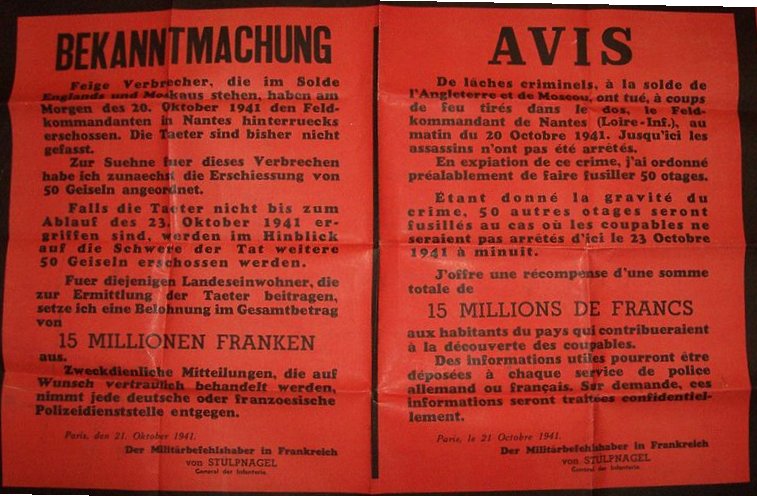


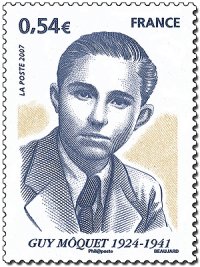 The youngest, 17-year-old

