1689: Kazimierz Lyszczynski, the first Polish atheist

On this date in 1689, in a Warsaw marketplace, Kazimierz Lyszczynski had his tongue torn out, his head struck off and his body burned to ashes which were shot from a cannon — all for scratching a few words with the whiff of atheism.

Lyszczynski — less dauntingly rendered “Cazimir Liszinski” — was convicted of holding such heretical doctrines as:

God is not the creator of man; but man is the creator of a God gathered together from nothing.

His actual writings are not known directly — his books were burned along with his flesh — but only from the transcripts of his rather hysterical trial, so it’s uncertain what he actually believed; for that matter, he vigorously (albeit unsuccessfully) abjured atheism. Some sources say that he was nailed for as little as irreverent marginal notations in a theological tract he found unconvincing; others report that he actually wrote a heretical text.

According to Valerian Krasinski’s Historical Sketch Of The Rise, Progress And Decline Of The Reformation In Poland V1 (available free from Google books)

Cazimir Lyszczynski, a noble and landowner of Lithuania, a man of a very respectable character, was perusing a book entitled Theologia Naturalis, by Henry Aldsted, a Protestant divine, and finding that the arguments which the author employed in order to prove the existence of divinity, were so confused that it was possible to deduce from them quite contrary consequences, he added on the margin the following words — “ergo non est Deus,” evidently ridiculing the arguments of the author. This circumstance was found out by Brzoska, nuncio of Brest in Lithuania, a debtor of Lyszczynski, who denouned him as an atheist, delivering, as evidence of his accusation, a copy of the work with the above-mentioned annotation to Witwicki, bishop of Posnania, who took up this affair with the greatest violence … nothing could shelter the unfortunate man against the fanatical rage of the clergy … On the simple accusation of his debtor, supported by the bishops, the affair was brought before the diet of 1689, before which the clergy, and particularly the bishop Zaluski, accused Lyszczynski of having denied the existence of God, and uttered blasphemies against the blessed Virgin and the saints. The unfortunate victim, terrified by his perilous situation, acknowledged all that was imputed to him, made a full recantation of all he might have said and written against the doctrine of the Roman Catholic church, and declared his entire submission to its authority. This was, however, of no avail to him, and his accusers were even scandalized that the diet permitted him to make a defence, and granted the term of three days for collecting evidence of his innocence, as the accusation of the clergy ought, in their judgment, to be sufficient evidence on which to condemn the culprit.

Pope Innocent XI at least salvaged the performance of the Catholic hierarchy in the affair by condemning, rather than promoting, the ambitious bishops.

Whatever the doomed man’s actual doctrines and writings, it is likely not coincidence that one finds this atrocious affair during at the moment of his country’s political collapse. The heretical knight’s 55 years corresponded to Poland’s fall from central Europe’s dominant power into the plaything of neighboring hegemons. The Polish-Lithuanian Empire stood at its maximum extent at his birth; during Lyszczynski’s boyhood, the Zaporozhian Cossacks broke free of Warsaw; as a young man, he saw the Swedes, the Russians, and Poland’s former vassal Prussia strip the empire of peoples and land.

By the time of Lyszczynski’s misfortunate death, Poland was a second-rate power on the brink of irrelevance — an abyss into which it would plunge in the century to come. Corwin’s Political History of Poland (another Google Books freebie) lays the scene:

The constant internal dissensions caused and nourished by foreign intrigues were in no mean measure responsible for the King’s failures in his final campaigns and in his diplomacy. They resulted in the loss of territory and the decline of Poland’s position as a great European power. French and Austrian money supported Polish anarchy. Diets were constantly torn up some even before the presiding officer could be elected. No law could be enacted. Corruption was rampant. Several attempts were made to depose the King. Religious intolerance became intensified and the first and last auto da fe in Poland was executed in 1689, on one Casimir Lyszczynski for his atheistic proclivities. The country became a theatre of constant strife between the various magnate families. At times the clashes resulted in formal civil wars.

It might be small consolation for having one’s head chopped off, but Lyszczynski’s reputation has far outrun his persecutors’, and in the lands of the old Polish-Lithuanian Empire, he cuts a pathbreaking figure for secularists and freethinkers.

There’s a substantial article about Lyszczynski on a Polish freethinkers’ site. As his hometown Brest lies in modern Belarus, he also enjoys a monumental biography on a Belarussian atheism site (and even favorite-son treatment on the city of Brest’s own page).

Lyszczynski’s gravestone — image (c) Irina Shvets and used with permission. The inscription reads, “Oh, travelers! Do not pass these stones. You will not stumble upon them if you don’t stumble upon the truth. Recognize the truth: for even those who know that it is the truth teach that it is a lie. The teachings of the wise are bound by deceit.”

On this day..

1720: Charles Vane, an unsinkable pirate

On this date in 1720, Charles Vane’s resilient pirate career finally came to the end of a noose.

Like his onetime lieutenant Calico Jack Rackham, Vane plundered the American coast and the Caribbean during the twilight heyday of the buccaneer.

The man had a gift. From 1716 to late in 1718, Vane looted dextrously, even boldly spurning a royal pardon the better to keep his loot and mounting a flamboyant escape from the armada subsequent sent to detain him.

If he had a weakness, it was not as a mariner but as a manager. A notoriously tyrannous captain, Vane saw one aide turn on him and escape with a ship and a second — the aforementioned Rackham — mount a seaborne coup after Vane judiciously refused to engage a larger French man-o-war.

Nothing daunted by the loss of his command, Vane set about rebuilding his fortunes by resuming the conquest of prizes. Little could he see that the day of piracy was fast drawing to a close, and his own hourglass running faster still.

For all the catastrophes visited on him by his confederates, it required the connivance of nature to do him in. Early in 1720, a hurricane obliterated his ship (and most of his crew); tough old Vane managed to wash up on a deserted island* … but was recognized by his “rescuers” and delivered up to the British governor of Jamaica, who strung him up within the week.

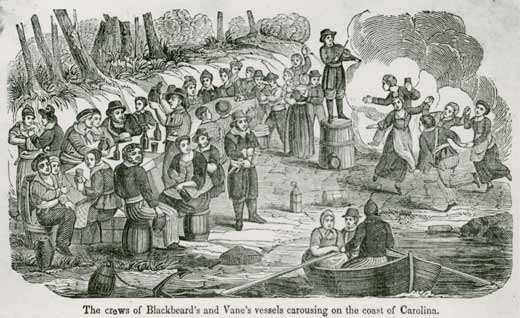
* Straight out of piracy central casting, no? Would you also believe his crew had a renowned “pirate party” rendezvous with Blackbeard’s?

On this day..

1757: Robert-Francois Damiens, disciplined and punished

On this date in 1757, Robert-Francois Damiens became the last Frenchman to suffer the dreadful punishment of drawing and quartering.

Damiens attempted to assassinate King Louis XV, inflicting, however, only a slight dagger wound.

He may be best-known today as the subject of the jarring opening passage of Foucault’s Discipline and Punish, in which the full flower of this medieval torture* is described in detail by way of contrasting it with the regimented penal institutions that would sprout up in a few decades’ time. Here’s Foucault’s rendering of the scene:

On 1 March 1757 Damiens the regicide was condemned “to make the amende honorable before the main door of the Church of Paris”, where he was to be “taken and conveyed in a cart, wearing nothing but a shirt, holding a torch of burning wax weighing two pounds”; then, “in the said cart, to the Place de Grève, where, on a scaffold that will be erected there, the flesh will be torn from his breasts, arms, thighs and claves with red-hot pincers, his right hand, holding the knife with which he committed the said parricide, burnt with sulphur, and, on those places where the flesh will be torn away, poured molten lead, boiling oil, burning resin, wax and sulphur melted together and then his body drawn and quartered by four horses and his limbs and body consumed by fire, reduced to ashes and his ashes thrown to the winds” (Pièces originales…, 372-4).

“Finally, he was quartered,” recounts the Gazette d’Amsterdam of 1 April 1757. “This last operation was very long, because the horses used were not accustomed to drawing; consequently, instead of four, six were needed; and when that did not suffice, they were forced, in order to cut off the wretch’s thighs, to sever the sinews and hack at the joints…

“It is said that, though he was always a great swearer, no blashemy escaped his lips; but the excessive pain made him utter horrible cries, and he often repeated: ‘My God, have pity on me! Jesus, help me!’ The spectators were all edified by the solicitude of the parish priest of St Paul’s who despite his great age did not spare himself in offering consolation to the patient.”

Bouton, an officer of the watch, left us his account: “The sulphur was lit, but the flame was so poor that only the top skin of the hand was burnt, and that only slightly. Then the executioner, his sleeves rolled up, took the steel pincers, which had been especially made for the occasion, and which were about a foot and a half long, and pulled first at the calf of the right leg, then at the thigh, and from there at the two fleshy parts of the right arm; then at the breasts. Though a strong, sturdy fellow, this executioner found it so difficult to tear away the pieces of flesh that he set about the same spot two or three times, twisting the pincers as he did so, and what he took away formed at each part a wound about the size of a six-pound crown piece.

“After these tearings with the pincers, Damiens, who cried out profusely, though without swearing, raised his head and looked at himself; the same executioner dipped an iron spoon in the pot containing the boiling potion, which he poured liberally over each wound. Then the ropes that were to be harnessed to the horses were attached with cords to the patient’s body; the horses were then harnessed and placed alongside the arms and legs, one at each limb.

“Monsieur Le Breton, the clerk of the court, went up to the patient several times and asked him if he had anything to say. He said he had not; at each torment, he cried out, as the damned in hell are supposed to cry out, ‘Pardon, my God! Pardon, my Lord.’ Despite all this pain, he raised his head from time to time and looked at himself boldly. The cords had been tied so tightly by the men who pulled the ends that they caused him indescribable pain. Monsieur le [sic] Breton went up to him again and asked him if he had anything to say; he said no. Several confessors went up to him and spoke to him at length; he willingly kissed the crucifix that was held out to him; he opened his lips and repeated: ‘Pardon, Lord.’

“The horses tugged hard, each pulling straight on a limb, each horse held by an executioner. After a quarter of an hour, the same ceremony was repeated and finally, after several attempts, the direction of the horses had to be changed, thus: those at the arms were made to pull towards the head, those at the thighs towards the arms, which broke the arms at the joints. This was repeated several times without success. He raised his head and looked at himself. Two more horses had to be added to those harnessed to the thighs, which made six horses in all. Without success.

“Finally, the executioner, Samson, said to Monsieur Le Breton that there was no way or hope of succeeding, and told him to ask their Lordships if they wished him to have the prisoner cut into pieces. Monsieur Le Breton, who had come down from the town, ordered that renewed efforts be made, and this was done; but the horses gave up and one of those harnessed to the thighs fell to the ground. The confessors returned and spoke to him again. He said to them (I heard him): ‘Kiss me, gentlemen.’ The parish priest of St Paul’s did not dare to, so Monsieur de Marsilly slipped under the rope holding the left arm and kissed him on the forehead. The executioners gathered round and Damiens told them not to swear, to carry out their task and that he did not think ill of them; he begged them to pray to God for him, and asked the parish priest of St Paul’s to pray for him at the first mass.

“After two or three attempts, the executioner Samson and he who had used the pincers each drew out a knife from his pocket and cut the body at the thighs instead of severing the legs at the joints; the four horses gave a tug and carried off the two thighs after them, namely, that of the right side first, the other following; then the same was done to the arms, the shoulders, the arm-pits and the four limbs; the flesh had to be cut almost to the bone, the horses pulling hard carried off the right arm first and the other afterwards.

“When the four limbs had been pulled away, the confessors came to speak to him; but his executioner told them that he was dead, though the truth was that I saw the man move, his lower jaw moving from side to side as if he were talking. One of the executioners even said shortly afterwards that when they had lifted the trunk to throw it on the stake, he was still alive. The four limbs were untied from the ropes and thrown on the stake set up in the enclosure in line with the scaffold, then the trunk and the rest were covered with logs and faggots, and fire was put to the straw mixed with this wood.

“…In accordance with the decree, the whole was reduced to ashes. The last piece to be found in the embers was still burning at half-past ten in the evening. The pieces of flesh and the trunk had taken about four hours to burn. The officers of whom I was one, as also was my son, and a detachment of archers remained in the square until nearly eleven o’clock.

“There were those who made something of the fact that a dog had lain the day before on the grass where the fire had been, had been chased away several times, and had always returned. But it is not difficult to understand that an animal found this place warmer than elsewhere” (quoted in Zevaes, 201-14).

Among the throngs in attendance that day was Casanova who, according to his memoirs, rented out a windowed flat to watch that stomach-churning torture for four hours with some male friends and female companions.

One of the legendary libertine’s friends found this moment, serenaded by the prisoner’s “piercing shrieks”, opportune for an altogether different adventure of the flesh:

The three ladies packing themselves together as tightly as possible took up their positions at the window, leaning forward on their elbows, so as to prevent us seeing from behind. The window had two steps to it, and they stood on the second; and in order to see we had to stand on the same step, for if we had stood on the first we should not have been able to see over their heads. I have my reasons for giving these minutiae, as otherwise the reader would have some difficulty in guessing at the details which I am obliged to pass over in silence.

…

Tiretta kept the pious aunt curiously engaged during the whole time of the execution, and this, perhaps, was what prevented the virtuous lady from moving or even turning her head round.

Finding himself behind her, he had taken the precaution to lift up her dress to avoid treading on it. That, no doubt, was according to the rule; but soon after, on giving an involuntary glance in their direction, I found that Tiretta had carried his precautions rather far, and, not wishing to interrupt my friend or to make the lady feel awkward, I turned my head and stood in such a way that my sweetheart could see nothing of what was going on; this put the good lady at her ease. For two hours after I heard a continuous rustling, and relishing the joke I kept quiet the whole time. I admired Tiretta’s hearty appetite still more than his courage, but what pleased me most was the touching resignation with which the pious aunt bore it all.

Casanova’s Complete Memoires are available free online; this episode is recounted in the first chapter of “Paris and Holland”.

* Damiens’ punishment was in fact already archaic at the point when it was inflicted. Somewhat unsure of itself, the court sought precedent in the last regicide executed — Francois Ravaillac, who in 1610 was also the most recent person to suffer this horrific penalty. The clumsiness of the Damiens’ execution can surely be attributed to the art being a century and a half out of practice.

On this day..

1796: Mastro Titta’s first execution of many

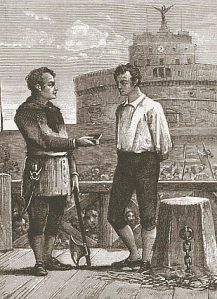
A Catholic man with the name Giovanni Battiste (“John the Baptist”) Bugatti could hardly have had a more ironic role in church history than the man who, on this date in 1796, dispatched his first victim as official executioner of the Papal State. Nicholas Gentilucci was hanged for killing a clergyman and his coachman, then robbing two friars while on the lam; Gentilucci’s corpse was subsequently quartered.

Little is known about Gentilucci, but much is known of his then-17-year-old executioner, for Bugatti, who would become known simply as Mastro Titta, turned out to be the most individually prolific taker of life in turn-of-the-19th century Rome.

Bugatti was born in Rome in 1779 and, even while putting criminals of the state to death, lived and worked on the west side of the Tiber River as an umbrella painter. Executions were a side job, and these ghastly deeds were recognized as such by the church, which compensated him a paltry three cents of a Roman lira for each body.

“Minister of Justice”

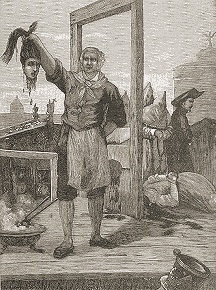
Mastro Titta brandishes an executed woman’s head.

The original Mastro Titta — the titular corruption of the “Minister of Justice” — took responsibility for each of his “patients” (as he called them, and as they were notoriously referred to by others), dutifully noting each of the 516 in his memoir. He stood for 69 years as the primary administrator of the death penalty in papal Rome, killing variously by beheading, hanging, and use of the mallet. Some were charged with murder, others with conspiracy, others with more petty crimes, but all were found guilty by the court of judges chosen by the Church’s bishops and cardinals.

The Minister’s performances were not without an (increasingly practiced) flair, heavy on the religious symbolism. Bugatti’s residence on the west side of the river meant that, when he was to carry out a punishment, he had first to cross the river.

Initially, the executions were carried out in the Piazza del Popolo, but that location was retired in the 1820’s; it’s not clear how consistent the location was after this, but at least one later execution occurred near San Giovanni decollato, home to the group of monks dedicated to comforting the condemned even when the final blow didn’t occur at its doorstep. Regardless of the locale, a spectacle soon arose surrounding that crossing and the parade which followed, as documented by Italian dialect poet G.G. Belli in 1835 (presumably for the execution of Giovanni Orioli di Lugo on July 11 of that year):

The Dilettante at the Bridge

They approach: Attention: the ceremony is brief.
Behold the condemned, neck bare and stretched.
He is the first man of the opera, the Patient,
The Ace of Spades, lord of the fesitval.

And behold the professor that will soon be
The surgeon acting for the people
For three pence, the community,
He will cure the ills of their pained head!

But not the man on the left: the other, to the right.
He in the second place is the Assistant.
The proceedings wait for Mastro Titta.

Do you want the usual from me, who takes the head?
I who never miss it: I am consistent;
And I know him as well as I know the Pope.

The translation is largely mine, with help on some difficult sections from a well-written and complete description of Mastro Titta’s life and work here and here.

Just a Job

A pinch of snuff before I snuff you?

Bugatti was known for playing the role of executioner in a manner which left no doubt as to his feelings towards the act: it was his job, his service to the Church itself, undisturbed by any personal animus towards the condemned — particularly early in his career.

He often offered snuff to his victims and spoke briefly and quietly with them prior to the execution, likely ploys to ease the victim into his role in the spectacle. Dickens viewed one of Mastro Titta’s beheadings on 8 March 1845*, and, in his Pictures From Italy, he remarked on the callousness of the event.

In keeping with this attitude, most of the entries in Mastro Titta’s memoir are fewer than 20 words. They reflect a man who seeks to distance himself from the crowd’s bloodlust. A selection:

  • “Tommaso Tintori, guilty of homicide, 28 February 1810″ (The first using the “new edifice for beheading from the French government” — that is, the guillotine)
  • “Pecorari Angel, of Poli, aged 29. Peasant guilty of premeditated homicide of one woman, condemned to «death as an example» in Poland on 21 January 1847.” (There were a number of prisoners sentenced in other Catholic parts of Europe sent to Rome for Titta’s ministrations.)
  • “Sabbatino Proietti, aged 25, «decapitated» in Rieti for petty theft and highway robbery and murder on 20 August 1853, died converted, executed through administration of justice at the public square at the Bridge.”
  • “Angelo Lisi di Alatri, found guilty of premeditated highway robbery and murder in Frosinone, «dead» on 30 April 1862.”

An Anomalous Man

Bugatti was born just seven years prior to the Grand Duchy of Tuscany becoming the first of the Italian states to abolish the death penalty. There, Leopold II barred torture and punishment of death, a decision heavily influenced by Cesare Beccaria’s On Crimes and Punishments and a desire to distance his nation from Rome.

In the neighboring Papal State, however, the practice continued, the embodiment of the church’s power over its people in matters earthly and spiritual. Executions of the time performed for various reasons, but with a handful of exceptions, they were almost exclusively performed on persons in the lower class. Many relied on the use of torture or testimony from confessionals. Papal executions were carried out until the 1870s and only declared unnecessary (though not banned by the Church) by Pope John Paul II in the 1990s.

A complete discussion of the role of executions in the Catholic Church is too much for this space,** but a man like Bugatti serves usefully to exemplify the absurdity endowed in these killings by the Catholic Church. Where the half-dozen popes who served over Bugatti thought such executions to be necessary for the control of the masses, they had no such ideas about nobles who committed crimes.

The execution itself consisted of a parade with masked priests, banners, scriptural readings, and sermonizing, culminating in the death of the condemned. John L Allen of the National Catholic Reporter described the treatment of these executions in that day as “a liturgy”, and descriptions from writers such as Lord Byron show a scene which could only be described as a mix of Catholic Mass and town festival.

Such ritualized killing came to contrast starkly with the Italian celebration of an anti-death penalty position, and the two stood at odds for over a century. In 1909, the topic was hot enough that a plaque glorifying two Italians executed by Bugatti in 1825 was erected; a dozen years later, its contents were concealed out of deference to Rome until after the Second Vatican Council. The commemorated, Angiolo Targhini and Leonida Montanari (here’s their Italian Wikipedia page), were convicted essentially of riling the people, and they were summarily beheaded; their story was the inspiration for Luigi Magni’s 1969 classic Nell’anno del Signore:

“So ends the long list of Bugatti.”

Mastro Titta was given an official residence, and at the end of his term, he was handsomely rewarded with a pension for his service — 30 scudi per year. His final executions were carried out on 17 August 1864, wearing his traditional red cloak (now on display at the Criminology Museum of Rome): Antonio Olietti of Rome and Domenico Antonio Demartini were beheaded for homicide.

The Minister of Justice was 85, four and some years from the end of his life, and the final line in his memoir reads, “So ends the long list of Bugatti. May that of his successor be shorter.”

Indeed it was.

The final executions in Rome occurred on 24 November 1868 at the hands of Antonio Balducci, Bugatti’s long-time apprentice; the event was marked by Pope Pius IX famously intoning in response to calls for a stay, “I can’t, and I don’t want to.” The last execution in the Papal State was of Agatino Bellomo on 9 July 1870, in Palestrina, shortly before the nascent unified Italy absorbed Rome.

Mastro Titta is still known in Italy,† but, adrift amid a particularly violent period of revolution, his legacy as papal executioner is largely lost to the rest of the world.

* The day’s guillotinee was Giovanni Vagnarelli, 26, from Augustine; he killed Bavarian Anna Cotten and robbed her, and her wife’s statement at confessional was used to convict Vagnarelli. Such confessional convictions were not uncommon, as Bugatti’s own memoir confirms.

** There’s surprisingly little reading out there about this topic, though it would seem ripe for a book or two. Here’s what I can find:

  • “Fear and Loathing in Bologna and Rome: The Papal Police in Perspective”, Steven Hughes, Journal of Social History, 1987.
  • “Capital Punishment: The Curious History of its Privileged Place in Christendom”, James J. Megivern, Proceedings of the American Philosophical Society, 2003.
  • For a discussion of current discourse in Catholic teachings, this is rather interesting: “To Kill or Not to Kill: The Catholic Church and the Problem of the Death Penalty”, lecture by E. Christian Brugger, Asst. Prof. of Ethics, Dept. of Religious Studies, Loyola University, 2001.

† A half dozen kilometers from the bridge that Mastro Titta crossed on his way to carry out Papal justice now stands the Mastro Titta Pub. It is reportedly “tastefully done” and serves mostly Belgian beers.

On this day..

1556: Thomas Cranmer, architect of Anglicanism

[audio:John_Merbecke_Creed.mp3]
(Part of John Merbecke‘s plainsong rendition of the Book of Common Prayer, as performed by the Virginia Theological Seminary motet choir. Via.)

Good Friday falls early this year, and gives pause to recollect the burning this date of Thomas Cranmer, Henry VIII’s Archbishop of Canterbury, author of this gentle prayer for Holy Week:

Almighty and everliving God, who, of thy tender love towards mankind, hast sent thy Son our Savior Jesus Christ to take upon him our flesh, and to suffer death upon the cross, that all mankind should follow the example of his great humility: Mercifully grant that we may both follow the example of his patience, and also be make partakers of his resurrection; through the same Jesus Christ our Lord, who liveth and reigneth with thee and the Holy Spirit, one God,for ever and ever. Amen.

Thomas Cranmer was an obscure middle-aged priest when happenstance acquainted him with the circle then endeavoring to engineer Anne Boleyn‘s elevation from Henry VIII‘s enamored to Queen of England.

Cranmer enthusiastically supported Henry’s position that his first marriage to Catherine of Aragon should be annulled, and the perspicacity of the doctrinal case he developed to that effect saw him admitted into the inner circle of royal theologians.

The papal case foundered because Catherine’s kinsman Charles V happened, in the course of politics on the Italian peninsula, to be holding the pope a virtual hostage in Rome. On such accidents of history do faiths arise — and the faithful burn.

The Break With Rome

The 16th century, yeasty with religious disputation widely circulated by the printing press, is thick with folk who are one sect’s martyrs and the other sect’s villains.

Cranmer is just such a character.

One could charge him — and Catholic partisans have, many times — with blowing with the wind, granting theological license to the whims of his sovereign. Henry pressed through Cranmer’s appointment as Archbishop of Canterbury in 1533, just in time for Cranmer to annul Henry’s marriage to Catherine and validate the secret vows he had taken with Anne, earning both bishop and king excommunication.

That Cranmer rose with Anne but was ready to hold against her when she fell from favor, that he authorized the king’s famous pattern of discarding his past wives, that he signed off on the crown’s seizure of monasteries — that, in the end, he navigated Henry’s bloody reign with his position intact and even enhanced puts the whiff of opportunism about him. As Cranmer expert Ashley Null says (the link is a .pdf):

Like his first royal master, Cranmer did not make himself easy to love. In an era noted for the fervent courage of many martyrs for faith, Cranmer’s very survival under a king as unprincipled, or at least unpredictable, as Henry VIII has made him suspect. His late vacillation under Mary has only seemed to confirm the image of a man ruled more by the grip of fear than the assurance of the faith.

Whatever kernel of truth one might discern in such a charge, the fact remains that the church Cranmer built has by the test of centuries proven itself far more spiritually significant than mere opportunism could have admitted.

The Archbishop truly came into his own after Henry’s death.

For six years during the regency of Henry’s sickly, doomed son Edward VI, Cranmer hammered together the Anglican liturgy, wrote prolifically and beautifully, and assembled the Book of Common Prayer, a text which still guides Anglican services to this day.

His words still retain their power, and in some cases, their recognizability:

One can read Cranmer, especially in this mature stage, through many prisms — the competing threads of Catholicism, Lutheranism and Calvinism in his developing thought; the attempt to steer his institutional church towards his vision of the Reformation; and certainly as an inconstant individual — for his recantation when the Catholic Mary Tudor took the throne shows us a man as prone as any to folly and weakness.*

It is not the headsman’s purpose, and certainly not on this day, to render judgment on Cranmer’s soul; still less to unpack his theology. If we find him a man of flaws to compensate his genius, we must do him the justice of remembering also his firmness at the last hour, dramatically abjuring the recantation that had been forced upon him and thrusting the offending right hand that had signed it first into the flames.

* Cranmer had endorsed Mary’s rival Lady Jane Grey in the contentious succession that followed Edward VI; for this, he was convicted of treason in a trial managed by his old friend and fellow-survivor Thomas Howard. (Source) The Queen spared him execution on this charge in order to have him up on heresy instead, and it was this that Cranmer attempted to avoid by submission to the pope.

On this day..

1600: Linköping Bloodbath, the dawn of Sweden’s glory

On this date in 1600, five former supporters of King Sigismund were beheaded at Linköping, as Sweden broke free of Poland and of Catholicism.

Eighty years before, the Swedish Vasa dynasty had established itself by surviving one bloodbath. Now, it would set its greatest scion in line for the throne by inflicting another.

Sigismund was Sweden’s legitimate heir; he was also a characteristic product of dynastic intermarriage whose loyalties were splintered between fiefdoms. But most crucially of all, he had been raised Catholic in a realm turning decisively towards Protestantism.

Born of a Polish-Italian mother, he had secured the Polish-Lithuanian throne by election in 1589; when succession added suzerainty of Sweden, his realm was a personal union stretching across central Europe from the Arctic Circle to the Black Sea.

Which looked better on paper than it would work in practice.

The persecutory stage of the Catholic counter-reformation had been in full throat this past half-century, and the accession of a Catholic prince raised a Scandinavian alarm.

Busy governing Poland, Sigismund left his Protestant uncle Duke Charles to administer Sweden; within five years, civil war had erupted between the two and in short order the victorious soon-to-be King Charles IX had occasion to make example of the nobles who had backed Sigismund’s cause.

Charles himself would be a transitional figure in Sweden, but what a transition: his victory made possible the the subsequent scintillating reign of his son, Gustavus Adolphus — the able commander who would raise Sweden into a true European power.*

There would be an interesting coda in that reign to this day’s doings. Gustavus’ greatest general, Johan Banér, was the son of one of those put to death in Linköping. In another time, between other men, that one fellow’s father had seen the other fellow’s butchered might have put a blood feud between them. But as young men — the king was just 18 months his senior — they formed a permanent friendship, upon which they founded the military collaboration that shook northern Europe.

“My dad beheaded your dad”
“Let’s play!”

* Among Gustavus Adolphus’ numerous exploits was war with his father’s old rival — that is, with his cousin Sigismund — in the 1620s. Foreign relations between Sweden and Poland had turned understandably frosty, with Sigismund spending the rest of his long life eyeballing the lost crown.

On this day..

1741: Jenny Diver, a Bobby Darin lyric?

On this date in 1741,* at Tyburn‘s largest mass-execution of the mid-18th century, renowned cutpurse Jenny Diver was hanged along with 19 others.

Born Mary Young in Ireland around 1700, the girl was abandoned as a child but deserted a benefactor’s household to take passage to London where she meant to work as a seamstress.

What the Newgate Calendar reads as ingratitude, the modern reader might more sympathetically see as the allure of a burgeoning city for a teenager full of dreams.

Dreams may nurture the spirit, but flesh must have bread. Like countless others through time — indeed, like countless other clients of Tyburn — Jenny found metropolis less than convivial to aspirations of honest labor.

Unable to live on her stitching, Jenny found more lucrative employment for her manual dexterity in a sizable gang of thieves — of which her uncovered criminal puissance gave her mastery.

The Newgate Chronicle bursts with almost doting memoirs of her agile fingers, like this one:

[S]he procured a pair of false hands and arms to be made, and concealing her real ones under her clothes she repaired on a Sunday evening to the place of worship above mentioned in a sedan-chair, one of the gang going before to procure a seat among the more genteel part of the congregation, and another attending in the character of a footman.

Jenny being seated between two elderly ladies, each of whom had a gold watch by her side, she conducted herself with seeming great devotion; but when the service was nearly concluded she seized the opportunity, when the ladies were standing up, of stealing their watches, which she delivered to an accomplice in an adjoining pew.

Not neglecting also to celebrate the gang’s more Sting-like ruses, like this hilarious turn of the tables on a credulous cuckolder:

Jenny dressed herself in an elegant manner, and went to the theatre one evening when the king was to be present; and during the performance she attracted the particular attention of a young gentleman of fortune from Yorkshire, who declared, in the most passionate terms, that she had made an absolute conquest of his heart, and earnestly solicited the favour of attending her home. She at first declined a compliance, saying she was newly married, and that the appearance of a stranger might alarm her husband. At length she yielded to his entreaty, and they went together in a hackney-coach, which set the young gentleman down in the neighbourhood where Jenny lodged, after he had obtained an appointment to visit her in a few days, when she said her husband would be out of town.

…

The day of appointment being arrived, two of the gang appeared equipped in elegant liveries, and Anne Murphy [another thief] appeared as waiting-maid. The gentleman came in the evening, having a gold-headed cane in his hand, a sword with a gold hilt by his side, and wearing a gold watch in his pocket, and a diamond ring on his finger.

Being introduced to her bed-chamber, she contrived to steal her lover’s ring; and he had not been many minutes undressed before Anne Murphy rapped at the door, which being opened, she said, with an appearance of the utmost consternation, that her master was returned from the country. Jenny, affecting to be under a violent agitation of spirits, desired the gentleman to cover himself entirely with the bed-clothes, saying she would convey his apparel into another room, so that if her husband came there, nothing would appear to awaken his suspicion: adding that, under pretence of indisposition, she would prevail upon her husband to sleep in another bed, and then return to the arms of her lover.

The clothes being removed, a consultation was held, when it was agreed by the gang that they should immediately pack up all their moveables, and decamp with their booty, which, exclusive of the cane, watch, sword, and ring, amounted to an hundred guineas.

The amorous youth waited in a state of the utmost impatience till the morning, when he rang the bell, and brought the people of the house to the chamber-door, but they could not gain admittance, as the fair fugitive had turned the lock, and taken away the key; when the door was forced open the gentleman represented in what manner he had been treated; but the people of the house were deaf to his expostulations, and threatened to circulate the adventure throughout the town, unless he would indemnify them for the loss they had sustained. Rather than hazard the exposure of his character, he agreed to discharge the debt Jenny had contracted; and dispatched a messenger for clothes and money, that he might take leave of a house of which he had sufficient reason to regret having been an inhabitant.

Alas to say, they all can’t come off like clockwork. Jenny was caught a couple of times, dodging the noose in 1733 and 1738, sentenced on both occasions to transportation to the American colonies.

Finding little to recommend colonial Virginia, she returned illegally from both sentences at the risk of her life (she only survived her second arrest by passing herself off under an alias). The third time broke the charm, however: one is saddened to find her in her last adventure nabbed like a tyro trying to pick a younger woman’s pocket of a few shillings. The victim snatched Jenny’s wrist in the act: perhaps those nimble hands, now pushing 40, had finally slowed down.

Jenny Diver’s hands, in their time, had profited her far more than needlework could have; they had given her a life of some comfort to compensate its perils; and at the end, they afforded their owner the last indulgence of a “mourning coach,” an enclosed carriage separate from the carts that hauled this day’s other 19 (unrelated) victims.

It was a rowdy hanging day with an unusual guard detail of soldiery: one of the prisoners had reported a pending rescue attempt, and for her resources and gang affiliations, Jenny was thought to be its intended beneficiary. (If the stool pigeon was hoping his own tattling would reprieve him, he was disappointed.) For reasons related or not, the crowd was in an ugly mood, as reported by the Newgate Ordinary:

In this Manner were they convey’d through a vast Multitude of People to Tyburn, some of whom, notwithstanding the Guard of Soldiers, were very rude and noisy, hallooing, throwing Brickbats, Mud, &c. at the unhappy Prisoners, as they passed.


Her notoriety would live on in cheap publications hawked by itinerant peddlers — 18th century precursors of the penny dreadful — that in Jenny’s case helpfully doled out tips on foiling pickpockets.

About That Name

We also have a modern context** for the name “Jenny Diver” as one of several women mentioned in the song “Mack the Knife”:

This song is an English riff on a German tune from The Threepenny Opera, concerning its principal male character, the highwayman Macheath. (Possibly inspired by the recently-executed Jack Sheppard.)

The Threepenny Opera updated the 18th-century Beggar’s Opera, a satiric (and extraordinarily popular) production setting operatic tropes among society’s whores, criminals and castoffs.

The sequence of female names Bobby Darin rattles off in this version of “Mack the Knife” all draw from these operas: Suky (sometimes Sukey or Sukie) Tawdry and Jenny Diver are underworld women in The Beggar’s Opera who set Macheath up for arrest; Lucy Brown is The Threepenny Opera‘s version of the original character Lucy Lockit, who under either name is the daughter of a law enforcement officer in love with Macheath who helps him escape.†

One might suppose such a fortuitous connection of Jenny Divers was a calculated one, but it seems both the character’s name and the thief’s were independently and coevally drawn from the rich vein of English thieves’ cant.

Strictly coincidental.

“Diver” as street slang for a pickpocket dated back 150 years, according to Philip Rawlings, so it was a natural sobriquet for an expert thief … and for an author (whose script is chock full of suggestively-named characters — Wat Dreary, Molly Brazen, Jemmy Twitcher) conjuring such a character. There’s no direct evidence indicating that either the cutpurse or the dramatist knowingly cribbed from the other.

A pity it was for the real Jenny that art and life couldn’t imitate one another more strongly.

PLAYER. But, honest Friend, I hope you don’t intend that Macheath shall be really executed.

BEGGAR. Most certainly, Sir.—-To make the Piece perfect, I was for doing strict poetical Justice—-Macheath is to be hang’d; and for the other Personages of the Drama, the Audience must have suppos’d they were all hang’d or transported.

PLAYER. Why then Friend, this is a downright deep Tragedy. The Catastrophe is manifestly wrong, for an Opera must end happily.

BEGGAR. Your Objection, Sir, is very just, and is easily remov’d. For you must allow, that in this kind of Drama, ’tis no matter how absurdly things are brought about—-So—-you Rabble there—-run and cry, A Reprieve!—-let the Prisoner be brought back to his Wives in Triumph.

* 1740, according to the original documentation; 1741 by modern reckoning, since the new year’s onset was at the time not recognized on January 1.

** There’s still another Jenny Diver reference in the literate comic book series The League of Extraordinary Gentlemen.

† The fourth name of the sequence originally was Polly Peachum, Lucy’s rival for Macheath’s affections — but when Louis Armstrong made the first popular recording of Mack the Knife, he ad-libbed the line “Look out for Miss Lotte Lenya!” referring the actress who played Polly Jenny in both the original German production and the then-current Broadway importation, and who also happened to be present at Armstrong’s recording. Darin’s subsequent (and eventually canonical) version followed that lead and replaced the original name outright.

On this day..

1457: László Hunyadi, the death before Hungary’s rebirth

On this date in 1457, Hungary lost a young prospective statesman and gained a national martyr.

A tale of noble bloodshed begins as so many do with a contested succession, this one amid the confusing feudal geometry of central Europe in the shadow of the rising Ottoman Empire. The untimely (albeit unsurprising) death in battle of warlike Albert II of Germany put the crown in the hands of a son born four months after his demise — the memorably named Ladislaus the Posthumous.

Effective government, needless to say, was in the hands of more senior gentlemen: the ambitious Slovenian-Croatian count Ulrich II and the able Hungarian commander John Hunyadi.* With two strapping Hunyadi boys who were contemporaries with the nominal king, it was only a matter of time before someone wound up dead.

Hunyadi pere saw it all coming. On his deathbed in 1456, he warned his children never to find themselves both together with Ladislaus.

Events moved fast after John Hunyadi’s passing. The Posthumous, now a teenager, set Hunyadi’s longtime rival up against the boys’ claim, but Laszlo, the elder brother, killed Ulrich. Ladislaus — answering the exigencies of the moment but possibly also sincerely relieved to be rid of his overbearing uncle — immediately pardoned the killer and offered to have him over to court.

Dad would have said, “I told you so.”

Upon arrival, Laszlo was seized, sentenced to death by a kangaroo court, and summarily beheaded. The most melodramatic version has the beheading botched three times and Laszlo demanding a reprieve on the grounds that heaven had attested his innocence by preserving him. Ladislaus had his guys keep at it until heaven threw in the towel.

The Buried Lead

So, hard going for some noble tit in the borderlands 551 years ago. What’s the relevance? Why, when Hungarian artists of the 19th century groped for an expression of national identity did they hark back to unlucky Laszlo on canvas …

The Mourning of Laszlo Hunyadi (1859) by Viktor Madarász shows the pallid-faced mother and bride of the prince bewailing his body, the fatal wound unmistakably suggested while remaining artfully concealed. Painted in Paris, it won a French state medal. (Source)

… and in opera?

The answer is less to do with Laszlo’s own qualities, courageous though they may have been.

A few months after having the young man put to death, Ladislaus himself died suddenly. Contemporaries suspected poison; others thought cosmic justice punished him for breaking faith. Modern science — vulture, whose wings are dull realities! — fingers something as unromantic as a medical condition.

One way or another, Ladislaus really was Posthumous, and into the empty throne stepped Laszlo’s 15-year-old brother Matthias — who had been more judicious about his head than his brother. Matthias would reign for 32 years and enter Hungarian folklore as “Matthias the Just”.

The long and adroit span of Matthias’ career and his father’s combined to immortalize the Hunyadi name (which fell extinct after Matthias’ passing before it could produce any buzzkilling scions of more doubtful abilities) as synonymous with Hungary’s golden age.

Laszlo’s reputation mostly just comes along for the ride — had, say, Ladislaus enjoyed Matthias’ run, the elimination of a boyhood rival would have been chalked down to the regrettable griminess of the day’s political reality; had some other claimant followed him to the throne, the Hunyadi name would never have had the luster to make him an attractive operatic subject.

A Symbol of National Rebirth

But they’re called “counterfactuals” for a reason: it may have happened by chance, but it did happen that Laszlo Hunyadi’s martyrology, in the victim’s very name, conveniently totes to the present day a pleasing theme of national redemption and greatness.

As described in this (.pdf) introduction to the opera (part of an extensive collection of information about Ferenc Erkel‘s operas, including a translated libretto of Hunyadi Laszlo):

In the national mythology the Hunyadi family’s descent into the underworld is symbolized by the fate of Laszlo Hunyadi, the firstborn of Janos Hunyadi who was 10 years Matyas’s senior. His life and death were preserved in the collective memory of the nation not as an independent legend but as the middle part of an imaginary trilogy about the Hunyadis. Laszlo Negyessy wrote that the opera Hunyadi Laszlo “has an air of incompleteness because the story is suspended at a point where all our senses appeal for continuation. However, this continuation and poetic justice is served in our national memory.”

Here is Erkel’s celebrated funeral march (“Gyaszindulo”) rendering the victim’s journey to his scaffold this day — the non-choral prelude to his mother’s dramatic plea for his life in the video above, and one of the signature compositions of Hungarian music**:

[audio:Hunyadi_Laszlo_funeral_march.mp3]

* John (Janos) Hunyadi wasn’t above meddling with the neighbors himself. Hungary figures as a bully of the kingdom of Wallachia (modern Romania) at this time; John Hunyadi deposed the father of, then (in the course of political alignment) helped raise to Wallachia’s throne, Vlad the Impaler, the sort-of historical model (and apparent historical namesake) for the vampire Dracula. When Vlad Dracula was deposed in turn, he fled to the protection of Matthias Hunyadi.

** Erkel also wrote the Hungarian national anthem.

On this day..

1998: Bahram Khan, by his victim’s brother

Ten years ago today, in Taliban-controlled Afghanistan, 30,000 people witnessed an alleged murderer shot to death by the victim’s brother at Kabul’s national stadium.

The Taliban had held Kabul for little more than a year at this point, and this sort of ostentatious shari’a execution was still a novelty. Amnesty International reported that loudspeakers summoned people to the stadium expressly to witness the execution (and the subsequent flogging of an accused rapist), and that the victim’s family refused the pleas of the crowd to spare Khan’s life.

Amnesty also excerpted a translated Taliban Radio report of the event.

The occasion of applying Shari’a law to a murderer in Kabul Stadium today was attended by a number of high ranking officials of the Islamic Emirate of Afghanistan and thousands of Kabul people. First some verses from the Koran were recited .. Deputy Court Martial .. Mawlawi Sayd Abdul Rahman Agha .. in turn spoke about the implementation of Allah’s order on Allah’s earth to criminals in order that other criminals should take an example from it. .. Subsequently Esteemed Abdul Nasir Nastier, an official of radio television introduced the criminal and read out the court martial’s decision. After reading out the court martial’s decision Bahram Khan, son of Mohsin Khan, citizen of Bagrami district of Kabul Province, who had killed Asadullah, son of Neck Mohammad on the night of 28th-29th of Sonbola [19th-20th September] this year .. was executed before thousands of Kabul people.

Here is the original Associated Press story, archived by Rick Halperin‘s death penalty news mailing list:

A convicted murderer was executed in a Kabul football stadium Friday — shot in the head and chest by the victim’s brother — despite a plea for mercy from a crowd of thousands. It was the 3rd public execution under the new Taliban regime, whose harsh brand of justice makes many Afghanis uneasy. That opposition was reflected Friday by the fact that even the judge in the case joined the effort to spare Bahram Khan’s life.

“Let him live!” the crowd shouted as Khan’s hands were bound behind his back and he was removed from the pickup truck that carried him into the arena. But the victim’s father, Nek Mohammed, strode to the microphone. “We won’t forgive him. If we let him live he will kill again. We know this man.”

While executions took place in Afghanistan before the Taliban’s takeover last year, the army of former Islamic seminarians has added several new twists. For example, it has curtailed defendants’ right to appeal rulings and gives the families of murder victims the option of carrying out a court-imposed death sentence or granting mercy.

It wasn’t immediately clear Friday whether the crowd’s intervention on behalf of Khan stemmed from general objections to such forms of punishment or was based on the particulars of the case. At any rate, it was fruitless. Khan’s executioner jumped up onto the truck and quickly dispatched one bullet into Khan’s head and another into the 29-year-old’s chest. Khan crumpled to the ground.

Khan’s body was carried and another man was pushed onto the field and given 100 lashes for raping a woman last year. In addition to the executions, the Taliban has also begun public amputations of hands and feet, an Islamic punishment for theft.

The Taliban religious militia overran the capital of Kabul in 1996 and now controls 85% of the country. Afghanistan’s former president, Burhanuddin Rabbani, heads an anti-Taliban alliance of minority ethnic groups that is fighting the Islamic army on several fronts.

On this day..

1845: An Italian highwayman, as witnessed by Dickens

On this date in 1845, Charles Dickens witnessed a man beheaded in Rome for robbery and murder.

At 33, Dickens was well-established in his field; he already had to his credit The Pickwick Papers, Oliver Twist, Nicholas Nickleby and others.

Dickens spent a good part of the mid-1840’s abroad, with extended stays in North America, Italy and Switzerland, although without much abating his prodigious output. He intended the travelogue Pictures From Italy to help finance his journeys; it met an unenthusiastic reception and rates distinctly among Dickens’ minor works.

This day’s events took place during the latter stages of Dickens’ stay in Italy and — as the distinctly proscriptive last paragraphs of this excerpt indicate — touch a social theme very pressing to the author, one to which he would soon return again. Years later, the utterly unedifying scene of the public guillotine would be fodder for Dickens’ A Tale of Two Cities, whose tragic protagonist has already appeared in these pages.

Of note also is Dickens’ implication — though he doesn’t quite state it outright — that the criminal was uncovered by a secret revealed under the seal of confession, a touchy point for the priesthood as any viewer of television crime dramas will certainly be aware. We have to allow a considerable latitude for a misapprehension on the traveler’s part here, especially given that Pictures as a whole caught considerable heat from the moment of its publication for its relentless anti-Catholicism. (Update: More on the use of confessionals in Papal Rome in this post about the Vatican’s headsman.)

Here’s the scene in its entirety:

On one Saturday morning (the eighth of March), a man was beheaded here. Nine or ten months before, he had waylaid a Bavarian countess, travelling as a pilgrim to Rome – alone and on foot, of course – and performing, it is said, that act of piety for the fourth time. He saw her change a piece of gold at Viterbo, where he lived; followed her; bore her company on her journey for some forty miles or more, on the treacherous pretext of protecting her; attacked her, in the fulfilment of his unrelenting purpose, on the Campagna, within a very short distance of Rome, near to what is called (but what is not) the Tomb of Nero; robbed her; and beat her to death with her own pilgrim’s staff. He was newly married, and gave some of her apparel to his wife: saying that he had bought it at a fair. She, however, who had seen the pilgrim-countess passing through their town, recognised some trifle as having belonged to her. Her husband then told her what he had done. She, in confession, told a priest; and the man was taken, within four days after the commission of the murder.

There are no fixed times for the administration of justice, or its execution, in this unaccountable country; and he had been in prison ever since. On the Friday, as he was dining with the other prisoners, they came and told him he was to be beheaded next morning, and took him away. It is very unusual to execute in Lent; but his crime being a very bad one, it was deemed advisable to make an example of him at that time, when great numbers of pilgrims were coming towards Rome, from all parts, for the Holy Week. I heard of this on the Friday evening, and saw the bills up at the churches, calling on the people to pray for the criminal’s soul. So, I determined to go, and see him executed.

The beheading was appointed for fourteen and a-half o’clock, Roman time: or a quarter before nine in the forenoon. I had two friends with me; and as we did not know but that the crowd might be very great, we were on the spot by half-past seven. The place of execution was near the church of San Giovanni decolláto (a doubtful compliment to Saint John the Baptist) in one of the impassable back streets without any footway, of which a great part of Rome is composed – a street of rotten houses, which do not seem to belong to anybody, and do not seem to have ever been inhabited, and certainly were never built on any plan, or for any particular purpose, and have no window-sashes, and are a little like deserted breweries, and might be warehouses but for having nothing in them. Opposite to one of these, a white house, the scaffold was built. An untidy, unpainted, uncouth, crazy-looking thing of course: some seven feet high, perhaps: with a tall, gallows-shaped frame rising above it, in which was the knife, charged with a ponderous mass of iron, all ready to descend, and glittering brightly in the morning sun, whenever it looked out, now and then, from behind a cloud.

There were not many people lingering about; and these were kept at a considerable distance from the scaffold, by parties of the Pope’s dragoons. Two or three hundred foot-soldiers were under arms, standing at ease in clusters here and there; and the officers were walking up and down in twos and threes, chatting together, and smoking cigars.

At the end of the street, was an open space, where there would be a dust-heap, and piles of broken crockery, and mounds of vegetable refuse, but for such things being thrown anywhere and everywhere in Rome, and favouring no particular sort of locality. We got into a kind of wash-house, belonging to a dwelling-house on this spot; and standing there in an old cart, and on a heap of cartwheels piled against the wall, looked, through a large grated window, at the scaffold, and straight down the street beyond it until, in consequence of its turning off abruptly to the left, our perspective was brought to a sudden termination, and had a corpulent officer, in a cocked hat, for its crowning feature.

Nine o’clock struck, and ten o’clock struck, and nothing happened. All the bells of all the churches rang as usual. A little parliament of dogs assembled in the open space, and chased each other, in and out among the soldiers. Fierce-looking Romans of the lowest class, in blue cloaks, russet cloaks, and rags uncloaked, came and went, and talked together. Women and children fluttered, on the skirts of the scanty crowd. One large muddy spot was left quite bare, like a bald place on a man’s head. A cigar-merchant, with an earthen pot of charcoal ashes in one hand, went up and down, crying his wares. A pastry-merchant divided his attention between the scaffold and his customers. Boys tried to climb up walls, and tumbled down again. Priests and monks elbowed a passage for themselves among the people, and stood on tiptoe for a sight of the knife: then went away. Artists, in inconceivable hats of the middle-ages, and beards (thank Heaven!) of no age at all, flashed picturesque scowls about them from their stations in the throng. One gentleman (connected with the fine arts, I presume) went up and down in a pair of Hessian-boots, with a red beard hanging down on his breast, and his long and bright red hair, plaited into two tails, one on either side of his head, which fell over his shoulders in front of him, very nearly to his waist, and were carefully entwined and braided!

Eleven o’clock struck and still nothing happened. A rumour got about, among the crowd, that the criminal would not confess; in which case, the priests would keep him until the Ave Maria (sunset); for it is their merciful custom never finally to turn the crucifix away from a man at that pass, as one refusing to be shriven, and consequently a sinner abandoned of the Saviour, until then. People began to drop off. The officers shrugged their shoulders and looked doubtful. The dragoons, who came riding up below our window, every now and then, to order an unlucky hackney-coach or cart away, as soon as it had comfortably established itself, and was covered with exulting people (but never before), became imperious, and quick-tempered. The bald place hadn’t a straggling hair upon it; and the corpulent officer, crowning the perspective, took a world of snuff.

Suddenly, there was a noise of trumpets. ‘Attention!’ was among the foot-soldiers instantly. They were marched up to the scaffold and formed round it. The dragoons galloped to their nearer stations too. The guillotine became the centre of a wood of bristling bayonets and shining sabres. The people closed round nearer, on the flank of the soldiery. A long straggling stream of men and boys, who had accompanied the procession from the prison, came pouring into the open space. The bald spot was scarcely distinguishable from the rest. The cigar and pastry-merchants resigned all thoughts of business, for the moment, and abandoning themselves wholly to pleasure, got good situations in the crowd. The perspective ended, now, in a troop of dragoons. And the corpulent officer, sword in hand, looked hard at a church close to him, which he could see, but we, the crowd, could not.

After a short delay, some monks were seen approaching to the scaffold from this church; and above their heads, coming on slowly and gloomily, the effigy of Christ upon the cross, canopied with black. This was carried round the foot of the scaffold, to the front, and turned towards the criminal, that he might see it to the last. It was hardly in its place, when he appeared on the platform, bare-footed; his hands bound; and with the collar and neck of his shirt cut away, almost to the shoulder. A young man — six-and-twenty — vigorously made, and well-shaped. Face pale; small dark moustache; and dark brown hair.

He had refused to confess, it seemed, without first having his wife brought to see him; and they had sent an escort for her, which had occasioned the delay.

He immediately kneeled down, below the knife. His neck fitting into a hole, made for the purpose, in a cross plank, was shut down, by another plank above; exactly like the pillory. Immediately below him was a leathern bag. And into it his head rolled instantly.

The executioner was holding it by the hair, and walking with it round the scaffold, showing it to the people, before one quite knew that the knife had fallen heavily, and with a rattling sound.

When it had travelled round the four sides of the scaffold, it was set upon a pole in front — a little patch of black and white, for the long street to stare at, and the flies to settle on. The eyes were turned upward, as if he had avoided the sight of the leathern bag, and looked to the crucifix. Every tinge and hue of life had left it in that instant. It was dull, cold, livid, wax. The body also.

There was a great deal of blood. When we left the window, and went close up to the scaffold, it was very dirty; one of the two men who were throwing water over it, turning to help the other lift the body into a shell, picked his way as through mire. A strange appearance was the apparent annihilation of the neck. The head was taken off so close, that it seemed as if the knife had narrowly escaped crushing the jaw, or shaving off the ear; and the body looked as if there were nothing left above the shoulder.

Nobody cared, or was at all affected. There was no manifestation of disgust, or pity, or indignation, or sorrow. My empty pockets were tried, several times, in the crowd immediately below the scaffold, as the corpse was being put into its coffin. It was an ugly, filthy, careless, sickening spectacle; meaning nothing but butchery beyond the momentary interest, to the one wretched actor. Yes! Such a sight has one meaning and one warning. Let me not forget it. The speculators in the lottery, station themselves at favourable points for counting the gouts of blood that spirt out, here or there; and buy that number. It is pretty sure to have a run upon it.

The body was carted away in due time, the knife cleansed, the scaffold taken down, and all the hideous apparatus removed. The executioner: an outlaw ex officio (what a satire on the Punishment!) who dare not, for his life, cross the Bridge of St. Angelo but to do his work: retreated to his lair, and the show was over.

Pictures from Italy is available free online from Project Gutenberg.

The date and description would indicate that Dickens witnessed the death of 26-year-old Giovanni Vagnarelli. (See this list of the Holy See’s executions.)

Part of the Themed Set: The Written Word.

On this day..