1943: Jerzy Iwanow (Georgios Ivanof)

On this date in 1943, Polish-born Greek resistance hero Jerzy Iwanow-Szajnowicz was shot (or shot attempting to escape the Kaisariani execution ground, which amounts to pretty much the same thing) for a dramatic career fighting the occupation of Greece.

Iwanow (Polish) — or Georgios Ivanof — was the son of a Russian officer, but his parents divorced in his childhood, and mom married a Greek.

Jerzy was on his way to a cosmopolitan upbringing, mastering half a dozen languages and apparently just as many sports.

His athletic and linguistic prowess would both come in handy for derring-do missions (more Polish) in the Greek waters that saw him sink a German submarine and a destroyer with magnetic bombs. He even escaped the first two times he was captured.

Third time was a charm for the Nazis.

Sounds like celluloid material. As a matter of fact, a 1972 Polish film valorized Iwanow as Agent Nr. 1.

You can see the full movie on Veoh, if you’re prepared to install their viewing software.

On this day..

1942: Eleven members of the Red Orchestra

On this date in 1942, eleven members* of a Berlin-based anti-Nazi resistance circle were executed at Plotzensee Prison — five by hanging, six by guillotine.

These members of the group organized around leftist Luftwaffe communications officer Harro Schulze-Boysen and intellectual Arvid Harnack were one of three Soviet intelligence nodes all of whom were confusingly designated Die Rote Kapelle.

That designation, assigned by Nazi intelligence rather than the networks themselves, has basically stuck and colored their postwar reputation with the anti-Communist politics of the Cold War.


Red affiliations that blackened Die Rote Kapelle’s memory west of the Berlin wall were more readily embraced by the Warsaw Pact. This East German stamp also honors John Sieg, a member of the circle who committed suicide upon his arrest.

And not only in retrospect: according to Gerald Reitlinger, the capture of known lefties misbehaving became the occasion of a McCarthyesque freakout full of internal political score-settling among the Nazis.

The affair of Burgess and Maclean will give some idea what capital can be made when someone with a leftish record enters and betrays a position of trust. The emotions roused are out of all proportion to the things that have been betrayed. [German military intelligence chief Wilhelm] Canaris declared that the conspiracy had cost the lives of 200,000 German soldiers.

While the cells in France/Belgium and Switzerland also covered by the “Red Orchestra” designation look like straight NKVD espionage operations, the Berliners were apparently more of a loose network of civilian dissidents who got pulled into (amateurish) spying as a part of their variety of quixotic protests from the very citadel of the Third Reich. When not nicking sensitive documents from Schulze-Boysen’s day job and haplessly attempting to ship them to the Russians, they made futile White Rose-like gestures of conscience, like anti-Nazi placarding under the cover of darkness, and more calculated stuff, like collecting war crimes evidence in the hopes of indicting their perpetrators after the war.

Well, what is one supposed to do as an anti-Nazi in Berlin in 1941?

And what if one is in a position to answer that question with, “provide effectual aid to the enormous army poised to destroy Hitler”?

Anne Nelson’s Red Orchestra: The Story of the Berlin Underground and the Circle of Friends Who Resisted Hitler (review | another) attempts to rehabilitate the Berlin circle from postwar red-smearing and underscore the everyday-ness of the participants (not all of them politically left) and the courage of their respective decisions to oppose Hitler actively.

Nelson’s book is new, but her argument is not unique.

Other books also titled Red Orchestra (Perrault, Tarrant | review of both) more strongly emphasize the commie-taskmaster dimension in what by any standard is thrilling real-life fare.

The German Resistance Memorial Center has salutes to the Red Orchestra’s members, networks and activities.

* Arvid Harnack’s American wife Mildred, initially condemned only to a prison term for her part in the Orchestra, had her sentence upgraded and followed her comrades’ fate on February 16, 1942.

On this day..

1532: Solomon Molcho

(Thanks to Jonathan Shipley of A Writer’s Desk for the guest post. -ed.)

Solomon Molcho, a Portuguese mystic, burned at the stake on this date in 1532 for apostasy.

Solomon Molcho’s Shel Silverstein-esque stylized signature. You can see his robe in Prague, or here.

He was in Regensberg, Germany with Jewish messianic adventurer David Reubeni meeting with Emperor Charles V hoping to persuade the ruler of the Holy Roman Empire to arm Marranos (Sephardic Jews forced to adopt Christianity) against the Turkish onslaught.

Charles imprisoned them both, turning them over to the Inquisition in Mantau, Italy. Reubeni died in prison, possibly poisoned. Molcho, who chose at the stake not to return to Christianity, burned.

Molcho’s life ended in flame but started in the warm bosom of the high echelons of Portuguese society. Born Christian to Marrano parents around 1500, Molcho held the post of royal secretary in the high court of Portuguese justice.

That is, until Reubeni visited Portugal on a political mission.

Enamored with Reubeni, who claimed to be a prince descended from the tribe of Reuben, and who had gained favor with Pope Clement VII, Molcho wanted to join Reubeni in the adventurer’s travels. Reubeni refused. Molcho circumcised himself in hopes of gaining Reubeni’s favor. It was all for naught, and so Reubeni emigrated to Turkey.

Soon Molcho was wandering through the Land of Israel, a preacher who predicted the Messianic Kingdom would come in 1540. He, too, gained favor with Pope Clement VII and, after studying the Kabbalah, predicted natural disasters like a flood in Rome in 1530 and an earthquake in Portugal in 1531. After those predictions, and dabbling in strange experiments, Molcho claimed himself to be a precursor to the coming Messiah, if not the Messiah himself.

This troubled many. Now traveling with Reubeni — one a Kabbalist mystical messianic preacher, the other a peripatetic Jewish dwarf — they sermonized, and allied themselves, where they could.

But not with the emperor.

Molcho, in the provincial capital of Mantua, south of Lake Garda in the Po plain, was given one last opportunity to convert back to Catholicism. Asking instead for a martyr’s death, Molcho got it.

On this day..

1950: Werner Gladow, teen Capone

On this date in 1950On November 10, 1950?, 19-year-old gangster Werner Gladow was beheaded in East Germany for his brief but scintillating criminal career terrorizing the postwar ruins of Berlin.

Werner Gladow

Young Gladow (German link) was just young enough not to get drafted as cannon-meat for the Red Army at the end of World War II, and just old enough to forge his own way as a crimelord when his conscripted dad returned from a Russian prison camp and started whaling on the family.

Evidently, the boy had charisma to burn.

Gladow soon gathered to his service a couple dozen young people doing a brisk business in black marketeering, stickup robberies, and kindred underworld phenomena, very soon to include homicide. He was a quintessential creature of the war-ravaged (but not yet wall-divided) capital, ducking between the city’s uncoordinated, rival jurisdictions for refuge.* The Gladow-bande‘s typical m.o. was a robbery in West Berlin, followed by flight to their base in the east.

There’s an interesting literature around Werner Gladow, who seems in his day to have epitomized to elders that eternal fear of the degenerate youth culture. His generation’s conception of youthful rebellion was warped by the World War it had survived, and the occupation it lived under. According to John Borneman,

Stealing had become a routinized, everyday activity; for the parents, it was a source of guilt, for the children, it was neither work nor play, but pleasure … Their economic activity led to increased autonomy and self-esteem. Adult attempts to discipline the children with a now-discredited moral authority, enforced by local civilian police or foreign occupation troops, were unlikely to have much success.

A sort of “freedom of the road,” in the old highwayman‘s sense.

Gladow, in turn, found his inspiration for this freedom in pop culture inputs like gangland movies (he’d make it to celluloid himself). Self-consciously self-styled after Chicago mobster Al Capone and resolved to become “an American-style gangster,”** Gladow would exude to a court psychologist “a psychopathological drive for freedom and unboundedness.”

Taking a Cut

Former Berlin executioner and Gladow accessory Gustav Voelpel (Ministry of Silly Masks department) served time, as did Voelpel’s wife Martha.

If our young Capone wanted a preview of his short life’s final destination, he had it readily at hand in the person of supposed assistant Berlin executioner Gustav Voelpel.

Voelpel claimed to have taken off a mere 30 heads from 1945 to 1949, a drastic falloff in business from the good old Hitler days, and

At 1,000 marks a head, I can scarcely make both ends meet.

So, he too turned to crime, with both an independent portfolio (he was nicked for robbing a woman with his mask for a disguise) and as an informant/tipster for the Gladow gang. Voelpel, papers reported,

preferred to use the axe in his executions as the guillotine was likely to jam after the second or third victim, whereas he never missed with an axe.

And Werner Gladow ought to have asked him about that, too.

German Engineering

We mentioned that Gladow’s base was in East Berlin.

Unfortunately for Gladow, this meant that when he was finally tracked down at his apartment just after his 18th birthday — his 48-year-old mother was with him, firing from the windows — he enjoyed the rough justice of the Russian administration, married to the political exigencies of using the “youth amok” trope as a club to beat the West with.

East and West German officials, like authorities in the Weimar Republic and the Third Reich, grew increasingly worried about the impact that American movies, jazz, and boogie-woogie had on German youth … East German authorities made highly publicized efforts to exploit hostilities toward American culture that existed in East and West Germany. During the 1950 trial of Werner Gladow, whose gang had engaged in a crime spree across East and West Berlin … officials and the press linked American culture directly to juvenile delinquency and political deviance.

Jazz, Rock, and Rebels: Cold War Politics and American Culture in a Divided Germany

Setting a stern example for future ne’er-do-wells, Gladow was beheaded in Frankfurt an der Oder† on the fallbeil, the German guillotine (literally “falling axe”).

According to the German Wikipedia account, the fallbeil actually failed to kill Werner Gladow the first time, and had to be re-dropped two more times. Wikipedia has the blade grotesquely lodging in the prisoner’s neck (non-fatally; he started screaming), which must have indicated some problem with the motion or lubrication of the mechanism that prevented its falling at speed, and/or an appallingly blunt blade.

Gladow’s prosecutor, present to witness the festivities, fainted dead away. Unlike Gladow, he was alive again the next morning.

* More here.

** Gladow’s own words as quoted in a press report of his trial in the Chicago Daily Tribune, March 25, 1950.

† Far to the east, near the Polish border; not to be confused with the western metropolis Frankfurt am Main.

On this day..

1945: Anton Dostler, gone commando

On December 1, 1945, German General Anton Dostler was shot by the American military at Aversa, Italy, for war crimes.

Gen. Dostler readied for execution, from the U.S. National Archives. Click for larger image, or click here for the post-execution photo.

Specifically, General Dostler was condemned for having ordered the summary execution of American saboteurs who had been taken behind enemy lines.* Dostler was the first German general tried by an American military commission, and the first put to death for war crimes.

And his sentence did not sit well with all.

There had been a group of German saboteurs captured in the United States during the war who had themselves been executed (after becoming the subject of Supreme Court landmark Ex parte Quirin). Here, a mirroring act on the German side brought a death sentence for its (supposed) author.

Dostler’s scenario therefore raised interesting questions of war crimes law, jurisdiction … and politics.

The essential legal difference between the German saboteurs and the OSS men shot at La Spezia was that the latter were found to have been taken in uniform. If uniformed, they were entitled to prisoner of war status; if not, then a summary execution might have been (however repugnant) permissible.

It seems to be generally agreed, and even conceded by Dostler’s defense, that the saboteurs were indeed in uniform, though the notes of the trial are rather vague on the point; there’s an intriguing indication that the defense disputed the notion that the captive saboteurs’ uniform had the necessary “fixed distinctive sign recognizable at a distance.” (Time said that “they wore no insignia, had turned their field jackets inside out.”)

In a do-over, Dostler’s defense might have dug very deep into what met the Geneva Convention’s definition of a uniform.**

For the Germans, however, the saboteurs’ fate was decided by Hitler’s notorious Commando Order, inflicting immediate death on any enemy personnel (uniformed or not) captured behind German lines.†

Understandably, then, Dostler’s counsel seems to have been much more interested in pursuing the “superior orders” defense, and did so with gusto: in this early landmark trial, it was an as-yet untested strategem even though the Allied Powers had decided as a matter of policy not to protect potential war criminals on that basis. Not only was the Führerbefehl at work in general, but Dostler had kicked this specific decision upstairs to the office of Gen. Albert Kesselring, which had insisted upon the executions (to the point of directly phoning the fortress which held the Americans to ask why they weren’t dead yet).

Dostler defense attorney Col. Claudius Wolfe appeared to strike a chord with the tribunal’s career military officers in his closing summation, impressing upon them the danger to military order or to their own persons of establishing a precedent that subordinates can be held accountable for illegal orders from above.‡

We won the war this time, but no one knows who will win the next time. We might lose and then you gentlemen might find yourselves sitting where this man is now sitting…

If we find this man guilty because of political pressure or because he lost the war and is in our power, we might as well not have won the war. (New York Times, Oct. 12, 1945)

But a more immediate precedent was at stake: the many imminent war crimes trials including the Nuremberg proceedings. Many of those would never get off the ground if a “superior orders” plea could work for someone as high-ranking as a general — or if the first war crimes trial out of the gate resulted in an acquittal.

A son of one of Dostler’s defense team makes a hotly-stated case for the general here; some factual errors (e.g., the “Roosevelt administration”) detract from the piece, but his recollection of the backstage machinations as related by his father are fascinating if true.

Video of Dostler’s execution is available, in its original silent cut.

* A description of the attempted operation, with helpful maps, is here (pdf). Coincidental — but perhaps informative for the Third Reich’s decision-making apparatus — was the fact that the La Spezia saboteurs were captured on March 24, 1944, the very same date as a reprisal mass execution in Rome for a partisan attack the day before that had claimed 33 Germans.

** Here (pdf) is a review of the current legal terrain around the “uniform” issue, significantly shaped by World War II. Executive summary: commanders should give awfully wide latitude to hostiles wearing less-than-standard uniform unless said hostiles are clearly using their wardrobe as a ploy to get the drop on your guys.

† Actually, the text of the Commando order directed that enemy “commandos” should without quarter “be exterminated to the last man, either in combat or in pursuit” (a “no quarter” order being illegal itself, but not relevant here); but, that those who somehow managed to be captured should be handed over to the SS. German officers seem to have understood, probably accurately, that the high command simply wanted them dead and wasn’t fussy about distinguishing the circumstances. Dostler’s guys (per the Oct. 13, 1945 London Times) contended that Hitler’s citation in the Führerbefehl of Allied atrocities made the German policy in reality a Geneva Convention-legal reprisal order.

‡ A German officer down the chain of command, Alexander zu Dohna-Schlobitten, actually refused to sign the execution order for the Americans because — yes — the order violated the Geneva Conventions. The Wehrmacht sacked him, but did not prosecute him, for his scruples.

Part of the Daily Double: Lesser War Criminals.

On this day..

1945: Heinz Eck, U-Boat commander

On this date in 1945, Heinz-Wilhelm Eck and two of his former subordinates on the Unterseeboot U-852 were shot in Hamburg for killing the survivors of a sunk target.


The defendants in the U-852 trial. From left to right: Eck, August Hoffmann, Walter Weisspfennig, Hans Lenz, Wolfgang Schwender. The leftmost three were executed.

On March 13, 1944, in the South Atlantic en route to the Indian Ocean, U-852 torpedoed the Greek-flagged Peleus.

The submarine commander Eck feared the steamer’s debris would be observed by a passing airplane, and give enough information to Allied reconnaissance to enable it to find his ship. He therefore surfaced and attempted to have the debris field eliminated by machine-gunning and grenading it into the watery deep.

This seems a rather curious expedient, but evidently it was a common one.

U-Boat ace Adalbert Schnee was called (German link) to testify that blasting away at ship wreckage actually was an effective practice. But on prosecution’s cross-examination, Schnee was deftly trapped — lest he incriminate himself in a potential war crime — into disavowing (pdf) the killing of survivors who happened to be clinging to that debris.*

Q. What would you have done if you had been in Eck’s position?

A. I would under all circumstances have tried my best to save lives, as that is a measure which was taken by all U-boat commanders; but when I hear of this case, then I can only explain it as this, that Captain Eck, through the terrific experience he had been through, lost his nerve.

Q. Does that mean that you would not have done what Captain Eck did if you had kept your nerve?

A. I would not have done it.

Survivors of torpedo attacks usually had problems enough without the sub crew taking pains to attack them. Eck claimed that he worried that the survivors’ rafts might have communications equipment that would call out the sub-hunters tout de suite, but a standing German directive forbade U-boat captains assisting their prey.

No attempt of any kind should be made at rescuing members of ships sunk, and this includes picking up persons in the water and putting them in lifeboats, righting capsized lifeboats and handing over food and water. Rescue runs counter to the rudimentary demands of warfare for the destruction of enemy ships and crews … Be harsh, having in mind that the enemy takes no regard of women and children in his bombing attacks of German cities.

An unpleasant reality of sub warfare, as depicted in the classic submarine film Das Boot:

But in this case, some of the Peleus crew managed to survive the mop-up operation, and then the open ocean, long enough to tell their tale.

The British military tribunal sentenced Eck to death, his plea of “operational necessity” (i.e., “I had to shoot the survivors to sink the debris to save my ship”) rejected; also condemned were the ship’s doctor Walter Weisspfennig, who wasn’t supposed to be involved in gunplay at all, and August Hoffmann. Both of them had taken the “only following [Eck’s] orders” line.

Hans Lenz, who had opposed Eck’s order but ultimately complied with it, drew a life sentence. Wolfgang Schwender, who seems to have shot generally at debris but not (he said) at human beings, and then got bumped off his gun by the reluctant Lenz, got off the easiest at 15 years.

Despite the predictable “victor’s justice” dynamic — American and British sub personnel, and even Japanese I-boat officers, evidently skated on similar conduct — Eck was the only U-boat commander in World War II to draw a war crimes conviction. That was surely due in part to the overwhelming majority of them having simply failed to survive the perilous undersea campaign long enough to see the inside of a war crimes court.

* Part of the past-is-prologue contest for this case was the World War I sinking of the Llandovery Castle by a German submarine, which had then proceeded to hunt down the lifeboats. It resulted in (non-death penalty) war crimes convictions for some of the U-boat officers involved. The existence of this precedent helped to defeat the “superior orders” defense of the junior officers, since they could be held to have known that Eck’s command was illegal.

Part of the Daily Double: Lesser War Criminals.

On this day..

1600: Hansel Pappenheimer, following his family

A few months ago, Executed Today detailed the dreadful fate of the Pappenheimers, a family of poor itinerants swept into a witch scare and horrifically executed.

10- or 11-year-old Hansel Pappenheimer was made to provide some of the testimony that condemned his parents and older siblings to a torturous public death. Then, he was made to watch.

This child was being monitored by the authorities for any sign of infernal possession himself, so his heartbreaking exclamations as the butchery unfolded — “Look how they’re thumping my father’s arms!” as the man was broken on the wheel; “My mother is squirming!” as she burned alive — were recorded.

That’s just about as horrible as the annals of execution get.

The only thing that would make it more horrible would be the coda the Bavarian duchy added this date in 1600, when it burned little Hansel Pappenheimer too.

On this day..

1803: Johannes Bückler, “Schinderhannes”

On this date in 1803, the famous German bandit “Schinderhannes” and 19 others of his gang were efficiently guillotined in French-occupied Rhineland.

Schinderhannes with mistress Juliana Blasius and their child.

As low-born as they come, Johannes Bückler (English Wikipedia link | German) hailed from a family of executioners and knackers (his appellation means “John the Knacker”).

But this outcast was born to command, and in the wild Rhineland at the close of the 18th century, his audacity, charisma, and deft cruelty made him a legendary bandit king.

He stole, he blackmailed, he slipped his fetters … “he seemed to contest French authority” recently projected by the revolutionary citizen-army, and he preyed heavily on unpopular Jewish merchants, all of which gave Bückler purchase on folk hero status with the boldness to hold a public “robber’s ball” at the ruined castle his band occupied.

His legend grew in his own lifetime, and as such things do, it inflated quite past any capacity of its originator’s character to support.

When things got too hot on the French side of the Rhine, he ducked over the frontier to the Holy Roman Empire in the east, but was nabbed attempting to lay low in the imperial army under an assumed name, and handed back to the French.

The authorities turned his outlaw gallantry to good effect (or at least, that’s the cover story his apologists have made for his stool pigeoning) by threatening to come down on the mistress who bore him a child, leading Schinderhannes to get her off with a slap on the wrist by giving up his bandit brethren.

And with French law came French execution technology, whose proliferation in the train of Napoleon’s Grande Armee would bequeath the German condemned death by the “falling axe” down to Hitler’s time and even after.

A spectacle here as it was in France, tens of thousands turned up in Mainz this date in 1803 for what sounds like an anticlimactic six-minute show of a score of Schinderhannes’ gang losing their heads to the mechanical contraption.

Scottish scribbler Leitch Ritchie helped convey to posterity the legend with Schinderhannes, the robber of the Rhine, which romantically celebrates a knave who must have been less lovable to those who knew him from the business end of his blade. These, nevertheless, are all long gone, and Ritchie has the authority of historical mythologizing to vindicate his text’s last eulogy with its hero’s foot upon the scaffold:

The bandit-chief preserved his intrepidity to the last, and left to other times, unsullied by many of the basenesses of his tribe, the name of SCHINDERHANNES, THE ROBBER OF THE RHINE.

He sure did. From the practically mandatory ballad …

… to the stage …

… to the screen

… to vicious-looking Cambrian anomalocarid Schinderhannes bartelsi

… the outlaw has long outlived his guillotining, to the profit of the tourist trade in his former stomping-grounds.

On this day..

1726: The Gypsy outlaws of Hesse-Darmstadt

On November 14 and 15, 1726, more than 20 Gypsy outlaws of Hesse-Darmstadt were executed en masse.

Detail view (click for full image) of the execution of the Gypsies at Giessen.

Gypsies in Europe still suffer ample discrimination today, so it’s little surprise to find early modern Europe thick with anti-Gypsy legislation.

No surprise, Angus Fraser writes in The Gypsies, this sort of thing

did in the end produce enormous changes in the life of the Gypsies in Europe. To survive, they had to adapt; they also had to make the most of the loopholes in a system which expressly sought, by denying them food and shelter, to make honest living impossible. Some found a degree of security in inaccessible waste-lands and forests. Some exploited differences in jurisdiction and the spasmodic nature of the authorities’ activity, by making a home in frontier regions … Many broke up into small groups when it was necessary to avoid attention; conversely, others gathered into larger bands to facilitate self-protection … sometimes resorting to violence. Certain Gypsy brigands gained notoriety in eighteenth-century Germany, large tracts of which were overrun with robber companies of mixed and varying origins. Some of these had a strong Gypsy element: numbering perhaps 50 or 100, armed and defiant, they stole for their sustenance and skirmished with the soldier-police sent to confine them.

“The poor Gypsies,” one poor Gypsy lamented to a contemporary German author,* “also want to have the right to live.”

Like the Gypsies’ other necessities, that right went as far as they themselves could secure it … and when secured by brigandage, it eventually brought down an overwhelming response.

The German author in question, J.B. Weissenbruch, relates the tale of a particularly notorious pack of Gypsy outlaws under the leadership of rough characters names of Antoine la Grave, aka “der Grosse Galantho” or “the Great Gallant”, and Johannes la Fortun, aka “Hemperla”.

These were no romantic Johnny Depp-esque Gypsies, at least according to Weissenbruch. Besides “their disposition to wandering, to idleness, to theft, to polygamy, or rather promiscuous license” — well, okay, sort of romantic — these went toe to toe with soldiery dispatched to corral them and had the chops to “take military possession” of a village for the purpose of exacting some corporal revenge.

We know where this ends up.

Though the Great Gallant escaped punishment,† Hemperla and 20-plus of his band (different sources quote slightly different figures) enjoyed the pleasures of the thumbscrew and the Spanish boot to secure confessions necessary to license their sentences. Some were hanged, others (including women) beheaded, and Hemperla and a few comrades were broken on the wheel.

* Cited here; regrettably, I have not been able to locate a browsable original of the Weissenbruch text.

** Same story in yet another Google books freebie.

This German book says his rank got him off the hook, but he lost his head just the same in 1733.

On this day..

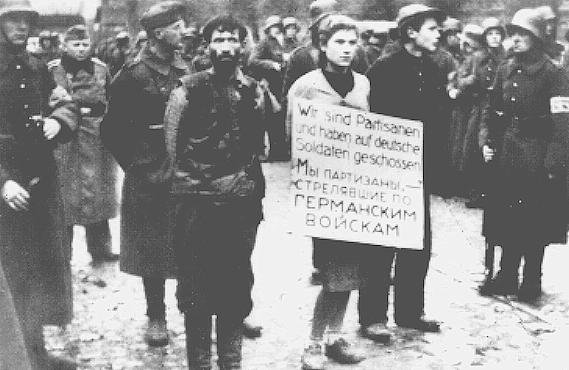
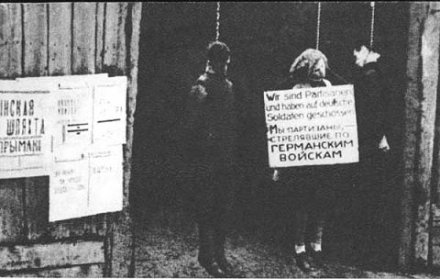
1941: Masha Bruskina, Kiril Trus, and Volodia Shcherbatsevich, partisans

On this date in 1941, the German occupiers of Minsk conducted an infamous public hanging of partisans — perhaps the first such salutary public execution of resistance members of the war.

Jewish* 17-year-old Maria (Masha) Bruskina was the central figure of the grim tableau, and wore the placard announcing “We are partisans and have shot at German soldiers.” Evidently, she also attracted the most attention** from the onlookers to whom the scene was addressed.

Before noon, I saw the armed German and Lithuanian soldiers appear on the street. From over the bridge they escorted three people with their arms tied behind their backs. In the middle there was a girl with a sign-board on her chest. They were led up to the yeast factory gate. I noticed how calmly these people walked. The girl did not look around … The first one led to the gallows was the girl.

She was hanged with bewhiskered World War I vet Kiril Trus and the 16-year-old Volodia Shcherbatsevich. The men were members of a partisan cell organizing anti-fascist resistance; Masha Bruskina was a nurse who had been caught aiding the partisans by providing civilian clothes and papers for wounded Red Army soldiers under her care to smuggle them back to the resistance.

The scene of their deaths was captured in a series of powerful photographs taken by one of the Lithuanian Wehrmacht collaborators.

(More images here and here.)

* Phototextualities: Intersections of Photography and Narrative claims that Bruskina lightened her hair and changed her name to prevent her Jewishness affecting her resistance work; even though she was a Minsk native, her initial identification didn’t happen until 1968. The men who suffered with her were named almost immediately after the war.

** Despite the eye-catching place of the girl, she was officially unidentified for decades even after the name Masha Bruskina surfaced. In “A Historical Injustice: The Case of Masha Bruskina,” (Holocaust Genocide Studies 1997, 11:3) Nechama Tec and Daniel Weiss argued that Soviet authorities, and later Belarusian ones, found her Jewishness problematic and resisted identifying her because of it — while an ethnically Russian female partisan like Zoya Kosmodemyanskaya could be more conveniently accepted as a heroine. Maybe, but bureaucratic inertia and simple precedence (since Zoya Kosmodemyanskaya was known immediately while Masha Bruskina was not) are also plausible contributing factors.

A plaque unveiled at the Minsk yeast factory in 2009 finally called her Maria Bruskina.

On this day..