1946: The Nuremberg Trial War Criminals

Victor’s justice was never better served than this date in 1946, when the brass of Third Reich hung for crimes against humanity during the late World War II.

[audio:http://www.stelzriede.com/ms/mus/nuremexe.mp3]

(From this page of original period audio files.)

The landmark legal proceeding* is covered well enough in many other sources for this humble venue to break new ground.

Apart from trailblazing international law, the trial was notable for the gut-punching film of German atrocities; this relatively novel piece of evidence is available for perusal thanks to the magic of the Internet. Caution: Strong stuff. An hour’s worth of Nazi atrocities.The climactic hangings in the predawn hours this day in Nuremberg were conducted by an American hangman who used the American standard drop rather than the British table calibrated for efficacious neck-snapping. As a result, at least some hangings were botched strangulation jobs, a circumstance which has occasionally attracted charges of intentional barbarism.

Media eyewitness Kingsbury Smith’s taut report of the night’s executions (well worth the full read) described just such an ugly end for propagandist Julius Streicher.

At that instant the trap opened with a loud bang. He went down kicking. When the rope snapped taut with the body swinging wildly, groans could be heard from within the concealed interior of the scaffold. Finally, the hangman, who had descended from the gallows platform, lifted the black canvas curtain and went inside. Something happened that put a stop to the groans and brought the rope to a standstill. After it was over I was not in the mood to ask what he did, but I assume that he grabbed the swinging body of and pulled down on it. We were all of the opinion that Streicher had strangled.

There were in all 12 condemned to death at Nuremberg; all hanged this day except Martin Bormann (condemned in absentia; it was only years later that his death during the Nazi regime’s 1945 Gotterdammerung was established) and Hermann Goering (who cheated the executioner with a cyanide capsule two hours before hanging). The ten to die this day were:

* Its resultant Nuremberg Principles comprise a lofty articulation of principles whose actual application, as Noam Chomsky has observed, would have meant that “every post-war American president would have been hanged.”

On this day..

39: Gnaeus Cornelius Lentulus Gaetulicus, erotic poet

On an uncertain date likely around early October* in 39 A.D., former Roman Consul Gnaeus Cornelius Lentulus Gaetulicus (not to be confused with Publius Cornelius Lentulus) was executed at the order of Caligula for his part in some sort of plot long lost to history.

In his public life, Gaetulicus was a Machiavellian politician connected to the fallen Praetorian Guard captain Sejanus (their kids were at one point engaged to be married). He evidently survived the post-Sejanus purge with an adroit bit of written diplomacy to the Praetorian’s patron-cum-executioner the Emperor Tiberius, tactfully pointing out that the Emperor had made the same errant choice of alliance. Thus did Gaetulicus retain both his head and his career.

After a decade milking his German province, and Tiberius shuffled off the mortal coil and young Caligula now ruling the empire, Gaetulicus seemingly** involved himself in something treasonable with Marcus Aemilius Lepidus, the latter a recent fave of Caligula and briefly his designated heir.

Or, if you credit scandal-mongering Roman historian Cassius Dio‘s description of the Emperor’s deadly northward road trip, he did it out of some whim of rivalry or opportunity for pecuniary advantage.

Gaius had now spent practically all the money in Rome and the rest of Italy, gathered from every source from which he could in any way get it, and as no source of revenue in considerable amount or practicable to collect could be found there, and his expenses were pressing him hard, he set out for Gaul, ostensibly because the hostile Germans were stirring up trouble, but in reality with the purpose of exploiting both Gaul with its abounding wealth and Spain also. However, he did not openly announce his expedition beforehand, but went first to one of the suburbs and then suddenly set out on the journey, taking with him many actors, many gladiators, horses, women, and all the other trappings of luxury. When he reached his destination, he did no harm to any of the enemy — in fact, as soon as he had proceeded a short distance beyond the Rhine, he returned, and then set out as if to conduct a campaign against Britain, but turned back from the ocean’s edge, showing no little vexation at his lieutenants who won some slight success — but upon the subject peoples, the allies, and the citizens he inflicted vast and innumerable ills. In the first place, he despoiled those who possessed anything, on any and every excuse; and secondly, both private citizens and cities brought him large gifts voluntarily, as it was made to appear. He murdered some men on the ground that they were rebelling, and others on the ground that they were conspiring against him; but the real complaint was one and the same for the whole people — the fact that they were rich. By selling their possessions himself, he realized far greater sums than would otherwise have been the case; for everybody was compelled to buy them at any price and for much more than their value, for the reasons I have mentioned. Accordingly, he sent also for the finest and most precious heirlooms of the monarchy and sold them off by auction, selling with them the fame of the persons who had once used them. Thus he would make some comment on each one, such as, “this belonged to my father,” “this to my mother,” “this to my grandfather,”, “this to my great-grandfather,” “this Egyptian piece was Antony’s, the prize of victory for Augustus.” At the same time he also explained the necessity of selling them, so that no one could persist in pretending to be poor; and thus he made them buy the reputation of each article along with the thing itself.

In spite of all this he did not secure any surplus, but kept up his customary expenditures, not only for other objects that interested him — exhibiting, for example, some games at Lugdunum — but especially for the legions. For he had gathered together two hundred thousand troops, or, as some say, two hundred and fifty thousand. He was acclaimed imperator by them seven times, as his whim directed, though he had won no battle and slain no enemy. To be sure, he did once by a ruse seize and bind a few of the foe, whereas he used up a large part of his own force, striking some of them down one at a time and butchering others then masse. Thus, on one occasion, when he saw a crowd of prisoners or some other persons, he gave orders in the famous phrase, that they should all be slain “from baldhead to baldhead.” At another time he was playing at dice, and finding that he had no money, he called for the census lists of the Gauls and ordered the wealthiest of them to be put to death; then, returning to his fellow-gamesters, he said: “Here you are playing for a few denarii, while I have taken in a good one hundred and fifty millions.” So these men perished without any consideration. Indeed, one of them, Julius Sacerdos, who was fairly well off, yet not so extremely wealthy as to become the object of attack on that account, was slain simply because of a similarity of names. This shows how carelessly everything was done. As for the others who perished, there is no need of my naming over most of them, but I will mention those of whom history requires some record. In the first place, then, he put to death Lentulus Gaetulicus, who had an excellent reputation in every way and had been governor of Germany for ten years, for the reason that he was endeared to the soldiers. Another of his victims was Lepidus, that lover and favourite of his, the husband of Drusilla, the man who had together with Gaius maintained improper relations with the emperor’s other sisters, Agrippina and Julia, the man whom he had allowed to stand for office five years earlier than was permitted by law and whom he kept declaring he would leave as his successor to the throne. To celebrate this man’s death he gave the soldiers money, as though he had defeated some enemies, and sent three daggers to Mars Ultor in Rome. He deported his sisters to the Pontian Islands because of their relations with Lepidus, having first accused them in a communication to the senate of many impious and immoral actions. Agrippina was given Lepidus’ bones in an urn and bidden to carry it back to Rome, keeping it in her bosom during the whole journey.

It’s a pity that the details of this affair, whatever they were, have been lost to history. The History of Rome podcast treats this episode among a review of Caligula’s gnarly reign

According to Post-Augustan Poetry, Gaetulicus

was consul in 26 A.D., and for ten years was legatus in Upper Germany, where his combination of firmness and clemency won him great popularity. He conspired against Caligula while holding this command, and was put to death. Pliny the younger speaks of him as the writer of sportive and lascivious erotic verse, and Martial writes of him in very similar terms. His mistress was named Caesennia, and was herself a poetess.

Only a fragment (which I have not been able to locate online) of a Latin verse describing Britain remains affirmatively attributed to this poet, though he is sometimes speculatively identified with the “Gaetulicus” to whom some epigrams in the Greek Anthology (or “Palatine Anthology”) are attributed e.g.

TO APHRODITE EUPLOIA

Guardian of the seabeach, to thee I send these cakes, and the gifts of
a scanty sacrifice; for to-morrow I shall cross the broad wave of the
Ionian sea, hastening to our Eidothea’s arms. But shine thou
favourably on my love as on my mast, O Cyprian, mistress of the bride-
chamber and the beach.

* Date ballparked by public sacrifices offered in Rome on October 27 “to mark the exposure of the evil plots of Gnaeus Lentulus Gaetulicus against Gaius Germanicus.” (Agrippina: Sex, Power, and Politics in the Early Empire, which speculates at some length on what the dimensions of a Gaetulicus plot might have been.)

** Though Lepidus was executed at about the same time, and Cassius Dio suggests a connection, it’s not completely clear that they conspired together. Since Cassius Dio (and Suetonius, who also connects them in Life of Claudius), wrote generations after the events themselves, we want for dependable information.

On this day..

1941: Karel Treybal, Grand Master

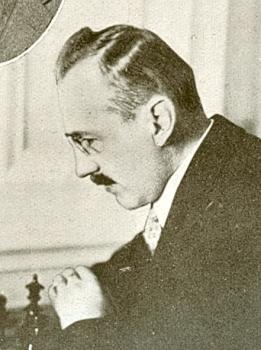
On this date in 1941, chess grand master Karel Treybal was shot in occupied Czechoslovakia as a suspected subversive for illegally stockpiling weapons.

The Bohemia-born Treybal was one of the great Czech players from the turn of the century.

Competing as an amateur — his day job was as a barrister — his attacking play made him one of the world’s best for most of his adult life. (Chess aficionados can browse his big matches here and here, or take in some Treybal chess puzzles. It says here that Treybal once played countryman Franz Kafka.)

Like everyone else standing between the great imperial powers come wartime, grand masters were just so many pawns.

The particulars of Treybal’s death seem murky: whether or not he received a nominal Nazi trial before his execution; whether there was anything to the weapons charges against him. Word, nonetheless, got right around.

According to a UP report datelined this very day that ran in the New York Times on Oct. 3,

German occupation forces have executed nearly 1,000 persons in Europe, in some cases shooting them by the carloads, in reprisal for a mounting tide of violence in the occupied countries, a compilation showed tonight.

German dispatches said eighteen persons were executed in Bohemia-Moravia today [Thursday, Oct. 2 -ed.], and thirty-nine yesterday. Six were executed Sunday, twenty Monday and fifty-eight Tuesday, according to earlier German announcements, making the total so far this week 141.

Those executed today were said to include Josef Benes, manager of the Farmers’ Association at Raudnitz; Anton Kvarda, manager of the trades school at Rakonitz; Karel Treybal, salesman; Josef Smrkovsky, business man, and Manzel Svoboda, former Czech Army lieutenant.

From Norway to Greece the executions have been Germany’s answer to all forms of opposition — sabotage, espionage, armed resistance, murder, treason, arson, aiding the enemy, listening to the foreign radio, operating illegal markets, dynamiting and the ill-inclusive “Communist” activity.

A postwar tournament was played in tribute of Treybal and the great Czech women’s champion Vera Menchik.

On this day..

1942: Bishop Gorazd of Prague

On this date in 1942, the Orthodox Bishop Gorazd — Matej Pavlík is what his parents named him — was shot in Prague along with priests of Sts. Cyril and Methodius Cathedral for sheltering the Czechoslovakian resistance fighters who had lately assassinated Nazi Reichsprotektor Reinhard Heydrich.

After icing Heydrich, the assassins had taken shelter in the Cathedral basement … only to be betrayed by a onetime compatriot.

The Nazis besieged the church — fiercely, but hopelessly defended.

With the Germans already visiting unspeakable collective punishment for the murder, the act of sheltering the assassins had trouble written all over it.

The Serbian-consecrated first bishop of the Czech Orthodox Church, Gorazd sought to limit the potential scope of reprisals by writing the German authorities, directly claiming responsibility — even though, in fact, he hadn’t found out who his sanctuary was concealing until several days after they had already been installed by sympathetic priests.

He enjoyed the characteristic hospitality of the Gestapo, and was shot at Kobylisy along with priests Vaclav Cikl and Jan Sonnevend; theologian Vladimir Petrek followed them the next day.


From left to right (not counting the guards, of course): Jan Sonnevend, Vaclav Cikl, Vladimir Petrek, and the bearded Bishop Gorazd, at their public show trial September 3. From the Czech Ministry of Defense’s slick and well-illustrated publication (pdf) on Operation Anthropoid.

The Czech Orthodox Church was suppressed while the Germans held Czechoslovakia. Bishop Gorazd is recognized in the Orthodox martyrology on August 22nd (the date of his death per the Julian calendar).

On this day..

1944: Bronislav Kaminski, Waffen SS collaborator

On this date in 1944, the Gestapo eliminated more-trouble-than-he-was-worth Russian SS man Bronislav Kaminski.

The St. Petersburg-born Kaminski was Soviet by citizenship, but not Russian by nationality. Half-German and half-Polish, he’d done time twice for his questionable loyalties during the paranoid 1920’s and 30’s.

Turns out the commissars were on to something … or maybe, to paraphrase the old saying, that a Nazi is a Communist who’s been to the gulag.

Either way, when the front swept past Belarus where Kaminski was serving his post-release internal exile, the engineer jumped on an opportunity to join a classmate with the Russian National Liberation Army (RONA, or ROA). Kaminski soon rose to command the anti-partisan “army,” and earned an Iron Cross and the rank of Major General when it was incorporated into the Waffen-SS.

Unfortunately for Kaminski — and more so for anyone who happened to be in his unit’s vicinity — the 29th Waffen Grenadier Division was much better at roughing up partisans and their presumed civilian sympathizers than conducting disciplined military operations.

Little more than a roving band of armed thugs,* it was completely ineffective in the Siege of Warsaw earlier in August 1944, spending its time raping and looting instead.

That, evidently, was enough for Himmler, who had Kaminski eliminated** in punishment for his own looting (the booty was supposed to belong to the Reich), and the alleged rape-murder of German women along with all the expendables in Warsaw.

The exact trigger for this execution (for the juridical machinery always veils acts of discretion and intentionality; certainly, this is evident in a state like Nazi Germany) has never been completely clear; it may have been that between Kaminski and turncoat Red Army general Andrei Vlasov, the shrinking Reich had room enough for only one Russian commander.

Devil knows what he was commanding, anyway.

When, post-Kaminski, Vlasov assigned the remains of the RONA to Ukrainian collaborator Sergei Bunyachenko, the latter fumed, “So that’s what you’re giving me, bandits, robbers and thieves! You’ll let me have what you can no longer use!” … and soon bailed on his “patrons” by switching sides in the war yet again.

* It had some operations with the notorious Dirlewanger Battallion.

** The official announcement was that Kaminski had been killed in a partisan ambush; crazy conspiracy theorists refused to buy it.

On this day..

1944: Ernst Thälmann, German Communist

On this date in 1944, German Communist Ernst Thälmann was shot at the Buchenwald concentration camp.

A true proletarian turned proletarian leader (and reliable adherent to Moscow’s line), Thalmann stood for election to the German presidency no the Communist Party ticket against Hindenburg and Hitler in 1932 (he’d also run in 1925).

Hitler wasn’t a very good winner.*

The Gestapo nabbed Thalmann in its sweep for leftists following the Reichstag Fire. Eleven years he waited in prison — being tortured, naturally — for his turn on the stage of a show trial. Or any trial at all.

It never took place.

Instead, the Weimar Communist leader languished in detention as the horror of Naziism swallowed Germany, with nothing to give the anti-fascist cause but his name — here adopted by a Spanish Civil War battalion.

We have such cinematic treatment of the man because after the war, the legitimately proletarian, demonstrably antifascist, ideologically unsullied, and conveniently dead Thalmann made ideal material for the Communist East German state’s national pantheon.

The myth employed all of the media available to a modern industrialized state. In addition to the scholarship produced by professional historians, popular works with a similar agenda also appeared. Irma, the slain party leader’s daughter, wrote a biography of her father intended for children. Max Zimmering wrote one of several children’s novels about Thalmann, and East German poets lionized the martyred communist leader. … Thalmann memorials were built, and membership in the SED’s youth organization, the Free German Youth (FDJ), began with the Thalmann Pioneers. Finally, Thalmann’s life was the topic of several films and television movies, the most important being the two features, Ernst Thalmann – Sohn seiner Klasse (Ernst Thalmann – Son of His Class, 1954) and Ernst Thalmann – Fuhrer seiner Klasse (Ernst Thalmann – Leader of His Class, 1955).

And something else, too: a barely-there Caribbean island ceremonially gifted to East Germany by Cuba in 1972. Is it the last outpost of the German Democratic Republic?

* Yes, this is glib; Hindenburg, not Hitler, won the 1932 election. However, the Nazis’ plurality victory in that year’s Reichstag election also gave Hitler the juice to demand the Chancellorship and set himself up to wield total power in Germany. Whatever the ballot boxes on any particular day had to say, Hitler obviously won the early 1930’s.

On this day..

1943: Blessed Franz Jagerstatter, conscientious objector

On this date in 1943, an Austrian farmer was beheaded in Berlin’s Plotzensee Prison for refusing to fight for the Third Reich.

Franz Jägerstätter, who lost his own father in World War I, was anschlussed right into the Third Reich when Germany absorbed Austria in 1938.

In Solitary Witness is the aptly-titled biography of the man; though his fatal refusal of mandatory military service (and his critique of Nazi Germany) sprang from his deep-rooted Catholicism, it was far from the norm for his German-Catholic neighbors.

“We must go courageously on the way of suffering,” he wrote, “whether we begin sooner or later.” Somewhat oddly neglected as a martyr figure in the immediate postwar period, Jagerstatter was recently beatified by Pope Benedict XVI — a German himself, of course, who did not refuse his tiny measure of youthful service to the Wehrmacht in those years, and who assuredly grasps the untapped public relations potential of this compelling figure.


An icon of Franz Jagerstatter, and a naked Nazi imp.

Jagerstatter’s widow is still alive; she and her children movingly keep Franz’s memory to this day — and his example continues to inspire Catholics who go the way of suffering today against war and injustice.

On this day..

1628: Johannes Junius “will never see you more”

On this date in 1628 was burned in Bamberg (former) Burgomaster Johannes Junius, a civic official caught up in the frenetic witch-hunts of Bavaria in the Thirty Years’ War.

Fellow townspeople under torture accused him; Junius eventually did the same, copping to the stock stuff witch trials knew just how to use:

there had come to him a woman like a grass-maid … And thereafter this wench had changed into the form of a goat, which bleated and said, “Now you see with whom you have had to do. You must be mine or I will forthwith break your neck”. Thereupon he had been frightened, and trembled all over for fear. Than the transformed spirit had seized him by the throat, and demanded that he should renounce God Almighty, whereupon Junius said, “God help me”, and thereupon the spirit vanquished through the power of these words. Yet it came straightway back, brought more people with it, and persistently demanded of him that he renounce God in Heaven and all the heavenly host, by which terrible threatening he was obliged to speak this formula: “I renounce God in Heaven and his host, and will henceforward recognize the Devil as my God”.

After the renunciation he was so far persuaded by those present and by the evil spirit that he suffered himself to be baptized by the devil in the evil spirit’s name. The Morhauptin had given him a ducat as dower-gold, which afterward became only a potsherd.

He was then named Krix. His succubus was called Vixen (Füchsin). Those present had congratulated him in Beelzebub’s name and said that they were now all alike.

Etc.

What survives of him among the thousands of similar unfortunates is the illicit letter in his own hand describing those tortures in detail … a reminder (regrettably current) of the reality of crippled limbs and ripped flesh and the meager limits of human hardiness that surround a word like “torture”.

July 24, 1628

Many hundred thousand good-nights, dearly beloved daughter Veronica. Innocent have I come into prison, innocent have I been tortured, innocent must I die. For whoever comes into the witch prison must become a witch or be tortured until he invents something out of his head and – God pity him – bethinks him of something.

I will tell you how it has gone with me.

When I was the first time put to the torture, my brother-in-law, Dr. Braun, Dr. Kotzendorffer, and two strange doctors were there. Then Dr. Braun asks me; “Kinsman, how come you are here?” I answer, “Through falsehood and through misfortune”. “Hear, you,” he retorts, “you are a witch. Will you confess it voluntarily? If not, we’ll bring in witnesses and the executioner for you”. I said, “I am no witch; I have a pure conscience in the matter. If there are a thousand witnesses, I am not anxious, but I’ll gladly hear them”.

Then the Chancellor’s son was set before me, who said he had seen me. I asked that he be sworn and legally examined, but Dr. Braun refused it. Then the Chancellor, Dr. George Haan, was brought, who said the same as his son. Afterward Höppfen Ellse. She had seen me dance on Hauptsmorwald, but they refused to swear her in. I said: “I have never renounced God, and will never do it – God graciously keep me from it. I’ll rather bear whatever I must”.

And then came also – God in highest Heaven have mercy – the executioner, and put the thumbscrews on me, both hands bound together, so that the blood spurted from the nails and everywhere, so that for four weeks I could not use my hands, as you can see from the writing.

Thereafter they stripped me, bound my hands behind me, and drew me up on the ladder. Then I thought heaven and earth were at an end. Eight times did they draw me up and let me fall again, so that I suffered terrible agony. I said to Dr. Braun, “God forgive you for thus misusing an innocent and honorable man”. He replied, “You are a knave”.

And this happened on Friday, June 30, and with God’s help I had to bear the torture. When at last the executioner led me back into the cell, he said to me, “Sir, I beg you, for God’s sake, confess something, whether it be true or not. Invent something, for you cannot endure the torture which you will be put to; and, even if you bear it all, yet you will not escape, not even if you were an earl, but one torture will follow another until you say you are a witch. Not before that,” he said, “will they let you go, as you may see by all their trials, for one is just like another”.

Then came George Haan, who said the commissioners had said the Prince-Bishop wished to make such an example of me, that everybody would be astonished.

And so I begged, since I was in wretched plight, to be given one day for thought and a priest. The priest was refused me, but the time for thought was given. Now, my dearest child, see in what hazard I stood and still stand. I must say that I am a witch, though I am not – must now renounce God, though I have never done it before. Day and night I was deeply troubled, but at last there came to me a new idea. I would not be anxious, but, since I had been given no priest with whom I could take counsel, I would myself think of something and say it. It were surely better that I just say it with mouth and words, even though I had not really done it; and afterwards I could confess it to the priest, and let those answer for it who compel me to do it . . . And so I made my confession, as follows; but it was all a lie.

Now follows, dear child, what I confessed in order to escape the great anguish and bitter torture, which it was impossible for me longer to bear.

Then I had to tell what people I had seen (at the witch sabbat). I said that I had not recognized them. “You old knave, I must put the torturer at your throat. Say – was not the Chancellor there?” So I said yes. “Who besides?” I had not recognized anybody. So he said: “Take one street after another. Begin at the market, go out on one street and back on the next”. I had to name several persons there. Then came the long street (die lange Gasse). I knew nobody. Had to name eight persons there. Then the Zinkenwert – one person more. Then over the upper bridge to the Georgthor, on both sides. Knew nobody again. Did I know nobody in the castle – whoever it might be, I should speak without fear. And thus continuously they asked me on all the streets, though I could not and would not say more. So they gave me to the torturer, told him to strip me, shave me all over, and put me to the torture. “The rascal knows one on the market-place, is with him daily, and yet won’t name him”. By this they meant Burgomaster Dietmeyer: so I had to name him too.

Then I had to tell what crimes I had committed. I said nothing. . . “Hoist the knave up!” So I said that I was to kill my children, but I had killed a horse instead. It did not help. I had also taken a sacred wafer, and had buried it. When I had said this, they left me in peace.

Now, dearest child, here you have all my acts and confession, for which I must die. And they are sheer lies and inventions, so help me God. For all this I was forced to say through dread of the torture beyond what I had already endured. For they never leave off with the torture till one confesses something; be he ever so pious, he must be a witch. Nobody escapes, though he were an earl. If God send no means of bringing the truth to light, our whole kindred will be burned. God in heaven knows that I know not the slightest thing. I die innocent and as a martyr.

Dear child, keep this letter secret, so that people do not find it, else I shall be tortured most piteously and the jailers will be beheaded. So strictly is it forbidden. . . . Dear child, pay this man a thaler. . . . I have taken several days to write this: my hands are both crippled. I am in a sad plight. . . .

Good night, for your father Johannes Junius will never see you more.

Junius adds, in the margin, a touching gesture towards posthumous healing by asking no bitterness be kept against his false accusers.

Dear child, six have confessed against me at once: the Chancellor, his son, Neudecker, Zaner, Hoffmaisters Ursel, and Hoppfens Elsse–all false, through compulsion, as they have all told me, and begged my forgiveness in God’s name before they were executed. . . . They know nothing but good of me. They were forced to say it, just as I myself was. . . .

Haan, Junius’s accuser, was also burned at the stake.

Their mutual inquisitor, Dr. Braun, was arrested in 1629 — tortured — confessed — and burned as well. (Source)

On this day..

1904: Heinrich, a Herero

The Times of London reported thus, on Aug. 30, 1904:

GERMAN SOUTH-WEST AFRICA.

(FROM OUR OWN CORRESPONDENT.)

BERLIN, AUG. 29.

It is intended to hold Courts-martial in German South-West Africa for the trial of natives who have been implicated in the massacre of German colonists or who have rendered assistance to the insurgents. The first of these trials resulted in the condemnation of a Herero named Heinrich, alias Egbert, who had been concerned in the murder of a German farmer, and who had also acted as a spy in the interest of the rebels. Heinrich, who is described as “a schoolmaster and Evangelist,” was sentenced to death, and, according to intelligence just received, was hanged at Swakopmund on August 2. This case will produce a painful impression in German missionary circles, which have lately been in bad odour with the Government owing to the criticisms they had passed upon the conduct of some of the whites.

This “Heinrich” was thereby the first judicial execution for the January 1904 Herero raid that touched off the Herero genocide. Germany would secure the military scene just nine days later by routing Herero warriors at the Battle of Waterberg … and then proceed to drive almost the whole of the Herero nation into the deserts on pain of instant execution. (Jolly postcards were made of such scenes.)

Estimated body count: tens of thousands. Germans feel just awful about it.

On this day..

1600: The Pappenheimer Family

On this date in 1600, Bavarians thronged to a half-mile-long procession in Munich for the horrific execution of the Pappenheimer family.

They were marginal, itinerant types: the father, Paulus Pappenheimer, cleaned privies (“Pappenheimer” would remain as Nuremberg slang for a garbageman into the 20th century, according to Robert Butts); the mother, Anna, was the daughter of a gravedigger. They wandered, begged, did odd jobs. They were Lutherans in a Catholic duchy.

So they were vulnerable to their extreme turn of bad luck. Fresh to the throne of Bavaria, young Catholic zealot Duke Maximilian I wanted a crackdown on the infernal arts, and when others accused the Pappenheimers of witchcraft, they found they had become the stars of a show trial.

Tortured into a spectacular litany of confessions, Anne Llewellyn Barstow, records,

they were stripped so that their flesh could be torn off by red-hot pincers. Then Anna’s breasts were cut off. The bloody breasts were forced into her mouth and then into the mouths of her two grown sons … a hideous parody of her role as mother and nurse …

Church bells pealed to celebrate this triumph of Christianity over Satan; the crowd sang hymns; vendors hawked pamphlets describing the sins of the victims.

Meanwhile, Anna’s chest cavity bled. As the carts lurched along, the injured prisoners were in agony. Nonetheless, they were forced at one point to get down from the carts and kneel before a cross, to confess their sins. Then they were offered wine to drink, a strangely humane act in the midst of this barbaric ritual.*

One can hope that between the wine and loss of blood, the Pappenheimers were losing consciousness. They had not been granted the “privilege” of being strangled before being burned, but in keeping with the extreme brutality of these proceedings, they would be forced to endure the very flames.

Further torments awaited Paulus. A heavy iron wheel was dropped on his arms until the bones snapped … [then] Paulus was impaled on a stick driven up through his anus …

The four Pappenheimers were then tied to the stakes, the brushwood pyres were set aflame, and they were burned to death. Their eleven-year-old son was forced to watch the dying agonies of his parents and brothers. We know that Anna was still alive when the flames leapt up around her, for Hansel cried out, “My mother is squirming!” The boy was executed months later.

Ouch.


The Pappenheimers’ appalling end, famous in its own time, hit modern bestseller lists with Michael Kunze‘s work of popular history, Highroad to the Stake: A Tale of Witchcraft (Review).

Dr. Kunze was good enough to share his thoughts on the Pappenheimers’ milieu with Executed Today.

You present the Pappenheimers as a sort of “show trial” case; what makes a witchcraft show trial a compelling need for a German duke at the end of the 16th century? Why do you think witch persecution arises so especially in this period especially?

Towards the end of the 16th century the Middle Ages had been overcome. People no longer believed in a God taking care of every little thing in their lives. The world was no longer regarded a safe home, guarded by the Father in heaven. Religion had been replaced by reason. The kings, princes and dukes took over direct responsibility for their countries and citizens. They started to build modern states, rationally organized und fully controlled.

The main problem was that full control was difficult to achieve. The streets were in very bad condition, the countryside far stretched, the woods were dark, the villages far away. All kinds of crimes were committed, and when the police arrived the robbers, thieves and murderers had long disappeared. In time without photographs or identity papers it was difficult to trace them. The slow flow of information was also a problem.

That’s why the authorities tried to abhor criminals by show trials and spectacular executions. A witch trial was ideal, because people believed that all mischief and evil was induced by the devil. All criminals were more or less suspected of a deal with the devil.

What’s the biggest challenge we have in our time to re-imagining the world that witch prosecutors and “witches” lived in, or the biggest difference in mindset?

People in the 16th century were absolutely convinced that the devil was a real force trying to use humans to work against God’s intentions. They believed in a huge battle between good and evil, and those who changed sides and helped the devil were regarded as traitors committing High Treason.

At the same time the modern idea that everything that happens has an explainable cause made the authorities suspect the devil’s work behind every thunderstorm, not to mention deadly accidents. People were not more stupid than we are. It was the mixture of medieval superstitions and modern rationalization that led to the witch trials.

How did contemporaries of the Pappenheimers and Duke Maximilian think about this event?

It was indeed a monstrous case and quite an event at the time. The contemporaries did not doubt that 1) the Pappenheimer family had been instruments of the devil, and 2) that the brutal punishment had saved their souls. Duke Maximilian certainly regarded the execution as a means to stabilize safety in his country.

In researching the interrogations and trials in these cases, where did you get the sense that we still revert to “witch trial logic” in some modern cases? If so, when does it arise?

It’s obvious that we still interpret laws based on our beliefs and point of views. The judges involved in the witch trials thought they “knew” for certain that the devil can talk to people and make deals with them. They also believed that torture brings the truth to light. Isn’t today’s deal bargaining also a form of torture? After all the authorities tell the defendant that he will be severely punished if he does not confess. That’s what I call a forced confession. Yet it is done around the world.

Obviously, this execution is utterly horrific in its particulars. How typical would this sexualized theater — slicing off Anna Pappenheimer’s breasts, impaling Paulus Pappenheimer — have been for a witchcraft case at that time and place? How would this have been understood by witnesses, as opposed to “merely” burning or breaking on the wheel?

The point was to abhor by cruelty. People should see what horrors the criminals had to endure and tell it to everyone for years to come.

* Or, perchance, the wine was offered to revive them and protract their tortures.

On this day..