1872: Sher Ali Afridi, assassin of the viceroy

On this date in 1872, Sher Ali Afridi was hanged at Viper Island for knifing to death the British Viceroy of India 32 days before.

Richard Bourke, the 6th Earl of Mayo, had stopped off to visit the convict settlement at the Andaman Islands.

Little remembered today, Great Britain shipped tens of thousands of Indian convicts to that Bay of Bengal archipelago in the latter half of the 19th century (and continuing into the 1930s).

One of them was Sher Ali.

This former cavalryman in the UK’s Indian military forces had murdered a relative in a private feud, and was dispatched to the prison colony for his trouble. Evidently he nursed a terrible grudge at being judicially punished for what, in his opinion, was no crime at all. The standard story* is that he dreamed of wreaking revenge on the person of “some high British official.”

They don’t come much higher than the Viceroy to India.

So despite his sterling conduct record as a prisoner, Sher Ali was ready with an opportunistic blade when Lord Mayo took the wrong pause at the wrong spot.

Notwithstanding the enormity of the blow — the Viceroy of India was literally one of the most powerful figures in the British Empire — the incident was relatively downplayed, perhaps to avoid stoking any wider sectarian martyr-making or conveying the impression of colonies in turmoil. Arrested on the spot, Sher Ali was condemned quickly and hanged with little fanfare.

An Indian paper quoted by the April 15 London Times reported the assassin’s last hours thus:

I had a long interview with the prisoner the evening previous to his execution. He talked quite freely, and appeared to think he had done a fine thing. He had been told about an hour before I saw him that he was to be hanged next morning. We got up steam early next morning and went to Chatham, passing him with his police guard in a boat on the way. As soon as we were moored we got over to Viper Island, where the gaol is. There was no unusual preparation for the affair, and the convicts were at work as usual. Indeed, it was not generally known that it was to be. There were from 30 to 40 Europeans present, no natives except the police and sepoys, and no European soldiers. About a quarter to 8 the fellow was led out. He was smiling and quite collected. The police officer who came down to investigate the affair, as he ascended the steps leading up to the scaffold, asked him a question. He shook his head with a smile, as he said nahin sahib. As soon as he got up he asked the hangman to turn his face towards Mecca, and then began to pray very loudly and quickly. He said two prayers, and kept on repeating the Mussulman’s creed. The drop fell at seven minutes to 8 o’clock exactly. The knot slipped round to the back of his neck, and although he had nearly seven feet of a drop, his neck was not broken, so he died very hard. He was hanging about ten minutes before he ceased to struggle. As he was scantily clothed, and his legs and most of his body naked, his struggles were distinctly visible. We were quite close to the scaffold. After he was dead we adjourned, and returned to see him cut down at 9. His face was not distorted in the least, but wore an expression of pain. We afterwards went to see the post mortem examination. There were only eight persons present. The prisoner’s lungs, liver, heart, &c., were taken out and weighed. The top of his head was cut off, and his brain taken out: the latter weighed 47 ounces.

Despite not making a particularly big deal about Lord Mayo’s murder, the Empire did favor its Indian subjects with a Calcutta equestrian statue of the assassinated viceroy.
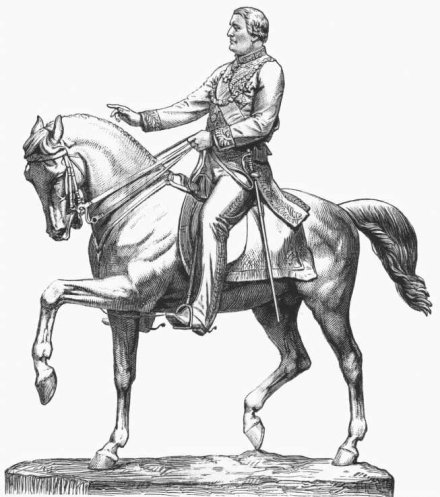

This monument and other former public memorials from the British imperial period now squirreled out of view in independent India can be found on a fun Flickr gallery, Forgotten Statuary of the British Raj. Brits can find the Earl of Mayo in marble closer to home in Cockermouth.

Mayo was also the namesake of the Mayo School of Arts in Lahore, present-day Pakistan (it’s now known as the National College of Arts). The school’s first principal was Lockwood Kipling, and this man was able to hook his 16-year-old son up with an assistant-editorship at a Lahore newspaper … from which young Rudyard Kipling launched his literary career.

* The “lone nut with a grudge” version has been latterly disputed with attempts to reconstruct Sher Ali as an Islamic revolutionary.

On this day..

2013: Afzal Guru, India parliament attack terrorist

This morning at New Delhi’s Tihar Jail, India hanged the Jaish-e-Mohammad terrorist Mohammad Afzal Guru for the deadly attack on India’s parliament building eleven-plus years before.

In that December 13, 2001 strike, a team of five gunmen infiltrated the New Delhi government building and went to work. No government ministers were killed, but several police officers and a gardener died in the ensuing shootout before the militants were themselves shot dead. Some eighteen others were wounded.

The subsequent investigation led back to Kashmiri separatists, coordinating with the Pakistani Lashkar-e-Toiba.

Afzal Guru, a fruit seller and Jammu and Kashmir native, had found his way into that struggle years before via the Liberation Front founded by Kashmir separatist martyr Maqbool Bhat.

He was condemned for having conspired in the attacks, arranging the attackers’ weapons, and procuring the New Delhi safehouse where the gunmen organized.* (When searched, the place was found stocked with explosives.) Afzal Guru claimed that he was tortured into confessing and denied taking part in the conspiracy.

Though there’s been criticism of the trial’s fairness given the raw aftermath of the shocking attack, India’s Supreme Court confirmed the death sentence years ago:

The incident, which resulted in heavy casualties, has shaken the entire nation and the collective conscience of the society will be satisfied if the capital punishment is awarded to the offender. The challenge to the unity, integrity and sovereignty of India by these acts of terrorists and conspirators can only be compensated by giving the maximum punishment to the person who is proved to be a conspirator in this treacherous act. The appellant, who is a surrendered militant and who was bent upon repeating the acts of treason against the nation, is a menace to the society should become extinct. Accordingly we uphold the death sentence. (from the judgment upholding Guru’s hanging, via this anti-execution pdf pamphlet)

However, actual execution of the death sentence stalled out during the condemned man’s post-appeals clemency petition. It was a sensitive political case, for Kashmir itself (whose towns are reported today to be fortified with added security details), and as a potential irritant to Hindu-Muslim relations and India’s own tense border with Pakistan. (In the weeks following the parliament attack, India and Pakistan had a dangerous military standoff which could easily have become a nuclear war.)

Plus, at the time, actual executions were an extreme rarity in India.

Those times might be changing. While it’s conceivable that Afzal Guru might have lived out his natural life in prison under an empty death sentence, the even more devastating “26/11” plot in Mumbai in 2008 advanced an even more notorious Pakistan-backed terrorist incident to the front pages — and the front of the hanging queue. India broke an eight-year death penalty moratorium on November 21, 2012 when it hanged the Mumbai plot’s lone survivor, Ajmal Kasab.

To judge by nothing but the visible public clues, that execution might have pulled Afzal Guru to the gallows in its train, inasmuch as it ratcheted up the profile, and the perceived stakes, of Islamic terrorism in India. Guru’s hanging was being publicly demanded almost as a logical consequence as soon as Ajmal Kasab’s execution went public.

Kasab’s death also provided a logistical game plan for this date’s hanging: the entire operation arranged in secret, set up to go into immediate motion upon rejection of that long-neglected clemency brief, and the wider public to find out only after the fact.

Kasab and Guru were implicated in extraordinary crimes; it will be interesting to discover whether either the fact of their actual executions or the stealth with which they were conducted will pattern to the more humdrum common-criminal murderers and rapists also lying under sentences of death.

* Three others, SAR Geelani, Shaukat Hussain, and Afsan Guru (no relation), also stood trial for the conspiracy; the former two were condemned, but the sentences vacated on appeal, while Afsan Guru was acquitted outright. All three are free today, or at least are free of of legal jeopardy in this case.

On this day..

2012: Ajmal Kasab, 26/11 Mumbai terrorist

At 7:30 this morning at Yerwada jail in Pune, Maharashtra, the sole surviving author of 21st century India’s most notorious terrorist plot was put to death.

Ajmal Kasab was captured alive after the deadly November 26, 2008 Mumbai terrorist attacks. The “26/11” date will live quite a while in infamy on the subcontinent … as will the chilling CCTV images of the armed and armored Kasab prowling the Chhatrapati Shivaji Terminus. Kasab and his partner in the rail station attack slew more than 50 people that evening, and another dozen-plus policemen in running gun battles as they fled the scene.

This was only one of a multitude of Mumbai targets hit in an audacious attack on that 26/11 by a ten-man team of Lashkar-e-Taiba* Islamic militants, trained in Pakistan. They had sailed in from Karachi (murdering the crew of a small fishing boat they hijacked) just for the occasion.

Kasab’s confederates elsewhere in town achieved a similar body count hitting a pair of five-star hotels, the Taj Mahal and the Oberoi Trident, each of which turned into a multi-day hostage standoff only resolved by a bloody to-the-death shootout with paramilitaries.

Attacks on a cafe and a Jewish center, as well as several timed bombs, also took place. In all, some 166 people — plus nine of the ten terrorists responsible — died, with hundreds more wounded and a nation of more than a billion shaken and angry. It’s one of those cases that make people say, “if ever there was a death penalty case …” Kasab’s speedy dispatch has been a hot political topic since he was first handed a death sentence on May 6, 2010, and the whole affair has not done any favors for the ever-touchy India-Pakistan relationship.

The (usually) sluggish India death penalty process requires that cases cleared by the judiciary receive executive clemency consideration — a stage of the process that often takes years. Recent presidents have tended to stand on only considering such applications in the order they are submitted, and then either granting those clemencies after ponderous review, or scarcely prioritizing any review at all, with further judicial interventions and a shrinking pool of trained hangmen also gumming up the works.

It’s been a recipe for virtual death penalty abolition: the last hanging prior to Kasab’s was in 2004, India’s only other execution this century. This is in a country with one-sixth of the world’s population.

Pranab Mukherjee, India’s new president, took office with a number of presidential clemency applications still pending, some dating back to the late Nineties. While there’s no guarantee that he’ll break with the glacial pattern established by his predecessors when it comes to backlogged everyday criminals, Mukherjee advanced this exceptional petition right to the front of the line and turned it down flat even as Kasab was secretly transferred from his unusual egg-shaped bombproof Mumbai cell to the hanging facility at Yerwada.

“His execution,” said Maharashta Home Minister R.R. Patil, “is a tribute to the victims.”

* Lashkar-e-Taiba also masterminded a 2001 massacre at the Indian Parliament, which brought India and Pakistan to the brink of war.

On this day..

1908: Khudiram Bose, teenage martyr

The investigations following upon the recent raids on Anarchist dens here prove the existence of a revolutionary plot on a vast scale and show that there was a systematically organized “college” … where bombs were manufactured and instruction in explosives was given … The prisoners talk freely of their “heroic conduct” and “noble design,” while refusing to impart any informaton incriminating those working behind the scenes and furnishing the funds. They all confess, however, that their minds have been fired by writings in the Press and speeches on platforms.

London Times

It’s a timeless story, really; with a tweak here or there, the excerpt above could do for reportage on seditious movements by the hundredfold. As it happens, its dateline is May 11, 1908 — Calcutta.

Separatist stirrings on the subcontinent were then manifesting themselves in the explosive revolutionary language of the day, and the chief magistrate of that ancient city of Calcutta — Kingsford by name, as in charcoal — was a character notorious for his harshness toward the movement. The year before, he’d had a 15-year-old flogged for trying to stop a British soldier beating Indian activists.

Among the more militant types excited to wrath against Kingsford was an 18-year-old Bengali who would have the privilege of martyrdom for the cause of national self-determination.

Khudiram Bose sought the judge out in Muzaffarpur and, with another young revolutionary, attempted to assassinate him in April 1908 by tossing a couple of bombs into Kingsford’s carriage.

Minor problem: it was the wrong carriage.

Instead of popping the nefarious judge, the bombs killed the wife and daughter of a barrister.

The other assassin committed suicide when cornered by police, but Bose would meet his end via the judiciary.

Bose played his patriotic martyr’s role to the hilt in the few brief weeks before his hanging, and found himself on the leading edge of a growing movement of anti-British bombers. “People are prepared to do anything for the sake of swarajya [home rule] and they no longer sing the glories of British rule,” one contemporary newspaper (quoted here) put it. “They have no dread of British power. It is simply a question of sheer brute force.” The editor was convicted of seditious libel.

One can now find plentiful Khudiram Bose hagiographies celebrating the youthful freedom fighter … regardless of his target selection.

On this day..

1915: 22 Singapore mutineers

On this date in 1915, “the sentences of the court-martial on a batch of 45 mutineers of the 5th Light Infantry were promulgated in public” — as the Straits Times reported — “and, in the case of 22 who were condemned to death, the sentences were executed on the spot.”

A crowd of fifteen thousand watched the spirited Indian sepoys shot dead for revolting the previous month.

This demoralized 800-strong garrison of Punjabi Muslims — who had, it need hardly be added, a noble history of insurrection to think upon — was already deployed far from home to look after the imperial interests of the London gentry while British lads mustered for bayonet charges in No Man’s Lands.

The last straw for these sepoys was a rumor that they were to be shipped to the European theater and made to turn their weapons against the Turkish sultan, their Muslim coreligionist.*

On February 15, 1915, helpfully covered by the celebratory fireworks of the Chinese New Year, about half the garrison left its barracks, attacked its British officers, and started killing any European they came across. (Many British familes took refuge in jail cells.)

Around 40 died in a few days before a mixed British-French-Russian-Japanese force arrived to crush the revolt. It was just one among a number of insurrectionary outbreaks during the war to rattle Britain’s possessions in Asia and elsewhere.

Punishments meted out this day were not the end of it at all; the court of inquiry sat until May, sentencing several dozen to death and many others to prison terms or penal transportation.

And if the mutiny never really threatened British control of Singapore, the ethnic and religious fissures it exposed in the imperial order have obvious resonances (pdf) for our present day.

And not only in the event, but in the aftermath. Prof. C.M. Turnbull noted (pdf)

In order to distinguish mutineers from peaceable citizens, all Indian residents were required to register and obtain passes. This aroused considerable anger, which was exacerbated by the cavalier attitude of some registration officers, who acted as if all Indians were to blame.

* The Ottomans had also issued a call to jihad with the onset of war, hoping to drive just this sort of wedge among Britain’s colonies.

On this day..

1931: Bhagat Singh

I am full of ambition and hope and of full charm of life. But I can renounce all at the time of need, and that is the real sacrifice. These things can never be hinderance in the way of man, provided he be a man. You will have the practical proof in the near future.

Bhagat Singh

On this date in 1931,* India revolutionary Bhagat Singh was hanged by the British in Lahore, together with Shivaram Rajguru and Sukhdev Thapar. The hanging was surreptitiously done, on the evening before it was officially scheduled, with the men’s cremated ashes scattered into the nearby Satluj River.


Statue of the three March 23 martyrs near Amritsar, Punjab, close to the Pakistani border. (cc) image from Alicia Nijdam.

Though only 23 years of age when he hanged, Singh’s renown as a nationalist freedom-fighter was already considerable. It has not lessened in the intervening decades.

The teenage Singh had participated in Gandhi‘s nonviolent Non-Cooperation Movement, but violent British suppression of independence demonstrations soon had Singh looking for a more energetic response.

Till that time I was only a romantic revolutionary, just a follower of our leaders. Then came the time to shoulder the whole responsibility. … I began to study in a serious manner. My previous beliefs and convictions underwent a radical change. The romance of militancy dominated our predecessors; now serious ideas ousted this way of thinking. No more mysticism! No more blind faith! Now realism was our mode of thinking.

-Singh, from “Why I am an atheist”

Singh issued his definitive reply to British violence in 1929 by exploding a couple of bombs in the subcontinent’s legislative building.**

“It takes a loud noise to make the deaf hear,” read their leaflet, vindicating the (non-lethal) ordnance.

Singh’s arrest, along with a fellow bomb-tosser, was an intended consequence, but the official pursuit of the case against him also led back to Singh’s fellow-revolutionaries and bomb-manufacturers. Some of these were induced to inculpate Singh, Rajguru, and Thapar to the theretofore-unsolved murder of Lahore policeman John Saunders in December 28.

Saunders had been mistakenly assassinated: Singh et al took him for John Scott, a police superintendent who ordered a baton charge against protesters and personally helped beat to death one of the independence movement’s revered fathers.

While the law wrapped its coils about him, Singh led a successful hunger strike for better prison conditions, and kept churning out writing.

His example of sacrificial revolutionary ardor — not to mention his leftist politics — kept him a popular martyr figure for years after his death, all the way down to the present day.


Climactic execution scene from the 2002 Hindi flm The Legend of Bhagat Singh — one of many different cinematic adaptations of his story.

The Shaheedi Mela (Martyrdom Fair) is observed across Punjab each March 23 in honor of these men.

* Not on Valentine’s Day, as a 2011 Twitter hoax claimed.

** Shades of Auguste Vaillant.

On this day..

1989: Kehar Singh and Satwant Singh, assassins of Indira Gandhi

On this date in 1989, the last hangings at Delhi’s Tihar Jail dispatched two Sikhs for the assassination of Indira Gandhi.

Indira Gandhi (no relation to Mahatma Gandhi) was the daughter and political heir of Jawaharlal Nehru and one of the postwar world’s more remarkable political biographies.

Never averse to breaking a few eggs, Gandhi led her country (sometimes autocratically) for four terms from 1966 to 1984, sandwiched around a stint under a legal cloud for political corruption.

She backed East Pakistan’s breakaway from India’s neighbor and rival, but also negotiated a Kashmir settlement with her Pakistani opposite number; oversaw the Green Revolution; pushed ahead with a nuclear weapons program; maneuvered between American and Soviet foreign policy.

The omelet that cost her life was the June 1984 Operation Blue Star, when she had the Indian military storm a Sikh shrine that armed militants had turned into a virtual fortress, even using tanks and artillery in the shrine’s residential area.

Although the operation “worked,” hundreds — maybe a thousand or more — lost their lives and the shrine itself suffered heavy damage.

Sikhs were incensed — including, apparently, Beant Singh and Satwant Singh, two Sikh bodyguards of the Prime Minister who probably ought to have been reassigned. Maybe that’s just hindsight speaking, after they took the opportunity afforded by an escort assignment on Halloween 1984 to suddenly gun down their charge.

Beant Singh was shot down on the spot by other guards, but Satwant Singh was arrested.

He and Beant Singh’s uncle and alleged inciter Kehar Singh would later stand trial for their lives — but not before the assassination triggered an apparently government-blessed four-day anti-Sikh pogrom. The disturbing orchestration and four-figure body count of this infamous affair remain sensitive subjects on the subcontinent to this day, especially insofar as nobody has ever been punished for it.

The accused assassins were not so lucky — although they were more than content to accept martyrdom for avenging Operation Blue Star.

I have no hatred for any Hindu, Muslim, Christian, neither hatred for any religion. After my Shaheedi, let no Sikh throw any rock at any Hindu. I am not in favor of any retaliation or bloodshed over my Shaheedi. If we do create bloodshed, then there is no difference between us and Rajiv Gandhi. I am proud of the task that I did! I do ardas in front of Waheguru! If I am blessed with a human life, then give me a death of the brave when I am hanged. Forget one life, if I could I would give up a thousand lives to kill dushts like Indira Gandhi, and laugh as I become Shaheed by hanging.

Satwant Singh in court

The killers were then and are still held in high regard by many Sikhs. (Satwant’s fiancee even married his picture.)

Indira Gandhi’s son Rajiv Gandhi followed her as head of state — and followed her fate when he was assassinated by Tamil terrorists in 1991. The Nehru-Gandhi family remains a powerful force in Indian politics.

On this day..

1857: Twelve blown from cannons in British Punjab

An account from the February 15, 1862 Harper’s Weekly of a very messy spectacle orchestrated to maintain British control of Punjab.

Another execution of a similar nature took place on the 13th of June, at Ferozepore. All the available troops and public establishments were convened to witness the scene. Some of the mutineers were to be hung, and around the gallows, erected during the night previous, the soldiers were drawn up. The mutineers were then brought into the centre, and the proceedings of the general Court-Martial was read. Upon being informed that if they would become Queen’s evidence they would be reprieved, twelve of the criminals accepted the offer and were marched to the rear. Two were taken to the gallows. They ascended the ladder with firm steps, and to the last moment betrayed no emotion of fear.

The remaining ten were now led away to the artillery guns, and while their irons were being struck off some cried, “Do not sacrifice the innocent for the guilty!” Two others rejoined, “Hold your sniveling: die men and not cowards — you defended your religion, why then do you crave your lives? Sahibs! they are not Sahibs, they are dogs!” Others then began to upbraid their commanding officer. The wretched beings were quickly fastened to the muzzles of ten guns, charged with blank cartridge.

The commanding officer directed port-fires to be lit. “Ready!” “Fire!” and the drama was played out. An eye-witness says: “The scene and stench were overpowering. I felt myself terribly convulsed, and could observe that the numerous native spectators were awe-stricken — that they not only trembled like aspen-leaves, but also changed into unnatural hues. Precaution was not taken to remove the sponge-and-load men from the muzzles of the guns; the consequence was that they were greatly bespattered with blood, and one man in particular received a stunning blow from a shivered arm!


A lengthier account, no less riveting and we suppose more accurate on account of its primary sourcing, is to be found in this memoir or the British campaign against the Sepoy rebellion.

June 13 The morning of June 13 was fixed upon for the execution. A gallows was erected on the plain to the north side of the fort, facing the native bazaars, and at a distance of some 300 yards. On this two sepoys were to be hanged, and at the same time their comrades in mutiny were to be blown away from guns.

We paraded at daylight every man off duty, and, with the band playing, marched to the place of execution, and drew up in line near the gallows and opposite the native quarter.

Shortly after our arrival the European Light Field Battery, of six guns, appeared on the scene, forming up on our left flank, and about twenty yards in front of the Light Company.

The morning was close and sultry, not a cloud in the sky, and not a breath of wind stirring; and I confess I felt sick with a suffocating sense of horror when I reflected on the terrible sight I was about to witness.

Soon the fourteen mutineers, under a strong escort of our men with fixed bayonets, were seen moving from the fort. They advanced over the plain at our rear, and drew up to the left front of, and at right angles to, the battery of artillery.

I was standing at the extreme right of the line with the Grenadier Company, and some distance from the guns; but I had provided myself with a pair of strong glasses, and therefore saw all that followed clearly and distinctly.

There was no unnecessary delay in the accomplishment of the tragedy. Two of the wretched creatures were marched off to the gallows, and placed with ropes round their necks on a raised platform under the beam.

The order was given for the guns to be loaded, and quick as thought the European artillerymen placed a quarter charge of powder in each piece. The guns were 9-pounders, the muzzles standing about 3 feet from the ground.

During these awful preparations, I watched at intervals the faces of the condemned men, but could detect no traces of fear or agitation in their demeanour. The twelve stood two deep, six in front and six in the rear, calm and undismayed, without uttering a word.

An officer came forward, and, by the Brigadier’s order, read the sentence of the court-martial, and at its conclusion the six men in front, under escort, walked towards the battery.

There was a death-like silence over the scene at this time, and, overcome with horror, my heart seemed almost to cease beating.

Arrived at the guns, the culprits were handed over to the artillerymen, who, ready prepared with strong ropes in their hands, seized their victims. Each of these, standing erect, was bound to a cannon and tightly secured, with the small of the back covering the muzzle. And then all at once the silence which reigned around was broken by the oaths and yells of those about to die. These sounds were not uttered by men afraid of death, for they showed the most stoical indifference, but were the long-suppressed utterances of dying souls, who, in the bitterness of their hearts, cursed those who had been instrumental in condemning them to this shameful end. They one and all poured out maledictions on our heads; and in their language, one most rich in expletives, they exhausted the whole vocabulary.

Meanwhile the gunners stood with lighted port-fires, waiting for the
word of command to fire the guns and launch the sepoys into eternity.

These were still yelling and raining abuse, some even looking over their shoulders and watching without emotion the port-fires, about to be applied to the touch-holes, when the word “Fire!” sounded from the officer in command, and part of the tragedy was at an end.

A thick cloud of smoke issued from the muzzles of the cannons, through which were distinctly seen by several of us the black heads of the victims, thrown many feet into the air.

While this tragic drama was enacting, the two sepoys to be hanged were turned off the platform.

The artillerymen again loaded the guns, the six remaining prisoners, cursing like their comrades, were bound to them, another discharge, and then an execution, the like of which I hope never to see again, was completed.

All this time a sickening, offensive smell pervaded the air, a stench which only those who have been present at scenes such as these can realize — the pungent odour of burnt human flesh.

The artillerymen had neglected putting up back-boards to their guns, so that, horrible to relate, at each discharge the recoil threw back pieces of burning flesh, bespattering the men and covering them with blood and calcined remains.

A large concourse of natives from the bazaars and city had assembled in front of the houses, facing the guns at a distance, as I said before, of some 300 yards, to watch the execution. At the second discharge of the cannon, and on looking before me, I noticed the ground torn up and earth thrown a slight distance into the air more than 200 paces away. Almost at the same time there was a commotion among the throng in front, some running to and fro, while others ran off in the direction of the houses. I called the attention of an officer who was standing by my side to this strange and unaccountable phenomenon, and said, half joking: “Surely the scattered limbs of the sepoys have not been carried so far?”

He agreed with me that such was impossible; but how to account for the sight we had seen was quite beyond our comprehension.

The drama came to an end about six o’clock, and as is usual, even after a funeral or a military execution, the band struck up an air, and we marched back to barracks, hoping soon to drive from our minds the recollection of the awful scenes we had witnessed.

Two or three hours after our return news arrived that one native had been killed and two wounded among the crowd which had stood in our front, spectators of the recent execution. How this happened has never been explained. At this time a “cantonment guard” was mounted, consisting of a company of European infantry, half a troop of the 10th Light Cavalry, and four guns, and two of these guns loaded with grape were kept ready during the night, the horses being harnessed, etc. Half the cavalry also was held in readiness, saddled; in fact, every precaution was taken to meet an attack.

As far as I can recollect, there were but two executions by blowing away from guns on any large scale by us during the Mutiny; one of them that at Ferozepore.

On this day..

1984: Maqbool Bhat, for Kashmir

On this date in 1984, India hanged Kashmiri nationalist Maqbool Bhat.

A terrorist to his enemies and a freedom fighter to his friends, Bhat was born in the Kashmir region back when it “was ruled by the Dogra Family and the entire Kashmiri nation was living a life of slavery.”

When Bhat was a nine-year-old child, the prince of Jammu and Kashmir inked a bitterly controversial accession of his domain to the foundling independent nation of India. Kashmir has been hitched to the adjective “troubled” ever since.

The broader Kashmir region remains a warren of competing claims among Pakistan, India, and China. Bhat operated not for any of these governments, but for Kashmiri independence … and since he came of age in the revolutionary twilight of colonialism, he did not shy from putting the fight in freedom fighter. Bhat was an early exponent of an armed independence struggle.

Both India and Pakistan proscribed as terrorist Bhat’s Jammu and Kashmir National Liberation Front (forerunner of the still-extant JKLF, which is the same acronym less the middle letter); both those longtime subcontinent antagonists arrested Bhat at different times for subversive activities. The most notable: Bhat engineered an airplane hijacking in 1971 to push his cause onto the world’s front pages.

But the hostage-taking game came a-cropper for the Kashmiri rebel.

Languishing under a dormant death sentence for the 1968 murder of an Indian policeman,* Bhat unexpectedly became the focus of his fellow-travelers’ revolutionary ardor: in Birmingham, England, Kashmiri activists kidnapped Indian diplomat Ravindra Mhatre in an attempt to force a hostage exchange.

When Delhi refused to deal, the captors executed Mhatre. Within days, India traded tit for tat by stringing up Bhat — a man who in life had been known for his boast that “nobody has the rope which can hang men.”

They may not have got their man, but they sure got a martyr.

Five years after Bhat’s execution, Kashmir finally broke into armed revolt — Bhat’s very own project, and one that has claimed tens of thousands of lives in the succeeding years.

That movement repeatedly demands the return of Bhat’s remains for burial. It annually marks this anniversary of his martyrdom with tributes and strikes.

* Bhat’s partisans insist that he was wrongly accused.

Update: Reprint of a 1984 article, “The last days of Maqbool Butt”

On this day..

1943: Hemu Kalani, Sindh revolutionary

On this date in 1943, the British hanged India independence activist Hemu Kalani in Sukkur for attempting to sabotage a rail line.

You could say the Sindh youth was not cowed by the Empire’s suppression of the Quit India movement.

“In the face of this shameful capitulation of the ‘left’ leaders,” he raged of respectable pols prepared to accept office at the pleasure of the British during wholesale confinement of political prisoners, “what should the rank and file ‘leftists’ do?”

It is only by waging unremitting struggle against capitulation in every form, by fighting against dissolution of their own organizations, that they can seriously fight to attain the goal. Intransigent opposition to every capitulationist masquerading as a ‘leftist’!

As the British rounded up the Quit India leadership, less conciliatory young people like Kalani came to the fore (pdf) and then were further radicalized by British intransigence.

If you’re going to lock up Mr. Nonviolence himself, Mahatma Gandhi, you’re going to get to deal instead with the elements he keeps in check. That was certainly Gandhi’s argument: he refused to condemn violence, observing that the British themselves had called it up.

Mass protests gave way to more aggressive direct action; in Kalani’s case, that meant derailing a train bringing ammunition to the European forces occupying his native province.

Caught in the act, he refused under torture to shop his comrade, earning a hemp necktie from the occupiers and the tribute of posterity on the subcontinent.

Somewhat ironically, the relative intransigence of Quit India supporters during this period, as compared with the Muslim League‘s greater support for Britain’s immediate World War II exigencies, helped to cleave apart Pakistan and India when independence did come in the late 1940s … which is why the Hindu Kalani is most honored in India, even though his native soil is now in Pakistan.

On this day..