1715: William Ainslie, Edinburgh Castle betrayer

Edinburgh, Scotland held a Christmas Eve 1715 hanging of a soldier for abortive plot in the abortive Jacobite rising of 1715

The plot was a bold conspiracy of Highlanders to seize Edinburgh Castle itself, which would have been every bit the coup it sounds like. Sergeant William Ainslie and two other soldiers of the garrison had been bribed to admit the plotters via a sally port.


(cc) image from Stephanie Kirby.

Once there, the Highlanders meant to seize the castle’s ample stock of weapons and cash, and also “fire three cannon; that when this signal should be heard by some men stationed on the opposite coast of Fife, a fire should be kindled on the heights; and that these beacons, continued northward from hill to hill, should, with the speed of a telegraph, apprise Mar of his advantage.”

One minor problem: the whole enterprise depended on the ability of at least 83 people to keep a secret, but “they were so far from carrying on their affairs privately, that a gentleman who was not concerned told me that he was in a house that evening, where eighteen of them were drinking, and heard the hostess say that they were powdering their hair to go to the attack of the Castle!” Even so, the word only barely got out in time, the conspirators self-defeating by showing up late (too much time powdering?) and with ladders that were too short.

William Ainslie, the sergeant who was planning to open the gate for the Highlanders, had to shout the alarm and play it off that way once he realized that the dawdling had wasted the opportunity, but he was soon found out and spectacularly hanged over the castle wall for his trouble. The inevitable hanging-ballad broadside (“The Lamentation, and Last Farewell, Of Serjeant William Ainslie, who was executed over the Castle-Wall of Edinburgh for High Treason and Treachery, on Monday the 24th of December, 1716”*) emphasizes the pecuniary motive at the expense of the patriotic, but maybe it should have been dedicated to the principle that loose lips sink ships.

Let all Bold Soldiers far and near,
That sees my dismal Fall,
Lament my sad and wretched End,
That’s brought my self in Thrall;
Here to the World I do declare,
The Castle to Betray.
Full Fifty Pounds I was to have,
for which I’m doom’d to Die.

My Name is William Ainslie,
A Serjeant Stout and Bold,
In Flanders I the French have Fought,
And would not be Control’d:
And Loyal was to King and Crown,
my Trust did ne’re Betray,
Till I was tempted with that Gold,
For which I’m Doom’d to Die.

While I did in the Castle ly,
In Irons close Confin’d
For my Dear Wife and Children all,
My Heart no Ease could find,
To GOD I did for Mercy cry,
As I in Fetters lay.
Both Night and Day to him I’le Pray,
Since I am Doom’d to Die.

Ah! wo be to that cursed Gold,
That did my Heart intice,
To act such a gross Treachery,
The Castle to Surprise;
But wo’s me, for my Treachery,
My Hour is drawing nigh.
For I most hang out o’re the Wall,
Most Just Deservedly.

Good People, pray do not revile,
My Wife and Children dear;
Whom I so dearly lov’d on Earth,
Lord to my Soul draw naer: [sic]
I hope in Mercy he’l appear,
For still to him I’ll cry;
Since I most Justly, am condemn’d,
Over the Wall to dy.

They told me a must hang some Days,
Over the Castle-Wall;
Until the Rope takes Fire and breaks,
Then to the Ground I fall:
But since that I must suffer here,
Unto the Lord, I’ll pray;
Take Warning by my shameful End,
I just deserve to dy.

Since many People here is come,
This Day to see me dy;
I hope their Prayers to God they’l send,
For me, before I dy:
My vital Breath will soon be gone,
With a strong Rope and Tree;
But yet I hope my Peace is made,
With God who lives on high.

Those that did cause my dismal End,
I do forgive them here;
For now my Life lyes at the Stake,
Oh! Lord, to me draw near:
My precious Soul I pray receive,
For unto Thee I’ll fly;
For I have acted Treason great,
And for it I must die.

I wish all People Warning take,
That’s come to see me die;
The World unto you I’ll leave,
For all Eternity:
I must away, farewel, adieu
My Wife and Children all;
For I must hang into the Air,
Over the Castle Wall.

All you that sees me here this Day,
I desire you all to pray;
That all my Sins God would forgive,
Since I am brough to die:
Let every one both far and near,
Take Warning now by me;
Your Trust, I pray, never betray,
For which you see me die.

FINIS.

* I believe this is misdated since the plot was clearly set for September 9, 1715

On this day..

1605: Niklaus von Gulchen, Nuremberg privy councillor

On this date in 1605, Nuremberg privy councillor Niklaus von Gulchen (or Gilgen) was beheaded for his scandalous corruption. The wheeler-dealer’s graft had problematically extended to playing false with and backstabbing any number of elite patrons, from Nuremberg burghers all the way up to the Prince of Sulzbach, and even gone so far as to provide advice to foreigners against the interest of his own city.

The great executioner Franz Schmidt, whose many diary entries record (often tersely) the hundreds of hangings, beheadings, drownings, burnings, and breakings on the wheel he performed for Nuremberg over his lifetime, made an unusually voluminous entry for this shocking treachery. And from the sound of it, the duplicitous Master Doctor earned every drop of his executioner’s opprobrium — even if, according to Schmidt’s biographer, the malefactor’s misused position still entitled him to the privilege of execution by the sword, exemption from torture, and a dignified black cloak to wear to his last performance.

December 23rd (a Monday).* Master Doctor Nicholas von Gilgen, who was by appointment a privy councillor in an honourable council and was bound to that council by oaths he did not observe; for the sake of money received wrote for and advised two (opposite) parties in many affairs; also gave evidence and sat in council for deliberations and decisions; also stole from my lords of this town the allowances for beer and wine, causing it to be stored by his servants.

Also he debauched before her marriage, forcing her to do his will, his servant whom he brought from Trier to this town, and whom he gave as a wife to his clerk Philip Tumbler, by a promise of 50 florins and large presents. According to her declaration she brought forth five children by him, three of which miscarried during delivery or by fright in the twelfth week, two remaining alive, a boy and girl, he being sponsor to the boy at baptism.

Similarly, by like promises, he forced his under-maid to consent to his will a year ago, and tried likewise to persuade his brother’s two daughters; one, the wife of Doctor Wurffbaum, he tried to compel, but she resisted, the other the wife of Doctor Calrot, who yielded to his will and consorted with him before and after her marriage, according to her account through fear and compulsion and the promise of many presents and a wedding portion (he did not admit he compelled her, and I do not believe he forced her).

Lastly he played false when serving the Prince of Sultzbach, whose advocate he was; he also mediated dishonestly between the families of Nuremberg, and between the noble families of Leschwitz and Redwitz, writing to, and advising both parties in one affair. Likewise he counselled the Italian Charles Albert Nello and other Italians against the rulers of our town; also stole the decrees from the office of an honourable councillor.

In Italy too, at Padua, he produced a false certificate, when he figured as a doctor there by means of a false certificate, for he became a doctor at Basel only long after. For his evil deeds he lay in prison for thirty-eight weeks in Lugins Land and in the jail. He was led out on Monday by favour in a long mourning cloak, his arms bound behind him with a black silk cord, and led by a cord, a black cloth being spread on the seat (on the scaffold).


Niklaus von Gulchen’s beheading, from the Nuremberg chronicle. Note that the illustration portrays the doomed pol kneeling, when in fact he was beheaded in a chair. In any stance, von Gulchen “was a mischievious, gold-grubbing man,” according to the chronicler.

When he had been beheaded his body was wrapped in the cloth and laid in a wooden coffin, nailed down and taken to St. Peter’s church by the assistant executioner, but removed at night in a cart to St. John’s by the little gate that leads to the Butts, and buried in the graveyard by the walls.

* Nuremberg, a Protestant city, was still on the Julian calendar.

On this day..

69: Vitellius, “yet I was once your emperor”

Were 69 C.E. known as the Year of the Three Emperors, maybe the long and glorious era of the porcine Vitellius would still be celebrated today.

Unfortunately for Vitellius, 69 was the Year of the Four Emperors … and our Emperor No. 3 had his brief reign brutally aborted at the Gemonian Stairs on December 22.

Vitellius came from a political family; his father as Governor of Syria deposed Christ‘s reluctant judge Pontius Pilate.

In time, Vitellius’s own ruin would emerge from the Levant.

But first he had a run down Roman elites’ cursus honorum of Roman offices; he served as Consul in the year 48. Even so, he’s described to us as a ridiculous character, so much so that Vitellius himself supposedly mocked astrologers over the self-evidently preposterous prediction that he of all people could become emperor.

“Addicted as he was to luxury and licentiousness,” Cassius Dio reports, Vitellius “no longer cared for anything else either human or divine. He had indeed always been inclined to idle about in taverns and gaming-houses, and devote himself to dancers and charioteers.”

According to these chroniclers, the dissipated Vitellius entered history by the side door. The first emperor of our august year was Galba, who overthrew Nero late in 68. Galba appointed Vitellius to command the restive Rhine legions, who had notably put down the revolt of one of Galba’s early supporters and were now getting short shrift from the Galba administration. The plan here is a little sketchy; Suetonius says it was “rather through contempt than favour,” perhaps that this no-account fop would deprive the Germanic forces of an adequate figurehead for revolt. Vitellius’s dismayed creditors could scarcely be prevailed upon to let him leave Rome.

Now, Suetonius and Cassius Dio are extremely hostile witnesses who wrote (respectively) during the Flavian dynasty that Vitellius’s own usurper established, and in the wake of that period.* The facts on the ground are that Vitellius had been Consul as well as a provincial governor, was appointed by Galba to manage the vital German frontier, and leveraged the position into mastery (however brief) of the Roman world. Even these historians give Vitellius grudging credit for some of his wise civic reforms once he took power. And at the end, when all was hopeless, Vitellius’s loyalists furiously resisted their foes in the streets of Rome herself, fighting “in a solid mass opposed the victors and to a man fell giving blow for blow, dying with faces to the foe” (Tacitus, who wrote after the Flavians had passed, but whose family was elevated during that dynasty). Read without interlocutors’ gleeful character assassination, we might better incline to perceive not a buffoon but a capable political leader whom fortune (and a very large army) contrived to crush at the moment of his glory.

Be that as it may, the Caput Mundi was to find in the generations ahead that men of mediocre stature could readily be wrapped in purple by a willing army. More often than not it proved a purple shroud — as it did with Vitellius.

These Rhine legions had their grievances and whether Vitellius was a great man or small, he was emperor material enough for them. On New Year’s Day of 69, when they were supposed to take an oath to the sitting emperor, they instead cast down images of the much-resented Galba and acclaimed their new governor in his place. But even as the rebellious legions strapped on their greaves, Galba was being overthrown and executed within the walls of Rome itself.

That left Emperor No. 2, Otho, vainly endeavoring to find an arrangement with Vitellius and his marching German ranks. Even though Vitellius et al had rebelled against Galba (not Otho) they were now entirely too committed to their treasonable endeavor to just turn around and march home. In April, Vitellius won the decisive Battle of Bedriacum and Otho made his fame by nobly taking his own life rather than protracting a bloody civil war: “Let Vitellius be victor, since this has pleased the gods; and let the lives of his soldiers also be spared, since this pleases me. Surely it is far better and far more just that one should perish for all than many for one, and that I should refuse on account of one man alone to embroil the Roman people in civil war and cause so great a multitude of human beings to perish.” (Cassius Dio)

Otho’s scruples were not shared by all, including devoted supporters who could hardly fail to be moved by the sacrificial gesture. Most of these declared with the eastern provinces for the general Vespasian, lately engaged in smashing the Jewish revolt in Judea.

Vespasian was destined to be the ultimate winner in the Year of the Four Emperors — the man who could claim power, and hold it, and pass it on to his heirs. With the East came Egypt’s grain supplies, upon which Rome depended. He moved methodically but by October 69 one of his generals was penetrating Italy. By coincidence, the forces of the rival emperors again met at a second Battle of Bedriacum. Once again, it was won by the upstart.

Vitellius was offered appealing surrender terms by the approaching army but his negotiations with Vespasian’s brother were aborted by his own supporters, who besieged that enemy envoy on the Capitoline Hill and eventually put him to death over Vitellius’s objections. Yet as furiously as the Vitellian faction in Rome resisted Vespasian’s conquest that December, the balance of forces decided the outcome in advance. The Flavians at length broke through and on the 22nd of December a desperate Vitellius was captured hiding himself in the palace and making ready to flee once night fell. “Tearing off his tunic,” Cassius Dio writes,

they bound his hands behind his back and put a rope round his neck. And thus they led down from the palace the Caesar who had revelled there; along the Sacred Way they dragged the emperor who had often paraded past in his chair of state, and they conducted the Augustus to the Forum, where he had often addressed the people. Some buffeted him, some plucked at his beard; all mocked him, all insulted him, making comments especially upon his riotous living, since he had a protuberant belly. When, in shame at this treatment, he lowered his gaze, the soldiers would prick him under the chin with their daggers, in order to make him look up even against his will. A German who witnessed this could not endure it, but taking pity on him cried: “I will help you in the only way that I can.” Thereupon he wounded Vitellius and slew himself. Now, Vitellius did not die of the wound, but was dragged to the prison, as were also his statues, while many jests and many opprobrious remarks were made about them. Finally, grieved to the heart at what he had suffered and what he had been hearing, he cried: “And yet I was once your emperor.” At that the soldiers became enraged and led him to the Stairway, where they struck him down. Then they cut off his head and carried it about all over the city.

The Roman History podcast covers Vitellius in Episodes 71 and 72

* Suetonius was also directly self-interested: his father fought for Otho, and against Vitellius, at Bedriacum.

On this day..

1893: Frederick Wyndham, unrepentant patricide

On this date in 1893, Frederick Wyndham, aged 45, was hanged at Gloucester Gaol for the shotgun murder of his own father near Stroud.


From Illustrated Police News, via.

This murder discharged a vast accumulation of Oedipal wrath in the Wyndham family.

The eventual victim, 73-year-old widower farmer James Wyndham, had taken up with his housekeeper, a woman by the provocative and wholly unmerited name of Virtue.

She was, James retorted to his son’s protests, the “biggest whore” he could lay hands on.

Meanwhile, Frederick’s unmarried sisters had been turned out of the house. Following a dispute over money, Old Man Wyndham actually tried to run one of them down with his horse and cart.

On October 19, 1893, it all came to a head. Frederick, drunk on rum and cider, took some friends in a hunting party to James’s land and ran into dad. The two fell into a furious row over Virtue, the sister, and who knows how many pent-up grievances when Frederick finally whipped out his shotgun and blasted his father through the neck and heart.

Then the parricide went straight back to his sister to inform her what he had done and make some arrangements for the disposal of affairs, and marched himself off to the police to turn himself in.

“I have only done my duty,” he told the lawmen. “I solemnly declare I shot him. I put two barrels into him. I hope he is dead. I can die happy.” (London Times, Oct. 21, 1893) By the time his trial came around he’d thought of something else that would make his life complete, belligerently interrupting the testimony of his late father’s lover with sundry threatening vituperations.

His last sentiment on the scaffold, after shaking hands with his executioner,* was the regret that he had not killed “that whore” Virtue, too. (Times, Dec. 22)

* According to the Times (Oct. 21), Frederick Wyndham himself once applied for the hangman’s job.

On this day..

1806: Hepburn Graham, HMS St. George rapist

Hepburn Graham, masters’ mate aboard the HMS St. George, was tried by Admiralty court-martial in early December on a charge of sodomy forwarded by the ship’s captain, Thomas Bertie.

We excerpt from the trial record via Gay Warriors: A Documentary History from the Ancient World to the Present:

George Parr, a boy of fourteen years of age belonging to His Majesty’s ship, St. George, called in and sworn:

Capain Bertie asked:

Q. Do you know the prisoner?

A. Yes

Q. Relate to the court what the prisoner was guilty of with you on the twenty-first of November last, the day after the St. George arrived in Torbay, and also n the twenty-seventh of November last.

A. On the twenty-first of November last, Mr. Graham took me into his hammock. He got me on a stool and got hold of me, telling me I must be a good boy. He got hold of my hair, and pulled me into his hammock in his berth on the starboard side, forward on the lower gun deck. It was between eight and nine o’clock in the evening of the first watch. He told me to put down my trousers, and he put them down himself. He pulled his yard out, and put it into my backside. He kept doing backwards and forwards, and made my arse wet. I was laying on my side in his hammock when he committed the act, and immediately afterwards he said you may go to your hammock now, and told me I must not tell any one, and if I did he would get me flogged …

On the twenty-seventh of November at night, between eight and nine o’clock in the [illegible] watch, I was in his berth attending him as his servant. He told me I must be a good boy. He would make me a good boy. He got hold of me and pulled me into his hammock. I did not want to get into it and he kept hitting me on the head while I was in the hammock. I wanted to get out, and he kept hitting me and asked me to stay in and said if I did not, he would get me flogged, he would get me three dozen [lashes]. He had made me unbutton the buttons before, and he them pulled down my trousers and pulled out his yard and put it into my backside. It went into my backside. He kept moving backwards and forwards, and made my backside wet. He then told me to go to my hammock and get up in good time in the morning and I went away. On the following morning early, I was again in his berth. It was before breakfast, before the hammocks were up. He pulled a hole in my trousers behind with his fingers and told me he would get them mended. He then pulled his yard out, and put it through the hole of my trousers to my backside, but did not enter it, but kept moving backwards and forwards and made my arse wet.

Q. Did he ever make any more attempts than what you have related?

A. Yes, he has attempted it five times in all, but only entered me twice.

A second boy on the same ship gave similar testimony.

John Sky, a boy about fifteen years of age, belonging to the St. George, called in and sworn.

Captain Bertie asked:

Q. Relate to the court what the prisoner was guilty of with you on the twenty-ninth of November, last.

A. On the twenty-ninth of November last I was down between decks talking to one of the boys whose name is Taylor. Mr. Graham, the prisoner came to me and [illegible] me he wanted me in his berth. I went in and he told me he would give me a bed. He then took me round the deck and set me down on a stool [illegible] of him. He began kissing me and told me he must feel my cock. I told him to leave it alone. If he did not, I would sing out. He was at this time going to unbutton the flap of my trousers. Mr. Miller, a midshipman, came in and he asked Mr. Miller to take down a great coat that [illegible] on the gun to give him more light. He said it gave him light. Whilst Mr. Miller was taking down the coat, he took me by the arm and hoved me out of the berth. I told the boy, George Parr, if he did not complain, I would. He then said that he would complain, and I told him to mention my name. He did complain to the first lieutenant, and mentioned my name. I told Mr. Graham that I could not stand it, and would complain. About a fortnight before, Mr. Graham [illegible] me in his berth and had my trousers down and pulled out his private parts. He tried to get these into my backside, but could [illegible], but got them between my thighs. Before he had had his turn, someone came in and disturbed him. I told him I would go out of the berth, and he put me out of the berth. He never succeeded with me in what he wanted to do.

George Parr’s rape claim was vouched by the ship’s surgeon.

Mr. Hugh Hughes, surgeon of the St. George, called in and sworn:

Captain Bertie asked:

Q. On the twenty-ninth of November was the boy, George Parr, sent to you to undergo a certain examination?

A. Yes.

Request: Relate to the court the result of your examination.

A. About seven o’clock in the evening of the twenty-ninth of November I was sent for by Lieutenant Caulfield on the quarter deck, and when I appeared, he said that Captain Bertie desired that I should examine the two boys, Parr and Sky. I immediately took them down to the sick bay accompanied by my two assistants, and there examined them immediately and found the anus of George Parr inflamed and not excoriated at all. I also examined Sky, and found no appearance of inflamation in the anus, as in the former boy. In order to corroborate what I have now stated I requested both my assistants to examine them also and begged that they would give me their opinion, and it corresponded with my own.

The court asked:

Q. Did you ask the boy, Parr, what had occasioned this appearance in his anus?

A. I did. He answered that two nights before, the twenty-seventh, that Mr. Graham had connection with him and gave him an infinite deal of pain. I asked him whether the anus was very painful at the time he was examining. He said, no, not very painful just then.

Q. Was it your opinion that the apperance was occasioned by the insertion of an instrument similar to a man’s yard?

A. I could not ascertain that.

Q. Would such an insertion cause a similar appearance in your opinion?

A. I think it would.

Q. As a professional man, do you think that the crime of which the prisoner stands charged could be committed upon a boy so young as George Parr.

A. Yes, I do.

Q From your knowledge of instruments could you imagine that the crime could be committed with a passive obedience on the part of that boy?

A. I do think he must have been placed in a particular position and he must have been a passive instrument.

One of the surgeon’s assistants testified to like effect. At this point, the Graham gave a scanty defense, merely describing his service since 1793 without addressing the charges against him.

The court was cleared and agreed that the charge had been proved against the said Hepburn Graham, and did adjudge him to suffer death by being hanged by the neck onboard such ship of His Majesty and at such time as the commissioners for executing the Office of Lord High Admiral of the United Kingdom of Great Britain and Ireland, etc. or any three of them for the time being should direct.

The court was again opened, the prisoner brought, [illegible] audience admitted, and sentence passed accordingly.

Greentham
Deputy Judge Advocate of the Fleet

Just a few weeks before he’d been wetting the arse of boys on the St. George. Now, only King George III stood between Graham and the noose.

Admiralty, 16 Dec 1806.

Mr. Grenville has the honour to lay before your Majesty the minutes and sentence of a court martial held on Mr Hepburn Graham, master’s mate on board the St George for an unnatural crime.

Mr. Grenville humbly submits to your Majesty that the sentence of the court martial may be put into immediate execution.

This petition was transmitted simultaneously with a like appeal from a seaman condemned for a Caribbean mutiny. Mr. Grenville recommended a pardon for the mutineer, and recommended denying pardon for the sodomite; King George endorsed both recommendations.

The King’s reply, Windsor Castle, 17 Dec.

The King upon consideration of what is stated in Mr Grenville’s letter in regard to the case of Naiad Sware, consents to remit the sentence of death pronounced by the court martial. Under the circumstances which attend the crime of which Mr Hepburn Graham has been found guilty, his Majesty is under the painful necessity of directing that the sentence of death may be carried into immediate execution.

Accordingly, that same day the Admiralty issued a warrant to hang Hepburn Graham on the upcoming Saturday, December 20.

On this day..

1475: Louis de Luxembourg, Count of Saint-Pol

On this date in 1475, the Louis de Luxembourg, Count of Saint-Pol was beheaded.

The French King Louis XI “had need of a head such as his” because of Louis de Luxembourg’s part in the pompously self-styled League of the Public Weal. The “public weal” in question comprised civil war on behalf of feudal prerogatives that had slipped from aristocratic hands during the Hundred Years’ War.

They were led by the ruthless Duke of Burgundy Charles the Bold.

Louis de Luxembourg’s allegiance with Charles the Bold netted him, during the League’s successes, the title of Constable of France and the hand of the queen’s sister as inducements from Louis XI.

But Saint-Pol was not the type to stay bought.

Treacherously maneuvering between the Burgundian party, the royals, and the English (Luxembourg’s uncle sold Joan of Arc to the English, so they went way back) Louis eventually managed to irritate them all. He ultimately hatched a plan to assassinate Louis XI himself and fracture the French realm among a variety of great lords.

The English and French kings having acquainted each other with the comte’s underhanded schemes on their respective sides of the channel, Saint-Pol was obliged to seek Charles the Bold’s protection — but the latter had himself contracted with the French crown to hand him over if captured, and duly forwarded the traitor to the Bastille. (There’s more about Saint-Pol’s prosecution in this volume.)

Louis did his sovereign one last little injury on his way off this mortal coil: sixty additional sous were required by the executioner of Paris “for having the old sword done up, which was damaged, and had become notched whilst carrying out the sentence of justice upon Messire Louis de Luxembourg.”

On this day..

1894: John Cronin, by an automated gallows

From the Dec. 18, 1894 Atchison (Ks.) Daily:

HARTFORD, Conn., Dec. 18. — John Cronin was hanged here at 1:00 o’clock this morning.

The execution of Cronin was especially interesting, being the first hanging in this state under the law passed by the last general assembly and the first trial of an automatic gallows in the east.

This last is the idea of Warden Woodbridge. Aided by James H. Rabbett, a forger, now serving a two and one-half years’ sentence, the warden evolved what he considers an improvement on the hanging machine in use in Colorado.

Small shot has been substituted for water in the operation of the lever which releases the weight and an arrangement made whereby the execution may be stayed at any moment.

The compartment in which the shot are confined resembles an hour glass and the mechanism is thoroughly under the warden’s control. The shot was started in motion by the movement of a lever, and another lever would have enabled the warden to have stopped it at any time. The progress of the shot and the approaching moment when the weight would be released is indicated on a dial resembling a clock.

When Cronin had been seated in the chair and made fast, a signal from the executioner indicated to the man who had charge of the lever that he was ready. The machinery was then set in motion, there being no visible evidence of anything unusual.

The adjustment of the machine was made so perfect that the weight of 306 pounds made no perceptible noise as it was released and fell back to the ground beneath. Instantaneously the victim was jerked into the air, falling backward to within 2 feet of the floor.

One of the principal improvements over the Colorado appliance is the fact that the prisoner is not his own executioner. With the original machine,* when the prisoner was placed on the chair it released a lever which started the mechanism and in this way the man was practically forced to commit suicide.

John Cronin’s crime was the murder of Albert Skinner, at South Windsor, October 6, 1893. He was prompted by revenge for some fancied grievance. He had been boarding with Skinner for several months, but finally was ordered away. A fight ensued at the time and Cronin then went on a protracted debauch. The morning of the murder he went to Skinner’s house and meeting Skinner in the yard immediately shot him, inflicting a fatal wound.

* Developed to hang Dr. T. Thatcher Graves but to my knowledge never actually used.

On this day..

1963: Russell Pascoe and Dennis Whitty, Britain’s second-last hanging date

On this date in 1963, gallows traps dropped simultaneously in Bristol and Winchester to hang two men for murdering a Cornish farmer.

Russell Pascoe and Dennis Whitty were laborers living out of a caravan in the Truro area; Pascoe had formerly worked for the victim, William Rowe, and knew a rumor that the 64-year-old recluse kept a small fortune stashed at Nanjarrow farm.

Late the night of August 14, 1963, the young toughs called at Nanjarrow. When William Rowe answered the door, they instantly beat and stabbed him to death. Perhaps they ought to have thought the plan out better, because William Rowe actually did have £3,000 on the premises … but Pascoe and Whitty only found four quid. (They split it.)

The killers were picked up before the week was out.

“We are both over twenty-one, so I suppose we can hang?” Whitty inquired.

Then they both started trying to blame each other. So the answer was yes.

Robert Douglas, later a bestselling author, was then a young prison guard beginning a career in corrections. He was on the detail guarding Pascoe and on friendly terms with the condemned man who was practically his own age.

Years later, with a lifetime’s wisdom at his back, Douglas wrote about it in his memoir of the prison At Her Majesty’s Pleasure. It’s an experience he says he has always remembered:

I can remember saying to Ken [Russell, another guard], ‘I’m not looking forward to this shift — I mean, what the hell are we going to talk about all evening?’ I was only 24 years old myself at the time, and we had built up a good relationship with Pascoe over the previous six weeks – playing cards and Monopoly and listening to the radio.

We went into the cell, and I asked Russell if he wanted a cup of tea. He said he didn’t. So I tried to coax him – ‘I’ve brought you a cream doughnut’ – I’d brought him a cream cake each day as a little treat. With that, he perked up a little and said, ‘ah go on then, I’ll have a tea’.

So we sat drinking tea for a while, none of us really saying anything. Just blathering about nothing to try to fill the silences.

Then Russell suddenly said, ‘They weighed me today, so they’ll know how far I’ll drop.’ Ken and I just looked at each other – what are you meant to say to that?

These were the third- and fourth-last men people put to death under Britain’s capital punishment statutes. (Here’s a picture at the doors of Bristol’s Horfield Gaol.) England would see only one more hanging date, another double execution conducted at two different prisons, before it abolished the death penalty.

* Writing a piece for his local paper about the hanging actually led Douglas into his later career

On this day..

1794: Jean-Baptiste Carrier, of the Noyades de Nantes

On this date in 1794,* a revolutionary Montagnard who had overstayed his welcome made his departure through the guillotine’s window.

Carrier (English Wikipedia entry | French) was the Revolutionary Convention’s proxy in Nantes where he distinguished himself in bloodthirstiness while putting down a counterrevolutionary revolt.

He’s most particularly noted for the Noyades de Nantes, a series of mass drownings in the Loire that claimed two thousand or more victims — mostly priests and civilians viewed as refractory. Overall the casualties in the Vendee ran to six figures; there’s been latter-day debate over whether the Republican policy there rose to the level of genocide.


Les noyades de Nantes en 1793, by Joseph Aubert (1882).

He was “one of those inferior and violent spirits, who, in the excitement of civil wars, become monsters of cruelty and extravagance” Adolphe Thiers judged him. (Ironically, considering Thiers’ subsequent career.) “This frantic wretch imagined that he had no other mission than to slaughter.”

Now, one could author a bloodbath in the provinces and still stick around for posterity, but that play depended on a timely volte-face with the Thermidorean reaction.

Unlike Fouche and Tallien, Carrier couldn’t pull that off. He was left in an increasingly untenable position after Robespierre fell.

What would follow Robespierre? Carrier’s own person and the Noyades de Nantes were central to this question in the tumultuous latter half of 1794. His beheading would be the climax of a string of pivotal trials.

Ninety-four Bretons already under arrest by the revolutionary committee were put to trial in the weeks following Thermidor. En route to their spectacular acquittal, these accused

subpoenaed as witnesses the members of the Nantes revolutionary committee, who had also been arrested … [and] charged that they were guilty of summary executions and of mass drownings in the Loire; they acknowledged these acts but placed the responsibility for them on Carrier. This meant that there were three trials — that of the ninety-four, that of the Nantes revolutionary committee, and that of Carrier — each revealing ghastly atrocities, which were given wide coverage in the anti-Jacobin press throughout France. (Gilded Youth of Thermidor)

The atrocious stories from Nantes promulgated in Paris by these first trials soon had the city in an uproar and dealt the already-reeling Jacobins “a terrible blow in public opinion” according to one newspaper also quoted in Gilded Youth. The Nantes revelations would provide the impetus (or the pretext) for the riots that soon shuttered the Jacobin Club and placed the Parisian bourgeoisie firmly in control.

If Carrier was the casualty in all this, well, he wasn’t exactly in a position to complain about being sacrificed for someone’s ideology.

Gracchus Babeuf, later to drop his own head into the basket, campaigned against Carrier furiously during a robust pamphlet war.

Carrier: this horrible name strikes all ears, is issued from all mouths. Merely speaking it causes a shiver of horror. There is not a single Frenchman for whom this word does not suffice to tell the story of the man it designates. It reminds all of his contemporaries of the most irascible of carnivorous beings. Posterity will not be able to find in any tradition an exterminator who was his equal. The crimes of this master villain are recognized by, and proven to, all, and yet he has unofficial defenders in the National Convention, and it even appears that there exists a strong party that wants to save him. Even more, there are signs that announce that there are those who want to influence, even terrify the just tribunal that, with its usual wisdom, is investigating the affair of the infamous drowner who has far surpassed Nero and all the other great executioners. …

they’ll justify the mass killer of the west with the excuse that the terrorism he provided the earth an example of was necessary for the salvation of the Fatherland.

Exterminable system! It was necessary for the salvation of France to erase the entire population of its western parts! It was necessary for the salvation of the Fatherland to turn its most beautiful countryside into a horrible desert, to make it the lair of voracious animals both terrestrial and aquatic by covering the waters, fields, and woods with corpses! …

In order to save the Fatherland were the 23 noyades of Nantes, one of 600 children, needed? Were “republican marriages” necessary, where young boys and girls tied together naked were knocked unconscious with saber blows and then tossed into the Loire? (Deposition by Philippe Tronjoli and Bourier) Was it necessary (another deposition of 25 Vendémiaire) to cause to die in the prisons of Nantes through hunger, infection, and misery, 10,000 citizens, 30,000 if we include the executions and noyades? Were the sabrades necessary (deposition of Laéné) on the departmental square, which occupied 300 men for six weeks filling the mass graves with those who perished from this torture? Was it necessary for Carrier (deposition of Tronjoli of the 27) to sleep with three beautiful women and then drown them? Was it necessary to execute (deposition of Renaudot) infantry and cavalry detachments of the rebel army who had voluntarily surrendered? Was it necessary to drown or execute (deposition of Thomas) 500 children, the oldest of whom wasn’t fourteen and who Carrier called vipers that must be suppressed? Was it necessary (same deposition) to drown 30-40 women eight and eight and a half months pregnant and to offer horrified eyes the still palpitating corpses of the babies tossed into a tub filled with excrement? Was it necessary (deposition of Abraham and goodwife Puchotte) to kill in one night by suffocation (caused by infection and lack of air) 50-60 prisoners in a galleon whose side panels were shut expressly to cause suffocation?

Carrier’s likeness is preserved in wax at Madame Tussaud’s.

* A few sources give November 16; this is unambiguously mistaken. (See e.g. London Times, Jan. 15, 1795, reporting the December 16 execution.)

On this day..

1941: The massacre at Skede in Liepaja

The World War II occupation of the Latvian town of Liepaja (Libau, to the Germans) produced mass executions throughout 1941.

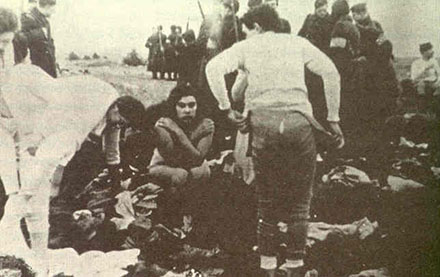
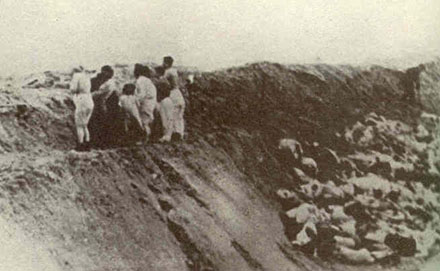
This date in 1941 commenced one of the largest such actions: over 2,700 Jews as well as 23 Communists forced over the course of two-plus days to strip on the freezing Skede dunes overlooking the Baltic and there shot by German and Latvian teams into a vast pit. It’s one of the most recognizable Holocaust atrocities because it was extensively photographed.*

As one can see from the pictures, the victims here were mostly women.


Some of the women in this photographs can be identified by name (pdf). Left to right: (1) Sorella Epstein; (2) presumably Rosa Epstein, her mother; (3) unknown; (4) Mia Epstein; (5) unknown. Alternate identification makes Mia Epstein (5) instead of (4), and (2) Pauline Goldman.

Almost all of Liepaja’s Jews perished during the war.

* Germany’s Bundesarchiv (search on Libau 1941) confirms the precise December 15 dating for these images; it also has some other photographs of atrocities in Liepaja/Libau on other occasions.

On this day..