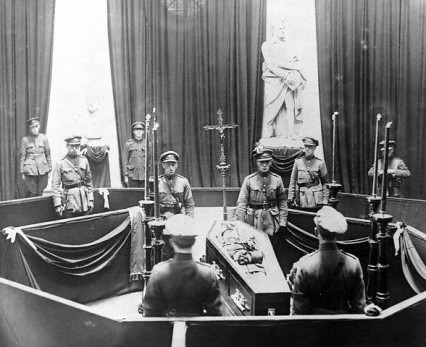
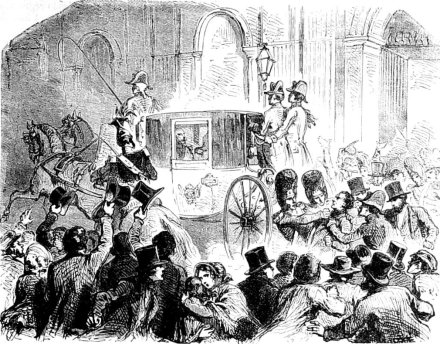
1922: Joseph O’Sullivan and Reginald Dunne, helping spark the Irish Civil War

(Thanks to Rob at Another Nickel In The Machine, a delectable blog about 20th century London, for this post. It originally ran on Another Nickel October 4, 2008.)

“I do not approve, but I must not pretend to misunderstand” – Eamon de Valera

The arrest of Reginald Dunne and “James Connolly” (Joseph O’Sullivan) in 1922

On December 1921 at 22 Hans Place in Knightsbridge, a treaty was signed between a provisional Irish Government and the British to create what was called the Irish Free State. However only six months later, a few hundred yards away in Eaton Place, an assassination occurred, the reverberations of which could be said to have helped start the Irish Civil War in 1922.

Sir Henry Hughes Wilson in 1918

Sir Henry Hughes Wilson in 1921

At around midday of 22 June 1922, Field-Marshall Sir Henry Wilson unveiled a war memorial at Liverpool Street Station. He made a speech, quoted some relevant Kipling poetry and soon after returned by taxi to his home at 15 Eaton Place in Knightsbridge. Two 24 year old men, Reginald Dunne and Joseph O’Sullivan, were surreptitiously waiting for his arrival. They watched while Wilson paid for his taxi before running up to him and killing him in cold blood on the footsteps leading up to his front door. In Dunne’s words:

I fired three shots rapidly, the last one from the hip, as I took a step forward. Wilson was now uttering short cries and in a doubled up position staggered towards the edge of the pavement. At this point Joe fired once again and the last I saw of him he (Wilson) had collapsed.

Joseph O’Sullivan

Reginald Dunne

The Field Marshall had half withdrawn his sword in a futile effort to protect himself but after being shot seven times he fell face first on to the pavement with blood running profusely from his body and mouth. Dunne and O’Sullivan started to run but O’Sullivan had been seriously wounded at Ypres during WW1 (both men had fought for the British) and his wooden leg severely hindered their escape. Dunne and O’Sullivan both attempted to shoot their way out of trouble and shot and injured two policemen and a civilian in the process but were soon surrounded by an angry and hostile crowd and the two men were quickly arrested. They actually had to be protected by the police from a mob who wanted instant revenge for Wilson’s death.

The steps of 36 Eaton Place where the Field Marshall fell fatally wounded.

The killing of Field-Marshall Wilson in Eaton Place turned out to be pivotal in an extraordinarily complex political period of Ireland’s history when a national liberation struggle turned into a civil war. However much of Britain was outraged with the murder and The Times wrote:

Field-Marshall Sir Henry Wilson, the famous and gallant soldier, was murdered yesterday upon the threshold of his London home. The murderers were Irishmen. Their deed must rank among the foulest in the foul category of Irish political crimes.

Six months earlier at 2.20 am 6th December 1921 the Anglo-Irish Treaty was signed between an Irish delegation, led by Michael Collins, and the British Government at 22 Hans Place. Incidentally, there is nothing on the outside of the building commemorating the historical event and today, in what is probably one of the most expensive property areas of London, seems to be unused and empty with security boards up in the windows.

22 Hans Place in Knightsbridge and where the Anglo-Irish Treaty was negotiated

Signing the Anglo-Irish treaty in 1922

Michael Collins in London October 1921

11th October 1921

Collins outside Downing Street 1921

The treaty envisaged an independent Ireland that would be known as the Irish Free State but the agreement was hugely controversial, especially back in Ireland. For a start, de Valera, the President of the Irish Republic and who had a difficult relationship with Collins at the best of times, was angry that the treaty was signed without his authorisation (although it was at his insistence that Collins went, with de Valera considering it wrong to be involved in the negotiations if Britain’s King George V wasn’t either). Also controversial was both the British insistence that they continued to control a number of ports, known as the Treaty Ports, for the Royal Navy and that Northern Ireland (which had been created in the Government of Ireland Act 1920) was able to leave the Irish Free State within one month, which of course it duly did.

In April 1922 a group of 200 anti-treaty IRA men had occupied the Four Courts in Dublin in defiance of their Government. Collins, wanting to avoid Civil War at all costs, decided to leave them alone. However after the Field Marshall’s assassination and the subsequent Fleet Street outrage this all changed. It was assumed by the British that Dunne and O’Sullivan were anti-treaty IRA men and after the shock of the Field Marshall’s murder Winston Churchill wrote to Collins threatening that unless he moved against the Four Courts anti-treaty garrison he (Churchill) would use British troops to do so for him. After a final attempt to persuade the men to leave the Courts, Collins borrowed two 18 pounder Artillery guns from the British and bombarded the Four Courts until it’s garrison surrendered. A surrender which almost immediately led to the Irish Civil War with fighting breaking out over Dublin and subsequently the rest of the country.

The Four Courts siege, Dublin 1922

Sackville Street, Dublin 1922

Meanwhile back in London at the Old Bailey, and before Mr Justice Shearman, Dunne and O’Sullivan were both tried together for the murder of Sir Henry Wilson on 2 July 1922. Dunne stood with his arms folded while the charge was being read while O’Sullivan stood stiffly at attention. When Dunne was asked, “Are you guilty or not guilty?” he replied “I admit shooting Sir Henry Wilson.” “Are you guilty or not guilty of the murder?” the Clerk of Arraigns repeated. “That is the only statement I can make,” was the response. O’Sullivan made a similar reply and after some discussion the plea was treated as one of “Not guilty.”

Towards the end of the trial, which lasted just three hours, the defence Counsel handed the judge a double sheet of blue official paper given to him by Dunne. After perusing the contents Mr Justice Shearman said – “I cannot allow this to be read. It is not a defence to the jury at all. It is a political manifesto…I say clearly, openly, and manifestly it is a justification of the right to kill.”*

Dunne’s hand written statement

Dunne and O’Sullivan were sentenced to death by hanging and sent to Wandsworth gaol where they were both hanged together by the executioner John Ellis on the 10th August 1922.

Less than two weeks later Michael Collins was ambushed and shot dead in his home county of Cork by anti-treaty IRA members.
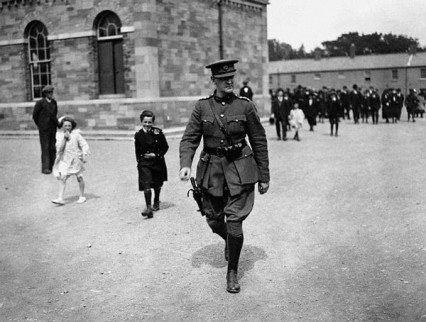
Commander in Chief Michael Collins in July 1922, two or three weeks before he was assassinated in Cork.

Michael Collins' funeral, O'Connell Street August 1922

The coffin bearing the body of Michael Collins lying in state in the City Hall, Dublin. September 2, 1922 Dublin, Ireland

Michael’s brother Sean Collins

It was never really established whether Dunne and O’Sullivan acted on their own (the assassination seemed pretty badly organised for an official assassination so this was likely) or with the approval and help of Michael Collins. Collins had been a friend of Dunne’s while Sir Henry Wilson was responsible for establishing the Cairo Gang (a group of experienced British Intelligence agents who met frequently at Dublin’s Cairo Cafe) twelve of whom were murdered by the IRA acting under Collins command in 1920. The Cairo Gang killings provoked the British Auxiliaries in Dublin to shoot trapped innocent civilians at Croke Park in not the bloodiest but perhaps the nastiest of the various historical Bloody Sundays.

The infamous Cairo gang

Perhaps the ironic aspect to the story of the murder of Sir Henry Hughes Wilson was that Reginald Dunne and Joseph O’Sullivan were both born and bred in London, whereas Field-Marshall Wilson was born smack bang in the middle of Ireland at Ballinalee in County Longford.

A letter sent to O'Sullivan while waiting for his execution

Sinéad O’Connor – She Moves Through The Fair

* The text of Dunne’s intended last statement, as transcribed from the images in this post.

Lord and Members of the Jury. My friend and I stand here before you today charged with the offense of murder; and I have no doubt that, from the evidence placed before you by the prosecution, you will find us both guilty. With respect to the charges of attempted murder, we merely tried, as everyone must know, to try and escape arrest.

The offence of murder is a very serious matter; so much so, that any act which results in loss of human life requires very grave and substantial reason. We have never until now been charged with any crime. As you have heard from the Police Officer, who gave evidence as to our character and our previous records, we have both been in the British Army. We both joined voluntarily, for the purpose of [making Europe safe?] in order that the principles for which this country stood, should be upheld and preserved. These principles, we were told, were Self-Determination and Freedom for Small Nations. We both, as I have said, fought for these principles, and were commended for doing so; and I imagine that several of you gentlemen of this jury did likewise. We came back from France to find that Self-Determination had been given to some Nations we had never heard of, but that it had been denied to Ireland, We found, on the contrary that our Country was being divided into two Countries; that a Government had been set up for the Belfast district, and that under that Government outrages were being perpetrated, that are a disgrace to civilization — many of the outrages being committed by men in uniform and in the pay of the Belfast Government. We took our part in supporting the aspiration of our fellow Countrymen, in the same way as we took part in supporting the nations of the world who fought for the right of small nationalities.

Who was Sir Henry Wilson? What was his policy? And what did he stand for? You have all read in the newspapers lately, and been told, that he was a great British Field Marshal; but his activities in other fields are unknown to the men of the British public. The nation to which we have the honour to belong, the Irish nation, knows him, not so much as the British Field Marshal, but as the man behind what is known in Ireland as the Orange Terror. He was at the time of his death the Military Advisor to what is colloquially called the Ulster Government, and as Military Advisor he raised and organized a body of men known as the Ulster Special Constabulary, who are the principle agents in his campaign of terrorism.

My Lord and Members of the Jury, I do not propose to go into details of the horrible outrages committed on men, women and children of my race in Belfast and other places under the jurisdiction of the Ulster Government. Among Irishment it is well known that about 500 men, women and children have been killed within the past few months, nearly two thousand wounded, and not one offender brought to justice. More than 9000 persons have been expelled from their employment; and 23,000 men, women, and children driven from their homes. All the big cities of this country and even those of Northern France are now receiving these refugees. Sir Henry Wilson was the representative figure and the organiser of the system that made these things possible.

At his suggestion and advice the Ulster Parliament passed an Act authorising the [purging?] of political opponents and this power is now exercised and enforced by the Courts in Ulster.

There is and can be no political liberty in a country where one political party outrages, oppresses, and intimidates not only its political opponents, but persons whose religious opinion differ from those of the party in power. The same principle for which we shed our blood on the Battle Field of Europe led us to commit the act we are charged with.

My Lord and Members of the Jury, you can condemn us to death today, but you cannot deprive us of the belief that what we have done was necessary to preserve the lives, the homes, and the happiness of our countrymen in Ireland. You may by your verdict find us guilty, but we will go [to] the scaffold justified by the verdict of our own Conscience.

Dunne truncated his statement to “cut out the patriotic adjectives I feel inclined to use under the present circumstances” (as well as his specific delineation of the atrocities of Henry Wilson and the Ulster government). -ed.

On this day..

1793: Charlotte Corday, Marat’s murderess

On this date in 1793, Charlotte Corday lightly dropped her head beneath the guillotine for the murder of Jean-Paul Marat.


The Death of Marat, by David.

She is of stately Norman figure; in her twenty-fifth year; of beautiful still countenance: her name is Charlotte Corday, heretofore styled d’Armans, while Nobility still was … A completeness, a decision is in this fair female Figure: ‘by energy she means the spirit that will prompt one to sacrifice himself for his country.’ What if she, this fair young Charlotte, had emerged from her secluded stillness, suddenly like a Star; cruel-lovely, with half-angelic, half-demonic splendour; to gleam for a moment, and in a moment be extinguished: to be held in memory, so bright complete was she, through long centuries!–Quitting Cimmerian Coalitions without, and the dim-simmering Twenty-five millions within, History will look fixedly at this one fair Apparition of a Charlotte Corday; will note whither Charlotte moves, how the little Life burns forth so radiant, then vanishes swallowed of the Night.

Carlyle’s voluptuous prose is well-suited to our heroine (for so she has officially seemed, since fall of Robespierre, or from the very first): in the mere hours from striking dead the ferocious Jacobin Jean-Paul Marat on July 13 to her beheading this day, she captivated the country and immortalized her name.

Hapless beautiful Charlotte; hapless squalid Marat! From Caen in the utmost West, from Neuchatel in the utmost East, they two are drawing nigh each other; they two have, very strangely, business together.

Or was it strange at all?

Implacable in her purpose, utopian in her design, unafraid to plant a butcher’s knife into the chest of an enemy of France, Corday has a little something in common with her mortal foe.


Charlotte Corday, by Paul-Jacques-Aime Baudry.

These make casting too easy: Marat, bad because he was ugly and ugly because he was bad; Charlotte, therefore, just the reverse. (She was also a virgin; they made sure to check at the autopsy.) Our Norman assassin’s looks have inordinately exercised her interlocutors from the moment of her arrest; her prosecutors, too, understood them as essential.

“Not at all pretty,” a contemporaneous government article (cited in Crisis in Representation) put about. “She was a virago, brawny rather than fresh, without grace, untidy as are almost all female philosophers and eggheads … an old maid … with a masculinized bearing … [who] had thrown herself absolutely outside of her sex.”

And there it is. Charlotte Corday’s power to excite both rapture and repulsion is plainly rooted in the unexpected contradiction between her sex and her crime. If she is a resolute political assassin, surely she is not feminine … or is it the other way around?

Take Andre Chenier‘s engorged ode: “Fair, young, resplendent, led to the executioners, you seemed to be riding in your bridal car … You alone were a man and vindicated the human race. And we, vile eunuchs, a cowardly and soulless herd, we know how to repeat some womanly whimper, but the steel would weigh heavy in our feeble hands. … One scoundrel less crawls in this slime. Virtue applauds you. Hear the majestic sound of its virile praise, heroic maid.” This is “throwing herself outside of her sex” in the affirmative sense of uplifting herself beyond mere womanhood, a girl so heroic she might almost qualify as a dude.

Place it at the historical pivot into a modernity unready to reckon with the place of the woman, and confusion reigns.

“The spectacle of such wickedness, beauty, and talent united in the same person,” a newspaper recorded, “the contrast between the magnitude of her crime and the weakness of her sex, her appearance of actual gaiety, and her smile before the judges, who could not fail to condemn her, all combined to create an impression on the spectators that is difficult to portray.”*

Still, this judgment offers more insight than some latterly “tributes,” like this Anglo magazine piece 30 years later: “an ornament and an honour to the sex of woman … Woman is the child of feeling. From this source spring up all her good and bad qualities. It is seldom ambition or policy which leads her on to any enterprise: it is the passions. … it was under the influence of such feelings that Charlotte Corday performed that act, which virtuous and generous minds, so far from considering a crime, will look upon as one of the most heroic deeds of recorded history.”

Which is a fascinating form of sexism, since it was precisely Corday’s unearthly calm — masculine virtue! — that awed the Revolutionary Tribunal. But everything about Charlotte Corday is up for interpretive grabs; Nina Rattner Gelbart even argues, in “The Blonding of Charlotte Corday” (Eighteenth-Century Studies 38.1 (2004)) that though a real-life brunette, her depictions trend increasingly flaxen-haired.**

As for Charlotte Corday her work is accomplished; the recompense of it is near and sure. The chere amie, and neighbours of the house, flying at her, she ‘overturns some movables,’ entrenches herself till the gendarmes arrive; then quietly surrenders; goes quietly to the Abbaye Prison: she alone quiet, all Paris sounding in wonder, in rage or admiration, round her. …

On Wednesday morning, the thronged Palais de Justice and Revolutionary Tribunal can see her face; beautiful and calm: she dates it ‘fourth day of the Preparation of Peace.’ A strange murmur ran through the Hall, at sight of her; you could not say of what character. Tinville has his indictments and tape-papers the cutler of the Palais Royal will testify that he sold her the sheath-knife; “all these details are needless,” interrupted Charlotte; “it is I that killed Marat.” By whose instigation? — “By no one’s.” What tempted you, then? His crimes. “I killed one man,” added she, raising her voice extremely (extremement), as they went on with their questions, “I killed one man to save a hundred thousand; a villain to save innocents; a savage wild-beast to give repose to my country. I was a Republican before the Revolution; I never wanted energy.” There is therefore nothing to be said. The public gazes astonished: the hasty limners sketch her features, Charlotte not disapproving; the men of law proceed with their formalities. The doom is Death as a murderess. To her Advocate she gives thanks; in gentle phrase, in high-flown classical spirit. To the Priest they send her she gives thanks; but needs not any shriving, or ghostly or other aid from him.

On this same evening, therefore, about half-past seven o’clock, from the gate of the Conciergerie, to a City all on tiptoe, the fatal Cart issues: seated on it a fair young creature, sheeted in red smock of Murderess; so beautiful, serene, so full of life; journeying towards death,–alone amid the world. Many take off their hats, saluting reverently; for what heart but must be touched? Others growl and howl. Adam Lux, of Mentz, declares that she is greater than Brutus; that it were beautiful to die with her: the head of this young man seems turned. At the Place de la Revolution, the countenance of Charlotte wears the same still smile. The executioners proceed to bind her feet; she resists, thinking it meant as an insult; on a word of explanation, she submits with cheerful apology. As the last act, all being now ready, they take the neckerchief from her neck: a blush of maidenly shame overspreads that fair face and neck; the cheeks were still tinged with it, when the executioner lifted the severed head, to shew it to the people. ‘It is most true,’ says Foster, ‘that he struck the cheek insultingly; for I saw it with my eyes: the Police imprisoned him for it.’†

In this manner have the Beautifullest and the Squalidest come in collision, and extinguished one another. Jean-Paul Marat and Marie-Anne Charlotte Corday both, suddenly, are no more. ‘Day of the Preparation of Peace?’ Alas, how were peace possible or preparable, while, for example, the hearts of lovely Maidens, in their convent-stillness, are dreaming not of Love- paradises, and the light of Life; but of Codrus’-sacrifices, and death well earned? That Twenty-five million hearts have got to such temper, this is the Anarchy; the soul of it lies in this: whereof not peace can be the embodyment! The death of Marat, whetting old animosities tenfold, will be worse than any life. O ye hapless Two, mutually extinctive, the Beautiful and the Squalid, sleep ye well,–in the Mother’s bosom that bore you both!

In Carlyle’s third volume on the French Revolution, “Charlotte Corday” is the first chapter in Book IV: The Terror.

While the assassin went contentedly to her death, and left smitten admirers in her passing, more realistic politicians saw that all her magnificent stoicism, all her self-sacrifice, had doomed the liberals who were her political fellow-travelers and opened the door to the very Terror she meant to avert. (And also that the gesture might have been better directed elsewhere, since Marat was already dying.)

“She has killed us,” prophesied Girondin deputy Pierre Vergniaud. “But she has taught us how to die.”

What meaning this leaves one with — any at all? — is the subject of the Peter Weiss play-within-a-play Marat/Sade, which sets a cast of lunatics in the Napoleonic era under the direction of the Marquis de Sade to portraying Marat’s rendezvous with Charlotte Corday.

* Cited by Elizabeth R. Kindleberger in “Charlotte Corday in Text and Image: A Case Study in the French Revolution and Women’s History,” French Historical Studies, Vol. 18, No. 4 (Autumn, 1994).

** Also of interest from Gelbart is the Vichy government’s affinity for our murderess: “Antisemitism made of Marat a Jew and a vile creature, dark, dirty, satanic, a bloodthirsty monster. In contrast, Corday was pure, saintly, beautiful, virginal, and of course fair.”

† The slap given Charlotte Corday’s severed head is historically attested by the French press (which was aghast); the famous story about it of a much more fantastic quality is that the severed head blushed — and, in the phrasing of Englishwoman Helen Maria Williams, “exhibited this last impression of offended modesty.” The legend of Charlotte’s crimsoned cheeks always comes up in the backstory of the guillotine’s experiments to determine if a head retained consciousness; Charlotte’s blush may in fact be credited as one of the reasons these experiments actually came to pass.

Part of the Themed Set: The Feminine Mystique.

On this day..

1836: Louis Alibaud, failed regicide

Early this Monday morning in 1836, Louis Alibaud — having been condemned to death by the Chamber of Peers at trial the preceding Friday and Saturday — lost his head for taking a shot at oftshotat French King Louis-Philippe.

As related by the London Times (July 6, 1836),

at half-past 6 in the afternoon of the 25th of June, 1836; the windows of the carriage were lowered, and it was passing through the gate [of the Tuileries palace] leading to the Pont Royale, when a man, who had been standing by a post in the court, raise [sic] a cane gun and discharged it against the King. By a miraculous chance the King was lowering his head to salute the National Guard under arms, and the ball passed just four lines above his head, and entered one of the angles of the carriage, settling about an inch deep in an oak beam.

The assassin was immediately arrested; he was a young man, of about 25 years of age, dressed in a dark coat, cloth pantaloons, and black hat, and wearing under his chin a thick brown beard.

The disabled former infantryman, “inspired by political fanaticism and a morbid satiety of life,” mounted no defense of himself save for a defense of tyrannicide — “I had the same right to his life that Brutus had to the life of Julius Caesar!” (Source)

Naturally, this line had neither the intent nor the effect of securing clemency, and he was repeatedly cautioned by the court against pursuing it; all concerned knew precisely where matters were headed, of course, and the state had no interest in providing a public forum for sedition.

On this day..

1962: Georges Kageorgis, assassin

On this date in 1962, Georges Kageorgis* was shot at Usumbura (now Bujumbura) for assassinating the charismatic national figure seemingly destined to lead the country into its postcolonial age.

“It was a bit like what could have happened in South Africa if Nelson Mandela was murdered before assuming the presidency in 1994,” said one pol later.

A prince, a pro-independence nationalist, a Tutsi who had married a Hutu and spurned a tribal leadership position lest he cast too sectarian a profile, Louis Rwagasore became prime minister in the fall of 1961 on the strength of his party‘s comprehensive electoral victory.

Rwagasore admired Patrice Lumumba. He was destined to share Lumumba’s fate.

Two weeks after his election, “the one truly popular national figure” was gunned down by Kageorgis, a Greek mercenary drawing pay from Belgian settlers who reckoned a better situation (French link) for themselves with Hutu governance. A revolution of (Belgian- and Catholic-backed) Hutu in Rwanda had had a “neo-colonial” character, according to Rene Lemarchand … and it had heightened ethnic tensions in Burundi.

With the murdered prince went ethnic cohesion; the bloody Kamenge riots of January 1962 presaged worse to come as leadership in the Rwagasore-less party collapsed. Ethnic conflict sharpened through the 1960’s, with a Tutsi-dominated dictatorship ultimately gaining control of the country and setting the stage for intermittent massacres (two classed as genocides) that haunt Burundi to this day and form part of the context for the Rwandan genocide.

Rwagasore Day — October 13, the anniversary of the prince’s assassination — is still observed in Burundi. Kageorgis’s execution date is notable for other reasons: it was the last day before Belgian authority in Ruanda-Urundi officially ended.

* This Greek newspaper gives the killer’s name as Ioannis Karagiorgis.

On this day..

1980: Kim Jaegyu, intelligence chief

On this date in 1980, the former intelligence chief of South Korea was hanged for assassinating President Park Chung-hee.*

In this surreal affair — known after its date as the “10.26 incident” in South Korea — the head of the Korean Central Intelligence Agency popped the autocratic head of state during a private dinner party at a secret KCIA compound.

He then returned to another dinner party at the compound and, without disclosing what he had done, reported an “accident” and started dropping suggestions to a general that this might be an opportune moment to arrange martial law. Instead, the two repaired to a bunker. There, several hours’ confused wind-gauging by a hastily assembled cross-section of the country’s power brokers (not knowing their own chief spook had pulled the trigger) gave illustration to the Ovid maxim that “treason doth never prosper: what’s the reason? If it prosper, none dare call it treason.”

Only two participants, Kim Chae Kyu and Kim Kye Won, had witnessed the assassination, and neither disclosed the killer … Without an explanation from these two, the others present were left to speculate whether the killings were truly accidental, organized by North Koreans, or perpetrated as part of a South Korean conspiracy, large or small. They could not rule out the possibility that some among them … were part of a plot. Without knowing the balance of power, both civilian ministers and military officers worried about making a wrong move … (Source)

The truth, eventually, would out. But the reason for this shocking internecine turn by a supposed confidante of the president? The murder was too well-planned to square with initial reports of an argument gone out of control. It seems a coup, but if so, our assassin disastrously — almost delusionally — miscalculated the post-Park lay of the land. Maybe we have to entertain the defendant’s own far-out claim to have struck against the authoritarian concentration of presidential power.

I shot the heart of Yusin Constitution like a beast. I did that for democracy of this country. Nothing more nothing less.

The controversial 2005 flick The President’s Last Bang offers a darkly comic look at the twisted mise en scene in the intelligence compound that fateful 10.26 … and doesn’t find a lot of participants worth admiring.

Whatever its cause, South Korea’s unanticipated transition was a wobbly one. Even as the spymaster who had set it in motion was hanged this date with some of his conspiring security men, successor dictator Chun Dwoo-hwan was crushing a student uprising in Gwangju.**

* Park had survived previous assassination attempts, often authored by North Korea — including one that slew his wife in 1974.

** This uprising resulted in a death sentence against future South Korean president Kim Dae-jung — obviously not carried out. Under Kim’s administration years later, Chun was himself condemned to die for the massacre; Kim returned the gesture of clemency.

On this day..

1948: U Saw and the assassins of Aung San

On this date in 1948, Burma hanged six for a shocking assassination that haunts the country to this day.

The previous summer — specifically, at 10:37 a.m. on July 19th — independence hero/proto-head of state Aung San and six members of his cabinet had been massacred by gunmen

The trail quickly led back to rival pol U Saw, himself a former Prime Minister of under British colonial rule.

U Saw had once defended in court the hero of a peasant revolt that the British had quelled with some difficulty. His own maneuverings were heretofore of a more slippery character, having negotiated with the British government early in World War II for independent dominion status — and then turned around and negotiated with the Japanese for consideration in their occupation government.

(The British caught him at his act, and locked him up for the rest of the war. Aung San — “hands … dyed in British and loyal Burmese blood,” Winston Churchill charged* — had also collaborated with the Japanese, who were viewed as liberators by many who had struggled against British domination.)

U Saw was executed with three collaborators in this plot this day at Insein prison, while two others were hanged at Rangoon prison.

But were the British the unindicted co-conspirators?

The damage done by the assassination, in any event, could not be undone with the noose. Aung San appeared to be the only person with sufficient stature to govern Burma effectively. After his death, the newly independent country suffered impotent governments, ethnic conflict, and eventually coups that have today brought to power one of the more repugnant military dictatorships in the world.

The current Burmese junta has for a generation held under house arrest the most recent person to democratically win (but not assume) the office of Prime Minister: Aung San’s daughter, Nobel laureate Aung San Suu Kyi.

* Churchill said this after Aung San’s assassination. See London Times, Nov. 6, 1947, p. 4.

On this day..

1868: Henry James O’Farrell, would-be assassin

On this date in 1868, the first Australian known to have attempted a political assassination received the short drop and sudden stop that often constitutes the wages of that distinguished profession.

It was March 12 — less than six weeks before — that Henry James O’Farrell, Dublin-born alcoholic vegetable merchant fresh from the asylum, had shot the visiting Prince Alfred, Duke of Edinburgh at a picnic in the Sydney suburb of Clontarf.

Someone was smiling down on Alfred that day, because the shot was deflected by a metal buckle and inflicted only a flesh wound. Onlookers tackled the assailant before he could finish the job.

O’Farrell claimed affiliation with the Irish nationalist Fenian brotherhood, which inflamed anti-Irish passions (some cynically whipped up by New South Wales Prime Minister Henry Parkes). Paranoia redoubled when a Fenian assassin killed a Canadian politician a few weeks later.*

Under the circumstances, it was a hopeless struggle for O’Farrell’s attorney, who strove to demonstrate (probably accurately) that his charge was not so much a terrorist as a madman. Even the Duke of Edinburgh’s own intercession for clemency did not secure it, eager as the populace was to make an offering of its loyalty.**

* Irish convicts transported to Australia, especially after the 1798 uprising, formed a significant demographic among early New South Wales settlers. (Source)

** Another offering was a still-extant hospital in Sydney named for Prince Alfred.

On this day..

1881: The assassins of Tsar Alexander II

On this date* in 1881, five members of the Russian terrorist organization Narodnaya Volya were publicly hanged in St. Petersburg, where they had slain the tsar Alexander II a few weeks before.

“The People’s Will” etched in blood its place in the dangerous late 19th century ferment of Russian revolutionaries. In time they would read as the politically immature forerunners of the Bolsheviks, whose turn into terrorism was a political dead end.

But as of this date, they were at the top of their arc.

Every St. Petersburg tourist sees the place Alexander II died: the spot received a picturesque church that is now one of the city’s principal attractions.

On March 13, 1881, Narodnaya Volya assassinated the former tsar with a suicide bombing on the streets of St. Petersburg. With the death of the monarch who had emancipated the serfs, and was on the very day of his murder tinkering with plans to introduce an Assembly, liberalism arguably lost its weak purchase on Russia’s future.

The Nihilists** — who immediately sent an open letter to the new tsar demanding amnesty and a representative political body† — did not prevail in any direct sense.

Their dramatic gesture failed to ignite a social revolution or topple the autocracy, and they would find in Alexander III an implacable foe.

But while this spelled the end for the old man’s five assassins,‡ and even the end of Narodnaya Volya as an effective organization as the 1880’s unfolded, Alexander III’s efficacious repression was a Pyrrhic victory for the Romanov dynasty.

By depending on police operations rather than political reforms, Alexander III bequeathed his doomed successor a hopelessly backward political structure … and a considerably more dangerous revolutionary foe.


Refusal of Confession (Before Execution), by Ilya Repin, 1879-1885. (Via)

Alexander II’s death in the context of the times and its effect for Russia’s fate receive diverting treatment in a BBC In Our Times broadcast

* April 15 was the date on the Gregorian calendar; per the Julian calendar still in use in Russia at the time, the date was April 3.

** A quick summary of the strains of Russian revolutionary thought of the time here.

† Despite their dramatic tyrannicide, the Nihilists’ letter was angled for the consumption of mainstream post-Enlightenment Europeans. Karl Marx noted its “cunning moderation,” and its call for freedom and civil rights commonplace in more developed countries drew considerable support in the west. The Nihilists even took care to underscore their reasonableness a couple months later by condemning the senseless assassination of American President James Garfield. (See Inside Terrorist Organizations.)

Andrei Zhelyabov, Sophia Perovskaya, Nikolai Kibalchich, Nikolai Rysakov and — though he had backed out of the plot — Timofei Mikhailov, whose noose broke twice in the attempt to hang him. A sixth condemned assassin, Gesya Gelfman, escaped hanging due to pregnancy … but she and her child both died shortly after the birth.

Perovskaya gets adulatory treatment in this 1910 New York Times retrospective (pdf) on Russian political violence and repression.

On this day..

1804: Louis-Antoine-Henri de Bourbon-Condé, duc d’Enghien

It was worse than a crime, it was a blunder on this date in 1804.

Napoleon shocked, just shocked, his admirers and more especially his foes by having a royal relative ventilated at Vincennes for the trifling offense of plotting against his life.

The particular allegations against him may have been formulated with greater haste than precision, but the duc d’Enghien actually had been taking English coin to overthrow Republican France for the past decade, and nonchalantly avowed as much at his drumhead tribunal.


The Duke awaiting execution in the predawn gloom in the moat of the Chateau de Vincennes. The pathos of the accompanying dog is mandatory for this scene, as in this Harold Piffard illustration. This spot is now marked with a monument.

After surviving one too many assassination attempts, Napoleon was in the market for someone to make an example of, and the Bourbon scion, hanging about the French frontiers conniving with the English, certainly qualified.

The dispatch of his military commission, which rammed through a conviction the night of the 20th and arranged the fusillade immediately thereafter, raised self-righteous hackles among rival monarchs who had little enough compunction of their own about politically expeditious regicide.

Conventional disdain for the shooting (as with this (pdf) from the Fourth Estate), reached far and wide, and appears in Tolstoy’s War and Peace as a subject for (spurious) gossip in the Russian salons.

The group about Mortemart immediately began discussing the murder of the Duc d’Enghien. The vicomte said that the Duc d’Enghien had perished by his own magnanimity, and that there were particular reasons for Bonaparte’s hatred of him.

The vicomte told his tale very neatly. It was an anecdote, then current, to the effect that the Duc d’Enghien had gone secretly to Paris to visit Mademoiselle George; that at her house he came upon Bonaparte, who also enjoyed the famous actress’ favors, and that in his presence Napoleon happened to fall into one of the fainting fits to which he was subject, and was thus at the duc’s mercy. The latter spared him, and this magnanimity Bonaparte subsequently repaid by death.

Pierre Bezukhov, the novel’s spirit-questing Russian noble then in the thrall of the Little Corporal, has the rashness to defend d’Enghien’s execution.

“The execution of the Duc d’Enghien,” declared Monsieur Pierre, “was a political necessity, and it seems to me that Napoleon showed greatness of soul by not fearing to take on himself the whole responsibility of that deed.”

Though that defense went over like a lead balloon with the partygoers (and with Tolstoy), others have ventured to stand in the breach for the Corsican, who assuredly attracts far more opprobrium as a commoner shooting a royal traitor than he would have had their bloodlines been reversed. Bonaparte enthusiasts, like those of the Napoleon podcast, are particularly susceptible to such impolitic sentiment.

[audio:http://napoleon.thepodcastnetwork.com/audio/tpn_napoleon_20060920_011.mp3]

But Louis-Antoine-Henri normally gets better sympathy than that, as he did with the like of Chateaubriand, who resigned his Napoleonic commission in outrage.

And his death — far more notable than anything he did in life — is supposed to have occasioned the quip, “C’est pire qu’un crime, c’est une faute”: “it is worse than a crime, it is a blunder.” (Or, “it is worse than a crime, it is a mistake.”) Often attributed to Talleyrand, it was more likely uttered by his machiavellian mirror image, Joseph Fouche.

(See here for more on the phrase’s lineage. Talleyrand was so strongly in support of d’Enghien’s death that he is sometimes accused of steamrolling Napoleon on the subject. The wily minister destroyed some evidence and effected a timely volte-face when Bonaparte fell.)

The First Consul — he would crown himself Emperor later in 1804 — never had use for any such soft-pedaling, and unapologetically avowed the Duke’s execution literally to the end of his life.

Dying in exile on St. Helena years later, it is said, Napoleon read a calumny upon the d’Enghien shooting in the English press and promptly hauled out his already-completed will to insert in his own hand his lasting justification for the affair.

I caused the Duc d’Enghien to be arrested and tried, because that step was essential to the safety, interest, and honour of the French people, when the Count d’Artois* was maintaining, by his own confession, sixty assassins at Paris. Under similar circumstances, I should act in the same way.

* The Comte d’Artois was, at the time of Napoleon’s writing, the heir presumptive to the restored Bourbon monarchy — and he did indeed succeed in 1824 as Charles X. In 1804, the future king was in exile in Britain funding hits on Bonaparte and kindred counterrevolutionary stuff. For adherents of the much-disputed theory that Napoleon was poisoned in his island captivity, d’Artois figures as a possible instigator of the murder.

On this day..

1858: Felice Orsini, Italian revolutionary

On this date in 1858, Italian revolutionary Felice Orsini calmly lost his head for the nation.

Something of a celebrity revolutionary, Orsini joined the independence movement of Giuseppe Mazzini and embarked on a generation’s worth of conspiracy, covert operations and prison spells and prison breaks which he himself voluptuously recounted in hot-selling autobiographical tomes.

Orsini became convinced that French ruler Louis Napoleon* was the chief obstacle to Italian unification, and accordingly chucked a bomb at the dictator’s carriage on January 14, 1858.

Ever theatrical, the condemned Orsini addressed a letter to Louis Napoleon while awaiting execution. In it, he urged the emperor to take up the Italian cause.

Whether mindful of the prospect of another Orsini waiting for his carriage, remembering his own youthful plotting with the Italian carbonari, or simply for reasons of French statecraft, Napoleon did just that. His alliance with the Piedmont state in northwest Italy (for which France received Savoy and the French Riviera in exchange) helped it absorb most of what now constitutes the Italian state.

Within three years of Orsini’s death, only a reduced papal enclave around Rome and the Austrian holdings around Venice separated the peninsula from unification.

In life, Orsini had been a prominent advocate of the Italian cause and played to packed houses in England. In death, he was felt further afield than that.

Tacking to a moderate stance on slavery abolition ahead of his presidential campaign, Abraham Lincoln condemned the late radical abolitionist John Brown as another Orsini — “an enthusiast [who] broods over the oppression of a people till he fancies himself commissioned by Heaven to liberate them. He ventures the attempt, which ends in little else than his own execution.”

Among Lincoln’s officers in the coming Civil War would be Charles DeRudio, the anglicized name of Orsini co-conspirator Carlo di Rudio.

Di Rudio had drawn a death sentence himself for the Orsini plot but was spared (pdf) by the clemency of his intended victim. He would go on to fight in the Battle of the Little Bighorn where he once again managed to cheat death.

* aka Napoleon III. He was the grandson of Josephine’s guillotined first husband.

On this day..