1944: Mala Zimetbaum and Edek Galinski

(Thanks to Meaghan Good of the Charley Project for the guest post. -ed.)

On or about this day in 1944, Malka “Mala” Zimetbaum and Edward “Edek” Galinski were executed in the Auschwitz Concentration Camp after a failed escape attempt. Mala was 22 or 24; Edek was 20 or 21.

Mala Zimetbaum.

Mala, a Belgian Jew of Polish descent, had been living in Auschwitz for two years and had a privileged position because of her linguistic skill; she could speak about five languages and worked as an interpreter and courier. The staff trusted her and she had permission to go everywhere in camp. She often used her position to help the inmates.

Mala fell in love with Edek Galinski, a Polish gentile prisoner. He was also a longtime inmate, having been in Auschwitz since 1940. He also had the freedom to go anywhere in the camp in his capacity as a mechanic.

Sometime in the late spring or early summer of 1944, they escaped together. What they planned to do afterward is unclear; there are some stories that Mala carried documents from the camp and planned to tell the world what was happening there. How they were caught is also a bit of a mystery. According to some accounts, only one was arrested and the other went voluntarily so they could die together.

Their subsequent executions have been the subject of legend, and lives large in many memoirs by survivors of the camp. Among those who wrote about it were Primo Levi, Sara Nomberg-Przytyk and Fania Fenelon. A witness, Raya Kagan, also testified about it at Adolf Eichmann‘s 1961 war crimes trial.

All the accounts contradict each other; practically everything about the execution is disputed. Contrary to what the Wikipedia entry says as of this writing, we don’t even know whether it really took place on September 15; other dates have been suggested, including August 22. (Curiously, September 15 is also the date given for Mala’s arrival at Auschwitz in 1942.) Edek was apparently hung in the men’s camp, possibly alongside several other prisoners; Mala was executed in the women’s camp that same day. Edek supposedly tried to jump into the noose before the SS guard could finish reading his sentence, in defiance of protocol. His last words may have been “Long live Poland.” Everyone agrees that Mala slit her wrist with a hidden razor blade as she was standing before the crowd of woman prisoners waiting to be hanged. When the SS guards tried to intervene, she slapped one of them. They bound up her arm to keep her from bleeding to death. She may have been trampled to death at the execution site, but most accounts state the guards ordered some prisoners to cart her to the crematorium and throw her in alive. Several reports state that she either died on the way there, or was shot or poisoned by an SS guard who took pity on her.

According to some accounts, Mala’s last words were directed at the guard she hit: “I shall die a heroine, but you shall die like a dog!” Others say she addressed the crowd of prisoners and told them liberation was in sight, or urged them to revolt. We will never know what her final words truly were, but their meaning is clear enough.

On this day..

1942: Lodz ghetto “Children’s Action” begins

(Thanks to Meaghan Good of the Charley Project for the guest post. -ed.)

Between September 5 and September 13 was the great deportation of vulnerable individuals from the Lodz Ghetto, one of the largest Nazi ghettos in Europe.

The 150,000-odd Jews within had starved, slaved and suffered for nearly two years, but what came next was almost too much to bear. The Nazis demanded that Mordechai Chaim Rumkowski,* the ghetto’s controversial chairman, turn over 20,000 non-working people for deportation, including the elderly and all children under the age of ten.

Those two groups constituted only 13,000 people altogether, so the gap had to be filled with the sick. The police and other Jewish authorities in the ghetto would have a chance to round up the deportees themselves. If they didn’t accomplish this, the Germans would do it themselves.

Rumkowski’s policy had always been one of accomodating to the Nazis’ demands and appeasing them with the goal of saving as many Jews as possible. He didn’t deviate from his plan even in this instance, and tried to explain himself to the ghetto population in an electrifying speech on September 4:

A grievous blow has struck the ghetto. They are asking us to give up the best we possess — the children and the elderly. I was unworthy of having a child of my own, so I gave the best years of my life to children. I’ve lived and breathed with children, I never imagined I would be forced to deliver this sacrifice to the altar with my own hands. In my old age, I must stretch out my hands and beg: Brothers and sisters! Hand them over to me! Fathers and mothers: Give me your children! […] I must perform this difficult and bloody operation — I must cut off limbs in order to save the body itself. I must take children because, if not, others may be taken as well — God forbid.

I have no thought of consoling you today. Nor do I wish to calm you. I must lay bare your full anguish and pain. I come to you like a bandit, to take from you what you treasure most in your hearts! I have tried, using every possible means, to get the order revoked. I tried — when that proved to be impossible — to soften the order. Just yesterday, I ordered a list of children aged 9 — I wanted at least to save this one aged-group: the nine to 10-year-olds. But I was not granted this concession. On only one point did I succeed: in saving the 10-year-olds and up. Let this be a consolation to our profound grief.

There are, in the ghetto, many patients who can expect to live only a few days more, maybe a few weeks. I don’t know if the idea is diabolical or not, but I must say it: “Give me the sick. In their place we can save the healthy.” I know how dear the sick are to any family, and particularly to Jews. However, when cruel demands are made, one has to weigh and measure: who shall, can and may be saved? And common sense dictates that the saved must be those who can be saved and those who have a chance of being rescued, not those who cannot be saved in any case. […]

Although it was never explicitly stated, the beaten-down, demoralized Lodz Jews harbored few illusions about the fate of deportees; most of them knew by now that deportation meant death.

Naturally there were cries of protest. People in the crowd suggested alternatives. They should all go together. Parents’ only children should not be taken; children should only be taken from families who had several. Rumkowski would have none if it:

These are empty phrases! I don’t have the strength to argue with you! If the authorities were to arrive, none of you would be shouting! I understand what it means to tear off a part of the body. Yesterday, I begged on my knees, but it did not work. From small villages with Jewish populations of 7000 to 8000, barely 1000 arrived here. So which is better? What do you want? That 80,000 to 90,000 Jews remain, or God forbid, that the whole population be annihilated? I have done and will continue doing everything possible to keep arms from appearing in the streets and blood from being shed. The order could not be undone; it could only be reduced.

One needs the heart of a bandit to ask from you what I am asking. But put yourself in my place, think logically, and you’ll reach the conclusion that I cannot proceed any other way. The part that can be saved is much larger than the part that must be given away!

In short, Rumkowski believed that only by cooperating with the German orders could he prevent even more lives from being lost.

He did have a point: The chairman of the Warsaw Ghetto, when faced with a similar deportation order, had committed suicide, and, as the Jewish authorities dragged their feet, the Nazis stepped in and, with much terror and bloodshed, forcibly deported close to 300,000 people over the course of six weeks. Resistance in Warsaw had made no appreciable difference in the death toll.

During the days that followed Rumkowski’s announcement, a general curfew was implemented and everyone was ordered to remain in their homes while the German SS and authorities, assisted by the Ghetto police and fire department (whose own families were exempted from the deportation) went from house to house to select their victims. The orphanages and old age homes were emptied, and Rumkowski himself supervised this to make sure no one was left behind.

People worked desperately to try to save themselves and the families. They knew the Germans would not be picky, would not be closely checking birth records or doctors’ certificates; it was enough for someone to simply look old or sick or very young.

Older men and women darkened their gray hair with coffee. Sick people dragged themselves out of bed and used makeup to brighten their faces. Children tried to hide, with their parents’ help, as Gordon J. Horwitz described in his book
Ghettostadt: Lodz and the Making of a Nazi City:

Some children hid in furniture and bedding, others in basement, in heaps of garbage and laundry, or in woodpiles. Parents did whatever they could, concealing children “in barrels in the attics, in ditches in the field, covered with leaves and branches.” One child sought refuge in a tree but was shot dead when discovered. Another, thanks to his father’s efforts to fashion an unusual hideout, rode out the danger concealed in a chimney on the roof. Though isolated and abandoned by the time they had been assembled in the collection area, child captives fought and scratched at the walls in a last-ditch effort to resist removal.

One teenage girl, after many attempts, managed to escape the assembly point and hid inside a mattress until it was safe to come out. Six-year-old Sylvia Perlmutter, whose experiences were fictionalized in her niece’s verse novel Yellow Star, hid in the cemetery.

Most of these efforts were in vain, however.

The search was thorough and the hunters ruthless. On September 13, the Nazis announced that the deportation was over. The survivors could resume their daily lives. It was not as bad as it could have been; 20,000 were not taken, after all. 15,859 people had been packed into trains, taken to the Chelmno Extermination Camp and killed. A further 600 had been shot within the ghetto itself.

For a long time after this, there were no more deportations. The ghetto inhabitants, although many of them continued to perish from starvation, overwork and disease, dared to hope that perhaps the Nazis would let them survive as long as they worked. But in the end, they didn’t escape: in August 1944, with the approaching Russian Army just 60 miles away, the entire ghetto population was deported to Chelmno and Auschwitz. An overwhelming number, including Chairman Rumkowski, perished.

* It was an open secret that Rumkowski was a pedophile who sexually abused the children in his charge both before and during the war. See Lucille Eichengreen’s Rumkowski and the Orphans of Lodz, and Edward Reichter’s Country of Ash.

On this day..

1938: Bela Kun, Hungarian Communist leader

On this date in 1938 — so the Soviet government finally announced in 1989, after decades of opacity — the Hungarian Communist leader Bela Kun was secretly shot by firing squad in the gulag.

The pudgy and pugnacious* onetime journalist whose capture by the Russians during World War I enabled him to get in on the ground floor with the Bolshevik Revolution became the de facto leader of the short-lived Hungarian Soviet Republic. For a few months in 1919, it was the world’s second Soviet state after Russia itself.

Bela Kun’s moment in the sun was particularly notorious for his advocacy late in the Soviet Republic’s brief life of a Red Terror against internal opposition. Several hundred people were killed over the last few weeks of the state’s existence, until a Romanian invasion toppled the reds and sent Bela Kun fleeing back to the Soviets. There, he’s supposed to have brought his gift for wholesale murder to surrendered White prisoners in the Crimea.

Still, Hungary was an insurrectionary success next to most everywhere else, and Bela Kun was detailed to Germany to revive the flagging fortunes of a revolution that the Bolsheviks thought would be critical to sustaining their own. Modeling on Lenin’s own coup d’etat in 1917, Kun pushed the Germans to go all-in on an aggressive 1921 “March Action” offensive to capture state power — which backfired catastrophically, essentially marking the end of the post-World War I revolutionary window. Vladimir Ilyich gave his Magyar counterpart a dressing-down for that gambit at that summer’s Comintern summit.

He’d become associated in this time with Zinoviev, an Old Bolshevik whose comradeship would blow an ill wind come the killing time of the 1930s. Kun himself was long past his sell-by date at this stage, knocking around Moscow feuding with other Hungarian exiles.

Stalin eventually had him arrested for “Trotskyism”, and he disappeared into the Gulag never to be seen again.

Like many purge victims, Bela Kun was rehabilitated under Khrushchev, which also made him fitting source material for statuary congenial to the post-World War II Hungary, situated (however unhappily) within Moscow’s sphere. Some of the detritus of this age can be found at Budapest’s Mememto Park outdoor fairgrounds of discarded Communist kitsch.


Bela Kun, marshaling the Magyar masses. The streetlamp behind him (a literary symbol of hanging) alludes to his martyrdom. Wider views of the entire monument: 1 | 2

* He had a rep in his youth for fighting duels.

On this day..

Feast Day of the Holy Maccabees

This is the feast date, in both the Orthodox and Catholic traditions, of the Woman with Seven Sons — each of whom is supposed to have been put to death for refusing to break the Mosaic law by eating pork.

Although they are Jewish martyrs more than a century before Christ, they are revered most especially by the Christian faith that elbowed Judaism aside. Their story comes from 2 Maccabees, a “deuterocanonical” text that is part of the Old Testament but not part of the Hebrew Bible — for reasons having to do with the contingent process of formulating the canon.* (Short explanation | Long explanation)

Whether sent from the Lord or not, this story features the righteous resistance of the faithful family against Antiochus IV Epiphanes, ruler of the Seleucid Empire, which was one of the successor Hellenistic states to Alexander the Great’s conquests.

In 2 Maccabees (and also in 1 Maccabees, which covers the same period, though not this specific martyrdom), Antiochus IV is making an unwelcome pro-heathen intervention in a Jewish civil war on the side of the hellenizers as against the hidebound traditionalists. This comes to attempting “to compel the Jews to depart from the laws of their fathers, and not to live after the laws of God: And to pollute also the temple in Jerusalem, and to call it the temple of Jupiter Olympius.” (2 Maccabees 6:1-2; this chapter features a Whitman’s sampler of other faithful traditionalists slaughtered for various forms of adherence to the Law.)

Same deal with the dietary laws, whose countermanding edict Antiochus (being a wicked heathen king) is pleased to enforce by the most ghastly tortures.

Here’s the description of the martyrdom from 2 Maccabees chapter 7:

Das Martyrium der sieben Makkabaer, by Antonio Ciseri, in an aptly classical setting.

1: It came to pass also, that seven brethren with their mother were taken, and compelled by the king against the law to taste swine’s flesh, and were tormented with scourges and whips.
2: But one of them that spake first said thus, What wouldest thou ask or learn of us? we are ready to die, rather than to transgress the laws of our fathers.
3: Then the king, being in a rage, commanded pans and caldrons to be made hot:
4: Which forthwith being heated, he commanded to cut out the tongue of him that spake first, and to cut off the utmost parts of his body, the rest of his brethren and his mother looking on.
5: Now when he was thus maimed in all his members, he commanded him being yet alive to be brought to the fire, and to be fried in the pan: and as the vapour of the pan was for a good space dispersed, they exhorted one another with the mother to die manfully, saying thus,
6: The Lord God looketh upon us, and in truth hath comfort in us, as Moses in his song, which witnessed to their faces, declared, saying, And he shall be comforted in his servants.
7: So when the first was dead after this number, they brought the second to make him a mocking stock: and when they had pulled off the skin of his head with the hair, they asked him, Wilt thou eat, before thou be punished throughout every member of thy body?
8: But he answered in his own language, and said, No. Wherefore he also received the next torment in order, as the former did.
9: And when he was at the last gasp, he said, Thou like a fury takest us out of this present life, but the King of the world shall raise us up, who have died for his laws, unto everlasting life.
10: After him was the third made a mocking stock: and when he was required, he put out his tongue, and that right soon, holding forth his hands manfully.
11: And said courageously, These I had from heaven; and for his laws I despise them; and from him I hope to receive them again.
12: Insomuch that the king, and they that were with him, marvelled at the young man’s courage, for that he nothing regarded the pains.
13: Now when this man was dead also, they tormented and mangled the fourth in like manner.
14: So when he was ready to die he said thus, It is good, being put to death by men, to look for hope from God to be raised up again by him: as for thee, thou shalt have no resurrection to life.
15: Afterward they brought the fifth also, and mangled him.
16: Then looked he unto the king, and said, Thou hast power over men, thou art corruptible, thou doest what thou wilt; yet think not that our nation is forsaken of God;
17: But abide a while, and behold his great power, how he will torment thee and thy seed.
18: After him also they brought the sixth, who being ready to die said, Be not deceived without cause: for we suffer these things for ourselves, having sinned against our God: therefore marvellous things are done unto us.
19: But think not thou, that takest in hand to strive against God, that thou shalt escape unpunished.
20: But the mother was marvellous above all, and worthy of honourable memory: for when she saw her seven sons slain within the space of one day, she bare it with a good courage, because of the hope that she had in the Lord.
21: Yea, she exhorted every one of them in her own language, filled with courageous spirits; and stirring up her womanish thoughts with a manly stomach, she said unto them,
22: I cannot tell how ye came into my womb: for I neither gave you breath nor life, neither was it I that formed the members of every one of you;
23: But doubtless the Creator of the world, who formed the generation of man, and found out the beginning of all things, will also of his own mercy give you breath and life again, as ye now regard not your own selves for his laws’ sake.
24: Now Antiochus, thinking himself despised, and suspecting it to be a reproachful speech, whilst the youngest was yet alive, did not only exhort him by words, but also assured him with oaths, that he would make him both a rich and a happy man, if he would turn from the laws of his fathers; and that also he would take him for his friend, and trust him with affairs.
25: But when the young man would in no case hearken unto him, the king called his mother, and exhorted her that she would counsel the young man to save his life.
26: And when he had exhorted her with many words, she promised him that she would counsel her son.
27: But she bowing herself toward him, laughing the cruel tyrant to scorn, spake in her country language on this manner; O my son, have pity upon me that bare thee nine months in my womb, and gave thee such three years, and nourished thee, and brought thee up unto this age, and endured the troubles of education.
28: I beseech thee, my son, look upon the heaven and the earth, and all that is therein, and consider that God made them of things that were not; and so was mankind made likewise.
29: Fear not this tormentor, but, being worthy of thy brethren, take thy death that I may receive thee again in mercy with thy brethren.
30: Whiles she was yet speaking these words, the young man said, Whom wait ye for? I will not obey the king’s commandment: but I will obey the commandment of the law that was given unto our fathers by Moses.
31: And thou, that hast been the author of all mischief against the Hebrews, shalt not escape the hands of God.
32: For we suffer because of our sins.
33: And though the living Lord be angry with us a little while for our chastening and correction, yet shall he be at one again with his servants.
34: But thou, O godless man, and of all other most wicked, be not lifted up without a cause, nor puffed up with uncertain hopes, lifting up thy hand against the servants of God:
35: For thou hast not yet escaped the judgment of Almighty God, who seeth all things.
36: For our brethren, who now have suffered a short pain, are dead under God’s covenant of everlasting life: but thou, through the judgment of God, shalt receive just punishment for thy pride.
37: But I, as my brethren, offer up my body and life for the laws of our fathers, beseeching God that he would speedily be merciful unto our nation; and that thou by torments and plagues mayest confess, that he alone is God;
38: And that in me and my brethren the wrath of the Almighty, which is justly brought upon our nation, may cease.
39: Than the king’ being in a rage, handed him worse than all the rest, and took it grievously that he was mocked.
40: So this man died undefiled, and put his whole trust in the Lord.
41: Last of all after the sons the mother died.
42: Let this be enough now to have spoken concerning the idolatrous feasts, and the extreme tortures.

The upshot of the Maccabees texts is the revolt of Judas Maccabeus against the Seleucids, the episode that gives us Hanukkah, when that “temple of Jupiter Olympius” was rededicated back to YHWH.

And though not specifically because of the Holy Maccabees, the start of that revolt is the very next thing to occur in the text,** at the start of chapter 8:

1: Then Judas Maccabeus, and they that were with him, went privily into the towns, and called their kinsfolks together, and took unto them all such as continued in the Jews’ religion, and assembled about six thousand men.
2: And they called upon the Lord, that he would look upon the people that was trodden down of all; and also pity the temple profaned of ungodly men.
3: And that he would have compassion upon the city, sore defaced, and ready to be made even with the ground; and hear the blood that cried unto him,
4: And remember the wicked slaughter of harmless infants, and the blasphemies committed against his name; and that he would shew his hatred against the wicked.

And then, of course, it’s the good guys’ turn to start killing.

* It is worth noting that deuterocanonical books aren’t part of the Old Testament for most Protestants; Martin Luther declared himself “so great an enemy to the second book of the Maccabees, and to Esther, that I wish they had not come to us at all, for they have too many heathen unnaturalities.”

** The book’s chronology is scarcely rigorous, but if the episode is considered historical, it would have occurred in 167 B.C.E. (the year the Maccabean revolt began) or the few years before, reaching back to Antiochus’s anti-Mosaic injunctions c. 175 B.C.E.

On this day..

1222: An apostate deacon

Thirteenth century England was a dicey place for theological heterodoxy.

On this date in 1222, Archbishop of Canterbury Stephen Langton held at Oxford a provincial council that ordered for immediate execution

an apostate deacon, who for the love of a Jewess had circumcised himself. When he had been degraded he was burnt by the servants of the lord Fawkes.

The story of this nameless and foreskinless deacon — and the link includes several congruent descriptions from primary sources — is sometimes conflated with that of Robert of Reading, another Christian divine who converted in the late 13th century.

Robert’s fate — or Haggai’s, to use the new name he took — seems to be officially unknown, and might have unfolded overseas: Edward I expelled Jews from England in 1290. Nevertheless, the mixed Robert-anonymous deacon story was commemorated with a plaque at Osney Abbey.

Whomever this date’s deacon really was, he wasn’t the only one for whom this council ordained a dreadful end for having the wrong idea about the Almighty.

And there was brought thither into the council an unbelieving youth along with two women, whom the archdeacon of the district accused of the most criminal unbelief, namely that the youth would not enter a church nor be present at the blessed sacraments, nor obey the injunctions of the Catholic Father, but had suffered himself to be crucified, and still bearing in his body the marks of the wounds had been pleased to have himself called Jesus by the aforesaid women. And one of the women, an old woman, was accused of having long been given to incantations and having by her magic arts brought the aforesaid youth to this height of madness. So both being convicted of this gross crime, were condemned to be imprisoned between two walls until they died. But the other woman, who was the youth’s sister, was let go free, for she had revealed the impious deed.

Our source thinks this means life imprisonment rather than being bricked up behind the amontillado. Whatever. It’s not every day we get to use the “immured” tag.

On this day..

Jesus of Nazareth, King of the Jews

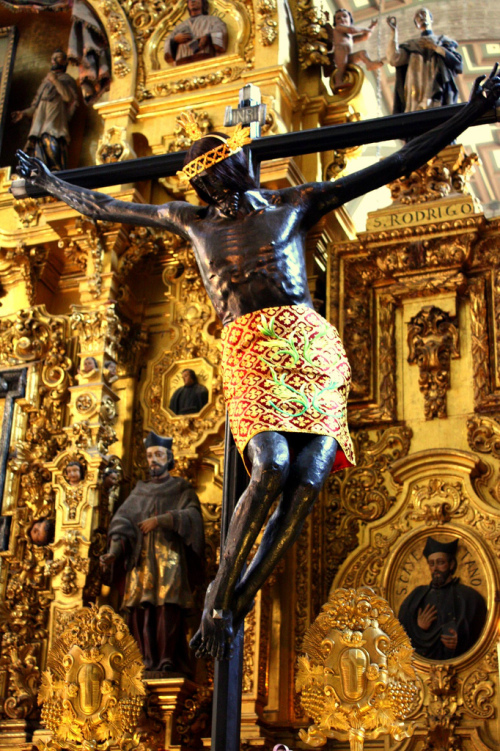
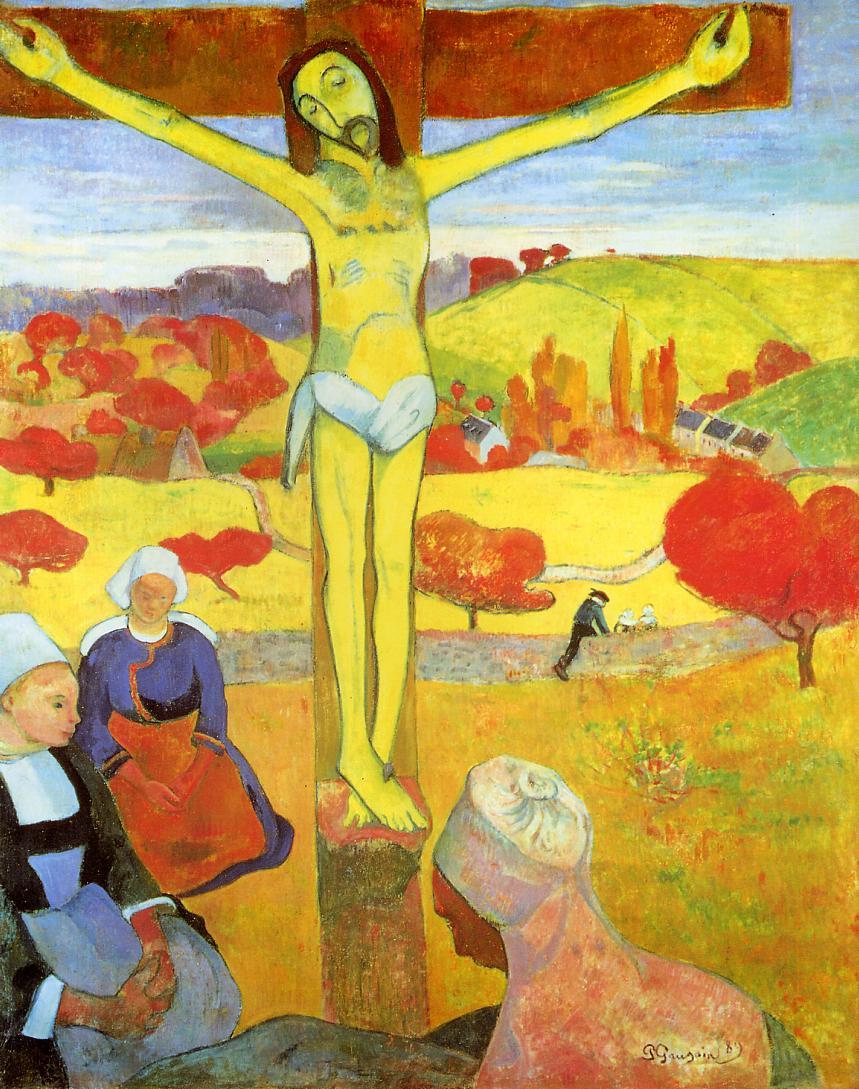
Images of the Crucifixion


(Thanks to Jeffrey Fisher [jeffreyfisher at me.com] for the guest post.)

On Good Friday every year,* Christians around the world commemorate the death by crucifixion of Jesus of Nazareth, rabbi, prophet, Son of God, Son of Man, messiah, and all-around trouble-maker.

The truth is that very little is known of Jesus’ life and teachings from verifiable accounts, but this has not stopped generation after generation of Christians from telling his story, beginning with Jesus’ semi-official biographers, the evangelists of the New Testament. Almost everything we know about the life and teachings of the physical human being Jesus are in those writings, which do not portray him always in compatible ways, and which are almost entirely unconfirmed by any external source. The Roman historian Tacitus mentions (with disdain if not disgust) Jesus’ cult following, as does the Jewish historian and philosopher Josephus, but neither gives us anything to work with as historians (or, for that matter, as theologians). For the record, Suetonius and Pliny also talk about Christians, but these piecemeal sources tell us much more about Roman perceptions of Christians than about Christ and his teachings, or even necessarily Christian beliefs and practices.

What, then, can we reasonably say about Jesus?

It is almost impossible to find universal agreement around anything more than a few basics, including most importantly Jesus’ crucifixion. The Gospels narrate it; Paul the Apostle (who never met Jesus in the flesh, as it were) hangs his theology on it, together with the equally important resurrection; and no contemporary sources (Christian or otherwise) dispute it.

But it’s when we ask why Jesus was crucified that things start to get interesting.

What did he do? The two men he is traditionally said to have been crucified with are commonly understood to be “robbers,” but that they were common criminals is highly unlikely. Crucifixion is a horrible death designed to make a very public statement about the crucified, the sort of thing you use on gladiator-slave rebels like Spartacus, not on pickpockets and roustabouts. The Greek term used for these two men (lestai) is consistent with the description of the released Barabbas as one who had participated in rebellious activities, whose “criminality” was related to his revolutionary business. Moreover, the name “Barabbas” means literally “son of the father,” a purely symbolic and surely entirely fictional name, and that the people choose to have him released indicates their affinity for him as a thorn in the side of the Romans. He is thus contrasted with Jesus, the other son of the father, the peaceful (apocalyptic) revolutionary.

So Jesus would have been crucified as a political criminal, a rebel. This would make sense of accounts of his having been identified by the Romans as “Iesus Nazarenus Rex Iudaeorum”: “Jesus of Nazareth, King of the Jews.” Anyone claiming to be king (and “son of God” was a Jewish way of talking about the king of Israel recorded clearly in Psalm 2), would, if taken seriously, be understood as challenging Roman authority.

Insofar as Jesus seems to have been deliberately poking the Romans’ local running dogs, the Sadducees and the Temple priests, his seizure and termination were surely inevitable. If his teaching is as opposed to violence and unconcerned with “politics” as it seems to have been, it’s hard to believe the Romans would have noticed him without some prodding, this coming not from the “crowd,” but from the leadership (who in Mark and Matthew incite the crowd). Indeed, the priests and scribes look for ways to arrest him when the crowds are not around, because they fear a riot.

If we take the Gospel of Mark at all seriously, Jesus was preaching a new kingdom of God, an apocalyptic redemption of the people of the earth by God’s direct intervention (and with Jesus as the sacrificial pesach lamb). If we take the Gospel of Luke seriously, Jesus spoke in a classic prophetic mode, calling people — Jew and Gentile both — to care for the oppressed of the earth, the poor and the hungry and the helpless. Both Jesuses called for people to be better to each other, to love each other, and indeed to love each other when love was, according to common sense, the foolish thing.

Why would this get you executed?

Well, in itself, it wouldn’t. But the Gospel of Mark tells us of Jesus speaking with a man who realizes that all the animal sacrifices in the world don’t amount to a hill of beans (in that crazy world). When love counts more than sacrifice, we are undermining the Temple. When we go into the Temple, start knocking things over, and say it’s become about robbing the poor and not about loving God and one’s neighbor, we are undermining the Temple. And to undermine the Temple’s authority is also to undermine Rome’s authority, and Rome’s cash flow.

Jesus, like the Essenes he may or may not have associated with, was a purist.

The Temple was full of collaborators and exploiters, the kind seen before in the history of Israel (and berated by prophets like Isaiah and Amos), the kind hated also by the Dead Sea community of apocalyptic purists awaiting a final showdown between God and evil (i.e., the Roman Empire and their local potentates, the Temple authorities).

Jesus, like other Jewish prophets before him, thought that Judaism was about something. That it was somehow about justice and not just about following rules or waiting around for things to get better: that it was about our making the world a better place, and not just making our own lives better.

Start talking that way and get people on your side, and you’re fairly likely to get killed, even twenty centuries later.

* Though the actual date (even the year) of the execution marked by the movable feast of Good Friday is fundamentally unknowable, there are some present-day astronomer types who’d like to sell you April 3, 33 A.D.

On this day..

1938: Arkadi Berdichevsky, Jon Utley’s father

On this date in 1938, Arkadi (or Arcadi) Berdichevsky, a Russian Jew run afoul of the (pre-KGB) NKVD, was executed in the Arctic Circle prison town of Vorkuta for leading a prisoners’ hunger strike.

Though the powerful whom Stalin purged are well-known to the student of Russian history, Berdichevsky is just one of the countless obscure Soviet citizens who disappeared into the gulag never to emerge again.

Berdichevsky had something most of his fellow-victims did not: an English wife.

Freda Utley and her son Jon Utley — the couple cannily gave the boy his mother’s foreign last name to make it easier to emigrate if it should come to that, as indeed it did — left the USSR and Freda’s communist youth for fame as (paleo)conservative giants.

While young Jon — just two years old when his father was whisked out of their Moscow flat by the spooks — came of age, Freda Utley naturalized as an American and turned against her former ideology with the zeal of the converted.

Berdichevsky’s widow, Freda Utley, published this book in 1940 about her disillusionment with communism. This work and many others by Utley are also available as free pdfs from FredaUtley.com.

She savaged the U.S. government officials who “lost China”, and testified at Sen. Joseph McCarthy’s behest in the latter’s 1950’s red-hunt. (Utley also supplied McCarthy some research. She defended Tailgunner Joe until her death in 1978.)

Along the way, Freda Utley learned the date of her husband’s death, but never the circumstances.

That discovery fell to Jon Utley, who made his own fortune in business and became a conservative activist/intellectual himself, notable for his anti-imperialist position. (Utley writes regularly for antiwar.com, and opposed the recent Iraq blunder.)

In 2004, Jon Utley finally obtained the remarkably detailed records revealing that it was a firing squad rather than cold or malnutrition that took his father’s life. Utley then personally visited the sites of that Calvary in the Komi region of Russia.

Jon Utley gives a video interview about the experience and about his own path as an anti-communist here, but most especially recommended for our purposes is his written account of finding his father: HTML form here; pdf here.

On this day..

1880: Ippolit Mlodetsky, Loris-Melikov’s would-be assassin

If you were a person of any privilege or official authority in late 19th century Russia, chances are that Narodnaya Volya was planning to take a shot at you.

If you were General Loris-Melikov, a Ukrainian Jew did that to you two days before this date in 1880.*

And if you were that errant assassin, Ippolit Mlodetsky, this was your execution date.

Even though Melikov rated as something of a liberal on the Russian autocracy spectrum, he had no qualms about ordering legal proceedings barely this side of summary.

Gen. Melikoff, on Wednesday evening, ordered a court-martial to assemble on Thursday morning. The trial of the prisoner was opened at 11 o’clock in the morning. The prisoner was insolent in his language and demeanor, and refused to stand up or take any part in the proceedings. He said he had nothing to add … that he did not want to be troubled any more, and wanted the matter finished. … at 1 o’clock … judgment was pronounced against him. The judgment on the prisoner sentenced him to be hanged, and his execution was appointed for 10 o’clock this (Friday) morning on the Simeonofsky Plain, near the Tsarskoe-selo Railway terminus.

And so he was.

Mlodetsky’s public hanging was witnessed by novelist Fyodor Dostoyevsky in the very square where Dostoyevsky himself had faced mock-execution for revolutionary activity 30 years before.

Dostoyevsky was, even then, pulling together his magnum opus, The Brothers Karamazov.

The very day Mlodetsky tried to kill Melikov found Fyodor Mikhailovich chatting with fellow reactionary journalist Aleksey Suvorin about the plague of terrorism and its accompanying social malaise.

On the day of the attempt by Mlodetsky on Loris Melikov I was with F. M. Dostoyevsky.

… Neither he nor I knew anything about the assassination. But our conversation presently turned to political crimes in general, and a [recent] explosion in the Winter Palace in particular. In the course of talking about this, Dostoyevsky commented on the odd attitude of the public to these crimes. Society seemed to sympathize with them, or, it might be truer to say, was not too clear about how to look upon them … (Quoted here.)

Dostoyevsky in this conversation revealed that for the planned sequel to The Brothers Karamazov — never to be realized in the event —

he was going to write a novel with Alyosha Karamazov as the hero. He planned to bring him out of the monastery and make a revolutionary of him. He would commit a political crime. He would be executed.

(Much more about this sequel in this paper.)

Melikov’s brush with death did not dissuade him from continuing to push for constitutional reforms as the antidote to terrorism, including introduction of a parliament. Tsar Alexander II was on the point of implementing that proposal … when he himself was assassinated by Narodnaya Volya, precipitating a political backlash.

That murder of Alexander II helped put the kibosh on the Karamazov sequel, which would thereafter have become politically problematic.

Nor was that the only artistic casualty of the Russian terrorists.

A discomfiting thematic similarity in Mlodetsky’s execution with that of the protagonist resulted in the cancellation of a just-opened opera: The Merchant Kalashnikov. (It would be a few more decades before that connection could appear ironic.)

* The assassination attempt occurred on February 20, with the execution on February 22, according to the Julian calendar still in use in Russia at that time. By the then-12-days-later Gregorian calendar, the dates were March 3 and March 5, respectively.

On this day..

1945: Denise Bloch, Lilian Rolfe and Violette Szabo

On or about this date in 1945, three women who had been caught behind German lines working for the British Special Operations Executive were shot at Ravensbruck.

Left to right: Denise Bloch, Lilian Rolfe, Violette Szabo.

Denise Bloch, Lilian Rolfe, and Violette Szabo were all fluent young Francophones who volunteered their services for Britain’s dangerous spying-and-sabotage operations in support of the French Resistance.

Bloch and Rolfe were wireless operators; Szabo, the most famous of the three, got her hands dirtier with explosives and sabotage.

One evening towards 1900 hours they were called out [of the punishment block] and taken to the courtyard by the crematorium. Camp Commandant Suhren [German Wikipedia link] made these arrangements. He read out the order for their shooting in the presence of the chief camp doctor, Dr. Trommer, SS Sergeant Zappe, SS Lance Corporal Schult, SS Corporal Schenk, and the dentist Dr. Hellinger

All three were very brave, and I was deeply moved. Suhren was also impressed by the bearing of these women. He was annoyed that the Gestapo did not themselves carry out these shootings.

Extensive and illustrated biographies on all three, as well as other SOE agents, can be found at 64 Baker Street: Bloch; Rolfe; Szabo.

Violette Szabo in particular was much written-of after the war (long out of print, the classic Carve Her Name With Pride was recently republished), and was posthumously awarded a variety of decorations by both England and France.

Szabo has what looks to be a charming museum in Herefordshire (phone ahead to Miss Rigby before visiting!); for a younger generation, she’s the inspiration behind “Violette Summers”, the protagonist of the video game Velvet Assassin.

On this day..

1955: Moshe Marzouk and Shmuel Azar

On this date in 1955, two Egyptian Jews enrolled by Israeli intelligence as saboteurs were hanged in Cairo.

Marzouk (left) and Azar, from this page.

The strange and disturbing “Lavon affair” — or “Esek habish,” the “shameful affair” — has never had a completely satisfying explanation.

It broke in 1954, when Egypt arrested a ring comprised of Egyptian Jews who had bombed locations in Alexandria and Cairo, including an American diplomatic post, in an apparent false flag operation meant to be attributed to the radical Muslim Brotherhood. (The apparent operation had a recent precedent.)

The germ and the goal of this project have been fodder for speculation ever since; the most commonly accepted theory is that it was intended to trigger western intervention or pressure on Egypt that would prevent Nasser from nationalizing the Suez Canal.

Initially blamed on the Defense Minister Pinhas Lavon, unrelated court testimony in 1960 would reveal that he was a fall guy.

But in any guise, the hangings this day in Cairo prompted national mourning in Israel and an immediate political shakeup whose dimensions might as well have sprung from this morning’s paper:

The dovish government of Moshe Sharett fell; hawkish founding Prime Minister David Ben-Gurion was recalled from retirement in a Negev kibbutz; and Israel launched a reprisal raid at Gaza. Little more than two years later, Israel and Egypt would contest control of the Suez on the battlefield.

On this day..