1929: Constantine Beaver, Alaskan native

On this date in 1929, Alaskan native Constantine Beaver hanged in Fairbanks, Alaska.

Described as a “woodsman”, Beaver shot his friend Egnatty Necketta during a drunken altercation the previous December.

Neither Beaver himself nor the several witnesses spoke or understood English, so much of the trial was conducted via interpreters. The jury, in finding him guilty, availed an option to remain silent as to the penalty, punting the decision to the judge — who went with hanging. Several jurors then protested, too late, that they hadn’t understood that was a possible outcome of their silent penalty decision.

In pre-statehood Alaska under federal governance, it was U.S. President Herbert Hoover 4,000 miles away in Washington who would have the final say in this affair — riding high, as it happened, at the very moment of the stock market peak right before the economic meltdown that would define his presidency.

Hoover said no.

Hopeful throughout the greater part of the night that a stay of execution would arrive Beaver bore himself with fortitude when informed that he must die. His only wish was that the intervening time might speed by so that his mental agony might be ended.

When Beaver reached the death chamber he broke into a tribal chant which continued until the floor opened beneath him.

It was “the saddest affair I’ve had to witness,” said a U.S. deputy who was present at the execution. And it was the last hanging ever conducted in Fairbanks.

Of possible interest: “American Indian Executions in Historical Context” by David V. Baker, a lengthy pdf.

On this day..

1987: Moses Jantjies and Wellington Mielies, after the Langa massacre

On this date in 1987, Moses Jantjies and Wellington Mielies — “political prisoners” in the estimation of their supporters — hanged along with five common criminals at Pretoria for the murder of Ben Kinikini and five others.*

The killing of Kinikini occurred in an environment of bitterly escalating hostilities in the eastern cape city of Uitenhage and especially the KwaNobuhle township. Anti-apartheid school boycotts dating back to September 1984 (part of a spreading revolt in the townships at that time) had metastasized into violent confrontations when protesters were denied meeting space by the black KwaNobuhle councillors.

Kinikini was such a councillor, and he and the others had been under popular pressure to resign, and even had their homes stoned, since the last weeks of 1984.

Protesters stoned vehicles. Riot squads roamed the streets. Police shootings became everyday events, and more enraged crowds gathered at the resulting funerals of their victims.**

On March 21, 1985,† police opened fire on one such funeral procession, slaying some 20 people in a single go — the Langa Massacre.


Coffins of the Langa Massacre’s victims. (cc) image from United Nations Photo Library. Also see this, this, this and this.

And then it really hit the fan.

Riots erupted following the Langa massacre, and it was on March 23 that Kinikini was dragged from his house and murdered: black township councillors were liable to be seen as apartheid collaborators. Defense witnesses for Jantjies and Mielies were quite a bit more specific, slating Kinikini with direct links to murderous vigilantes who liked to beat up and rape protesters in the creepy privacy of Kinikini’s apt personal business, a mortuary.

And as one memoir of the period puts it, “the government knew black councillors would not participate in a democratic charade unless their lives and property were protected and avenged. Some two and a half thousand black councillors, policemen and informers, real and rumoured, had been killed in the unrest that had begun in 1984.”

For South African president and white-rule stalwart P.W. Botha, those were far more pressing constituencies than mercy appeals from usual suspects like black activists and the West German government. These were also the first two township-rising convicts to come up for execution, out of some 33 then on death row, so their treatment figured to set the precedent for even higher-profile cases on the horizon like the Sharpeville Six. (In the event, apartheid collapsed before the Six could actually be hanged.)

The message was hardly lost on its internal audience.

“We have come to terms with the fact that the enemy has declared war,” Winnie Mandela told a Johanessburg memorial service for Jantjies and Mielies hanged. “We accept the challenge. The blood of the comrades has not flowed in vain.”

* Ben Kinikini, his four sons and nephews, and one other person were stabbed and burned to death. Some reports term at least Ben Kinikini’s killing a “necklacing” — the brutal method of popular execution that arose in the 1980s in which the “jewelry” was a rubber tire filled with flaming petrol. It sounds from the widow’s secondhand description as if this could indeed characterize it, though the fact that the Truth and Reconcilation Commission called a July 1985 killing the country’s first necklacing might indicate otherwise. News stories suggest that photographs and video exist of, if not the murder, at least the aftermath: perhaps these are dispositive on the point.

** See Thole Majodina, “A Short Background to the Shooting Incident in Langa Township, Uitenhage,” Human Rights Quarterly, August 1986.

† March 21 also happened to be the very anniversary date of one of apartheid South Africa’s most infamous police atrocities, the 1960 Sharpeville Massacre. Thanks to Sharpeville, this first day of spring is the International Day for the Elimination of Racial Discrimination, as well as the date on which South Africa marks Human Rights Day.

On this day..

1890: Otto Leuth

(Thanks to Meaghan Good of the Charley Project for the guest post. -ed.)

On this date in 1890 at the Columbus Penitentiary in Ohio, a sullen German-American teenager named Otto Leuth (sometimes spelled “Lueth”) paid with his life for the brutal murder of his seven-year-old neighbor, Maggie Thompson.

John Stark Bellamy II, writing of the murder in his book The Corpse in the Cellar: And Further Tales of Cleveland Woe, noted how familiar the case sounds to modern ears:

[T]he sickening murder of an innocent child; yet another child accused for the dreadful deed; a sensational trial, replete with dubiously “expert” testimony, suspicious “confessions,” allegations of police “third-degree” methods, and charges of biased press; not to mention “latchkey” children, systematic child abuse, saccharine sympathy for the guilty, and charges of ethnic favoritism.

Yet it happened over a century ago.

Otto, sixteen at the time he killed little Maggie Thompson, had had a hard life, as Bellamy explains in his book. His mother, Lena, testified at his trial that she

went into veritably demonic fits of rage, during which she was in the habit of physically abusing her children, especially Otto. From an early age, she blandly admitted, she had pulled his hair, kicked him, beaten him, walked on him, and often hit him with any object that came to hand. Once, when Otto was eight, she had beaten him with a chair leg and, when [Otto’s father] Henry tried to intervene, stabbed Henry twice with a convenient butcher knife. Just a few months before Maggie Thompson’s murder, Lena had repeatedly slammed Otto’s head into a wooden door.

It speaks volumes of the difference between that century and this one that nobody who heard Lena’s testimony seemed to think this was in any way excessive, never mind cruel; on the contrary, one person praised her methods as being “good German discipline.”

On May 9, 1889, sixteen-year-old Otto was alone at his family’s home at 47 Merchant Avenue in Tremont, a suburb of Cleveland. He was used to being alone: his mother had been committed to a mental hospital some months before, his father was wrapped up in his cabinet-making business, and his older brother had moved out of the house.
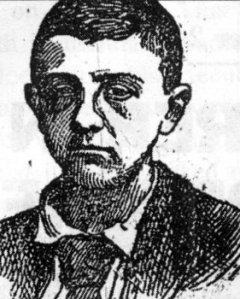

Otto (top) and his victim.

That morning, down the street at 24 Merchant Avenue, Maggie Thompson set off for school. Her mother, Clara, dropped her off at the front gate; it was the last time she would see her daughter alive.

Maggie attended the morning classes and, when school was dismissed for lunch at 11:15 a.m., started on the four-block walk home. En route, she vanished without a trace, as if “the sidewalk might have opened and swallowed the girl.”

Naturally there was a frantic search, lead by her devastated parents and the Cleveland Police Department, who tore the city apart looking for her.

But, although there were numerous false sightings and a few wild stories about Maggie’s disappearance, in spite of everyone’s efforts they couldn’t find her.

Otto participated in the search, along with most of the neighborhood. Nearly every day he would approach Clara Thompson and solicitously ask if she’d heard any news of her child.

In early June, Clarissa Shevel, the woman who lived with her husband in the back of the Lueths’ two-family house, asked Otto to do something about the terrible stench that pervaded the entire building. Otto suggested the odor was caused by a dead animal. He bought some chloride of lime and put it in the ventilation hole, then burned some sulfur, but it didn’t help.

Around that time he was witnessed carrying some badly stained bedding to the smokehouse at the back of the property.

On June 9, Otto’s mother Lena, who had by now been discharged from the mental hospital, became fed up with the smell and sent her husband Henry down to the cellar to investigate. He came back up a few minutes later, deeply shaken, and ran out to find a policeman.

In the Lueths’ cellar was the nude corpse of Maggie Thompson.

She was wrapped in one of Lena’s dresses and her own clothes lay underneath her. She had been beaten to death and her body was so badly decomposed that her parents had to identify her by scars on her hips.

The police promptly arrested everyone who lived at the house: Henry and Lena Lueth, Clarissa Shevel and her husband, and Otto, who was picked up on his way home from the ice cream parlor. All five suspects were separated and subjected to a serious “sweating,” but Otto was the prime suspect. He had a reputation as a bully, and he’d been at home alone for much of the previous month.

Bellamy records:

The climax came at 3:30 a.m., when an agonized female shriek resounded from the floor below the sweating room. “Who is that?” cried Otto to Detective Francis Douglass. “Your mother, I believe,” replied Douglass. “She had nothing to do with it!” blurted out Otto. “Who did?” queried Douglass. Otto: “I did it! I did it!” Douglass: “Did what, Otto?” “I killed her! I killed her! Please give me your revolver so I can kill myself!”

Resisting the temptation, the police instead took his verbal confession, wrote it down, had him sign it and escorted him to a cell.

Otto said he had been standing outside his parents’ home at about 11:30 a.m. on May 9 when he encountered Maggie. She asked him if he could donate any buttons to the “button-string” she was making, and he said he had four and would give them to her if she came inside.

Maggie obediently followed him in, and he led her upstairs to his bedroom, where he attempted to rape her. When she screamed, he hit her with a nearby hammer.

Otto said he thought he’d probably killed her with the first blow, but he kept striking her until her head was a pulp and the bed was covered in blood. After an unsuccessful attempt to have sex with her body, he fled the scene. He did go back to the house that night, but spent the next several days at his brother’s home.

Six days later, just before his mother was supposed to come home, Otto returned home to clean up. He carried Maggie’s corpse to the family cellar and left it lying there; he didn’t even bother to bury it or cover it up.

Given Otto’s confession, the circumstantial evidence and the revulsion his crime invoked in the city of Cleveland, his lawyer didn’t have much to work with. Not even trying for an acquittal, his defense instead claimed Otto was mentally impaired and/or insane.

Otto had a strange depression in his skull and his attorney suggested he was brain-damaged — which might very well have been true, given the abuse he had suffered at Lena’s hands. Several members of his family, including his mother and brother, had epilepsy, and his attorney suggested he might have had a seizure and committed his crime without even knowing what he was doing.

Such a scenario was possible. The problem was, though, that none of the medical experts who testified for the defense could diagnose Otto with epilepsy.

The claims of subnormal intelligence were contradicted by the testimony of Otto’s former teachers. Although his pathetic attempts to conceal Maggie’s body might indicate otherwise, his intellect seems to have been about average. Before he quit school at age 13, he had been an unexceptional student with some talent as a violinist.

Otto’s lawyer also said his client had not, in fact, attempted to sexually assault Maggie Thompson either before or after death, and Otto had invented that part of his confession because the police were pressing him to cough up an explanation for his motiveless crime. But given the fact that Maggie’s body was found naked, this claim didn’t carry much weight either.

It was no surprise that, when the trial concluded on December 27, 1889, the jury came back with a verdict of guilty without a recommendation of mercy. Perhaps the only surprising thing was that they actually bothered to deliberate for a whole four and a half hours.

Otto rapidly exhausted his appeals and was hanged eight months after his trial, alongside another killer, one John “Brocky” Smith of Cincinnati. Two other men had also been scheduled to die that night, but one got reprieved and the other’s execution was postponed.

Otto left behind a statement where he admitted he’d killed Maggie Thompson, but denied his previous claims that he’d tried to rape her. He died calmly and without a fuss, standing on the trap and saying simply “All right, let her go.”

On this day..

1987: Dale Selby Pierre, Hi-Fi Murderer

On this date in 1987, Utah executed Dale Selby Pierre for one of the most notorious crimes in that state’s history — the Hi-Fi Murders.

Pierre, along with two fellow airmen from the Hill Air Force Base, William Andrews and Keith Roberts, began an armed robbery of a hi-fi shop in nearby Ogden near closing time on the evening of April 22, 1974.

The night that unfolded would be a visit to an antechamber of hell not only for the two young clerks on duty at the time, but three other people who wandered into the store while the crooks were still in it — each of whom was added to the growing pen of hostages Pierre et al kept in the basement.

After plundering the shop of $25,000 worth of electronics, Pierre and Andrews went to get rid of their prisoners by making them drink liquid Drano.

This method of homicide, theoretically an elegantly quiet one which would facilitate a clean getaway, had been cribbed from a murder scene in the 1973 Dirty Harry movie Magnum Force.

The struggles of Cortney Naisbitt, one of the surviving victims, forms the subject of Victim: The Other Side of Murder — a classic of the true-crime genre and of the victim’s rights movement.

But human flesh is hardier than celluloid.

Unlike the poor prostitute in Magnum Force, Pierre and Andrews’s victims groaned and gurgled, their blistering mouths suppurating so much fluid that duct tape to quiet them down wouldn’t stick. And the Drano didn’t kill them, or at least it was sure taking its time.

“I remember the noise they were making, the sounds of pain they were making,” Pierre told his clemency hearing. “It was something greater than sad.”

Since they hadn’t got rid of their victims quite so cleanly, Pierre simply set about shooting them — and in the case of Michelle Ansley, a 19-year-old in her first (and last) week on the job at the Hi-Fi shop, raping her first. These execution-style murders had only mixed results, and one of the hostages — 43-year-old Orren Walker — being noticeably not dead, had a ball-point pen kicked into his ear in an attempt to finish him off.

Somehow, Walker still survived, as did 16-year-old Cortney Naisbitt, who suffered severe brain damage. (Both have since died.) Stanley Walker, Carol Naisbitt, and Ansley were not so “lucky.” But neither were the perps: since Andrews had openly talked at the Air Force base about boosting that very hi-fi shop and even killing anyone who “gets in the way,” suspicious fellow airmen soon turned them in.

The 21st century’s more polished and calculating strategic communications consultant probably would have advised keeping well clear of such an incendiary crime, but death penalty opponents actually pushed clemency hard in the Hi-Fi case.* For the NAACP, the sentences underscored racial disparity in the death penalty.

Rubbish, one might say, given the killers’ epically villainous conduct. But one member of the all-white jury was apparently passed a note by parties unknown reading “Hang the niggers.” And the NAACP noted that Utah gave death sentences to these guys, but not to a white supremacist who murdered two black men for jogging with white women.

None of this cut any ice with Utah. Years later, the killers themselves had a hard time fitting that monstrous night into any kind of comprehensible rationale. Pierre:

The crime took a course of its own. It wasn’t planned that way. People kept coming in and I just panicked. The only way to prevent what happened was to have been moved away from the Air Force entirely … Of course the alcohol and the pills I was consuming didn’t help — valiums, reds, black beauties and yellow jackets … I tell myself, “You have to accept responsibility for it — you did it, you were there. You can’t rationalize it.”


Dale Pierre pleads his case to the Utah clemency board.

Dale Pierre was the very first person put to death in Utah after its famously groundbreaking execution of Gary Gilmore in 1977. But in fact, the Hi-Fi killers had preceded the eager volunteer Gilmore on Utah’s death row, and Gilmore as he walked his last mile reportedly wisecracked to Pierre and Andrews, “I’ll be seeing you directly.”

Pierre’s accomplice William Andrews was also finally executed in 1992, after a then-unimaginable (and anything but “direct”) 18 years on death row — nearly half his life. Their fellow accomplice Keith Roberts didn’t personally take part in the cellar hecatomb and therefore avoided the death sentence: he was paroled in 1987.

* The clemency push was much stronger for William Andrews than for Dale Pierre, since Andrews was also making the argument that he hadn’t directly killed anyone and hadn’t intended to. As a matter of fact, the manipulative Andrews was and is widely doubted on that point — but any such claim was wholly unavailable to the acknowledged triggerman Pierre.

On this day..

1932: Richard Johnson, great-grandfather of Craig Watkins

On this date in 1932, two African-American men were electrocuted in Huntsville, Texas.

Richard Johnson was a career criminal already serving a 35-year sentence for various burglaries when he busted out of prison in 1931. He teamed up with 20-year-old Richard Brown to rob a white couple in a parked car.

When the man, Ted Nodruft, tried to drive away, they shot him (he died the next day), and then proceeded to rape his fiancee and steal her jewelry. When caught, each man tried to throw the lion’s share of blame on the other.

These two on their own hardly stand out to posterity, and certainly not in the context of notoriously execution-friendly Texas, whose “List of individuals executed in Texas” Wikipedia entry (most states have such a page) is actually paginated by decade. Here’s the doings for the rest of the 1930s in the still-newish Texas electric chair.

We pause to note them here on this site because they made unexpected headlines earlier this year when Dallas County District Attorney Craig Watkins — the first elected black D.A. in Texas history — publicly revealed that Richard Johnson was his great-grandfather.

Long before that revelation, Watkins had already earned nationwide plaudits for doing what every district attorney should be doing as a matter of course: publicly emphasizing justice rather than conviction counts as his office’s guiding principle, greeting the rising tide of exonerations with a proactive program to search out potential miscarriages of justice rather than doubling down on them … hell, even apologizing to people whose lives have been ripped apart by wrongful convictions.

Watkins knew about the “dark secret of our family” for many years before he mentioned it in the run-up to witnessing his first execution (it was topical because Watkins used the trip to also visit his great-grandfather’s grave in the prison cemetery). How exactly that blood tie has helped to shape Craig Watkins’s outlook is hard to say, but not for any reticence on the DA’s part: he’s been disarmingly public about speaking to the real ambiguities and human costs of the criminal justice system that prosecutors are usually not supposed to acknowledge.

The broader issue is, look, I have walked 25 men out of prison for crimes they didn’t commit. We have gotten this case in Williamson County, where the DA withheld evidence, or it’s alleged that he withheld evidence. Because of that, a guy spent 25 years on death row. The Supreme Court of Texas has instituted a court of inquiry to look into the actions of this individual. At the time he was DA; now he is a judge. You have got the Todd Willingham case. We have had all of these folks who have been exonerated that were on death row throughout our nation.

And so my concern, basically, is, look, we are seeking the ultimate punishment against someone, and we need to have all the safeguards in place to make sure that we don’t wrongly execute someone. And I think with all the evidence that we have seen, I think anyone that does not come to the conclusion that a person has been executed in this country for a crime they didn’t commit is being irresponsible. So that’s my position. Like I said, I can argue from my moralistic standpoint all day, but that’s not where the argument should be had. It should be one of logistics. Are we making mistakes? Do we need to reevaluate the process to make sure we are not making mistakes?

Watkins personally opposes the death penalty on moral grounds, but seeks it routinely in his capacity as district attorney. Here’s the man expanding on some of those themes in a 30-minute interview with the Dallas-Fort Worth NBC affiliate:

Watkins (or someone in his office) blogs infrequently here, and tweets @craigmwatkins.

On this day..

1852: Ann Hoag and Jonas Williams

On this date in 1852, a white woman and a black man — no connection between them — were hanged on an upward-jerking gallows in Poughkeepsie, New York.

31-year-old (though she looked 22, said smitten newsmen) Ann Hoag was a foundling who’d been raised by an adoptive family, then married a local farmer in a union that featured at least five children, financial loss, and a good deal of unhappiness. The sequence of causation among those mutually convivial characteristics is left for the reader’s imagination. Eventually — the New York Times (July 31, 1852) is most piquant on this — succumbing to the thrall of a younger lover, “the ill-starred woman plunged into misery and degradation, renounced virtue, reputation, husband, and children, until at last she murdered her husband” with arsenic and eloped with her paramour to Bridgeport.

Luckily for Ann, her brief summer of carnal liberty sufficed to quicken her belly, with the result that her delicate condition bought her a few extra months of life. On April 18, 1852, she gave birth to a baby daughter, and sealed her own fate.

A most interesting scene occurred in the separation of the child from the unhappy mother, which none but a mother’s heart can conceive. It appeared as if the last prop of life, the very cords of the heart were being severed, when, with the most endearing caresses, amid tears and sobs, the mother looked for the last time on that innocent babe, which since its birth had unconsciously shared her solitude and been her solace. As it passed forever from her sight, she exclaimed — “Now let them execute me — I have nothing to live for — one by one they have dragged my children from me.” (Albany Journal, Aug. 5, 1852)

Although the faithless wife left a 70-page statement implicating her lover William Somers, that gentleman was acquitted in October of 1852 on a charge of accessory to murder.

Jonas Williams, Ann Hoag’s partner upon the gallows, was much less the sighed-over. Williams committed a “fiendish outrage” upon his 11-year-old stepdaughter, killing her.

On this day..

1735: Patience Boston, converted

On this date in 1735, a truculent indentured servant with a name like a primetime drama was hanged in York, Maine (at that time part of the Massachusetts colony), for killing her master’s grandson.

Patience Boston had cut a hard-partying, hard-drinking swath from her teen years to her execution at age 23, leading a succession of masters to dump her contract on whomever would take it. Early American Crime tracks her rowdy career, “mad and furious in my Drink, speaking dreadful Words, and wishing bad Wishes to my self and others” through a succession of fights, adulteries, dead infants (which she didn’t kill), a nonexistent infant (which she claimed to have killed).

All this draws upon a lengthy “Faithful Narrative of the Wicked Life and Remarkable Conversion of Patience Boston alias Samson” published three years after the woman’s death by her ministers Samuel and Joseph Moody (more on them in a bit). In it, “Patience” relates in a first-person voice* the real murder she finally did commit.

From some groundless Prejudice which I had taken against my Master, to whom I was sold by Mr. Bailey, I did last Fall bind my self by a wicked Oath that I would kill that Child, though I seem’d to love him, and he me; which is an Aggravation of my bloody Cruelty to him. Having solemnly sworn that I would be the Death of the Child, I was so far from repenting of it, that I thought I was obliged to fulfil it. And I often renewed my Resolution when I had been in Drink, and made my Master angry, that to be revenged on him, I might Murder his Grand-Child, of which I thought he was very fond, having bro’t him up from his Infancy. I would have killed my Master himself, if I could have done it; and had Thoughts of putting Poison into his Victuals, if I could have got any. But when the Time came for me to be left under the prevailing Power of Satan’s Temptations; I took the Opportunity of my Master and Mistress being from Home, and both his Sons also abroad; that the Child and I were left alone. The Evening before I had been contriving to burn the Barn, but was prevented: I had also once before drawn the Child into the Woods with me, designing to knock him on the Head, and got a great Stick for the same Purpose; but as I was going to lift it up, I fell a trembling, from a sense of God’s Eye upon me; so that I had not Power to strike. — But now, as I was going to say, when the Time was come to fill up the Measure of my Iniquity; I went to the Well and threw the Pole in, that I might have an Excuse to draw the Boy to the Well, which having done, I asked his Help to get up the Pole, that I might push him in, which having done, I took a longer Pole, and thrust him down under the Water, till he was drowned. When I saw he was dead, I lifted up my Hands with my Eyes towards Heaven, speaking after this Manner, Now am I guilty of Murder indeed; though formerly I accused my self falsly, yet now has God left me &c. And it seemed as if the Ground where I went was cursed for my sake, and I thought God would not suffer me to escape his righteous Vengeance. I went forthwith, and informed the Authority, and when the jury sat on the Body, I was ordered to touch it: This terrified me, lest the Blood should come forth, to be a Witness against me; and I then resolved in my Heart, that I would be a Witness against my self, and never deny my Guilt; so I tho’t God would not suffer the Child to bleed; then I laid my Hand on it’s Face, but no Blood appeared. Yet after this, I would fain have covered my Sin in Part, as if the Child had of himself fallen into the Well, and I was tempted to thrust him down under the Water. After the Jury had bro’t in wilful Murder, I was sent to Prison, but got Drunk by the Way, having little Sense of my dreadful Case; yet my Temptation in Part was to drink that I might forget my Sorrow.

Patience would need her namesake virtue, since she had the best part of a year to wait before the Supreme Court could gavel in a session to hear her case — a case where she would plead guilty and embrace the certain sentence.

In the meantime, we get to the real meat of the Moody pamphlet: our murderess’ conversion.

Allowing even for the interlocution of her reverend ministers, it presents a moving portrait of a genuine spiritual experience during the “Great Awakening” of religious revival. The narrative’s latter half tracks the doomed woman’s refinements of conscience, of fear, of religious comfort and joy in God — all as she grapples with her conduct and her fate.** “How are we condemned by the Covenant of Works,” Patience remarks, “and relieved by the Covenant of Grace.”


Now … as for this clan Moody that supplies our day’s post.

Samuel Moody, the father, had nudged young Joseph into the ministry business in York. Both men appear to have ministered to Patience Boston.

In 1738, the same time they were readying all this text about “rejoyc[ing], though with trembling” the younger Moody began a bizarre practice: he took to shrouding his face with a handkerchief.

In boring reality, this seems to have been occasioned by a breakdown caused by the sudden death of his wife in childbirth, a breakdown from which Moody recovered over the succeeding months.

In the much spicier legendary embellishment that developed, however, Moody was thought to have kept this veil for the balance of his life: he would present himself in this state, it is said, to his own congregation, turning his back on the multitude so that he could lift the veil to read a sermon, and likewise sitting face to corner when he should eat in public.

In this version, Moody is supposed to have confessed on his deathbed to having shrunk from men in his own spiritual torment over having accidentally killed a childhood friend while hunting, a killing that had been popularly ascribed to Indians and therefore unpunished save by the scourge of conscience. Nathaniel Hawthorne mined this irresistible New England folklore for his short story “The Minister’s Veil”.

“Tremble also at each other! Have men avoided me, and women shown no pity, and children screamed and fled, only for my black veil? What, but the mystery which it obscurely typifies, has made this piece of crape so awful? When the friend shows his inmost heart to his friend; the lover to his best beloved; when man does not vainly shrink from the eye of his Creator, loathsomely treasuring up the secret of his sin; then deem me a monster, for the symbol beneath which I have lived, and die! I look around me, and, lo! on every visage a Black Veil!”

-Hawthorne’s “Reverend Hooper”

* “It must be confessed,” the Moodies gamely preface their text, “that it could not be exactly taken in her own Way of expressing her self” so long after her death. But they gave it their best shot, and “here is nothing false or feigned.”

** The Faithful Narrative takes special note of the impression made on our subject by “the Case of the Prisoners at Boston, especially when the Day came for their Execution”. Although the text here refers to “three Malefactors”, there’s no 1734-1735 triple execution recorded in the Espy files; I believe the event intended here is the October 1734 double hanging of Matthew Cushing and John Ormsby.

On this day..

2011: A day in the death penalty around the world

China

On the morning of July 19, 2011, two Chinese politicians were executed for corruption.

Xu Maiyong (right), former vice mayor of Hangzhou in Zhejiang and bearer of the Santa Claus-esque nickname “Plenty Xu”, was on the hook for $30 million of embezzlement as part of a wide-ranging campaign of public graft in service of a suitably luxuriant lifestyle filled with homes and mistresses.

Jiang Renjie, deputy mayor in charge of urban planning, construction, transportation, communications and housing in Suzhou, had made about half that much in bribes from developers around 2001-2004.


United States

On July 19, 2011, Arizona executed 52-year-old Thomas Paul West, a mere 24 years after he beat a man to death while robbing his Tucson trailer in June 1987.

West had the depressing background so common to condemned prisoners, a litany of childhood sexual abuse that drove him to drug abuse and a PTSD diagnosis: he would claim that he “freaked out” when the homeowner Donald Bortle surprised him and started yelling at him, and that he didn’t think he’d killed Bortle at all.

He lost a closely divided clemency vote shortly before his death on a 3-2 margin. He also lost judicial appeals over Arizona’s having illegally obtained the execution drug sodium thiopental, and then switched the injection protocol at the last minute to the instead use the hip new killing-drug pentobarbital. He even lost after he was already dead.

The Grand Canyon State, more famous perhaps for its outre immigration policies, is an emerging death penalty hot spot.

Per the Death Penalty Information Center’s database, Arizona didn’t conduct its first 21st-century execution until 2007, nor its second until 2010. But West was the fourth man (no women since 1930) put to death there in 2011, and the state could carry out up to seven in 2012.


Iran

The public triple-hanging in Azadi Square in the ethnically Kurdish west Iranian city of Kermanshah on this date was just a drop in the bucket relative to Iran’s hundreds-strong annual execution toll. But this one made the headlines.

Fazel Hawramy of Kurdishblogger.com provided the following video of the public hanging to Amnesty International, which helped focus worldwide attention on the event … although to what real consequence for “the continuing horror of the death penalty in Iran” (Amnesty’s words) is harder to say.

Equally hard to say from here is what relationship the hanged men’s rape conviction had to reality.

Warning: This is a snuff film.

On this day..

1949: Jake Bird

(Thanks to Meaghan Good of the Charley Project for the guest post. -ed.)

Contrary to what all the slasher films would have you believe, an ax does not make a very good murder weapon. Axes are big. They are heavy. They are difficult to conceal. When used they create a big mess. And if you are caught with one, it’s hard to come up with a suitably innocuous explanation for it.

Nevertheless, this was Jake Bird’s weapon of choice on October 30, 1947, when he broke into Bertha Kludt’s home and killed her and her seventeen-year-old daughter, Beverly June.

Perhaps if he had used a different weapon, things would have turned out differently. As it was, the two women’s screams — and that’s another problem with the ax: unless you can wield it like Gimli, the victim is going to survive the first blow and start hollering — attracted two police officers, who apprehended Bird after a foot chase.

This excellent History Link article provides a thorough account of Bird’s life and crimes. 45 years old at the time of his arrest, he was a drifter and a ne’er-do-well with an extensive criminal record. He’d spent a third of his life in prison for various offenses. Bird openly confessed to the Kludt killings, saying the murders were the result of a botched burglary.

One of the police officers who testified at the trial admitted he beat the daylights out of Bird after his arrest. Naturally, the defense moved to throw out the murder confession on the grounds that it was obtained under force, but the judge ruled that the police brutality and Bird’s statements were “unrelated” and so the confession was admitted into evidence.

This was the attorney’s only attempt to defend his client; he called no witnesses and presented no evidence at the trial.

In all fairness, it must be said that Bird was spattered with gore when he was arrested, they found his fingerprints in blood at the crime scene and on the ax, and he’d left his shoes at the Kludt house. So the confession didn’t figure to be exactly decisive.

This would be a fairly unremarkable murder case, but shortly after his arrival on Death Row, Bird suddenly discovered he had an excellent singing voice. For the next several months he detailed 44 murders from all across the country which he claimed he’d committed during his wanderings. Most of his victims were women.

Bird’s claims, if true, would make him one of America’s most deadly serial killers, right up there with the much more famous Ted Bundy and the Green River Killer, Gary Leon Ridgway. One inevitably wonders if all of his statements were genuine. Henry Lee Lucas, another violent drifter much like Bird, admitted to hundreds of homicides and captivated police from all over the nation before it was discovered that many of his confessions were lies.

Police in several states did find Bird credible, though. Bird was calm and ready for his hanging, which went off without a hitch. He willed his estate, valued at $6.15, to his appeals attorney.

On this day..

1844: Gabriel de la Concepcion Valdes, “Placido”

On this date in 1844, Cuban poet Gabriel de la Concepcion Valdes was executed in Matanzas for conspiring to overthrow Spanish authority on the island.

His mother (who gave him up to an orphanage) was a Spanish dancer. His father (who adopted him back) was a “quadroon” barber. Valdes, aka Placido (Spanish link, which is true of most available online resources about him) grew up as a free mixed-race youth in a slave society.

This situated him in the privileged (relative to plantation slaves) but precarious position of the petty bourgeoisie, menaced not only by the prospect of economic reversal but by the vicissitudes of Spanish policy towards his caste — whose growth many colonial officials fretted warily.

Though Placido made his bread apprenticing as a print-maker and later making turquoise combs, he made his fame by dint of literary gift that was celebrated throughout Cuba and abroad. His “La siempreviva” won a literary competition when he was just 25, and led to an invitation to visit Spain (Placido declined it); the Cuban-born, naturalized Mexican poet Jose Maria Heredia visited Cuba in 1836 and made a point to look up Placido; and according to the out-of-print Cuba’s Romantic Poet: The Story of Placido by Frederick Stimson, the young Cuban was wildly popular with North American slavery abolitionists as well.

Placido is less well-remembered beyond his home island today, but arguably rates as Cuba’s most distinguished Romantic poet.

In the 1830s especially, when civil war in Spain put the reigning monarch on the liberal side, Placido was able to exploit the opening to write openly of Cuban political aspirations.

His La Sombra de Padilla, dedicated to Spain’s “wise and exalted Queen”, imagines one of Spain’s martyred comuneros charging him to venture his life for liberty against absolutism.

Better to fall prey to La Parca [the Grim Reaper]
Than to a despotic Monarca

But notwithstanding the war in Iberia, the exalted Queen still put Cuba under special (read: repressive) law. Placido’s prominence, having advocated for much more freedom than Cuba was slated to enjoy, subjected him to automatic Spanish suspicion as more authoritarian governance arrived in the 1840s.

The poet was arrested in the Conspiración de La Escalera (Conspiracy of the Ladder, so named for the structure its accused were tortured upon). This purported plot to raise a slave revolt may or may not (pdf) have really existed, but the crackdown it authorized sure did. Indeed, despite the “slave revolt” bogeyman, it was overwhelmingly free blacks whom the Spanish suppressed in this affair.

Gariel de la Concepcion Valdes, known as “Placido”, was shot with ten others, “miserable instruments of the most depraved machinations of immoral men, men who deserve the curse of the living and the opprobrium of generations to come,” just a week after his conviction.

The appointed lot has come upon me, mother,
The mournful ending of my years of strife,
This changing world I leave, and to another
In blood and terror goes my spirit’s life.

But thou, grief-smitten, cease thy mortal weeping
And let thy soul her wonted peace regain;
I fall for right, and thoughts of thee are sweeping
Across my lyre to wake its dying strains.

A strain of joy and gladness, free, unfailing
All glorious and holy, pure, divine,
And innocent, unconscious as the wailing
I uttered on my birth; and I resign

Even now, my life, even now descending slowly,
Faith’s mantle folds me to my slumbers holy.
Mother, farewell! God keep thee — and forever!

-Valdes, “Farewell to My Mother”

There are volumes of Placido’s poetry (in the original Spanish) freely available via public-domain Google books offerings here and here, with a short thumbnail biography here. For the nonfiction biographical exploration of Placido’s life, and detailed critical analysis of his poetry, this Vanderbilt master’s thesis (pdf) is highly recommended.

On this day..