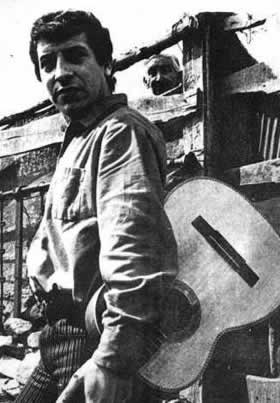
1934: Marinus van der Lubbe, for the Reichstag fire

On this date in 1934, Dutch bricklayer Marinus van der Lubbe was beheaded by guillotine in Leipzig for setting the Reichstag Fire.

A watershed event* in the formation of the Nazi dictatorship, the Reichstag fire days before a parliamentary election enabled Hitler to stampede voters, suspend civil liberties, suppress left-wing parties on grounds of a suspected Communist plot, and seize “emergency” powers he would never relinquish.
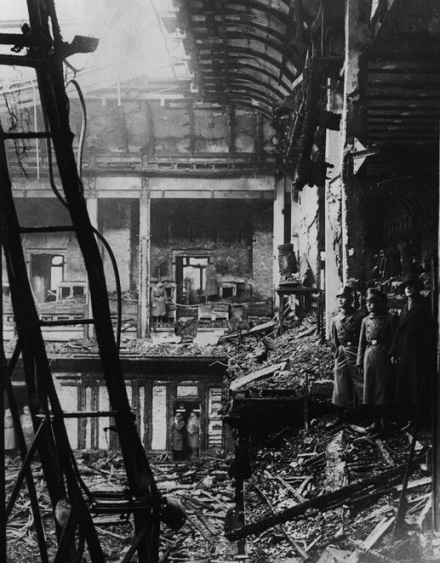
Heil Hitler.

This clip from an American miniseries on Hitler with the characters chattering in unaccented English portrays the fascists’ opportunistic use of the attack on a national symbol … something not exactly unknown to later generations.
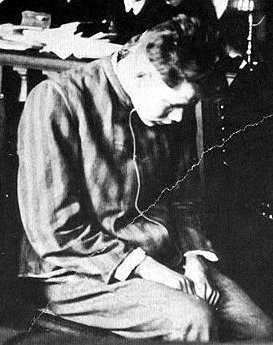
Van der Lubbe, who was arrested on the scene, suffered the predictable fate. Four other Communists charged as accomplices were acquitted, in a trial with the gratifying spectacle of Hermann Goering personally testifying, and being undressed on cross-examination by one of the reds. One is reminded here that Hitler did not yet have everything in the state apparatus at his beck and call … although he did have a great deal already, inasmuch as the arson law under which van der Lubbe died was passed after the Reichstag fire and made retroactive.

If the big-picture outcome of the Reichstag fire is pretty clear-cut, its real origin and the corresponding rightness of the judicial verdicts have remained murky ever since. The fact that the scene of the crime became Nazi ground zero for the next decade sort of obscures the evidence.

Van der Lubbe confessed, so his participation is generally taken as a given.

Whether he was really able to start the blaze acting alone, as he insisted, and the Nazis “only” exploited this fortuitous calamity; whether he was part of a larger leftist plot, as his prosecutors claimed; or whether, as Shirer and many others since have viewed him, he was a patsy in a false flag operation set up by the Nazis with an eye towards creating a politically advantageous national emergency — these possibilities remain very much up for debate.

For what it’s worth, postwar West German courts reversed and un-reversed the sentence before officially rehabilitating van der Lubbe last year on the non-specifically indisputable grounds that the legal machinery brought to bear on the Reichstag fire “enabled breaches of basic conceptions of justice.”

* From Defying Hitler: A Memoir by a writer who would soon emigrate:

I do not see that one can blame the majority of Germans who, in 1933, believed that the Reichstag fire was the work of the Communists. What one can blame them for, and what shows their terrible collective weakness of character … is that this settled the matter. With sheepish submissiveness, the German people accepted that, as a result of the fire, each one of them lost what little personal freedom and dignity was guaranteed by the constitution, as though it followed as a necessary consequence. If the Communists had burned down the Reichstag, it was perfectly in order that the government took “decisive measures”!

Next morning I discussed these matters with a few other Referendars. All of them were very interested in the question of who had committed the crime, and more than one of them hinted that they had doubts about the official version; but none of them saw anything out of the ordinary in the fact that, from now on, one’s telephone would be tapped, one’s letters opened, and one’s desk might be broken into. “I consider it a personal insult,” I said, “that I should be prevented from reading whichever newspaper I wish, because allegedly a Communist set light to the Reichstag. Don’t you?” One of them cheerfully and harmlessly said, “No. Why should I? Did you read Forwards and The Red Flag up to now?”

On this day..

1937: Masao Sudo, since rehabilitated

On this date in 1937, Japanese emigre Masao Sudo was shot in Moscow as a spy.

The executed man’s son, Dr. Mikhail Masaovich Sudo.

A true-red Communist who had fled increasingly right-wing Japan in the 1920’s and become a labor organizer in the far east, Sudo shared the tragic fate of the Japanese community in Stalin’s USSR, decimated by denunciations of one another.

Sudo was the father of Russian geologist Mikhail Masaovich Sudo, author of several abstruse texts (and also, it would appear, Japanese language primers for Russian speakers) — and under whom, apparently, you can take classes at the International Independent University of Environmental and Political Sciences.

Masao Sudo was rehabilitated in 1956.

On this day..

1871: Eight Cuban medical students

On this date in 1871, eight first-year medical students, aged 16 to 19, were shot in Havana Place de la Punta by Spanish colonial authorities in one of the most notorious episodes of that island’s independence struggle.

Cuba was three years into the Ten Years’ War, the first of three major 19th century insurrections that would eventually throw off Spanish rule, but popular support for independence was far from universal.

This book is the English translation of the classic Cuban text written by their schoolmate.

A vocal pro-Spanish element opposed the rebels to the extent of mobilizing right-wing volunteer goon squads to rough up demonstrators and menace the government into dealing with them only at bayonet-point … proto-brownshirts, albeit from a more well-heeled class position.

Mostly middle- or upper-class peninsulares, they were able by sheer force of numbers to cow [liberally inclined Captain-General Domingo] Dulce into acceptance of their views … Their journal, La Voz de Cuba, accused Dulce of working for the rebels …

The volunteers were a foretaste of those twentieth century lower middle-class mobs of young men who often protest violently against the end of empire. Shouting Viva Espana! in the Villanueva Theatre, foreshadowing the pieds noirs of Algeria, they bridge the gap between Carlism and Fascism. (Cuba, Or, The Pursuit of Freedom by Hugh Thomas)

The Volunteers would make themselves felt this day.

The editor of that Volunteer paper La Voz de Cuba was assassinated in 1870. The fatal accusation against the students was that they had desecrated the grave of that editor.

In Cuba in 1871, vandalism with the wrong politics was good enough to get you shot … four days after the supposed crime. In that environment, it’s practically beside the point that one of the eight wasn’t even in town at the time and the “desecration” was so exaggerated (the link is a Spanish backgrounder) as to be essentially fabricated.

The procedural rigging dignified with the word “trial” wasn’t going to get hung up on that detail, but it was also on the verge of an acquittal or a light sentence when a Caribbean Brooks Brothers riot steamrolled it (Spanish again) into sentencing eight to death and most of the others to significant prison terms.

Defense attorney Frederico Capdevila alone distinguished himself (more Spanish) at this circus with an indignant and energetic defense, despite being attacked at one point by the Volunteer mob. At its appalling conclusion, he drew his sword and theatrically broke it over his knee — a gesture of contempt for the military tribunal that cost him his military career and made his reputation to posterity.

Radical writer Jose Marti, 18 years old at the time of this execution, summoned the image frequently and helped raise 27 Noviembre de 1871 into an enduring emblem of the worst of colonialism.

Che Guevara would say of the martyrs, “El Ășnico delito era el de ser cubano” — “Their only crime was to be Cuban.”

On this day..

1887: Parsons, Spies, Fischer and Engel, the Haymarket Martyrs

On this date in 1887, the Chicago political machine hanged four at Cook County Jail to defend civilization from the eight-hour day.

The Haymarket martyrs, as they would be remembered ere the hysterical atmosphere of their sentencing had passed, were four from a group of eight anarchist agitators rounded up when a never-identified person threw a bomb at Chicago police breaking up a peaceful rally. The bomb killed one cop; the indiscriminate police shooting that followed killed several more in friendly fire, plus an uncertain number of civilians.

The incident occurred just days after nationwide strikes began on May 1, 1886, in support of the eight-hour day. Nowhere were the tensions greater than Chicago, an epicenter of militant organizing. When tens of thousands poured into the streets on May 1, the Chicago Mail darkly said of high-profile radicals Albert Parsons and August Spies,

Mark them for today. Hold them responsible for any trouble that occurs. Make an example of them if trouble does occur.

Sure enough …

Most of the eight hadn’t even been present at the time the bomb was thrown, but the state put anarchism itself on trial under the capacious umbrella of “conspiracy,” in a proceeding so absurdly rigged that a relative of a slain cop was on the jury. Quoth the prosecutor,

Law is upon trial. Anarchy is on trial. These men have been selected, picked out by the grand jury and indicted because they were leaders. They are no more guilty than the thousand who follow them. Gentlemen of the jury; convict these men, make examples of them, hang them and save our institutions, our society.

That was the argument for hanging them. And right-thinking burghers applauded it.

Seven of the eight were condemned to die; two had their sentences commuted, but the other five refused to ask for clemency on the grounds that, innocent, they would “demand either liberty or death.” One of those five, Louis Lingg, painfully cheated the hangman by setting off a blasting cap in his mouth the night before his execution. (Lingg might have made, though seemingly not thrown, the mysterious bomb.)

The others — Parsons and Spies, along with Adolph Fischer and George Engel — hanged together, with their epitaphs upon their lips — literally so for Parsons, whose parting remark is at the base of the Haymarket Martyrs Monument*

“The time will come when our silence will be more powerful than the voices you are throttling today.”

“Throttle” was right, as the Chicago Tribune reported the next day, taking up when the trap was sprung:

Then begins a scene of horror that freezes the blood. The loosely-adjusted nooses remain behind the left ear and do not slip to the back of the neck. Not a single neck is broken, and the horrors of a death by strangulation begin.

Six years later, Illinois Gov. John Altgeld granted the free pardon the hanged men had demanded to the three surviving Haymarket anarchists. There is no institutional mechanism to determine erroneous executions in American jurisprudence — a fact that occasionally leads to smugly circular avowals that nobody recently executed has ever been “proven” innocent — and death penalty researchers Michael Radelet and Hugo Bedau believed as of this 1998 paper (pdf) that Altgeld’s executive statement flatly asserting the injustice of the Haymarket convictions was the most recent official acknowledgment of a wrongful execution in U.S. history. If true, its uniqueness would be understandable: the gesture cost Altgeld his political career.

Long gone as all these principals are, the legacy of Haymarket remains very much with us, and not just as a magnet for digital archives like this, this and this (don’t miss the brass gallows pin).

May 1, now rich with the symbolism of the Haymarket Passion, was soon selected by the international labor movement as the date to resume the eight-hour-day push — thus becoming the global workers’ holiday it remains to this day.

* Opposing interpretations of the Haymarket affair — which can be the “Haymarket riot” or the “Haymarket massacre,” depending on where you line up — were marked by opposing memorials. The police memorial was itself eventually bombed by the Weather Underground, and subsequently squirreled away from easy public view. Paradoxically, the Haymarket Martyrs Monument has been federally dignified as a National Historic Landmark.

On this day..

1943: 98 American civilian contractors on Wake Island

On this date in 1943, after Japanese-occupied Wake Island was subjected to a withering bombardment from the United States Navy, garrison commander Shigematsu Sakaibara ordered the summary execution of 98 American prisoners of war.

Wake Island came under Japanese attack immediately after the bombing of Pearl Harbor raised the curtain on the Pacific theater — and was overrun in two weeks.

It was strategically situated halfway between Hawaii and the Philippines. That’s why the Japanese wanted it — and that’s why the Americans wanted it back.

Caught in the middle were 1,600-plus Americans captured when Wake fell in December 1941, 1,100 of them civilian contractors of construction conglomerate Morrison Knudsen there to build a naval base. Most of these, and all military personnel, were shipped to POW camps in China early in 1941; only 700 contractors would survive their four-year sojourn in Japanese captivity.

By September 1942, only 98 Americans remained* on Wake Island — all contractors, the last remnants of the prison labor force who had been forced to lattice the island with defensive fortifications against the expected American invasion.

U.S. forces bombed Wake Island repeatedly during World War II — rare respites from the monotony of forced labor — but the most intense attack was an orchestrated naval bombardment and aerial attack beginning Oct. 5. Shigematsu Sakaibara feared it was the prelude to a long-anticipated landing attempt. And he wasn’t the only one: reporting the attack, the New York Times tried to read the tea leaves of the official pronouncements:

The fact that Wake was attacked yesterday by surface bombardment as well as aeriel bombing probably indicates that a major reduction of Wake is now intended. The atoll, which is the closest Japanese base to Pearl Harbor with the exception of a few islands in the Marshalls group, is a key stepping stone on Japan’s fastest aeriel route to her other central Pacific possessions in the Marshalls and Gilberts southwest of Hawaii.

Still,

[o]ccupation by United States forces of Wake Island, which is 1,033 miles from Midway, has been predicted for some time, but there is no indication that such an operation is probable immediately.

Sakaibara, unfortunately, didn’t have a Times subscription.

Expecting a landing, and fearing the prisoners would rise up as a “fifth column” against their captors when it came, Sakaibara had the 98 prisoners machine-gunned en masse on the beach. One of them managed to survive and escape the slaughter, but was recaptured shortly after, and is supposed to have been personally beheaded by the admiral. It’s said that unidentified man carved a (misdated) testimony to the crime on a nearby coral rock known as “98 Rock”: “98 US PW 5-10-43”.

As it turned out, the landing never did come. The U.S. Navy bypassed Wake Island, allowing it to languish under a blockade as it advanced elsewhere in the Pacific, and received Sakaibara’s peaceful surrender after the bombings of Hiroshima and Nagasaki.

Although the Japanese had hastily exhumed the murdered POWs and reburied them in a cemetery as the end of the war approached, the cover story on the “Wake Island Massacre” soon cracked. For this day’s affair, Sakaibara was convicted of war crimes by an American tribunal, and hanged in Guam on June 18, 1947.

* The identities of the 98 are known, and are listed online here as well as on a plaque at the site.

On this day..

1973: Victor Jara, among thousands in Chile’s September 11

At an unknown time on this evening in 1973, or else the early hours of the following day, Chilean putschists ushering in the Pinochet dictatorship machine-gunned folk singer Victor Jara near the Santiago stadium that today bears his name.

“I don’t see why we need to stand idly by and let a country go communist due to the irresponsibility of its own people,” said Henry Kissinger of Allende’s election. Victor Jara had another idea.

Four days before, Chile’s September 11 had seen General Augusto Pinochet topple the elected leftist government of Salvador Allende, murdering the president in his palace. (Or, go some accounts, Allende committed suicide — “pausing only twice to reload.”)

A long pall of evil settled over the country, with all the accustomed chilling familiars: “disappeared” people, mirrored shades, Jeane Kirkpatrick.

The day after the CIA-backed coup, popular folk singer and activist Victor Jara, a pioneer of the Nueva Cancion (“New Song” movement) then teaching at Santiago’s Technical University, was among thousands of undesirables rounded up and packed off to a makeshift prison camp at the city’s Chile Stadium — a stadium Jara had performed at.*

Left there to the tender mercies of a thuggish Chilean officer, Jara was beaten and tortured over the intervening days — evocative but possibly undependable tradition holds that the guitarist’s hands were cut off, shattered or otherwise destroyed. According to the U.S.-based United States Institute of Peace,

[t]he the last day Víctor Jara was seen alive was September 15. During the afternoon he was taken out of a line of prisoners who were being transferred to the National Stadium. In the early morning of the next day, September 16, shantytown dwellers found his body, along with five others, including that of Littré Quiroga Carvajal, near the Metropolitan Cemetery. As the autopsy report states, Víctor Jara died as a result of multiple bullet wounds (44 entry wounds and 32 exit wounds).

The Commission came to the conviction that he was executed without due process of law by government agents, and hence in violation of his fundamental human rights.

To say the least.

And as the text implies, Jara was only the most recognizable name among unknown hundreds killed as the military cemented its control of the country.

Jara remains larger-than-life martyr figure in Latin America and liberation movements worldwide, but he’s almost unknown north of the Rio Grande. Pinochet was our bastard; in the weird way history writes its own geography, Jara became a political emblem behind the Iron Curtain for the perfidy of the capitalist powers: obscure in Peoria, but a household name in Potsdam, as the credit roll from this 1978 East German film suggests.**

That’s Jara himself on the soundtrack, of course. The pat conclusion for such a figure is that his art is his legacy, and that Jara’s body of work as against Pinochet’s will be a walkover in posterity. Is that enough? Pinochet died in his bed at age 91; earlier this year, the Jara case was closed in underwhelming fashion. Thirty-five years down the road, most authors of Pinochet’s human rights depredations are dead or lost or decrepit. Justice delayed is justice denied.

Victor’s widow, Joan Jara — today director of the Fundacion Victor Jara (it’s a Spanish-only site); you can hear her interviewed on Democracy Now! for the 25th anniversary of her husband’s death in 1998 — managed to leave the country with some of his works.

Her publication of a poem he wrote while imprisoned, an untitled, unfinished work generally known as “Estadio Chile,” made it a signature cry of hope amid desperation. Here it is in the Spanish rough-hewn under the shadow of death; there’s an English translation here.

Somos cinco mil
en esta pequena parte de la ciudad.
Somos cinco mil
¿Cuantos seremos en total
en las ciudades de todo el pais?
Solo aqui, diez mil manos que sembran
y hacen andar las fabricas.

¡Cuanta humanidad
con hambre, frio, panico, dolor
presion moral, terror y locura!

…¡Y Mexico, Cuba y el mundo?
¡Que gritan esta ignomonia!

Somos diez mil manos menos
que no producen.
¿Cuanto somos en toda la Patria?
La sangre del companero Presidente
golpea mas fuerte que bombas y metrallas.
Asi golpeara nuestro puno nuevamente.

¡Canto que mal me sales
cuando tengo que cantar espanto!
Espanto como el que vivo
como el que muero, espanto.

De verme entre tanto y tantos
momentos de infinito
en que el silencio y el grito
son las metas de este canto.
Lo que veo nunca vi,
lo que he sentido y lo que siento
hara brotar el momento…

Whether or not it’s enough, his work is his legacy after all.

* Some 7,000 people were held at Chile Stadium in the days after the coup, most later moved in with other detainees at the larger Estadio Nacional. The USIP excerpt alludes to Jara being pulled out for execution during such a move.

** In a similar vein, Stanford has a small online exhibit of Jara-themed East German propaganda art. Not to be outdone, there’s a Soviet rock opera about Jara, and an asteroid discovered by a Soviet astronomer was named in Jara’s honor within a week of his execution.

On this day..

1794: The last cart of the Terror, not including the Marquis de Sade

July 27th, 1794 — the 9th of Thermidor, year II — is inscribed in history as the day Robespierre fell, when a parliamentary coup d’etat between the right and the remnants of the parties he had destroyed shouted him down as he readied the National Convention for his next purge.

This scene from the multinational bicentennial epic La Revolution Francaise conflates the events of 8 Thermidor — when Robespierre delivered a menacing two-hour address but provoked outcries by failing to name the deputies he implicated in “conspiracy” — and 9 Thermidor, when Robespierre’s lieutenant Saint-Just was shouted down from the podium and Robespierre ended up staggering through the benches appealing against the imprecations of his colleagues as his arrest is decreed.

Even as the month of Thermidor’s eponymous epochal event was unfolding, the daily gears of Revolutionary justice were turning: the usual haul of unfortunates condemned, including seven women from the previous day’s batch of Saint Lazare prison conspirators who had pled their bellies to buy a day.

That day was one day too little.

Stanley Loomis is overtly hostile to the Revolution, but his middlebrow sensibilities are well-tuned for the pathos of the scene:

Indifferent to the storms that were raging in the Convention, the Revolutionary Tribunal continued to go about its implacable business with cold efficiency. The arrest of its President [the Robespierrist Rene-Francois Dumas (the link is French), who was taken in the courtroom] startled no one. Since its inception that court had been witness to too many dramas to be astonished any further. Dumas quietly departed; the trials continued. Forty-two prisoners were sentenced to death. By four o’clock their hair had been cut and they were ready to be sent on their way. But Samson, aware of disturbances in the St. Antoine quarter of the city, suggested to [prosecutor] Fouquier[-Tinville] that the executions be deferred until the morrow.*

“Justice must take its course,” snapped the Public Prosecutor. “Do your work.”

And so the last “batch” lumbered off in the direction of the Faubourg St. Antoine and the Place de la Nation. With the exception of the Princesse de Monaco, they were nearly all obscure and humble members of the petite bourgeoisie. Hanriot, waving his sabre, conducted the procession to the place of execution. By seven o’clock that evening, as the minutes of the military escort poignantly show, the unfortunate victims, who had been so close to deliverance, had all been executed.

Henriot proceeded directly from his escort service to the Convention to liberate Robespierre for the night’s brief pitched battle against the Convention, and here we take our leave of them, for now. We shall meet both of them on the scaffold tomorrow.

Not on the wagon** with the Princess of Monaco was a man whom Loomis would have pitied rather less.

The bloated, penniless 54-year-old fruit of an ancient noble house, Donatien Alphonse François de Sade, Marquis de Sade had, in the most recent chapter of his astounding career, navigated the Revolution in the improbable guise of a proletarian section head and revolutionary tribunal judge, until his own arrest late the previous year.

This day, de Sade’s name was on a list of prisoners to be seized from Madelonnettes Prison — “Sade, former count, captain of Capet’s guards in 1792, has corresponded with enemies of the republic,” it said — which he had occupied until a recent transfer to Picpus, a monastery converted into a prison adjacent to the guillotine’s place at the Place de la Nation. Whether the result of another of the many bureaucratic snafus we’ve witnessed this week or a well-placed bribe from his friend and/or mistress Marie-Constance Quesnet, the guards were in the wrong place, didn’t find him, and didn’t care to dig any further.

Three months later, he was — for the last time in his life — a free man.

One could hardly say that the Revolution made the author of Justine the man he so (in)famously was — but having lived within sight of the blade that might any day be called upon to chop off his own head, and the entire tableau of the years preceding, left their impression. Hundreds of bodies from the Terror were stuffed in the unpropitious clay of the makeshift jail’s yards under de Sade’s cell. “Those few months in the shadow of the guillotine did me more harm than all the years of my incarceration under the King,” he wrote a friend.

According to Writing the Orgy: Power and Parody in Sade, Revolutionary France would inexorably influence his subsequent work,

strangely mixing real memories with very Sadean embellishments … Plots, betrayals, denunciations, beheadings: these fictional motifs and Sadean phantasies are linked with the reality and the imaginary of the Revolution.

Good for what ails you.

* Sanson’s diaries — a memoir of the family business constructed by the famous executioner’s grandson — leave off before the events of Thermidor and suggest that the hecatombs of the Terror were taking their toll on the aging headsman. Other accounts of this day have the tumbrils stopped in the streets by clemency-inclined onlookers, only to be forcibly extricated by Henriot.

** Also not (really) on the cart: the fictional occultist Zanoni, who is beheaded in this batch in the novel of the same title by legendary awful writer Edward George “it was a dark and stormy night” Bulwer-Lytton.

Part of the Themed Set: Thermidor.

On this day..

1794: Loizerolles and others for the Conspiracy of the Prisons

On this date in 1794, the Jacobin government struck what would prove to be its last blow against the “Conspiracy of the Prisons.”

The “conspiracy” was really a cover story for Robespierre‘s boys to wield their purifying torch against prisons and (of course) tighten the grip of authority by wild reference to treasonable plots abroad.

Supposedly, the prisons had birthed a scheme to effect a mass escape further to some sort of counterrevolutionary insurrection, or assassination of Robespierre. Marvelously, these conspiracies simultaneously spanned most all of Paris’ prisons, and their “authors” formed a dominant demographic among the Terror’s last tumbrils as the authorities purged each prison in turn.

While we have tarried to profile select victims individually this week, we have in fact repeatedly met so-called prison conspirators.

Luxembourg Prison — whose warders had concocted the earlier “conspiracy” involving Camille Desmoulins’ wife — had been purged repeatedly earlier in the month; its last spasm swept up the Noailles women.

An efficient detour to the Carmelite Monastery converted by revolutionary Paris into another gaol netted Alexandre de Beauharnais.

And the first batch of St. Lazare Prison felled Andre Chenier, where, as elsewhere, dozens were punished for some impressively villainous designs.

Being convicted of having declared themselves the enemies of the republic, by keeping up communications with the enemies of the state; by furnishing them with assistance; by participating in the plots, conspiracies, and assassinations of the tyrant and his wife, against the people; by conspiring in the maison d’arret (lock-up house), called Lazare, to escape, and to dissolve, by the assassination and murder of the representatives of the people, and more especially of the members of the committees of public safety and general security, the republican government, and to re-establish royality; — in fine, by wishing to destroy the unity and indivisibility of the republic.

(The march of the penal inquisitors through the plots is covered in a French Wikipedia page.)

Charles-Louis Muller’s 19th century painting of the Saint Lazare Prison “conspirators” being summoned to their doom. Seated in the center is Andre Chenier.

Each of these famous figures is a noticeable face among dozens of hapless wretches, largely drawn from the Third Estate and often laughably implausible escape artists and assassins — such as, among this day’s victims, an 80-year-old priest. The most poignant fate among the many forgotten threads threads of life clipped short is undoubtedly one Jean Simon Loizerolles, who was imprisoned with his son.

On the 7th Thermidor, about four o’clock, p.m., the bailiff of the tribunal presented himself at the prison with the mortuary list, or, in other words, the death-warrant.

Loizerolles was called for: it was Loizerolles, junior, whom death surrounded. Loizerolles, the father, did not hesitate to present himself; and, comparing his sixty-one years to the twenty-two years of his son, he determined to give him life a second time: the father went down, and was conducted to the Conciergerie.

He there received the bill of accusation, drawn up by order of the Committee of Public Safety, and headed Prison Conspiracy.

This bill bore the name of Loizerolles, junior.

The next day the father appeared for examination, with his twenty-five companions of misfortune.

The bill of accusation, which was joined to the depositions, stated that it was Francois Simon Loizerolles, junior, aged twenty-two.

The declaration of the sentence, prepared in anticipation upon the bill, bore the same designations. The recorder contented himself with effacing the name of Francois, and putting above it Jean.

Finally, the questions submitted, for the sake of form, to the jury, and drawn up in anticipation upon the same bill of accusation, contained the names and the designation mentioned in the accusation. But, at the time of the trial, when the charge was made to the jury, Coffinhal took care to efface the name of Francois, to substitute that of Jean, and to erase te word son, which was replaced by the word father. He rudely altered the two figures from twenty-two to sixty-one, and added the former profession of the father, which the accusation did not state.

And Jean Simon Loizerolles, against whom there was no accusation, was put to death on the 8th Thermidor.

Loizerolles is renowned for nothing in life save the touching valor of his death, but his name was a watchword for paternal devotion in France in the 19th century; Jadin wrote a short opera to his honor, and Victor Hugo references Loizerolles (bizarrely side by side with Robespierre’s younger brother) in Les Miserables as the sort of paragon of loyalty disdained by a gauche skeptic. But the gambit worked: Loizerolles junior survived the last days of the Terror, and was later pensioned by Charles X.

For every triumph, there were countless tragedies. The prisoners had wind of the enterprise to decimate their number days before; an anonymous account printed here (also the source of the Loizerolles story) describes a ramping-up of abuses great and petty in an effort to provoke a rising that would license a bloodbath, and the fear and desperation of the prisoners as death circled them.

Our melancholy and dejected hearts prepared themselves for death. The prison appeared surrounded by a funeral veil, and the death-like silence which pervaded it produced a dreadful feeling of misery in its inmates. Games and amusements were banished from the grounds, and our cadaverous countenances afforded an index of our afflicted souls; the refectory, which was wont to inspire a sentiment of cheerfulness, became a meeting of moving spectres, who quitted each other without exchanging a word.

The prisoners at St. Lazare could no longer indulge in illusions on the fate that awaited them … old age and infancy had ceased to be respected; all were alike condemned as guilty of the project of escape; and the man who was the most harmless and the most devoted to his country was no longer exempt from accusation.

But there was a small favor: a third repetition of the scene was postponed two days, which turned out to be all the difference between life and death.

[T]he Robespierrists, delighted in perpetuating our terrors, announced that the tragic scene would be renewed on the 10th.

The two days which we passed in anticipation of our destiny were two days of unmitigated agony: a general mourning reigned through our asylum; our eyes, in fancy, beheld on all sides the palpitating and struggling bodies of the victims of Robespierre, and of the villainy of his agents; tranquility quite abandoned us; death was hovering over our heads; and the prison appeared, to our diseased fancies, like a sea of blood, on which we had suffered shipwreck …

In this deplorable situation we saw no end to our sorrows but in death; and, however terrifying the grim visitant may naturally be, yet we deemed his arrival too long delayed, and invoked his coming, while we regretted that we had not been of the number of the first victims. When, about ten o’clock, p.m., of the 9th Thermidor, it was reported in the prison, that Robespierre was formally accused, the news, which had been brought by three new prisoners from without, inspired distrust, and savoured too much of the miraculous to be easily believed.

The following morning … the information was confirmed … in such a positive and circumstantial manner that we could no longer entertain a doubt of its truth.

It may easily be conceived how sudden was the change which was effected in the prison of St. Lazare: the prisoners began, for the irst time, since the 5th, to breathe more freely; their hearts, which had been so long cast down, received a fresh inspiration; their countenances cleared up; the full use of their suspended faculties was restored; and the images of death, which had affrighted them, were dissipated; and if they could have forgotten the assassination of their companions, they might have entirely lost the recollection of their misfortunes.

The death of Robespierre, and the close of his dark crimes, were the subject of an epigram, which an individual wrote upon the wall; it describes the monster too accurately, not to find a place here:

Il s’abreuva du sang d’un million de victimes, —
Il parla de vertus, et commit tous les crimes.

A thousand victims slaked his thirst for blood,–
He spoke of virtues while he swam in crimes.

Part of the Themed Set: Thermidor.

On this day..

1822: The audacious Denmark Vesey

On this date in 1822, white South Carolinians hanged the most terrifying slave insurrectionary who never rose — and breathed a sigh of relief as they clamped the shackles ever tighter upon their groaning servile class.

Inspired by slave revolts shaking the Caribbean, the Denmark Vesey plot was the South’s worst nightmare: Nat Turner, multiplied by about nine thousand.

That’s the size of the slave and free black network Vesey is said to have recruited — ready to undertake a coordinated uprising to seize Charleston, slaughter the white populace, and possibly then to sail for a Haiti whose own slave revolt had recently established it a black-governed republic. The mind boggles at such a scheme’s bravado … but in an age when horseshoes and mizzenmasts could outrun information, Vesey’s plot could have been past any prospect of obstruction before anyone in a position to obstruct it even knew what happened. Had they not flown but defended Charleston, the event would have ignited a conflagration to outshine every other slave uprising.

The weak point, of course, were those 9,000 — or however many — slaves who had to act ruthlessly and in unison, and keep their peace until they struck. It is incredible enough that such a secret kept among so many for up to four years.

The plot finally leaked mere days before it was to have been attempted when a middling player attempted the unnecessary freelance recruitment of a house slave — a class Vesey had intentionally (and rightly, events would prove) excluded for dangerously excessive personal loyalty to their masters’ families.*

Melancholy Dane

A well-educated and well-traveled man on account of his years as the personal property of a slaver — Joseph Vesey, who bequeathed his purchase both a surname and the given name Telemaque, subsequently corrupted into “Denmark” by Charlestonians — the plot’s signature hero/villain had managed to purchase his freedom and establish himself in the anomalous position of free black artisan/entrepreneur in the slaveholding South.

His successful carpentry business (apt choice, for a martyr) had given him the prestige and the werewithal to start an independent African Methodist Episcopal church where he poured out a hatred of chattel slavery undiminished by his own liberty.

For several years before he disclosed his intentions to any one, he appears to have been constantly and assiduously engaged in endeavoring to imbitter [sic] the minds of the colored population against the whites. He rendered himself perfectly familiar with those parts of the Scriptures which he could use to show that slavery was contrary to the laws of God; that slaves were bound to attempt their emancipation, however shocking and bloody might be the consequences … (Source)

His judges were later incredulous that he’d be so hung up about it:

It is difficult to imagine, what infatuation could have prompted you to attempt an enterprise so wild and visionary. You were a free man, comely, wealthy, and enjoyed every comfort compatible with your situation. You had, therefore, much to risk and little to gain.

An American Spartacus?

Denmark Vesey blurs into myth as he approaches his end, together with lieutenants: among them, Peter Poyas, the organizational maven of the operation who was hanged along with Vesey and four others; and Gullah Jack, an African priest among the 29 more who would die in the weeks ahead.

Most of the principals held their tongues before interrogators; the tribunals were held secretly; their records were censored against the apprehension by other slaves of the potential for such designs as “a bottle with poison to put into my master’s pump & into as many pumps he could about town.”

But there was enough known to shatter forever any illusion of paternal congeniality more liberal masters might have fancied. One planter was incredulous that his agreeable charge might be involved in such nefarious doings until he asked the man directly and was astonished to hear from his trusted coachman’s lips the frank intention “to kill you, rip open your belly and throw your guts in your face.” (Both quotes are from this book review.)

Whites were scared. “I have never heard in my life, of more deep laid plots or plots more likely to succeed,” wrote Anna Haynes Johnson, niece to Gov. Thomas Bennett. (Source) Another concluded that “our NEGROES are truly the Jacobins of the country.” (Source)

But as initial panic (and federal troop deployments) gave way to a more pervasive undertow of security paranoia, the affair was self-consciously downplayed and records intentionally destroyed for fear that too-careful documentation of its particulars could map the way for a revival. An 1861 piece in The Atlantic — an excellent read on the progress of the conspiracy — grapples with what was even then a gaping evidentiary vacuum.

The intense avidity which at first grasped at every incident of the great insurrectionary plot was succeeded by a distaste for the memory of the tale; and the official reports which told what slaves had once planned and dared have now come to be among the rarest of American historical documents. In 1841, a friend of the writer, then visiting South Carolina, heard from her hostess for the first time the events which are recounted here. On asking to see the reports of the trials, she was cautiously told that the only copy in the house, after being carefully kept for years under lock and key, had been burnt at last, lest it should reach the dangerous eyes of the slaves. The same thing had happened, it was added, in many other families. This partially accounts for the great difficulty now to be found in obtaining a single copy of either publication; and this is why, to the readers of American history, Denmark Vesey and Peter Poyas have been heretofore but the shadows of names.

Antebellum September 11

Even as a nonstarter, the insurrection was an antebellum 9/11 that spurred a reactionary crackdown on perceived liberalities in the system — most vividly symbolized by the construction of the fortress that became the still-extant military academy The Citadel, but more systematically impinging blacks’ everyday freedom to assemble and worship, and even requiring (until the Supreme Court overruled the law) free black sailors be detained whenever a northern ship called at port. Pro-slavery southerners blamed open disapprobation for slavery voiced in Congress during the recent Missouri Compromise wrangling, and even similar sentiments expressed in the British parliament, for emboldening the terrorists.

All this yielded a rich political harvest from the fruit of the gallows — like Charleston mayor James “there is nothing they are bad enough to do, that we are not powerful enough to punish” Hamilton, who rode his timely suppression of the plot to Congress later that year.

Such political profiteering, combined with the sketchiness of primary sources, has licensed a revisionist take on the orthodox history — that there was never any conspiracy, but that reactionary white elites concocted the plot from a tissue of loose liberation talk, false confessions, and latent white fear in order to win political power. This contested minority interpretation has been a recent topic of academic dispute, since Michael P. Johnson floated it in 2001 (an account is required to read Johnson’s original essay; here’s a synoptic article that appeared subsequently in The Nation).

Markers of historiography around these competing versions of Vesey, bearing directly on the question current in today’s Charleston of whether and how to memorialize this episode, are ripe with controversial modern-day implications.

Consider: if Vesey is a rebel indeed, the silence of (most of) the plotters is a noble acceptance of torture to protect their confederates; if they’re framed, they’re silent because there’s nothing to confess. Either way, the modern reader’s sympathies are likely to lie with the blacks, but Johnson’s interpretation removes the locus of action from them to white elites. If he’s right, would that derogate an entire narrative of black resistance to slavery, drain the martyrdom from their deaths? Or would it correct an overstated romantic mythology of armed resistance, and color this day’s hanging with a different heroism: refusing to purchase their lives with a false accusation?

* For his timely betrayal, Peter Desverneys received his liberty and a state pension; he later became a slaveholder himself. See Black Slaveowners.

On this day..

1766: Jean-François de la Barre, freethinker martyr

On this date in 1766, a 20-year-old French chevalier’s freethinking proclivities got him beheaded and burned for impiety in one of Bourbon France’s most notorious episodes of religious chauvanism.

Check that date again. This is 69 years after the British Isles’ last execution for blasphemy; Voltaire was alive, and already in his dotage — and the fact that young Chevalier de la Barre was reading him was proclaimed as evidence. Such a benighted proceeding with the French Revolution on the horizon calls Dickens to mind:

it was the epoch of belief, it was the epoch of incredulity,
it was the season of Light, it was the season of Darkness

The luckless youth and a couple of friends had pissed off a local judge, which got ugly for them when the unexplained vandalism of a town crucifix availed the opportunity for the magistrate to wield a sledgehammer against a fly.

De la Barre’s volume of Voltaire was tossed onto the pyre with him. That Enlightenment colossus made a measured posthumous effort at having the boy rehabilitated* — primarily for the benefit of his more judicious friend, who had fled the country and required his death sentence in absentia be lifted in order to inherit the family estate — but the verdict was not set aside until the French Revolution, a few months after the end of the Terror.

France’s overall secular trajectory since has rendered this date a sort of national freethinkers’ holiday, Chevalier de la Barre Day. A statue of its namesake stands in Paris’ Montmarte:

* Voltaire’s writings on the case in the original French are collected by the Association Le Chevalier de la Barre here.

On this day..