1416: Jerome of Prague, the first Hussite martyr

On this date in 1416, the Council of Constance had Jerome of Prague burned at the stake in the town square.

This eloquent, injudicious theologian studied at Prague, Oxford, Paris, Cologne, Heidelberg … accumulating Master’s degrees along the way like a career graduate student, but repeatedly finding himself run off the premises on suspicion of heresy.

Jerome’s “heresy” was an excessively combative hostility to ecclesiastical corruption. And although Jerome was known for his rapier tongue, he didn’t always find the pen mightier than the sword: he got into a few physical scraps with his foes.

While in England, he copied out a manuscript of preacher John Wycliffe — whose radical piety (or pious radicalism) inspired the rebellious Lollard movement.

Back on the continent, Jerome fell in with Jan Hus. Ten years Jerome’s senior, Hus was and remains the first name in Bohemian religious reform, and the “Hussite” church he founded still retains his name.

After Hus unwisely accepted a guarantee of safe conduct to dispute at the Council of Constance, the more ornery Jerome slipped into town to propagandize on his mentor’s behalf. After placarding his way to trouble, he slipped back out and must have thought he’d had his cake and eaten it too … until he was caught in the Black Forest.

Jerome spent nearly a full year in a dungeon — the Council met for four years; it had a massive schism to sort out — and at one point the privations of imprisonment led him recant. He later bitterly regretted that concession to “pusillanimity of mind and fear of death,” but on a strictly doctrinal level Jerome of Prague wasn’t anti-Catholic: he just wanted the church to be less of a bunch of corrupt, overweening racketeers.

By the time he was ready to answer for himself, and his soul, he was well past any spirit of capitulation. A witness to the procedure wrote of Jerome on trial for his life:

I have never seen any one, who, in pleading, especially in a capital offence, approached nearer the eloquence of the ancients, whom we so greatly admire. It was so amazing to see with what fluency of language, what force of expression, what arguments, what looks and tones of voice, with what eloquence, he answered his adversaries and finally closed his defence. It was impossible not to feel grieved, that so noble, so transcendent a genius had turned aside to heretical studies, if indeed the charges brought against him are true.

When that part of his indictment was read in which he is accused of being “a defamer of the papal dignity, an opposer of the Roman pontiff, an enemy of the cardinals, a persecutor of the prelates and clergy, and a despiser of the Christian religion,” he arose, and with outstretched hands and with lamenting tones, exclaimed: “Whither now, conscript Fathers, shall I turn myself? Whose aid can I implore? Whom supplicate, whom entreat for help? Shall I turn to you? Your minds have been fatally alienated from me by my persecutors, when they pronounced me an enemy of all mankind, even of those by whom I am to be judged. They supposed, should the accusations which they had conjured up against me, seem trivial, — you would, by your decisions, not fail to crush the common enemy and opposer of all, — such as I had been held up to view, in their false representations. If, therefore, you rely upon their words there is no longer any ground for me to hope.”

Some of them he wrung hard by the sallies of his wit; while others he overwhelmed with biting sarcasms; and from many, even in the midst of sadness, he forced frequent smiles, by the ridicule which he heaped upon their accusations.

At length, launching out in praise of John Huss who had been condemned to the fire, he pronounced him a good, just, and holy man, altogether unworthy of such a death, — adding that he was also prepared to undergo, with fortitude and constancy, any punishment whatsoever, yielding himself up to his enemies and the impudent lying witnesses, “who would, at length, have to give an account of all they had uttered, before God, whom they could not possibly deceive.” Great was the grief of all that stood around him. Thee was a universal desire among them to save so noble a personage, could his own consent be obtained. Persevering, however, in his opinions, he seemed voluntarily toseek death; and continuing his praise of John Huss, he declared that man had never conceived any hostility to the church of God; but that it was to the abuses of the clergy, and the pride, pageantry and insolence of her prelates alone he felt opposed; for, since the patrimony of the church was due, in the first place, to her poor; then to her guests; and finally to her on workshops; it seemed to that good man, a shameful thing, to have it expended upon courtezans and in banquets; for the sustenance of horses and dogs, the adornment of garments and other things unworthy of the religion of Christ.

Most exalted was the genius of which he showed himself possessed! Often was he interrupted in his discourse by various noises; and greatly vexed by those who carped at his opinions; yet he left none of them untouched, but equally avenging himself upon all, he either covered them with confusion, or else compelled them to hold their peace. A murmur arising against him, he paused for a moment; and then, having admonished the crowd, proceeded with his defence, — praying and beseeching them to suffer one to speak whom they would soon hear no more. At none of the noise and commotion around him did he tremble, or lose, for a single instant, the firmness and the intrepidity of his mind.

“You will condemn me iniquitously and unjustly,” he prophesied to his judges, “and when I am dead, I shall leave remorse in your consciences and a dagger in your hearts; and soon, within a hundred years, — you will all have to answer me, in the presence of a Judge most high and perfectly just.”

Reports differ as to the subsequent standing of all these men’s souls. But for the church as a going earthly concern, Jerome nailed it almost exactly: 101 years after he followed Jan Hus to the stake,* that long-suppressed spirit of reform irrevocably splintered papal authority.

* In the very same spot where Hus himself was burnt.

On this day..

1945: Sigmund Rascher, feared science

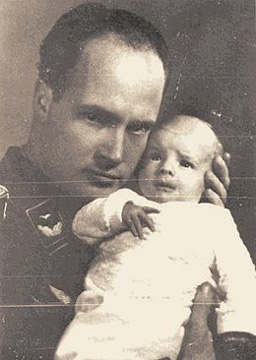
It’s on this date in 1945 that Sigmund Rascher is supposed to have been summarily executed in Dachau.

If that’s what happened, it’s no more than Rascher (English Wikipedia page | German) deserved.

This doctor made his Nazi bones by forging a relationship with Heinrich Himmler (he married Himmler’s ex-mistress), and joining Himmler’s SS.

Rascher was doing cancer-cure experiments on animals, but once he had Himmler in his Rolodex he graduated to research on homo sapiens.

From 1941 to 1944, Rascher conducted some of the textbook ethical trespasses of Berlin’s human experimentation regime, using Dachau prisoners in:

  • high-altitude experiments to help fighter pilots, tested by subjecting prisoners to rapid de- and re-pressurization;
  • freezing experiments, tested by subjecting prisoners to freezing water or outdoor exposure, and then attempting by various methods to restore body warmth;
  • blood clotting experiments, tested by giving prisoners major gunshot wounds or other grievous bodily injuries, then monitoring how well a new drug slowed the bleeding.

Class act all the way. Rascher did publish some papers and deliver some conference presentations on aspects of his horrifying science, but in one of those little contradictions of the evil security state, the man was foiled in his bid for an advanced academic credential because much of the research was too secret for his peers to review.

In the end it was a much more mundane breach of ethics that did him in: Rascher and wife were arrested in 1944 for having actually kidnapped the children they claimed were their own.

They were stashed away in separate camps. For unclear reasons — perhaps because Rascher connected all this atrocious research back to Himmler, who was vainly trying to cut a peace deal with the West at this point, or maybe simply because Himmler was annoyed at the embarrassment his protege’s misconduct had given him — the bad doctor was summarily shot in his cell as the Allies bore down on Dachau.

(We will note in passing this argument, and this, disputing that story as well as this execution date. Executed Today is not in a position to contribute to that conversation.)


Elsewhere …


Caption: Polish and Russian forced laborers shot by the SS after they had collapsed from exhaustion during a death march. Wisenfeld, Germany, April 26, 1945.

— National Archives and Records Administration, College Park, Md. Via the U.S. Holocaust Memorial Museum

From the Themed Set: The Death Rattle of the Third Reich.

On this day..

1945: Wilhelm Cauer, but not Helmuth Weidling

On this date in 1945, the brilliant scientist Wilhelm Cauer was summarily executed by Red Army soldiers advancing into besieged Berlin.

Cauer hailed from a rich lineage of academics.

Although his career prospects in Nazi Germany were ultimately limited owing to that lineage’s kinship to Frederick the Great’s Jewish banker, they were not so limited that he was not able to become a university professor and one of the founding figures in the field of engineering network synthesis filters. The elliptical filter is known as the “Cauer filter” in his honor.*

By the end of World War II, he was, like millions of less-distinguished countrymen and -women, merely a person in the way of a terrible conflagration.

Cauer succeeded in evacuating his family west, where the American and not the Soviet army would overtake it — but for reasons unclear he then returned himself to Berlin. His son Emil remembered (pdf) the sad result.

The last time I saw my father was two days before the American Forces occupied the small town of Witzenhausen in Hesse, about 30 km from Gottingen. We children were staying there with relatives in order to protect us from air raids. Because rail travel was already impossible, my father was using a bicycle. Military Police was patrolling the streets stopping people and checking their documents. By that time, all men over 16 were forbidden to leave towns without a permit, and on the mere suspicion of being deserters, many were hung summarily in the market places. Given this atmosphere of terror and the terrible outrages which Germans had inflicted on the peoples of the Soviet Union, I passionately tried to persuade my father to hide rather than return to Berlin, since it was understandable that the Red Army would take its revenge. But he decided to go back, perhaps out of solidarity with his colleagues still in Berlin, or just due to his sense of duty, or out of sheer determination to carry out what he had decided to do.

Seven months after the ending of that war, my mother succeeded in reaching Berlin and found the ruins of our house in a southern suburb of the city. None of the neighbors knew about my father’s fate. But someone gave identification papers to my mother which were found in a garden of the neighborhood. The track led to a mass grave with eight bodies where my mother could identify her husband and another man who used to live in our house. By April 22, 1945, the Red Army had crossed the city limits of Berlin at several points. Although he was a civilian and not a member of the Nazi Party, my father and other civilians were executed by soldiers of the Red Army. The people who witnessed the executions were taken into Soviet captivity, and it was not possible to obtain details of the exact circumstances of my father’s death.

Cauer’s name was actually on a list of scientists the Soviets were looking to recruit, not eliminate. Presumably he and those other civilians who shared his nameless grave fell foul of the occupying army in some incidental way and were shot out of hand in the fog of war.


By contrast, April 22 was the lucky day for Wehrmacht General Helmuth Weidling.

Weidling had been forced by overwhelming Russian power to withdraw from a position and an enraged Hitler ordered him summarily shot.**

Fortunately, it was not effected so “summarily” that Weidling wasn’t able to get his side of the story in and have the execution order revoked. Lucky Helmuth was within hours, uh, “promoted” to commander of the Berlin Defence Area, which is supposed to have led him to remark, “I’d rather be shot than have this honour.”

This was not to be his fate.

Instead, after a week’s overseeing the suicidal exertions of his underaged, underarmed Volkssturm militia, it fell to Weidling on May 2 to issue the order directing remaining garrisons in Berlin to lay down their arms.

On April 30, 1945, the Führer committed suicide, and thus abandoned those who had sworn loyalty to him. According to the Führer’s order, you German soldiers would have had to go on fighting for Berlin despite the fact that our ammunition has run out and despite the general situation which makes our further resistance meaningless. I order the immediate cessation of resistance.

The devastated Berlin of the Soviet encirclement was Weidling’s last glimpse of his homeland: he was flown to the USSR as a prisoner of war and died there in captivity in 1955.

* Also working against the big brain’s career path in academia: “few people could appreciate the vast potential of Cauer’s special field of work … for mathematicians, he seemed too involved in applied sciences, and for electrical engineers his contributions included too much mathematics.” These days, Cauer’s disciplined application of mathematical principles to the field of network filtering is precisely what he’s remembered for.

** This was a notably bad day for der Fuhrer: it was also on April 22 when the impotence of the German army’s remaining shreds caused him to launch into that bunker tirade that has spawned a thousand Internet parodies.

From the Themed Set: The Death Rattle of the Third Reich.

On this day..

1956: Jesus Maria de Galindez

(Thanks to Meaghan Good of the Charley Project for the guest post. -ed.)

On this date in 1956 or very shortly thereafter, Jesus Maria de Galindez was probably executed in the Dominican Republic.

Jesus Maria de Galindez

The previous day, he had vanished without a trace from New York City. According to unconfirmed but highly credible accounts, he was killed on orders from — and in the presence of — Dominican dictator Rafael Leonidas Trujillo.

Galindez’s disappearance caused an international incident. It was covered in numerous newspapers and periodicals, including Time and Life, and was the subject of much speculation and many conspiracy theories. In spite of an extensive search, his body has never been found. The case has remained in memory into the 21st century, however, as this 2001 New York Press article demonstrates.

Who was Galindez?

Born in Spain in 1915, he was a political activist, a committed anti-fascist and Basque nationalist. As a result, he ran into trouble with Spain’s dictator, Francisco Franco, and had to run for his life.

In 1939, Galindez set up shop in the Dominican Republic, only to find fascism polluting this country as well. He had to run again in 1946, this time to New York City.

While working on his Ph.D in political science from Columbia University, Galindez found the time to teach college classes, write a newspaper column which was syndicated throughout Latin America, and represent the Basque government-in-exile. He was a busy man.

He was also very afraid, and with good reason. Like most despots, Rafael Trujillo held grudges for a long, long time, and his henchmen kidnapped and/or killed many of his enemies, even those outside the country. One of Galindez’s friends was killed by Trujillo’s agents in Manhattan in 1952.

Galindez then wrote a letter to be opened in the event of his death or disappearance, stating that if he should come to harm, Trujillo was surely behind it.

On March 12, 1956, Galindez taught a class at Columbia and a student gave him a lift to the subway. This was the last time he was seen alive. When he was reported missing five days later, all his belongings were found undisturbed in his apartment. The FBI and the New York Police Department searched for him without result.

According to an investigation by Life magazine, which published its conclusions in 1957, Trujillo’s agents forcibly abducted Galindez on March 12, drugged him and bundled him aboard a small private plane piloted by an American, Gerald Murphy.

Early in the morning on March 13, Murphy stopped in Miami for fuel, then continued southward, stopping at Monte Cristi in the Dominican Republic. From there another pilot, Octavio de la Maza, took over. De la Maza was a tough character who had already committed one murder, in England. He flew Galindez to Ciudad Trujillo. Galindez was then shot to death in Rafael Trujillo’s presence and buried.

The Dominican government tried to buy off Murphy with a plum job as a flight captain, but pretty soon he started blabbing about his mysterious plane trip and its passenger, whom he’d at first thought was a wealthy invalid.

Pilot Octavio de la Maza: mopped up.

Thus was a second assassination necessary to cover the first: in December 1956, Murphy vanished without a trace in the Dominican Republic, only days before he was due to fly home to America. His body was never found. Now, his co-pilot had to be silenced, and a very neat job it was too: Octavio de la Maza was arrested and charged with Murphy’s murder. He had just enough time to get his parents out of the country before the ax fell, but never came to trial because he was found hanged in his cell in January … conveniently leaving a full confession in writing: Murphy had hit on him, and De la Maza lost his temper and pushed him off a cliff.

The world smelled a rat. Trujillo, of course, denied everything and went so far as to hire an American lawyer, Morris Ernst, to conduct his own investigation into Galindez’s disappearance. After ten months, Ernst issued a report predictably exonerating his employer. He claimed Galindez had stolen money earmarked for the cause of Basque Nationalism and simply walked out of his life.

And there the matter rests.

No charges were brought against anyone in Galindez’s disappearance. Columbia awarded him his Ph.D in absentia and his thesis, published as The Era of Trujillo, became a bestseller throughout Latin America.

What goes around comes around: Trujillo was himself assassinated in 1961. One of the men who plotted his murder was Antonio de la Maza, Octavio’s brother.

On this day..

1801: Chevalier, bomb plot scapegoat

On this date in 1801, a Jacobin chemist was wrongly executed for Royalists’ plot against Napoleon.

Our scene is France, the year following Napoleon’s coup of 18th Brumaire (November 9, 1799 on the stodgy old Gregorian calendar). Marx’s “first time as tragedy”* saw the Corsican achieve monarch-esque power, and the months ensuing saw a plethora of plots against him.

The ranks of aggrieved potential assassins included both Jacobins, incensed at the military dictatorship, and Bourbons, incensed that it wasn’t their dictatorship — in both cases exacerbated by Napoleon’s decisive battlefield triumphs which consolidated his hold on power.

On Christmas Eve 1800, the man on horseback was a man in a carriage, careening through Paris to catch a performance of Haydn’s oratorio The Creation.

When, all of a sudden, a gigantic explosion on the Rue Saint-Nicaise attempted to un-create the First Consul. It failed, exploding after Napoleon had passed and before Josephine’s family followed, “merely” killing and maiming fifty-some miscellaneous Parisian bystanders instead.


Kablamo! The explosion of the Infernal Machine.

The Catherine Delors historical novel For the King (author’s teaser) is built around investigating the Plot of the Rue Saint-Nicaise.

“Every one,” wrote Sir Walter Scott,

shocked with the wild atrocity of such a reckless plot, became, while they execrated the perpetrators, attached in proportion to the object of their cruelty. A disappointed conspiracy always adds strength to the government against which it is directed; and Buonaparte did not fail to push this advantage to the uttermost.

This “Infernal Machine” had actually been built by disgruntled monarchists at the instigation of intriguer Georges Cadoudal, as was swiftly discerned by Napoleon’s Minister of Police, the ruthless ex-revolutionary Joseph Fouche.

Realpolitik exigencies — Napoleon was trying (unsuccessfully) to reach political terms with the royalist faction — instead drove a rush to pin the detonation on the Jacobins.

Who, it should be said, made themselves the primary suspects by virtue of the fact that they’d also been trying to blow up Napoleon. Chevalier had been arrested a couple of months before when a bomb of his, evidently an experiment for a similar Jacobin plot, loudly blew up near Salpetriere.

Four other Jacobins followed Chevalier to death later in January (and two royalists actually involved in the bomb got the same treatment). Some 130 other prominent Jacobins (French link) were expelled on Napoleon’s say-so — no legislative consultation — to the empire’s far-flung colonies, pretty much putting the remains of the long-supine revolutionary left permanently out of the picture as a political force.

* See the 18th Brumaire; the “second time as farce” also came with its own history-repeating-itself executions.

On this day..

1937: Martemyan Ryutin, for his affair

On this date in 1937, Martemyan Ryutin was condemned to death and immediately executed in Stalinist USSR.

Ryutin (English Wikipedia entry | Russian | another Russian bio) was a revolutionary from the Far East who by the late 1920s was in the Bolsheviks’ heretical right wing; his affiliation with Bukharin and Rykov got him temporarily booted out of the Communist party in 1930.

Not content to keep his head safely down as Stalin’s star ascended, Ryutin typed out an anti-Stalin pamphlet and the 200-page “Ryutin Platform” denouncing Josef Djugashvili as “the gravedigger of the Revolution” and urging that he be removed — even by force.*

Weeks after Ryutin began circulating this incendiary samizdat the secret police busted him.

Though open discussion of the so-called Ryutin Affair was nonexistent in the Soviet Union until the Gorbachev era, it was a matter of dire importance for the Politburo in 1932; indeed, fleeting as it was, it’s one of the few organized elite attempts to thwart Stalin discernible during the 1930s. Stalin wanted Ryutin executed, but he was outvoted; this is a small milepost on the way to the Yezhovschina indicating that Stalin’s power still had its limits … and Bolsheviks still recoiled at the prospect of killing other party members.** These constraints were not very long for the scene.

Even so, Ryutin got a 10-year prison sentence and anyone else who had read the Ryutin platform without informing on it to the Party was in seriously hot water. Twenty-four were expelled from the party in October 1932 for this reason, including once-proud and soon-doomed Old Bolsheviks Zinoviev and Kamenev.

Ryutin, for his part, had only a few years to wait before the deteriorating political climate dispensed with those taboos about internecine bloodletting. The Supreme Court signed off on his execution this day with just a few minutes’ hearing, and it was immediately carried out.

Ryutin’s two sons were also executed in 1937, and his wife died in a labor camp. Only his daughter Lyubov survived the Ryutin Affair — which convictions were posthumously reversed in 1988.

* Bukharin’s widow later wrote that Stalin’s agents later added the most inflammatory material — like that violent overthrow stuff.

** Had Stalin had his way in 1932, Ryutin would have had the distinction of being the first Central Committee member to be executed, according to Suzi Weissman.

On this day..

1999: James Beathard, on the word of a known liar

(Thanks to Mary O’Grady for the guest post. -ed.)

Murder is not a common occurrence in Trinity County, Texas. The shotgunning of three members of the Hathorn family in their trailer home on the evening of October 9, 1984 remains notorious, even among locals who were not yet born on the date of the crime.

Clues scattered at the crime scene, African-American human hairs and Kool cigarette butts, were supposed to convince authorities that a certain sort of suspect had killed Gene Hathorn, Sr., his wife Linda Hathorn, and their teenaged son Marcus Hathorn. Mr. Hathorn’s recent receipt of a $150,000 property settlement and his recent disputes with his elder son, Gene Hathorn, Jr., led law enforcement in a different direction. Less than one month after the bodies were found, Gene Hathorn, Jr., and his running buddy James Lee Beathard faced charges of capital murder.

Prosecutors developed evidence that Gene Hathorn, Jr., hatched the plot to kill his family in order to inherit his father’s new wealth. It seems he was unaware that his father had formally disinherited him three weeks before he was murdered.

James Beathard was first to stand trial.

Called to the witness stand by District Attorney Joe Price, Gene Hathorn, Jr., testified against Beathard, to devastating effect. Hathorn claimed that Beathard entered the trailer, killed all three victims, and planted the false clues, while he himself fired only one shot through a window. Beathard was sent to death row.

When the younger Hathorn was brought to trial, District Attorney Price reversed his theory from Beathard’s trial, depicting Hathorn as the “inside man” and the strategist who believed he had concocted the perfect crime. Gene Hathorn, Jr., joined James Lee Beathard on Texas’s death row. Hathorn recanted his testimony against Beathard. No appeals court took notice.

In the mid-1980s, Texas’s male death row occupied part of the aging, red brick and steel Ellis I prison unit outside Huntsville. For prisoners such as James Beathard and Gene Hathorn who conformed themselves to the rules, a considerable amount of communication with other prisoners and with the outside world remained possible. Each of these sons of East Texas soon found himself editor of a death row periodical, the Lamp of Hope in Hathorn’s case and the Texas Death Row Journal for Beathard. Over the years, Beathard emerged as a prolific letter-writer and essayist, publishing a brief nonfiction piece describing life on death row in the British Guardian Weekly in August, 1996.

Beathard’s talent as a correspondent won him considerable sympathy during his fourteen years on death row. As they exchanged letters, American playwright Bruce Graham fictionalized Beathard in his short play, Coyote on a Fence.

James Beathard’s intelligence and powers of articulation were unusual among death row prisoners. Since he could be trusted to exit and re-enter his cell with no fuss and to refrain from blithering forth psychotic delusions, he was sometimes trotted out when prison authorities needed a condemned man to meet the press.

James Beathard’s appeals ran out at last in 1999. He was executed, still protesting his innocence, on December 9th of that year.

His partner in crime, Gene Hathorn, Jr., won an appeal in 2009 based on his trial attorney’s failure to introduce evidence of his father’s abuse of him in childhood. He is now serving consecutive life sentences, reportedly working as a prison cook in general population.

On this day..

1938: Corneliu Codreanu, Romanian fascist martyr

“In place of the weak and beaten man who bends with every breeze, a man who is all too common in politics and other fields, we must create for this nation a man who does not bend, who is inflexible.”

-Corneliu Codreanu

On this date in 1938, 14 political prisoners of the Romanian Legionary movement were extrajudicially executed — including Corneliu Codreanu, one of the Romanian right’s leading spirits.

The son of a Bukovina schoolteacher in what was then Austria-Hungary, Codreanu came to political maturity in the interwar heyday of Greater Romania. It was a moment of national aspiration — the Romanian state had never before grown so large — but it was abutted by the great threats of Germany and Russia, and haunted by nationalism, economic crisis, shaken political authority, and all the other spooks conjured by the first World War.

For Codreanu as for many at that time it was the stage for a blood-and-soil death struggle against Communist agitators and sinister Jewish financiers.

But his vision was an intensely positive one as well: a valiant new Romania founded by a courageous new man, honorable and true to the virtues of the nation’s noble peasant stock. “We shall create,” Codreanu declared, “a spiritual atmosphere, a moral atmosphere, in which the heroic man may be born and on which he can thrive.”

Codreanu’s vehicle for stamping out these heroic countrymen was the Legion of the Archangel Michael* which our principal founded in 1927. Named for God’s ass-kickingest enforcer, this movement/militia was not above creating its spiritual atmosphere with political assassinations by adherents widely noted for a willingness to die for the cause.

Later known as the Iron Guard, the Legion, in the view of German historian Ernst Nolte, “plainly appears to be the most interesting and the most complex fascist movement, because like geological formations of superimposed layers it presents at once both prefascist and radically fascist characteristics.” (Qutoed here.)

As his Legion’s name suggested, Codreanu was intently religious — virtually a mystic, and a messianic Romanian Orthodox Christianity was essential to his new Romania. His movement took root in a peasant society, not an industrial state with a revolutionary working class to crush or co-opt. Rather, it organized in opposition to a mediocre king and a feckless, heavily non-Romanian oligarchy which maintained its enervating grip on the nation with “endless appeals to the Fatherland which it does not love, to God in whom it does not believe, to the Church where it never sets foot, to the Army which it sends to war with empty hands.”*

And also to the police, which clapped Codreanu and his confederates in prison after the revolutionaries declined the elite incumbents’ offer of political collaboration.

In 1938, Codreanu was hit with a long prison sentence for sedition. Uncowed, the Legion grew ever more overtly aggressive when Nazi Germany successfully dismembered Czechoslovakia; Berlin made the Legions plainly aware that it saw their movement as Romania’s future, German-allied government. Futilely maneuvering for his own scope of action, Carol attempted to decapitate the Iron Guard by having its imprisoned leadership “shot while trying to escape” on this date.

This did not turn out to help the king. Codreanu’s movement traded stripe for stripe with its foes; within two years, Carol had been forced to abdicate and the Iron Guard helped govern (albeit with tension) a fascist state.

The contemporary Romanian right aggressively reclaimed Capitanul, “the Captain”, after the fall of communism. Codreanu is now revered among not only among Romanian nationalists but in fascism’s wider populist Strasserite tradition. (Gregor Strasser, who liked the socialist part of national socialism too much for Hitler’s taste, was among those murdered on Nazi Germany’s Night of the Long Knives.)

* Eugen Weber in Varieties of Fascism, quoted by Anthony James Joes in “Fascism: The Past and the Future,” Comparative Political Studies, April 1974

On this day..

1793: Jean-Sylvain Bailly, moonstruck

See Bailly, likewise of Paris, time-honoured Historian of Astronomy Ancient and Modern. Poor Bailly, how thy serenely beautiful Philosophising, with its soft moonshiny clearness and thinness, ends in foul thick confusion — of Presidency, Mayorship, diplomatic Officiality, rabid Triviality, and the throat of everlasting Darkness! Far was it to descend from the heavenly Galaxy to the Drapeau Rouge: beside that fatal dung-heap, on that last hell-day, thou must ‘tremble,’ though only with cold, ‘de froid.’ Speculation is not practice: to be weak is not so miserable; but to be weaker than our task. Wo the day when they mounted thee, a peaceable pedestrian, on that wild Hippogriff of a Democracy; which, spurning the firm earth, nay lashing at the very stars, no yet known Astolpho could have ridden!

Carlyle

On this date in 1793, French astronomer turned revolutionary Jean-Sylvain Bailly was guillotined during the Paris Terror.

Bailly ditched a family trade in the arts — his father was a supervisor at the Louvre — and turned his gaze skyward.

Studying astronomy under Lacaille, Bailly made a quick splash in astronomical circles with meticulous work on Halley’s Comet and the moons of Jupiter. He was inducted into the French Academy of Sciences while still in his twenties. Not quite the guy every schoolchild knows, but a significant scientist in his time. As one twentieth-century reviewer put it,*

Bailly was not a great thinker or the discoverer of new concepts; no case can be made for placing his name beside those of Newton, Leibnitz, and Laplace. But he should not be denied a niche among the numerous competent and persevering work-a-day scientists who, perhaps, in the long run make possible the achievements of a few great men. His observations and reductions, his application of a mathematical discipline to the movements of the heavenly bodies, and his detailed publications had brought him, by 1766, considerable credit among fellow scientists.

His “considerable credit” in the public sphere, enhanced by his widely-admired writing, set him up for election to the Estates-General in 1789. Indeed, Bailly was elected to head the body’s Third Estate.

On June 20th of that pregnant year, days after the Estates-General had constituted itself a National Assembly with ambitions far outstripping the limited purpose of revenue collection the king intended them for, Louis XVI locked the delegates out of their meeting-room.

Bailly, in consequence, would lead one of the pivotal actions of the embryonic French Revolution. “I do not need to tell you in what a grievous situation the Assembly finds itself,” he said to the assembly reconvened at a nearby tennis court. “I propose that we deliberate on what action to take under such tumultuous circumstances.” The result of that deliberation was the Tennis Court Oath.


Detail view (click for the full image) of Jean-Sylvain Bailly administering the Tennis Court Oath, in Jacques-Louis David‘s sketch of the event.

When the Paris provost — an archaic municipal office — was shot by the mob on Bastille Day, Bailly became the City of Light’s first mayor.

But as with other principals of the Revolution’s earliest stirrings, like Bailly’s ally Lafayette, the man was left behind by the rapid progress of events. He’d been two years retired out of public service in Nantes when he was hailed before the Revolutionary Tribunal on the preposterous charge of having conspired in Louis XVI’s attempted flight and guillotined on that basis.

A lunar crater — the largest crater visible from earth — is appropriately named after this prolific observer of the heavens.

* Edwin Burrows Smith, Transactions of the American Philosophical Society, New Series, Vol. 44, No. 4 (1954).

On this day..

1449: Ulugh Beg, astronomer prince

On this date in 1449, Timurid sultan and astronomer Ulugh Beg was beheaded at the order of his son.


Ulugh Beg and his famous astronomical observatory, depicted on a Soviet stamp.

Grandson of the conqueror Timur (Tamerlane), Ulugh Beg had hitched along on some of those legendary military campaigns.

As power passed to Ulugh Beg’s father Shah Rukh, our man settled in as governor of the silk road city of Samarkand, in modern Uzbekistan — and turned it into an intellectual capital of the empire.

A great patron of the sciences, Ulugh Beg was a brilliant astronomer in his own right, nailing NASA-quality precise calculations of heavenly bodies’ positions and the revolutions of the earth a century ahead of the likes of Copernicus.

An inscription on the madrasah he erected summed up the city’s philosophy under its philosopher-prince: “Pursuit of knowledge is the duty of each follower of Islam, man and woman.”

Wedding scientific genius to political power enabled Ulugh Beg to build a great observatory in Samarkand. Though this structure unfortunately did not outlive Ulugh Beg himself, it made Samarkand the world’s astronomical capital in the 1420s and 1430s.

But the flip side of wedding scientific genius to political power was that the guy had to govern — which wasn’t his strong suit. Within two years of his father’s 1447 death, Ulugh Beg had been overthrown by his own son* and summarily beheaded.

* The son became known as “Padarkush”, meaning “parricide” … and appropriately, he was overthrown by his own cousin within months.

On this day..