1911: Shusui Kotoku and ten other anarchists

A century ago today, eleven Japanese anarchists were hanged for plotting the assassination of the Emperor.

Radical journalist Shusui Kotoku challenged Meiji Japan from the insurrectionary anarchist left.

A socialist early on — he helped translate The Communist Manifesto into Japanese — Kotoku turned towards anarchism when he read Kropotkin while serving time for opposing the Russo-Japanese War. He “had gone [to jail] as a Marxian Socialist,” he said, “and returned as a radical Anarchist.”

After his release, and a trip to America which had just birthed the anarcho-syndicalist Industrial Workers of the World, Kotoku returned to Japan as his nation’s patriarch of anarchism.*

All of this, naturally, drew a Sarah Palin-sized targetsurveyors’ symbol on Kotoku’s back.

So, when police uncovered an apparent plot by other radicals to off Emperor Meiji, and opportunistically used it to sweep up as fellow-travelers a nationwide “conspiracy” of twenty-plus alleged plotters, Kotoku was naturally one of the bad apples they were pleased to indict.**

The twelve ultimately doomed to death were slated to receive their judicially appointed sanctions on this occasion, just six days after conviction. (The rest of the anarchist movement was harshly suppressed in the years ahead.)

Among the most noteworthy of these Japanese Saccos and Vanzettis:

The first eleven (all men) took so long that the twelfth doomed soul, Suga Kanno — Kotoku’s lover and a genuine bomb-plot participant, who enjoys the distinction of being the only woman her country ever hanged for treason — had her execution put off to the 25th for want of daylight.

Though he’s never been officially [judicially] exonerated, Kotoku’s native Nakamura voted in 2000 to declare his rehabilitation. A secret letter that surfaced only in 2010 appears to support that position.

* Shusui Kotoku in turn greatly influenced Chinese anarchism.

Some of Kotoku’s writing is available online in Japanese here.

** George Elison translated a Kotoku Shusui letter denying any interest in the anarchist assassination racket. It appears as “Discussion of Violent Revolution, From a Jail Cell,” in the Vol. 22, No. 3/4 (1967) Monumenta Nipponica.

How is the anarchist revolution to be brought about if not by bomb-throwing attempts upon the life of the sovereign? The Japanese word for “revolution” — kakumei — is Chinese in origin. In China, the term was used to describe the process in which the emperor of dynasty A, receiving the Mandate of Heaven, replaced the emperor of dynasty B; so it signified mainly the change of emperors, the change of sovereigns. Our “revolution” has quite a different meaning. We do not place much value upon the mere transfer of power between potentates; we do not use the word “revolution” except to mean a fundamental change in the governmental system and in the organization of society.

… they who for the sake of universal peace and liberty participate in this revolution must endeavor as best they can to avoid violence, to avoid producing victims to the revolution. For it seems that the great revolutions of the past were accompanied by much violence and required a great number of victims … I only hope for the disappearance of the misconception that the anarchist revolution has as its objective the assassination of the sovereign …

the prosecution and the examiners first put the title “Violent Revolution” to what I had said and contrived the stern-sounding phrase “death-defying band,” with other similar phrases. And I believe they condemned us under this syllogism: “The anarchist revolution is concerned with the destruction of the Imperial Family. But Kotoku’s plan was to carry out a revolution by violence. Therefore, all who were party to this plot planned to commit the crime of High Treason.” So the fact that these people used to discuss such things as direct action and the revolutionary movement has now served to get them into trouble! This I deeply regret.

On the other hand, Kotoku openly celebrated the assassination of Ito Hirobumi by a Korean nationalist.

Part of the Daily Double: The High Treason Incident.

On this day..

1209: The Oxford clerks

On an uncertain date speculatively identified with December 6, in either 1208 or (more usually attributed) 1209, the near-riotous townspeople of Oxford hanged two or three student “clerks” at that settlement’s famous university.

About this time, a certain clerk engaged in the liberal arts at Oxford killed a certain woman by accident and when he found that she was dead he decided to flee.

But when the mayor of the city and many others who had gathered found the dead woman they began to search for the killer in his house which he had rented together with three of his fellow clerks.

Not finding the man accused of the deed they seized his three fellow clerks who said they were wholly ignorant of the murder and threw them into prison; then a few days later they were, by order of the King of the English, in contempt of the rights of the church, taken outside the city and hanged.

When the deed had been done, both masters and pupils, to the number of three thousand clerks, left Oxford so that not one remained out of the whole university; they left Oxford empty, some engaging in liberal studies at Cambridge and some at Reading.

The Flowers of History, as translated for the Beeb

This ugly affair rooted in the ancient conflict between university and town caused much of the ancient academy‘s student population to flee town — some proceeding to found Oxford’s rival institution Cambridge. (This pdf short story on the Cambridge site dramatizes events.)

The conflict between the town and university at Oxford over this bloodletting persisted until 1214 when a Papal legate settled the dispute in favor of the university.

The authors of the hanging were required to carry the bodies to an honorable resting place, and the town was required to host a dinner for poor students once every year — on St. Nicholas‘s day, Dec. 6, which on that basis has become associated with the otherwise never-specified date of the unfortunate clerks’ demise.

On this day..

1674: The Chevalier de Rohan and Franciscus van den Enden

On this date in 1674, the former Grand Huntsman of France was beheaded in Paris for conspiring to betray Normandy during the Franco-Dutch War.

Your basic debt-mired noble and court cad, the Chevalier de Rohan (French Wikipedia link) through an accomplice “intimated that Normandy was very much dispos’d to a revolt, & that if hee would send a fleet with 6 thousand men, & armes for twenty thousand, with necessaries for sieges & two million of livres, that there was a greate man who would engage himself upon the assurance of thirty thousand crownes pension …”

The correspondence was discovered and Rohan arrested, but his role in the plot was sufficiently anonymized that even an absolutist state didn’t have the goods to convict him. Meanwhile, Rohan’s accomplice was hunted to ground and killed in Rouen during the attempt to arrest him.

This left the authorities in the position, common to every cop show and not a few real-life cases, of requiring a confession from the accused to proceed at all. Rohan’s friends realized this too, and tried desperately to warn him against self-incrimination.

Persons attached to the chevalier de Rohan went every evening round the Bastile, crying through a speaking trumpet, “La Tuanderie is dead, and has said nothing;” but the chevalier did not hear them. The commissioners, not being able to get any thing from him, told him, “that the king knew all, that they had proofs, but only wished for his own confession, and that they were authorized to promise him pardon if he would declare the truth.” The chevalier, too credulous, confessed the whole. Then the perfidious commissioners changed their language. They said, “that with respect to the pardon, they could not answer for it: but that they had hopes of obtaining it, and would go and solicit it.” This they troubled themselves very little about; and condemned the criminal to lose his head. He was conducted on a platform to the scaffold, by means of a gallery raised to the height of the window of the armoury in the arsenal, which looks towards the little square at the end of the Rue des Tournelles. He was beheaded on November 27, 1674.

It is hoped that, should the reader ever become a person of police interest, s/he will recall from Rohan’s example that inspectors do not have suspects’ best interests in mind.

A couple of other nobles also lost their heads along with our chevalier.

Hanged for his trouble was Franciscus van den Enden (English Wikipedia page | Dutch), the elderly Dutchman — and accused Dutch agent — who recruited these toffs for the purpose of seizing Le Havre.

Van den Enden is an interesting, perhaps underappreciated, radical intellectual of secular-democratic persuasion (he attracted the suspicion of atheism, and his Vrye Politijke Stellingen made an unabashed case for democratic government). He’s best known for being a schoolmaster of philosopher Baruch Spinoza; W.N.A. Klever, in an October 1991 paper in the Journal of the History of Philosophy (“A New Source of Spinozism: Franciscus Van den Enden”) traces the connections between the philosophy of the master and that of the pupil and rather dramatically argues that

Van den Enden must be considered as a kind of “Proto-Spinoza.” … He was the hidden agent behind Spinoza’s genius … [t]he origin of Spinoza’s anomalous philosophy.

A variety of (untranslated) references to the “Proto-Spinoza” from 17th century correspondence are available here.

Those inclined more towards geopolitics than philosophy might enjoy Victor Magagna’s podcast lecture on the great-power calculus driving France’s conflict with the Netherlands — which, as we have noticed in these pages, claimed the life of the longtime Dutch leader Johan de Witt.

On this day..

1793: Philippe Egalite, hoisted on his own petard

On this date in 1793, Philippe Egalite was hoisted on his own petard.

To hoist with one’s own petard actually has an older derivation, dating to siege warfare engineers whose primitive bombs, petards, were liable to detonate unexpectedly and gave their makers a “hoist.”

Still, the phrase sounds like something that ought to come right out of the French Revolution, redolent (as are petards themselves: the explosive word is from the French “to fart”) of angry mobs hoisting aristocrats, as was their wont, up on pikestaffs and lampposts and … petards. Whatever those are.

Philippe Egalite — the Duke of Orleans, as he was known for most of his life — was such an aristocrat: in fact he was royalty, the First Prince of the Blood and a cousin to Louis XVI.

And he was the member of the royal house who most vibed on the revolutionary spirit of the times, literally bankrolling the Jacobins before the Revolution. Hilary Mantel* notes that Orleans made the Palais Royal “into a sort of demagogue’s shopping centre — Paris’s most volatile public space, crammed with cafés and bookshops, a gathering place for the disaffected. In July 1789, three days of orchestrated violence began there, and culminated in the taking of the Bastille.”

Now that is a petard.

Philippe’s class-traitor politics obviously exposed him to the wrath of the monarchists — a particular irony since the man’s son Louis-Philippe, was France’s last king from 1830 to 1848 — but as usual in Paris during the Terror, it was the the Revolution devouring its children that did him in.

Despite taking up during the Revolution the very Republican name Egalite by which we know him, and despite Egalite‘s vote in the Convention in favor of guillotining Louis XVI (this is sometimes described with more melodrama than accuracy as the “decisive” vote), and despite his many years’ prior revolutionary sympathy, the Duke of Orleans was rounded up with the rest of the available Bourbons when the French General Dumouriez‘s spring 1793 defection prompted a panicky revolutionary purge in Paris. Philippe’s own son, the future king, had gone over with Dumouriez to the Austrians.

Rosebud

The Duc d’Orleans employed Choderlos de Laclos, author of the notoriously delicious Dangerous Liaisons.

As an individual citizen turned politician turned guillotinee, Egalite doesn’t much stand out in those perilous years: one more vulnerable Convention delegate outmaneuvered by Robespierre et al.

As the Daddy Warbucks of the Rights of Man, however, Egalite was a titanic figure for his contemporaries. Not many held him in high personal esteem, but movements need moneybags, and the Prince of the Blood bankrolled his from the bottomless revenues he earned on estates that would dwarf entire departements.

The Duke of Orleans and those around him, according to George Armstrong Kelly in “The Machine of the Duc D’Orléans and the New Politics” (The Journal of Modern History, Dec. 1979)

invented something novel in the history of French politics: the massive use of wealth, research, and propaganda** for the purpose of forming public opinion and swaying public policy. No doubt there are analogues among the Romans and the eighteenth-century English; but here we are almost reminded of the Rockefellers and Kennedys.

Orleans was accused of generating all this mayhem to make his own bid for the throne; those accusations may even hold a bit of truth. Such machinations remain for the conspiratorial among posterity a shadow-play upon the wall; one is left to guess at their potential dimensions from shreds of evidence and the vying vituperations of various contemporary revolutionary factions.

But if extant, such schemes were fatally compromised by the mediocrity of the figurehead who lost his head this day. Though a revolutionary in his philosophy, he was still a doughy Bourbon scion in his soul, and heir to the many shortcomings that characterized that dynasty in its decadence.

Dissolute in the enjoyment of privilege; irresolute in the conquest of power; blithely rearing wolves to his own destruction. That was some petard.


Philippe Egalite and his onetime lover Grace Elliott are the titular characters of the 2001 Eric Rohmer movie The Lady and the Duke.

* Hilary Mantel is the same author who penned the acclaimed historical novel Wolf Hall, about Thomas Cromwell.

** Kelly claims that Egalite funded Marat.

On this day..

1470: John Tiptoft, Butcher of England

On this date in 1470, cultured and bloodthirsty* English noble John Tiptoft, Earl of Worcester was beheaded at Tower Hill during the War of the Roses.

Tiptoft’s calling card says he’s one of England’s first Renaissance men — literally so, because after cutting his teeth at Oxford, he spent several years in Padua, Ferrara, Rome and Florence, brushing up on Latin and law.

Besides culture and erudition, Tiptoft is supposed to have picked up from his Italianate exposure a taste for that fragmented peninsula’s barbarous political jockeying.*

Back in Britain from the start of the 1460s, Worcester aligned with the Yorkists during the War of the Roses, and made liberal use in both England and Ireland of his continental savvy in matters of torture, earning that unflattering sobriquet Butcher.

Tiptoft gave them the material, exercising,” in his constabulary post, “more extreme crueltie (as the fame wet) then princely pity.” For instance, when putting down one revolt,

the Kynge Edwarde came to Southamptone, and commawndede the Erle of Worcetere to sitt and juge suche menne as were taken … and so xx. persones of gentylmen and yomenne were hangede, drawne, and quartered, and hedede; and after that thei hanged uppe by the leggys, and a stake made scharpe at bothe endes, whereof one ende was putt in att bottokys, and the other ende ther heddes were putt uppe one; for whiche the peple of the londe were gretely displesyd; and evere afterwarde the Erle of Worcestre was gretely behatede emonge the peple, for ther dysordinate dethe that he used, contrarye to the lawe of the londe.

Too bad for the gretely behatede Erle of Worcestre that this was an era when anyone‘s uppance could be coming at any time.

This last, well, butchery was effected against supporters of the Earl of Warwick, the “kingmaker” whose fluid alliances shaped the royal jostle in the mid-15th century.

And the trouble for Tiptoft was that Warwick’s 1470 revolt against Tiptoft’s ally and kin Edward IVworked. Okay, only temporarily, but it was long enough to do in John Tiptoft.

For a brief moment, the Yorkist cause waned and the Lancastrian waxed; during the brief moment, the Butcher of England was haled before the Lancastrian Earl of Oxford, a man who occupied that office because Tiptoft had executed his father and elder brother.

The wheel of fortune had turned. A massive, jeering crowd turned out to see Tiptoft de-topfed. He asked the executioner to do it in three strokes rather than one, in honor of the Trinity.


Prayerful: John Tiptoft’s tomb at Ely Cathedral. (He’s flanked by two of his three wives, one of whom is in the foreground.) Image used with permission.

Tiptoft [wrote Henry Pancoast] was the most learned man among the English nobility of his time … [he] reflects his age at its best and worst. He was set at a confluence of evil influences, when civil strife following the Hundred years War [sic] had debauched the English nobility. Abroad he came close to that Italy which Machiavelli called “the corrupter of the world.” Yet a new intellectual life was growing, and Tiptoft’s career alternates between scholarship and political intrigues. He shows us how early the new spirit was astir in England, and how it was retarded; is is the “butcher” and “the first fruits of the Italian Renaissance.”

You can explore a bit more about John Tiptoft in the first third of this BBC radio 4 program, with author Alison Weir. (Her Tudor books burn up the bestseller lists, but she’s also written about the War of the Roses.) Or, look up the Household of Worcester, a medieval re-enactment society that takes name and inspiration from our day’s butchered butcher.

* This supposed southern influence on our friend the Earl might well be true, but it also strikes this author as an answer in search of a question. It’s hardly necessary to posit foreign influence to explain brutality in 15th century England, nor to explain educated men with a taste for cruelty.

But Tiptoft’s “wanton ferocity,” says Pancoast, “brings to mind the Italian proverb, quoted by Ascham in proof of the brutalizing effect of Italy upon the English nature: Inglese Itilianato e un diabolo incarnato.”

Since oiled stakes up buttocks were no more characteristic of Italian jurisprudence than English, the obvious place one might inquire for an outside influence would be that better-known diabolo incarnato, Vlad the Impaler: stories of Vlad Dracula’s then-contemporary skewerings were even then circulating and magnifying in the 15th century’s fresh new media channel, the printing press.

On this day..

1689: Quirinus Kuhlmann, mystic poet

“Seldom is a poet burned alive, no matter how critics may roast his work!”

-Robert Beale

On this date in 1689, German poet and mystic Quirinus Kuhlmann was roasted in Moscow for heresy.

This Silesian millenarian (English Wikipedia entry | German) experienced a mystical conversion and spent his law school hours instead scribbling visionary poetry and devouring visionary texts.

Inflamed with Bohmian fire, I read Bohme with fiery eagerness and capacity. I did not know the Bohmian texts and I knew them the same day. What an admiration (o Jesus!) overcame me when I heard Bohme tell his revelations which I had learned from the universe of nature, with God as my teacher, it were the revelations the first outlines of which I just had begun to delineate in my own works.

-Quoted in Toward the Millennium: Messianic Expectations from the Bible to Waco

Quirinus’s particular vibe was an end-times kingdom of Jesus thing with the Catholic Church as the Antichrist. He cast about Europe vainly imploring princes to ally — Protestants with Orthodox with Mussulmen — to destroy the papal whore of Babylon. This

Prince of Fanatics … wrote a book, entitled Prodromus Quinquennii Mirabilis, and published at Leyden in 1674, in which he set forth his peculiar views. He stated that in that same year the Fifth Monarchy or the Christian Kingdom was about to commence, that he himself would bring forth a son from his own wife, that this son by many miracles would found the kingdom, and that he himself was the Son of God. On account of these mad ravings he was exiled by the Chief of the United Provinces of the Netherlands, and expelled with infamy from the University of Leyden. But his strange mission did not cease. He wandered for some time in France and England … He then proceeded to Turkey on his mission, and presented himself to the Sultan. Although ignorant of the language of the country, he persuaded himself that he could speak in any tongue; but when they led him into the presence of the Sultan he waited in vain for the burning words of eloquence to flow. The Turks dealt with him according to his folly, and bestowed on him a sound thrashing. Thence he proceeded to Russia …

Kuhlmann could have picked a better time to evangelize Russia than the reign of Peter the Great. This progressive despot did indeed look west for Russia’s future: in industry, in law, in war, even in fashion. But certainly not in holy alliances.

It was a fellow-German in Moscow, a Lutheran pastor, who denounced Kuhlmann as a dangerous heretic. He and a follower were duly burned as such.

On this day..

1950: The Leningrad Affair “culprits”

Fifty-nine minutes after midnight on this date in 1950, five Soviet cadres were condemned to death in a secret trial on trumped-up charges of treason in one of Stalin’s party purges. An hour later, they were shot.

The “Leningrad Affair” saw Uncle Joe — with the urging of other henchmen jockeying for the imminent post-Stalin succession — liquidate the excessively independent leaders of Russia’s other capital.

During the late World War, the “hero city” Leningrad withstood a withering 28-month Nazi siege stretching from the very first weeks of war into 1944.

In those days there was something in a man’s face which told you that he would die within the next twenty-four hours …

I shall always remember how I’d walk every day from my house near the Tauris Garden to my work in the centre of the city, a matter of two or three kilometres. I’d walk for a-while, and then sit down for a rest. Many a time I saw a man suddenly collapse on the snow. There was nothing I could do. One just walked on. And, on the way back, I would see a vague human form covered with snow on the spot where, in the morning, I had seen a man fall down.

One didn’t worry; what was the good? People didn’t wash for weeks; there were no bath houses and no fuel. But at least people were urged to shave. And during that winter I don’t think I ever saw a person smile. It was frightful. And yet there was a kind of inner discipline that made people carry on.

-A survivor of the siege

This horror cost the lives of a million Leningraders, and tour guides will be sure to point out the physical scars still to be seen.

But the city never fell, and its resistance wrote one of the 20th century’s awe-inspiring monuments to human perseverance. Dmitri Shostakovich, caught in the city himself, composed one of the Great Patriotic War’s most famous musical anthems, defiantly performed by the Leningrad symphony itself during the actual siege, and broadcast on Soviet radio and around the world.

One result of a city’s being carved away from its country — and of consequence to this date’s victims — was that it put Leningrad on increasingly autonomous footing.

Voznesensky, who literally wrote the (incautiously heterodox) book on The Economy of the USSR during World War II

And as the war receded, the men who administered Leningrad were left with an unusual scope of action … bolstered by their recent reputation for anti-fascist heroism. The so-called “Leningraders” had become an embryonic rival power center.

The Leningrad Affair corrected that unwelcome-to-Stalin development with a wholesale purge. While the Soviet judiciary harvested the most illustrious heads on this date — economist Nikolai Voznesensky, Party bigwig Aleksei Kuznetsov — Michael Parrish observes in The lesser terror: Soviet state security, 1939-1953 that

[t]he executions of October 1, 1950, were only the tip of the iceberg … The Leningrad Affair probably claimed more than 1,300 victims, including over 100 who were shot, nearly 2,000 people who were dismissed, and many arrseted.

This day’s victims (though not all those persecuted) were officially rehabilitated during the Khrushchev era; responsibility for the Leningrad Affair even served to condemn one of its authors, NKVD torturer Viktor Abakumov, to death in the 1950s.

But compared to the corpse motel of 1930s USSR, this purge was distinctly small potatoes. One of its survivors — a man who could easily have been condemned on the same evidence that doomed the likes of Kuznetsov — was politician Alexei Kosygin, later to emerge as one of the USSR’s leading liberalizers in the 1960s and (in the words of Canadian Prime Minister Pierre Trudeau) “the forerunner of Mikhail Gorbachev.”

On this day..

1672: Cornelis and Johan de Witt lynched

Chapter 1. A Grateful People

On the 20th of August, 1672, the city of the Hague, always so lively, so neat, and so trim that one might believe every day to be Sunday, with its shady park, with its tall trees, spreading over its Gothic houses, with its canals like large mirrors, in which its steeples and its almost Eastern cupolas are reflected,–the city of the Hague, the capital of the Seven United Provinces, was swelling in all its arteries with a black and red stream of hurried, panting, and restless citizens, who, with their knives in their girdles, muskets on their shoulders, or sticks in their hands, were pushing on to the Buytenhof, a terrible prison, the grated windows of which are still shown, where, on the charge of attempted murder preferred against him by the surgeon Tyckelaer, Cornelius de Witt, the brother of the Grand Pensionary of Holland was confined.

the whole town was crowding towards the Buytenhof, to witness the departure of Cornelius de Witt from prison, as he was going to exile; and to see what traces the torture of the rack had left on the noble frame of the man who knew his Horace so well.

Yet all this multitude was not crowding to the Buytenhof with the innocent view of merely feasting their eyes with the spectacle; there were many who went there to play an active part in it, and to take upon themselves an office which they conceived had been badly filled,–that of the executioner.

There were, indeed, others with less hostile intentions. All that they cared for was the spectacle, always so attractive to the mob, whose instinctive pride is flattered by it,–the sight of greatness hurled down into the dust.

-Alexandre Dumas, pere, The Black Tulip

That ominous mob got its spectacle this date in 1672, lynching the Dutch Republic’s longtime de facto head of state, Johan de Witt along with his brother Cornelis/Cornelius.


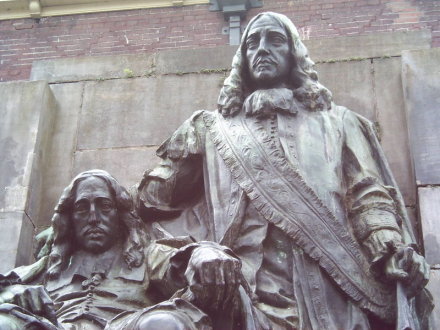
A statue of Johan (standing) and Cornelis de Witt in their native Dordrecht.

The mercantile powerhouse that was the 17th century Dutch Republic was the stage for a long-running conflict between the Orange monarchists (hence the soccer uniforms) and the Republican merchant class.

With the sudden death of the young William II, Prince of Orange in 1650, leaving the (non-hereditary) executive office of stadtholder vacant, the Republicans became ascendant.

And the outstanding figure of the First Stadtholderless Period was Johan de Witt, scion of a Dordrecht merchant family powerful enough that William II had imprisoned de Witt’s own father during a power struggle.

Elevated in 1653 and at the tender age of 28 to the leadership position of Grand Pensionary, Johan de Witt’s “eloquence, sagacity and business talents” guided the Dutch ship of state for essentially the remainder of his life.

This was the apex of the Dutch Golden Age. The Dutch East India Company dominated Asian trade routes,* and the Low Countries’ culture thrived on the wealth: Rembrandt and Vermeer were at the height of their talents; Spinoza revolutionized philosophy; van Leeuwenhoek invented the microscope.

While all these guys were landing themselves in their respective canons, Johan de Witt was trying to keep the age Golden.

Having only relatively recently broken free of Spain, the small country was an up-and-comer on the horns of a serious security dilemma: its leading commercial position put it into maritime competition with England, while its continental location made it vulnerable to the enormous army of the neighboring continental hegemon, France. Ultimately, even with its trade wealth, it did not have the resources to keep up with both of western Europe’s leading powers.

For a generation, de Witt’s statecraft kept the men of the Low Countries out of that predicament, while his brother Cornelis chipped in with a couple of timely naval victories. (Actually authored by Michiel de Ruyter, but Cornelis rode shotgun.)

In 1654, Johan brought the First Anglo-Dutch War to a close, making with Oliver Cromwell a secret pact he was only too happy to enforce never to allow William II’s son, the eventual William III, to be named stadtholder. Reason being: William III was the grandson of the Stuart king Cromwell beheaded, Charles I, and thus a potential claimant to the English throne. Both Protestant Republics had a distinct interest in keeping this monarchist well away from power. (Both would be sorely disappointed.)

A decade and a Stuart Restoration later, de Witt maintained (mostly) Dutch dominance of the seas in the Second Anglo-Dutch War, then held off France (with the help of a timely alliance with the recent adversary, England) in the War of Devolution.

In each case, he kept at least one of England or France on the sideline, or in his own camp.

But the Third Anglo-Dutch War was the charm — as it was also the Franco-Dutch War, and therefore 1672 was Rampjaar: disaster year. While the Dutch were aces on the waves, a massive French invasion easily overwhelmed them on terra firma.

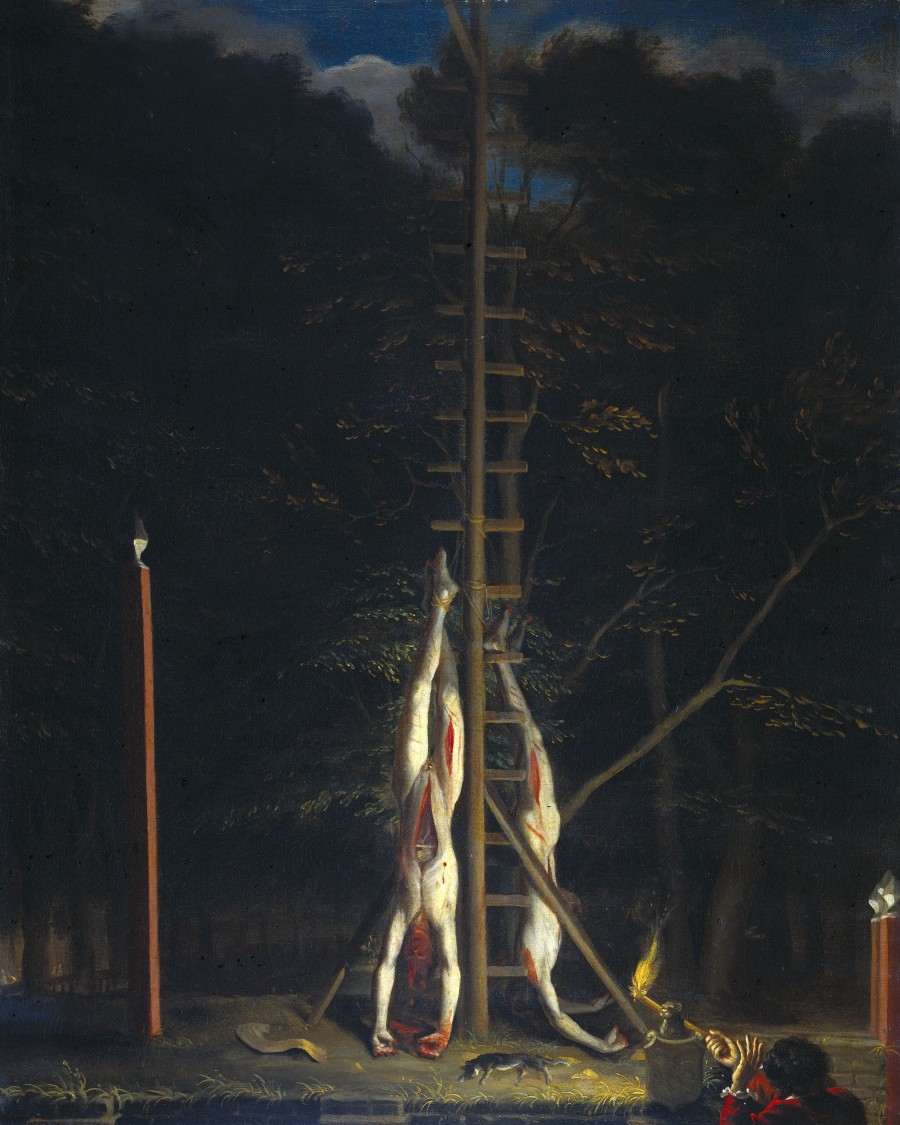
Detail view (click for the full image) of a grisly painting of the mutilated de Witt brothers strung up at The Hague. It’s attributed to Jan de Baen, who in better times took Johan de Witt’s portrait.

De Witt’s never-beloved mercantile oligarchy speedily collapsed with the military reverses, and the now all-grown-up William III was there to pick up the pieces to popular acclaim. Arrested for treason, Cornelis sustained torture without confessing, but when Johan visited him in prison — and William III incriminatingly withdrew the cavalry protecting the brothers — the mob quenched its fury with the de Witts’ blood.

every one of the miscreants, emboldened by his [Johan’s] fall, wanted to fire his gun at him, or strike him with blows of the sledge-hammer, or stab him with a knife or swords, every one wanted to draw a drop of blood from the fallen hero, and tear off a shred from his garments.

And after having mangled, and torn, and completely stripped the two brothers, the mob dragged their naked and bloody bodies to an extemporised gibbet, where amateur executioners hung them up by the feet.

Then came the most dastardly scoundrels of all, who not having dared to strike the living flesh, cut the dead in pieces, and then went about the town selling small slices of the bodies of John and Cornelius at ten sous a piece.

-Dumas

The word “ungrateful” comes to mind.

De Witt stood altogether on a lower plane than Cromwell. We regard him rather as a man of rare and singular talent, than as one of the chosen great ones of the earth, which Cromwell was. He stands far above the common run of men; and he was head and shoulders above nearly all the notable men of his time. He would have been greater if the movement of his limbs had been less burdened with the Dutch governing apparatus … He is not one whom the world can ever greatly admire or love.

History of the administration of John De Witt, grand pensionary of Holland, a Google books freebie.

(Here’s another, and here’s a 17th century volume de Witt himself coauthored.)

The rise of William III came with the decline of that Dutch Golden Age: the country fended off the immediate military threat, but it increasingly slipped behind its larger neighbors. Costly as was the Franco-Dutch War, it is a step on the path towards the present-day Europe, and this gives us enough excuse to notice that the Eurovision lead-in tune is actually from a Te Deum composed to mark its end.

But William’s own ascent to this wealthy sovereignty was just the beginning for him. Sixteen years later, the House of Orange’s champion vindicated Cromwell’s trepidation about him and gained a far more satisfactory position from which to do battle with his Gallic rival Louis XIV by stunningly overthrowing the Stuart dynasty and becoming King of England in the Glorious Revolution.**

* The Dutch remained the sole western contact of closed Japan until 1854, which is why Japan’s eventual period of scientific advancement became known as ‘Dutch Learning’.

** Albion did not forget the de Witts, either: according to this 1785 cant dictionary, the term “dewitted” had a 17th-18th century run in English to denote — well, exactly what happened to Cornelis and Johan.

On this day..

1916: Cesare Battisti and Fabio Filzi

On this date in 1916, the Austro-Hungarian empire executed Cesare Battisti and Fabio Filzi for treasonous Italian nationalism.

It was the multiethnic Habsburg state that was itself dying of its constituents’ national aspirations; in little more than two years, the state entity that carried out this day’s sentences would no longer exist at all.

Pre-World War I, Battisti (English Wikipedia entry | Italian) was actually a Socialist representative in the Austrian parliament.

When the unpleasantness broke out, though, he made a break for the peninsula where he agitated* (successfully) for Italian entry into the fray against Austria-Hungary. Irredentists had long coveted Habsburg properties with a heavy Italian population, like the Adriatic port of Trieste and Battisti’s own native Trento; the war offered an opportunity to swipe those territories, notwithstanding Italy’s putative prewar alliance with the Austrians.

Although already 40 years of age when Italy entered the war, the intrepid Battisti enlisted to fight. He was captured along with an otherwise obscure subaltern, Fabio Filzi, on the Alpine slope of Monte Corno (now known as Monte Corno Battisti) repelling the Austrian Strafexpedition.**

Austria did not stand on ceremony with these men; their capture took place on July 10, their trial on July 12, and their executions at the Castello del Buon Consiglio — an ironic Calvary, for a parliamentarian — later that same day. (To complete the scene, the strangulation-hanging was botched when Battisti’s first rope broke.)

The Austrian writer Karl Kraus would observe that “they thought they were hanging Italy, but it was really Austria on the gallows.”

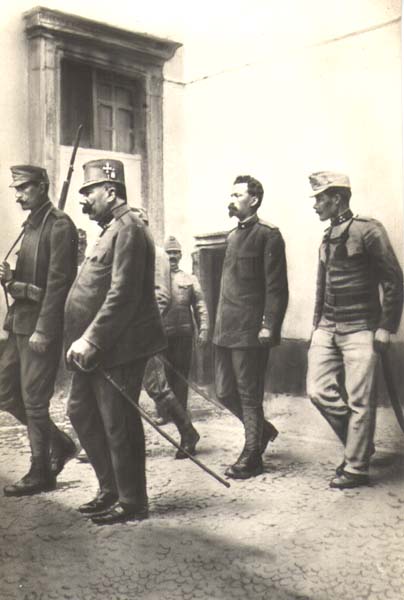
Whichever one it was, they took a lot of pictures.


Battisti and Filzi as prisoners.


Battisti leaving the courtroom en route to his execution.


Battisti approaches the scaffold.


Battisti waiting at the scaffold as the sentence is read.


The Austrian army offers a prayer and salute to the shrouded body of Cesare Battisti.

* As a socialist who broke against the internationalist position and in favor of violent nationalism, Battisti was an ally of Benito Mussolini. It was Battisti, actually, who pioneered the socialist-nationalist-newspaperman act upon which Mussolini would later raise is own star, to such an extent that Battisti’s paper, Il Popolo — the apparent inspiration behind Mussolini’s own subsequent paper, Il Popolo d’Italia — gave the still-obscure future Duce some of his earliest gigs.

A martyr’s death during World War I fortuitously spares Battisti’s legacy the unpleasant association with his friend’s postwar turn towards fascism, so there are many streets and plazas named for Battisti, as well as a memorial in Trento. He’s also honored by name in the 1918 patriotic tune La Leggenda del Piave (lyrics).

** “Punitive expedition”.

On this day..

1816: Jorge Tadeo Lozano, Colombian Renaissance man

On this date in 1816, Jorge Tadeo Lozano was executed by firing squad in a Bogota temporarily reconquered for the Spanish crown.

Scientist, journalist, essayist and man-about-town Lozano (English Wikipedia entry | Spanish) sprang from the stock of New World Spanish nobility.

He studied literature, philosophy, medicine, chemistry, mathematics, mineralogy, botany; he served in the Spanish military and traveled in Europe; he returned to his native New Granada, where he became drawn into the liberal ferment with a celebration of the emerging bourgeoisie obviously contextualized by his scientific education.

Money, like the blood of a body, gives life and shares with each and every one proportionally the movement and robustness that it needs to freely comply with the action that it must complete as a member of society … This inistrumental motive of wealth can not be hushed, if it is to produce an effect … in the manner of electric flow [it] passes through bodies, leaving them with a glowing heat, also enlivens the arms and hands through which it passes… (Studies in the History of Latin American Economic Thought)

As a member of the constituent assembly, he helped draft an 1811 constitution that acknowledged the authority of the Spanish crown, but not of its viceroy, creating (so its signers thought) a new commonwealth state. Lozano thereupon became the first President of Cundinamarca, essentially the forerunner to the present-day Colombian presidency.

Since Lozano turned out to be a better botanist than executive, he resigned the office after a few months.

Only after Europe had sorted out the Napoleonic wars did the Spanish free up the resources for a brutal reconquista of their errant provinces. But when it came, under a general with the macho nickname El Pacificador, it had intellectuals just like Lozano right in its sights.

Even though he’d been back at lower-profile scribbling since his stint at the top, Jorge Tadeo was just the sort of guy Pablo Morillo targeted for demonstrative executions over the second half of 1816.

Thus perished the persons of the greatest wisdom, the most virtuous and wealthy, in New-Granada. The object which Morillo had in view, was to extinguish intelligence, remove men of influence, and destroy property, so that, in future, there should be none capable of originating or directing another revolution. (Source)

Thus perished Lozano this date, along with another intellectual, Miguel Pombo (Spanish link) among a whole train of patriotic martyrs over the months of Morillo’s rule.

The policy of killing these men to deprive New Granada of revolutionary potential was, however, an abject failure: just three years after these men were shot as traitors to that distant European line, Simon Bolivar detached Colombia from Spain at the Battle of Boyaca.

On this day..