1624: Antonio Homem, at the hands of the Portuguese Inquisition

On this date in 1624, Coimbra University theologian Antonio Homem was burned at the stake in a Lisbon auto de fe.

Homem came from a “neo-Christian” family, Jews who had been forced to convert to Christianity. Considering the compulsion, one could fairly question the piety of such “Christians”; in a great moment in damned-if-you-do, damned-if-you-don’t, the Spanish Inquisition fired up to probe the potential un-Christian activity of neo-Christians.

Neighboring Portugal was just a beat behind Spain in all this; Spain expelled its Jews — the ones who weren’t willing to convert — in 1492, and Portugal did so in 1497. The Portuguese Inquisition began in 1536 and, like Spain’s, took conversos as a primary focus.*

Homem’s family’s response was to be more Catholic than the Pope and have Antonio trained for the clergy; he became canon of the Cathedral of Coimbra and a doctor at the University of Coimbra.

Homem was in his fifties when it became known among his colleagues that he was of New Christian stock, and this circumstance soon attracted unwanted attention — and eventually, his denunciation for allegedly leading a secret Judaic cell. Homem, it is said, “often took the part of priest”; The Other Within: The Marranos, Split Identity and Emerging Modernity describes a Kippur ceremony from the Inquisition records.

The public, all fasting and dressed in white, used the Christian Bible (the Vulgate) to recite Latin Psalms that expressed a Jewish-Marrano sentiment (Psalms such as “When Israel came out of Egypt,” “On the rivers of Babylon,” and “From the Abyss I called you, O God”). In those ancient Jewish poems the Marranos expressed their own, specific sense of exile and yearning for redemption. A few “priests of the Law of Moses,” replicating a Catholic ceremony, dressed Homem in a long elegant garment and put “a sort of miter” on his head, decorated with golden plaque. There was an altar there, and incense, and painted images of Moses and of a Marrano martyr or saint “who had been … burned as a Jew.”

The inner life of the converso is a great riddle from our distance of time and context. It is immediately tempting to perceive religious martyrs here, people who were forced underground but still kept what they could of the faith of their fathers at risk of life and limb.

Such a reading paradoxically allies us with their persecutors, for it is by the Inquisition’s hand that we have the evidence — and this is a source whose evidence we greet very skeptically when it, for instance, charges conversos with murdering Christian children. Inquisitors all around Europe were after all involved in these very years in scaring up secret witches’ covens to incinerate, and it was not unknown for the deadly judicial apparatus to be borrowed here and there from restraining the minions of Hell in order to service business opportunities, political aspirations, or private grudges of the personal or professional variety. Try asking a present-day academic how easy they’d sleep knowing their colleagues on the tenure committee also had a few buddies in the Holy Inquisition.

Antonio Jose Saraiva’s The Marrano Factory: The Portuguese Inquisition and Its New Christians 1536-1765** contends that most “Judaizing” Christians were just plain Christians — caught up like accused witches and warlocks could be in some specious neighborhood rumor that became a self-fulfilling accusation. “Inevitably,” says Saraiva, “a family quarrel or a commercial intrigue would lead to several series of denunciations, followed by arrests. Arrests led to trials which spiraled into new rounds of arrests and trials.” Saraiva argues that Homem’s recently-exposed Jewish heritage probably just made him a ready target when a commercial dispute of some sort led the Inquisition’s Coimbra tribunal to seize “scores of merchants engaged in the triangular commerce between Brazil, Oporto and Amsterdam.”

Whether Homem really did head a covert cult with 100-plus adherents reading Old Testament verses from the Latin Bible — or whether this was what an inquisitor goaded by Homem’s enemies supposed a secret Jew might do — he was left to rot in prison several years† after his 1619 condemnation while the Inquisition investigated dozens of his alleged adherents. These included other cathedral canons, professors and students at the university, nuns from four nearby convents, and other persons of some stature. (Homem, to his credit, refused to accuse anyone else.)

Homem was eventually among eight burned (Portuguese link) at an auto this date at the Ribeira de Lisboa, and his house was torn down to be replaced with a pillar inscribed “Praeceptor infelix”. Prior to their destruction they were favored with the preachings of Friar Antonio de Sousa who railed against the insidious Semitic threat to homeland security.

For our sins of the last years people of quality have been cross-breeding with these perverse Jews to whom I am referring. They became corrupted by their contact with them and have become Jews like they are. Just a few years ago only low-class, trashy Jews were paraded at the autos-da-fe. See what now appears for sentencing in the autos-da-fe and in this very one at which I am preaching: ecclesiastical personnel, friars, nuns, holders of master’s degrees, licentiates, doctors and professors with family connections to the nobility, people only half of New Christian origin, or a quarter, or an eighth, all confessing and convicted of Judaism. (Translated excerpt via Saraiva)

Readers with Portuguese proficiency can find more on this case in this 1999 book exploring the Inquisition’s Coimbra archives, or in Antonio Homem e a inquisição.

* For the setting of this post, the 1620s, Spain and Portugal are under the personal union of a common monarch, Philip IV.

** We’ve mentioned it before.

† One of the great (and eventually fatal) inefficiencies of the auto-de-fe system was its tendency to leave its future exhibits to languish for years in prisons before the prescribed spectacle could be properly arranged.

On this day..

1908: Massillon Coicou and the Firminists

On this date in 1908, the octogenarian Haitian president Pierre Nord Alexis had a number of political opponents arrested and, that very night, summarily executed.

Nord Alexis, a career officer risen to the post of Minister of War in a provisional 1902 government* when the previous president Tiresias Simon Sam* resigned to avert a constitutional crisis.

That was a strange affair: a misreading of the constitution had Sam set to rule until 1903, until someone caught the mistake. Sam’s diligently on-time resignation proved not the Rule of Law victory he might have hoped when the resulting power vacuum brought civil war.

The contest for power boiled down to Nord Alexis on one side, and the scholar and diplomat Joseph Auguste Antenor Firmin on the other.**

As one can see, Nord Alexis won it — but the conflict flared again in 1908, with the exiled Fermin making an attempt to return to Haiti. Nord Alexis’s response was ruthless and, for now, effective. (Nord Alexis was ousted later in 1908, however.)

Massillon Coicou

Prominent among the victims of the crackdown this date was the novelist and poet Massillon Coicou (English Wikipedia entry | the more detailed French).

Coicou had been in the diplomatic service in France with Firmin, where the two forged a close affinity, and Coicou became a toast of literary circles.

Coicou and his two brothers Horace and Pierre-Louis, staunch Firminists all, were shot together with a several others at the walls of the Port-au-Prince cemetery on the night of March 14-15. (The exact number of others seems a little hard to come by; there are different counts from around 10-15 ranging up to 27+ total people executed in this incident, although the larger count may encompass executions other than those at the cemetery.)

For Francophones, several of Coicou’s poems can be perused via links at the bottom of this biographical page.

* Sam’s cousin Jean Vilbrun Guillaume Sam held that same office for a brief and bloody interval in 1915.

** Firmin is noted for his 1885 book De l’égalité des races humaines, which mounted a strong defense for the fundamental equality of the races, and also predicted a black U.S. president.

On this day..

1562: Michael Lindener, poet laureate

The Holy Roman Empire poet laureate — self-proclaimed, at least — Michael Lindener was beheaded with a sword on this date in 1562 in Friedberg as a murderer.

Lindener (German Wikipedia entry) routinely signed himself “Poeten”, or “P[oeta].L[aureatus].” — for instance, in the preface to his vernacular satiric classics Rastbüchlein and Katzipori.

Whether Lindener really was an official poet laureate of the empire, however, is not so clear. Lindener was a bit of a hustler and in scrabbling to support himself with his pen in Nuremberg and then Augsburg in the 1550s did not shrink from forging the likes of Savonarola, Melanchthon, and Hessus. (He also worked as a proofreader and a teacher.) His honorifics might also have been fraudulent.

Lindener’s mischief was not confined to literary offenses; he led the roguish life of a Villon-esque picaro.

But while that latter author, a mere thief, escaped the fate anticipated in his “Ballad of the Hanged Man”, Lindener found that stabbing an innkeeper to death was an offense much beyond his eloquence to excuse.

On this day..

1943: Yitskhok Rudahevski and family

(Thanks to Meaghan Good of the Charley Project for the guest post. -ed.)

Sometime in early October 1943, fifteen-year-old Yitskhok Rudashevski and his entire family were rousted out of their hiding place in the Vilna Ghetto, taken to nearby Ponary, shot to death and buried in a mass grave.

The Rudashevski family were among the last remnants of a once-vibrant Jewish community in the city once known as “the Jerusalem of the north” for its culture and scholarship. People came there from as far away as the United States to study in its highly regarded yeshivas.
After the start of World War II, Vilna was annexed by the Soviet Union. It became a sanctuary to Jews fleeing from the Nazis, who occupied western Poland.

All of that changed on June 22, 1941, when Operation Barbarossa began. On the day Germany invaded the USSR, there were approximately 80,000 Jews living in Vilna, many of them refugees from the Nazi terror. By the time the Red Army arrived and kicked the Nazis out three years later, Vilna’s Jewish population had been reduced –through starvation, disease, deportation and executions — to zero.

Yitskhok (also spelled Yitzhak, Yitzak, etc., or anglicized to Isaac), was thirteen years old at the time his city was occupied by the Germans.

An only child, he was the son of a typesetter and a seamstress. Talented in writing, history and languages, he was also a faithful Communist and a member of the Pioneers, the Communist youth organization.

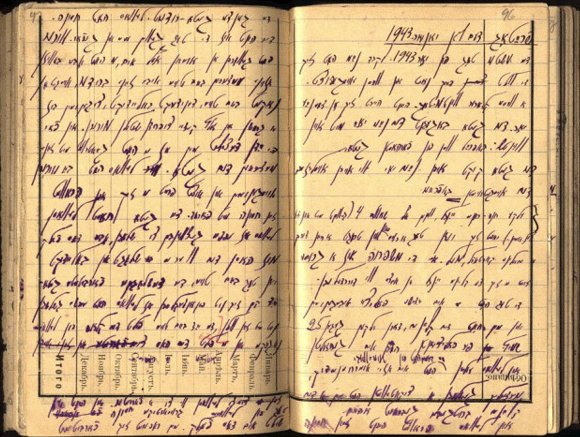
From June 1941 to April 1943 he kept a diary in Yiddish. Yitskhok had a sense of the significance of his account; at one point he wrote, “I consider that everything must be recorded and noted down, even the most gory, because everything will be taken into account.”

He not only wrote about his own life and his family and friends, but about the wider community events and the devastation the Germans wrought on his people. The historian Allan Gerald Levine called him “an astute and passionate observer of the times,” and compared him to Anne Frank.

Nor was the diary Yitskhok’s only writing project.

When one of his teachers, a beloved figure in the ghetto, died, he wrote a eulogy for the man and read it out before a large audience. He was a member of a literary group and was also attached to the ghetto’s history project, for which he interviewed ghetto residents about their lives:

I got a taste of the historian’s task. I sit at the table and ask questions and record the greatest sufferings with cold objectivity. I write, I probe into details, and I do not realize at all that I am probing into wounds … And this horror, this tragedy is formulated by me … coldly and dryly. I become absorbed in thought, and the words stare out of the paper crimson with blood.

The Vilna Ghetto, whose population initially numbered 40,000, had a rich cultural life, just like prewar Jewish Vilna had. There were theaters, cabarets, the symphony, art exhibits, a library, public lectures, and underground schools for both children and adults.

Vilna Jews saw art, music, literature and the pursuit of knowledge as a form of resistance. As Jacob Gens, head of the “ghetto’s Judenrat, put it, cultural activity gave a person “the opportunity to free himself from the ghetto for a few hours … We are passing through dark and difficult days. Our bodies are in the ghetto, but our spirit has not been enslaved.”

Reality intruded, however, and in the final analysis the Vilna Jews were doomed to extinction.

Yitskhok’s final diary entry was dated April 7, 1943, two days after five thousand Vilna Jews had been rounded up and shot at Ponary. He was understandably in a very grim mood. His prophetic last line was, “We may be fated for the worst.”

On September 23, 1943, the Nazis began the final liquidation of the Vilna Ghetto, which had by then been reduced to about 10,000 people. After a selection, those who could work were sent off to labor camps in Estonia and Latvia, where almost all of them died due to the brutal conditions there.

Children, the elderly, and the sick were shot at Ponary or sent to the extermination camp Sobibor and gassed.

Yitskhok, his parents and his uncle’s family chose to go into hiding rather than take their chances at the selection. In hiding he sank into apathy and said very little. After about two weeks in the hideout, they were discovered and taken to their deaths.

The only surviving member of Yitskhok’s family was his teenage cousin, Sarah “Sore” Voloshin. Somewhere on the route to Ponary she was able to escape. She joined a partisan group in the forest and survived until the Red Army liberated the area in the summer of 1944. After the war was over, she returned to the family’s hiding place and found Yitskhok’s diary. As of 2010, Sore Voloshin was still alive in Israel.

And the diary she retrieved had become one of the major sources on day-to-day life in the Vilna Ghetto.

Yitskhok Rudashevski suffered and died in just the same way as hundreds of thousands of others, but unlike them he did not remain anonymous: he is one of the ghetto’s most famous inhabitants. His writings have been published in their original Yiddish and in Hebrew, German and English translations. Extracts of his diary can be found in several anthologies, and it’s available in its entirety under the title The Diary of the Vilna Ghetto.

On this day..

1567: Pietro Carnesecchi, Florentine humanist and heretic

On this date* in 1567, Florentine humanist Pietro Carnesecchi was burned after beheading at the Ponte Sant’Angelo in Rome.

Carnesecchi (English Wikipedia entry | Italian) was born to a wealthy Florentine merchant family allied with the Medici; as a child, Carnesecchi probably dandled the infant Cosimo, the future ruler of the city. His education was patronized by the Medici cardinal who went on to become Pope Clement VII.

All these friends in high places would prove in time to be a poisoned chalice.

But the young man was in his glory in his twenties at Clement’s papal court, as notary and protonotary, excelling in his lucrative sinecures on the curial cursus honorum.

To his grief and/or glory, he met along the way the Spanish reformer Juan de Valdes, who had taken refuge in Naples from the Spanish Inquisition, and the spellbinding pulpit orator Bernardino Ochino, who was by the late 1530s to trend towards outright apostasy.

Intellectual curiosity was a quality dangerous to its owners during the Reformation. Carnesecchi had his own insider’s view of the Church’s warts to add to the influences of these brilliant associates, and by the 1540s was obliged by his affinities to seek his safety in the more liberal religious environment of Venice … and later, after a close first brush with the Roman Inquisition, to leave Italy altogether.

He wasn’t on the run per se, but his was a contingent life: a few years in a place, with the ever-present peril that a shift in the political winds could see him or his friends to the scaffold. He returned from France to Venice in 1552, spurned a summons to justify himself once more to the Inquisition under the furiously anti-Protestant Pope Paul IV, and was even able to move back to the Eternal City with the accession to St. Peter’s Throne of another Medici cardinal as Pope Pius IV. The Inquisition, nevertheless, drug its feet when it came to acquitting Carnesecchi once again.

“Nothing progresses!” he cries in one of his letters, for the Inquisitors “will not judge as right and duty dictate, for they suggest scrupulous hesitancy where there is no ground for it, and interpret that prejudicially which, rightly apprehended, is good and praiseworthy.” In other words: prosecutors.

As Popes are said to alternate fat with thin, and old with young, here they traded zealot of the faith with mellow humanist. When Pius IV died, the pendulum swung back against Pietro and the relentlessly orthodox** Pius V took charge.

Carnesecchi took refuge in his native Florence, governed by that baby Cosimo de’ Medici, all grown up now into an authoritarian state-builder. Cosimo had welcomed him before, and interceded on his behalf in the last go-round with the Inquisition; Florence, moreover, had a long-running rivalry with Rome in peninsular politics. Carnesecchi would have supposed himself as safe there as ever he had been in his peregrinations.

“But how did Ghislieri’s [Pope Pius V’s given name] reckless energy paralyse others!” as this book puts it. “Cosimo, too, was destined to feel its influence.”

Carnesecchi was a guest at his sovereign’s table when the friar Tomaso Manrique, the Master of the Papal Palace, was announced, as sent on a special mission to Florence, and desiring an interview with the Duke. The Pope had furnished his messenger with a letter bearing date June 20th, 1566, in which, after greeting Cosimo with the Apostolic Benediction, ‘he was called upon, in an affair which nearly affected obedience to the Divine Majesty and to the Catholic Church, and which the Pope had greatly at heart, as being of the highest importance, to give to the bearer of this letter the same faith as though His Holiness were present conversing with him.” Manrique claimed in the Pope’s name the delivering over of Carnesecchi into the hands of the Inquisition. The Duke made his friend and guest rise from the table and surrender himself on the spot to the Papal messenger. And he abjectly added, that, “had His Holiness — which God forfend — called upon him to surrender his own son for the same motive, he would not have hesitated one moment to have him bound and surrendered.”

Thanks, buddy.

Hauled immediately to a Vatican dungeon, Carnesecchi spent his last 15 months in prison, under interrogation, and sometimes on the rack.

“They would fain have me say of the living and of the dead things which I do not know, and which they would so fain hear,” Carnesecchi pleaded in (futile, intercepted) letters to old associates from the Curia. He admirably refused to incriminate anyone, but was convicted in September 1567 on 34 counts of obstinate heresy. They can all be read here — headlined by that hallmark of rank Protestantism, justification by faith alone.

Carnesecchi was stripped of his ecclesiastical ranks and his property, and turned over to the secular arm — the latter hypocritically “beseech[ed] … to mitigate the severity of your sentence with respect to his body, that there may be no anger of death or of shedding of blood,” which was, of course, the very intent and the effect of turning him over. Carnesecchi met his fate sturdily; his Catholic confessor complained that he was more interested in bantering ideas than penitence for his wrong opinions, and showed no proper fear of death.

In 1569, Pius V bestowed the title of Grand Duke of Tuscany on Cosimo.

Carnesecchi, long obscure to posterity, was exhumed almost literally when the Napoleonic Wars gave anti-clerical factions the opportunity to ransack secret Roman Inquisition archives. His meter-long file passed into a succession of private hands and was finally published in the mid-19th century, and as a result there are several public-domain volumes about the heretic in addition to the one we have already cited. Some of the original documents, with English translation, can be read in this volume; Italian speakers might give this one a go.

* There are a few citations out there for October 3. I can’t find a definitive primary source, and it may be that the original records are themselves ambiguous, so I’m going with the bulk of the modern and academic citations in favor of October 1.

** Anglos may recognize Pius V as the pope whose bull explicitly releasing Catholics from their allegiance to Queen Elizabeth put English followers of the Old Faith in an untenable position, much to the grisly profit of this here blog.

On this day..

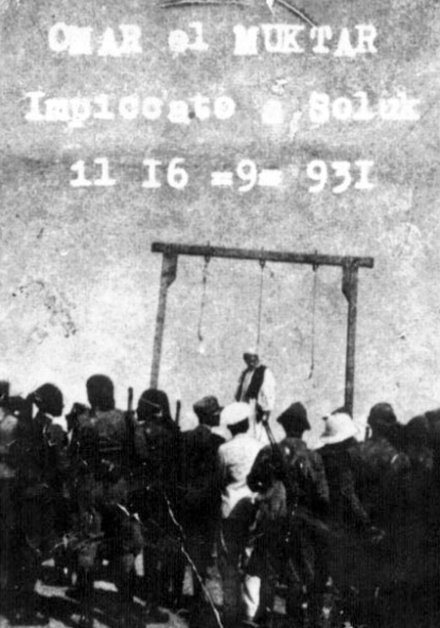
1931: Omar Mukhtar, Libyan revolutionary

On this date in 1931, Libyan independence martyr Omar [al-]Mukhtar was publicly hanged by the Italians at their concentration camp in Suluq.

Mukhtar (English Wikipedia entry | Italian) was born an Ottoman subject back in 1858 and had lived long enough to see his native Libya seized in the 1911-12 Italo-Turkish War.

Mukhtar, a religious teacher and follower of the Senussi movement, became the leader of the Libyan resistance that dogged the Italian occupation. Mukhtar proved an energetic and successful desert guerrilla fighter, and he had to be given the Italians’ mechanized military.

The Italians executed an estimated 4,000 Libyans in the 1920s, and drove hundreds of thousands into concentration camps, and gradually, only gradually, gained the upper hand on their adversaries.

Captured in battle after he abandoned a 1929 truce, Mukhtar was denied prisoner-of-war status and subjected to a snap military tribunal in one of the small coastal enclaves actually controlled by Italy — “a regular trial and consequent sentence, which will surely be death,” as the Italian general directed. It surely was.

He’s played by Anthony Quinn in the 1981 film Lion of the Desert — a better movie than you might think given that it was bankrolled by Muammar Gaddafi.

A national hero for contemporary Libyans across any social divide you’d care to name, Omar Mukhtar was valorized by the rebels who recently overthrew the aforementioned Gaddafi (here’s Mukhtar on a billboard in rebel-held Benghazi). “The whole world knows what Omar al-Mukhtar did,” Mukhtar’s 90-year-old son told media during the civil war. “That’s where they get their energy from. Ask the youth, they’ll tell you they are all the grandsons of Omar al-Mukhtar.”

His steely profile can be seen on Libya’s 10 10 dinar note.

On this day..

1941: Alexander Svanidze, Stalin’s brother-in-law

On this date in 1941,* Stalin’s own brother-in-law was shot in the gulags.

In 1906, a whole lifetime before, the Georgian Alexander Svanidze introduced young Joseph Dzhugashvili to his, Svanidze’s, sister, Kato. She and Dzhugashvili wed that year, and Kato soon bore her husband’s firstborn, Yakov.

Stalin was already a wanted Bolshevik revolutionary at this time, but so was Svanidze. Kato was a homebody with no known political interest, and sufficient piety to force her communist groom to say his vows in an Orthodox church. Afterwards, his priorities reasserted themselves.

While Stalin agitated, propagandized, and politicked against Menshevism in the wild oil boom city of Baku,** his pretty wife kept an empty apartment tidy and fretted the omnipresent danger of her husband’s arrest. “When he was involved, he forgot everything,” fellow-Bolshevik Mikheil Monoselidze remembered. Many revolutionaries’ wives walked similarly lonely roads.

Kato did not have to walk hers very long: she contracted a horrible stomach/bowel disease and wasted rapidly away late in 1907. Stalin’s own indifference might have been the ultimate cause, for when she was unwell the young cadre took her on a sweltering 13-hour train ride back to Tiflis that greatly worsened her condition — all so that her family could care for her, and free Stalin’s time for his plots. Kato died in Stalin’s arms, but only when he had been urgently summoned back from Baku with word that her condition had become dire.

Whatever his actions said about him as a family man, the future dictator really loved his neglected wife. He “was in such despair that his friends were worried about leaving him with his Mauser,” writes Simon Montefiore in Young Stalin.

“This creature,” [Stalin] gestured at the open coffin [at her funeral], “softened my heart of stone. She died and with her died my last warm feelings for humanity.” He placed his hand over his heart: “It’s all so desolate here, so indescribably desolate.”

At the burial, Soso’s habitual control cracked. He threw himself into the grave with the coffin. The men had to haul him out. Kato was buried — but, just then, revolutionary konspiratsia disrupted family grief. Soso noticed some Okhrana agents sidling towards the funeral. He scarpered towards the back of the graveyard and vaulted over the fence, disappearing from his own wife’s funeral — an ironic comment on his marital negligence.

For two months, Stalin vanishes from the record. “Soso sank into deep grief,” says Monoselidze. “He barely spoke and nobody dared speak to him” … “He cried like a brat, hard as he was.”

Stalin’s deep grief did not change his life’s work. If anything, he would seem in later years almost too aghast by the whole experience (and his uncharacteristic bout of sentiment) to grapple with it. He abandoned little Yakov to the Svanidzes, and would curiously dislike his son so much that he eventually permitted Yakov to die as a German POW during World War II rather than exchange prisoners for his release.

By the time of the great purges, then, being Stalin’s brother-in-law was of little help to Alexander Svanidze. It might have been an outright detriment; certainly Svanidze’s own prominence — he had served as People’s Commissar for Finances of the Georgian SSR, and founded a scholarly journal in his capacity as a historian — were of a kind with Old Bolsheviks who had also attracted denunciations.

In 1937, most of the beloved Kato’s family was arrested: Alexander Svanidze, but also Alexander’s wife Maria, and opera singer, and his sister Mariko. Svanidze defiantly refused NKVD blandishments to confess to spying for Berlin to save himself, perhaps realizing that such a deal would merely sell his pride for a mess of pottage. “Such aristocratic pride!” Stalin is supposed to have tutted upon hearing the way Svanidze went to his execution still insisting he had done nothing wrong. (Svanidze’s ancestors were petty nobility.)

Svanidze’s son, Johnreed† — named for the American radical who chronicled the Bolshevik Revolution in Ten Days That Shook The Worlddenounced his doomed father to save his own skin, but was sent to the gulag just the same. Johnreed was released, and Alexander posthumously rehabilitated, after Stalin’s death in 1953.

* There are some other dates out there for Svanidze’s execution. I’ve had difficulty identifying a primary source for any of them, but am prepared to be corrected if an alternative possibility can be strongly documented.

** They moved to Baku from Tiflis, where Stalin had helped to orchestrate a huge bank robbery.

† Revolutionary Russia produced a number of similarly curious neologisms on birth certificates, such as “Vladlen” (blending “Vladimir Lenin”), and even the outlandish “Electralampochka” (“light bulb”, inspired by the Soviet electrification campaign).

On this day..

1941: 534 Lithuanian Jewish intellectuals

(Thanks to Meaghan Good of the Charley Project for the guest post. -ed.)

On this date in 1941, 534 Jewish intellectuals were lured out of the Nazi ghetto in the city of Kovno, Lithuania (also known as Kaunas), taken to Ninth Fort, and shot to death.

Over 5,000 Jews would die there during the Nazi occupation.

The Nazis had captured these people using a very clever ruse: on August 14, they had advertised for 500 Jews to help sort out the archives at City Hall, which were in disarray due to the chaos that followed the Germans’ conquering the city in June.

The workers had to be intelligent, educated types and fluent in German and Russian. They would be treated well and given three solid meals a day, in order that they could do the work properly and make no mistakes.

Most of the other jobs available for Jews at that moment involved manual labor under brutal conditions, on starvation-level rations.

More than the requested 500 showed up. The Nazis happily took them all.

Vilius “Vulik” Mishelski (later anglicized to William Mishell), who was 22 and had studied engineering in Vytautas Magnus University [Lithuanian link], was nearly victim no. 535. His mother told him about the job offer, because it upset her when he home from working at the airfield, “my clothes torn, my face covered with dust and sweat, my fingers bleeding, and I myself so exhausted I could hardly speak.” The archives job seemed like a gift from heaven to her.

Vulik wasn’t so sure.

Why, he asked, had the archives not been sorted out sooner? After all, the Germans had conquered Kovno a full two months earlier.

And why not get Lithuanians to do the job? It certainly wasn’t necessary to employ Jews.

He debated with himself for the next four days, then finally decided to go. Many of his friends were going, he wrote later on, and “this put me at ease. All of them could not be crazy.”

When he actually arrived at the gate, however, what he saw made him profoundly uneasy. The size of the guard was unusually large, and he witnessed Jewish police and Lithuanian partisans mistreating and beating people. Because it was taking long for the quota of 500 people to arrive, the Lithuanians started dragging people from their homes by force.

This struck me as odd. This was supposed to be a job where we were to be treated in a civilized manner; was this the treatment awaiting us? Oh, no, I would not be caught in this mess! Without hesitation, I turned around and rushed back home.

My mother was astounded. “What happened, why are you back?” she asked.

“Don’t ask questions,” I said, “move the cabinet, I’m going into hiding.”

Vulik was right not to trust the Nazis’ promises. He stayed in his hideout, a little cubbyhole behind the kitchen cabinet, all day.

The chosen 534 didn’t return that night, or the next night either, and no one believed the assurances that the work was taking longer than they thought, and they had spent the night at City Hall. Before long, the truth leaked out.

That same day, the men had been lead away in several smaller groups to an area containing deeply excavated holes in the ground. Then the Lithuanian guard, known as the Third Operational Group, had shot them all. Several men who tried to escape were killed on the run. Almost the entire intelligentsia of Jewish Kovno had thus been liquidated in one mass execution.

Mishelski stayed in the Kovno Ghetto until 1944, when he was sent to Dachau. He survived the war: 95% of the Lithuanian Jews, including most of his family, did not.

Mishelski moved to America, changed his name to William Mishell, got a master’s degree in engineering from New York University, and settled in Chicago. Following his retirement in the 1980s, he wrote a memoir titled Kaddish for Kovno: Life and Death in a Lithuanian Ghetto, 1941 – 1945. Mishelski died in 1994, aged 75.

On this day..

1969: Lee Soogeun, North Korean defector

On this date in 1969, alleged North Korean operative Lee Soogeun (other transliterations exist for his given name, such as Soo Keun or Soo-geun) was hanged at a Seoul prison for espionage.

A North Korean party elite, Lee was the Vice President of the North Korean Central News Agency.

On March 22, at the Military Armistice Commission meetings at the border outpost of Panmunjom, Lee suddenly leapt into a UN official’s vehicle and escaped over the frontier.

The high-profile defector got a hero’s welcome in the South. (A U.S. Army captain also copped a medal for helping him escape.)

Lee hit the lecture circuit critically discussing the situation north of the 38th parallel, and worked as an analyst for South Korean intelligence.

However, the KCIA also had Lee under surveillance, and came to believe that he was actually gathering intelligence to send to the north. Realizing his predicament, Lee fled with his niece for Cambodia. They were captured en route in Vietnam.

South Korea’s Truth and Reconciliation Commission has, while stopping short of exonerating Lee, ruled his confinement illegal, and the self-incriminating statements he made in that environment insufficient evidence, and urged his case be re-tried. Lee’s niece served 20 years of a life sentence as his accomplice, but was released in 1989 and eventually won a 6.8 billion won wrongful imprisonment suit.

On this day..

1794: Simon-Nicholas Henri Linguet, who defended Nero

On this date in 1794, Simon-Nicholas Henry Linguet was guillotined during the French Revolution for having written praise of foreign tyrants.

Linguet (English Wikpiedia entry | French) was a brilliant lawyer and a prolific but prickly man of letters. Famous in his own day for his prose, he’s of less account to a modernity that’s long forgotten the various axes he had to grind.

The one sure constant in his life was a gift for making enemies.

Linguet was an Enlightenment philosophe at the start of his public life, and made an early name for himself when his forceful intervention in the case of the Chevalier de la Barre helped save La Barre’s friends from sharing his fate.

He soon apostatized from the Reason-worshipping “fanatical” philosophes, and eventually found himself disbarred for irritating too many fellow barristers. Turning instead to journalism, his Annales politiques, civiles et litteraires — published mostly in exile from 1777 to 1792 — became, as his biographer put it, “a quasi-independent force for molding opinion and policy in the power centers of Europe. Maneuvering among the great powers of Europe wielding the power of his public’s opinion, Linguet institutionalized political influence for himself, and liberty as well.” And of course the writing business really let Linguet’s native gift for pissing people off shine.

He scalded the French Academy and settled scores with rivals old and new. Eventually a suit by one of them landed Linguet in the Bastille when the latter tried to return to Paris in 1780.

Linguet got out (and left France again) in 1782, turning his spell in the Bourbon dungeons into a Memoirs of the Bastille,* which didn’t buy him as much sympathy as one might assume come revolutionary times since he had scarcely incurred his sufferings on behalf of the masses.

Linguet was finally able to return to his country with the Austrian embassy courtesy of ennoblement conferred by Marie Antoinette‘s brother Emperor Joseph II. His restored relations with Europe’s crowned heads, however, did not prevent him taking up the cause of Belgium’s Brabant Revolution as well as the Haitian Revolution.

An early member of the Cordeliers and temporary enthusiast of the Revolution, Linguet would later be bold enough to write Louis XVI offering to defend him. He was easy pickings in the end for a revolutionary tribunal that accused him of prostituting his literary gifts to Europes various ancien regimes: Linguet had taken refuge in his time with all of revolutionary France’s principal enemies, and had flattered their princes for his trouble; his provocative pen had set his name to a defense of slavery; and he’d even mounted an attack on Alexander the Great which in the great tradition of contrarian provocateurs compared the legendary conquerer unfavorably (on the body count metric) with the Emperor Nero. Literally defended Nero was the epitaph his prosecutors pinned to him, and it’s never fully come unstuck. It’s unfair, sure … but Linguet was the last man in a position to complain, and not just because he’d had his head cut off.

A manuscript of a history of France Linguet was working on was found among his papers after his visit to the guillotine. It made fine cartridge paper for France’s muskets.

* At one point in this text — an overwrought rant against the rigors of his imprisonment from the pen of a man whose previous treatises had scornfully defended absolutism against his former buddies among the philosophes — he mounts a defense of executioners, who “ought to be much less ignominious in the public opinion.” After all, they

are only the ministers of an indispensible severity: they are officers, and necessary officers, of a lawful power they may sometimes execute unjust orders; but they act constantly in obedience to justice and the laws. They are certain that the unfortunate being who is delivered to them, either has had, or will have, the means of defending himself: they are sure, or at least must believe, that an equitable and impartial enquiry has preceded the rigorous decision under which they act. They are authorized to think that none but the guilty, or at least men justly suspected, have ever been the objects of them.

On this day..