1617: Eleonora Galigai, Marie de’ Medici favorite

On this date in 1617, Italian noblewoman Eleonora Galigai was beheaded in Paris for witchcraft.

Continuing the French crown’s glorious tradition of importing dubious Italians in the train of a Medici, Eleonora (also known as Leonora or Dianora) shipped over from Tuscany with her mistress Marie de’ Medici when the latter was dynastically married off to Henri IV. Like many in its time it was a marriage of convenience: Henri brought the kingdom — and Marie the money.


Detail view (click for the full panoramic panel) of Peter Paul Rubens‘s Coronation of Marie de’ Medici in [the Basilica of] St. Denis, part of a cycle of Marie de’ Medici paintings Rubens produced on the queen’s commission beginning in 1622.

The coronation depicted above occurred on May 13, 1610 after ten quarrelsome years of marriage, and it was noteworthy timing (some thought suspicious timing) because her husband was assassinated the very next day, leaving Marie to rule France in the stead of her eight-year-old firsborn Louis XIII.

To the boundless irritation of France’s native optimates, the import queen now bestowed an incommensurate favor on her own people, and were the French nobility to draw up their bill of particulars for us the very first name might be Eleonora Galigai’s husband.

This character, Concino Concini by name, was the quick-witted son of a Florentine notary who had hustled his way into that same nuptial entourage. Marrying Eleonora, who was one of Marie’s favorites, put him squarely in the limelight among the regal expats; indeed it was he who had the honor of informing Marie of her late husband’s murder with the cold words “L’hanno ammazzato”: they killed him.

Now (runs an English traveler’s epistle), Marie’s “Countenance came to shine so strongly upon him, that he became her only Confident and Favourite, insomuch that she made him Marquis of Ancre, one of the twelve Mareschals of France, Governor of Normandy; and conferr’d divers other Honours and Offices of Trust upon him.” He lived with his wife in splendor at the Louvre, both of them in the constant orbit of the queen whom they dominated.

Haughty, insolent, low-born, foreign, and possibly complicit in regicide, D’Ancre was widely loathed in France; certainly he had few greater enemies than the growing young king, who would already have been disposed to chafe under his mother’s regency. In Louis’s eyes, this adventurer-marquis was both emblem of his mother’s misrule and (as Marshal of France) a substantive roadblock to his own power.

At last in 1617 — not yet 15 years of age — Louis seized his own realm* by having D’Ancre ambushed crossing in front of the Louvre and murdered by palace guards. Afterwards, a crowd long hostile to the noxious favorite brutally vented its rage on his naked corpse, gleefully shouting at Eleonora those words Concino had made so notorious: l’hanno ammazzato! They were really baying for her blood, too.

And they got it.

With France in hand and public opinion at his back — “I cannot represent to the king one thousandth part of joy of all these people who are exalting him to heaven for having delivered the earth from this miserable burden,” one toady reported; “I can’t tell you in what execration this public pest was held” — Louis’s party began purging the remaining dregs of his mother’s regency.** They soon shut up Eleonora in the Bastille, and had her charged as a sorceress.

* This coup was naturally big news in England as well; there’s evidence of a now-lost play about it within weeks of D’Ancre’s murder.

** The eminence grise himself, Cardinal Richelieu, first attained the summit of the state as a loyal aide to Marie and Concino. Briefly banished from Paris in the wake of Louis’s coup, Richelieu bided his time and won his way back into the confidence of the young king with whom he was to become so closely identified.

On this day..

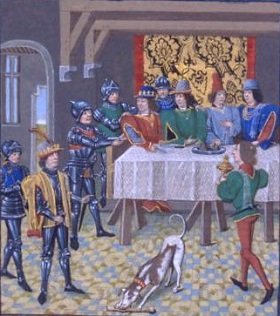
1378: Pierre du Tertre and Jacques de Rue, Charles the Bad men

On this date* in 1378, Jacques de Rue and Pierre du Tertre, aides to King Charles II of Navarre, were beheaded at Les Halles.

Both men were casualties of their devious master’s most recent betrayals, part of a career that had honed the double game to nearly sadistic precision.

Navarre spent the latter half of the 14th century fouling up alignments in the Hundred Years’ War by constantly switching his allegiances between England and France. Come the 1370s, he was supposed to be on team France — having paid homage to the French king in 1371 — but was still conniving with the English whose expeditions might one day apply enough pressure to force France to restore him some lost domains.

The last great plot of the man contemporaries knew as Charles the Bad really fell apart in the spring of 1378 when the French detained en route to Normandy Jacques de Rue and Pierre du Tertre, two emissaries of Charles’s “criminal entourage”. They carried coded messages** confirming that Navarre was not only back to scheming with the English, but that he was trying to orchestrate the assassination of the French king by means of poison — plots that Jacques confirmed under torture.

France retaliated by attacking its disloyal partner’s Norman holdings and by year’s end the whole region had been chopped up between the French and the English, never to return to Navarrese hands. His retainers were put to death and their corpses strung up on Montfaucon.

This was the humiliating end to the political life of Charles the Bad: reduced to a client king dominated by France (to his north) and Castile (to his south). It would soon find its parallel in the horror ending of his actual life on New Year’s Day 1387:

Charles the Bad, having fallen into such a state of decay that he could not make use of his limbs, consulted his physician, who ordered him to be wrapped up from head to foot, in a linen cloth impregnated with brandy, so that he might be inclosed in it to the very neck as in a sack. It was night when this remedy was administered. One of the female attendants of the palace, charged to sew up the cloth that contained the patient, having come to the neck, the fixed point where she was to finish her seam, made a knot according to custom; but as there was still remaining an end of thread, instead of cutting it as usual with scissors, she had recourse to the candle, which immediately set fire to the whole cloth. Being terrified, she ran away, and abandoned the king, who was thus burnt alive in his own palace.

* There are some cites for May 21 out there, but the sourcing on June appears stronger to me, and references to the men’s interrogations and trial run to June. The beheading is also referred to as having taken place on a Monday, which fits June 21 (but not May 21) in 1378.

** According to CryptoSchool this is one of the oldest known documents in the history of cryptology. Devised personally by Charles of Navarre, its gambit was to “move the names of princes, castles and cities to other names not their own.” (Chronique Normande)

On this day..

1375: Niccolo di Toldo, in the arms of St. Catherine of Siena

I have one body
And to you I offer and return it.
Here is my flesh;
Here is my blood;
Let me be slain, reduced to nothing;
Let my bones be split apart
For those for whom I am praying, if such is your will.

-Prayer of St. Catherine of Siena (Source)

This date in 1375 is the best data point we have for the beheading of Niccolo di Toldo.

The Sienese archives offer scant documentation of this political execution; a decree of June 4, 1375 orders his examination for “the discord sowed by him in the city of Siena, pernicious and deadly to the state of the present government” — and a couple of letters on Niccolo’s behalf from the governor of neighboring Perugia. Francis Thomas Luongo in The Saintly Politics of Catherine of Siena — we will come to Catherine presently — next points in lieu of any remaining record of Niccolo’s execution to “the necrology of the Sienese Dominican friary [which] includes an entry for one ‘Nicholaus, familiarius of the Lord Senator,’ who died and was entombed in the cloister of San Domenico on 20 June, the vigil of the feast of Corpus Christi.” It’s not certain that this is the same man but the description fits him, and the date is one week after the last known letter on his behalf from Perugia — which was an appeal for mercy.

We are as ignorant of Niccolo di Toldo’s offense as we are of the date of his death. But his position (in the household of a senator) and his Perugian affiliation suggest him an agent of papal subversion.

Siena’s centuries-long decline from the ranks of Italy’s city-state powers dates ultimately to the Black Death outbreak of 1348. The Plague devastated Siena.

The ensuing generations saw authority in the great Tuscan city furiously contested; the government turned over repeatedly in the 1360s — the Dodici (the Twelve), the Tredici, the Quindici, each an executive committee of interested parties in the coalition of the day.

From the late 1360s and through the 1370s, the Quindici held sway: reformist guild leaders* who were opposed by the the deposed (and by now proscribed) ex-Dodici, Siena’s great magnates in alliance with the papacy. (Luongo delves into Sienese politics in considerable detail in his book.) By year’s end Siena would join a city-state coalition led by Florence that fought a three-year war against the papal states with the excellent name “the War of Eight Saints”.

That coalition and that thrust of policy is likely what a “political subversive” in 1375 Siena would be subverting. And the governor of Perugia appealing to the Sienese for Toldo’s life? He was a French cardinal, kin to Pope Gregory XI.**


Little as we know of Niccolo di Toldo prior to his death, that execution is one of the most famous in all of medieval Europe.

The wretch was comforted in his last days by Catherine of Siena, a young mystic — and, not incidentally, an increasingly influential opponent of the anti-curial political climate. Today, Catherine is the patron saint not only of Siena but of all Europe, and her dessicated head (sawed off her body by devotees for use as a fetish) greets the reverent and the gawker alike, enthroned in its grisly reliquary in the Basilica San Domenico.


(cc) image by Patrick Denker.

Catherine found Niccolo angry at his impending fate, initially refusing to see any spiritual counselor: no state of mind for a soul to meet its maker. Any of the confraternities tasked at this time with succoring those about to face execution would have been charged with bringing such a person to a condition of resignation and penitence.

Catherine achieved her mission to join the doomed man to God but much, much more than that: her account of their relationship, up to the moment when she ecstatically catches his falling bloody head, is a celebration of erotic mysticism. It’s also one of the most famous episodes of the saint’s life.

Niccolo’s virgin helpmate was herself noted for her mystical “marriage to Christ”: in it, Catherine presented her heart to the phantom Savior, and he his ritually circumcised foreskin to her.

Converging religious fervor and carnality mark her interaction with Niccolo, too; at one point she implies that she has sublimated the condemned traitor’s attraction to her into piety, and (as Catherine wrote a follower),

God’s measureless and burning goodness tricked him, creating in him such an affection and love in the desire of me in God, that he did not know how to abide without God, and he said: ‘Stay with me and do not leave me. Like this I cannot but be alright, and I will die content!’ and he had his head resting on my breast. I sensed an intense joy, a fragrance of his blood, and it was not without the fragrance of my own, which I wait to shed for the sweet husband Jesus.

Catherine saw Niccolo di Toldo only twice in the days leading up to his execution. When he went to the block, she was there to meet him: in fact, she was there early and made bold to occupy the condemned’s place on the scaffold, and to stretch her own neck out over the headsman’s block that her kindred spirit would soon soak in gore. It was as if preparing his bridal bed, where she would embrace Niccolo even as the executioner struck — the two as passionately near to one in soul and body as the logistics of a heavy blade’s arc can permit.

[H]e arrived, as a meek lamb, and seeing me, he began to laugh, and he wanted me to make the sign of the cross. When he received the sign, I said, “Come on! to the nuptials, my sweet brother! for soon you will be in life without end.” He got down with great meekness, and I stretched out his neck, and leaning down, I reminded him of the blood of the Lamb. His mouth said nothing but “Jesus” and “Catherine.” And, as he was saying thus, I received his head in my hands, closing his eyes on divine goodness and saying, “I want this!” (“lo voglio”)†

She clutched to herself the lifeless head that had dropped into her lap and beheld “with the greatest envy” Niccolo’s soul ascending in the martyrdom Catherine aspired to. Afterwards, she was reluctant to wash out the clothes spattered with blood from the sacred climax of death.

The Dominican friar Caffarini, an ally of Catherine who was later to become of the principal exponents of her canonization, wrote of the tableau that Niccolo

accepted death while still at a young age, in the presence of the Virgin and with her receiving his head into her hands, with such marvelous devotion that it was like the transitus of some devout martyr and not the death of one who was condemned for a human crime. And everyone watching among whom I was only one was so moved internally and from the heart that I do not remember any previous burial accompanied with as much devotion as that one.


Panel of Francesco Messina‘s 1962 monument to St. Catherine of Siena outside Rome’s Castel Sant’Angelo.

* Apart from the enmity of the papal party, the powerful guild leaders of the Quindici faced working-class opposition that resulted in a 1378 revolt.

** Gregory XI was the guy who moved the papacy back from Avignon to Rome.

† Translated excerpts culled from snippets and excerpts in various locations. Original Italian versions of Catherine’s poetic letters are available in public-domain Google books here; there’s also a recent English translation by Susan Noffke.

On this day..

1650: James Graham, Earl of Montrose

On this day in 1650, James Graham, Earl of Montrose, was hanged in Edinburgh.

The tragic “Great Montrose” was renowned for his tactical genius on the battlefield during the civil wars that cost King Charles I both crown and head. Although Montrose would die as a royalist he first entered the lists in the 1630s’ Bishops’ War as part of the Covenanter army resisting the king’s bid to impose top-down religious governance on Scotland.

But Montrose was the moderate and post-Bishops War found himself a leading exponent of the pro-reconciliation faction, bitterly opposed by the chief of the Campbell clan, the Marquess of Argyll.

These two became the opposing poles for the ensuing civil war in Scotland, at once a local clan war and the vortex of a border-hopping conflict that sucked in Ireland and England too. Although Montrose, now King Charles’s lieutenant-general in Scotland, could kick tail in battle his faction was divided and ultimately outnumbered by the Covenanters. Montrose had to flee Scotland for exile in 1646.

The execution of Charles I opened the door for Montrose’s own untimely end, in one of those classic affairs of double-dealing. The exiled Charles II, having now inherited the claim, named Montrose his lieutenant in Scotland and dispatched his family’s longtime paladin back to native soil to try to raise an army. But even as he did so, he was negotiating with Argyll’s Covenanters, who saw a chance to make good their political and religious objectives by playing kingmaker with their former enemy.

So when Montrose landed in 1650, he found little support and was overwhelmed at the Battle of Carbisdale. After several days’ wandering he sought refuge with a former friend who he did not realize was now also on the government’s side, and was promptly arrested and given over to his enemies for execution and for posthumous indignities: his head was mounted on a pike atop Edinburgh’s Tolbooth, and his four limbs nailed to the gates of Stirling, Glasgow, Perth and Aberdeen.

After the end of Cromwell‘s Protectorate, and the actual restoration of Charles II, these scattered remains were gathered up and interred with reverence at St. Giles Cathedral. The present-day Dukes of Montrose are his direct descendants.

James Graham, Earl of Montrose and his execution have the still more considerable honor of a verse tribute by legendary dreadful poet William McGonagall. (Montrose himself was known to try his hand at poetry, too.)

The Execution of James Graham, Marquis of Montrose
A Historical Poem

‘Twas in the year of 1650, and on the twenty-first of May,
The city of Edinburgh was put into a state of dismay
By the noise of drums and trumpets, which on the air arose,
That the great sound attracted the notice of Montrose.

Who enquired at the Captain of the guard the cause of it,
Then the officer told him, as he thought most fit,
That the Parliament dreading an attempt might be made to rescue him,
The soldiers were called out to arms, and that had made the din.

Do I, said Montrose, continue such a terror still?
Now when these good men are about my blood to spill,
But let them look to themselves, for after I am dead,
Their wicked consciences will be in continual dread.

After partaking of a hearty breakfast, he commenced his toilet,
Which, in his greatest trouble, he seldom did forget.
And while in the act of combing his hair,
He was visited by the Clerk Register, who made him stare,

When he told him he shouldn’t be so particular with his head,
For in a few hours he would be dead;
But Montrose replied, While my head is my own I’ll dress it at my ease,
And to-morrow, when it becomes yours, treat it as you please.

He was waited upon by the Magistrates of the city,
But, alas! for him they had no pity.
He was habited in a superb cloak, ornamented with gold and silver lace;
And before the hour of execution an immense assemblage of people were round the place.

From the prison, bareheaded, in a cart, they conveyed him along the Watergate
To the place of execution on the High Street, where about thirty thousand people did wait,
Some crying and sighing, a most pitiful sight to see,
All waiting patiently to see the executioner hang Montrose, a man of high degree.

Around the place of execution, all of them were deeply affected,
But Montrose, the noble hero, seemed not the least dejected;
And when on the scaffold he had, says his biographer Wishart,
Such a grand air and majesty, which made the people start.

As the fatal hour was approaching when he had to bid the world adieu,
He told the executioner to make haste and get quickly through,
But the executioner smiled grimly, but spoke not a word,
Then he tied the Book of Montrose’s Wars round his neck with a cord.

Then he told the executioner his foes would remember him hereafter,
And he was as well pleased as if his Majesty had made him Knight of the Garter;
Then he asked to be allowed to cover his head,
But he was denied permission, yet he felt no dread.

He then asked leave to keep on his cloak,
But was also denied, which was a most grievous stroke;
Then he told the Magistrates, if they could invent any more tortures for him,
He would endure them all for the cause he suffered, and think it no sin.

On arriving at the top of the ladder with great firmness,
His heroic appearance greatly did the bystanders impress,
Then Montrose asked the executioner how long his body would be suspended,
Three hours was the answer, but Montrose was not the least offended.

Then he presented the executioner with three or four pieces of gold,
Whom he freely forgave, to his honour be it told,
And told him to throw him off as soon as he uplifted his hands,
While the executioner watched the fatal signal, and in amazement stands.

And on the noble patriot raising his hands, the executioner began to cry,
Then quickly he pulled the rope down from the gibbet on high,
And around Montrose’s neck he fixed the rope very gently,
And in an instant the great Montrose was launched into eternity.

Then the spectators expressed their disapprobation by general groan,
And they all dispersed quietly, and wended their way home
And his bitterest enemies that saw his death that day,
Their hearts were filled with sorrow and dismay.

Thus died, at the age of thirty-eight, James Graham, Marquis of Montrose,
Who was brought to a premature grave by his bitter foes;
A commander who had acquired great military glory
In a short space of time, which cannot be equalled in story.

On this day..

1548: Giulio Cybo, Andrea Doria disaster

On this date in 1548, Giulio Cybo was beheaded in Genoa for plotting against his father-in-law Andrea Doria.

Cybo (English Wikipedia entry | Italian) was a babe of barely 20 when he died, the whole of his short life lost to frustrating defeats in the skein of peninsular and familial politics.

His parents were the original Cybo and Malaspina whose union founded the Cybo-Malaspina house that until the 18th century ruled the small Duchy of Massa and Carrara where Liguria meets Tuscany.

Successful though their line might prove, theirs was a house divided and the parents’ rivalry for precedence in their territory transferred to their two sons. Thus Giulio, the father’s favorite, makes his first appearance on history’s stage invading Massa with a cohort of gendarmes to seize power from his own mother.

The success of his rude maneuver was short-lived and mom soon restored her authority — backed by the imperial forces haunting the land during the interminable Italian Wars. Although Giulio was married to the daughter of the Genoese admiral Andrea Doria,* whose word was law in that city, the in-laws frustratingly stiffed him out of the dowry payment that Giulio intended to use to restore his Freudian conquest.

These material grievances, and a young man’s wide streak of tragic impetuousity,** drove Giulio into the arms of Giovanni Luigi Fieschi. The latter was a Genoese nobleman whose dramatic plot to topple Doria failed with operatic† absurdity in 1547 when Fieschi mid-coup fell off a gangway and drowned in the harbor. Only in Genoa.

Cybo’s complicity in this scheme could not be proven because he arrived too late to do anything other than make a politic show of support for the already-victorious Doria. But now, encouraged by the French — the Habsburg empire’s enemy in the aforementioned Italian Wars and therefore the sponsor of its every rival faction — Cybo gathered some fellow malcontents in Venice and began working up a plot to oust Doria, restore the liberty of Genoa, and really put all the parents in their place. Once bitten, however, the wily old Doria was on the lookout for these troublemakers and had Cybo’s circle infiltrated early. The young man was arrested en route back to Genoa to implement his design.

The letters of the Fieschi [family] which were found on his person left no room to doubt his guilt. Some tell us that he was several times tortured and confessed that Farnese, Maffei, Ghisa and the Pope himself were accomplices in the plot, and that the Fieschi and Farnese were its instigators.

The emperor did not wish to execute Cybo; and we find evidence in documents of the period that even the bloodthirsty Gonzaga made every exertion to save him. On the other hand Graneville and Doria laboured with all their power to secure his punishment. In fact, so soon as Doria heard of this plot, committed rather in intention than act and excusable by the youth of the conspirator, “the prince (I use the words of Porzio) inflamed to wrath by the offence and full of vengeful animosity, disregarded the double tie which bound him to the young man, and made incessant appeals to Caesar for the blood of his relative.”

Many Italian and foreign princes asked grace for the prisoner, and the emperor was at first undecided; but severity triumphed over mercy — Doria desired vengeance and he obtained it. The victim met his fate with manly intrepidity. He was beheaded and his body exposed between two wax candles in the public square … on the 18th of May, 1548. He was scarcely twenty years of age.

Porzio says: —

His courage and military capacity inspired all who knew him with the conviction that, if he had not perished in boyhood, he would have become one of the first captains of his age. He made a single mistake: that of endeavouring to expel one foreigner with another — to drive out the Spaniards in order to establish the French in Italy.

* This man, one of the great naval captains of his age, was of course the namesake of the Genoese ocean liner Andrea Doria that sank in 1956.

** Cybo “liked not to rest contented in the battle of life,” was James Bent’s judgment, although it is difficult to tell that he ever had the option to do so.

** Well, stage-worthy at any rate: Fieschi’s fiasco is the basis of Schiller’s play Fiesco.

On this day..

1356: Four friends of Charles the Bad

On this date in 1356, the French King John II — John the Good, to history — avenged himself on his cousin and rival, Charles the Bad.

This affair embroils us in the French dynastic turmoil that spawned the Hundred Years’ War: five months after the nastiness in this post, King John was an English prisoner following the catastrophic Battle of Poitiers. It’s a good job he got his revenge in when he had the chance.

The fight — in its largest sense — was all about the throne of France, the poisonous fruit of the dynasty-wrecking Tour de Nesle affair of royal adultery decades before. That affair destroyed two princesses who could have become queens, and with it the potential of legitimate heirs for their husbands. With the family tree’s next generation barren, succession passed from brother to brother until the last brother died.

So now who’s big man in France?

Awkwardly, the last king’s nearest male relative also happened to be the king of France’s rival — his nephew, Edward III of England.

France barred Edward with a quickness, on the grounds that Edward was related via a female line. That put the patrimony in the hands of John the Good’s father, a previously un-royal cousin known as Philip the Fortunate. Less fortunately, this succession also conferred upon the new Valois line Edward’s rival claim and the associated interminable violent conflict.

Besides these two, there was yet another cousin who aspired to the French scepter: our guy Charles the Bad, King of the Pyrenees-hugging realm of Navarre. This guy’s mother had her legitimacy cast in doubt by the whole Tour de Nesle adultery thing years ago, and her woman bits had ruled her out of ruling France — but not Navarre. (No Salic Law in Navarre: a digression beyond this post.)

So Charles, her son and heir in Navarre, was at least as close to the Capetian dynasty as were his cousins — and maybe closer. He was also “one of the most complex characters of the 14th century,” in the judgment of Barbara Tuchman (A Distant Mirror: The Calamitous 14th Century). “A small, slight youth with glistening eyes and a voluble flow of words, he was volatile, intelligent, charming, violent, cunning as a fox, ambitious as Lucifer, and more truly than Byron ‘mad, bad and dangerous to know.’

“His only constant was hate.”

And Charles sure hated King John. Was it the political rivalry? The daughter John had foisted on him as a bride? The territory John nicked from Navarre to confer on John’s favorite as Constable of France?* Yes.

Charles had subtlety in his bag of clubs, and brutal directness too. In 1354, he revenged at least one slight by having his brother murder the aforementioned Constable — also a favorite and childhood friend** of King John — in a tavern ambush.

(There’s an audio introduction to Charles the Bad complete with hammy re-enactment of the homicide in episode 110 of the History of England podcast. What follows below leads off episode 111.)

Too weak politically at that moment to repay Charles in his own coin, John had to sullenly consent to a putative reconciliation … but he was only biding his time. Charles compounded the enmity by his scheming on-again, off-again negotiations with the English, hoping to leverage the war between those powers to his own advantage.

He was a constant thorn in King John’s side, and the latter had problem enough with the English invasions and the struggle he had to gin up tax revenue to oppose them. The apparent last straw: Charles buddied up to John’s son the Dauphin and tried to engineer a coup d’etat against John. John settled on a vengeful stroke to put both the King of Navarre and the crown prince in their places, a party-fouling scene to beggar Game of Thrones in Froissart’s description:

The king of France, on Tuesday the 5th of April, which was the Tuesday after midlent Sunday, set out early, completely armed, from Mainville, attended by about one hundred lances. There were with him his son the earl of Anjou, his brother the duke of Orleans, the lord John d’Artois, earl of Eu, the lord Charles his brother, cousins-german to the king, the earl of Tancarville, sir Arnold d’Andreghen, marshal of France, and many other barons and knights. They rode straight for the castle of Rouen, by a back way, without passing through the town, and on entering found, in the hall of the castle, Charles, duke of Normandy, Charles king of Navarre, John earl of Harcourt, the lords de Preaux, de Clerc, de Graville, and some others seated at dinner. The king immediately ordered them all, except the dauphin, to be arrested, as also sir William and sir Louis de Harcourt, brothers to the earl, the lord Fricquet de Friquart, the lord de Tournebeu, the lord Maubué de Mamesnars, two squires called Oliver Doublet and John de Vaubatu, and many others. He had them shut up in different rooms in the castle; and his reason for so doing was, that, since the reconciliation made on occasion of the death of the constable of France, the king of Navarre had conspired and done many things contrary to the honour of the king, and the good of his realm: the earl of Harcourt had also used many injurious expressions in the castle of Vaudreuil, when an assembly was holden there to grant a subsidy to the king of France against the said king, in order to prevent, as much as lay in his power, the subsidy from being agreed to. The king, after this, sat down to dinner, and afterwards, mounting his horse, rode, attended by all his company, to a field behind the castle, called the Field of Pardon.

The king then ordered the earl of Harcourt, the lord of Graville, the lord Maubué and Oliver Doublet to be brought thither in two carts: their heads were cut off,† and their bodies dragged to the gibbet at Rouen, where they were hung, and their heads placed upon the gibbet. In the course of that day and the morrow, the king set at liberty all the other prisoners, except three: Charles king of Navarre, who was conducted to prison in the Louvre at Paris, and afterwards to the Châtelet: some of the king’s council were appointed as a guard over him. Fricquet and Vaubatu were also confined in the Châtelet. Philip of Navarre, however, kept possession of several castles which the king his brother had in Normandy, and, when the king of France sent him orders to surrender them, refused to obey, but in conjunction with the lord Godfrey de Harcourt and other enemies of France, raised forces in the country of Coutantin, which they defended against the king’s troops.

* The post was vacant because the previous Constable had been executed.

** And distant kin, but who isn’t?

† By a convenient prisoner dragooned into the duty, who required many more hacks at the bone than there were heads to sever.

On this day..

1560: Baron de Castelnau, for the Amboise Conspiracy

On this date in 1560 the second Baron de Castelnau, Jean Boileau, was beheaded as a Huguenot traitor. His was one of the opening casualties of France’s devastating Wars of Religion.

We find Castelnau’s end before war began, when the Huguenot party — although it had been pressed sorely enough for martyrmaking in the years of the Reformation — was perhaps not yet quite steeled for the measure of purposeful violence it would require to conquer state power. After the events in this post, the great Huguenot leader Gaspard de Coligny would remonstrate at a royal Council of Notables protesting the loyalty of the realm’s Protestant subjects. Two years later, he was commanding rebels in the field; a decade later, he would be murdered in the St. Bartholomew’s Day Massacre.

“Rashly designed and feebly executed,”* the plan of these 1560 pre-rebellion Huguenots was to tilt France’s religious policy by muscling out the top Catholic.

If it were possible to imagine such a gambit it was amidst the flux following King Henri II‘s sudden death at the jousts in 1559. his sickly 15-year-old heir Francis was dominated by the staunchly Catholic Duke of Guise; policy accordingly trended away from religious accommodation for the Calvinist Huguenot minority.

Considering the new king’s youth and Guise’s prestige, here was the potential to lock in for decades to come a situation intolerable to France’s Protestants. (In actual fact, Francis had not long to live himself and the country soon fell into civil war … but the characters in this post did not have the benefit of hindsight.)

So the muscling-out plan was born: the Amboise conspiracy. Named for the castle where the attempt was unsuccessfully executed, this plot aimed to seize the Duke of Guise by main force and begin forcing a more satisfactory policy direction on the malleable sovereign.

This scheme became very widely known among Protestant nobles and even bourgeois, who variously signed on or demurred; no surprise, someone in the ever-widening circle of confidantes eventually leaked it to the court. Guise quietly made ready the castle at Amboise to repel the putsch, and when the attempt was made in mid-March it was not the Catholics but the attacking Huguenots who were surprised and routed. Over 1,000 men involved in the attempt were slaughtered in the ensuing days — by the rope, the sword, or the waters of the Loire. Its chief architect, La Renaudie, was killed in the skirmishes but his corpse was still posthumously mutilated.


Castelnau’s beheading is foregrounded

The Lord Castelnau’s detail for the conspiracy was to seize the nearby Chateau Noizay. He did so only to discover himself in a most embarrassing position when his comrades were crushed. The Guise-allied young Duke of Nemours persuaded Castelnau to surrender under safe conduct:

“Lay down your arms then,” said Nemours, “and if you wish to address the king as becomes a faithful subject, I promise you, upon my faith, to enable you to speak to the king and to bring you back in safety.”

Castelnau, in consequence, surrendered the castle of Noizai to the Duke of Nemours, who took an oath and signed it, that no harm should happen to him or his followers. They went together to Amboise, where the unfortunate baron found that the promise which had been made him was not binding, for the Duke of Nemours had exceeded his orders.

Castelnau’s bravery did not forsake him on the scaffold, where he died a martyr to his religion; the Duke of Nemours felt very indignant at the circumstance, as he had given his signature, which tormented him probably much more than it would have done if his word alone had been passed. (Source)

This traitorous conspiracy — and the ferocity of its destruction — helped to initiate the ensuing years‘ tit-for-tat confessional violence that plunged France headlong into the Wars of Religion (and got Guise himself assassinated in 1563). “A morbid desire to witness the shedding of blood seized upon society,” one historian wrote. “D’Aubigne the eminent historian of the French Reformation, was an eye-witness of such incidents, and though but ten years of age, swore like young Hannibal before his father, to devote his life to vengeance of such atrocities.”

A century-plus after events in this post, when France revoked the Edict of Nantes and resumed official harassment of Huguenots, the Baron Castelnau of that time (our Jean Boileau’s great-grandson) was clapped in a dungeon. His son and heir Charles escaped to England where the family continues to this day — the Boileau Baronets.

* Cambridge Modern History, vol. 14.

On this day..

Unspecified date: Mariotto Mignarelli, proto-Romeo

On a never-specified date in 15th century Siena, the tragic lover Mariotto Mignarelli was beheaded in Masuccio Salernitano‘s story Mariotto and Ganozza — the apparent wellspring (via an English interlocutor) for Shakespeare’s Romeo and Juliet.


Mid-16th century translation of Romeus and Juliet by Arthur Brooke. (via)

Masuccio’s tale is itself an Italian Renaissance gloss on an old Ovid story; its outline will be instantly recognizable to devotees of the Capulets and Montagues. But instead of dueling suicides, Masuccio ends one of the star-crossed lovers with an executioner’s blade.

In Mariotto and Ganozza, which can be enjoyed for free in the original Italian here or here, the young lovers secretly wed only to find “that wicked and hostile fortune reversed all their present and future desires.”


These violent delights have violent ends
And in their triumph die, like fire and powder …

“Fortune’s” inscrutable hand turns out to be that of Mariotto himself, who gets into a fight with some other nobleman and, slaying him, must flee into exile. Posterity must excuse Mariotto/Romeo his hotheadedness, for were he not the type to wreck his own life by murdering a guy in a street fight he also wouldn’t be the type to pursue forbidden tragic romance. That’s art.


Fortune’s fool …

“How great was the supreme grief of the two most wretched lovers, so lately wed, and how bitter their tears at the thought of what they believed to be their endless separation, he alone who has been pricked by such wounds can truly tell.” (Translation source.)

“So deep and bitter it was, that at their last parting, they seemed for a long while to have died in each other’s arms.”

It next comes to pass that Gianozza’s father, ignorant of her secret marriage to the town fugitive, arranges a match for her. This development leads our Juliet figure to seek out the aid of the friar who has secretly wed them in a scheme that is precisely Shakespearean.

The friar “made up a certain water with certain concoctions of various powders that, when the draught was ready and she had drunk it, it would not only make her sleep for three days, but seem to be really dead.” With this potion they stage Gianozza’s death; then, the friar secretly steals her hibernating “corpse” from its tomb, revives her, and packs her off to find her beloved.

He, of course, has separately received word of Gianozza’s death — and (also of course) the courier that had been dispatched pre-death elixir to clue him into the plan has been waylaid by pirates and left his essential plot spoilers at the bottom of the sea.

Disconsolate, Mariotto returns to Siena with the unproductive object of mooning over Gianozza’s grave and “weep[ing] as if their lives were ended.” Don’t worry, he has a backup plan! “If by misfortune he was recognized, he thought he would gladly be condemned as a murderer, knowing that she was already dead whom he loved more than himself and who loved him with equal love.”

This works as well as you expect, albeit with less panache than Shakespeare’s crypt climax: Mariotto gets caught in a transport of the macabre trying to break into Gianozza’s sepulcher, and is recognized as a condemned outlaw.

Before dawn, all Siena was full of the news, which reached the ears of the Court, who ordered the mayor to go and arrest him and quickly do that which the laws and the State commanded.

So, a prisoner in fetters, Mariotto was led to the palace of the mayor. When he was flogged, without needing long tortures, he faithfully confessed the cause of his desperate return. Though all alike had the greatest pity for him, and amongst the women he was bitterly wept for and thought the only perfect lover in the world, and each of them would have willingly redeemed him with her own life, yet he was at once condemned by the law to be beheaded. When the time arrived, without his friends or parents being able to aid him, the sentence was carried out.

Three days later, Gianozza — having reached Mariotto’s former refuge of exile and there learned of his misapprehension — turns up in Siena again only to discover that she is too late. Rather than stabbing herself to death right then and there as the Bard’s heroine would do, she shuts herself up in a convent “with intense grief and tears of blood and little food and no sleep, continually calling for her dear Mariotto, [and] in a very short time ended her wretched days.”


Prokofiev’s unwilling balletic finale

On this day..

845: The 42 Martyrs of Amorium

March 6 is the feast date of the 42 Martyrs of Amorium, the day in the year 845 when they submitted to the caliphate’s executioners in preference to conversion.

Though they were people of rank in their lifetimes, most of them are not known to posterity by name or even position. Devotionally, they govern no special sphere of intercession; iconographically, they have no special device. When depicted (itself unusual) it is simply as a gaggle of generic courtiers.*

It seems a fitting fate for mere individuals ground up between states and faiths; even so, their weedy tombs mark a fork on the path trod by Byzantium.

The 42 earned their martyrs’ crowns at the end of seven years’ imprisonment, so it is to the Byzantine war with the Abbasid Caliphate in 837-838 that we must return to unravel their story. This war was itself merely the resumption of a conflict that had been ongoing between the civilizations for two centuries since Arab conquerors emerged from the desert to found an empire.

With the connivance, encouragement, or cajoling of anti-caliphate rebel Babak Khorramdin, the young Byzantine emperor Theophilos broke four years of tense peace with destructive effect in 837, ravaging the Upper Euphrates.

“He captured and burned the fortress of Zapetra, putting to death the male population and carrying off the women and children,” John Bury wrote in A History of the Eastern Empire from the fall of Irene to the Accession of Basil I. Upon his return to the mandatory official Triumph, “[t]roops of children with garlands of flowers went out to meet the Emperor as he entered the capital. In the Hippodrome he competed himself in the first race, driving a white chariot and in the costume of a Blue charioteer;** and when he was crowned as winner, the spectators greeted him with the allusive cry, ‘Welcome, incomparable champion!'” Because the one thing 200 years of engaging the Arabs in back-and-forth raids, counterattacks, and suits for peace had taught Byzantium was that victories would surely prove durable.

In truth this war was also politics by other means — domestic politics, that is.

Theophilos really did aspire to incomparable championhood of something far more important than the position of the frontier: in matters religious, he was a stringent iconoclast and he meant to win Christendom firmly over to this philosophy.

The century-old schism within the communion — pitting iconoclasts, like Theophilos, who condemned as idolatrous the veneration of religious imagery against iconophiles or iconodules who embraced it — itself likely owed much to the stunning march of Arab arms and the wound Caliphate success had inflicted on a state and faith that had formerly presumed itself hegemonic. It was certainly the case that Roman superstition† perceived in the battlefield results of imperial adherents to the rival icon’isms a going divine referendum. God says go with whichever icon policy starts beating Islam!

Well might the triumphant Theophilos preen, then — right before the fall, like the Good Book says. Gibbon charged that Theophilos “was rash and fruitless” and “from his military toils he derived only the surname of the Unfortunate.”

The caliph al-Mu’tasim counterattacked the Unfortunate ruthlessly in 838, invading Anatolia in two huge columns that converged on a major city, Amorium.‡ There, they penetrated the city’s walls and put her to the sack — slaughtering unnumbered thousands and carrying away most survivors as slaves, outrageously unmolested by the chastisement of any Byzantine army.


12th century illustration from the Madrid Skylitzes, an edition of the chronicle written by 11th century Greek historian John Skylitzes. The volume was produced in Sicily; it’s got “Madrid” in the name because that’s where the sole surviving copy of it resides today.

Byzantium might have been fortunate on this occasion that, before he could extend his conquest, al-Mu’tasim’s domestic politics promptly recalled him to the caliphate to deal with plots against his own throne. But the raid devastated the martial credibility of Theophilos the incomparable champion, and with it the credibility of iconoclasm. Nor can there have been much fortune reckoned by the thousands of prisoners marched out of the smouldering ruins of Amorium to the new Arab capital Samarra — among whom we find this post’s titular 42 martyrs.

They were, or at least seemed, the crown jewels among the captives, meaning the ones with cash value. Constantinople and Samarra would engage in periodic negotiations over the next several years to exchange them; the Caliphate’s insistence on obtaining for their return a treasure equal to the cost it had incurred to attack Amorium in the first place put an unbridgeable gap between the sides.

The nameless and rankless commoners among them went to their nameless destinies; undoubtedly their experience was cruel and many died or were killed, but for those who endured the tribulations there was a return to hearth and home in a prisoner exchange in 841.

For the VIPs, deliverance sank into the Mesopotamian mud.

Both Theophilos and al-Mu’tasim died in 842 and sometime around there the respective empires seem to have given up trying to resolve the impasse about the Amorium ransom. A few more years on with no apparent relief forthcoming from the annoyance of maintaining these now-useless prisoners of war, someone in Samarra decided to dispose of them with the ultimatum.

Their martyrs’ glory assured their afterlife in Byzantine religious propaganda. Yes, these two Christian sects had made martyrs of one another within the empire. But iconoclasm really hinged on one crucial argument fatally undone by the 42 martyrs: victory. The pro-icon emperors from 797 to 813 had been associated with retreat and humiliation;§ one had even been killed on campaign in the Balkans leaving the Bulgar king Krum to fashion the imperial skull into a ceremonial goblet. That the iconoclast rulers of the succeeding generation had at least stabilized the situation was their ultimate scoreboard taunt. Amorium dispelled that glow of providential favor, especially when followed by the years-long abandonment of that razed city’s noble hostages to the heathen dungeon.

Little could the monk Euodios know that his iconoclasm-tweaking hagiography of these martyrs would prove a redundant step.

The late Theophilos had only an infant son, so governance after his death fell to a regency led by the empress Theodora. Despite her dead husband’s scruples, Theodora didn’t mind an icon one bit, and restored icon veneration to a favor it would never again lose for the six centuries remaining to Byzantium.

* See for example the leftmost group on the second row in this image. (Located here)

** One of the principal charioteering teams/factions that had, centuries before, nearly overthrown Justinian and Theodora.

† Among the Romans themselves for whom supernatural causation was an assumed fact on the ground, superstitio had a more attenuated meaning, contrasting with religio. That is far afield for this post; I use the term here advisedly from a post-Enlightenment cosmology.

‡ Amorium is no more today: just a ruin buried under a village. But not because of this siege.

§ Charlemagne being crowned “Holy Roman Emperor” in 800 was also a gesture of disregard for a weakened (and at that moment, female-ruled) Byzantium, which dignified itself the Roman Empire despite having long since abandoned Rome itself.

On this day..

1554: Henry Grey, Duke of Suffolk

On this date in 1554, Tudor nobleman Henry Grey — who for nine days had been the father of the queen — was beheaded at Queen Mary’s command.

He was one of the inveterate schemers who grappled to secure his family’s foot upon the throne during the uncertain years when Edward VI succeeded Henry VIII. Frail and underaged, Edward’s foreseeable early death without issue created a situation where the cream of the aristocracy could plausibly dream themselves the namesakes of the next great English dynasty. Heck, the late royal monster was himself just the son of the guy who had taken the throne in battle by offing the previous dynasty, an event still knocking about in a few living, wizened memories.

So for the late 1540s into the early 1550s the court’s nigh-incestuous parlor game of consanguinary bedroom alliances was played for the highest stakes.

Queens were wild at this table. Henry VIII’s will had queued up the succession after Edward with his two half-sisters, Mary and Elizabeth, followed next the three daughters of our man Henry Grey — because Henry Grey was married to King Henry’s niece. (That niece got cut out of the succession herself, however.) It was Henry’s fond hope, but not his kingdom’s destiny, that Edward would have grown up to sire a male heir who would render academic the ladies’ pecking-order.

But until that time the order mattered, and Henry Grey — let’s just call him Suffolk for simplicity’s sake even though he doesn’t obtain that title until 1551; he’d previously been Marquess of Dorset — started angling to jump the queue by cuddling up to King Edward.

There was a concoction with Thomas Seymour in the 1540s to orchestrate the marriage of Suffolk’s oldest daughter Jane Grey to Edward, where the Grey family could do the heir-siring directly; but, Edward’s other guardians discovered and scotched the plan. Yet even though young Edward didn’t put a ring on it, he so favored this family — and, a staunch Protestant, he so feared the potential succession of his Catholic sister Mary — that Edward when dying drew up his own will designating this same Jane Grey as his heir while declaring Mary and Elizabeth illegitimate.*

This was actually a coup not so much for Suffolk as for the realm’s de facto executive, John Dudley, Duke of Northumberland — who had been the one to secure Jane Grey’s hand in marriage to Dudley’s own son, Lord Guildford Dudley. Both were teenagers: it was Northumberland who meant, through them, to rule. It need hardly be added that Suffolk was pleased enough in 1553 to tie his family’s fortunes to the big man on campus.

The plan’s speedy and total failure is well-known but that is not the same as saying it was foreordained. England had to this point never submitted to a female sovereign ruling in her own right; Mary, an on-again off-again bastard during the wild realignments of Tudor dynastic politics, was a Catholic who had remained nearly cloistered on her estates for the past several years, rarely seen at court. How much “legitimacy” would she command when the chips were down, against Northumberland who already had the apparatus of state in his hand? For the chance to make the Tudors just the overture to the glorious era of Dudley England it was surely worth a roll of the bones.

At any rate, Edward died on July 6, 1553 and Lady Jane Grey was duly pronounced queen on July 10 — the “Nine Days’ Queen” for the span of her reign before Mary supplanted her. On that very same July day a letter from Mary, gathering her adherents in Dudley-hostile East Anglia, arrived to the realm’s ruling clique demanding her own prompt recognition. Even as Northumberland marched out to fight for Jane’s rights (and his own) English grandees were going over to Mary’s claim in a landslide. That’s legitimacy for you: when you’ve got it, you’ve got it.

It was Dudley who caught the brunt of Mary’s wrath in this instance; the kids (quite rightly) were understood as his pawns and stored away in the Tower, heads firmly attached to shoulders but under a dangling treason conviction with which Mary could destroy them at her whim. That time would not be long in coming: as many monarchs have found before and since, a living rival claimant, however submissive, poses a grave danger just by breathing in and out.

Suffolk made sure of it — and doomed his daughter in the process.

Although he already owed his life and his liberty to Mary’s clemency to the onetime friends of Northumberland,** Suffolk wagered both desperately as one of the chief conspirators in Thomas Wyatt‘s January 1554 Protestant rising. This attempted restoration of Protestant power in the kingdom brought fighting to the walls of London and gave the shaken Queen Mary cause to close one security gap by having the Nine Days’ Queen beheaded on February 12, 1554 — while, to far fewer tears, avenging another more self-evident treason by executing Jane’s father as a rebel, too.

* King Edward didn’t have a beef with the Protestant Elizabeth; it’s just that as a legal matter she was either in or out on the line of succession by the same logic that Mary would be in or out. The point was to disinherit Mary.

** Suffolk’s wife, the one whom Henry VIII cut out of the female succession scramble, was friendly with Mary and got hubby released from the Tower post-Northumberland with a slap on the wrist.

On this day..