1785: Three at Shrewsbury, in depraved times

The assize model we’ve been featuring this week surely underscores during the Bloody Code days the law as a wholesale instrument.

For a site like this which prefers to zero in on a story for the day, the phenomenon is most discomfiting. But even if executions in the Anglo world have for the past century or two mostly unfolded as individual tragic stories arcing from beginning through middle and end, they have still merely sat atop a legal machine that grinds up lives by thousands.

The specter of the noose perhaps highlights the trend in a way that “mere” terms of years does not quite dramatize for us. Even so, now as then, no small number of convicts prefer the hemp to the life-destroying “mercy” of a lengthy prison sentence or penal transportation overseas.

All of this is mere commentary for today’s hanging trio, who are criminals of no consequence with misdeeds but scantily attested; their trials, like most in that period, would have spanned only minutes or at most a couple of hours, and been determined by gentlemen already looking ahead to the next case. “The hungry judges soon the sentence sign, and wretches hang that jurymen may dine”: Alexander Pope had set that line down in The Rape of the Lock more than 70 years before.

“The capital convictions of the late Lent assizes, exhibit a most melancholy picture of the depravity of the times,” lamented the Leeds Intelligencer taking stock on April 5, 1785 of that season’s legal bulletins. “The following short list will prove it; — at Shrewsbury 11, York 7, Derby 6, Lincoln 9 (executed), Gloucester 11, Nottingham 4, (executed) Stafford 3, (executed) and Dorchester 5. There were 112 tried at Gloucester.”

Shrewsbury split its sentences, five for the scaffold and six for reprieve; the last three of the doomed lost their lives on this date in 1785 for various property crimes. These few words on the Salopean assizes were printed in several newspapers, and are quoted here from The British Chronicle, or, Pugh’s Hereford Journal, March 31, 1785:

At the assizes for Shropshire, which ended at Shrewsbury on Wednesday night last, John Green, for the wilful murder of his wife Elizabeth Green, by shooting her through the head, in a cellar in his own house, at Bromfield near Ludlows, and Ann Hancock, for the wilful murder of her male bastard child, at her lodgings in the Castle-foregate, in Shrewsbury, being fully convicted, received sentence of death, and were on Friday [March 18, 1785] executed at the Old Heath, pursuant thereto, and their bodies were delivered to the surgeons to be anatomized. At the place of execution Ann Hancock comfessed the fact for which she suffered, but Green did not.

Here the Shropshire narrative breaks, consigning the remaining death sentences to the newspaper’s dregs.

Image: 'For the Remainder of these Pests, see the last Page.'

… where we find:

The nine following persons were also capitally convicted, and received sentence of death, viz. William Williams, for burglariously stealing 130l. and upwards, the property of Mr. Edw. Jeffreys; Edward Edwards, for burglariously stealing a considerable sum of money, the property of Robert Pemberton, Esq; Sarah Davies, for housebreaking; William Griffiths, for stealing a black mare; Mary Davies, Rich. Pyfield, Mary Boulton, alias Bolton, William Evans, and William Hotchkins, for burglaries. The six latter were reprieved; and William Williams, Edward Edwards, and Sarah Davies, left for execution.

The hangings took place on March 26.

Part of the Themed Set: Shropshire.

On this day..

1775: Joseph Skidmore, carrier

From the London General Evening Post, Dec. 15-17, 1774

Extract of a letter from Birmingham, Dec. 15.

On Sunday morning last Ann Mansfield, the widow of a soldier, and lately a servant to Mr. Richard Wilson of this town, on her return to her father, who lives at Cradley, near Stourbridge, was found on the road, about half a mile beyond Hales-Owen, barbarously murdered. It is supposed, from the circumstances under which she was found, that she had been also ravished: her hair was dishevelled, her handkerchief and cap torn off, and her under petticoat lay by her side.

When she set out from hence, she had a small bundle, containing a new pair of stuff shoes, one pair of pattens, a black silk handkerchief, with lace to trim it, and sundry other things of small value; a new black silk hat pinned to her side, and wore a black and a white cloak, over both of which she pinned a white hat; which were all taken away.

A strong suspicion prevails against the S———- carrier (behind whom she rode through Hales-Owen the night before) who not only that night delivered a woodcock and some light parcels in S———-, but sent on Sunday morning her two cloaks to her father by two chimney-sweepers, who were both stopped, in order to undergo an examination. — The carrier is also taken up.

This “letter” was printed in several English newspapers; sometimes abridged for space needs, in time it appears to have evolved with the progress of available facts and suppositions.

Here it is in the Leeds Intelligencer for Dec. 27:

On Saturday evening last, Ann Mansfield having left the service of Mr. Richard Wilson, was returning to her father, who lives at Cradley, near Stourbridge, and for that purpose had sent part of her things by the carrier, and intended to have accompanied him herself; but calling on her sister, who lives with Mrs. Horton, in Mount-Pleasant, was detained till near dark, when the mistress very humanely begged her to stay all night, as it was impossible for her to overtake the carrier; but neither Mrs. Horton’s kindness nor her sister’s persuasions could prevail, for she unhappily persisted in her design of going home; and what is very remarkable, on leaving the house complained (to make use of her own expression) or a sinking at her heart.

She had with her a small bundle, containing a new pair of stuff shoes, one pair of pattens, a black silk handkerchief, with lace to trim it, and sundry other things of small value; a new black silk hat pinned to her side, and one black and one white cloak, both of which she wore, and a white hat pinned over them.

Some time yesterday morning she was found murdered near the spot where the Darbys are now hanging. — She is supposed from the situation she was found in to be ravished, and that the villains who perpetrated the horrid fact stuffed something in her mouth to prevent her alarming the neighbours with her cries, as no wounds of consequence enough to cause her death appeared outwardly, but the skin is forced off her hands and fingers, as supposed by struggling.

When found, she had her hair dishevelled, her handkerchief and cap torn off, and every thing of value taken away. — She had only four-pence in her pocket, which she intended to give the carrier. She was carried to Hales-Owen church.

Two fellows are taken up on suspicion of committing the horrid crime, one of whom had a white cloak in his pocket, supposed to belong to the unfortunate young woman, and they are sent this morning for examination. It appears that the carrier before-mentioned waited for this poor young creature and took her behind him, and was met by many people; which getting wind the carrier was taken up, and it is feared is too justly suspected, as he greatly prevaricates.

However much embroidery affects this story, we have a sense of the event — and of the dangers of an unlit nighttime road.

That this attack was (quite deservedly) recognized as the most egregious crime handled at Shrewsbury’s Lent 1775 assizes can be seen in the disposition of the sentences. This from Say’s Weekly Journal of April 1, 1775:

At Shrewbury assizes the following persons received sentence of death, viz. John Parry, and William Roberts, capitally convicted last assize, for plundering a wreck; Joseph Skidmore, for the murder of Ann Chandler, in a lane near Hales-Owen; Edward Stol, for horse stealing; Jane Aston, for stealing household goods; Samuel Thomas and Philip Jones, for horse-stealing; and Jemima Asplin, for breaking out of gaol, after having received sentence of transportation at last county sessions. — A respite during his Majesty’s pleasure was received for Roberts on Thursday; Aston, Thomas, Jones, and Asplin were reprieved; and Parry, Stol, and Skidmore, left for execution, the latter of whom suffered on Saturday last.

Just why the victim has become “Ann Chandler” instead of “Ann Mansfield” nor which a historian ought to prefer I cannot determine. But after Skidmore’s March 25 hanging, and the April 1 execution of Parry, all the others condemned at the 1775 assizes were reprieved their death sentences.

Part of the Themed Set: Shropshire.

On this day..

1823: John Newton, violent spouse

(Thanks to Meaghan Good of the Charley Project for the guest post. -ed.)

On this date in 1823, 40-year-old farmer John Newton was hanged for the murder of Sarah, his wife, who was heavily pregnant with their fifth child.

What happened is this: George Edwards, a local man, stopped by the Newton house and asked John for repayment of three shillings owed him for a lamp he’d sold the couple. In response, John flew into a rage, saying he had already given Sarah the money to settle the debt. This wasn’t the first time she’d done this, he told Edwards, and she had to be taught a lesson. He called Sarah into the room and threatened to thrash her.

Edwards was aghast and begged John not to hurt his wife, saying he’d rather forget about the three shillings altogether than have John do something so stupid. The three of them sat down and shared several jugs of weak beer — Edwards refusing to depart until John promised he would not hurt Sarah. As he left, he warned John that if he abused his wife, he, Edwards, would never speak to him again.

In the early hours of the next morning, John showed up at Edwards’s house and asked him for directions to the doctor’s, saying Sarah was suffering from pregnancy-related complications and “a bad job has happened.” When the doctor came, however, he found this wasn’t the case at all. Sarah had, in fact, been brutally beaten. Although she was given medical attention, she died at around midnight.

In Nicola Sly’s book Shropshire Murders, she notes,

The medical witnesses all agreed that Sarah Newton had died as a result of blood loss and, since the newspapers of the time seemed strangely reluctant to detail her injuries, it can probably be assumed that she had a miscarriage, caused by the beating and kicking she had been given by her husband.

Newton’s defense was three-pronged: first, he pointed out that Sarah had previously hemorrhaged after giving birth. Second, he claimed she had attacked him and he had hit her only in self-defense and only a few times with an open hand. Third, he presented various witnesses to suggest he had been insane at the time.

None of these arguments impressed: the jury deliberated all of two or three minutes before finding him guilty of willful murder. John said, incredulously, “I have lost my life for three shillings.”

John Newton wasn’t the only person to face trial in connection with his wife Sarah’s death, however. After John’s execution, the coroner who handled Sarah’s death inquest was brought up on charges of malpractice.

The coroner, a man named Whitcombe, had dismissed half the jury before the case was over because he considered the investigation to be “trifling.” He tried to persuade the rest of the jury members that Sarah had died “by visitation of God” before settling for an open verdict. He had Sarah’s body dissected before the inquest jury could examine it, and his own inspection of the body was judged to be perfunctory. Whitcombe had also failed to call George Edwards to the stand during the inquest, even though he was an important witness; Whitcombe also had an improper private interview with the defendant.

Whitcombe’s jury judged him culpable of “gross violation of his duty,” but in view of the fact that he had retired from his post in the meantime, he was not punished.


From the Caledonian Mercury, April 7, 1823

EXECUTION OF JOHN NEWTON, FOR THE MURDER OF HIS WIFE.

After this unfortunate man had been conveyed from the place of trial to the jail, on Saturday evening, he continued for many hours in a state of great agitation and mental distress.

On Sunday he attended divine service in the chapel of the prison, where he conducted himself with propriety. On the more near approach of the hour of dissolution his feelings again became more agitated.

At about a quarter after 12, on Monday, he was brought towards the scaffold, exclaiming, as he passed along, “I have lost my life for three shillings.” Having ascended the lodge of the jail, where he passed a few minutes in prayer with the chaplain, and some fellow prisoners, he was conducted to the scaffold; when, looking towards the immense multitude assembled, he exclaimed in a very loud tone, several times, “John Bolton!” “John Bolton, of The Hem!”

A voice appeared to answer from the crowd; and the prisoner then exclaimed, “John Edwards, are you come from Severn Hall?”

While on the scaffold, he said to the crowd, “This is a sad death to die, my lads, for a young man lie me; God bless you all.”

“I would give all the world it had not happened.”

He exclaimed two or three times, “Don’t hang me.” “I hope, gentlemen, you’ll not hang me yet.”

Occasionally he ejaculated, “Lord have mercy on me!”

Previous to being turned off, he put off his shoes (which he wore slipperways) from his feet; and when the drop fell he died instantly, and apparently without a struggle.

The unhappy man occupied a farm of about 170 acres, had been married about ten years, and has left four children. He told a gentleman who visited him, he had been a very bad husband at all times; that when he committed the fatal act, he struck and kicked his wife several times; and that, but for the interposition of Providence, he should, under the influence of his ungoverned feelings, at the same time have sacrificed the life of the child who interposed its cries in behalf of its mother: this addition to his crimes was happily prevented by the poor child outrunning and escaping from him. The unhappy criminal was a large and very muscular man. -Salopean Journal

Part of the Themed Set: Shropshire.

On this day..

1812: John Griffiths, crummy friend

Chester Chronicle, Feb. 14, 1812:

On the morning of Saturday the 1st inst. William Bailey, collier, of Old Park Iron Works, near Shifnal, Shropshire, was found robbed and murdered in an iron-stone work, at Red-lake, in the parish of Wellington, having his throat cut and skull fractured in several places.

Suspicion immediately attached the crime to John Griffiths, a cooper, who resided about two hundred yards off, (and that from his bad character, he having been twice convicted of felony, as well as its being known that he had recently much importuned the deceased for the loan of cash,) and he was accordingly taken into custody in the [fear?] of absconding.

Notwithstanding there had been much rain during the preceding day, and the roads dirty in consequence, yet the shoes of Bailey were perfectly clean when his body was found; and it was conjectured that he had been murdered in some building and his remains carried to where they then lay.

The search was in consequence directed to a house lately erected by Griffiths about one hundred yards off, and the attention of those who entered it was attracted by stains of blood on the wall, and a quantity of sand which appeared to have been recently laid on a part of the floor. The latter was immediately ripped up, and underneath it was found a vault about eight feet long, four feet wide, and five deep, to which there was no communication but by removing the boards of the floor.

The boards were much stained with blood, and a considerable quantity in a coagulated state, which had evidently run down between them, was found in the bottom of the vault. A shirt, marked with the initials of Bailey’s name, was found hid under some coals in the cellar, and which has been sworn to as his property. A cooper’s bloody adze, exactly corresponding with the fractures in Bailey’s skull, was found on the floor; and a large horse pistol secreted in the brick work.

No part of Griffith’s working apparel, or dirty linen, could be found; but it appeared his wife had been washing the major part of the preceding night. A woman that lives nearly opposite the end of Griffith’s new house, and about twenty yards off, swore that on the night of the murder, at about half past nine o’clock, she saw (from her window) Griffiths come out of his house, and reconnoitre the road both ways, and seeing no one in sight, drag out a bag containing some weighty matter, and haul it round the end of his house in the direction to where the body of Bailey was found.

A bag was found in Griffith’s house containing a quantity of coagulated blood at the bottom of it.

Bailey’s house at Old Park, was robbed of every thing valuable on the night of the murder, and, no doubt, by the murderer or his associates; from his person was stolen an old silver watch, maker’s name, “C. Harrison, Limerick, No. 76.” Bailey was in the 64th year of his age, and of the Methodist persuasion; Griffith is about 28, and pretended to be of the same profession; he was at the meeting the same evening immediately after the murder. They were in the habit of praying together in private.

Coroner’s verdict, wilful murder against John Griffith. He is now in Shrewsbury gaol to take his trial at the next assizes. He denies all knowledge of the murder, and says if he should be found guilty, he is determined not to be publicly hanged. Griffith is a native of Wellington.


Original caption: “The above is a plan of the premises: — a. — The road to Potter’s Bank. — b. — Griffith’s dwelling house. — c. — Red Lake. — d. — The house, from whence the woman saw Griffith in the act of hauling the bag out of his new house. — e. — Road to Old Park Iron Works. — f. — Griffith’s New House. — g. — Iron Stone Work. — h. — Here Bailey’s body was found. — i. To Ketley Iron Works.”

Salisbury and Winchester Journal, April 6, 1812

At Shrewsbury Assizes, on Friday se’nnight, John Griffiths was tried for the wilful murder of Mr. W. Bailey, of Ketley, near Wellington, on the evening of the 31st of January last.

The deceased and the prisoner lived near each other, and were in habits of intimacy, the latter having experienced many acts of friendship from the former, whom he at length resolved to murder, in order to get possession of some cash bills which he understood he had about him.

The prisoner was a cooper by trade, and was carrying on his business in a house he had newly built, but to which he had not wholly removed. He was seen on the evening stated dragging something from his new house round the old one, to the spot where the body of the deceased was found, the skull beat in with a hammer part of a cooper’s adze, and Griffiths’s adze was found bloody on the hammer part, which exactly fitted the wounds.

Blood was found on the floor of a room in his new house, and had run through to the cellar; the walls were sprinkled with it, and attempts had evidently been made to scrape it off, and to clean it from the floor. A train of circumstances, related by different witnesses, brought the fact so close home to the prisoner, that the Jury had no hesitation in pronouncing him Guilty.

He was hanged on Monday last, and his body given to the surgeons for dissection. He had previously made a full confession of his guilt.

Part of the Themed Set: Shropshire.

On this day..

1824: Richard Overfield, wicked stepfather

(Thanks to Meaghan Good of the Charley Project for the guest post. -ed.)

On this date in 1824, only three days after his indictment, Richard Overfield was hanged in Shrewsbury, England for the murder of his three-month-old stepson, Richard Jr.

The child died on September 21 the previous year. Overfield’s wife, Anne, rushed to the doctor’s after finding her little son in apparent agony. When she kissed the baby, she noticed his lips were white-colored and blistered and tasted bitter.

Little Richard Jr. died later that day in spite of the doctor’s attempts to save him.

“Overfield, it turns out,” notes Samantha Lyon in her book A Grim Almanac of Shropshire,

worked in a carpet factory and so had access to sulphuric acid. This he stole to administer to the baby. The already terrible picture this forms is made all the more grotesque when you know how sulphuric acid kills: the acid is so corrosive that it burns the mouth, throat, esophagus and stomach when ingested. It can, and often does, cause the sufferer to experience severe thirst and to have difficulty breathing.

The motive came out during the trial: Overfield knew when he got married that Anne was pregnant with another man’s child. This was, in fact, why he married her in the first place.

The parish didn’t want to pay out welfare for yet another illegitimate baby, so they offered Overfield a lump sum of money to marry its mother. Any baby born more than a month after marriage would be considered legitimate and its purported father would have to support it.

Overfield accepted the parish’s offer, but although the baby bore his name, he told Anne he would never accept her son as his own. And since he already had the lump-sum payment, well …

“There seems to have been absolutely no step-paternal feelings on the elder Richard’s part,” notes David J. Cox’s book Foul Deeds and Suspicious Deaths in Shrewsbury and Around Shropshire:

[He] was heard to frequently express a hatred for the infant and on several occasions was reported as stating that he would not support his wife or her ‘bastard child.’

Matters came to a tragic head …

At his trial Overfield tried to blame the family cat: he’d seen it lying on top of the baby’s face, he said, and shooed it away, and little Richard started choking shortly thereafter.

Beyond that, he had little to say for himself. The jury showed its contempt for his so-called defense by convicting him after only five minutes’ deliberation.

Overfield made a full confession and expressed public repentance for his crime. He calmly accepted his fate.

Part of the Themed Set: Shropshire.

On this day..

Unspecified date: Mariotto Mignarelli, proto-Romeo

On a never-specified date in 15th century Siena, the tragic lover Mariotto Mignarelli was beheaded in Masuccio Salernitano‘s story Mariotto and Ganozza — the apparent wellspring (via an English interlocutor) for Shakespeare’s Romeo and Juliet.


Mid-16th century translation of Romeus and Juliet by Arthur Brooke. (via)

Masuccio’s tale is itself an Italian Renaissance gloss on an old Ovid story; its outline will be instantly recognizable to devotees of the Capulets and Montagues. But instead of dueling suicides, Masuccio ends one of the star-crossed lovers with an executioner’s blade.

In Mariotto and Ganozza, which can be enjoyed for free in the original Italian here or here, the young lovers secretly wed only to find “that wicked and hostile fortune reversed all their present and future desires.”


These violent delights have violent ends
And in their triumph die, like fire and powder …

“Fortune’s” inscrutable hand turns out to be that of Mariotto himself, who gets into a fight with some other nobleman and, slaying him, must flee into exile. Posterity must excuse Mariotto/Romeo his hotheadedness, for were he not the type to wreck his own life by murdering a guy in a street fight he also wouldn’t be the type to pursue forbidden tragic romance. That’s art.


Fortune’s fool …

“How great was the supreme grief of the two most wretched lovers, so lately wed, and how bitter their tears at the thought of what they believed to be their endless separation, he alone who has been pricked by such wounds can truly tell.” (Translation source.)

“So deep and bitter it was, that at their last parting, they seemed for a long while to have died in each other’s arms.”

It next comes to pass that Gianozza’s father, ignorant of her secret marriage to the town fugitive, arranges a match for her. This development leads our Juliet figure to seek out the aid of the friar who has secretly wed them in a scheme that is precisely Shakespearean.

The friar “made up a certain water with certain concoctions of various powders that, when the draught was ready and she had drunk it, it would not only make her sleep for three days, but seem to be really dead.” With this potion they stage Gianozza’s death; then, the friar secretly steals her hibernating “corpse” from its tomb, revives her, and packs her off to find her beloved.

He, of course, has separately received word of Gianozza’s death — and (also of course) the courier that had been dispatched pre-death elixir to clue him into the plan has been waylaid by pirates and left his essential plot spoilers at the bottom of the sea.

Disconsolate, Mariotto returns to Siena with the unproductive object of mooning over Gianozza’s grave and “weep[ing] as if their lives were ended.” Don’t worry, he has a backup plan! “If by misfortune he was recognized, he thought he would gladly be condemned as a murderer, knowing that she was already dead whom he loved more than himself and who loved him with equal love.”

This works as well as you expect, albeit with less panache than Shakespeare’s crypt climax: Mariotto gets caught in a transport of the macabre trying to break into Gianozza’s sepulcher, and is recognized as a condemned outlaw.

Before dawn, all Siena was full of the news, which reached the ears of the Court, who ordered the mayor to go and arrest him and quickly do that which the laws and the State commanded.

So, a prisoner in fetters, Mariotto was led to the palace of the mayor. When he was flogged, without needing long tortures, he faithfully confessed the cause of his desperate return. Though all alike had the greatest pity for him, and amongst the women he was bitterly wept for and thought the only perfect lover in the world, and each of them would have willingly redeemed him with her own life, yet he was at once condemned by the law to be beheaded. When the time arrived, without his friends or parents being able to aid him, the sentence was carried out.

Three days later, Gianozza — having reached Mariotto’s former refuge of exile and there learned of his misapprehension — turns up in Siena again only to discover that she is too late. Rather than stabbing herself to death right then and there as the Bard’s heroine would do, she shuts herself up in a convent “with intense grief and tears of blood and little food and no sleep, continually calling for her dear Mariotto, [and] in a very short time ended her wretched days.”


Prokofiev’s unwilling balletic finale

On this day..

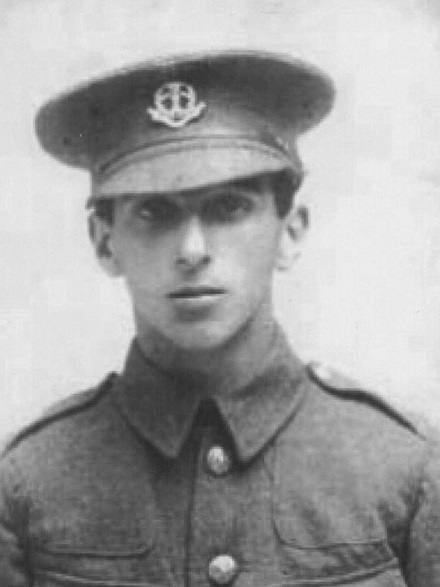
1916: Abraham Bevistein, child soldier

One century ago today, a Polish Jew from east London named Aby Bevistein was shot for cowardice in Calais — four weeks shy of his 18th birthday.

Abraham Bevistein was among an estimated quarter-million Brits who bore arms as minors in World War I. Fired by patriotism, these boys dodged the military’s 18-year-old minimum by … telling their recruiters they were 18. No documentation necessary.

Bevistein, whose family had moved to London from Warsaw when he was a small child, was British through and through enough to surge into the army with the first wave of pie-eyed volunteers in September 1914. He had 16 years and four months, and if he was like many of his new comrades in arms he probably reckoned on being back home by 17 — a bonny hero of a speedy war.

Instead, he spent most of 1915 navigating the labyrinth of trenches in France, and all their attendant horrors. He was wounded in December of that year but soon passed fit for duty again. On February 12-13, 1916, shellshocked and deafened by German grenades, he again sought medical help but was directed back to the lines by a harried medical officer. Instead, Bevistein wandered away to the rear, and took temporary refuge at a French farm.*

“We were in the trenches and I was ill so I went out,” he wrote to his mother by way of all-too-nonchalant explanation. “They’ve taken me to prison and I’m in a bit of trouble now.”

Anti-war suffragette Sylvia Pankhurst took up Bevistein’s cause when she learned about his execution, prominently publishing a sympathetic feature story in her newspaper, Women’s Dreadnought. Like 305 other British and Commonwealth soldiers shot at dawn during the Great War, Bevistein was posthumously pardoned and added to war memorials in the 21st century.

* The farm owner’s later testimony to Bevistein’s court-martial that the young tommy had expressed an intent to return to England sealed his fate as a deserter.

On this day..

1875: Jesse Fouks, for murdering the Herndon family


Sunderland (U.K.) Daily Echo and Shipping Gazette, April 6, 1875.

A despatch from Brentville, Prince William County, Va., dated March 19, says: —

Jesse Fouks, the negro who murdered the Herndon family, consisting of Jeremiah Herndon, his wife, and a coloured boy named Addison Russell, near Cedar Run, in the lower part of this county, on the 4th of last December, was hanged this morning.

The circumstances of this murder were very horrible. Mr. Herndon, a well-to-do farmer, was about 70 years of age, his wife was a few years younger, and the coloured boy about 18 years old.

On the morning after the murder, Mr. Summerfield Herndon, a son of the venerable couple, who resided not far from their farm, went to pay a visit to his parents. Entering their yard, he saw bloody footprints, which led to the door of the dwelling. Passing into the house, a ghastly spectacle was presented to his view. Upon a pallet on the floor the coloured boy Russell lay cold in death, with his head split open. Upon the bed lay Mrs. Herndon, weltering in blood. A little later Mr. Herndon was found lying in a field about 400 yards from the house, barefooted and bareheaded, with his head and face cut and bleeding in many places.

On being asked who had done this deed, Mr. Herndon, who seemed bewildered, said he did not know who had done it; that he had been walking about all night, and felt cold when he went into the water.

He was taken to his house, and there told a clearer story to Justices Horton and Woodyard of a quarrel with Jesse Fouks, who had been hauling wood for him.

It was ascertained, on searching the house, that 235 dols. had been taken by the murderer. Fouks was arrested on suspicion at the house of a neighbour the day after the murder.

Both Mr. and Mrs. Herndon lingered some days, Mrs. Herndon dying on the Wednesday following, and Mr. Herndon on the succeeding Friday. Fouks was tried, found guilty, and duly sentenced to be hanged.

On the 31st of last January he made an attempt to escape from gaol. He burned a hole through the partition of his cell, and got out into the passage, where there was nothing to prevent his escape except an iron-grated door, which was unlocked, and the outer door.

On his appearance at the outer door, he was met by the gaoler’s wife, who, with great presence of mind, seized him and called for help, but he managed to get free and got away.

He was captured on the following day in a straw rick, about six miles from Brentsville.

He acknowledged his guilt, and said that on the evening of the murder he took some meat, and that Mr. Herndon threatened to prosecute him; that he went into the house to try to induce the old man not to prosecute him; that he refused to retract, and that they then began quarrelling, and Mr. Herndon took up the axe and threatened to knock his brains out.

Fouks retreated to the door (the door being open), seized the axe handle, and to use his own words, “Old Satan was in me. I struck Mr. Herndon; took da axe from him, and den struck de old woman twice wid de axe. I did’nt strike her wid nuffin else, and den I struck Add (the coloured boy) twice wid de axe also.”

About 1,000 persons were present at the execution. The prisoner exhibited the utmost self-composure, and warned his hearers to escape the effects of bad passion.

Last Tuesday Fouks gave his body to a physician of Fauquier County, saying that the doctors would get it anyhow.

On this day..

1752: Helen Torrence and Jean Waldie

Helen Torrance and Jean Waldie were executed this day, for stealing a child, eight or nine years of age, and selling its body to the surgeons for dissection. Alive on Tuesday, when carried off, and dead on Friday, with an incision in the belly, but sewn up again.

Tolbooth’s log for March 18, 1751/2*

This date in 1752 marks a milestone in the mutation of the Enlightenment’s piercing medical gaze into the beginnings of a macabre and sordid niche industry that kept doctors well-supplied with cadavers into which to gaze.

The March 18 hanging in Edinburgh of Helen Torrence and Jean Waldie appears to be the first known execution for an anatomy murder.

In the bad old days when dissection subjects were so hard to come by that medical students were known to snatch fresh bodies from the grave like Dr. Frankenstein, the Scots Magazine reported that the two women “frequently promised two or three surgeon-apprentices to procure them a subject” in exchange for a small fee. That fee really was quite small: two shillings, and a few extra pence they haggled for, not at all a favorable rate to sell one’s soul and maybe little more than enough to cover their costs.

Torrence and Waldie were supposed to obtain the subject while sitting on a ceremonial death watch with a dead child, but having no such deceased moppet to hand and really needing a couple of shillings, the ladies went the far more perilous route of snatching a real live eight-year-old while his parents were away. They plied little John Dallas with ale and suffocated his breath away, and Torrence even schlepped the cadaver to the apprentice surgeons in her own apron for an added tip.

The prisoners’ hair-splitting defense, a masterpiece of legal black comedy, was that they could only be shown guilty of kidnapping a living child and then selling a dead child — and neither of these acts constituted a capital crime. Considering the deep-rooted public loathing of resurrectionists’ grave-raiding, the court readily made free to infer from the juxtaposition of these circumstances the hated women’s culpability for John Dallas’s demise.

* 1752 was the last year that England maintained the old Julian calendar, and with it, the recognition of New Year’s Day on Lady Day (March 25) rather than January 1, so the documents of the time make this execution March 18, 1751. The change to the Gregorian calendar took place that summer.

On this day..

1706: Matthias Kraus, Bavarian rebel

On this date in 1706, Bavarian butcher Matthias Kraus was beheaded and quartered for an anti-Austrian rebellion.

This commoner was the victim at several orders’ remove of distant imperial politics; as such, he will enter this story only as a coda. Instead, we begin in the 1690s, in Spain, with the approaching death of the childless Spanish king Charles II.

The question of who would succeed Charles presented European diplomats the stickiest of wickets: there were rival claims that augured civil war, which was bad enough, but such a war’s potential winners could themselves be scions of the French Bourbons or the Austrian Habsburgs … which meant that Spain’s world empire could become conjoined with that of another great European power and unbalance everything.

Now, it just so happened that the Elector of Bavaria Maximilian II Emanuel had a ball in this game — because his marriage to a Habsburg princess had produced a kid who could plausibly receive the throne, Joseph Ferdinand of Bavaria. (The mom died in 1692, but had she been alive, she would have stood to inherit Charles II’s throne.)

For a while this whelp looked like the answer the continent’s schemers were searching for, since neither the state of Bavaria nor his father’s House of Wittelsbach was already a great power — and thus, they could be elevated without creating a new hegemon. But in 1699, months after the infirm Charles had designated the little boy “my legitimate successor in all my kingdoms, states and dominions,” Joseph Ferdinand too dropped dead.

The boy was only seven years old — but he had lived long enough to whet his father’s appetite for a more substantial patrimony. When Charles II finally died in 1700 with the inheritance situation still unresolved, Max Emanuel entered the resulting continental war — the War of Spanish Succession — allying himself with France with the intent of supplanting the Habsburg dynasty on the Austrian throne.

This was a bold gambit to be sure but in the war’s earliest years it looked like it might really work. The Elector of Bavaria parlayed his strong position on the Danube (and ample French support) into a menacing thrust into Austria that threatened to capture Vienna. For the Wittelsbachs, this would mean promotion to a higher plane of dynastic inbreeding; for France, it would mean a lethal blow to the rival Austrian-English-Dutch “Grand Alliance”.

But things went pear-shaped in 1704.

Marlborough mounted a famous march to Austria’s rescue and trounced the Bourbons and Bavarians at the Battle of Blenheim, completely reversing the tide of events. Bavaria now came under Austrian occupation, as Max Emanuel hightailed it to the Low Countries.

All this statecraft brings us as a postscript the unhappy fate of our butcher, Herr Kraus.

The Austrian occupation of Bavaria — complete with punishing wartime levies — triggered in 1705 a peasants’ revolt grandly titled the Bavarian People’s Uprising. Matthias Kraus was a leader in this rising.


Matthias Kraus in Kelheim (Via)

Like the Wittelsbach pretension writ small, Kraus was intrepid but doomed. Having seized the town of Kelheim with a force of 200 or so, he held it for just five days. Austrian forces appearing at the gate negotiated for a peaceful surrender of the city, but as soon as they got the gates open they ran amok in a general massacre.

Kraus himself, interrogated under torture in Ingolstadt, was returned to Kelheim for public execution — his body’s quarters to be mounted around the city as a warning.


Detail view (click for a full image) of an Austrian leaflet publicizing the fate of the rebellious Kraus.

His martyrdom at the hands of a foreign occupation has stood Kraus in good stead in posterity. There is a Matthias-Kraus-Gasse in Kelheim, as well as a fountain memorial put up to celebrate the 1905 bicentennial of his his fleeting moment of heroism.

On this day..