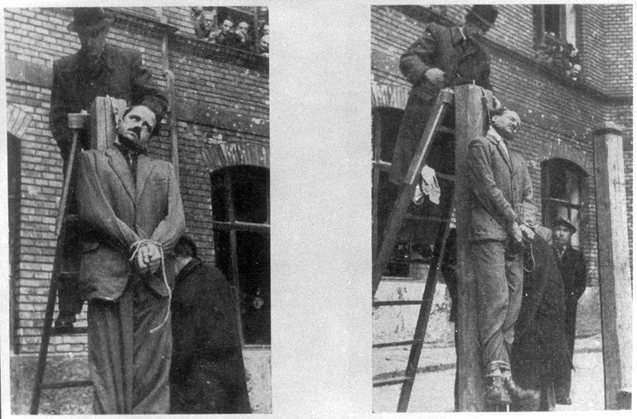
1905: Chief Zacharias Kukuri

On this date in 1905, in the midst of Germany’s genocidal destruction of the Herero people in its Southwest Africa colony (present-day Namibia), the Otjosazu chief Sacharias Kamaituara Kukuri was hanged in Windhoek.

More than half the Herero population perished following an abortive attempt to resist German colonization during this unfortunately little-remembered period, perhaps the very first of the 20th century’s ample store of genocides.

Our man’s execution occurred at the moment of a policy pivot: after the horrific extermination policy initially practiced by General Lothar von Trotha, Germany’s Herero policy was “moderating”. Von Trotha’s extermination order had been officially reversed by Berlin; by November of 1905, the murderous general would be recalled to Germany. Instead, they’d be collecting the Herero into concentration camps.

It was into the Windhoek camp that Kukuri arrived as the wounded prisoner of a German ambush.


The concentration camp under the walls of Windhoek’s Alte Feste (Old Fort). Today, the fort is a museum … and the camp, forgotten, is the grounds of a high school. (Source)

Of course, it goes without saying that, even if state policy no longer aimed officially at racial annihilation, the system of concentration camps continued the de facto genocide: the systematic destruction of Herero life in order to incorporate the population as a subject proletariat (enlightened self-interest — the colony’s “economic future would be completely destroyed by the extermination of the indispensable labor power” — is what finally trumped von Trotha). At the same time, camps structured a punitive neglect of Herero living conditions, a years-long “period of suffering” in which Herero died of overwork, malnutrition, disease and neglect as surety against any future resistance. Courts-martial of fighting-age men alleged to have had some hand in resisting by arms the German onslaught completed the salutary lesson.

Missionary sources provide us with eyewitness accounts of conditions in the camps. Missionaries stationed in the Herero Konzentrationslager reported to their superiors in Germany on the extensive and unchecked rape, beatings and execution of surrendered Herero by German soldiers. Missionary Kuhlmann spoke of the delight of settler women witnessing the drawn-out public hangings of captured Herero in Windhoek. At one such hanging, a drooling Herero fighting for his life was berated” ‘You swine, wipe your muzzle’. (pdf source)

Kukuri fell into this last category.

His fate is especially poignant for us (and, convenient to date) thanks to the memoirs of Friedrich Meier, one of the many German Christian missionaries who had poured into Namibia ever since it became a German colony. As Meier’s account of swapping Biblical allusions with Kukuri in the shadow of the latter’s gallows underscores, these missionaries had achieved some inroads.

I did not see the slightest trace of fear on him, instead it was as if he were going to a wedding. ‘Muhonge’, he said at one stage, ‘oami otja Elias mohamakuao na je otjinga me keende kejuru metemba,’ i.e. ‘Muhonge, like Elias, I too travel to heaven in a waggon.’

Having arrived at the execution site, I noticed how he kept looking at the gallows, at which preparations were still taking place. I feared for his tranquility and asked him to stop looking at it. ‘Muhonge,’ he said to me, ‘I hear everything, why should I not look at it? For is it not “my wood” [my cross]?’

When we finally stood underneath the gallows, we prayed together that beautiful song: ‘So then take my hand and lead me.’

German:

English:

Possibly he noticed that I was worried about him. Anyway when I was finished he said, ‘It would appear that you still fear that I am afraid, but have I not told you: “When a father calls his child, does that child then fear to go to him?” Give my wife, who is in Okahandja, my greetings and tell her that I have died in the faith of the lord Jesus, so too tell my children if you should ever see them.’ I asked him again to be infatuated with the lord Jesus. ‘Lord Jesus, you help me,’ with this, after he had given me his hand, he climbed up the ladder. Soon the noose was laid around his neck. And then — never will I forget that moment — the unheard-of happened, as he fell the noose slipped and the wretch fell to the ground. He lost consciousness for a moment, so too, the observers were dumbstruck. Today I still see how his eyes sought me out. Soon, however, two soldiers were there, they lifted him up, and then a little to the side, on orders of the major who led the proceedings, he was shot.

Kukuri’s grave can still be seen at the Gammans cemetery (German link) in Windhoek.

His memory as an emblem of Herero dignity under persecution also remains in present-day Namibia.

Anette Hoffmann (in “The Merits and Predicaments of Opacity: Poetic Strategies of Evasion and Resistance” for the fall 2007 Research in African Literatures) relates a later “praise poem” for 1959 Herero martyrs, whose allusion to the hanged chief (as “Hauzeo”) emphasizes his agency, rather than his victimhood.

For he as the son of the chief Kukuri and must die since Samuel Maherero had escaped to Botswana. They said that if they kill him, then that could serve as a symbol that they had exterminated the sovereignity of the Herero … he was taken to a tree near the White’s cemetery in Otjomuise, which is still here today. I can show you his grave. He is still there until now, near the railway line to Aris … when he was taken to the tree, the tree of Hauzeu, as you hear about it, it was said: now you will be hanged to die. Heavily wounded as he was, he had a rope around his neck and was hanged. However, his weight broke the rope. Then the Germans said he was innocent and had to be released. But he himself insisted to be hanged again … [he said] “I have come to see the children of Tjamuaha’s house, those left in the camps of enslavement: to see them with my own eyes … this is why I have come: take me up the tree.” They did and he died. He lies at Hauzeu’s tree. He had given himself to be hanged.

On this day..

1946: Laszlo Baky and Laszlo Endre, Hungarian Holocaust authors

On this date in 1946, fascist Hungarian politicians Laszlo Baky and Laszlo Endre were executed by hanging in Budapest for their role in the decimation of Hungarian Jewry.

These two charmers were major figures in Hungary’s horrible final months of World War II.

Post-Stalingrad, the Hungarians had realized they were yoked to the losing side and started looking for an exit strategy; instead, early in 1944, they got a German occupation.

This occupation lifted the virulent anti-semites Baky and Endre into national power, because along with keeping Hungary in the Axis coalition, the Nazis also forcibly overcame its junior partner’s former reticence about Jewish genocide.

Adolf Eichmann arrived into Nazified Hungary and used our day’s two principals (along with another executed collaborator, Andor Jaross, they’re known as the “deportation trio”) as his instruments. Within months, hundreds of thousands of Hungarian Jews were being shipped to the gas chambers. This period is one of the waypoints of pernicious Nazi race theory, when the collapsing German regime spent military resources urgently needed at the front to organize the mass slaughter of Jews.*

And they had to work fast, because by that next winter the Red Army was seizing Budapest. These enthusiastic fascist operators did not fare well by the postwar government.

Most photos from Kuruc.info (the garishly branded ones) and the Yad Vashem database (the not garishly branded).


Laszlo Endre under arrest.


Both men, just prior to their execution.

* To do justice to the breadth of the human capacity, this is also the time and place where we find Raoul Wallenberg minting lifesaving Swedish passports by the thousands.

On this day..

2010: Modise Mokwadi Fly, Botswana pol

(Thanks to Meaghan Good of the Charley Project for the guest post. -ed.)

On this day in 2010, reggae artist, politician, activist and convicted child killer Modise Mokwadi Fly was hanged in Botswana’s capital city of Gaborone.

He was the second person to be executed under the administration of President Ian Khama; the first was also a child killer.

Fly, a South African national, had been general secretary of the Botswana Congress Party Youth League. On November 27, 2006, he killed his two-year-old son, Tawana Mosinyi, with an ax while the toddler slept. Fly maintained until his death that Tawana’s death was accidental and he’d actually been trying to throw his ax at the police who were firing shots at his house from outside. The prosecution believed Fly deliberately killed his son to spite the child’s mother, whom he’d recently quarreled with.

After his conviction on October 17, 2008, Fly apologized to Tawana’s family for his death. He sentenced to hang five days later, then he waited a year and a half for his date with death. Witnesses reported he seemed oddly cheerful and gregarious in court, smiling and chatting amiably with his friends and relatives who attended the trial.

In February 2010, the month before his execution, Fly made an attempt to escape from prison. He was the first prisoner to succeed in escaping from Botswana’s death row — but he was only free for fifteen minutes. After his capture, it was alleged, he was brutally beaten by the guards and then placed in solitary confinement so no one could see his injuries.

If the prison did in fact do this, it didn’t work: the news of the alleged mistreatment became public on March 23. Whether the timing had anything to do with his secretive execution the next day is unclear. Predictably, Botswana’s Department of Prisons and Rehabilitation denied that the prisoner had been abused or placed in isolation.

On this day..

1784: Anton Joseph Suter, Appenzell politician

On this date in 1784, 64-year-old former Landammann of Appenzell,** was beheaded in a nasty bout of local politics.

The amiable and fair-minded Suter (wee German bio), a tavernkeeper, won election to his position at the head of a popular party — in the process defeating a local aristocrat who expected the gig as his birthright and nursed a terrible grudge against Suter for the defeat.


The cantonal form of direct democracy by which Suter was elected, the Landsgemeinde, is still practiced in Appenzell. This (cc) image from Götz A. Primke shows the 2009 assembly in Appenzell, at which crotchety, longsword-bearing residents voted a ban on nude hiking.

This aggrieved aristocrat, Geiger by name, had to bide his time all through the 1760s and into the 1770s, until the political stars aligned against Suter.

It seems a neighboring town had been able to take possession of a lush alpine slope in Appenzell’s environs by dint of an unpaid mortgage, a terrible wound to Appenzell’s pride and no small inconvenience to its residents.

Suter pushed an attempt to force repurchase of this land in a suit at the Swiss Diet, a sort of United Nations of otherwise-autonomous Swiss cantons. But he lost the suit, and the Diet demanded that Appenzell cough up the court costs as well.

Accustomed as we are today to the suits and countersuits that constitute the very cogs of late capitalism, it’s a little hard to understand how the trifling matter of a court fee could suffice to topple a government — but it did. Geiger’s people prevailed upon the canton’s executive council to drop the suit (Suter pursued it on his own), and now persuaded it to drop Suter.

Well, persuaded. It’s more like, it did several days frantic retail politicking from the pulpits and in the streets, then showed up when the council met to shout down Suter and drag him out by force, not neglecting to disenfranchise Suter’s many supporters who fought them on the point. As Suter fled into exile, Appenzell pronounced him a rebel on the strength of some super-secret documents.

That really could have been that, but Suter’s foes were so intent on his head that they contrived a ruse to lure him back into the canton’s territory on the pretext of a secret meeting with his daughter — then arrested him, tortured him with thumbscrews and the rack, and finally sentenced him to death.

On the day appointed the scaffold was closely surrounded by troops. Suter, maimed and pale, was assisted to his place. Standing there a moment he addressed the people, declaring himself robbed and murdered by his country. He then knelt down and in clear tones thrice pronounced the Ave Maria. With the last word of the last repetition of the prayer the sword descended and his head fell …

The sight of the blood of the ex-Landamman filled the people with rage. They had looked for a reprieve to the very last; and now that all hope was gone, they fell upon such of the victim’s enemies as were to be found lingering in the streets and fought and struggled with them in their desperation … The enemies of Suter were found to form no exception to the rule that retribution pursues the murderer. No sooner was the ex-Landamman in his grave than the Furies took up their task … Geiger, who formerly had gone about demanding Suter’s life, now — a pitiable victim to remorse — went about acknowledging that for seven long years he had pursued him without a cause. It is related concerning the member of the Blood Court that they all ever afterwards were harassed by terrors of conscience, one to such an extent that he even became insane. The guilt of Suter’s murder settled upon Inner-Rhoden irretrievably … like the very brand of Cain. Time went by and changes occurred, but that remained. Finally in 1829, forty-five years after the execution, the Great Council met and, with a solemnity befitting he occasion, unanimously revrsed the findings of the court by which Suer had been banished, as also of that by which he had been sent to the block.

Another summary of Suter’s career and sad end can be found here.

* Thanks to the same public-domain source, we’ve visited Appenzell before.

On this day..

1561: Cardinal Carlo Carafa, papal nephew

On this date* in 1561, the once-powerful Cardinal Carlo Carafa was put to death by strangulation in Rome’s Castel Sant’Angelo — victim of deadly Vatican politics.

Fruit of a powerful Neapolitan noble house — it was a Carafa who stuck fig leafs on Michelangelo nudes — Carlo Carafa went out on campaign in the dynastic wars chewing up the peninsula in the 16th century. In some outlandish vindictive pique, he elevated an offense from a Spaniard into not only a reason to switch sides to the French, but a reason to do stuff like massacre Spaniards in a captured hospital. Class act all the way.

When the boy’s (similarly pro-French) Carafa clansman ascended St. Peter‘s throne as Pope Paul IV in 1555, Carlo Carafa beat his sword into a galero as the Catholic Church’s newest cardinal-nephew.**

In this capacity, he had the whip hand in Vatican foreign policy in the late 1550’s … until the growing reports of his reprobate lifestyle led Paul IV to demote him. Virulently anti-Protestant, the obnoxiously upright Paul had been preoccupied intensifying the Inquisition. He took personal umbrage once convinced of his relative’s unworthiness: “He had planned to make his reign the period of great reforms,” writes Kenneth Meyer Setton. “The corruption of Cardinal Carlo Carafa had made a travesty of his efforts.”

These travesties included rumors of the love that dare not speak its name. Poet Joachim du Bellay, according to Who’s Who in Gay and Lesbian History, made sport of ecclesiastical buggery in Les Regrets:

now you should mourn
handsome Ascanio himself, Ascanio, O pity!
Ascanio, whom Carafa loved more than his own eyes:
Ascanio, whose face was handsomer
than that of the Trojan cupbearer, who pours for the gods

(Carafa had a plentiful menu of heterosexual scandals attributed, too. And other good stuff like starting an idiotic war of choice — with Spain, of course — that despoiled Church coffers and reversed the Vatican’s strategic interests.)

In such a state of disgrace — and more importantly, having been stymied in their anti-Spanish foreign policy — the Carafa house and faction was in line for something more serious than public humiliation when the disappointed octogenarian pontiff passed away later in 1559.

Upon the succession of a rival Medici pope, Pius IV, Carlo Carafa was hailed before a kangaroo court with his brother and partner-in-dissipation Giovanni on a rap sheet with every real and imagined indiscretion of their wild years.† Carlo was strangled and Giovanni Carafa beheaded.

Despite the nephews’ undoubted viciousness, their executions were basically about power and policy.

And though they had also screwed up policy, the next pope decided to look forward-backward, not backward-backward. In 1567, Pius V posthumously rehabilitated the naughty dead Carlo; today, you’ll find his now-vindicated remains interred at the family chapel in Rome’s Santa Maria sopra Minerva cathedral.

“The people wish to be deceived; let them be deceived.”

Carafa

* Seems like the best-sourced date, albeit uncertain — as discussed in this biography.

** Cardinal-nephews are the etymological source of the word nepotism.

† Carafa’s defense attorney was the noble Marc’ Antonio Borghese, father of a then-prepubescent kid named Camillo who would grow up to be Pope Paul V.

On this day..

1870: Wyatt Outlaw lynched by the Ku Klux Klan

On this date in 1870, the lynching of a mulatto freedman in Alamance County, North Carolina sounded the tocsin for ex-Confederates’ rollback of Reconstruction.

Perhaps America’s most tragic period, the aftermath of the Civil War saw a too-brief attempt to enforce ex-slaves’ civil rights, before it succumbed to violent counterattack. The prevailing historiography in the century-long era of Southern apartheid that followed remembered it as a time of impertinent Negroes ravishing Dixie’s virtue by being seated in the legislature and giving orders to their natural betters.

Winners write history, after all.

Those of the pro-Republican coalition at the time, before Northerners folded their hand, had a mind to write a different history.

Alamance County was one epicenter of this aborted alternative. The enclave was cool to secession from the beginning, and in the early years of Reconstruction had a live black-white coalition. Wyatt Outlaw, a mixed-race Alamance native who had fought for the Union, was a local leader in it. A member of the antislavery Union League, which registered freedmen as voters throughout the South, he was appointed a town commissioner for Graham, N.C. under the state’s new constitution.

This made him a prime target of Ku Kluxers. On the night of February 26, 1870, an armed party of white supremacists about 100 strong raided his home and strung him up on an elm tree facing the county courthouse. Pinned to his corpse for the edification of the morning’s churchgoers was a note:

“Beware you guilty — both white and black.”

North Carolina Governor William Holden complained to the U.S. Senate of federal unwillingness to act against such outrages.

What is being done to protect good citizens in Alamance County? We have Federal troops, but we want power to act. Is it possible the government will abandon its loyal people to be whipped and hanged? The habeas corpus should be at once suspended.

After another pro-Reconstruction politician was murdered later that year, Holden boldly took the initiative himself and called out the troops to arrest suspected Klansmen. But the right-wing Democratic party won midterm elections in 1870, and promptly impeached Holden for this atrocious tyranny; he was the first U.S. governor ever removed from office by impeachment.*


A “carpetbagger” ally of Wyatt Outlaw named Albion Tourgee — a judge who stood as one of North Carolina’s most prominent and hated advocates for African American equality — later wrote a novel about his experiences, A Fool’s Errand, by One of the Fools. Now in the public domain and available free online, this book’s portrayal of the Reconstruction South is receiving renewed scholarly appreciation** — including Tourgee’s catalogue of terrorism against emancipated blacks and the Republican government. The novel was a sensation (pdf) in its time.

One of the characters in Fool’s Errand is a nearly exact representation of Wyatt Outlaw: “Uncle Jerry Hunt”, who resists the Klan. It is “chiefly through Uncle Jerry’s persuasions, and because of his prominence and acknowledged leadership, this spirit had gone out among the colored men of the county.” He meets a graphic end that almost journalistically reports Outlaw’s real fate.

It was a chill, dreary night. A dry, harsh wind blew from the north. The moon was at the full, and shone clear and cold in the blue vault.

There was one shrill whistle, some noise of quietly moving horses; and those who looked from their windows saw a black-gowned and grimly-masked horseman sitting upon a draped horse at every corner of the streets, and before each house, –grim, silent, threatening. Those who saw dared not move, or give any alarm. Instinctively they knew that the enemy they had feared had come, had them in his clutches, and would work his will of them, whether they resisted or not. So, with the instinct of self-preservation, all were silent–all simulated sleep.

Five, ten, fifteen minutes the silent watch continued. A half-hour passed, and there had been no sound. Each masked sentry sat his horse as if horse and rider were only some magic statuary with which the bleak night cheated the affrighted eye. Then a whistle sounded on the road toward Verdenton. The masked horsemen turned their horses’ heads in that direction, and slowly and silently moved away. Gathering in twos, they fell into ranks with the regularity and ease of a practiced soldiery, and, as they filed on towards Verdenton, showed a cavalcade of several hundred strong; and upon one of the foremost horses rode one with a strange figure lashed securely to him.

When the few who were awake in the little village found courage to inquire as to what the silent enemy had done, they rushed from house to house with chattering teeth and trembling limbs, only to find that all were safe within, until they came to the house where old Uncle Jerry Hunt had been dwelling alone since the death of his wife six months before. The door was open.

The house was empty. The straw mattress had been thrown from the bed, and the hempen cord on which it rested had been removed.

The sabbath morrow was well advanced when the Fool [i.e., Tourgee himself] was first apprised of the raid. He at once rode into the town, arriving there just as the morning services closed, and met the people coming along the streets to their homes. Upon the limb of a low-branching oak not more than forty steps from the Temple of Justice, hung the lifeless body of old Jerry. The wind turned it slowly to and fro. The snowy hair and beard contrasted strangely with the dusky pallor of the peaceful face, which seemed even in death to proffer a benison to the people of God who passed to and fro from the house of prayer, unmindful both of the peace which lighted the dead face, and of the rifled temple of the Holy Ghost which appealed to them for sepulture. Over all pulsed the sacred echo of the sabbath bells. The sun shone brightly. The wind rustled the autumn leaves. A few idlers sat upon the steps of the court-house, and gazed carelessly at the ghastly burden on the oak. The brightly-dressed church-goers enlivened the streets. Not a colored man was to be seen. All except the brown cadaver on the tree spoke of peace and prayer–a holy day among a godly people, with whom rested the benison of peace.

The Fool asked of some trusty friends the story of the night before. With trembling lips one told it to him,

“I heard the noise of horses–quiet and orderly, but many. Looking from the window in the clear moonlight, I saw horsemen passing down the street, taking their stations here and there, like guards who have been told off for duty, at specific points. Two stopped before my house, two opposite Mr. Haskin’s, and two or three upon the corner below. They seemed to have been sent on before as a sort of picket-guard for the main body, which soon came in. I should say there were from a hundred to a hundred and fifty still in line. They were all masked, and wore black robes. The horses were disguised, too, by drapings. There were only a few mules in the whole company. They were good horses, though: one could tell that by their movements. Oh, it was a respectable crowd! No doubt about that, sir. Beggars don’t ride in this country. I don’t know when I have seen so many good horses together since the Yankee cavalry left here after the surrender. They were well drilled too. Plenty of old soldiers in that crowd. Why, every thing went just like clock-work. Not a word was said–just a few whistles given. They came like a dream, and went away like a mist. I thought we should have to fight for our lives; but they did not disturb any one here. They gathered down by the court-house. I could not see precisely what they were at, but, from my back upper window, saw them down about the tree. After a while a signal was given, and just at that time a match was struck, and I saw a dark body swing down under the limb. I knew then they had hung somebody, but had no idea who it was. To tell the truth, I had a notion it was you, Colonel. I saw several citizens go out and speak to these men on the horses. There were lights in some of the offices about the court-house, and in several of the houses about town. Every thing was as still as the grave,–no shouting or loud talking, and no excitement or stir about town. It was evident that a great many of the citizens expected the movement, and were prepared to co-operate with it by manifesting no curiosity, or otherwise endangering its success. I am inclined to think a good many from this town were in it. I never felt so powerless in my life. Here the town was in the hands of two or three hundred armed and disciplined men, hidden from the eye of the law, and having friends and co-workers in almost every house. I knew that resistance was useless.”

“But why,” asked the Fool, “has not the body been removed?”

“We have been thinking about it,” was the reply; “but the truth is, it don’t seem like a very safe business. And, after what we saw last night, no one feels like being the first to do what may be held an affront by those men. I tell you, Colonel, I went through the war, and saw as much danger as most men in it; but I would rather charge up the Heights of Gettysburg again than be the object of a raid by that crowd.”

After some parley, however, some colored men were found, and a little party made up, who went out and saw the body of Uncle Jerry cut down, and laid upon a box to await the coming of the coroner, who had already been notified. The inquest developed only these facts, and the sworn jurors solemnly and honestly found the cause of death unknown. One of the colored men who had watched the proceedings gave utterance to the prevailing opinion, when he said,–

“It don’t do fer niggers to know too much! Dat’s what ail Uncle Jerry!”

And indeed it did seem as if his case was one in which ignorance might have been bliss.

The multitalented, ahead-of-his-time Tourgee might well have uttered the same sentiment in 1896, when he was the lead attorney on the losing side of Plessy v. Ferguson — the Supreme Court’s landmark sanction of the color line that Uncle Jerry’s hangmen had drawn.

There are a couple of interesting journal articles touching on Alamance County during Reconstruction which are freely available as pdfs from the Journal of Backcountry Studies: “Other Souths”: The Civil War and Reconstruction in Alamance County, North Carolina and Scalawags Among Us: Alamance County Among the “Other Souths”.

* Narrowly beating Nebraska’s David Butler, who got the boot a few months later. Holden remains the only governor to suffer this indignity in North Carolina history; there has been a recent push in the Raleigh legislature to posthumously pardon him. Holden’s own memoirs are also available free online.

** Along with the book’s contention that northern Republicans were to blame for vacillating on Reconstruction. “This cowardly shirking of responsibility, this pandering to sentimental whimsicalities, this snuffling whine about peace and conciliation, is sheer weakness … [the North is] a country debauched by weak humanitarianisms, more anxious to avoid the appearance of offending its enemies than desirous of securing its own power or its own ends.”

On this day..

1934: Augusto Cesar Sandino, national hero

“The sovereignty of a people cannot be argued about, it is defended with a gun in the hand.”

-Sandino

On this date in 1934, the first name in Nicaraguan anti-colonial resistance was abducted and summarily executed by the Nicaraguan National Guard.

From 1927 until his death, Sandino led an armed peasant insurgency from the Nicaraguan mountains against the Yankee imperialists and the domestic dictatorship they backed.

Washington had had its nose (and its marines) in Managua’s business for decades, continuously occupying the Central American country since 1912. The Marine Corps saw this country’s people as

Densely ignorant … little interested in principles … naturally brave and inured to hardships, of phlegmatic temperament, tough, capable of being aroused to acts of extreme violence, they have fought for one party or the other without considering causes since time immemorial … a state of war is to them a normal condition.*

All this was the time of Sandino’s own coming-of-age. The son of a wealthy landowner and his domestic servant, Sandino grew up with the unprivileged and the working classes, eventually asorbing an eclectic mix of that period’s revolutionary ideologies.

From 1927 he took to the Segovia and began writing the playbook for the 20th century guerrilla: mobile infantry irregulars, striking from familiar-to-them forest cover, melting away among sympathetic campesinos.

The “Colossus of the North” — Sandino made no bones about his foe; his personal seal showed an American marine being killed — invariably described him as a “bandit” because he also raided towns to commandeer food, clothing, and medicine.

“Washington is called the father of his country; the same may be said of Bolivar and Hidalgo; but I am only a bandit, according to the yardstick by which the strong and the weak are measured.”

-Sandino

The strong, in this case, found little public appetite for the steady attrition of servicemen, and the U.S. employed a familiar strategy of its own: “Nicaraguanizing” the conflict by building up a National Guard to do the dirty work domestically.

That Guard’s head was headed by Anastasio Somoza — the very son of a bitch of whom FDR said, “but he’s our son of a bitch.”

While it’s hardly the only country to have been favored with an American son of a bitch, you could say that Nicaragua has been the American empire’s very own heart of darkness. Washington’s initial interest in the place after the Spanish-American War concerned preventing a canal project to compete with Panama. It invented dive-bombing to hunt Sandino. And it ranged around the world and outside the law to battle Sandino’s successors under the aegis of a modern imperial presidency.

Small wonder that an official anthem of the movement denounces “The Yankee / The enemy of all humankind.”

In the immediate aftermath of the American departure in January 1933, Sandino began coming to terms with the the country’s new president: the Sandinistas disarmed in exchange for amnesty and land. But Somoza, who at this point was “only” the head of the National Guard, was building up his own power … and he meant to have done with this inconvenient insurgent.

After Sandino left a presidential meeting on this date, at which the erstwhile rebel negotiated for his continuing demand to disband Somoza’s Guardia, Sandino was stopped at the gates by Guardsmen. They took Sandino, his brother, and two of his generals and marched them off to be shot. Then the Guard forcibly broke up the Sandinista remnants. Somoza soon seized official power for himself; his family ruled, and plundered, Nicaragua until 1979. Washington never called them bandits.

While Sandino vanished (the whereabouts of his remains are unknown), his revolutionary vision and praxis also persist down to the present day.

Sandinismo (aging much better than Somocismo) would influence Fidel Castro and Che Guevara during the Cuban Revolution.

And in 1979, the Sandinista National Liberation Front finally succeeded in overthrowing the last loathsome scion of the Somoza dictatorship.

The United States, of course, went right back to war against its long-dead “bandit” foe.

* From Julian C Smith’s officially commissioned History of the Guardia Nacional de Nicaragua (1933), as quoted in Michael J. Schroeder’s “Bandits and Blanket Thieves, Communists and Terrorists: The Politics of Naming Sandinistasin Nicaragua, 1927-36 and 1979-90,” Third World Quarterly, Vol. 26, No. 1 (2005).

Schroeder runs the definitive English-language website on Sandino and the original Sandinistas, with a truly vast collection of documents and resources.

On this day..

1799: Constantine Hangerli, tax man

On this date* in 1799, Constantine Hangerli was deposed from his post as Prince of Wallachia by a Moorish executioner.

A veritable watchword for bad times, Hangerli was one of a clutch of disposable puppet rulers situated on the Wallachian throne by the Ottomans around the turn of the 19th century.

As had often before been the case, Wallachia was sorely pressed at this time by the cumulative exactions of its native boyars, the Ottoman Porte, and the plunder taken by the expeditions of rising Bosnian warlord Osman Pasvan Oglu.

Our man is famous, in particular, for the “Hangerli winter” of 1798, just after his elevation — when a confiscatory tax regime seized most of the countryside’s lifestock. Hangerli had a message for the generally currency-poor common man who objected to the much-despised per-head duty on cattle.

Pay the taxes, and you won’t be killed.

Hangerli’s real problem this year wasn’t the unmourned misery of his overtaxed serfs, but the Ottoman commander sent to rein in the Bosnians. Pasvan Oglu whipped that expedition, and its general Hussein Kucuk turned up at Hangerli’s doorstep late in 1798.**

Since it was dangerous for Ottoman generals to lose, Kucuk evidently arrived intending to put some blame on Hangerli — or at least, Hangerli thought that was the case. Secret dispatches from both parties to Istanbul ensued.

Whoever it was who schemed first, Kucuk schemed best. Selim III (later to die of palace scheming himself) decreed Hangerli’s immediate execution and dispatched a kapucu, one of the frightening envoy-executioners (two different men, in this case) who carried such decrees to their victims.

* I believe this may be per the Old Style/Julian date still in use in the Orthodox world.

** Having executed Rigas Feraios in Belgrade en route.

On this day..

1907: Gen. Antonio Paredes, Venezuelan rebel

In the small hours this date* in 1907, Venezuelan Gen. Antonio Paredes was summarily shot for an abortive rising against dictator Cipriano Castro.

The Andean military governor Castro had overthrown the previous kleptocracy in the Restoration Revolution of 1899.

Castro’s state was racked by internal conflicts as Castro’s body was by collapsing organ systems. Both factors helped encourage malcontents towards designs upon his job.

Paredes was one of the regime’s chief opponents, an admired officer who had been the last holdout (Spanish link) against the 1899 revolt from his own base in the port city of Puerto Cabello, latterly knocking about in exile openly scheming against Castro. Paredes steamed in to New York in the summer of 1906 “to obtain arms and ammunition … for this movement against Castro,” he told the New York Tribune in a story wired from coast to coast. “I came here solely on that mission.”**

Paredes finally landed in his homeland in early February 1907, just as Castro was undergoing an emergency surgery. The Chicago Tribune Feb. 9, 1907 dispatch ran under a headline announcing “Paredes’ Long Planned Insurrection Begun”.

But long planned evidently wasn’t well planned.

Making landfall with a token force of retainers, he banked on “rally[ing] an army of 5,000 to 8,000 men.” (Chicago Tribune, op. cit.) But he in fact rallied zero, and was almost instantly intercepted by Castro’s troops. After a couple of days in captivity, the men in the field received a curt telegram over Cipriano Castro’s name — either dictated from the president’s hospital bed between chloroform stupors, or simply given in his stead by powerful Interior Minister Julio Torres Cardenas — ordering the summary execution (Spanish link) of the prisoners.

The whole lot of 17 or 18 prisoners (including two US expatriates, John Godskin and Thomas Lovelace), were accordingly dispatched (Spanish again) without color of law.

Venezuela had actually abolished capital punishment for all crimes in 1863. While extrajudicial executions are always in a gray area, this might be the last event in that country’s history that could clearly be classified as an execution.

* This memoirs of Paredes’ 1899-1903 imprisonment at one point states that the execution occurred in the small hours of Feb. 16, but I believe this is mistaken.

** Quotes from an A.P. story titled “Planning Revolution Against Gen. Castro” in the Los Angeles Times, Aug. 11, 1906.

On this day..

1940: Nikolai Yezhov, terror namesake

In the terrible years of the Yezhovshchina, I spent seventeen months in lines outside the prison in Leningrad [queuing to deliver food to or get news of imprisoned loved ones: in her case, her son Lev]. One day somebody in the crowd identified me. Standing behind me was a woman, with lips blue from cold, who had, of course, never heard me called by name before. Now she started out of the torpor common to us all and asked me in a whisper (everyone whispered there):
‘And can you describe this?’
And I said: ‘I can.’
Then something like a smile passed fleetingly over what had once been her face.

-Poet Anna Akhmatova

On this date in 1940, the first name in Stalin’s terror got his just deserts.

Well. The first name after Stalin’s own, a point energetically made by Nikolai Yezhov’s daughter* in her fruitless post-Soviet attempts to rehabilitate the man.

But clearing a fellow’s name is a tough task when that name is the mother tongue’s very metonym for political persecution: the Soviet Union’s mind-bending late-1930s witch hunt for internal enemies, known as the Yezhovshchina.

From late 1936, when he eliminated his predecessor Genrikh Yagoda (later executed, of course), until his own fall from power in at the end of 1938, Yezhov presided over the apex of Stalinist terror, averaging hundreds of political killings daily — perhaps north of 600,000 for the two-year period, plus a like number disappeared into the Gulag’s freezers. (Just browse this here site’s ‘1937’ tag for a taste.)

Departments and regions received quotas for executions as if they were tractor factories. Security officials well understood that their own heads would be next on the block for any perceived shortcoming; Yezhov had thousands of them arrested, too. (pdf)**

We are launching a major attack on the Enemy; let there be no resentment if we bump someone with an elbow. Better that ten innocent people should suffer than one spy get away. When you chop wood, chips fly.

-Yezhov

The “Bloody Dwarf” — surely there is some of Yezhov in the Master and Margarita character Azazello, the Satan/Stalin figure’s murderous and diminutive attendant — rode this tiger unto his own destruction.


Stalin and other Soviet VIPs with (front right) Nikolai Yezhov.

The same photo ‘updated’ after Yezhov’s fall. (For a similarly chilling photographic disappearance, see Vladimir Clementis.)

As Yezhov had once displaced and killed his mentor Yagoda, so Yezhov’s own nominal underling Beria would displace Yezhov.

Power in the NKVD shifted towards Beria over the course of 1938 until Yezhov’s own resignation that November. The former boss was quietly arrested the next April and barely troubled his skilled torturers before copping to the usual litany of official self-denunciations: corruption, economic sabotage and “wrecking”, treasonable collaboration with the Germans, plus a bisexual personal life. (That last one was true.)

Bound for historical infamy, Yezhov salvaged a shred of dignity in the last, when he was “tried” a few hours before death and renounced those confessions — albeit from the twisted standpoint of a man still unquestioningly committed to the man and the system that had destroyed him.

It is better to die, but to leave this earth as an honorable man and to tell nothing but the truth at the trial. At the preliminary investigation I said that I was not a spy, that I was not a terrorist, but they didn’t believe me and applied to me the strongest beating. During the 25 years of my party work I have fought honorably against enemies and have exterminated them. I have committed crimes for which I might well be executed … But those crimes which are imputed to me by the indictment in my case I did not commit …

My fate is obvious. My life, naturally, will not be spared since I myself have contributed to this at my preliminary investigation. I ask only one thing: shoot me quietly, without tortures …Tell Stalin that I shall die with his name on my lips.

And indeed, Yezhov knew from plenty of personal experience how this script ended. It was called the Yezhovshchina for a reason.

The judges pretended to deliberate for half an hour. Ezhov fainted at the verdict, then scrawled a petition for mecy; it was read out over the telephone to the Kremlin and rejected. Ezhov was taken in the dead of night to a slaughterhouse he himself had built near the Lubianka. Dragged screaming to a special room with a sloping cement floor and a log-lined wall, he was shot by the NKVD’s chief executioner, Vasili Blokhin. Beria gave Stalin a list of 346 of Ezhov’s associates to be shot. Sixty of them were NKVD officers, another fifty were relatives and sexual partners. (From Stalin and His Hangmen: The Tyrant and Those Who Killed for Him

* Natalia Khayutina is actually Yezhov’s adoptive daughter. Her birth parents were killed … in the Yezhovschina.

** “I purged 14,000 chekists,” Yezhov later said. “But my guilt lies in the fact that I did not purge enough of them.”

On this day..