On this date in 1918, four sailors who were ringleaders of a failed Austrian naval mutiny were executed at the Montenegrin port of Kotor.
It’s been largely forgotten beyond its Balkan environs — indeed, reports of its very existence were hushed up at the time it occurred — but it prefigured the more famous, war-ending Kiel mutiny later that year in Austria’s Entente ally. It was a heyday for radical sailors, taking heart from the inspiration of the famed Russian cruiser Aurora, whose guns launched Russia’s October Revolution.
On February 1, this crew, gnawed by hunger, deposed their officers and ran up the red flag, chanting for bread and peace.
Although about 40 other ships in the Austrian fleet there responded with revolutionary flags of their own, the mutiny collapsed within two days. Alas, the sailors of this flotilla were not so determined as their Russian counterparts upon any particular course of action: they waffled upon considerations like defecting in the war or firing on the naval base, and deferred action until morale and common purpose dissipated. The Austrian military kept a tight lid on news of the rebellion, frustrating any prospect of catalyzing a wider insurrection among landlubbers.
Some 800 participants in the mutiny were arrested and some of them tried months afterwards; forty leader figures, however, were prosecuted within days by a summary court-martial and four of them executed on February 11: Franz Rasch, Jerko Šižgoric, Anton Grabar and Mato Brnicevic.
El Salvador campesino Jose Feliciano Ama was hanged in the town square of Izalco on this date in 1932 during a ferocious repression of the peasantry.
In an environment of desperate economic immiseration for nearly all Salvadorans below the landed oligarchy, the heavily indigenous western peasantry rebelled on January 22, 1932 — aided or led by the Communist Party.*
This fate of this rebellion might be inferred by its historiographical sobriquet, the Salvadoran peasant massacre — or simply la Matanza, the slaughter.
In numerical terms, it ran to well into the tens of thousands, maybe up to 40,000 — indiscriminately visited on peasants of originario complexion in the zone of rebellion, batches of them summarily shot into mass graves they’d been forced to dig for themselves.
In the Pipil town of Izalco, where coffee latifundias dominated the best agricultural land,* up to a quarter of the population was butchered. None of those put to la Matanza were more recognizable nor more vividly recalled than the local rebel leader Feliciano Ama English Wikipedia entry | Spanish), extrajudicially noosed in front of the Izalco church. Today a small plaque in this square honors him as a popular martyr.
A Viet Minh activist from childhood, Sáu (English Wikipedia entry | the more extensive Vietnamese) got her start in revolutionary praxis chucking a grenade at a group of French soldiers when she was 14.
She did three different turns in French custody over the very few years remaining her, the last of which was at Côn Đảo Prison* awaiting execution for murdering a French officer and a number of Vietnamese collaborators — “crimes” committed before she had attained majority. She poured invective upon the court that condemned her, correctly prophesying that Vietnamese resistance would defeat it.
Today Sáu is well-represented in monuments around Vietnam where she is of course honored as a patriotic hero; her tomb in Côn Đảo receives a steady tribute of offerings from admirers. She’s valorized in the 1994 film Daughter of the Red Earth:
* Later infamous as the location where the next imperial power kept its political prisoners in tiny “tiger cages”.
Hungarian politician József Dudás was hanged on this date in 1957, for participation in the previous year’s abortive Hungarian Revolution.
Although he’d been a Communist in his prewar youth, Dudás won election to the postwar government on the Independent Smallholders line. This agrarian opposition party was gradually pushed out of power and eventually suppressed over the course of the late 1940s; Dudás himself ended up getting arrested and detailed for a long visit to the feared Romanian Securitate.
He’d long since been repatriated as a non-political engineer when the Hungarian Revolution briefly cracked open the horizon of possibilities in the autumn of 1956.
Dudás immediately proved himself not so non-political — and a distinct thorn in the side of the Imre Nagy government. He advocated not only for Hungarian Independence (which was also the title of his newspaper) but also for a multiparty reformulation of the Hungarian state, which was a bit much for Nagy to process during the revolution’s two-week lease on life. Dudás’s penchant for off-script revolutionary improvisations, such as putting out feelers to Soviet commanders and also having his militia lynch agents of the temporarily disempowered secret police, made him an unwelcome wild card and Nagy had him arrested shortly before Soviet tanks re-established control.
The Soviets, of course, also had no use themselves for the peasants’ party deputy who’d been trying to subvert Nagy from the right.
On this date in 1915, Mewa Singh Lopoke was hanged in British Columbia, Canada.
He was part of a massive influx of Punjabi migrants to Canada, and particularly its westernmost province of British Columbia, from around 1904 until Canada clamped down on immigration from the subcontinent in 1908.*
There Mewa Singh became involved in activism for the Ghadar Party — the North American expatriate movement for Indian independence. This movement was heavily infiltrated by spies and informants, some of whom ratted Mewa Singh out after he attempted to deliver some firearms to Punjabi passengers stranded on the Komagata Maru in Vancouver’s harbor and slated for return to the subcontinent.**
In an atmosphere of rising tension within the Vancouver Sikh community, a police informant named Bela Singh, driven to desperation by the pressure of his handlers and fear of exposure, opened fire on his coreligionists inside a Sikh temple. In the resulting trial, B.C. immigration inspector William C. Hopkinson — the man who ran the spies within the Sikh community — was scheduled to testify on the gunman’s behalf. Instead, Mewa Singh shot him dead in the hallway outside the courtroom, them immediately surrendered his pistol and calmly submitted to arrest. As he entered a guilty plea and took full responsibility for the murder, his trial came in under two hours.
“These people have disgraced us,” Mewa Singh said in his confession, accusing Hopkinson of exploiting vulnerable Sikhs to mine them for information and bribes.
We are poor, only coolie men, and whatever Hopkinson said was law. The Government listened to him completely.
Everyone knows that Hopkinson did these underhand things and it must be brought to light. The European public must be aware of the fact that Hopkinson draws money from us poor native men. In the Vancouver public there are a few that are Christian men who have received us with the proper spirit. The other have treated us like dogs.
He hanged at 7:45 a.m. at New Westminster jail. To this day he remains a martyr to many within his community; there have been campaigns for a posthumous pardon on grounds that his assassin’s turn was strictly the result of the injustice Sikhs faced in Vancouver.
Funerary procession for Mewa Singh.
By the time of Mewa Singh’s execution, World War I was well underway and Ghadrites, sensing their chance to break free from British domination, were working on orchestrating a mutiny in India. Thanks in no small part to the many spies keeping tabs on the Ghadrites, that mutiny was strangled in its crib.
* As a longer-range effect of this migration period, Canada today has a reputation as “Little Punjab” and its substantial Sikh minority is a significant political bloc — especially in B.C.
** This incident, in which 352 Punjabis were refused entry into Canada and forced to return to India — where Raj police arrested a number of the leaders as subversives, triggering a riot that took 20 lives — is still notorious in Canada today. “Not to be confused with Kobayashi Maru,” Wikipedia observes, sagely.
More than one hundred prisoners awaiting their sentence have also been slain in their attempts to escape. Here, too, the official story has been written not to be believable, but rather to show the guerrillas and the political parties that even those who have been acknowledged as prisoners are held on strategic reserve: the Corps Commanders use them in retaliation depending on how the battles are going, if a lesson can be learned, if the mood strikes them.
That is how General Benjamin Menendez, Commander of the Third Army Corps, earned his laurels before March 24: first with the murder of Marcos Osatinsky, who had been arrested in Cordoba, and then with the death of Hugo Vaca Narvaja and another fifty prisoners through various, merciless applications of the escape law; the official story of these deaths was told without any sense of shame. The murder of Dardo Cabo, arrested in April 1975 and executed on January 6, 1977, with seven other prisoners under the jurisdiction of the First Army Corps led by General Suarez Mason, shows that these incidents do not constitute the indulgences of a few eccentric centurions, but rather are the very same policies that you plan among your general staff, that you discuss in your cabinet meetings, that you enforce as commanders-in-chief of the three branches of government, and that you approve as members of the Ruling Junta.
On or very near this date in 1977, Argentinian social activist Dardo Cabo was executed by the Argentine military junta.
Cabo (English Wikipedia entry | Spanish) had public notoriety from a 1966 airplane hijacking, for which he served three years in prison; by the 1970s, he was associated with the Montoneros, a Peronist urban guerrilla/terrorist organization.
Considering his prominence, he was an obvious early arrestee of the Argentina military junta in the first weeks after it overthrew Isabel Peron.
Held at La Plata Federal Penitentiary for the balance of the year, Cabo was removed along with Roberto Rufino Pirles on January 5, 1977 for a supposed transfer to another prison. On January 7, the junta “reported that during the transfer of Cab and Rufino Pirles in Zone 1, ‘subversive elements’ in ten cars attacked the vehicle carrying the prisoners. After a brief, intense firefight, the ‘delinquents’ escaped, minus four who were killed. The two prisoners were alos shot in the firefight.” (Source)
They were just two among a series of high-profile militants being held in that same prison unit who were extrajudicially executed under similar circumstances in those weeks — like Montoneros Angel Alberto Georgiadis and Horacio Rapaport, who “committed suicide” during transfer a couple of weeks later.
Juan Oliva Moncusi (sometimes given as Moncasi) was publicly garroted at Madrid’s Campo de Guardias on this date in 1879 for his failed assassination attempt on King Alfonso XII the previous October 25.
Everywhere he was received with hearty welcomes; the crowds cheered, and ladies showered bouquets of flowers upon him from the balconies. As the royal cortege passed along the principal street of Madrid a young man pressed through the soldiers who kept the line, and, drawing a pistol, fired point-blank at Alfonso. The bullet missed its aim. The would-be assassin was instantly seized, and he proved to be one Juan Oliva Moncasi, a cooper, twenty-three years of age. He had for several years been noted in the district of Tarragona, in the province of Catalonia, where he was born, for his exaggerated ideas in politics. He was uncommonly daring and cool in his behavior after his arrest, and he declared that he did not feel the slightest remorse. He had meditated this crime for a long time past, and came to Madrid with the firm resolve to carry out his design. He admitted that he had forfeited his life, but said he believed that he was, like Nobiling and Hoedel, furthering the objects of his school in social questions.
Source are at odds over whether to characterize this young man as a socialist or an anarchist, but his attack — succeeding the aforementioned separate assassination attempts by Nobiling and Hoedel upon the German Kaiser, and followed by the November 1879 attempt on the Italian king by Giovanni Passannante — shook Europe’s crowned heads. The anarchist Kropotkin would complain in his memoirs of the harassment he endured in Switzerland by authorities who suspected a coordinated international plot.
Although that proved not to be the case, Moncusi’s errant bullet might have actually insured the continued existence — down to the present day — of the Bourbon line in Spain, for in view of the year’s campaign of attentats “the royal advisers deemed it urgent that the succession to the throne should be assured” and accelerated negotiations to wed Alfonso to the Habsburg princess Maria Christina.
And not a moment too soon. When Alfonso died young of dysentery in 1885, Maria Christina was pregnant with what proved to be a posthumous son and heir.
On this date in 1963, Cameroon guerrilla Tankeu Noé
He had been a commander of rebels in Cameroon’s Littoral Province in the 1950s — fighting what was then a nationalist war against the French, who still held the central African territory as a colony.*
Cameroon attained independence in 1960 but Noé’s outlawed Marxist Union of the Peoples of Cameroon (UPC) stayed outlawed, its leadership in exile. Cameroon’s post-colonial state looked a lot to the UPC like the colonial state: working hand in glove with the French military, both parties intent on crushing the militants. The new ruler of Cameroon, Ahmadou Ahidjo,** used the continuing fight against the insurgency to consolidate power in his own hands, eventually establishing a one-party state.
And the fight was exceptionally brutal, with mass forced resettlement and tens of thousands killed across the last years of French rule and the first years of “independence”. In one noteworthy incident in 1962, dozens of UPC fighters were asphyxiated after being packed together into a sealed train. When the Catholic archbishop publicized the incident and announced plans to say a requiem mass, Ahidjo promptly had him expelled.
Still fighting, Tankeu Noé was captured by the new boss/old boss joint military operations in 1963. Exploiting new powers arrogated that year to suppress regime opponents, the government had him shot in public in Douala, lashed to a power pole.
His movement was strangled over the ensuing years, effectively vanishing after the 1971 execution of Ernest Ouandie. It’s resurfaced as a legitimate political party in 1991 and has contested and sometimes won seats in various elections ever since.
* France had taken it from Germany after World War I.
** Ahidjo finally resigned for health reasons in 1982; within months, he would take exile refuge in France, pursued by an in absentia death sentence. He never returned to Cameroon; he was officially rehabilitated after his 1989 death in Senegal.
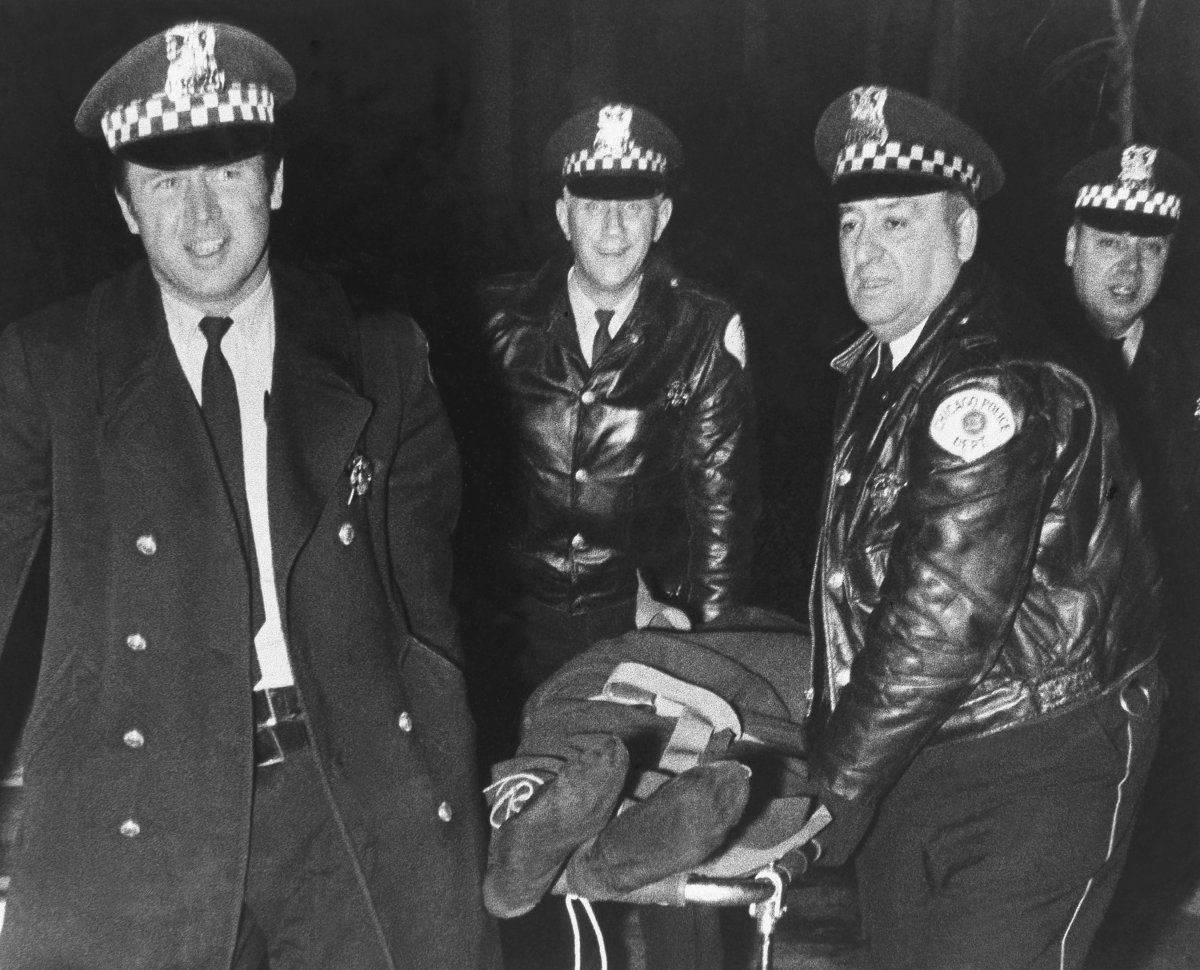
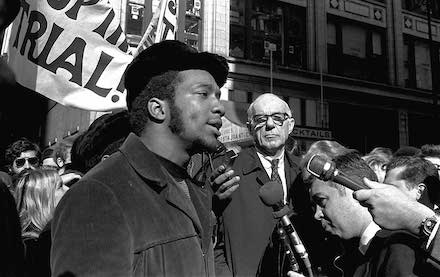
This charismatic — nearly every bio uses this word — 21-year-old star of the Illinois Black Panther Party had in his brief life shown himself a visionary exponent of radicalism; he would end as one of the signal martyrs to his movement’s violent suppression.
Well did he know it.
“If you’re asked to make a commitment at the age of 20 and you say, I don’t want to make a commitment only because of the simple reason that I’m too young to die, I want to live a little bit longer. What you did is, you’re dead already,” Hampton once mused. “You have to understand that people have to pay the price for peace. If you dare to struggle, you dare to win. If you dare not struggle then damnit, you don’t deserve to win … And I think that struggle’s going to come. Why don’t you live for the people? Why don’t you struggle for the people? Why don’t you die for the people?”
Emerging late in 1966 out of Oakland, Calif., the Black Panthers were a revolutionary and pointedly armed movement that fused black power demands with critique of the entire edifice — war, imperialism, capitalism and the rest of it. Although the organization was dissolved in 1982, the Panthers’ actions and legacy are still quite controversial and their mere specter remains a potent bogeyman for much of contemporary white America.
One thing is for sure: in their moment, they scared the shit out of the powers that be. Within months of its founding, the Federal Bureau of Investigation turned upon the Panthers its COINTELPRO program of domestic surveillance, suppression, and assassination. One particularly notorious FBI memo drew a bead on “Black Nationalist-Hate Groups” with an avowed intention to “prevent the rise of a ‘messiah’ who could unify, and electrify, the militant black nationalist movement” — and to “pinpoint potential troublemakers and neutralize them”.
Fred Hampton isn’t mentioned by name in this chilling missive from early 1968; he was just then beginning to emerge onto the FBI’s index of rabble-rousers. (Literally, the feds had a list called the “Rabble Rouser Index”.) He was fresh out of high school in 1966, and subsequently a wildly successful NAACP chapter leader, but gravitated to the new Illinois Panthers organ by 1968 where he quickly became its most outstanding organizer and spokesman, the prospective future face of a stirring cross-racial, class-conscious justice movement that Hampton perceived with a wisdom well beyond his years. Under his leadership the BPP spun out health care programs, legal aid programs, and free breakfast programs; he forged the original Rainbow Coalition* that brought rival street gangs and activist groups from different racial communities into a shared political ambition.
“We’re going to fight racism not with racism, but we’re going to fight with solidarity,” Hampton said. “We’re not going to fight capitalism with black capitalism, but we’re going to fight it with socialism.”
Just as energetically did the FBI work — and succeed, in the end — to break up such alliances, using informers and agents provocateur and false flags to encourage schisms and discredit leaders. Chicago’s police department was a ready collaborator in these operations; its relationship was the Panthers was hostile and often violent. Just three weeks before Hampton’s murder, two Chicago cops and a 19-year-old Black Panther were killed in a shootout. (Hampton was in California at the time.)
We don’t have the full documentary paper trail with deliberations and countersigned orders, but the known facts (and the smug grins of the cops) admit no reasonable dispute this side of performative naivete that Hampton was assassinated by a state death squad — “executed”, if you like, to fit an admittedly expansive read of this here site‘s mandate.
A compromised Hampton bodyguard named William O’Neal gave his FBI handler — who also happened to be running the Chicago COINTELPRO operation targeting the Panthers — a detailed floor plan of Hampton’s apartment, which the FBI shared with the Chicago police for a raid putatively hunting illegal weaponry. On the night of December 3, O’Neal slipped Hampton a barbituate to dull his reactions for what was to come; surviving comrades would describe Hampton being roused amid the early-morning fusillade only with difficulty, responding barely and in “slow motion” even as Chicago police stormed front and rear entrances and poured nearly 100 rounds into the place. Another Hampton aide named Mark Clark, sitting watch, was blasted dead in the initial barrage, convulsively discharging his shotgun once into the ceiling as he fell. It was the only shot fired that night by any of the Black Panthers.
By the account of Hampton’s eight-months pregnant partner Deborah Johnson, corroborated by other Panthers in the apartment, Fred Hampton was injured by the volley, but alive — and cold-bloodedly finished off with a coup de grace.
First thing that I remember after Fred and I had went to sleep was being awakened by somebody shaking Fred while we were laying in the bed. Saying, “Chairman, Chairman, wake up, the pigs are vamping, the pigs are vamping!” And, um, this person who was in the room with me, kept shouting out “we have a pregnant sister in here, stop shooting”. Eventually the shooting stopped and they said we could come out. I remember crossing over Fred, and telling myself over and over, “be real careful, don’t stumble, they’ll try to shoot you, just be real calm, watch how you walk, keep your hands up, don’t reach for anything, don’t even try to close your robe”. I’m walking out of the bedroom, there are two lines of policemen that I have to walk through on my right and my left. I remember focusing on their badge numbers and their faces. Saying them over and over on my head, so I wouldn’t forget. Um, as I walked through these two lines of policemen, one of them grabbed my robe and opened it and said, “Well, what do you know, we have a broad here.” Another policeman grabbed me by the hair and pretty much just shoved me — I had more hair then — pretty much just shoved me into the kitchen area. It was very cold that night. I guess that it snowed. And, ah, the back door was open. Some people were on the floor in the kitchen area. I think it was Harold Bell was standing next to me in the kitchen area. They, ah, it was a police, ah, plainclothes policeman there, and I asked him for a pin, so I could pin my robe, because it was just open. And he said, “Ask the other guy.” And, ah, then somebody came back and handcuffed me, and Harold Bell behind the back. I heard a voice come from the area, I guess from the dining room area, which was, the kitchen was off from that area. And someone said, “He’s barely alive, he’ll barely make it.” The shooting, I heard some shooting start again. Not much. Just a little shooting, and, um, and someone said, “He’s good and dead now.” I’m standing at the, um, kitchen wall, and I’m trying to remember details of these policemen’s face, say it over and over in my head, and, and badge numbers, so, you gotta remember, gotta remember. And then when I felt like I was just going to really just pass out, I started saying the ten-point program over and over in my head. Um, at one point I turned around, the shooting had continued again, and I saw the police drag Verlina Brewer and throw her into the refrigerator. And it looked like blood was all over her. And she fell to the floor and they picked her up and threw her again. I saw Ronald Satchel bleeding. I kept trying to focus on the ten-point program platform, because I, again, I wanted to take myself out of that place. And I knew I just couldn’t break down there. Because I didn’t know if I would be killed, or what would happen.
Incidentally, Hampton’s killing was also a key catalyst for the terroristic turn of the Weather Underground — whose decisive “war council” meeting occurred later that same month of December 1969, with Hampton’s blood heavy in the air (and his picture prominently displayed on the wall) as an emblem of the futility of pacific resistance within the belly of the beast. “It was the murder of Fred Hampton more than any other factor that compelled us to feel we had to take up armed sturggle,” said David Gilbert, who’s now serving a prison sentence for a deadly bank robbery. “We wanted to create some pressure, to overextend the police so they couldn’t concentrate all their forces on the Panthers. We wanted to create a political cost for what they were doing. And we also felt that to build a movement among whites that was a revolutionary movement, a radical movement … it had to respond when our government in our name was destroying the most promising, exciting, and charismatic leadership to come out of the Black movement in a long time.” (Source) It was a paradoxical inspiration, since Hampton himself had criticized the emerging Weathermen after their “Days of Rage” riot in Chicago as “anarchistic, opportunistic, individualistic,” and even “Custeristic” — as in Indian Wars cavalryman George Armstrong Custer, famous for his defeat — “in that its leaders take the people into situations where they can be massacred. And they call that revolution.”
* The name and concept of the Rainbow Coalition were later revived by Jesse Jackson in his left-wing presidential challenges in 1984 and 1988, but there is not a continuous institutional thread from Hampton’s coalition to Jackson’s. Jackson did, however, deliver a eulogy at Hampton’s funeral on December 6, 1969.
Spanish terrorist Santiago Salvador died to the garrot on this date in 1894.
A central-casting figure from the heyday of anarchist bomb attacks on bourgeois society, Salvador highlighted the November 7, 1893 premier of opera season at Barcelona’s Gran Teatre del Liceu by chucking a couple of Orsini bombs from the balcony during the second act of William Tell.*
“My wish was to destroy bourgeois society,” he would explain. “I did not set out to kill certain people. I was indifferent to killing one or the other. My desire was to sow terror.” A more specific provocation (cited by Salvador at his trial) was the execution one month before of another anarchist, Paulino Pallas.
Salvador successfully escaped the scene amid the confusion and the hunt for him licensed a year of martial law with a plethora of offices ransacked and subversives sweated.
The man died with the requisite cry of Viva la Anarchia! upon his lips; however, anarchist violence in his parts did greatly abate in the ensuing couple of years, with the main theater of the propaganda-of-the-deed tendency now shifting to France.
* France’s Le Petit Journal had an explosive illustration of the event on the cover of its 26 November issue.

 In an environment of desperate economic immiseration for nearly all Salvadorans below the landed oligarchy, the heavily indigenous western peasantry rebelled on January 22, 1932 —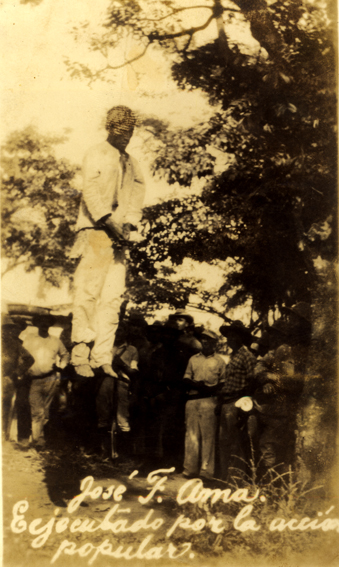

 Although he’d been a Communist in his prewar youth,


 Source are at odds over whether to characterize
 “My wish was to destroy bourgeois society,” he would explain. “I did not set out to kill certain people. I was indifferent to killing one or the other. My desire was to sow terror.” A more specific provocation (cited by Salvador at his trial) was the execution one month before of another anarchist,