1804: Ann Hurle, forger

(Thanks to Richard Clark of Capital Punishment U.K. for the guest post, a reprint of an article originally published on that site with some explanatory links added by Executed Today. CapitalPunishmentUK.org features a trove of research and feature articles on the death penalty in England and elsewhere. -ed.)

Ann Hurle was one of twelve people to be hanged for forgery in 1804. The law took a very severe view of this offence at the time and few forgers were reprieved.

Ann was an educated young woman of twenty-two, living in London, who had devised quite an elaborate plan to defraud the Bank of England of £500, which was a very large sum in those days and would now be the equivalent of over a quarter of a million pounds. The crime was perpetrated on Saturday the 10th of December 1803 when she met Stock Broker, George Francillon, at the Bank Coffee House and persuaded him to obtain a power of attorney for her to enable her to sell some Bank of England 3% stock belonging to one Benjamin Allin, an elderly gentleman from Greenwich. Mr. Francillon had known Ann for some six months and therefore was not overly suspicious. She told him that she had lived in Mr. Allin’s house as a child, where her aunt was the housekeeper, and that he had given her this stock in return for the aunt’s service to the household and the kindnesses she had shown him. Mr. Francillon obtained the power of attorney for Ann on the Saturday, and she told him that she was then going to take it Greenwich to get it signed by Mr. Allin.

Ann returned on Monday morning with the document purportedly signed and witnessed by Thomas Noulden and Peter Verney, who both ran small businesses in Greenwich. Ann met Mr. Francillon at the Bank of England where he took the document to the Reduced Office for verification. Ann meanwhile went off to sell the stocks. Mr. Thomas Bateman, the Clerk in charge of powers of attorney, asked to see George Francillon with Ann and informed them that Benjamin Allin’s signature on the power differed from that on the specimen held by the bank. Ann told Mr. Bateman that she knew Mr. Allin and that as he was nearly ninety years old, in poor health and nowadays wrote very little, it was not surprising that his signature differed. She also offered to take out another power of attorney and obtain a new signature on it. Mr. Bateman did not feel that this was necessary but wrote a letter to one of the witnesses to the document.

During the conversation in Mr. Bateman’s office, Ann mentioned that she had recently married and asked by Mr. Bateman why she had not taken out the power in her married name, she told him that she feared her marriage to one James Innes was not a good one. She suggested that he had stolen her money and then boarded a ship at Bristol and that he was already married to another.

Ann left the bank and returned on the following Tuesday. In the meantime, Mr. Francillon had become suspicious when he checked the document. He put their main meeting off to the following day while he did some further research, including going to see Benjamin Allin. As arranged, Mr. Francillon met Ann on the Wednesday morning at the Bank of England. He had previously had a meeting with Mr. Newcomb the principal clerk in the Reduced Office and explained his suspicions. He and Mr. Newcomb had a meeting with the Governors. Ann came to the Bank with a young man and must have realised from the delays in seeing her that all was not well and left. She was arrested the following day in Bermondsey and taken to the Mansion House for questioning. The young man turned out to be James Innes, who was also questioned. She was charged with the forgery and he with being an accessory to the crime, although it seems that his case was dropped as there is no record of a trial for him. The case was obviously unusual and of some public interest as it was reported in The Times of Wednesday, the 21st of December 1803. Ann was committed for trial at the next Sessions of the Old Bailey in London.

These Sessions opened on the 11th of January 1804, before the Lord Chief Baron of the Exchequer, Sir Archibald Knight. Ann was charged with four offences. The first was “feloniously, falsely, making, forging, and counterfeiting, on the 12th of December, a certain instrument, or letter of attorney, with the name Benjamin Allin thereunto subscribed, purporting to have been signed, sealed, and delivered, by one Benjamin Allin, of Greenwich, in the county of Kent, gentleman, a proprietor of certain annuities and stock transferable at the Bank of England, called Three per Cent. Reduced Annuities, to sell, assign, transfer, and convey, the sum of five hundred pounds of the said transferable annuities, the property of the said Benjamin Allin, to her, the said Ann Hurle , with intent to defraud the Governor and Company of the Bank of England.” The second count was, “For uttering and publishing as true a like forged deed, knowing it to be forged, with the like intention.” There were two further counts on the indictment against her, being the same offences against Benjamin Allin. Mr. Garrow led for the prosecution and Mr. Knapp for the defence.

George Francillon and Benjamin Allin were the principal prosecution witnesses. Mr. Francillon related the above story to the court and Mr. Allin examined the power of attorney document and declared that the signature was not his and that he had never signed such a document. Thomas Bateman, Peter Verney and Thomas Noulden also testified against her. Ann’s aunt, Jane, told the court that Ann had not visited Mr. Allin’s house recently and neither had Messrs. Verney and Noulden, the two purported witnesses to his signature on the document.

The witnesses’ testimonies were cross examined at this time but Ann offered no actual defence, leaving this to her counsel. She was thus convicted and remanded to Tuesday, the 17th of January 1804 for sentence. Four men and three women were bought before the court to received their death sentences that Tuesday, with the Recorder of London making particular reference to the gravity of Ann’s crime and the fact that she preyed upon “an infirm and imbecile old man”. He opined that only death was sufficient punishment for such a crime. He then proceeded to pass sentence on each prisoner. When Ann’s turn came, she was asked in the normal way if their was any reason why sentence of death should not be pronounced against her and replied that she thought she was “with child” (pregnant). She did not make this claim with any apparent confidence so no further enquiry into its validity was made. Sarah Fisher, another of the condemned women, also claimed to be pregnant but did so much more forcibly, thus requiring the court to empanel a Jury of Matrons, who examined her and declared that she wasn’t. It is feasible that both women could have been in the early stages of pregnancy, although neither was “quick with child”. Only if the prisoner was obviously pregnant was her execution respited until after she had given birth. In most cases she was reprieved altogether and her punishment commuted to transportation. “Pleading the belly” as it was called was a frequently used tactic at this time by women desperate to avoid the noose.

The Recorder of London reviewed the cases of those condemned to death and made a recommendation in each one. He then presented his recommendations in person to the Privy Council, which was chaired by King George III. In Ann’s case, there could be no recommendation for a reprieve. She was therefore scheduled for execution, along with Methuselah Spalding who had been convicted of sodomy at the previous Sessions held on the 30th of November 1803. It is interesting to note that Spalding was the only one of five condemned men at that Sessions not to be reprieved and that Ann was the only one out of the six men and three women at the January 1804 Sessions not to get a reprieve. Non-murderers normally had a period of two to three weeks before execution at this time and Ann’s execution was set for Wednesday, the 8th of February.

For reasons that are unclear, the normal “New Drop” style gallows at Newgate was not to be used for these two hangings. A simple gallows was erected at the top of the Old Bailey, near to St. Sepulchre’s Church.

On the morning of execution, Ann and Spalding were brought from their cells and pinioned in the Press Room. They were then taken out into the yard and loaded into a horse drawn cart covered in a black cloth which emerged from the prison at about 8.10 a.m. for the short ride to the gallows. The cart was backed under the beam and the two prisoners were allowed to pray with Ordinary and make their last statements. Ann was dressed in a mourning gown and wore a white cap. She made no address to the multitude who had come to see her die but prayed fervently with the Ordinary for five minutes or so. William Brunskill, the hangman for London & Middlesex, placed the rope around her neck and when she had finished praying, pulled the white cap down over her face. The cart was now drawn away leaving them both suspended. It was recorded that Ann let out a scream as the cart moved and that she struggled hard for two to three minutes before becoming still, her hands were observed to move repeatedly towards her throat and her un-pinioned legs kicked and padded the air. No doubt the eyes of the crowd were riveted on her poor writhing form. After hanging for the customary hour, they were taken down and returned inside Newgate from where they could be claimed by relatives for burial.

An angry letter appeared in The Times newspaper the following week castigating the authorities for the execution on the grounds of cruelty compared with the New Drop and the difficulty in seeing the prisoners and thus taking a moral lesson from their demise. It was alleged in the letter that the reason for the change of gallows was that the Newgate staff were too lazy to assemble the New Drop gallows. Whether this was true or whether the drop mechanism had become defective we will never know, but it was returned to service for the next execution, that of Providence Hansard for the same crime on the 5th of July 1805.

It seems surprising looking back two centuries that Ann, acting alone, would have devised such an ambitious plan to obtain this large sum of money. However, no evidence was offered at her trial to show that anyone else was involved, other than perhaps James Innes on the periphery of the crime. It must have taken quite some time to think through and make the necessary contacts, such as George Francillon, who would be able to obtain the power of attorney for her. It is hard to believe she was not aware of the risk of failure and the deadly consequences that would follow it. In the period 1800 – 1829, an amazing 218 people were to die for forgery in England and Wales. Another two women were to follow Ann to the gallows outside Newgate over the next two years, Providence Hansard mentioned earlier and Mary Parnell on the 13th of November 1805. Forgery ceased to be a capital crime in 1832 and the last execution for it took place on the 31st of December 1829, when Thomas Maynard was hanged at Newgate. Over two centuries attitudes have altered; had a modern day Ann committed the crime in the 21st century, she would have got somewhere between four and five years in prison and have been released on licence half way through this sentence.

On this day..

2013: Kepari Leniata burned as a witch

On this date in 2013, villagers at the Papua New Guinea village of Paiala tortured their neighbor Kepari Leniata into confessing the witchcraft murder of a local child, then burnt her alive in a trash dump. Sorcery is widely feared and practiced in PNG.

Kepari Leniata, 20, ‘confessed’ after she was dragged from her hut, stripped naked and tortured with white-hot iron rods.

She was then dragged to a local rubbish dump, doused in petrol and, with hands and feet bound, thrown on a fire of burning tyres. As the mother-of-two screamed in agony, more petrol-soaked tyres were thrown on top of her.

The tragedy unfolded after Miss Leniata’s young neighbour fell sick on Tuesday morning. He complained of pains in the stomach and chest and was taken to Mt Hagen hospital where he died a few hours later.

Relatives of the boy were suspicious that witchcraft was involved in the death and learned that two women had gone into hiding in the jungle.

After they were tracked down, the pair admitted they practised sorcery but had nothing to do with the boy’s death. Miss Leniata, they said, was the person responsible.

The boy’s family went to her hut at 7am on Wednesday, stripped her and dragged her away to torture and death. (Source)

Horrific pictures circulated in the international media.

On this day..

1977: Marta Taboada and Gladys Porcel, Argentina revolutionaries

Early in the morning on this date in 1977, Argentinian revolutionaries Marta Angélica Taboada de Dillon and Gladys Porcel were shot by the junta.

Essentially all the information available about these Dirty War murders is in Spanish, as are most of the links in this post. The preceding October, Argentina’s new military junta — having just a few months previous seized power by deposing Juan Peron’s widow — raided the Buenos Aires house shared by the pregnant Marta Taboada with Gladys Porcel and the latter’s boyfriend Juan Carlos Negro Arroyo, all of them adherents of the October 17 Revolutionary Movement.*
They vanished into the shadow ranks of the “disappeared” — the women shot on February 3 in Ciudadela, Negro Arroyo executed separately with some other male activists that same month, all to be dumped into the mass graves that became the usual repose of the junta’s enemies.

Taboada’s children, notably including journalist and activist Marta Dillon, who was 10 at the time, witnessed their mother’s abduction. In 2000, all four children marked the anniversary of that terrible night — a night, Marta Dillon described, after which there was “nothing left of the world that I had known” — by publishing a letter in a newspaper pledging militancy in their mother’s memory.

Mama, in your name and in that of all the compañeros, we uphold the joy of standing and fighting. We do not forget, we do not forgive, we do not reconcile, we judge and punish the genocides and their accomplices.

-Marta, Santiago, Andrés and Juan Dillon.

The remains of Taboada, Porcel, and Negro Arroyo were identified by forensics teams in 2011 and interred with honor.

* The name alludes to the date in 1945 when popular protests forced the army to release Juan Peron from custody.

On this day..

1715: Ann Wright, branded

On this date in 1715, a longtime petty thief named Ann Wright — or was it Martha Wright? or Ann Hutchins? or Elizabeth Jolly? — hanged at Tyburn.

In the absence of modern trappings like a standing police force, criminal dossiers, and systematic record-keeping — innovations that lay decades into the future — small-time criminals could float at the margins for the duration of many years and many offenses by relying on the forgetfulness of the legal apparatus: with nothing but a casual alias, one might hope to appear over and over again as a new offender.

Here we see Ordinary of Newgate Paul Lorrain deploy his own investigative acumen to trace for us one woman’s career, a very much more penetrating biography of an Early Modern commoner than we can usually access. We can see from his account of offenses — for how many crimes must Lorrain be omitting in this register? — that he was greatly aided by Wright’s own body which bore the mark of our Old Offender’s repeated brandings. That included scars earned during the brief period from 1699 to 1707 when brands could be applied to an offender’s cheeks, a fate which apparently befell Ann Wright on no fewer than five occasions.*

By the time he came to Wright’s terminal adventure, Rev. Lorrain had held the post of ministering to convicts for fifteen years and could probably boast as expert an acquaintance with London’s criminal underworld as any square; whether he knew Ann Wright on sight or knew her by reputation, he knew her.

Ann Wright, condemn’d for breaking the Lock of Eliz. Barrot’s Chamber-Door, with an intent to rob her, on the 30th of October last. She was about 38 Years of age, and liv’d in the Parish of St. Dunstan, Stepney. She would hardly confess her self guilty of the Crime for which she was justly Condemn’d; neither did she readily acknowledge, that she had done several other Facts of the like heinous nature, and was an old Offender: But when I laid before her, and charg’d her with diverse Burglaries and Robberies, which I knew she had committed, then she could not deny her being Guilty of them.

Here I shall give the Reader a Particular of some of those wicked Facts of hers, and the several Punishments she receiv’d for them, the Time when, and the various Names she went by.

1st, She was (under the Name of Martha Wright) Burnt in the Cheek at the Old-Baily, on the 10th of July, 1702, for entring the House of Mr. James Gee, and taking thence 4 Muslin-Neckcloths, 2 Holland-Aprons, a Hol-Smock, a Cloth-coat, Wastcoat and Breeches, with diverse other Goods, on the 2d of the said Month of July.

2dly, She was (under the Name of Ann Rebel alias Ann Hutchins, which latter, as she said, was her Maiden-Name) also Burnt in the Chek at the Old-Baily, on the 11th of September, 1702, for Robbing the House of Mr. Joseph Lineum, on the 7th of August before, and taking thence 6 Hempen-Aprons, 6 Dowlas-Shirts, 6 Smocks, &c.

3dly, She was again (under the same Name of Ann Hutchins) Burnt in the Cheek, at the Old-Baily, on the 9th of July, 1703, for stealing 5 ounces of China-Silk from Mr. John Sheppard, and other Silks from Mr. Nathanael Wichel, on the 19th of May before.

4thly, She was in like manner (under the Name of Ann Hutchins) Burnt in the Cheek, at the Old-Baily, on the 2d of June, 1704, for stealing 4 Buck-Skins from Mr. Tho. Boddington, on the 4th of May preceding.

5thly, She was (under the Name of Elizabeth Jolly alias Hodges, which latter she said was her Husband’s Name) again Burnt in the Cheek, at the Old-Baily, on the 17th of January, 1704/1705, for stealing 16 yards of Silk, a Stuff-Gown and Petticoat, 12 ells of Holland, 26 yards of Lace, and diverse other Goods of Mr. Edward Kenworthy’s, on the 14th of June, 1704.

6thly, She was (under the Name of Eliza. Wright) on the 6th of July, try’d at the Old-Baily, and order’d to be whipt, for stealing a Silver-Spoon and a Cambrick-Handkerchief, from Mr. Anthony Moreing, on the 17th of June before.

7thly, She was (under the Name of Ann Hicken) Burnt in the Hand, at the Old-Baily, on the 26th of February, 1707/1708, for stealing 10 ounces of Silver Orrice-Lace, and 12 ounces of Gold-Lace, from Mrs. Margaret Tiplady, on the 3d Day of the same Month.

8thly, She was again (under the Name of Ann Hutchins) Burnt in the Hand at the Old-Baily, on the 9th of July, 1708, for Robbing Mrs. Mary Collier’s House, and taking from thence 1 pound 15 ounces of Raw-Silk, on the 26th of the preceding June.

9thly, She did (under the Name of Ann Hodges alias Hodgkins) receive Sentence of Death, at the Old-Baily, on the 6th of May, 1709, for Breaking the House of Mr. John Marsh, and taking from thence a Psalm-book, two Cloth-Coats, a Diaper Table-cloth, 10 Napkins, and several other things, on the 11th of April before; for which having obtain’d a Reprieve, and afterwards a Pardon, which she pleaded in Court at the Old-Baily, on the 8th of December, 1710, (at which time she was order’d to the Bridewell of Clerkenwell for 2 Years) she no sooner had her Liberty (which she got by breaking out of that House of Correction) but she return’d to her former wicked Way of Robbing. So that,

10thly, She was again (under the Name of Ann Hutchens) Burnt in the Hand at the Old-Baily, on the 12th of April, 1711, for stealing 4 Holland-Smocks that hung up a drying in the Yard of Mr. William Baker, on the 28th of March preceding.

11thly, She was (under the Name of Ann Hodges) Burnt in the Hand at the Old-Baily, on the 28th of February, 1711/1712, for Stealing a Coat, Wastcoat, and Breeches, Linnen, Gold-Rings, and other Goods, of Mrs. Susannah Butterwick, on the 12th of the same Month.

12thly, and Lastly, (to mention no more of these sad Particulars) She was again (under the Name of Ann Hodges, alias Jenkins, alias Jeatzin) Burnt in the Hand, at the Old-Baily, on the 2d of May, 1712, for a Felony, in stealing Pewter and other Goods out of the House of Mr. John Simmonds, on the 5th of the ‘foregoing March.

All these her notorious Facts, of which I had taken a particular Account, I laid before her, together with some others she had been try’d for, but acquitted of, for want of positive Evidence to convict her, tho’ there was no great reason to doubt her being guilty of ’em: And moreover, I put her in mind of her having frequently broke out of the Workhouse, to which she had several times been sent, for her Correction and Amendment; the former whereof she would not receive, nor bring her self to the practice of the latter, but plainly shew’d her ill Disposition and wicked Desire of returning (as she did so fast as she could) to her sinful Course of Life; of which I exhorted and press’d her to make a free Confession, and repent. Whereupon she acknowledg’d her Guilt in these Matters, saying, (in general) That she had done many ill things, but her discovering them in particular (were she able fully to do that) would be now of no use to the World. Having some just Suspicion that she had been concern’d in Facts committed in Surrey, and try’d for them in that County, I put the Question to her, which she answer’d in the Negative, thinking (I suppose) that those Facts could not so easily be known to me, being done not only at a distance, and in a County where I have nothing to do, but also under Names which she thought fit at times to take and shift, as suited best her Occasions of disguising her self, and concealing Who and What she was. I found her all along very stupid, and insensible both of her sad Condition, and the Cause of it. When I examin’d her in private, she was very sullen, spoke but few (and those angry) Words, and shed fewer Tears: What her inward Thoughts were, I can’t tell; but she gave little sign of true Repentance. As I observ’d her in that harden’d Temper, so I told her, That she behav’d her self just as I had seen others do, who were guilty of Murder, whom (above all other Sinners) the Devil does what he can to hinder from repenting; and therefore I must needs plainly say this to her, That I was afraid she had been concern’d in some Bl[oo]dy Fact or other; for she seem’d to me to be more than a common Sinner. To this she answer’d, That she never committed any Murder in her Life. No? said I to her; Did you never kill a Bastard-Child, to hide your Shame when you were in Service? (for I knew she had been a Servant in some Families in and about London.) At this Question she startled, and after a Pause (not without some discomposure) said, She was very clear of that Crime. However I gave her to understand I greatly suspected she was not, for she had been a very wicked, lewd, and debauch’d Woman; and so I offer’d her some ghostly Advice herein. Then I further ask’d her, Whether she knew any thing of the Murder of Esq. Hanson and Mr. Carlton, who (some Years ago) were found murder’d, viz. the first near the Vinegar-house beyond Moorfields, and the other between Rosemary-branch and Cambray-house, in Islington Parish. To which she reply’d, That she had indeed heard of those Murders, but was not in the least concern’d in ’em, nor knew who had committed them. This is all I could get from her, who (as I observ’d with great Concern) instead of making a right use of the long Time and good Instruction she had under this Condemnation, seem’d (all the while) to have nothing so much at Heart as getting a Reprieve, and avoiding this Death; tho’ I endeavour’d to make her sensible, there was no manner of ground for her Hope of Life in this World; and, that if she were wise she would (as ’twas infinitely better she should) seriously consider her sad and miserable Condition by reason of her Sins, and so by all the Acts of Repentance she was capable of exerting, prepare herself for her great Change that was approaching and inevitable. And this important Consideration I urg’d to her, to the very last.

At the Place of Execution (whither both she and George Hynes were this Day carried from Newgate in a Cart, and where I attended them for the last time) she seem’d to be much dejected and sorrowful; and no Wonder, for she had great Cause to be so. Hynes likewise cry’d bitterly, lamenting and bewailing his past sinful Life. Here I gave them proper Admonitions; and after I had pray’d, and sung some Penitential Psalms with them, and made ’em rehearse the Apostles Creed, I advis’d, that they would (and accordingly they did) desire the Spectators to pray for them, and take Warning by their Fall; To keep the Sabbath-day, serve God, and live honestly. Then I withdrew from them, recommending their Souls to God, and leaving them to their private Devotions, for which they had some Time allotted. After this the Cart drew away, and they were turn’d off, crying all the while to God for Mercy, Pardon, and Salvation.

* We’ve previously seen that London authorities didn’t mind applying the brand several times to a habitual offender.

On this day..

1591: Agnes Sampson, North Berwick witch

On this date in 1591, Agnes Sampson, the “Wise Wife of Keith”, went to the stake at Edinburgh during the North Berwick Witch Trials.

Perhaps Scotland’s most notorious witch hunt, the 1590-1591 sweep caught up something approaching 70 supposed sorcerers thanks to the king’s security panic after dangerous North Sea storms had beset the sea voyages uniting King James VI of Scotland and his new wife Queen Anne of Denmark. An inquisition in Denmark had made witches the culprit, and the young James — amusingly described by one commenter as “a superstitious and distrustful poltroon”* — opened an inquiry of his own as soon as he returned to native heather. His subsequent obsession with witchcraft is one of the signal characteristics of his reign, immortalized in literature via Shakespeare’s Macbeth.

James turned 24 in the summer of 1590, his short life already buffeted by fratricidal court politics (his mother, Mary Queen of Scots, lost her head; the regents who subsequently jostled over control of James had a frightening tendency to violent death). However misplaced upon magicians, his fear was well-founded; James’s cousin Lord Bothwell, himself escaped from arrest during the North Berwick scare, openly plotted against James throughout the early 1590s — one occasion coming “with fire to the king’s door, with hammers to the queen’s door” and on another surprising him in a vulnerable position during his morning toilet, causing the king to exclaim, “Came they to seek his life? let them take it — they would not get his soul.”

Peril to life and soul everywhere stretched into James’s world from the world beyond. “Our enemie is over craftie, and we over weake,” James would write in his remarkable 1597 disquisition on black magic, Daemonologie: Satan’s earthly minions so mighty that “They can rayse stormes and tempestes in the aire, either upon Sea or land.”


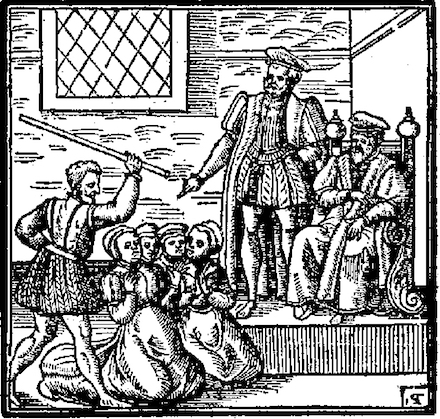
In an illustration from Daemonologie, James personally interrogates witches.

A woman named Geillis Duncan, maid to the deputy mayor of a small town near Edinburgh, was the fountainhead of the the North Berwick trials, when her suspicious master tortured her into admitting to witchcraft. King James personally joined the ensuing interrogations which saw her denounce several dozen Edinburghers as fellow necromancers, among them our day’s principal — a matronly widow named Agnes Sampson, who was a respected “wise woman” and folk healer much in demand among Edinburgh’s elites.

In Duncan’s involuntary narration, this woman “was the elder Witch” and when she “stood stiffely in the deniall of all that was laide to her charge” they dragged her to prison and put her to torture, also shaving her hairless in search of the inevitable small disfigurement that would be prejudicially construed her witches’ mark — “and forasmuch as by due examination of witchcraft and witches in Scotland, it hath latelye beene found that the Deuill dooth generallye marke them with a priuie marke, by reason the Witches haue confessed themselues, that the Diuell dooth lick them with his tung in some priuy part of their bodie, before hee dooth receiue them to be his seruants, which marke commonly is giuen them vnder the haire in some part of their bodye.”

We’re quoting here the 1591 pamphlet Newes from Scotland, one of the key primary sources (and justifications) of the witch trials which was issued from a pen very near to the king’s own hand. Having endured the cruel torture of having her hair wrenched (“thrawn”) by ropes for an hour, Newes from Scotland reports, Sampson broke down when an incriminating wart was discovered upon her bared pudenda.

the said Agnis Tompson confessed that the Divell being then at North Barrick Kerke attending their comming in the habit or likenes of a man, and seeing that they tarried over long, he at their comming enjoyned them all to a pennance, which was, that they should kisse his Buttockes, in signe of duetye to him: which being put over the Pulpit barre, everye one did as he had enjoyned them: and having made his ungodly exhortations, wherein he did greatlye enveighe against the King of Scotland, he received their oathes for their good and true service towards him, and departed: which doone, they returned to Sea, and so home againe.

At which time the witches demaunded of the Divel why he did beare such hatred to the King, who answered, by reason the King is the greatest enemy he hath in the worlde: all which their confessions and depositions are still extant upon record.

Item, the saide Agnis Sampson confessed before the Kings Majestie sundrye thinges which were so miraculous and strange, as that his Maiestie saide they were all extreame lyars, wherat she answered, she would not wishe his Maiestie to suppose her woords to be false, but rather to beleeve them, in that she would discover such matter unto him as his majestie should not any way doubt off.

And therupon taking his Majestie a little aside, she declared unto him the verye woordes which passed betweene the Kings Majestie and his Queene at Upslo in Norway the first night of their mariage, with their answere eache to other: whereat the Kinges Majestie wondered greatlye, and swore by the living God, that he beleeved that all the Divels in hell could not have discovered the same: acknowledging her woords to be most true, and therefore gave the more credit to the rest which is before declared.

One can see the work this tract — circulated as its title implies in England, where James was already being set up to inherit rule from the aging Queen Elizabeth — effects as propaganda: James as “the greatest enemy [the Devil] hath in the worlde”; James as the savvy and thorough interrogator too worldly to be taken by Agnes Sampson’s crazy stories until she proved them with a conveniently unfalsifiable private conference. Definitely no superstitious poltroon! Why, it was only by his superlative faith that James earned the divine favor required to overcome his adversaries’ weather machinations.

She confessed that she tooke a blacke Toade, and did hang the same up by the heeles, three daies, and collected and gathered the venome as it dropped and fell from it in an Oister shell, and kept the same venome close covered, untill she should obtaine any parte or peece of foule linnen cloth, that had appertained to the Kings Majestie, as shirt, handkercher, napkin or any other thing which she practised to obtaine by meanes of one John Kers, who being attendant in his Majesties Chamber, desired him for olde acquaintance betweene them, to helpe her to one or a peece of such a cloth as is aforesaide, which thing the said John Kers denyed to helpe her too, saying he could not help her too it.

And the said Agnis Tompson** by her depositions since her apprehension saith, that if she had obtained any one peece of linnen cloth which the King had worne and fouled, she had bewitched him to death, and put him to such extraordinary paines, as if he had beene lying upon sharp thornes and endes of Needles.

Moreover she confessed that at the time when his Majestie was in Denmarke, she being accompanied with the parties before specially named, tooke a Cat and christened it, and afterward bound to each parte of that Cat, the cheefest partes of a dead man, and severall joynts of his bodie, and that in the night following the saide Cat was conveied into the midst of the sea by all these witches sayling in their riddles or Cities as is aforesaide, and so left the saide Cat right before the Towne of Lieth in Scotland: this doone, there did arise such a tempest in the Sea, as a greater hath not beene scene: which tempest was the cause of the perrishing of a Boate or vessell comming over from the towne of Brunt Iland to the towne of Lieth, wherein was sundrye Jewelles and riche giftes, which should have been presented to the now Queen of Scotland, at her Majesties comming to Lieth.

Againe it is confessed, that the said christened Cat was the cause that the Kinges Majesties Ship at his comming foorth of Denmarke, had a contrary winde to the rest of his Ships, then being in his companye, which thing was most strange and true, as the Kings Majestie acknowledgeth, for when the rest of the Shippes had a faire and good winde, then was the winde contrarye and altogither against his Majestie: and further the saide witche declared, that his Majestie had never come safelye from the Sea, if his faith had not prevailed above their ententions.

Moreouer the said Witches being demaunded how the Divell would use them when he was in their company, they confessed that when the Divell did receive them for his servants, and that they had vowed themselues unto him, then he would Carnallye use them, albeit to their little pleasure, in respect of his colde nature: and would doo the like at sundry other times.

The History of Witchcraft podcast does a deep dive on the North Berwick trials in episode 9 which indulges detail (from about 25:40) on the logistics of witch-burning executions. This episode is part of a whole series on witchy King James that also compasses episodes 7, 8, and 10.

* Ray Defalque and A.J Wright, “In the Name of God: Why Agnes Sampson and Eufame McCalyean were burned at the stake” in Bulletin of Anesthesia History, July 2004. The interest in the case from this unusual-to-Executed Today source is that the charges against Sampson included those of witcherous midwifery, to wit, “remov[ing] Lady Hirmestone’s pain and sickness the night of her labor” and doing the same for Eufame McCalyean. As a result, “several authors have suggested that obstetrical analgesia started in Edinburgh in 1591,” an interpretation that Defalque and Wright, both anesthesiologists, reject.

** Newes from Scotland puts this part of the confession into the mouth of a more historically elusive woman called “Agnis Thompson”: many scholars believe that Sampson and Thompson are the same person.

On this day..

1884: Maggie and Michael Cuddigan lynched in Ouray

(Thanks to Meaghan Good of the Charley Project for the guest post. -ed.)

Shortly after midnight on this date in 1884, a mob of masked men dragged Michael and Maggie Cuddigan out of the Delmonico Hotel in the Rocky Mountain mining town of Ouray, Colorado, marched them to the town limits, and lynched them. Michael was hanged from a tree and his wife, who was visibly pregnant, was hanged from the ridgepole of a cabin on the opposite side of the road. It was later said that the whole business “was quietly and neatly done.”

The Cuddigans had adopted Mary Rose Matthews from St. Vincent’s Orphan Asylum in 1883. She was about ten years old at the time; she had been sent to the orphanage after her mother died and her father found himself unable to care for her. On January 13, 1884, only a few months after her arrival at the Cuddigans’ ranch ten miles outside Ouray, the child died.

That day a hunter found Mary Rose crouched beside a haystack near the Cuddigans’ home. It was freezing cold and she was underdressed for the weather. Michael and Maggie were notified and took her home, but she died a few hours later. The next day they buried her themselves, quickly and with some secrecy, in a distant part of the ranch. Anyone who asked was told she had accidentally fallen down the cellar steps and been killed.

Mary Rose’s sudden and mysterious death gave rise to suspicion of foul play. The neighbors who had seen her in the days and weeks prior to her death noted that she’d been visibly bruised and barefoot in spite of the frigid January temperatures. They approached the coroner and asked him to investigate.

When the body was exhumed and a postmortem performed, there were clear signs that the little girl had been cruelly abused and overworked. Her remains showed numerous scars, bruises, broken bones and knife wounds, as well as severe frostbite to both feet and one hand. There was also evidence of sexual abuse. The cause of death was blunt force trauma to the head.

The Cuddigans were arrested, as was Maggie’s brother, John Carroll, and charged with murder. They were held in temporary custody at the Delmonico Hotel between Fourth and Fifth Avenues. That’s when the lynch mob intervened, overpowered the sheriff and his deputies, and took the suspects away.

Carroll was questioned separately from his sister and brother-in-law, roughed up, and threatened with death. There are reports that the mob actually did string him up, but changed their mind and lowered him to the ground before he actually died. At any rate, he claimed he wasn’t at the Cuddigans’ ranch when Mary Rose died and he was able to convince his captors to release him. Michael and Maggie were not as fortunate, and both died a slow death from strangulation.

Until January 21 their bodies were displayed in public view in town; hundreds of people saw them. The community remained incensed about Mary Rose’s murder. The so-called bed she’d slept in at the Cuddigans’ ranch during the final months of her life was also on public display: it consisted of four gunnysacks stitched together, nothing more.

Before Mary Rose’s death, Michael Cuddigan had not had a bad reputation in the community, but after the lynching, the locals in Ouray mostly believed he and his wife got what they deserved.

Officials at Cedar Hill Cemetery refused to allow the Cuddigans to be buried there, and the local Catholic priest, although he harshly condemned the lynching, refused to officiate at their funerals. Michael Cuddigan’s own two brothers (who had been present and heavily armed when he and Maggie were taken from the hotel, but had done nothing to intervene) wanted nothing to do with it either. Finally the coroner had them buried on their own ranch, expenses covered by the $240 that had been in Michael’s pocket at the time of his death. No mourners attended.

The body of Mary Rose Mathews taken back to her hometown of Denver after the lynching and presented before the public, so they might see how she had suffered. Approximately 12,000 men, women and children viewed the corpse before it was buried in a Denver cemetery, but reports of her ghost haunting the former Cuddigan ranch have persisted ever since.

Maggie Cuddigan was the first woman known to have been lynched in Colorado history, and it should be noted that that state has never judicially executed a woman.

An editorial in the Leadville Daily Herald opined that

The citizens of Ouray have distinguished themselves by a most outrageous and barbarous act of lawlessness … It is the boast of Americans that a woman’s weakness will shield her from violence at the hands of a true American … The men of Ouray can find no apology for their brutal conduct by the plea that the woman was guilty. All the world knows that a woman may be coerced by the power of her husband and compelled to do a thing at which she herself would naturally revolt.

Michael and Maggie Cuddigan left a sizable estate, valued at $4,500 once their debts were paid. The inheritance was placed in trust for their baby son, who was raised by relatives.

No one was ever arrested for the lynching.

On this day..

1949: Margaret “Bill” Allen, transgender

(Thanks to Meaghan Good of the Charley Project for the guest post. -ed.)

On January 12, 1949, Margaret Allen was executed by Albert Pierrepoint at Strangeways Gaol. She was the first woman hanged there since Charlotte Bryant in 1936.

41-year-old Margaret had beaten to death an elderly neighbor, Nancy Ellen Chadwick, on August 21, 1948, after Nancy stopped by Margaret’s cottage at 137 Bacup Road, Rawtenstall, Lancashire. Several hours later, she dragged the body outside and left it in the road, almost literally right on her doorstep.

The following facts can be gleaned about Margaret Allen’s life:

  1. Since her early twenties, she had habitually worn men’s clothing and said she wanted to be a man.
  2. She wanted everyone to call her “Bill.”
  3. She wore her hair in a short, slicked-back cut, a common style for men at the time.
  4. She once went on holiday to Blackpool with her best (and perhaps only) friend, Annie Cook, and they checked into a boarding house under the names “Mr. Allen” and “Mrs. Allen.”
  5. In 1935, after a stay in St. Mary’s Hospital, Manchester, Margaret told people she’d had a sex change operation and was now a man.*

All of it adds up to this: although few even knew it was a thing in the 1940s, it seems highly likely that if Margaret was alive today, she would have identified as a transgender man and pursued treatment, such as hormonal therapy, to change her sex.

But in 1948, such options weren’t available to Margaret. She felt like a man, dressed like one and cut her hair like one, and even adopted a man’s name. But in spite of all her efforts she didn’t really look like a man, and the local townspeople didn’t think of her as one. “Bill” Allen must have been the subject of curiosity and gossip in the small town of Rawtenstall.

As with most transgender individuals even today, Margaret’s life was difficult. She had an elementary education, had never married, and worked grueling jobs her entire life, such as in the mills and in the postal service.

Alan Hayhurst, in his book More Lancashire Murders, suggests that the four years she was a bus conductor may have been the happiest period in her life, since female employees wore slacks as part of their uniform. She was ultimately dismissed from that job for being “rude and aggressive” towards passengers.

By 1948, Margaret’s parents were dead, and she was estranged from all twenty-one of her siblings. It’s likely they were put off by her inclination to be a man.

Due to ill health, Margaret hadn’t worked since January 1948. She was living on 11 shillings a week in welfare and 26 shillings a week in National Health sick pay.

She was behind in her rent to the tune of £15, and her landlord had been threatening eviction. She hadn’t paid the electricity or coal bills in almost two years, and she had several court judgments pending against her besides. All told, she was £46 in debt and had no realistic hope of ever paying it off.

On top of everything else, Margaret was going through menopause — often a difficult time in any woman’s life, never mind a transgender one’s — and suffered frequent headaches, dizzy spells and depression as a result. Her friend Annie Cook was worried about her; she smoked too much and didn’t eat properly. She begged Margaret to pull herself together.

Enter Nancy Ellen Chadwick.

Nancy was housekeeper to a Mr. Whitaker, and lived on Hardman Avenue, about half a mile from Margaret’s home. She and Margaret first met at a mutual acquaintance’s house, then a week later on the street in the center of town. Nancy mentioned that she was out of sugar, and Margaret offered to lend her a cupful. This was generous: Britain was still laboring under postwar rationing, and sugar was rare and precious.

Margaret visited Nancy’s home a few times after that, although she did not bring the sugar. She visited her again at 8:30 a.m. on Saturday, August 21, and said she would have sugar on Monday.

“Nancy Chadwick,” Hayhurst says in his book, “was getting more and more curious about the little woman in men’s clothing.”

At about 9:30 that same morning, by accident or design, Nancy appeared on Bacup Road, saw Margaret and asked to be invited inside her home. Hayhurst describes their fatal encounter:

‘I’m afraid I haven’t got time, Nancy,’ she said, ‘you can see inside another time.’ But she found herself being pushed back into the scullery as Nancy Chadwick made a determined effort to gain entrance. Margaret still protested, but Nancy now had the bit between her teeth and was shutting the front door behind her and making for the living room.

At around 4:00 a.m. the next day, a bus driver traveling along Bacup Road stopped when he saw, illuminated in his headlights, what looked like a bundle of rags lying in the road. When he got out to take a closer look he realized it was a woman’s body.

When the doctor arrived, he determined the woman had been dead at least ten hours. There was a deep gash in her head and blood on her arms and hands, but her injuries were not consistent with a hit-and-run accident.

Two witnesses who had been walking home later told the police they’d walked past that spot at 3:45 a.m. and there was nothing there, indicating the body had been dumped sometime between 3:45 and 4:00.

Nancy Chadwick’s nephew identified the body. At the postmortem, Hayhurst records,

Dr. Bailey found that the vault of the skull was fractured in several directions over almost the whole of the skull, and there were seven incised wounds to the head, each just over 1 inch long. The cause of death was shock, produced by multiple fractures to the skull and hemorrhaging of the scalp wounds. It was apparent that Nancy Chadwick had suffered a frenzied attack with a heavy implement.

An obvious motive for the murder was robbery, for “it was common gossip in the town that Mrs. Chadwick had lots of money and was suspected of carrying it round with her.”

The police searched the nearby River Irwell for evidence. They didn’t find the murder weapon, but did find Nancy Chadwick’s handbag. Inside were some sewing materials, scissors, and a pack of playing cards, but no money at all.

Authorities also began a house-to-house search of Bacup Road, interviewing all the residents. Because there was a large drag mark leading from No. 137 to where the body lay, they paid particular attention to Margaret Allen. A look into her background would have revealed her financial problems.

At first they could find nothing suspicious inside No. 137. Margaret was taken to the police station and gave a statement, admitting she knew Nancy. Nancy had been to see her on the day she died, Margaret said, but she had refused to let her in. The old woman had left, and this was the last time Margaret had seen her alive.

The police smelled a rat. They reappeared the next day and took Margaret back to the station, where she issued a second statement, which did not differ significantly from her first. A second search of Margaret’s home, however, turned up large bloodstains in the coalhouse.

In the living room she said quietly, “I’ll tell you all about it. The other statements I gave you were wrong.” Back at the police station she made her confession:

As I was saying, I was coming out of the house on Saturday last about twenty past nine in the morning, when Mrs. Chadwick came around the corner. She asked if this was where I lived and could she come in. I told her I was going out. I was in a funny mood and she seemed to get on my nerves, although she hadn’t said anything. I said I would have to go, as I was going out and could she see me sometime else, but she seemed somehow to insist on coming in.

I just looked round and saw a hammer in the kitchen. This time we were talking just inside the kitchen with the front door closed. On the spur of the moment, I hit her with the hammer. She gave a shout that seemed to start me off more. I hit her a few times but I don’t know how many. I then pulled the body into my coalhouse. I’ve told you where I was all day, that part is true and true that I went to bed at ten to eleven. When I awoke, the thought of what was downstairs made me keep awake. I went downstairs but couldn’t tell the time as all the clocks are broke. There were no lights in the road and I couldn’t hear any footsteps. My intention was to pull her into the river and dispose of the body but she was too heavy and I just put the body in the road. Later, I heard the noise outside and knew they had found her. I looked out of the window and saw the bus. Then I went back to sleep. Just before I put the body out, I went round the corner and threw the bag into the river. The bag I sort of dropped in, the hammer head I hit her with I threw some distance up the river and the handle I used for the fire. I looked in the bag but there was no money in it. I didn’t actually kill her for that. I had one of my funny turns … I had no reason to do it at all. It seemed to come over me. The noise after the first hit seemed to set me off.

She made her first court appearance on September 2, her forty-second birthday. The Bacup Times website notes she was wearing her preferred masculine outfit of navy blue pants, a checkered shirt, a grayish-blue pullover sweater and a fawn overcoat.

At Margaret’s trial, the defense didn’t bother to pretend she was innocent. How could they, when the evidence was so overwhelming? Her legal aid attorney merely pointed out that she had not committed the murder for financial gain and asked for a verdict of “guilty but insane.”

You can’t just go around beating old ladies in the head with a hammer, of course. But given the stress Margaret was dealing with, and her considerable need for privacy, it would be perhaps understandable if she had panicked and lashed out violently when a near-stranger tried to push her way into her home.

Had the murder happened today, Margaret might have chosen the partial defense of diminished responsibility, which would have given the jury the option of convicting her of manslaughter rather than murder. This defense would have fit the case much better than an insanity plea, but it was not available to her in the 1940s.

Annie Cook, Margaret’s friend (lover?), testified as to Margaret’s “funny turns” and headaches, as well as one prior suicide attempt, but the prison medical officer said he could find no signs of physical or mental disease.

In his summing-up the judge said there was no medical evidence to support an insanity verdict. The outcome was clear, and the jury deliberated only fifteen minutes before convicting her.

Annie visited her until the end, and sent around a petition for a reprieve, but it got a hostile reception and only 112 people signed.

In spite of everything, Margaret remained calm and cheerful. The prison chaplain would later write,

She was a woman with plenty of grit and she faced it as a man would and I felt the whole thing was bestial and brutal. She was well prepared and behaved like a man. In fact she had more guts then most men I have seen.

Margaret wanted to dress in men’s clothing at her hanging, but the prison authorities said no and gave her a blue smock and a frock to wear instead.

Annie inherited her ring and cigarette lighter, as per her wishes.

* Whatever procedure Margaret may have had, it seems unlikely that it was a sex-change operation. That type of surgery was in its infancy in the 1930s, and female-to-male sex reassignment surgery is rare and difficult to perform even today.

On this day..

1917: Marguerite Francillard, seamstress and spy

On this date in 1917 — with the parting cry, “Je demande pardon à la France! Vive la France!” — 18-year-old Grenoble seamstress Marguerite Francillard was shot at Paris’s St. Lazare prison as a German spy.

Her lover, a German agent posing as a traveling silk salesman, had induced the naive young woman to act as his courier and in this capacity she shuttled his messages treasonably between Paris and Geneva. Eventually, German intelligence sacrificed her: a nothing loss for an empire at war.

The cell Marguerite Francillard inhabited while awaiting execution was subsequently occupied by a more famous (albeit similarly marginal) German asset, Mata Hari.

On this day..

1763: John Brannon, Joseph Jervis, Charles Riley, and Mary Robinson

On this date in 1763, four thieves hanged at Tyburn to great public indifference.

They were of such scanty account that one is hard-pressed to find a newspaper report of the executions; even the Ordinary of Newgate didn’t bother to publish on them until weeks later, when he could combine them with a pair of February hangings. (Perhaps because, as he notes in his account, three of the four were Catholic and so gave the Anglican minister short shrift on the confessional front.)

Two of the men — and also one prosecutor, the victim Peter Manchester, who was robbed of his prize money — appear to have been recently from royal service in the just-concluded Seven Years’ War: early avatars of the crime wave that would engulf London as demobilized soldiers and seamen swamped its labor market.

six persons were capitally convicted and received sentence of death, for the several crimes in their indictments set forth, viz.

John Brannon, John Edinburgh, Joseph Jervis, Charles Reiley [Riley -ed.], Mary Robinson, and Mary Williams.

And on or about Friday the 16th of December the report of the said malefactors being made to his Majesty, by Mr. Recorder, two of them were respited, namely, John Edinburgh, for horse-stealing; and Mary Williams, for being concerned with Charles Reily and Mary Robinson in the robbery of Peter Manchester; and the remaining four ordered for execution on Wednesday December the 28th, and were accordingly executed.

1. John Brannon was indicted, for that he, on the King’s highway, on Thomas Worley did make an assault, putting him in corporal fear and danger of his life, and stealing from his person one pair of silver shoe-buckles, value 10s. his property; and Jane Blake, otherwise Buckley, spinster, for receiving the same, well knowing them to have been stolen, October 17.

The prisoner Brannon was one of five in a desperate gang, who attacked the prosecutor Worley, and another, John Paget, in Church-lane, White-chapel, about 12 at night. Having searched them and found no money on them, they took a pair of silver buckles from each, and a handkerchief from Paget: Mean time Esq. Gore’s chariot passing by, they fired two pistols at it, because the coachman would not stop. Brannon was positively sworn to, as one of the two first that came up to the prosecutor, and held a pistol to him while he was robbed. He was detected and taken the next day by means of Jane Blake offering the buckles to a pawn-broker, Mr. Samuel Spencer, who stopped them, secured her, and sent constables to search her lodgings, where they took Brannon, found the other pair of buckles and the handkerchief before mentioned, and also a pair of horse pistols loaded.

His behaviour after sentence was in general such as became his unhappy condition; but being under the influence and direction of the church of Rome, he gave no account to me of his accomplices, or any other fact: Nor did he pretend to deny this, either at his trial or afterwards, as indeed there was no room for it. He appeared to be about thirty years of age, was born in Dublin, was by trade a Carver, and had served six years in the Royal Navy.

2. Joseph Jervis was indicted, for that he, on the 14th day of November, about the hour of two in the night, on the same day, the dwelling house of Joseph Hill did break and enter, and steal one silver spoon, value 1s. the property of the said Joseph in his dwelling.

This convict lived in King-street, Spitalfields; but how he supported himself there, whether by any honest labour, doth not appear either by his own confession, or the evidence of several witnesses for him, who gave only a negative character, that they never heard any ill of him. And supposing he had practised this wicked scheme of breaking into houses, and plundering them in the hour of deep sleep undiscovered for a time, ’tis hard to imagine how they could hear any ill of him, however criminal. As to the present fact, he had prowled away as far as Kingsland, a mile or two, at midnight, to perpetrate it. But here, luckily for the publick safety, he was mistaken in his mark, and fell upon a house well inhabited by a master Carpenter and his workmen: The former, awakened by the noise of wrenching open the frame of a cellar window, alarmed two or three of his men, who came upon him, and with some difficulty seized and secured him; in effecting of which, by means of his resisting and endeavouring to escape in the dark, he had received two unlucky strokes, one with a pistol and another with a hanger, both on the head; by which he was wounded, and made more deaf and stupid than he was before, for he laboured under both those defects during the time between sentence and execution. After he was apprehended, he was found to be furnished with a tinder-box, a dark-lantern, a candle, and an iron bar flatted at one end. A silver spoon was also found upon him, the property of Mr. Hill, the prosecutor.

He had the artifice to plead on his trial, that he was non compos, out of his mind, and knew not what he did. But being reminded by the Court that his situation was very serious, and no proof of this assertion being offered, it was urged no farther. After conviction and sentence passed, he still appeared to be very hard of hearing and dull of apprehension; so that it was a difficult task to instruct and prepare him, whether this was real or partly affected. He said he was born at Hertford, where he learned to read and write, and then was brought up to the trade of dressing flour, which he afterwards followed for several years in London, in or near Houndsditch; he was now about forty-five years of age.

After he had been daily visited, assisted with prayers, and the plainest instructions, he was now and then questioned what progress he had made in his preparation for an awful change; but could give very little satisfaction in that matter, only said, he would trust to Providence; meaning, that he would give no farther account of his past life, nor confess any other facts; tho’ he did not pretend to deny he was guilty of any other.

When he found himself included in the Death-warrant, it did not much affect him, as he seemed to expect it. Endeavours were renewed to prepare him for the holy communion; but with no better success; he pleaded he had lost his memory, as well as his apprehension; and that what he read or heard made little impression, and was quickly gone from him; so that he seemed incapable of celebrating that sacred act of remembrance. However, there seemed to be a greater want of disposition than capacity. To arouse and quicken him, therefore, to a sense of his duty in this respect, he was permitted to be present, and very near, at the administration of the communion in the chapel, the day before he suffered; so as that he could hear and see all that was spoken, or done, without admitting him to partake of it. Several intelligent good neighbours were present now, and on other occasions, who took opportunities to speak familiarly to him before and after service, in order to bring him to a better disposition. But neither did these means kindle in him that desire, which we hoped. He still continued in a languid indifference. As he could still read, and as his last evening was now come, a brief but excellent little tract on spiritual communion was put into his hands, to assist and raise his thoughts this last night of his life. He returned it to me the next morning, and said he had read it. Being asked whether he understood it, and applied it to himself? he replied, he did, as well as God gave him leave; his usual answer to such questions.

3, 4. Charles Reiley, labourer, and Mary Robinson, and Mary Williams, spinsters, were indicted for that they, in the dwelling house of Francis Talbot, near the King’s high-way, on the body of Peter Manchester did make an assault, putting him in corporal fear and danger of his life, and stealing from his person four guineas and one half-guinea, his property, against his will, October 18.

The prosecutor, Peter Manchester, was a sailor, come to town about a week, and had received five guineas prize money the very day of this robbery. Passing along Salt-petre Bank, he was forced into this house by Williams and Robinson, shut in, and his purse violently taken from him by these two women, assisted by Charles Reiley. He was also beaten by the women, while Reily threatened to cut off his hand, if he did not let go the purse to him; by which means Reily got it, containing four guineas and a half, and he and Robinson ran off with it. The prosecutor pursued, but missed them; he then applied to two of his shipmates and a constable to assist him. By help of these, and others, the two women were found out, and apprehended the same night. Robinson being searched, had two guineas and a quarter found concealed upon her. The two guineas she confessed before the Justice next day to be the property of the prosecutor, and that they were given to her by Charles Reily, one for herself, and one for Mary Williams, to reward them for their trouble; and that he kept two guineas and a half, the remainder of the money. But luckily for Williams she had not fingered the guinea; which circumstance, together with her not being able to follow Reily, to get her share from him, seem to be the distinguishing considerations, which might turn the scale for a respite to one of these three, rather in her favour. As for Reily he was caught in the very trap for such creatures of prey. The prosecutor being at Hicks’s-hall next day, to prefer a bill of indictment against them, had intelligence that Reily was then drinking at Newgate, only as a voluntary visiter, went directly and found him there; and tho’ he fled, and had a long run for it, from thence to St. Dunstan’s church, he was there taken, detained in the cage at St. John’s, Wapping, examined, and committed, having confessed the fact, but said it was the first.

Being all three convicted the 10th of December, they came up to chapel the 11th, being Sunday morning, tho’ they professed all to be of the church of Rome. Yet Reily, to my surprize, joined in the service, made his responses, read his part in the Psalms and the Liturgy very distinct and intelligible, as if well acquainted with it. On questioning him, after divine service, he let me know, that he was brought up in an hospital for children on a Protestant foundation in a great city, where he received a common share of good learning and the principles of Christianity, but was now determined to die in the faith of the church of Rome; for which he could give no better reason, than that his father died in that persuasion. Endeavours were used to reason him out of this very groundless and weak resolution, and proper books put into his hands for that purpose, particularly a Protestant Catechism and a New Testament, both which he soon after returned, without suffering them to make any good impression upon him. As to the fact for which he was convicted, he said, he was not in the house when the fray began but, having his lodging there, came in, in the midst of it, and so was drawn in.

He was bred up to the sea from a lad, served his time in the Merchants service, in the New York trade; and between six and seven years since, entered into the King’s service, a volunteer, at Cork, in which he has continued ever since, till discharged about six months before from the Orford of 70 guns, in which he had been at the taking of the Havanna, from whence he came home in her; and had also a share in two Spanish prizes, the St. Jago and St. Charles, taken by the Orford in company with the Temeraire and the Alarm, a little before the peace extended thither. After he was a prisoner in Newgate, he was told that a dividend of 3l. 17s. a man was paid the 26th of October, which he did not receive, and believed he had much more due to him. In the same ship, he said, he was at the taking of Cape Breton and Quebeck, for both which he received some prize money. — He was about 30 years of age.

4. Mary Robinson was much about the same age of thirty, and had passed thro’ various scenes, in her way, which was none of the best. She had been at the cities of Bath and Bristol for five years, to which she came from Dublin, where she was born. She had left her husband there, having sold his goods and quitted him, because, as she said, he had used her ill. While she was under sentence, she owned she had been a wicked sinner in all respects, except the crime of Murder.

The Morning of EXECUTION, Dec. 28.

OF the four convicts, there being only Jervis who adhered to the church of England, he went up and attended to the duties of the chapel, as well as his imperfect state of sensibility and attention would permit. He was sincere and sensible enough to acknowledge the justice of his sentence; and also owned expressly that this was not his first offence of this nature; but would give no particulars of time, place, or persons. For, either he could not be convinced it was his duty, or else he could not be persuaded to comply with it; still persisting to say, that his memory was so bad he could not recollect any fact, or he did not see what use or satisfaction it could give the world, or any injured person, to confess it. To set this in a strong light before him, a plain case was put; Suppose you had been robbed, would it not give you satisfaction to know who did it? And what is become of him? Whether living or dead? Whether hardened and going on still in his wickedness, or penitent and reformed, at least past the power of offending any more. Would it not be a great ease and benefit to you to put an end to your doubts and suspicions? Would it not be the same to innocent persons, who might be suspected, to be cleared of those doubts and suspicions? Surely it might, to the saving of their character, their liberty, and their livelihood. Reason and justice, no less than our rational religion and our excellent church, join in requiring this mark of sincere repentance from dying criminals: And let those who teach, or think, or act otherwise, see to it.

There is the more reason to speak thus freely, because this duty is too often made a stumbling-block to several unhappy persons under sentence, whose preparation is obstructed, and rendered more difficult, by the contrary poisonous principles sown in the prison by some disguised enemy; tho’ it must be owned there is no need of this, while the native pride and corruption of the human heart, unmortified, are sufficient to harden it against this duty, and every act of self-abasement.

In a word, I could form no apology in my own mind for this criminal not complying with this duty, but his defect of apprehension and memory before-mentioned.

We used the Litany, and other proper acts of devotion in the chapel, in which he joined tolerably well for the most part. After which he was directed to meditate on proper subjects, or read in the way to the place. When he went down from the chapel, which was about twenty minutes before nine, he was asked, Are you resigned? He answered in the affirmative. Do you find peace and hope in your breast, on a sure foundation? He replied faintly in the same manner.

The other three convicts of the church of Rome, were kept ready in their cells, not in the Press-Yard, or Little hall, as usual, for what reason, as I did not enquire, so I did not learn. But all were detained about an hour later than usual, till after ten, on account, as it was said, of some necessary part of the apparatus not being provided in time.

After the Sheriff was set off in his chariot, preceded by proper officers on horseback, then followed the first cart with Charles Reily and Mary Robinson; and in the second were John Brannon and Joseph Jervis. In a little more than an hour they arrived at the place, where they read and repeated their prayers very earnestly, with an audible voice; the last offices of prayer were performed for Jervis, while the others were exercised in their own devotions. They were all greatly affected, the woman wept and bewailed herself much, till the cart being driven away, they all resigned their lives.

On this day..

1950: Shooting on Seoul’s Execution Hill

On this date in 1950, South Korean police shot more than 100 alleged Communists on a hill outside Seoul. It was just one day amid a weeklong bloodbath that claimed a reported 800 or more, although December 15 was the one that helped to thrust the horrors into public consciousness in the West.

These mass executions occurred in the paroxysm after the North Korean capital of Pyongyang — briefly captured by the United Nations offensive earlier in 1950 — was retaken by Chinese-supported Communist forces in early December.

These were themselves only the most recent installment of numerous indiscriminate mass murders that had scarred the South Korean rear once Chinese intervention in the summer of 1950 turned the tide of the war. A South Korean Truth and Reconciliation Commission investigation from the 2000s estimated that the collective death toll of countless such executions could “conservatively” run to 100,000-plus: “the worst tragedy of 20th century South Korea,” as one commission member provocatively characterized it.

In a Kafkaesque bureaucratic twist, many of those rounded up for execution were culled from the rolls of the “National Guidance League”, an organ set up by the Seoul government to re-educate former leftists. Enlistment to the League was incentivized by extra rations pushed by local officials with signup quotas to make, and that was just great for everyone until that same state decided to turn it into an expedient roster of fifth columnists.

“The authorities pressed us to join the league,” one aged survivor said at a 2009 news conference. “We had no idea that we were joining a death row.”

American officials directing the South Korean army downplayed all this as it was occurring. Even when the Korean War ended in 1953, South Korea remained under the dictatorial administration of its wartime president Syngman Rhee, whose commitment to strangling leftist dissent extended so far as hanging the presidential candidate of the Progressive Party. For many years the wartime massacres could be no more than murmured at.

The chaos of war helped bring the executions to momentary prominence in December 1950, however, when western conscripts bivouacked down adjacent to the capital’s “execution hill” and were aghast to witness what was happening there.

“A wave of disgust and anger swept through American and British troops who either have witnessed or heard the firing squads in action in the Seoul area during the last two days,” reported the United Press on December 17, 1950. (via the Trenton (N.J.) Evening Times of the same date) On Friday, December 15, those soldiers “were horrified upon seeing truckloads of old men, women, youths and several children lined up before open graves and shot down by South Korean military police with rifles and machineguns.

“One American captain George Graff reported he kicked aside the dirt lightly covering one of the bodies and found it still twitching.”

Deeply shocked, one British soldier wrote to the government “wondering which side was right in Korea.”

Revulsion among these forces and their newspaper-reading publics threatened to badly erode support for the mission — a point made forcefully by the Archbishop of York in a letter to the London Times (December 20, 1950):

Sir, —

I hope that our Government will convey to the South Korean Government the horror and detestation with which the people of this country have read the accounts of the wholesale execution of suspected Communist sympathizers. Your Correspondent says it is reported that some of the murdered women “carried babies on their backs.” If these barbarous executions continue, all sympathy with South Korea will vanish, and instead there will be a general demand that the forces of the United Nations should no longer be used to protect a Government responsible for these atrocities. I am glad to see that British soldiers on the spot already have shown their anger at these killings.

Yours faithfully,
Cyril Ebor
Bishopthorpe, York, Dec. 18

Christian ministers in Korea likewise raised alarm over these atrocities with both United Nations and South Korean authorities. Due regard for humanity and/or public opinion led the United Nations on December 17th to exhume the execution grounds looking for evidence of child executions. But the very same day, according to the U.P. (via the Cleveland Plain Delaer, Dec. 18, 1950),

South Koreans hauled another batch of prisoners to snow-covered “Execution Hill” this afternoon and shot them.

Evidently to escape the eyes of angry American G.I.s and British Tommies, the prisoners apparently were forced to lie down in trenches where they were killed.

The new executions occurred only two hours after U.N. observers had supervised an exhumation of bodies lying in four trench-like graves on the hill and after 29th Brigade Commander Tom Brodie had told his officers he was not prepared to tolerate further executions in his area.

As layer after layer of bodies were disinterred from the mountain graveyard, Fusillier Capt. Bill Ellery, tall, moustached British officer, said coldly and precisely what all watching British and American troops were thinking.

“We don’t do this sort of thing in my country.”

A South Korean apologized. The prisons were so crowded with Communists sentenced to death that Execution Hill was the only solution.

“There are so many to execute,” he said.

An abatement of visible-to-western-press executions and the cosmetic expedient of a small Christmas amnesty appears to have stanched the immediate threat to homefront support for the war — which would continue for another two and a half years.

On this day..