2005: Mahmoud Asgari and Ayaz Marhoni, gay teens

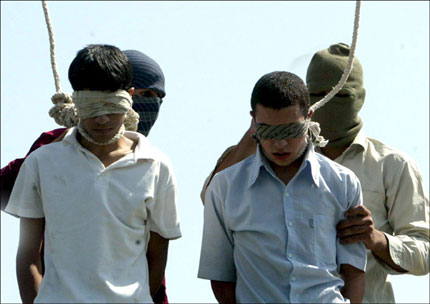
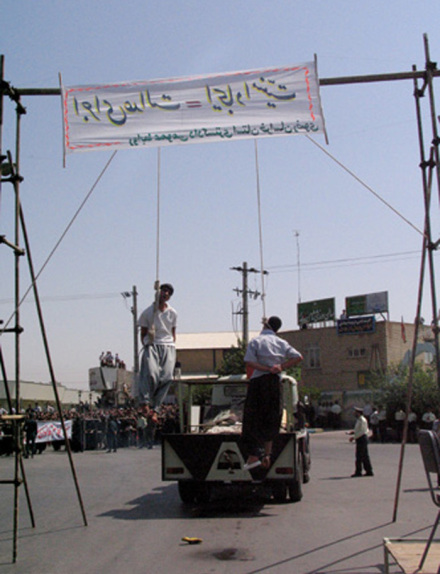
On this date in 2005, two teenagers were hanged in Mashhad, Iran.

Affecting photos of these two youths, their faces etched in fright and grief, their 16- and 18-year-old bodies pitifully boyish next to their executioners, became an immediate worldwide sensation.

These shocking images were quickly followed by a storm of controversy. The crime for which Asgari and Marhoni swung was the rape of a 13-year-old while both the offenders were themselves minors; gay organizations and human rights groups subsequently became mired in contentious dispute over whether (as a factual, legal, or tactical matter) they could be said to have succumbed to a “lethal reign of terror targeting Iranian gays”. For instance, was the conviction reliable, or a pretext? Would these boys actually have self-identified as “gay”?

To that were added charges and countercharges among western campaigners of racism, imperial lickspittle-ism, objective-pro-Islamic-fascism, and the like. Like, awfully convenient that Iran’s longtime dim view of homosexuality has everyone exercised at just the moment bombing Tehran was being openly mooted.

But whatever the text: those pictures. Still, those pictures.

It is certain that both Mahmoud Asgari and Ayaz Marhoni were juvenile offenders, whose execution is anathema almost everywhere in the world but Iran — just one of that country’s unique characteristics.

On this day..

1839: William John Marchant

On this date in 1839, a spooked 18-year-old servant was hanged at Newgate Prison for murdering fellow-servant Elizabeth Paynton.

A good Chelsea lad with no rap sheet, Marchant slashed Paynton’s throat with a razor when they were left alone, fled, but was so pursued by guilt that he gave himself up and pleaded guilty. Awaiting death, he lamely told his distraught parents

the upper house-maid and the cook went out, leaving [Marchant] with the deceased in the house by themselves. The cook, as she was leaving the house, dared him to get possession of a riband or pair of garters which the deceased had displayed before the servants in the kitchen in jest, and threatened to inflict some ludicrous punishment upon him if he did not … [Marchant] improperly endeavoured to obtain possession of the garters, but she resisted him, and at length slapped his face, called him some ill names, and said she would get him out of his situation for his rudeness. He then ran to fetch a razor to cut the garters and get them into his own possession, and he then had not the least intention of killing her or perpetrating any other offense … but when he did return with the razor in his hand he was seized, as he says, with a sudden and unaccountable impulse, which he could not define, and in a paroxysm of insanity in a moment, and without premeditation, he cut her throat.

(In a later telling, he dropped the garter cover story and copped to a more distinctly identifiable attempted rape, with the murder precipitated by its object’s threat to have him sacked.)

As the London Times remarked on the hanging,

It is difficult, perhaps, to hold him out as an example to other erring youth; for, as he neither appears to have been a drunkard, nor given up to licentious courses, his crime is of so extraordinary a character, that it is hardly possible any other, by following the same course, should terminate his career by the same shameful death … there [may] be no occasion to read a lesson to those who in ordinary cases might be seduced to commit a similar offence.

The dearth of instructional opportunity (and the fact that “the crowd was not great”) did not obstruct London’s enterprising gallows-foot entrepreneurs from cranking out multiple broadsides,* complete with cookie-cutter didactic poem. This sort of thing was standard fare for the day’s forgettable petty villains, not merely its crimes of the decade.

All ye who pity my sad fate,
With sorrow most sincere,
Unto the truth which I will state,
I pray you lend an ear.
Condemned in scorn and shame to die
My doom is most severe,
‘Tis but a few short days since I
Just reached my eighteenth year.

My face is all beset with woe,
My cheeks are worn with care,
My eyes are parch’d and sunk with Grief,
That once so sparkling were.
Strange horrors chill my every vein,
A voice most wild and true,
Whispers to this distracted brain,
Thy hand Elizabeth slew.

At this my very heart doth bleed
With grief, remorse, and guilt
To think upopn the ruthless deed,
The blood which I have spilt;
For never since that hour have I
One moment’s comfort knew,
And poor Elizabeth’s murdered corpse
Is ever to my view.

Behold my days are like a flower,
That blooms at break of day,
Cut down and withered in an hour,
And vanished away.
Lament, lament, to see me die
All ye who do me view,
A poor, heartbroken, wretched lad,
Must bid this world adieu.

Vain, are my lamentations, vain
These unavailing sighs,
Girm [sic] death is hastening apace,
I must prepare to die.
Heaven grant none may hereafter be
Like luckless me undone,
But always strive with humble mind,
The tempters snare to shun.

* From Harvard University’s collection.

Update: The Times Archive Blog flags another interesting bit of this story: the newspaper’s hectoring the doomed footman’s chaplain for excessive “enthusiasm.”

Part of the Themed Set: The Ballad.

On this day..

2000: Fu Xinrong, involuntary organ donor

One Fu Xinrong was shot in the back of the head this day in China’s Jiangxi province. The previous fall, he had raped his girlfriend, murdered their newborn son, and turned himself in to police.

His death, just one no-account criminal among China’s thousands of practically anonymous execution victims, attracted no particular notice.

But quite against all odds, Fu Xinrong posthumously became the subject of a scandal: the hook for a story in the Chinese press piquantly titled, “Where Did My Brother’s Body Go?”

For the answer — that Fu Xinrong’s corpse had been driven to a Nanchang hospital and its kidneys transplanted to unidentified recipients — unveiled the shadowy post-execution operations even more unseemly than China’s industrial-scale death penalty.

According to a Washington Post report of July 31, 2001,

After Fu was shot in the back of the head, four attendants got out of the van and picked up his corpse … A government prosecutor attempted to stop them, but they explained that they were from Nanchang and that they had a deal with the court …

“We found the hospital’s director and confronted him with the evidence,” one reporter said. “In the beginning, he refused to say anything about it, but when he saw what we had, he had to admit it on the condition that we did not release the hospital’s name in our report.”

Further investigation indicated that a senior court official, whose surname is Yang, had sold the body to the hospital, the report said.

Fu’s father committed suicide. The family sued the court in 2001; I have not been able to establish whether or how that suit was resolved. However, according to a 2003 U.S. Congress report (pdf) the editor who green-lighted the story’s publication was sacked.*

Fu’s case, in any event, is far from unusual.

On the contrary, his kidneys entered a veritable souk** of transplanted organs that’s been openly pitched at westerners willing to part with five figures and their decency in exchange for a life-giving replacement part from a shot-to-order prisoner.

* This would have been around the same time that a similar fate befell journalists indiscreet enough to explore the unflattering-to-the-People’s-Republic social environment of an executed gangster.

** Finally officially acknowledged in 2005.

On this day..

1972: The rapists of Maggie dela Riva

On this date in 1972, Jaime Jose, Basilio Pineda and Edgardo Aquino were electrocuted* in Muntinlupa for the gang-rape of actress Maggie de la Riva (or dela Riva) five years before.

The rising young actress had scarcely wavered after the assault before courageously making the always-fraught rape charge against a quartet** of attackers themselves from elite families. (The particulars are recounted in the Supreme Court ruling.)


J’accuse! Maggie de la Riva identifies two of the culprits just five days after her gang rape. Talk about facing your accuser; according to the accompanying article, “the frail-looking mestiza was a picture of righteous indignation as she extended her arms, showed her bruises, and asked Pineda, pointedly: ‘Do you remember these?'”

The case was a media sensation from day one. The Philippine film blog Video 48 republished a three-part series on the rapists’ capture (parts 1 and 2) and execution (part 3), complete with the desperate efforts of the offenders’ families to save them.

The victim herself continued her acting career.

Decades later, she’s still a public personality, and seems to have made peace with and moved on from her famous ordeal with impressive equanimity.

When that misfortune happened to me, I realized that although my body was raped my true self was never defiled and that there’s another person in me that’s beautiful, strong and true. The old Maggie has faded away. I look at my experience as something that happened to someone else who is no longer the person I am today. (Source)

* The Philippines adopted use of the electric chair in the early 20th century from the U.S., its colonial ruler at the time. It’s the only country besides the United States to have used the chair.

** One of the four condemned to death for the rape, Rogelio Canial, died in prison of a drug overdose several months before the executions.

On this day..

1994: John Wayne Gacy, scary clown

This date in 1994 was the last on earth for Pogo the Clown — better known as John Wayne Gacy.


Hello, children.

The local small businessman and closeted pederast filled his crawlspace with the remains teenage boys he’d either kidnap off the street, or hire in his capacity as an independent contractor.

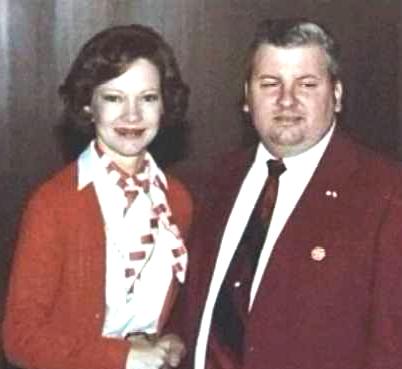
When he wasn’t raping and murdering, he kept up appearances as a Democratic machine operative (once photographed with First Lady Rosalynn Carter) and amateur block party harlequin.

Gacy was a notable “serial killer artist” in the years he spent awaiting lethal injection.* In that capacity, the clown motif continued to inspire him.


* The lethal injection was botched with a clogged IV tube. It took 18 minutes.

On this day..

1995: Nie Shubin. Oops.

On this date in 1995, Nie Shubin was shot in the back of the head in Hebei Province for the rape and murder of a woman in Zhang Ying village.

According to a 1994 newspaper report (.pdf) supplied by the authorities,

After a week of skillful interrogation, including psychological warfare and gathering evidence, police officers made a breakthrough. On September 29, this vicious criminal finally confessed to having raped and murdered the victim. On August 5, while loitering around Zhang Ying village, he stole a shirt and then walked to the vicinity of the Xinhua Road police station, where he saw Ms. Kang ride her bicycle into a corn-field path. He went after her, knocked her off her bike, dragged her into the field, beat her unconscious and raped her. He then used the shirt to strangle her to death.

Sounds pretty definitive, even if they did have to beat it out of him. A confession is a confession, after all.

Except, not.

In 2005, another man admitted to the murder, reportedly supplying persuasive crime scene details to boot.

Nie Shubin’s parents — who had complied with China’s one-child policy — have unsurprisingly been devastated by the loss of their only son, which they learned about the day after his execution when the boy’s father attempted to deliver a care package to the prison.

“All my hopes,” said the mother, “rested with him.”

Update: As of late 2011, the poor mother is still fighting to formally exonerate her executed son.

On this day..

1961: John A. Bennett, the last American military execution (so far)

As of this date, it’s been 48 years since the United States military last carried out an execution — the Fort Leavenworth hanging* of John Arthur Bennett for rape.

An epileptic black soldier with a family history of mental illness, Bennett had enlisted to find a way up out of sharecropping. Instead, on Christmas Eve 1954, he drunkenly raped a 12-year-old girl near his base in Austria.

He spent six years awaiting execution — “six years,” observed the Los Angeles Times, “in which six other black soldiers were hanged while all four of the white men — many of them multiple murderers — were saved.”

Bennett dodged two execution dates, once receiving his stay during his last meal, but a seemingly compelling plea for clemency — the victim herself, and her parents, asked for mercy — availed Bennett nothing. His last frantic plea to the new president, John F. Kennedy, was dispatched with only hours yet to live.

I beg in the name of God … Will you please in the name of God and mercy spare my life?”

No dice. Kennedy was preoccupied.

Coincidentally, but poignantly for this case, the Kirk Douglas vehicle A Town Without Pity opened a month before Bennett’s execution. In that film (trailer here), four American servicemen face capital trial for the rape of a German girl — and Douglas, as their lawyer, struggles to talk pity into someone so he won’t be obliged to humiliate the victim in court in order to save his clients from the noose.

The victim’s father in that movie is so blinded by his lust for vengeance that he forces Douglas to destroy his own daughter: striking contrast with the real-life father of Bennett’s flesh-and-blood victim, who wrote in support of clemency for his daughter’s assailant, “I know how hard it is for the parents when their own child is so close to the verge of death.”

Bennett’s milestone, however, is hardly assured of lasting much beyond this 49th year.

In 2008, President George W. Bush affirmed the death sentence of condemned Army cook Ronald Gray, the first such action by any U.S. president since Bennett’s day. According to the NAACP Legal Defense Fund’s Death Row USA most current as of this writing,** Gray is one of nine prisoners currently on the U.S. military’s death row.

* Curious to know about the procedure? The Library of Congress has that period’s Procedure for Military Executions — complete with exact diagrams — online in pdf form.

** Death Row USA, Summer 2008 (direct pdf link)

On this day..

2005: Mohammed Bijeh, the desert vampire

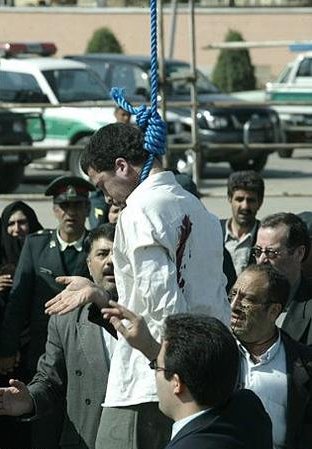
On this date in 2005, Iran “desert vampire” was flogged to the point of collapse and hanged before a bloodthirsty throng in Pakdasht.


Mohammed Bijeh collapses during his flogging (top); then, as he is hoisted by a crane — with what one would take to be the stab wound from a victim’s brother visible on his back. More frightful photos of this execution here.

Bijeh confessed to raping and murdering 16 boys age 8 to 15 over a yearlong spree.

His modus operandi? Lure them into the desert on the pretext of hunting animals.

Unsurprisingly a figure of intense public hatred, Bijeh stolidly endured his own death before a jeering mob.

Riot police held back the angry crowd, but at one point a brother of one of the victims managed to break through and stab Bijeh in the back.

After 100 lashes, the desert vampire was noosed to a crane arm by one of the victims’ mothers, and hoisted 10 meters into the air for public strangulation, to the cheers of onlookers who had to be restrained from savaging the body when it was finally brought down.

An accomplice, Ali Baghi, somehow avoided execution and got off with whipping and a prison term.

On this day..

1855: The slave Celia, who had no right to resist

(Thanks to Caitlin at Vast Public Indifference for the guest post -ed.)

In 1850, 60-year-old Robert Newsom, a prosperous farmer, traveled forty miles from his home in Callaway County, Missouri to neighboring Audrain County to buy a slave. Newsom was the head of a large and complex household that included several of his grown children, grandchildren, and five enslaved boys and men. His wife had died a few years earlier, a consideration that may have influenced his decision to purchase a female slave, a fourteen-year-old girl named Celia.

From the first day, Newsom treated Celia as his concubine. Testimony given before the Missouri Supreme Court in 1855 indicates that Newsom raped Celia for the first time on the journey home from the slave market. He installed her in a small cabin behind his house, where he continued to rape her on a regular basis over the next five years. During that time, she gave birth to two children.

In the spring of 1855, Celia began a relationship with George, another slave on the farm, and soon discovered that she was pregnant again. At George’s urging, Celia approached Newsom’s daughters and pled with them to protect her from their father during her pregnancy. The oldest daughter, Mary, later testified that Celia had threatened to hurt Newsom if he came to her cabin again, but there is no evidence that either she or her sister intervened.

On the night of June 23, 1855, Robert Newsom went to Celia’s cabin, no doubt intent on raping her yet again. He never returned to his own home.

Although Celia was never allowed to testify in her own defense, investigators reconstructed the events of the night through a combination of physical evidence and Celia’s confession. Fearful of Newsom, Celia had hidden a hefty stick in a corner of her cabin. When Newsom attacked her that night, Celia retrieved her weapon and beat him to death with it. She then dismembered the body and burned it to ashes in her fireplace. The next morning, Celia offered Newsom’s eleven-year-old grandson two dozen walnuts in exchange for his help cleaning out the fireplace and spreading the ashes in the yard.

The jury that convicted Celia of murder accepted her confession as fact, but some elements of her tale do not ring true. As Melton McLaurin observes in his book, Celia, A Slave, the task of cutting enough wood and tending the roaring fire necessary to consume a human corpse in a single night “would have taxed the strength of a healthy woman, and Celia was pregnant and sick” (McLaurin, 49). McLaurin implies that George either helped Celia or was primarily responsible for Newsom’s demise and that Celia may have lied to protect him. George disappeared shortly after the murder and was never arrested or charged.

Celia stood trial for Newsom’s murder in October of 1855 (State of Missouri v. Celia, a Slave). Her lawyer, John Jameson, argued that Celia was legally entitled to defend herself from a would-be rapist under an 1845 law that made any attempt “to take any woman unlawfully against her will and by force, menace or duress, compel her to be defiled” a felony. He requested that the jury be instructed that

The words “any woman” in the first clause of the 29th section, of second article of laws of Missouri for 1845, concerning crimes & punishments, embrace slave women, as well as free white women.

The judge, William Augustus Hall, refused to honor the defense’s motion. Instead, he instructed the jury that a slave had no right to resist her master, even in the case of sexual assault. The jury found Celia guilty and sentenced her to death. (Celia’s child was delivered stillborn in prison.) The Missouri Supreme Court denied her appeal, and she was hanged on December 21, 1855.

Celia’s story is currently part of the interactive Slavery and the Making of America exhibit at PBS.org.

For more information, please see the following books:

McLaurin, Melton A. Celia, a Slave: A True Story. (University of Georgia Press, 1991). Google Books preview

Gordon-Reed, Annette, ed. Race on Trial: Law and Justice in American History. (Oxford University Press, 2002). Google Books preview.

On this day..

1959: Genzo Kurita, serial killer

On this date in 1959, a disturbed Japanese serial killer was hanged for eight murders.

A past generation’s emblem of monstrousness, Genzo Kurita (English Wikipedia page | Japanese) was invoked on the floor of the Diet as a reason to keep the death penalty.

And no wonder.

He was caught early in 1952 for murdering a 24-year-old and her 63-year-old aunt, and defiling the younger woman’s body. Those murders led to a death sentence a few months later, but they also led to a string of unsolved homicides: another murder-necrophilia crime the previous summer, and the notorious Osen Korogashi incident, when he threw a rape victim’s family over the Osen Korogashi cliffs.*

He got a separate death sentence for those murders (plus two other earlier ones) later in 1952.

A touch unstable — obviously — Kurita withdrew his own appeals in 1954 to get it over with, but it still took the ponderous Japanese death penalty system the best part of the decade to see him to the gallows.

Most of what’s online about Genzo Kurita is in Japanese, like this more detailed survey of his life in crime.

* The raped mother, and three children; one of the children survived. The Osen Korogashi (or Osenkorogashi) cliffs, as it happens, have their own eerily topical legend of the generous daughter of a cruel lord being thrown over the precipice in her father’s place, prompting him to see the error of his ways.

On this day..