1560: Arnaud du Tilh, alias Martin Guerre

On this date in 1560, a French peasant was hanged outside the home he had made with another man’s wife in the southwestern French village of Artigat (or Artigues).

A poignant, perplexing tale of identity and social place — and possibly even of love — the story of Martin Guerre is at once exactingly local to its time and place, and timeless in its principals’ humanity.

As told in Natalie Zemon Davis’ captivating social history The Return of Martin Guerre, the restless (or ill-tempered) young titular peasant — impotent with his wife Bertrande, tense living with his father-in-law, chafing in rural Artigat — got out of town in 1548, joined one of the soldiering companies crisscrossing Europe, and was heard of no more.

In the centuries before fingerprints, credit cards, cell phones and Facebook, Guerre just disappeared. Constrained by Catholic law not to remarry without proof of his death, Bertrande just had to wait.

Until “Martin” returned in 1556 simply by reappearing at Artigat — moved in with Bertrande — resumed the vanished man’s name and with it his place in the village. There were suspicions from the first that he wasn’t quite right … but this man had Martin’s stories, and the villagers didn’t have so much as a photograph to test him against.

Martin was accepted in Artigat for three-plus years, fathered two children with Bertrande, and managed the estate as head of household. In Davis’s telling, he appears much the better husband and father than the pre-1548 version, and this bolsters her case that Bertrande must have been complicit in the fraud that unraveled in 1560.

Property and inheritance conflicts with Martin Guerre’s uncle (now married to Bertrande’s widowed mother) brought to the courts the novel case: was this man really Martin Guerre?

The inconclusive tools for establishing identity and a deft defense by “Martin” must have made for a riveting legal drama (French link) — with villagers taking up competing sides and the man put to the test of his memory of Martin’s life, which he impressively aced. So thoroughly did the man command the role that

the gesture, deportment, air, and mode of speaking of the prisoner were cool, consistent, and steady; while those who appeared in the cause of truth were embarrassed, hesitating, confused, and on certain points contradictory in their evidence. (Source)

On the point, perhaps, of acquittal, the case was resolved like any legal potboiler should be: with the dramatic reappearance of the real Martin — for so all the conflicting witnesses quickly agreed him to be, and so confessed the imposter husband, Arnaud du Tilh (or Arnaud du Tilb), a peasant from a nearby village also nicknamed “Pansette”. A onetime army buddy of Guerre’s, the enterprising du Tilh had been mistaken for Guerre, and had pieced together enough of the absconded husband’s life that by dint of total recall and superhuman audacity, he made for his own the place in the world that Martin Guerre disdained.

The sentence of the court was that Martin Arnaud

make amende honorable in the marketplace of Artigat, in his shirt, his head and feet being bare, a halter about his neck, and holding in his hands a lighted torch; to beg pardon of God, the king, and the justice of the nation; of the said Martin Guerre, and de Rols his wife; and this being done, the said du Tilh shall be delivered into the hands of the executioner, who after making him pass through the streets, and other public places in the said town of Artigat, with a rope about his neck, at last shall bring him before the house of the said Martin Guerre, where, on a gallows set up for that purpose, he shall be hanged and strangled, and afterwards his body shall be burnt. (Source of the translation, slightly tidied up based on the French version here)

Arnaud du Tilh, and Martin Guerre with him, passed thereupon into the historical memory, for in assigning names to bodies, had the court really sorted out who was who? What does it mean to drop out of one’s society … and what rights can one expect to command upon returning? What did it mean to be Martin Guerre but to live in the house of Martin Guerre and manage the affairs of Martin Guerre? And the characters: Arnaud with his mysterious spark of bravado; Martin and his sudden and unexplained reappearance; the two of them as if cast for one another’s roles in life and crossed up by the gods.

And the mysterious Bertrande — what did she do, and what did she want?

A bit of Rorschach history, then, which accounts for the still-robust liveliness the tale enjoys four and a half centuries later. And let’s admit: a bit of wistfulness for the time you could start on a clean sheet just by changing your name. (Although illiterate 16th century peasants had achieved TSA-quality security protocols in this respect.)

Natalie Zemon Davis, whose own account has been criticized for overclaiming Bertrande’s role and motivations, also consulted as she was writing it for a Gerard Depardieu film of the same title.

The same story transplanted to the Civil War United States yielded the 1993 film Sommersby:

And if you must, you can see Martin Guerre in show tunes.

(This medley sequence has second and third parts as well.)

On this day..

2007: Frank Duane Welch, a cold case CSI caught

One year ago today, justice was served better late than never, courtesy of the crime lab.

The 1987 rape and murder of Jo Talley Cooper, a pregnant 28-year-old Norman woman killed while her infant son lay unharmed in the next room, had stood unsolved for a decade.

Coincidentally — unluckily for Frank Duane Welch — forensic DNA testing was just coming online during that decade. A match in another case led the database to its culprit, in the Cooper murder and a similar crime around the same time.

Apart from the manner of his capture — and the incidental minor distinction of being the last person killed in Oklahoma’s busy death chamber before the 2007-2008 execution moratorium due to court challenges to lethal injection — Welch is an almost wholly unremarkable character, central casting for the modern American death row, a paragon of the banality undergirding appalling, life-shattering crimes.

The penpal site of the Canadian Coalition to Abolish the Death Penalty still preserves Welch’s c. 1999 appeal for correspondence:

My name is Frank Duane Welch, I am a 38 yr. old white male who is confined on Death Row within the Oklahoma Department of Corrections. I enjoy watching numerous sporting events, such as football, baseball, tennis and rodeo. Here on Death Row we have only two options of exercise, basketball or handball. I try and take advantage of both in order to stay in shape. Besides sports, I enjoy a good book, novels mostly. My tastes in music are first country and then some light rock, no heavy metal. My educational background consists of a bachelors degree in Animal Science. Now as for what I am looking for in a pen pal. I am looking for a friend, age not important. One who is willing to be straight forward with me, no games. For I will be straightforward with them. I need someone who is willing to help me both emotionally and financially. Someone who, when I am having a bad day, is willing to listen and give support. I am a proud man, but it is hard being alone in this place, no one to share your thoughts and feelings with. For this is the reason I have written this letter. If you are willing to accept me as I am and not hold my faults against me, I would love to hear from you.

According to the macabre* blog Dead Man Eating, Welch checked out with a belly full of pizza and a two-liter Coke, tritely last-wording:

There is nothing that can change the horrible thing I done. There is nothing that can change that. I take full responsibility for what I done. I am truly, truly sorry for all the hurt and pain I have caused you. I take full responsibility for what I’ve done. There’s no excuse for it. There never was. It was just me.

I love y’all. God bless y’all. I’m ready.

Maybe that’s as much closure as one can have in this world. That infant child who survived the horror had grown into a 20-year-old man who had never known his mother. Travis Cooper’s testimony at the clemency board hearing helped seal Welch’s fate.

It would be different if my mother would have died of natural causes. It would be different if it was God’s will, but the truth is that an evil man named Frank Welch took her life … And the unspeakable things he did to her, my mother, is what fills me with anger, the pain, and the loneliness that I feel to this day.

“None of this will ever bring my mom back,” Cooper told reporters after the execution. “I miss my mom.”

* Pot. Kettle. Black.

On this day..

1936: Rainey Bethea, America’s last public hanging

On this date in 1936, thousands thronged Owensboro, Kentucky, for a glimpse of what would prove to be the last public hanging in the United States.

The U.S. followed the trend of its onetime mother country, England, in moving the formerly iconic public hanging increasingly behind closed doors, but its federalist structure made that change uneven. In Kentucky itself at this time, the law displayed sedimentary layers of death penalty history.

Caught up for killing a 70-year-old woman — done in the midst of a drunken burglary, he had left a telltale ring at the scene; fingerprint analysis also helped establish his guilt — Rainey Bethea was on the hook for murder, robbery and rape. The former two indictments would have subjected him to (private) electrocution at the state penitentiary. The latter charge still carried the punishment of public hanging in the local county seat.

Bethea was charged only with rape.

While the explicit sentencing disparity between the crimes bears the clear marks of racism and patriarchy that made purported black-on-white sexual crimes such live fodder for lynch law, and the four-and-a-half-minute jury deliberation doesn’t have the look of solemnity, Bethea’s actual guilt seems fairly well-established.

But the case attracted a nationwide media swarm not for any exceptional quality of the crime or the anachronistic nature of the punishment, but for the involvement of a female sheriff. The “matronly” (virtually all descriptions of her gravitate to this adjective) Florence Thompson had inherited the top law enforcement post upon the death of her husband … and that meant she had inherited the responsibility of hanging Rainey Bethea, which would make her the first American woman to supervise an execution.

Would she or wouldn’t she? The press descended on Owensboro to cover the edifying spectacle of a plump mother stringing up a rapist, or else maneuvering her way out of the job. Thompson played cagey until the very last moment, when the ringers she had secretly hired appeared on the scaffold while she watched from a nearby vehicle.

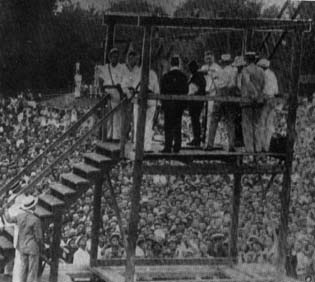
In this photo, Bethea — almost totally obscured between his escorts — has just begun ascending the gallows.

The man who threw the trap showed up drunk and performed appallingly, but press reports subsequently focused on the beastly behavior of the “jeering” crowd rushing the gallows to tear souvenirs from the corpse. (For instance, Time and the New York Times.)

But according to Perry T. Ryan’s 1992 review of the case — including interviews with surviving witnesses — little to nothing of the kind occurred. Ryan claims Bethea faced about the most dignified hanging mob imaginable.

Maybe hyped-up atrocities in the hinterlands were part of what distant editors demanded after H.L. Mencken at the Scopes trial. Certainly, the local Messenger-Inquirer painted a sharply different picture from more prominent outlets in this August 16 editorial (titled “Panderers Galore”) whose themes could have stepped fresh from a modern cable TV gabfest:

Ambitious and irresponsible reporters and photographers who swarmed into Owensboro for the Bethea hanging dipped their ready hands into the cloaca of evil designs and plastered over the name of this fair city the dirty results of their pandering.

Those who saw the dawn kindling in the east and ushering in the last sunrise of the despicable creature about to die, did not expect all of the watchers to be in reverent mood, but a calm, quiet demeanor characterized their behavior, as a group, throughout their long wait, surprisingly moderate for an occasion on which the law was exacting the supreme penalty.

Considering the size of the throng that witnessed the hanging Friday morning and that it was composed largely of people, who journeyed to Owensboro from distant places, the wonder is that there was no demonstration, no emotional outburst. There was not the semblance of ‘mob impulse’ or ‘eagerness for the kill.’ For the sensation seeking star scribes of quacks of American journalism, it was entirely too tame an affair. This is the reason that some of them reported it as they wanted it to be — not as it was.

They heard a very few people on the outskirts of the crowd call out at different times: ‘Hurry up,’ ‘Get it over’ or ‘hang him.’ To give screaming bulletins to the yellow press and to ruthless radio commentators, they magnified and colored it into a scene of ‘great disorder’ though there was never a general outcry of any kind.

When a priest held up his hand from the scaffold for silence, as Bethea was about to go to his death, there was no ‘blood thirst’ mob ‘shouting and yelling.’ Present were several thousand, who came from near and far to see a man legally hanged for the most heinous crime ever committed in Daviess county, and several thousand more, who turned out to see how the rest would act. When that hand went up in a gesture for silence, the buzz of the multitude’s conversations died down till the fall of the proverbial pin could have been heard.

The smart scribes and sob sisters looked on. All they saw was a black man standing on a scaffold with a rope around his neck and a mass of people peering up at him. That was too tame, they would call it a ‘jeering’ throng. All they heard was the click of the trap door. That would not do. There would have to be ‘cheering.’ So they said there was. Then they heard cameramen from cities where nothing is cared about the horrible crime Bethea committed. They were bawling at officials to ‘move out of the way,’ to ‘give us a break.’ They had to have their souvenirs to show the half civilized readers of their yellow sheets. The boys and girls who had to tell the story needed more color to regale them with atrocious accounts of how the people behaved. They found a few individuals who had gone in the bizarre which inspired thundering headlines about ‘gayety’ and ‘carnival’ spirit.

In administering the last sacrament, the Rev. H. J. Lammers, of Louisville, made an opening in the hood. When the doctors pronounced Bethea dead, one of the attendants at the scaffold took a tag off the hood. Another then took a fragment and others, who were at arms length from the dead man, followed suit. The blunder of tearing off that tag gave the high powered thrill-writers their big opening. They pictured the crowd as tearing Bethea’s clothes from his body. The crowd was never in disorder and Bethea’s clothes were never torn.

The ‘souvenir hunting mob’ did not even pick up the sox [sic] and shoes the doomed man left at the foot of the gallows. It did not so much as touch the basket in which Agnew and Wheatley, colored undertakers, placed the body, clothes and all, or molest it or them in the slightest as they bore it away.

The scavenger writers who came to depict a ‘jolly holiday’ and ‘gala occasion’ had both, but they never saw a more orderly throng at a baseball game.

The public hanging of Bethea was not a disgrace to Kentucky. But, a disgrace to Illinois, Missouri, Tennessee, and some other states, was the spectacle made of it in their scandal monger press. Owensboro should not be surprised at the scurrilous attack upon it by lurid writers and glib tongued talkers in northern and eastern states for they delight to distort any news from Kentucky into weird barbaric tales. We have learned how best to protect our women from rapists-murderers, white or colored. The only way, it seems, that we will ever be able to protect them from the cruelties of a sordid section of the press, will be by softening the state’s anti-rape law, which makes public hanging mandatory. So many as favor that will please tell the legislature.

Vendors of news occupy an important place in the nation, and their purpose should always be to maintain unquestioned exactness of facts. Where the subject matter is susceptible to coloring there should be no sacrifice of truth. To pervert the high honor of the profession for the paltry reward of more readers is a dangerous venture and one that should be curbed.

Owensboro’s citizenry, than which no finer representatives of high-bred Americans can be found anywhere, regrets that it was necessary to invoke the Mosaic law, but a sobered regret and a more solemn memory is that the hanging was eagerly seized upon and transformed into a picturization of the exhibition of low passions loosed.

We are proud of our city, and justly so, for no people are of finer fiber. The putrid pens of those who wore the garb of the news profession painted in lurid colors purported happenings, and it is sad but true that such distorted reports are accepted while the plain statement of facts is discarded as an attempted apology.

Thousands of those who witnessed the Bethea hanging came from outside the county. They belonged to good families in their communities, temporarily bereft of their better judgment and bent on viewing a scene which ordinarily would be extremely repugnant to them. And the out-of-town reporters found in the visitors elements to embody in their sordid stories.

A thoughtless word here and there, expressed without cognizance of its probability of misuse, and the staid citizen away from home becomes to the wild-eyed correspondent a Kentuckian gunning for human game. There should be available means of calling to account the writer who for a few filthy shekels diverts his sense of justice into the recording of things that never were.

As the editorial intimates, regardless of what actually happened in Owensboro, the circus atmosphere quickly brought the matter of public hangings into question. In 1938, the Kentucky legislature moved all executions behind prison walls … and Bethea secured an indefinite claim to the status of last person publicly executed in the United States.

Part of the Themed Set: At the End of the Rope.

On this day..

1993: Mohamed Mustafa Tabet, serial rapist with a badge

On this date in 1993, the police chief of Casablanca was shot in Kenitra Central Prison for abuse of power.

Mohamed Mustafa Tabet (or Tabit) wasn’t exactly Captain Renault.

While Morocco still has prisoners on death row, Tabet’s was the first execution actually carried out in 11 years, and it’s the last execution in Morocco to date. He went on the rocket docket, just five months from his arrest to standing up against a wall.

To earn that rare distinction, Tabet exploited his official power to rape or sexually exploit hundreds of women. Tabet confessed to some 1,500 victims over 13 years; the minimum figure matches the 518 personal identity cards found in his apartment. (Also found: 118 video cassettes — many of them violent — and a computer list of his crimes.)

The “Tabet Affair” — actually called “Tabetgate,” proving that the United States retains the power of exporting ideas — opened a discomfiting window on gender and power in Morocco.

Webster University Prof. Don Conway-Long was in Morocco at the time researching gender and masculinity for his dissertation. His paper “Sexism and Rape Culture in Moroccan Social Discourse” (pdf) is probably the most illuminating readily-available English* document on the affair — and the many contradictory reactions it drew from contemporaries, and the pressure it put on the government to contain the fallout as “a morals case, instead of looking further into overall police corruption.”

Prof. Conway-Long was good enough to spare Executed Today a few minutes to explore power and gender in Morocco, then and now.

ET: The scale of the crime spree seems just unimaginable, that he could get away with victimizing hundreds upon hundreds of women.

DCL: And not that many came forward! It was just a couple of women. If it’s difficult to talk to rape and sexual assault survivors here [in the U.S.], it’s exponentially harder in Morocco.

You were in Morocco in the years leading up to this trial. What was the country like in terms of its gender outlook?

It’s more like our 1950’s in terms of the attitudes towards women. Some educated professors at one point were laughing at the idea that a man could be charged with raping his wife in the West. In some ways, attitudes in Morocco are maybe 20 years behind what we see in the West. We had that same conception in the 1950’s — Missouri actually finally changed that law in 1993. [See here and here -ed.]

Morocco was also probably one of the most liberal countries of the Muslim world in the sense of being more closely connected to the West. Morocco has had more openness, more tourism.

How did the Tabet case impact women’s position?

[In 1995,] about a year after I left, a battered women’s shelter was set up in Casablanca, the first one in Morocco. By comparison, our first shelters in the U.S. and U.K. were set up in 1971, 1972.

In 2004, they passed a new family law that changed a lot of the freedoms that women have — e.g., women can ask for divorce, and don’t have to obey their husbands.

But I have no idea if you can claim there’s any causal relationship between the discovery of Tabet’s crimes and these later events. At the time, some men thought he was this great sexual hero, very virile.

So what lies ahead?

The old king died in 1999; his son Mohammed VI is in there now and he’s young and more aware and one of the rising stars of the monarchs of the middle east, like the king of Jordan. His [Mohammed’s] head is on the right way, but running a country like this with so much variation — there’s 50% illiteracy, the Western Sahara conflict, a certain level of Islamist opposition, and around twenty political parties all the way out to the Communists.

So there’s no certain future, absolutely not.

As far as cases like Tabet’s — let’s hope it’s not happening still, but Morocco when I was there was a place where you pass six different kinds of uniforms walking down the street with Uzis that would be pointed at your body as you passed.

* There’s more in French and Arabic.

On this day..

1535: Thomas More, the king’s good servant but God’s first

On this date in 1535, Sir — later Saint — Thomas More kept his conscience at the expense of his head on Tower Hill.

For all More‘s greatness — as intellectual, polemicist, lawyer, statesman, father — none of his many gifts at the end could avail him beside his commitment to Catholicism at the dawn of the English Reformation.

Yet it is for those gifts that he cut such a commanding presence in his times, for those very reasons that his sovereign hounded his first citizen to assent to the divorce and remarriage he was fixed upon.

A devotee and friend of Erasmus from years before, More was in Henry’s more orthodox youth the king’s very scourge of Protestantism. His scatological invective against Martin Luther in Responsio ad Lutherum — much in the impolite tenor of Catholic-Protestant rhetoric continent-wide, it should be noted — is of the sort to crimson the cheeks of the milquetoast modern:

Since he has written that he already has a prior right to bespatter and besmirch the royal crown with shit, will we not have the posterior right to proclaim the beshitted tongue of this practitioner of posterioristics most fit to lick with his anterior the very posterior of a pissing she-mule until he shall have learned more correctly to infer posterior conclusions from prior premises?

Over that hairshirt, he wore the robes of state. But his engagement with the world had a selective bent that must have exasperated his colleague and predecessor as Lord Chancellor, Cardinal Wolsey. Orson Welles and Paul Scofield spar here in the definitive More hagiography A Man for All Seasons over the intellectual’s delicate refusal to dirty his gloves with the great matter of state before them — the annulment the king demanded of his marriage to the Queen (and More’s friend) Catherine of Aragon:

Peas in a pod, these two: Wolsey, the cleric grounded in realpolitik; More, the barrister who trusts to God. (More considered holy orders as a young man.)

Our man’s reputation for honesty in a den of hypocrites has certainly outrun Wolsey’s. Still, all More’s disdain for the deal-making that invests the sovereign majesty and all his foreboding for the relationship he had with his dangerous king were not quite enough to stop him accepting the Chancellorship and the opportunity to stamp out Lutheranism … knowing perfectly well the simultaneous thrust of Henry’s boudoir policy.

It all cuts quite a contrast to More’s (barely) pre-Reformation text, Utopia (available free from Project Gutenberg), which named a literary genre and described an imagined society of tolerant primitive communism that surely would have blanched at its inventor’s coming role in the state’s machinations:

I can have no other notion of all the other governments that I see or know, than that they are a conspiracy of the rich, who, on pretence of managing the public, only pursue their private ends, and devise all the ways and arts they can find out; first, that they may, without danger, preserve all that they have so ill-acquired, and then, that they may engage the poor to toil and labour for them at as low rates as possible, and oppress them as much as they please

[E]very man might be of what religion he pleased, and might endeavour to draw others to it by the force of argument and by amicable and modest ways, but without bitterness against those of other opinions; but that he ought to use no other force but that of persuasion, and was neither to mix with it reproaches nor violence* …

It’s not a given that More himself agrees with every (or even any) sentiment expressed in Utopia, but his most famous work’s criticism of the death penalty too liberally applied makes interesting reading.

[E]xtreme justice is an extreme injury: for we ought not to approve of those terrible laws that make the smallest offences capital … God has commanded us not to kill, and shall we kill so easily for a little money [i.e., execute petty thieves]? But if one shall say, that by that law we are only forbid to kill any except when the laws of the land allow of it, upon the same grounds, laws may be made, in some cases, to allow of adultery and perjury: for God having taken from us the right of disposing either of our own or of other people’s lives, if it is pretended that the mutual consent of men in making laws can authorise man-slaughter in cases in which God has given us no example, that it frees people from the obligation of the divine law, and so makes murder a lawful action, what is this, but to give a preference to human laws before the divine? and, if this is once admitted, by the same rule men may, in all other things, put what restrictions they please upon the laws of God.

This insistence on the supremacy of divine law over human institutions forms the basis of his objection to parliament’s overthrowing the papacy — which he expressed openly only after he was convicted by obviously perjured “jailhouse snitch” testimony

[Y]ou have no authority, without the common consent of all Christians, to make a law or Act of Parliament or Council against the union of Christendom.

Paul Scofield bears enjoying in the role in A Man for All Seasons:

More is sometimes suspected of desiring martyrdom since he marched so unerringly into it, but he also made every attempt to survive Henry’s demand the he affirm the royal remarriage and the king’s ecclesiastical supremacy by withdrawing silently from the public sphere rather than openly opposing it. More had by every account an enviable, downright happy life at his own hearth, and a tender and intellectual relationship with his favorite daughter Meg. (Meg corresponded with her father in prison, collected his works, and retrieved his head from London Bridge.)

But by his way of thinking — Meg tried to talk him out of it — he couldn’t swear to the Act of Succession acknowledging the king’s right to divorce Queen Catherine and disinherit her daughter Mary if Henry decided to force the choice. And in the king’s eyes, there was no middle ground for someone of the ex-Chancellor’s stature.

Henry could see to it, though, to cut his old friend a break and commute the sentence from drawing and quartering to “mere” beheading, here depicted in the past season of the Showtime series The Tudors.

More’s last moments as rendered here — the ironic remark at the foot of the scaffold, “See me safe up: for my coming down, I can shift for myself”;** his generous answer to the headsman’s plea for forgiveness — are well-documented. Undoubtedly, his sturdy martyr’s bearing, the extension of a life of joyful piety, helped cement for posterity the fame he held in life.

And that dying address — “I die the King’s good servant, but God’s first” — gathers in one sentiment free of bombast or self-pity the irreconcilable demands of conscience that would lead many thousands besides More to Henry VIII’s scaffolds, and rings equally true to less lethal challenges to the conscience in every land and time since.

Anne Boleyn, who caused More’s fate, shared it less than a year afterwards.

Thomas More was canonized by the Catholic Church in 1935 — the patron saint of politicians. Rather bizarrely, July 6 is also his feast day on the Anglican calendar, a tribute to the nearly universal regard his memory enjoys.

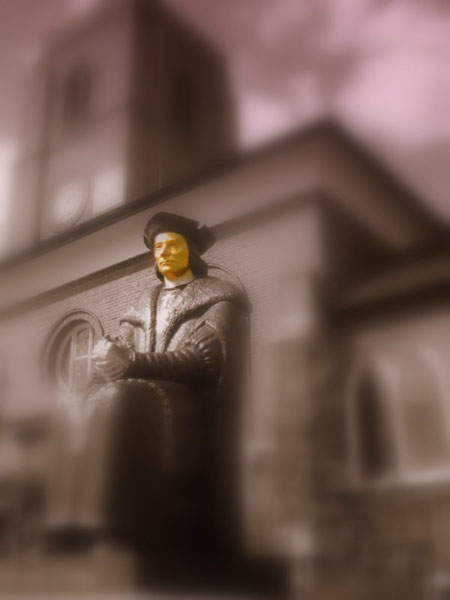
Thomas More's statue at the Chelsea Old Church

Chelsea resident Thomas More’s statue at the (Anglican) Chelsea Old Church.

* Despite its religious tolerance, More’s Utopia — anticipating Dostoyevsky — maintains:

a solemn and severe law against such as should so far degenerate from the dignity of human nature, as to think that our souls died with our bodies, or that the world was governed by chance, without a wise overruling Providence … since a man of such principles must needs, as oft as he dares do it, despise all their laws and customs: for there is no doubt to be made, that a man who is afraid of nothing but the law, and apprehends nothing after death, will not scruple to break through all the laws of his country, either by fraud or force, when by this means he may satisfy his appetites.

** According to the biography published by More’s son-in-law — who married More’s favorite, Margaret — the jest was occasioned by the rickety look of the scaffold. The Mirrour of Vertue in Worldly Greatness; Or, The Life of Sir Thomas More is available free on Google Books.

On this day..

1864: William Johnson, a bad example

On this date in 1864, the Union army in the American Civil War hanged a black deserter outside Petersburg, Va., for — in the delicate words of the army dispatch — “an attempt to outrage the person of a young lady at the New-Kent Court-house.”

The Union army was just taking up position for the coming monthslong siege of the Confederate capital, Richmond. Johnson, who confessed to deserting another unit, offered savvy blue commanders a win-hearts-and-minds opportunity: a public reassurance that the Old Dominion’s dim view of Negro outrages upon young ladies would be honored by its soon-to-be occupiers.

Not bad in theory. The execution left something to be desired.

The field of public relations being very much in its infancy, the upshot of this salutary demonstration seems not to have been conveyed to its target audience; so, when a defending Confederate battery caught sight of the gallows being thrown up in brazen view of its own lines, it jumped to the not-unreasonable conclusion that the Yanks were about to make an example of a southern spy. Rebel guns promptly made the Union detachment their “target audience.” An artillery shot struck one Sgt. Maj. G. F. Polley (or Polly) and “tore him all to pieces” before

[a] flag of truce was sent out to inform the enemy that a negro was to be hung who had insulted a white woman the day before; they stopped firing. We then marched back and saw the negro hung.

The return on investment for the souls of Johnson and the misfortunate NCO was altogether unsatisfactory:

The incident was cleverly turned to advantage by the Confederates, who had been losing hundreds of Negro laborers by desertion. The Rebels marched Negroes past the spot, pointing out to them the perils of fleeing their lines, saying that the Yankees hanged all ‘Contrabands.’ For weeks nocturnal escapes of Negroes ceased on that front. (Source)

It wasn’t a total loss, however. The Library of Congress ended up with some striking archival photos.

(There’s a better touch-up of this last photograph of Johnson’s body being cut down here.)

On this day..

1945: Aniceto Martinez, an American rapist in England

On this date in 1945, the last man executed for rape in England was hanged at Shepton Mallet prison — an American serviceman, hanged by the United States military.

Our story finds us in the Staffordshire town of Rugeley (for a second consecutive date), where a Mexican-American prisoner-camp guard named Aniceto Martinez raped a 75-year-old local. He should have put some thought into his alibi: he was the only American out of the camp that night, and hence easy pickings.

No, Martinez is notable only for his accidental milestones. His was the last U.S. military execution in Britain during World War II (actually coming over five weeks after Germany had capitulated). And he was the last person hanged on Albion’s soil for rape. This offense was not a hanging crime by English statute at the time, but was a capital offense in a U.S. military court … although all six of the personnel upon whom the sentence was inflicted were non-white, a pattern noticeable in stateside civilian cases as well.

The execution shed used by the U.S. military at Shepton Mallet Prison.

Martinez also, as it turned out, retired the use of Shepton Mallet as a facility for conducting executions. Dating to 1610, the prison had been out of commission during the 1930’s but taken over by the visiting American forces during the war years. (It’s remained in operation since, England’s oldest functioning prison.)

Though conducted under American law, the 16 hangings* at Shepton Mallet were actually carried out by British executioners in something of a procedural amalgam. American procedures in general governed the affair — and prolific British hangman Albert Pierrepoint, who conducted several, remarked on the (to him) oddities in his autobiography:

[A] custom which was strange to me was the practice of laying on a mighty feast before the execution. We were eating badly in this country at that time, but at an American execution you could be sure of the best running buffet and unlimited canned beer. The part of the routine which I found it hardest to acclimatise myself to was the, to me, sickening interval between my introduction to the prisoner and his death. Under British custom I was working to the sort of time where the drop fell between eight and twenty seconds after I had entered the condemned cell. Under the American system, after I had pinioned the prisoner, he had to stand on the drop for perhaps six minutes while his charge sheet was read out, sentence spelt out, he was asked if he had anything to say … and after that I was instructed to get on with the job.

One important concession to the British practice: use of the variable drop, designed to break the condemned wretch’s neck rather than a standard drop without accounting for the weight of the prisoner … which risked either slowly suffocating or outright decapitating the hanged man.

Northern Kentucky University professor J. Robert Lilly has more detail on American military executions at Shepton Mallet in this 1995 paper.

* There were also two executions by firing squad, “soldierly” executions for military offenses. A complete list of these executions is here.

On this day..

1718: John “Jack Ketch” Price, former hangman

On this date in 1718, the former common hangman got a taste of his own medicine.

As the 18th and especially 19th centuries unfolded and executions became more private, orderly and “humane,” the executioner’s office became more subtle and bourgeois. In the early 1700’s, however, it was commonly filled by a character who might just as easily have been on the other end of the rope. And once in a while … they were.

One disreputable character who performed the office for twenty years and more following the Stuart Restoration, Jack Ketch, lent his very name to the position (and its accoutrement — e.g., “Jack Ketch’s knot,” the hangman’s noose).

Our day’s victim, by the Christian name of John Price, was “Jack Ketch” in 1714-1715 until his debts caught up with him, and if the Newgate chronicle be believed wasn’t half-bad at the gig. Alas that he lost the position: his life in every other respect is reported by our sanctimonious interlocutors as one of drunken savagery.*

In such a state a couple of years later, he beat a woman to death during an attempted (or actual) rape at Bunhill Fields, at which location the law compelled him, in the parlance of the times, to “dance with Jack Ketch.” The prospect of hanging concentrated old Ketch’s mind wonderfully on the task of not missing one precious moment that might be spent drinking.

[H]e was no sooner confined in the condemned hold, than laying aside all thoughts of preparing himself for his latter end, he appeared quite void of all grace; and instead of repenting for his manifold sins and transgressions, he would daily go up to chapel intoxicated with cursed Geneva [i.e., gin] … As he was riding in the cart he several times pulled a bottle of Geneva out of his pocket to drink before he came to the place of execution

One would imagine that the dreadful scenes of calamity to which this man had been witness, if they had not taught him humanity, would at least have given him wisdom enough not to have perpetrated a crime that must necessarily bring him to a similarly fatal end to what he had so often seen of others: but perhaps his profession tended rather to harden his mind than otherwise.

Price/Ketch was not the only public executioner to find himself on the receiving end of his former trade, but he does seem to have the distinction of being the only one who was also gibbeted — his carcass hung up in an iron cage in the London district of Holloway.

Update: John Price’s career narrated by Lucy Inglis of Georgian London in a podcast interview with Early American Crime.

On this day..

1740: Not William Duell

On this date in 1740, five criminals were hanged at Tyburn.

Sixteen-year-old William Duell was among them. He was hanged — but he did not die. As recounted in The Newgate Calendar:

WILLIAM DUELL was convicted of occasioning the death of Sarah Griffin, at Acton, by robbing and ill-treating her. Having suffered, 24th of November, 1740, at Tyburn, with Thomas Clock, William Meers, Margery Stanton and Eleanor Munoman (who had been convicted of several burglaries and felonies), his body was brought to Surgeons’ Hall to be anatomised; but after it was stripped and laid on the board, and one of the servants was washing it, in order to be cut, he perceived life in him, and found his breath to come quicker and quicker, on which a surgeon took some ounces of blood from him; in two hours he was able to sit up in his chair, and in the evening was again committed to Newgate, and his sentence, which might be again inflicted, was changed to transportation.

Failed hangings were not unheard-of at this time … and if transportation was no mean sentence, the young criminal must have reflected that matters certainly could have gone much worse for him.

On this day..

1589: Peter Stubbe, Sybil Stubbe and Katharina Trump

On Halloween in 1589, the “Werewolf of Bedburg” was put to a horrible death for a supposed slew of crimes committed in lupine form in the environs of the German city of Cologne.

Our knowledge of the strange case of Peter Stubbe comes primarily from a single surviving account, and with many of the potential supplementary sources lost to the ravages of time and war, interpretations are inevitably speculative.

Stubbe reportedly confessed under (or facing) torture to having practiced witchcraft and claimed to have received a magic belt from the infernal powers enabling him to transform into a wolf. The doomed man owned, during the quarter-century riot of sin that ensued this youthful acquisition, to rape, murder, cannibalism, incest, filicide, slaughtering livestock and keeping a succubus in his bed. (Authorities were unable to recover this potent belt, and sighed that Satan must have reclaimed it.)

For these crimes, he was broken on the wheel, beheaded, then burnt — the latter punishment shared with his daughter and his mistress, apparently implicated as accessories.

Was there a real wolf terrorizing the vicinity? Was Stubbe an actual murderer with a supernatural cover story? Was he nursing a genuine delusion of lycanthropy? Did he back the wrong faith as strife over Protestantism rent Germany? Or was he just unluckily caught up in an instance of demonic hysteria?

Whatever the individual circumstances of Stubbe’s death might have been, it occurred during a surge of panic over the venerable superstition of were-beasts and shapeshifters (particularly pronounced in France) coeval with Europe’s crises of religious and political authority on the eve of the Thirty Years’ War.

Yet this troubled period bore the germ of a modernity whose pervasive social changes would upend, among other things, the idea of a real werewolf. As the sixteenth century closed, both medical and theological understandings of “werewolfism” increasingly located it in the realm of the psychological instead of the supernatural.

Within a few years of Stubbe’s torture, werewolves had left the hands of magistrates for those of doctors … bound eventually for the pens of screenwriters with Halloween fare in mind.

On this day..