Tourism is pretty essential to the Roman economy, and for as long as there have been dumb foreigners come to gawk, the Caput Mundi has supplied robbers alert to relieve them of their opes mundi.
And as it happens, that’s been for quite a long time. They don’t call it the Eternal City for nothing.
Ponte Sant’Angelo. (Hanged corpses not included.) The bridge was built by Emperor Hadrian in the early second century. (cc) image from Jimmy Harris.
On this date in 1500, a gang of 18 brigands were all hanged (Italian link) along Rome’s Ponte Sant’Angelo for their activities preying on traveling pilgrims.
One of those executed was an orderly at the nearby Ospedale S. Spirito, whose particular specialty was casing the infirmaries for weakened patients
This date in 1823 was that of the trial, conviction, and immediate execution of the first two men to suffer under color of law for the 1823 slave revolt in Demerara.
A sugar-producing colony recently ceded from the Netherlands to Britain (today, Demerara is part of Guyana), Demerara’s population was nearly 95% slaves. They would author one of the New World’s largest slave rebellions.
Ten thousand-plus are thought to have taken part in the rising — short-lived despite the numbers — starting on Aug. 18.
At the insistence of a well-regarded older slave named Quamina — nowadays honored as a Guyanese national hero — the rebels paradoxically committed themselves to nonviolence. Very few whites died; most plantation owners taken were simply tied up and held prisoner, to be rescued when government troops quelled the disturbance over the next few days.
This consideration was not reciprocated, including to Quamina himself: he was summarily executed upon capture, one of scores of rebels so treated.
But even while scattered mutineers still maintained themselves in the bush, “proper” judicial proceedings commenced on this date. (They’d been authorized just the day before. No time to stand on ceremony.)
Since these were the first public executions, they were carried out with great solemnity. A procession was formed to conduct the prisoners to the gallows that had been erected on the Parade Ground at Cumingsburg. First came an advance guard, followed by blacks beaing empty coffins. Then came the prisoners between guards, the garrison chaplain, and the band of the First Battalion, Demerara militia …
The procession moved slowly through the streets, the band playing a funeral march. As the procession passed up the main street of Cumingsburg, the whole of the Marine Battalion turned out and presented arms, until the procession had passed. When the prisoners were executed, a gun shot announced their deaths.
This author reports that, in contrast with the raucous scaffold support given popular “traitors” in the British homeland like Arthur Thistlewood, “in Demerara, silence and gloom surrounded the prisoners’ deaths. Those who dared to speak said they were dying for the sake of religion.”
Many would go to that silent gloom: two more the next day; four on the day after that; 47 judicially executed by the end of September. Different sources give different counts, so we’ll just say, look, it was more than a handful.
But in addition to whatever religious weight the condemned might have reckoned their sacrifice, they also died in the cause of slavery abolition. Alarmed by the scale of the uprising and not a little put off by the brutishness of its suppression, Parliament pressured on its overseas possessions to relieve the lot of the slave. Fewer beatings, a morsel of education, as a hedge against the danger of revolution. How about a bit of enlightened self-interest?
During the purges of the 1930s, Josef Stalin showed a particular relish for eliminating the Old Bolsheviks whose red credentials predated the revolution. (And potentially, outshone his own.)
Zinoviev
On this date in 1936, one of the oldest of them, Grigory Zinoviev, was shot with his longtime ally Lev Kamenev.
These guys had been major movers and shakers among the early Bolsheviki, adherents of Lenin during the first decade of the century when the aspiration for a Communist Russia seemed hopelessly far-fetched. Zinoviev rode with Lenin from Switzerland to Petrograd in the famous sealed train after the February Revolution toppled the tsar. (Not so Kamenev: he was serving time in Siberia, but was freed by the revolution.)
In the years that followed, both played leading roles in the Soviet government despite their impolitic opposition to the Bolshevik coup in October.
Kamenev was briefly head of state in 1917, and he married Leon Trotsky’s sister. Zinoviev was the longtime head of the Communist International, in which capacity he showed Moscow’s public face for communist movements in other countries. Bela Kun was another ally of Zinoviev’s.)
In this capacity, he’s known in British history for the “Zinoviev letter”, a purported summons to Anglo agitation that was actually a dirty trick dropped before an election to help the Tories sweep to power.*
Those were the good old days — when Lenin was fading away and Zinoviev, Kamenev, and Stalin were the “troika” running things. They should have checked with the Romans how triumvirates work out.
Because of their alliance, Zinoviev and Kamenev provided the decisive support that enabled Stalin to remain General Secretary of the party after the public airing of Lenin’s Testament warning against him. Without Zinoviev and Kamenev at this crucial moment, Stalin probably could not have survived politically; the name Koba might have gone into history books as little more than a terror to the paperwork of some forgotten bureau. (And the pre-revolutionary Caucasus!)
Having been helpfully maintained in his position against Lenin’s dying wish, Stalin soon marginalized these formerly useful creatures. Their last decade was doomed to a spiral of failing power struggles, sinking rank, furtive dissension, and craven submission to party discipline.
Stalin at length destroyed them at the first great Moscow show trial, the Trial of the Sixteen — which hyped a “Trotskyite-Zinovievite” plot in a nicely Orwellian twist. (Despite Kamenev’s marital connection, Trotsky was actually a political rival.) The charge sheet must have reminded the defendants on every one of their dwindling days of the alliance with Trotsky they could have made back when they mattered.
The Trial of the 16 defendants would help to write the script for succeeding acts of this awful theater: after fighting the allegations, Zinoviev and Kamenev agreed to plead guilty on private assurances that their lives would be spared.
But once he had their “admissions” on the record, Stalin altered the deal.
Not only Zinoviev and Kamenev, but all 16 from the trial of the 16 were shot shortly after midnight this date.
From exile, their “conspirator” Trotsky called it the “end of an epoch”.
His obituary for Zinoviev and Kamenev minces no words about the men’s personal shortcomings (“they lacked sufficient character”), but still achieves a certain elegaic sympathy for these former fellow-travelers and their shared movement, now swallowed by Stalinism.
I have had the occasion to hear tranquil petty bourgeois tell me in the days between the beginnings of the trial and my internment: “It’s impossible to understand Zinoviev … He is so lacking in character!” And I would reply: “Have you yourselves experienced the full weight of the pressure to which he has been subjected for a number of years?” Unintelligent in the extreme are the comparisons, so widespread in intellectual circles, of the conduct in court of Danton, Robespierre and others. These were the instances of revolutionary tribunes who found the knife of justice suspended over them, directly in the midst of the arena of struggle; at a time when they were in the full flower of their strength, with their nervous system almost untouched and, at the same time, when they despaired of all hope of salvation.
…
[By contrast] For ten years they [Zinoviev and Kamenev] had been enveloped by clouds of slander paid for in heavy gold. For ten years they had swayed between life and death, first in a political sense, then in a moral sense, and lastly in a physical sense. Can one find in all past history examples of such systematic, refined and fiendish destruction of spines, nerves and all the fibers of the soul? Zinoviev or Kamenev would have had more than ample character for a tranquil period. But the epoch of grandiose social and political convulsions demanded an extraordinary firmness of these men, whose abilities secured them a leading place in the revolution. The disproportion between their abilities and their wills led to tragic results.
On this date in 1782, a crowd contemporaries pegged at 100,000 mobbed the gruesome public execution of David Tyrie — the last man hanged, drawn, and quartered in British history.
Tyrie was a Scotsman clerking at a Portsmouth naval office, who was caught in a treacherous correspondence with the French. He lacked political pull of his own and either the means or inclination to shop confederates, and therefore faced the full weight of the treason statute.
Tyrie might have been small time by those standards, but he wore it well this date — “played the man,” in the old parlance — before the throng on Southsea Common.
From the time he was put on the sledge, till be came to the gibbet, he continued in an unconcerned conversation with the gaoler, in which he expressed that he thought there were not three better, sounder, or honester hearts in the kingdom, than his own, which was just going to be burnt. That there was only one thing which gave him concern, which was, that his father was living, and he feared this misfortune would bring his grey hairs with sorrow to the grave. He declined saying a word to the populace, observing, that he knew not why he was to feed or gratify the idle curiosity of the multitude. He never hung his head the whole time. — When arrived at the place of execution, no halter was provided, upon which he smiled, and expressed astonishment as the inattention and neglect of his executioners; and indeed the business would have been retarded for some time, had not a rope and pulley been procured out of a lugger that lay under shore, during which time he read several passages in a bible he carried in his hand. – Before he was drawn up, he delivered a paper, setting forth, that he had authorised no person to publish any account of his life, nor was there any one who knew sufficiently of him to give any genuine particulars of his transactions in the world.
After hanging exactly twenty-two minutes, he was lowered upon the sledge, and the sentence literally put in execution. His head was severed from his body, his heart taken out and burnt, his privities cut off, and his body quartered. He was then put into a coffin, and buried among the pebbles by the sea-side; but no sooner had the officers retired, but the sailors dug up the coffin, took out the body, and cut it in a thousand pieces, every one carrying away a piece of his body to shew their messmates on board. — A more dreadful, affecting execution was perhaps never seen.
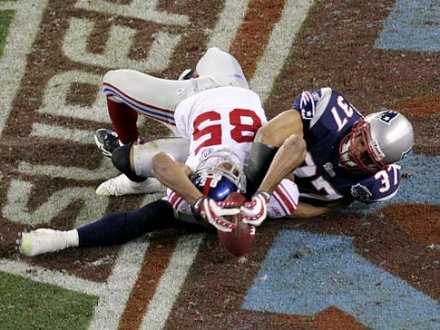
Before disemboweling, he was probably stretched out somewhat like David Tyree.
In fact, it was so dreadful (including many injuries in the distasteful rush for souvenirs) that they stopped doing it. Only gradually: Edward Marcus Despard, for instance, was sentenced to drawing and quartering, but they only hanged him to death and cut off his head posthumously. In 1814, that sentence — hanging plus posthumous beheading — formally replaced the old disemboweling-and-quartering bit as the penalty for treason.
On this date in 1594, legendary Japanese outlaw and folk hero Ishikawa Goemon was boiled to death in oil for attempting to assassinate Toyotomi Hideyoshi.
And he’s supposed to have had his son thrown into the kettle* with him, and, boiling to death himself, to have held the boy aloft out of harm’s way.
Just what his beef with national unifier Toyotomi Hideyoshi might have been is also subject to the exigencies of the story at hand. Let it be oppression or something, good enough for one of those classic outlaw-with-a-heart-of-gold retorts against condemnation for his thieving career.
It is you who are the robber who stole the whole country!
He gets to be the title character of the 2009 film Goemon:
Thanks to the inevitable marketing tie-ins, the world also has a Goemon action figure.
Personally, and especially because I would lose all these nifty accessories, I much prefer the adorable Goemon Cosbaby series.
* As a result of this famous exit, a Goeomon-buro (Goemon bath) in Japanese refers to a large iron kettle-shaped bathtub.
On this date in 1851, three men were publicly hanged from a scaffold at Fourth and O Street in Sacramento, California: John Thompson* and James Gibson legally, and William Robinson under color of lynch law.
According to Ken Gonzales-Day’s Lynching in the West: 1850-1935, all three had been condemned to death under the brand-new state‘s brand-new Criminal Practices Act, making theft a capital offense.
They had assaulted and robbed a guy on the streets of Sacramento a few weeks previous, and the local vigilance committee had already made plain its impatience with the matter: upon the granting of a legal motion to stay the trial three days in order to allow the defense to actually prepare, an orderly posse had firmly forced the court back into session to proceed with the speediest of trials. Any outcome other than death could scarcely have come to pass.
Nonetheless, California governor John McDougall made bold to stay one of the hangings, that of William Robinson.**
The San Francisco-based Alta California — which had previously (August 1, 1851) editorialized in strong support of the forced trial: “If our courts would in all cases act, the people would have no occasion for assuming the responsibility of ferretting out criminals, and awarding them their proper punishment” — narrated (September 1, 1851) a, er, popular veto of that gubernatorial mercy.
The Executions in Sacramento City
The Sacramento papers of Saturday are filled with accounts of the exciting scenes that have transpired in that city within a few days past.
We condense from the Sacramento Union, a decription [sic] of the occurrences of Friday last.
THE SCENES OF YESTERDAY. — By daylight yesterdat morning, teams, horsemen and pedestrians, were seen pouring into the city from every direction, and at an early hour the city was crowded with miners and strangers from the country, who had come in to witness the execution of the three culprits, Thompson, Gibson and Robinson.
Soon after nine o’clock, a rumor ran through the city, that a respite of Robinson’s sentence had been received from the Governor, and that the day of his execution was to be postponed until the 19th day of September. …
As the hour for the execution drew nigh, the crowd around the Station House became immense, and there was evidently a fixed determination in the minds of the populace that the prisoner, Robinson, should suffer the same penalty as the other two culprits, and that, too, in spite of the Governor’s proclamation …
The Sheriff, after reading the reprieve, ordered the two prisoners, Gibson and Thompson, to be taken to the place of execution, and likewise commanded the “Guards” to convey the prisoner, Robinson, to the Prison brig. The former two were then placed in a wagon, with their arms securely pinioned, and driven rapidly off, in company with the officers, to the scaffold.
The “Guards” then brought out Robinson, and attempted to convey him to the prison brig, but were compelled, on the corner of 2d street, to deliver their prisoner to the people, who placed him in a cart, and thus, surrounded by the “Guards,” were escorted to a grove near the place where the scaffold was erected.
A committee was appointed who were to take charge of the execution of Robinson after the legal authorities had performed their duty.
While these proceedings were going on at the grove, the final peparations for the execution of the unfortunate men, Gibson and Thompson, were progressing. …
The prisoners bore themselves with the greatest fortitude throughout the whole of this tragical scene, and not the slightest agitation was perceptible. At the moment the cord was cut, a cry was heard — “Now for Robinson.” The shout went up from the dense throng, “Hang the scoundrel!” — “Bring him here!” — “Let him hang too!”
The scene which followed was the most terrific we ever witnessed. The thronging crowds rushed for the station house in the greatest excitement, and on all sides was heard the thrilling cry, “Hang the rascal!” In the mean time the Sheriff, having performed his duty efficiently and faithfully, retired from the scene, as did also the officers with whom he was connected.
The muffled drum of the Guards announced that the culprit Robinson was approaching. The crowd gave way, the Committee with their prisoner slowly and solemnly ascended the scaffold, and the Guards formed a hollow square around it below.
Robinson appeared perfectly cool and collected, and on being requested to address the crowd, came forward, and in a clear voice made another confession. He evidently appeared desirous of creating a sensation, and accordingly commenced by alleging the grossest and most unfounded charges against men who stand high in this community … we do not feel ourselves justified on such evidence as this, in proclaiming to the world that officers who have heretofore been deemed perfectly upright and honourable, are no better than felons.
…
After the events of Friday, a portion of the excited populace assembled during the evening, and hung John McDougal in effigy. This proceeding, perhaps, was more the result of a hasty and excited spirit on the part of the few, than the calm reflection of the public mind, although the Union apologizes for the act by observing that persons engaged in it did not desire to cast obloquy on the office, but to exhibit their contempt for its incumbent.
* Thompson’s real name was evidently McDermott. The Espy file of historical American executions calls him “Thornton,” though it’s not clear whether this was yet another alias or simply an erroneous entry in the database.
** According to a different article in the same September 1, 1851 Alta California, the governor’s grounds for clemency were “the conviction of about thirty men … that Robinson was quite guiltless of the offence with which he stood charged. That false testimony had been trumped up to convict him, that he was not a hardened man, had fought the battles of his country, and finally, (as stated in a letter from a clergyman) he was quite a promising youth, of pious education, and possessing a ‘good understanding of the Christian doctrines.'”
On this date last year, four Equatorial Guinean men were executed immediately after they were convicted of treason in a military court in the tiny African nation’s capital of Malabo.
Fortunately for him, he wasn’t in residence that day.
The attack had originally been blamed on Nigerian militants; in the aftermath, seven Nigerian men were sentenced to prison for their alleged involvement, and dozens of Nigerian expatriates were expelled from the country.
International observers castigated the trials and executions as not meeting international standards of fairness. This is no surprise, seeing as how Equatorial Guinea has one of the worst human rights records in the world.
According to Amnesty International, the four men weren’t even in the country at the time of the attack, having been exiled to Benin some years before. President Obiang’s agents abducted them from Benin in January 2010. Because of the “chilling speed” of the executions, none of the condemned had the opportunity to appeal the verdict and sentences or seek clemency, as Equatorial Guinea’s own law is supposed to provide.
José Abeso Nsue, Manuel Ndong Anseme, Alipio Ndong Asumu and Jacinto Michá Obiang (no apparent relation to his alleged target) were the only Equatorial Guineans known to have faced the death penalty that year.
The Partisans were Tito’s Communist guerrilla movement against the Nazi occupation and while they were up against it at this early date, they would in due time wind up on the winning side and help birth the postwar government.
Their legacy remains in every European sports page as the namesake of the Belgrade sports association Partizan founded immediately after the war. It’s the umbrella entity for the frequent Serbian football and basketball champions as well as a variety of other sports. (Current world tennis no. 1 Novak Djokovic played for Partizan, for instance.)
This date in 1692 was the third of four execution dates during the notorious Salem witch trials.
Five souls were dispatched at Gallows Hill this date. With the executioner’s due respect to John Willard, George Burroughs, George Jacobs, Sr. and The Crucible main character John Proctor, we’re elated this date to focus on the only woman among them — Martha Carrier.
Carrier is the subject of the recent historical novel The Heretic’s Daughter by her tenth-generation descendant Kathleen Kent, whom we’re delighted to welcome for an interview on this anniversary.
How did you first learn of your connection to Martha Carrier, and how does your family feel about this link?
I was very fortunate to have heard stories of the colonial Carriers from the time I was a young child. My first memory of hearing about the Salem witch trials was when I was eight years old, visiting my maternal grandmother. She was the first one to tell me that my grandmother back nine generations, Martha Carrier, had been hanged as a witch in 1692. When I asked her if Martha was in fact a witch, my grandmother said, “Sweetheart, there are no such things as witches, just ferocious women.”
She, along with the rest of my family, had a great sense of pride over Martha’s courage in standing up to her accusers. She was one of the few people, out of the 150 New Englanders accused of practicing witchcraft, who not only refused to admit to being guilty, but also never accused anyone else of being a witch, which most people did to save themselves.
Your book tells the story of Martha Carrier from the perspective of her 10-year-old daughter. As an author, how did you approach the research, especially when it comes to Martha as an individual? Is that something you were able to source pretty strongly or did it require a lot of filling in the blanks?
The Heretic’s Daughter was my first novel, and it took five years of research and writing to complete it.
Fortunately, there is a wealth of historical information about the colonies during that time. The courts where the witch trials were conducted kept very meticulous records so I was able to gather a lot of facts regarding the magistrates and deponents, as well as the accused. There are so many wonderful fiction and non-fiction books alike that have been written about the Salem witch trials, but I wanted to write a very personal story about the Carrier family; how they lived day to day, how they survived disease, Indian raids, hostility from their neighbors, and ultimately the witch trials. I was able to weave in a lot of my family’s stories — the cow that gave golden milk, Andrew’s near death experience in the prison — that have been passed down through 10 generations.
When I first began working on the book, it was written from Martha’s point of view, but I decided it would make more compelling reading if the narrator was one of the Carrier children, Sarah, and it is through her eyes that we see the growing hysteria over witchcraft, and her struggle with Martha’s strong, unyielding character. This theme of mother-daughter conflict is central to the book’s development.
So, who was Martha Carrier and why did she become one of the people caught up in the Salem witch trials?
Martha Carrier had evidently long been resented by the community in Andover, where the Carrier family lived during the Salem witch trials, because of her forceful nature. She argued over boundary lines with several neighbors (which was a common occurrence amongst the settlers), telling one neighbor, “I will stick as close to you as bark on a tree.” (source: Salem witch trial deposition; see this document) She was also married to a man who had fought in the English Civil War, and was widely rumored to be one of the executioners of King Charles I of England. Martha fell outside of the Puritan ideal of what a woman was supposed to be and was so vocal in her own defense during the trials that when she was asked by her judges if she had ever seen the Devil, she responded by telling them that the only devils she had ever seen were the men sitting in judgment before her.
Her own children accused her of witchcraft. Are you descended through those kids as well? And do we know anything about how they later dealt with or rationalized that act?
My family is descended from Tom, Jr., and I learned the full genealogy at an early age from my grandparents. Four of Martha’s five children were arrested to compel her to admit to being guilty. Her two oldest sons were arrested first, and they were tortured until they agreed to testify against their mother. Tom and Sarah were then arrested — the real Sarah being only 7 years old at the time, and the second youngest child to be imprisoned during the trials — and they quickly admitted that they, too, were complicit in witchcraft.
During the research, I discovered how truly awful the conditions were in the Salem jail. Nearly half of the 150 people arrested from towns all over New England were under the age of 18. The surprising thing was not that people died, but that anyone survived at all. The four children were kept imprisoned for months after their mother was hanged and they were finally released in the fall of 1692. Within a few years, their father, Thomas, collected his children and grandchildren and moved to the wilds of Connecticut to start a new life.
How did she try to defend herself?
Martha Carrier was so vocal in her own defense during the trials that Cotton Mather, one of the most famous theologians of his day, named her the “Queen of Hell.”
This Rampant Hag, Martha Carrier, was the Person, of whom the Confessions of the Witches, and of her own Children among the rest, agreed, That the Devil had promised her, she should be Queen of Hell.
When she was confronted by the accusing girls, she turned to her judges and said, “It is a shameful thing that you should listen to these folks who are out of their wits.”
By the time of her arrest, several women had already been sentenced to be hanged, and she knew that her refusal to confess would mean death. She never wavered in her testimony and never accused another person to save herself, even when her four children were arrested and two of her sons were tortured.
Do you feel like she’s an overlooked figure in this affair? She’s not, for instance, even a character in The Crucible.
Arthur Miller did extensive research for The Crucible, but he did make changes to the historical facts for fictional purposes: for example John Proctor was in his seventies during the trials; hardly the strapping figure played by Daniel Day Lewis in the film adaptation.
There were so many remarkable people and events during the trials that he had to choose selectively in order to illustrate his primary motivation in writing the play which was to shed light on the McCarthy era communist “witch” trials.
Nathaniel Hawthorne wrote about Martha Carrier, as did Cotton Mather, but her forceful character made her a difficult subject, especially when there were more motherly figures like Rebecca Nurse, or titillating young characters like Abigail Williams to explore.
At this distance of time, Martha Carrier must have a great many descendants. Are you in touch with other branches of the family?
Soon after publishing The Heretic’s Daughter, I started getting emails and letters from fellow descendents of Thomas and Martha Carrier telling me that they, too, had heard many of the stories that I had grown up with.
For the release of my second novel, The Wolves of Andover, about Thomas Carrier’s life, I decided it would be fun to invite some of these extended family members to Salem for a book launch. On November 5th, 2010, nearly 250 Carrier descendents, some of them flying in from as far away as Washington State, California and Arizona, came to Salem for a weekend of author talks, receptions and story swapping. A video on my web site captured some of the highlights from that remarkable weekend.
We came as strangers and left Salem as family.
Ultimately, what’s changed about you yourself from your literary encounter with this famous ancestor?
The Salem witch trials were a dark period in American history, but from researching those events I discovered that positive changes occurred over time in the judicial system, the penal system, and for religious tolerance. I am awe-struck by the courage and fortitude of the settlers who sacrificed so much for their children and grandchildren.
And I am especially proud of my heritage: that my 9x great-grandmother defended her principles and conscience, even in the face of death. An interviewer once asked if, having written the novel, I felt I was speaking for Martha Carrier, and I said that I felt she had been speaking for me. A ferocious woman indeed!
With your second book, The Wolves of Andover, you’ve written two about the Carrier family. What’s your next project?
Wolves is a prequel to Heretic, as it explores the life of Thomas Carrier during the English Civil War and his journey to the new world from London.
I am about halfway through my third novel, but this one is quite different from the first two. It takes place during reconstruction era Texas in 1870, and chronicles a particularly chaotic, violent time in Texas history.
There’s another fine interview with Kathleen Kent here. -ed.
On this date in 1634, a Paris tribunal “declare[d] the said Urbain Grandier duly guilty of the crime of sorcery, evil spells, and the possession visited upon some Ursuline nuns of this town of Loudon and of other laywomen mentioned at the trial, together with other crimes resulting from the above. For redress of these, he has been condemned … to be taken to the Place of Saine-Croix of this said town, to be tied to a post on a pile of faggots that is to be built in the said Place. There his body is to be burned alive … and his ashes are to be scattered to the winds.”
The sentence was immediately enforced.
These Loudon possessions were a disgraceful carnival of simulated enspellment by the local Ursuline nuns engineered to destroy Grandier, a parish priest with a knack for acquiring enemies.
Alexandre Dumas, pere would write about Grandier in his Crimes Célèbres, and later in a stand-alone play. In Dumas’s rendering, Grandier arrived in Loudon as a handsome outsider, eloquent in the pulpit and doubly so in pursuit of a pretty girl,* as inexorable as Shylock in his victorious lawsuits against the local grandees.
Most recklessly of all, he made a foe of Cardinal Richelieu — snubbing him, opposing him politically, and (so it was alleged) authoring a scathing and anonymous lampoon of the Grey Eminence.
When Richelieu’s deputy came to town, the locals got the Ursuline nuns into their fits and got Grandier fast-tracked for hell.
The nuns put on a circus of frothing, profane, hip-thrusting demoniac possession accusing Grandier of bewitchment as they melodramatically underwent exorcism. (Fabulously attended, these public displays of possession and exorcism went on for several years after Grandier’s death as a perverse tourist attraction.)
Richelieu’s guy arranged to try Grandier in his own court (no appeal possible) and threatened to arrest for treason anyone who testified in his defense. In case that were insufficient advantage, a contract with Lucifer — a literal, signed document — was produced for the magistrates’ edification.
In fairness, this “contract” must have been a hell of a lot of fun to forge.
Heck, even nuns who tried to recant were turned away. Must be back under Lucifer’s influence!
Before proceeding to the stake, Grandier was subjected to one last “extraordinary” torture. His holy persecutors, “lest the Devils should have the power to resist the blows of a profane man, such as the hangman was, they themselves took the hammers and tortured the unhappy man” until the bone marrow leaked from his legs. Satan’s subcontractor suffered the blows without confessing or naming an accomplice.
In 1952, Aldous Huxley molded the horrible Grandier story into a non-fiction novel, The Devils of Loudun. Huxley’s take helped to popularize the tale — one that polemicists in the 17th century also recognized as an injustice — for the modern era of flesh minced by ideological madness.
From beginning to end, the trial proved a farce in which the condemnation of the accused was a foregone conclusion. By means of a series of trumped-up charges reinforced by an official philosophy and falsified theological dogmas, the resources of the state were mobilized to crush the offending individual. Huxley is not slow to point to the modern counterpart of such proceedings, notably in Fascist or Communist countries.
-Book review by S. van Dantzich, The Australian Quarterly, June 1954
Evidently, it struck a chord.
A 1971 cinematic adaptation of this book, The Devils, a captivating and sacrilegious tapestry of violent, sexual, and religious iconography, won critical praise and censor board bans, as well as an “X” rating in the United States. It’s hard to find, but worth the trouble.




 The sentence was immediately enforced.