1946: Takashi Sakai

On this date in 1946, Japan Gen. Takashi Sakai was shot by the World War II Allies at Nanking for war crimes.

Fifty-eight years old at his death, Sakai had built his career in the 1920s and 1930s manning various commands in the occupation of China.

Hours after Japan struck the U.S. at Pearl Harbor, Sakai commenced an attack on Hong Kong, then under British control but defended with only a token force that had no odds against the Japanese.

Sakai’s forces committed numerous summary executions and other cruelties on troops captured from the overwhelmed garrison before Hong Kong finally surrendered on Christmas Day.

The whole operation was much more protracted and difficult than Japan had anticipated and perhaps as a result Sakai was relieved of responsibility for the (similarly brutal) occupation of Hong Kong, and eased into retirement back on the mainland.

His next visit to China would occur under very different circumstances — where he would find himself obliged to dissociate himself from the atrocities that his men had authored in the capture of the city. His war crimes tribunal was not impressed.

The Tribunal dismissed the accused’s plea that he could not be held responsible for the above violations because they were perpetrated by his subordinates and he had no knowledge of them. The Tribunal’s findings were as follows:

That a field Commander must hold himself responsible for the discipline of his subordinates, is an accepted principle. It is inconceivable that he should not have been aware of the acts of atrocities committed by his subordinates … All the evidence goes to show that the defendant knew of the atrocities committed by his subordinates and deliberately let loose savagery upon civilians and prisoners of war.

The principle that a commander is responsible for the discipline of his subordinates, and that consequently he may be held responsible for their criminal acts if he neglects to undertake appropriate measures or knowingly tolerates the perpetration of offences on their part, is a rule generally accepted by nations and their courts of law in the sphere of the laws and customs of war.

(Conversely, Sakai’s attempt to cite superior orders as defense against charges for his part in initiating the war also got short shrift. So in terms of the chain of command, he got it coming and going.)

On this day..

1944: Fusilles de la Cascade du Bois de Boulogne

August 16 is a day of reverence in France for the execution on that date in 1944 — just days ahead of the allied liberation of Paris — of 35 young Francs Tireurs partisans.

In a dastardly operation, a French collaborator known as “Jacques” — actually Guy Glebe d’Eu, who was himself executed after the war — who had insinuated himself into resistance networks lured the youths, all aged about 18 to 22, to a purported weapons-smuggling operation. They were unarmed when they arrived, but the Gestapo was not.

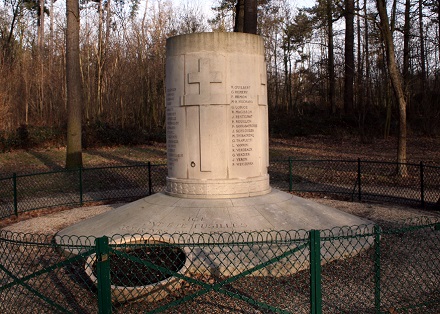
By nightfall the victims were being lined up at in the Bois de Boulogne and shot. The site today is marked by a stately monument that hosts public memorials every August 16.


(cc) image by Remi Jouan.


“Pass this oak with respect: it bears the scars of the balls that slew our martyrs.” (cc) image by Mickael Denet.

On this day..

1943: Marie-Louise Giraud, Vichy abortionist

On this date in 1943, the French executioner Jules-Henri Desfourneaux guillotined Marie-Louise Giraud as an abortionist.

Born in defeat, the Vichy regime had a program of renewing an enervated nation by restoring its values — families and proper sexual mores foremost among them. Marshal Petain famously diagnosed the reasons for France’s quick collapse under German guns: “Too few children, too few arms, too few allies.”

Interest in the fertility rate was not a Vichy innovation; worries about depopulation had become acute following the bloodbath of the First World War, and birth rates in the interwar years fell conspicuously too low for regenerating the cannon fodder. France’s scolds saw her as decadent, and eventually as deserving prey to the neighboring power that had regenerated both hearth and national purpose through fascism.

Petain placed a similar regeneration at the center of his broken nation’s agenda, and designed policy around cultivating traditional families with fecund and obedient wives.

One remarkable plank in that platform was to ramp abortion up to the stature of capital crime. Even though abortion was technically illegal before Vichy, it had long been winked at in practice.

No longer.

During the war years, the Vichy state plucked our principal Giraud from the seaside Norman village of Barneville-Cateret to prove they were serious about never again letting France get caught out with too few children.

Giraud had performed 27 illegal home abortions for hire, under hygienic conditions perfectly compatible with death by septicemia, which one of her patients suffered in January of 1942. Since the legitimate part of her economic life was as a hosteler to prostitutes, she was way out of strikes with the morals police.

The last woman ever guillotined in France, Marie-Louise Giraud is the subject of the wrenching 1988 Claude Charbol film Une Affaire de Femmes.

On this day..

1946: The Moore’s Ford Bridge lynchings

A quadruple lynching in rural Georgia on this date in 1946 shocked America.

These murders of two African-American couples near Moore’s Ford Bridge are described even to this day as America’s last unresolved mass lynching; that dubious milestone distinction also forms the subtitle of Laura Wexler’s Fire in the Canebrake, a 2004 book about the incident.

Just last year — 2015 — the FBI was reported to be investigating the Moore’s Ford lynching anew. SixtySeventy years on, it’s still just possible that a perpetrator or two remains alive who might be brought to book … provided the curtain of silence Walton County drew around itself so long ago can finally be lifted.

The victims of the lynching were the Dorseys (George and Mae) and the Malcoms (Roger and Dorothy), black sharecroppers employed by a farmer named J. Loy Harrison. Roger Malcom had been clapped in jail in Monroe, Ga., for stabbing a white man; on the day of the lynching, Harrison drove Dorothy Malcom and the Dorseys to Monroe, where he posted bail for Roger.

Just why Harrison did this appears to be one of the many mysteries of Moore’s Ford Bridge. Harrison was a Klansman, so one possible inference is that he was complicit in the events that were about to transpire; however, as Wexler notes, this bailing-out “favor” would not have been at all unusual for a Walton County plantation owner to do for his help.

[L]ike many large landowners in Georgia in 1946, he was perpetually in need of more help than [his sharecropping] tenants could provide. There were few prospects in the immediate community; as in much of the rural South, the area surrounding Loy Harrison’s farm had shrunk massively in population … Without a sufficient supply of “free” workers to fill his needs, Loy Harrison often did … pay off a prisoner’s fine, or post his bond, and let him work off the debt on his farm.

Loy Harrison was far from unusual in that respect. Large landowners all over the rural South, faced with both war-induced and urban migration, used the local jail as a labor pool. And often the local sheriffs and city police made sure the pool was stocked. They’d lock black people up on a Saturday night on minor– or trumped-up — charges, such as gambling, possession of liquor, or public drunkenness. When a landowner came to the jail on Monday morning to pay a prisoner’s fine, the police claimed part of it for making the arrest, the jailer claimed part of it for “turning the key,” and the landlord took hom a cheap, reliable worker who was bound to him until his debt was paid. … The practice of landowners buying prisoners — particularly black prisoners — out of jail was so common in Walton and Oconee counties that it had its own slogan. “If you keep yourself out of the grave,” landlords told their black tenants, “I’ll keep you off the chain gang.”

Returning from Monroe with his four sharecroppers in tow, Harrison was stopped near the bridge by a gang of armed white men — men that Harrison would later tell investigators he did not recognize, although it was 5:30 p.m. on a summer’s evening and nobody was wearing a disguise.

“A big man who was dressed mighty proud in a double-breasted brown suit was giving the orders,” reported Harrison, who is the best we’re going to do for an eyewitness. “He pointed to Roger and said, ‘We want that nigger.’ Then he pointed to George Dorsey, my nigger, and said, ‘We want you too, Charlie.’ I said, ‘His name ain’t Charlie, he’s George.’ Someone said ‘Keep your damned big mouth shut. This ain’t your party.'”

The “party” entailed forcing all four black men and women — whatever their names were — out of Harrison’s car, lining them up in front of an ad hoc firing squad, and on the count of three, gunning them all down. That night, all four corpses would be found riddled with bullets (the coroner estimated some 60 gunshots had been fired in all) and strewn near the bridge. Dorothy Malcom was five months pregnant.


There are now annual re-enactments of this notorious lynching; here’s another from 2007. When the tradition began in 2005, whites were unwilling to participate and so the first instance was staged with an all-black cast — the lynchers donning white masks.

By the 1940s, Judge Lynch’s gavel did not fall nearly so often as it once had; these mob executions which had once gone abroad with such numbing frequency now took place only sporadically, about once, twice, or thrice per year* in all of the United States.

So the mass murder of four people in a single go at such a late date shook the country. NBC news headlined the event with unconcealed disgust:

140 million Americans were disgraced late yesterday, humiliated in their own eyes and in the eyes of the world by one of the most vicious lynchings to stain our national record. A gang of armed and degenerate, poor whites, waylaid a Negro man and another man and their wives on a country road 40 miles from Atlanta. The brief and sadistic orgy ended in the bodies being riddled by 60 bullets.


Library of Congress image of Roger and Dorothy Malcom’s funeral.

Whether or not the lynchers anticipated this wave of national attention, they were ready to handle it. FBI officials dispatched by President Harry S Truman were systematically stonewalled; a suspect list as long as your arm (55 names!) went nowhere because, in the words of a Georgia patrolman, “the best people in town won’t talk.” And that really does mean the best people; one lead the FBI pursued into the usual cul-de-sac was that the white supremacist ex-governor Eugene Talmadge actually sanctioned the lynchings as an electoral ploy during a hard-fought 1946 campaign to regain his office.

The best folks’ silence — and the dire warning issued by their fusillades into the Dorseys and the Malcoms — stopped the mouths of everyone else, too. A federal $12,500 reward went begging.

Robeson Tells Truman: Do Something About Lynchings Or Negroes Will

Paul Robeson, Negro baritone, spearhead of the American Crusade to End Lynching, said yesterday after a White House visit that he had told the President that if the Government did not do something to curb lynching, “the Negroes would.”

To this statement, Robeson said, the President took sharp exception. The President, he said, remarked that it sounded like a threat. Robeson told newspaper men he assured the President it was not a threat, merely a statement of fact about the temper of the Negro people …

When he was asked whether he was a Communist, Robeson described himself as “violently anti-Fascist.” He said he had opposed Fascism in other countries and saw no reason why he should not oppose Fascism in the United States.

Philadelphia Tribune, Sept. 24, 1946 (Via)

While investigators were spinning their wheels, activists catalyzed by the Moore’s Ford horror were leaping into action. Singer-activist Paul Robeson launched the American Crusade to End Lynching in response to this event, and led a delegation to the White House. In a combative meeting with President Truman, he demanded stronger federal action.

Truman, like many politicians had before, voiced sympathy but demurred as to tangible remedies: the time was forever not right to push such politically treacherous legislation.†

Robeson replied firmly that if the government would not act to protect black lives, “the Negroes would.” Truman affected great umbrage at this threat to law and order and had no time for Robeson’s describing lynch law as a human rights abuse of the sort that the U.S. had only just finished prosecuting at Nuremberg.

The feds weren’t interested in putting the screws to lynching. But they were definitely interested in putting the screws to Paul Robeson.

The Communist Robeson, whose impossibly gorgeous voice we have previously featured in hymns to leftist martyrs John Brown and Joe Hill, was even then being investigated as a subversive by J. Edgar Hoover’s FBI. In time, Robeson’s passport would be revoked in part because he made bold while abroad to denounce racial injustice in the United States.

Come 1956, he was hailed before the House Un-American Activities Committee.


This audio is abridged; a more complete transcript can be read here.

No degree of dignity and self-possession in these inquisitions could avail Robeson, who not only did not regain his passport but was gradually levered out of America’s mainstream cultural life as punishment for his politics. He even remained estranged from the rising civil rights movement because his unwillingness to disavow his radical affiliations left him politically radioactive in those red-baiting days.

By the 1960s, the lynchings were a dead letter to those who were supposed to investigate them — just as the lynchers intended. Nobody had ever come close to being indicted. Robeson’s Crusade had gone by the wayside.

But they were not forgotten.

A young man named Bobby Howard, who was a five-year-old child in Walton County at the time the Dorseys and the Malcoms were gunned down, grew up to take an impolitic (not to mention dangerous) interest in the crime; he even pitched an investigation personally to Martin Luther King, Jr. shortly before the latter’s assassination.

All these years later, Howard remains the diligent custodian of the lynching’s memory, and he founded the Moore’s Ford Memorial Committee which among other things has established a historical marker near the site.

* In fact, there have never been so many as four recognized lynchings in any single calendar year in the United States since 1946.

** Talmadge’s 1946 gubernatorial campaign was demagoguing a 1944 Supreme Court decision that gave black voters access to racially desegregated primary elections. Talmadge would eventually win a Bush-v.-Gore-esque poll in which he lost the primary vote but won the county electors that at the time decided the race. (Talmadge carried Walton County by 78 votes.) Having done all that, he then dropped dead in December before he could take office and bequeathed his state — which had never thought to legislate the succession for this particular scenario — a constitutional crisis.

† All part of the great sausage-making of governance: Truman had met with a more moderate NAACP delegation a few days prior and set up one of those blue-ribbon commissions name of the President’s Committee on Civil Rights. Its manifold business affiliations and scanty deliverables were both considerably more welcome in Washington than was Robeson. See Penny Von Eschen’s Race against Empire: Black Americans and Anticolonialism, 1937-1957.

On this day..

1948: Meir Tobiansky, by summary judgment

On this date in 1948, an alleged spy was extrajudicially executed by the Israeli Defense Forces.

This execution occurred during a short truce punctuating Israel’s War of Independence, but prior to the ceasefire the nascent IDF had become suspicious at Jordan’s gift for accurately targeting critical infrastructure in Jerusalem.

Suspicions came to settle on Meir Tobianski a Lithuania-born former British officer who had become a captain in the Jewish militia Haganah: as an employee of the Jerusalem Electric Corporation, he would have made a great informant for enemy artillerymen.

On June 30, 1948, Tobianski was kidnapped and driven to a depopulated Arab village (present-day Harel, Israel), where four intelligence officers demanded to know if Tobianski had given any information to his British colleagues at the utility (he had), and then declared him condemned as a spy. (Efficiently, they had already prepared the firing squad ahead of time.)

The chief of these four, Isser Be’eri, was later charged with manslaughter for the affair, receiving a symbolic one-day sentence. His subordinates, who were never charged, had long careers in Israeli intelligence; one of them, Binyamin Gibli would go on to help cook up a subsequent espionage debacle, the Lavon Affair.

Tobianski has been officially rehabilitated by Israel. Despite the irregularity of the proceeding against him, he’s sometimes described as the first of only two executions in Israeli history, alongside the much more procedurally defensible hanging of Adolf Eichmann.

On this day..

1942: Evzen Rosicky, athlete

On this date in 1942, Czech athlete and resistance figure Evzen Rosicky was shot with his father at Prague’s Kobyliske shooting grounds.

His country’s former champion in the 800 meters and 400 meter hurdles, Rosicky had the honor of representing Czechoslovakia at the 1936 Olympics … Hitler’s Berlin showcase.

Three years later, it was the Czechs unwillingly playing host to the Germans. By then, Rosicky was a journalist of left-wing proclivities (he was a card-carrying Communist) and he naturally segued right into anti-occupation resistance.

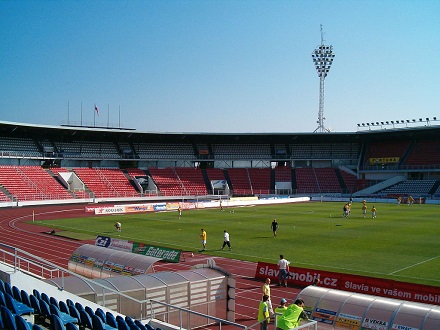
Arrested and shot along with his father, Jaroslav, Evzen Rosicky is the namesake of Prague’s Stadion Evzena Rosickeho.


(cc) image of Stadion Evzena Rosickeho by Honza Záruba.

On this day..

1940: Three saboteurs and a spy, “Fusilles et oublies”

On this date in 1940, the collapsing French state “shot and forgot” four subversives at Pessac. These cases are heavily covered by the French-language blog Histoire penitentiaire et Justice militaire; many links in this post point to well-illustrated articles on that site, which make recommended reading for those inclined to delve deeper.

Late June finds France in the dark weeks after Dunkirk — the very day, in fact, when Marshall Petain’s government formally surrendered to the German blitz.

Elsewhere, the remains of the Third Republic had fled west to Bourdeaux, taking along its death row prisoners. The state that condemned them did not mean to let its imminent disappearance cheat it of their blood.

Jean Amourelle, a stenographer in the French Senate whose duties included shorthanding the secret proceedings of its military commissions, was caught routing intelligence to Germany.

Set to join him for this date’s execution were two pairs of brothers: Roger and Marcel Rambaud, and Leon and Maurice Lebeau. Seventeen-year-old Maurice Lebeau had his sentence commuted to hard labor, however, and was spared from the firing detail.

The Rambauds and Lebeaus were factory workers sentenced as saboteurs for compromising the engine of a French military plane, causing it to explode mid-flight: strange behavior for Communist proletarians explained by the temporary peace between Germany and the Soviet Union that (for the moment) positioned the Comintern-directed French Communist Party as an opponent of the war.

Despite the sacrifice of the Rambauds and Lebeaus, this posture was short-lived. Just one year later — June 22, 1941, in fact — Germany’s invasion of the USSR thrust Europe’s Communist movements into common fronts with anti-fascist parties, and France’s Communists into the forefront of French Resistance martyrs.

On this day..

1945: Mile Budak, Ustasha ideologue

On this date in 1945, seven former members of Croatia’s World War II Ustasha regime were hanged in Zagreb by Tito‘s postwar Yugoslav government — the morning after they had all been death-sentenced at a one-day military trial.*

Despite the presence of wartime Prime Minister Nikola Mandic (English Wikipedia entry | Croatian) in the batch, the marquee name was writer Mile Budak
(English Wikipedia entry | the far more detailed Croatian and German).

The “minister of culture with a machine gun” in the branding of his leftist literary contemporary Miroslav Krleza, Budak spent the interwar years writing hit novels valorizing the Croatian peasantry (The 1,000-page OgnjiÅ¡teHearth — is the magnum opus) and also voluminous copy for far-right periodicals. Thanks to the latter activity, Budak endured an arrest, an attempted assassination, several years’ self-imposed exile to Italy, and (after his return) the murder of his wife.

Small wonder that when Germany broke off from the post-imperial Kingdom of Yugoslavia an “independent” Croatian puppet state, Budak signed up as its chief propagandist. Initially Minister of Education in 1941, he subsequently became its ambassador to Germany, and in 1943 its Foreign Minister.

He’s most notorious for the alleged aphorism “One third of the Serbs we will kill, one third expel, and the last third convert to Catholicism” — and though adherents widely dispute his authorship of any such phrase, Budak’s racial cosmology elevating Croatians (“an intersection of Slav and Gothic blood”) over their South Slav brethren was part of the intellectual scaffolding for his state’s wartime campaign of ethnic cleansing against Serbs. (It goes without saying that Jews and Roma were even more screwed.)

Judgments on the literary merit of Budak’s output appear to be driven heavily by the critic’s sympathy level with Budak’s politics. Post-independence Croatia has a robust far right that has often shown keen to rehabilitate the Ustasha, so it’s no surprise that Budak has been rediscovered as a writer and his name stapled to numerous streets in Croatia** and even to one in the Bosnian city Mostar — strictly in honor of his artistry and not the war business, mind you.

* Indeed, several — Mandic included — were only yielded up from British captivity in mid-May. (Link goes to a Croatian pdf)

** There’s one, for instance, in present-day nationalist enclave Knin — formerly the capital of the Serbian Krajina during the internecine 1990s wars. Knin’s capture and, er, ethnic reordering is the occasion celebrated on Croatia’s Victory Day holiday (August 5). It was for this operation that Croatian general Ante Gotovina was prosecuted by the International Criminal Tribunal for the former Yugoslavia; Gotovina’s eventual shock acquittal and release to a great nationalist orgy in Zagreb led Serbia to quit cooperation with the ICTY’s “selective justice”.

On this day..

1945: Pvt. George Edward Smith, on VE Day

(Thanks to Robert Walsh for the guest post. Mr. Walsh’s home page has a trove of articles about historical executions, including another American serviceman hanged at Shepton Mallet. -ed.)

VE (Victory in Europe) marked the official end of hostilities in the European theatre of operations and quite possibly the largest and most joyous celebration in human history.

Unless, of course, you happened to be former US Army Air Forces Private George Edward Smith.

While most of the rest of the world basked in the joy of victory and the relief of the European war being over, Private Smith had a rather more pressing engagement to think about. The rest of the population might be about to enter a brave new world, but Smith was about to depart rather suddenly from the old one.

It was his execution day.

Smith, previously serving at RAF Attlebridge in Norfolk with the US Air Force’s 784th Bombardment Squadron, wouldn’t be celebrating the end of the European war. He’d be watching the clock tick relentlessly down to 1 a.m. when he’d be escorted from the Condemned Cell at Her Majesty’s Prison, Shepton Mallet, Somerset (loaned to the US military for the duration of the war). He’d be sat near the gallows pondering a past that was about to cost him his life while hoping for a reprieve that wouldn’t arrive and a future that was already lost.

While most of the world celebrated, George Edward Smith was going to die.

Smith’s guilt wasn’t in any doubt. Near RAF Attlebridge lay the sleepy Norfolk town of Honingham and the stately home named Honingham Hall (demolished in the 1960s).

Honingham Hall and the adjoining land were home to distinguished diplomat Sir Eric Teichmann, a long-serving figure vastly experienced in the Far East and serving as advisor to the British Embassy at Chungking. He’d noticed, as so many country gentlemen do, that he had a problem with poachers. December 3, 1944 would be the last time he had a problem with anything. It was in the small hours of the morning that he met George Edward Smith.

Smith and his accomplice Private Wijpacha had ‘borrowed’ a pair of M1 carbines from the base armoury and decided to do a spot of illicit hunting. Teichmann, familiar with the fact that poachers aren’t usually violent offenders and will usually run if challenged, heard gunshots from nearby woodland and went out to investigate. He went out unarmed, challenged Smith and Wijpacha — and Smith promptly shot him once through the head with his M1. Both men fled hurriedly back to their base, hoping that their absence wouldn’t be noticed.

Of course, a senior British diplomat lying murdered in the woodland was noticed.

Before long both men were arrested and questioned, during which Smith confessed, a confession he later retracted claiming that it was made under duress. That, not surprisingly, cut no ice whatsoever with either the American military or the British authorities. Smith and Wijpacha were court-martialled at RAF Attlebridge and Wijpacha (who hadn’t fired a shot) received a lengthy prison sentence. Smith, the triggerman, drew the death penalty.

Under the Visiting Forces Act, 1942 the Americans were free to try, imprison and condemn their own criminals independent of the British system of justice, not that it would have made any difference to Smith’s case. Murder was then a capital crime in Britain regardless of the criminal’s nationality. If Smith hadn’t been condemned by an American court-martial then a British trial would have seen the judge don the legendary ‘Black Cap’ and pass what British reporters once called ‘the dread sentence’ especially given the status of the victim.

Smith was promptly shipped to the prison at Shepton Mallet in the county of Somerset to await a mandatory review of his case and, if clemency was refused, execution.

View of Shepton Mallet (left) and its execution shed (right)

Shepton Mallet had been a civilian prison for centuries before being turned over to the British military, who then lent it to the Americans as part of the Visiting Forces Act. Until its final closure a few years ago Shepton Mallet remained the oldest prison in the UK still operational, a dubious distinction now belonging to Dartmoor. There were, however, a few difficulties with the arrangement.

The Americans carried out 18 executions at Shepton Mallet during their tenure between mid-1942 and September, 1945. Two (Alex Miranda and Benjamin Pyegate) were by firing squad, upsetting local people, who knew very well what it meant to live next to a military prison and hear a single rifle volley at 8 a.m. The American military also preferred hanging common criminals to allowing them to be shot like soldiers.

The problems were simple. The locals didn’t like firing squads made no secret of it. Not surprisingly, there were complaints. The US military felt being shot was too good for most of its condemned and the British didn’t like the methods and equipment used by American hangmen, who had acquired a nasty and thoroughly-deserved reputation for using badly-designed scaffolds, the wrong type of rope and the antiquated standard drop instead of a drop length scientifically calculated by the prisoner’s weight.

The British also regarded American hanging equipment as outdated, while American military hangmen John Woods and Joseph Malta were entirely unfamiliar with the British kit. And British hangmen had evolved hanging to almost an art, needing mere seconds to complete the procedure.

Another problem was that the gallows at Shepton Mallet hadn’t been used since March, 1926. By 1942 it was considered unfit for service and needed replacing. A compromise had to be reached, and was.

The Americans could continue executions at Shepton Mallet, but the vast majority (16 out of 18) were performed by British hangmen using a British gallows in an extension built onto the end of one of the cellblocks. The Americans were permitted their usual practice of having the condemned stand strapped, noosed and hooded on the gallows while their death warrant and charge sheet were read out and then being asked for any last words. This caused executioner Albert Pierrepoint, master of the speedy hanging, to complain at what seemed to him a cruel, unnecessary delay in ending the prisoner’s misery.

Pierrepoint also complained about overcrowding in the gallows room during executions. At a British hanging there would be the prisoner, the hangman, his assistant, the prison Governor, the Chief Warder, the doctor, the Chaplain and two or four prison officers. At an American military hanging there were usually twenty or so people clustered around the trapdoors and lever. He felt a hanging should be both quick and perfect and that a crowded gallows room invited disaster.

Hangman Thomas Pierrepoint.

By VE Day the arrangement was well-established. Thomas Pierrepoint, uncle of Albert and brother of Henry (both of whom were also hangmen) performed 13 of the 16 hangings at Shepton Mallet while Albert performed the remaining three when he wasn’t busy elsewhere.

Their assistants were Steve Wade, Herbert Morris and Alexander Riley. Tom Pierrepoint had performed the last hanging at Shepton Mallet in 1926 (that of murderer John Lincoln) assisted by Lionel Mann. While the two firing squads were performed at 8 a.m., the hangings would be carried out at 1 a.m. which was discreet enough not to arouse neighbors’ ire.

Smith’s case was reviewed. Not surprisingly, his appeal was denied as were other requests including (most generously, under the circumstances) one from Lady Teichmann, widow of his victim. His date was set for 1 a.m. on what turned out to be the very day Europe’s guns fell silent. Tom Pierrepoint would do the job assisted by Herbert Morris. Smith was transferred to the Condemned Cell a few days prior to the execution date where he was granted free access to the military Chaplain.

When the time came, while the rest of the population celebrated the arrival of a new world and Smith contemplated his departure from the old one, it went as smoothly as could be expected. Smith was taken from his cell wearing standard military uniform, from which any badges or flashes marking him as a soldier were deliberately removed. Paperwork was completed signifying his dishonourable discharge from the US military as a common criminal and the US military were determined that he should die like one.

Given the delays caused by the reading of the charge sheet and death warrant and Smith being asked for his last words (he apparently had none) it took 22 minutes between Smith being taken from his cell and being certified dead by the prison doctor. Compare this with a standard British execution (minus the bureaucracy and speechifying) where 22 seconds would have been considered twice as long as was needed to do the job. Smith’s punishment, however, wasn’t done yet. Executed American servicemen were initially buried at Brookwood cemetery, but then moved to the notorious ‘Plot E’ of the Oisne-Aisne Military Cemetery in France. Plot E is deliberately hidden from the rest of that cemetery. Its residents have no names on their graves, only numbers. They have no headstones or crosses, only flat stone markers. No American flag hangs in their plot. It doesn’t appear on the plan of the cemetery even today and the markers are placed facing away from the graves of other Americans. Visits to Plot E are still discouraged and it wasn’t until a Freedom of Information request in 2009 that the names of those buried there were released.


A view of the “Dishonored Dead” in Plot E, Oise-Aisne American Cemetery. (cc) image by Stranger20824.

Whatever they may have done, and some committed truly dreadful crimes, it seems distasteful to virtually deny their existence and shame them even after death. It also denied their families and friends the chance to visit and grieve, despite the fact that they themselves had committed no crime.

That said, it’s no different to the routine imposed on condemned British criminals. In fact, the British death sentence expressly demanded that inmates be buried in unmarked graves within the prison walls inflicting the same suffering on their friends and relatives. The British hanged were officially designated ‘Property of the Crown,’ many of whom were not properly reburied until after abolition. At many British prisons they still remain in unmarked graves according to the following sentence:

Prisoner at the Bar, it is the sentence of this Court that you be taken from this place to a lawful prison and thence to a place of execution where you shall be hanged by the neck until you are dead, and that your body be afterwards cut down and buried within the precincts of the prison in which you were last confined before execution. And may the Lord have mercy upon your soul.

Remove the prisoner …

On this day..

1943: Rev. Leonard Kentish, kidnapped Australian civilian

On lonely scrubland at the Aru Islands port of Dobo on this date in 1943, the Japanese military beheaded kidnapped Australian Rev. Leonard Kentish.

Nobody knew his fate at the time — his wife spent years tring to discover it — but the so-called “Kentish Affair” was one of the true oddities of the Pacific War: a civilian of no particular import to the war effort who was snatched from Australian territorial waters.

On January 22, 1943, the civilian Kentish, chief of Northern Territory Methodist missions to the aboriginal peoples, had hitched a ride on the HMAS Patricia Cam, a wooden tuna trawler that had been requisitioned as a wartime naval transport. The Patricia Cam wasn’t running any blockades — she was strictly for local cargo runs, in this instance shuttling among Elcho Island and the Wessel Islands just off Arnhem Land.

She had no radar capacity, and no inkling at all of her fate that afternoon when the Aichi E13A floatplane dove out of the sky and skimmed above the Patricia Cam, within 100 feet of the mast — dropping a bomb amidships that ripped open the trawler’s belly and sent her to the bottom.

While survivors scrabbled in the Arafura Sea for “overboard drums, planks, boxes — anything that would float” the raider circled for another pass, splintering with a second bomb an emergency canoe that men were crowding into, then strafing the waves with machine gun fire. Finally, the victorious seaplane set down in the waves.

And then mysteriously, the pilot gestured Rev. Kentish into the vacant seat of his plane, and took off. Kentish was the only prisoner taken, and his countrymen never again laid eyes on him.

Sixteen other people survived the attack and were rescued a few days later. But poor Mrs. Violet Kentish remained entirely in the dark as to the fate of her husband. “I know that Len is not beyond God’s love and care wherever he may be,” she vainly pleaded to the Minister of the Navy. “But you will understand because we are only weak humans, the heartache and longing for one we loved so much.” (Quoted in Australia’s Forgotten Prisoners: Civilians Interned by the Japanese in World War Two)

After World War II, she desperately resorted to firing letters to newspaper editors, until an intelligence officer chanced to read one published in the Argus and made the necessary inquiries via U.S. Gen. Douglas MacArthur’s staff in Tokyo to unravel the mystery. In the clipped official findings:

1. The Rev KENTISH was taken on board a Jap float plane on Jan 22 43 after it had sunk the patrol vessel HMAS “PATRICIA CAM” off WESSEL IS.

2. Unfortunately no info can be obtained of the whereabouts of the Rev KENTISH until 13 Apr 43, when he arrived at DOBO.

3. The Rev KENTISH was held at DOBO as a prisoner till the 4 May 43. Throughout this period he was subjected to ill treatment by severe bashings, the most common being punches in the nose and eyes to such an extent that his nose was broken, and he had great difficulty in seeing. His diet, as such, was just sufficient to keep him alive.

4. On the morning of 4 May he was taken in to the scrub, (a distance of under 200 yds from the township of DOBO) where a grave had been prepared, and executed.

5. The execution was carried out by the order of 1st Lieut SAKIDJIMA.

6. The remains of the Rev KENTISH have been recovered, and handed over to Capt STOCKWELL, of the War Graves Unit. They will be transported to AMBON, and buried in the Internees cemetery there.

7. This case is now considered closed. All dates must be treated as approx.

The consequence of this inquiry was a 1948 war crimes case against Lt. Sagejima Maugan, who was hanged in Hong Kong on August 23, 1948 for conducting Rev. Kentish’s execution.

On this day..