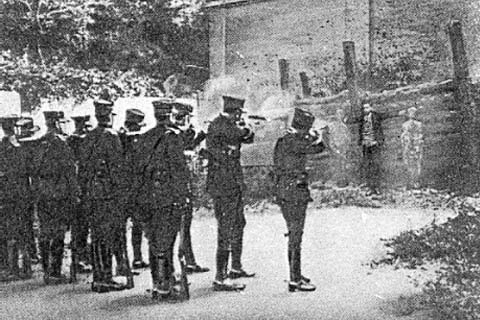
1929: José de León Toral, assassin of Álvaro Obregón

On this date in 1929, a Catholic militant who had gunned down the president of Mexico was shot for his trouble.

In the midst of the dirty Cristero War pitting Catholics against a secular, development-minded state, adroit former president Alvaro Obregon had just won election to a new term.

On July 17, 1928, as the president-elect banqueted in Mexico City, starving artist and father of three Jose de Leon Toral (English Wikipedia entry | Spanish) gained admittance as an itinerant caricaturist … then shot dead his putative subject square in the face.

En route to his inevitable Calvary, which he met like Father Miguel Pro with the insurgents’ cry of “Viva Cristo Rey!”, Toral had occasion to stand in a sensational trial where he described to a live radio audience his tortures at the hands of the police. (There’s an illustration at this Spanish-language biography.)

And of course, he’s got his own corrido.

On this day..

1661: Oliver Cromwell, posthumously

On this anniversary date of King Charles I’s beheading, the two-years-dead corpse of the late Lord Protector Oliver Cromwell was hung in chains at Tyburn and then beheaded, along with the bodies of John Bradshaw and Henry Ireton.

The great-great-grandnephew of ruthless Tudor pol Thomas Cromwell rose higher than any English commoner, high enough to be offered the very crown he had struck off at Whitehall. Oliver Cromwell declined it in sweeping Puritan rhetoric just as if he hadn’t spent weeks agonizing over whether to take it.

“I would not seek to set up that which Providence hath destroyed and laid in the dust, and I would not build Jericho again.”

The House of Stuart never could rebuild its Jericho while the Lord Protector ran the realm* — thirteen years, writes Macaulay, “during which England was, under various names and forms, really governed by the sword. Never, before that time, or since that time, was the civil power in our country subjected to military dictation.”

“Cromwell lifting the Coffin-lid and looking at the body of Charles I”, by Hippolyte (Paul) Delaroche — a French painter with an affinity for English execution scenes. The painting is based on an apocryphal but irresistible legend, also used by Nathaniel Hawthorne in a tedious short story.

And not only England. Cromwell’s prodigious depredations in Ireland — justifiably or not — remain a source of bad blood.

The English Commonwealth foundered after Cromwell’s death, however, and restoration of the monarchy — a rock, as it turned out, on which the Puritans’ bourgeois revolution could erect its colossus — came with the price of a few examples being made.

Of course, “executing” dead guys displays about as much strength as it does sanitation, and for all Charles II‘s demonstrative vengeance, the politically circumscribed throne he resumed was very far from his father’s dream of absolutism. Between the late dictator and the new king, the future belonged to the corpse clanking around on the gibbet.

When the able Charles II followed Cromwell into the great hereafter, his brother James II promptly fumbled away the crown with his anachronistic insistence on royal authority and his impolitic adherence to Catholicism.**

In the emerging England of the century to come, the divine right would depart the Stuarts for another dynasty more amenable to the rising authority of the parliament whose sword Oliver Cromwell once wielded.

* Resources on the particulars of Cromwell’s career, the English Civil War, et al, are in plentiful supply online. This BBC documentary is a very watchable overview: part I; part II; part III; part IV.

** James II remains England’s last Catholic monarch.

On this day..

1795: Unspecified Robespierrists

On this date in 1795, a Balzac story La Comedie humaine reaches its climax as the tumbrils of the Thermidorian Reaction wind their way to the scaffold.

In “An Episode Under the Terror”, a mysterious man appears to a priest in hiding and prevails upon him to say a secret mass for the recently executed Louis XVI.

It transpires in an exchange between the two that the stranger’s own conscience is somehow troubled.

“Remember, my son, [said the abbe] that it is not enough to have taken no active part in the great crime; that fact does not absolve you. The men who might have defended the King and left their swords in their scabbards, will have a very heavy account to render to the King of Heaven — Ah! yes,” he added, with an eloquent shake of the head, “heavy indeed! — for by doing nothing they became accomplices in the awful wickedness—-”

“But do you think that an indirect participation will be punished?” the stranger asked with a bewildered look. “There is the private soldier commanded to fall into line — is he actually responsible?”

We have no more answer in the text than we have in life.

Spoiler (That You Saw Coming) Alert

The stranger returns on the anniversary of the king’s martyrdom, but he remains enigmatic, until the abbe is caught up in a crowd watching the procession to the guillotine.

“What is the matter?” [the abbe] asked Madame Ragon.

“Nothing,” she said; “it is only the tumbril cart and the executioner going to the Place Louis XV. Ah! we used to see it often enough last year; but to-day, four days after the anniversary of the twenty-first of January, one does not feel sorry to see the ghastly procession.”

“Why not?” asked the abbe. “That is not said like a Christian.”

“Eh! but it is the execution of Robespierre‘s accomplices. They defended themselves as long as they could, but now it is their turn to go where they sent so many innocent people.”

The crowd poured by like a flood. The abbe, yielding to an impulse of curiosity, looked up above the heads, and there in the tumbril stood the man who had heard mass in the garret three days ago.

“Who is it?” he asked; “who is the man with—-”

“That is the headsman,” answered M. Ragon.

Meaning (though unnamed as such by Balzac), the phenomenally prolific Sanson.

On this day..

1922: Seven Republican guerrillas in the Curragh of Kildare

(Thanks to author and historian James Durney for the guest post, an excerpt from On the One Road: Political Unrest in Kildare 1913-1994. -ed.)

Seven men were executed in the Glasshouse, in the Curragh Camp on December 19 in the biggest official executions of the Civil War. They were Patrick Bagnall and Patrick Mangan, Fairgreen, Kildare; Joseph Johnston, Station Road, Kildare; Bryan Moore and Patrick Nolan, Rathbride, Kildare; Stephen White, Abbey St. Kildare and James O’ Connor, Bansha, Co. Tipperary. These seven men, along with Comdt. Thomas Behan were found in a dug-out at Mooresbridge, on the edge of the Curragh, on the night of December 13. They were under the command of Comdt. Bryan Moore, 38, a veteran IRA officer, and comprised a section of the 6th Battn. Column. They were armed with rifles bought from a soldier stationed in Naas Barracks.

A detachment of troops from the Curragh searching a farmhouse at Mooresbridge, about one-and-a-half miles from the Curragh Camp, “found the proprietress in possession of a fully loaded Webley revolver.” A subsequent search disclosed a dug-out underneath a floor. The dug-out was surrounded by National soldiers who called on the men to come out. Eight men were in the dug-out, which was also found to contain 10 rifles, a quantity of ammunition, one exploder, a roll of cable and food supplies. When they surrendered Tom Behan was struck with a rifle butt and had his arm broken. When the captives were ordered into the back of a truck Tom Behan could not climb aboard because of his broken arm. He was struck again on the head with a rifle butt and died at the scene. Behan was a veteran IRA man and at the time of his death was Intelligence Officer, 1st Eastern Division. The Free State authorities claimed that Behan was shot while trying to escape through a window in the Glasshouse (so called because of its roof), issuing a statement saying: “One of the party of men arrested when trying to make his escape from the hut in which he was detained at the Curragh, ignoring the warning of the sentry to desist, was fired on and fatally wounded.” Mick Sheehan was in the Glasshouse at the time and thought it highly unusual that an experienced volunteer like Tom Behan would try to escape through such a small window. It was only years later that he found out the truth. The Glasshouse was a small stone and brick military prison up the hill where the military usually housed their own prisoners. It consisted of two floors enclosed within a twelve foot high walled enclosure with cells for 64 prisoners. During the Civil War, and after, it was used as a punishment block for Republican prisoners.

The remaining seven men were executed by firing squad on the morning of December 19. The following official report was issued from Army Headquarters, GHQ, on that evening: “Stephen White, Abbey Street, Kildare, labourer; Joseph Johnson, Station Road, Kildare, railway worker; Patrick Mangan, Fair Green, Kildare, railway worker; Patrick Nolan, Rathbride, Kildare, railway worker; Brian Moore, Rathbride, Kildare, labourer; James O’Connor, Bansha, Tipperary, railway worker; Patrick Bagnel, Fair Green, Kildare, labourer who with others, were arrested at Rathbride, Co. Kildare, on the 13th inst., were charged before a Military Committee with being in possession, without proper authority, of – 10 rifles, 200 rounds of ammunition therefor, 4 bomb detonators, 1 exploder.

“They were found guilty and sentenced to death. The sentence was duly executed this morning, 19th inst., at 8.30 a.m.”

This stone at Grey Abbey commemorates the seven IRA men. Image courtesy of Mario Corrigan.

They were all veteran IRA men and belonged to a column of ten which operated against railways, goods trains and some shops in the vicinity of Kildare. Five of them were on the derailment of engines at Cherryville on December 11 when they made a serious attempt to dislocate the whole railway service on the Great Southern and Western Railway Line. Two engines were taken out of a shed at Kildare and sent down the line by Cherryville. One engine ran out of steam and did no harm, while the other overturned and blocked the line for a considerable time. The column was also responsible for an ambush on National troops at the Curragh Siding on November 23 when a large party of troops were returning to Dublin after escorting prisoners to the Curragh Internment Camp. On their return journey the troops were fired on at the Curragh Siding and two were wounded. In the confusion a policeman was accidentally shot by a National soldier. Father Donnelly, chaplain to the troops, administered to the seven volunteers before their executions. They were shot one by one and were buried in the yard adjacent to the Glasshouse.

The last letters from the seven men were printed in the Republican paper Eire. /The Irish/ /Nation/. James O’Connor of Bansha wrote to his mother: “I am going to Eternal Glory tomorrow morning with six other true-hearted Irishmen.” Patrick Mangan wrote to his mother: “I am to be shot in the morning. I fought for Ireland and am sorry I could not do more… I have made my peace with God and was never so happy as tonight.”

On March 31 1923 Eire (The Irish Nation) printed the last poignant letters from Bryan Moore, Patrick Bagnell and Paddy Nolan under the title ‘Last letters of “executed” soldiers of the IRA.’*

Letter of Bryan Moore to his Brother.

Hare Park Prison, 18-12-22.

Dear Pat, – I am about to die for the Cause of Ireland as many did before. Pray for me and get the children to pray for me. I’ve just had the priest and will see him again in the morning at 6.30 and receive Holy Communion. He says we are to be envied the deaths we are about to meet, as we shall go straight to Heaven.

Do all you can for Father and Mother. Tell Mary and Kathleen to say a prayer for me every night,

Bryan.

Letter of Bryan Moore to Mother and Father.

Hare Park Prison, 18-12-22.

Dear Mother and Father, – I am about to be executed in the morning and I wish to bid you good-bye, and to ask you to pray for me and the rest of the boys.

I had the priest this evening and will see him again to night. I am resigned to die. God comfort you both.

Tell Johnny to pray for me. – Your loving Son.

Bryan.

Letter of Bryan Moore.

Hare Park Prison, 18-12-22.

Dear Johnny, – Good-bye, and be good to Father and Mother. Pray for me. – Bryan.

P.S. – You can do a man’s part by looking after Father and Mother. Tell them not to worry for me, as I am better off. God bless you.

Dear Annie, – Good-bye. God bless you. Pray for me.

Bryan.

Letter of Patrick Bagnall to his Uncle.

Hare Park Prison, 18-12-22.

Dear Jimmy, – I hope you and Willie are well. Tell all the boys and girls I was asking for them. I am writing to my sister and father. I am to be shot in the morning, 19th December, at 8.15. Mind Mary and do what you can for her. I know this will nearly kill her. We had a priest who heard our confessions. We are all here, seven of us – Johnston, Mangan, White, Moore, Nolan, Connor, and I. We are all to go “West” together, so don’t forget to pray for us. I know you and Willie will be sorry, but it is all for the best, and I hope it sets old Ireland free. We are not afraid to die.

Tell them all in Kildare I was asking for them. Don’t forget Harry Moore. We are dying happy anyway. So good-bye old Kildare, good-bye Jimmy and God bless you. I will meet you in Heaven. Tell Tom Byrne I was asking for him. – Your loving nephew, Paddy Bagnall.

The priest’s name and address is Father_____, Curragh Camp, a very nice man: you can write him if you want to. He said we will die like men anyway.

Letter of Paddy Nolan to his Father and Mother.

Curragh Camp Prison, 18-12-22.

Dear father and Mother, – I am writing my last few lines to you. I am to be executed to-morrow morning, and I hope you will bear it with the courage of an Irish Father and Mother. I am proud to die for the Cause I loved and honoured, and for which I give up my young life.

Six more of my comrades are to be executed. We have all been to confession and Holy Communion. Father ______ told us we would go straight to Heaven, so do not worry.

Dearest Mother, there are a few pounds in my suitcase, you can have them, or anything else in the house belonging to me.

Loving Father and Mother , good-bye for ever, – Your fond and faithful Son.

Paddy.

Father _____, Curragh Camp, sends his sympathies and prayers.

Letter of Paddy Nolan to his Elder Brothers and Sisters.

Curragh Camp Prison, 18-12-22.

My Dear Brothers and Sisters.

Now that I’m about to part from this world, I ask you for one favour – be kind and good to Father and Mother, and never dishonour the Cause for which I die – a Free and Independent Ireland. I bear no ill will to any person. Fond Sisters and Brothers, pray for me. Good-bye forever.

Paddy.

Letter to his Young Brothers and Sisters.

My Dear little ones, – I, your fond brother about to pass out of this world, ask you loving little ones to offer up your innocent prayers for me and my comrades on Christmas morning. Be good children, and always obey your parents and do everything in your power to make them happy. God bless you little ones. Good-bye for ever. – Paddy.

The executions caused a lot of bitterness locally. Both Mick Sheehan’s uncles, who had taken the pro-Treaty side, left the National Army. One, Capt. Patrick Kelly, who had served in the Republican Police, resigned his commission and went to the Civic Guards.

* The last letter of 18-year-old Stephen White, which seems not to have been printed at the time, can be read on this history of the day’s executions. -ed.

On this day..

1927: Father Miguel Pro, “Viva Cristo Rey!”

On this date in 1927, the anti-clerical Mexican government made the emblematic martyr of the Cristero War.

This video is in Spanish, but the storyline is pretty easy to follow — young man finds faith, lives faith, dies faith.

Miguel Pro‘s dying cry, “Viva Cristo Rey!” — “Long live Christ the King!” — was a refrain of Cristeros, anti-government guerrillas who in the late 1920’s fought the revolutionary Mexican government’s attempts to forcibly restrict the power of the Catholic Church.

That conflict had been brewing for years, an outgrowth of Mexico’s own complex history of colonization and development — measures to restrict the church’s size, wealth, and social reach had been mooted and sometimes implemented well back to the middle of the 19th century.

Early in the 20th, the confrontation was merely a twist on its classic form: liberal state-builders and the Catholic hierarchy were (or increasingly saw themselves as) diametrically opposed in their vision for Mexico.

That conflict came to a head under president Plutarco Elias Calles, an irreligious northerner with a project of national capital development for whom the church’s intransigence from its agrarian strongholds was most unwelcome … and who seemed to delight in provoking Rome with sport like mandatory physicals for priests, not neglecting to publicize the incidence of venereal disease thereby revealed.

Liberals had already brought about drastically reduced clerical privileges in the Mexican Constitution of 1917; its somewhat draconian measures were neither fully enforced nor fully resisted, but initiated a period where the two hostile institutions rudely grappled for their respective spheres of influence on the ground.

Calles was the rudest grappler of all, and his 1926 Calles Law pushed for anti-clericalism stricter than the letter of the constitution … and sparked armed resistance.

It was an exceptionally dirty war with routine summary executions on both sides and thousands of Catholic refugees — a dangerous environment for any priest with legal sanctions against basically every practice of the vocation. (Photos of Cristeros, some in heroic resistance and others in grisly martyrdom, can be eyeballed here.)

Pro, a Jesuit who like many was forced underground, was under state surveillance and got picked up in the aftermath of an assassination attempt against a prominent politician. He was chosen to make an example of — without an actual trial, possibly because there’s no actual reason to think he was involved in the bombing.

Looking at these pictures of Pro’s last moments, it’s hard to believe that they were taken and circulated at government direction to cow the Cristero movement. Fail.


Led out to execution in a police courtyard. The place of his death today is (bizarrely) Calle Loteria Nacional.


Calmly at prayer before his death, under the eye of the firing squad commander.


Pro himself refused a blindfold. But why state authorities carrying out the execution with an eye towards public relations would allow him to die in this pose is anyone’s guess.


He blessed and forgave the firing squad, of course.


Just beginning to topple at the moment the bullets struck him.


Like many firing squad executions, this one failed to kill its victim with the ceremonial volley. Pro was finished off with a coup de grace.

Calles was simultaneously — the key measures were also enacted in 1926 — involved in a confrontation with the United States over oil rights, a situation that came to the brink of war, with Washington saber-rattling about “Soviet Mexico”. It’s tempting to wonder whether the two situations weren’t related, especially since the new American ambassador* who had arrived only the month before Pro’s execution would ultimately negotiate both situations’ resolutions.

While the natural resource politics went their separate way, the Mexican Revolution’s anti-clerical strain didn’t so much disappear by negotiation as fade away over decades, with regular new outbreaks.

One thinks of Mexico today as such so staunch a Catholic country that it’s hard to imagine that some of these provisions were only officially repealed in 1998.

As for Pro, he’s welcome in Mexico by now — celebrated by Pope John Paul II who ultimately beatified him, and the inspirational source of this hymn whose refrain is his famous last cry.

There’s a faithful site in his honor here, and apparently a shrine to him in Houston, Texas run by a group pushing for his canonization.

* The American ambassador in question, Dwight Morrow, invited Charles Lindbergh on a goodwill tour to Mexico, where the aviator would meet the diplomat’s daughter not long after Miguel Pro’s martyrdom. Little could Lindbergh and Anne Morrow suspect that their love match would set them on the path to their own famous encounter with capital punishment.

On this day..

1538: John Lambert, “none but Christ”

On this date 470 years ago, John Lambert was burned to death at London’s Smithfield market for heresy.

One possible way to read the early progress of the English Reformation is as an initial flowering of Protestantism followed — after the execution of Anne Boleyn — by a reactionary crackdown by the monarch.

In this telling, John Lambert (born John Nicolson or Nicholson) marks the turning point, the man in whose blood Henry VIII etched his warning against doctrinal liberality.

John Lambert cooked his goose by picking a theological dispute with a pastor in London. He didn’t buy into transubstantiation, the Catholic doctrine (still extant today) that the bread blessed on the altar became the literal body of Christ.

Though the Anglican church would ditch this belief soon thereafter, it came down hard on Lambert in a show trial attended by Thomas Cromwell, Thomas Cranmer, and all the Tudor big wheels whose heads were at that point attached to their shoulders.

The king himself — who here reminds one of the the stout defense of the sacraments that in his early Catholic period had earned him the papal honorific “defender of the faith” — debated theology with the accused, though mostly he left it to his august councilors.


John Lambert disputing before Henry VIII. Early 19th c. illustration.

But the crowned head made his doctrine as plain to the audience as the consequences of crossing it.

The pro-Lambert account from which this extract is drawn is available free on Google books:

At length [Lambert] was worn out with fatigue, having been kept five hours standing …

Night coming on, the King being desirous to break up this pretended disputation, said to Lambert, “What sayest thou now, after all this pains taken with thee, and all the reasons and instructions of these learned men? Art thou not yet satisfied? Wilt thou live or die? What sayest thou? Thou has yet free choice.” Lambert answered, “I yield and submit myself wholly unto the will of your Majesty.” Then said the King, “Commit thyself into the hands of God, and not unto mine.” Lambert replied, “I commend my soul unto the hands of God, but my body I wholly yield and submit unto your clemency.” Then said the King, “If you do commit yourself unto my judgment, you must die, for I will not be a Patron unto heretics.” And then turning to Lord Cromwell he said, “Cromwell, read the sentence of condemnation against him:” which was accordingly done.

A few months later, Henry induced Parliament to pass the Act of the Six Articles, essentially establishing Catholic doctrine — sans Pope, obviously — as the basis for the Church of England and criminalizing dissent.

What to make of this trial and the policy it represented is open to dispute. In a simple telling, Henry realizes his Reformation is running away from him, or becomes wise to discomfiting reforms that Cranmer or Cromwell are pushing. Too, the ebb and flow of Henry’s “Reformation” has sometimes been seen as a product of the shifting balance between reformers and conservatives advising the crown; Protestant martyrologist John Foxe favored this approach since it enabled him to celebrate a John Lambert without indicting the monarch by blaming advisors.

Lambert’s death is also sometimes interpreted in light of the international situation, as the Catholic powers of France and the Holy Roman Empire had made peace, potentially (along with Scotland) encircling England with Popish foes who might conceivably be less belligerent with a move towards traditional doctrine.*

But maybe that’s all a good deal more explanation than is needed for the old defender of the faith. G.W. Bernard’s consideration of The King’s Reformation argues that Lambert isn’t so pivotal after all:

[H]istorians who see … the trial of Lambert as some sort of turning point are greatly mistaken. There was absolutely nothing new in Henry’s policy in November 1538. Ever since radical — Zwinglian — notions on the mass had come to influence some within England, Henry had reacted firmly and boldly. This was not something that only came late in the 1530s, when he supposedly woke up to what Cromwell and Cranmer had been doing in his name but without his knowledge. It was there from the start. As early as March 1535 a proclamation fiercely denounced strangers who had presumptuously rebaptised themselves and who denied that the blessed and most holy sacrament of the altar was really the body of Christ. If there was a novelty in autumn 1538, it was the perception that such heresies were spreading through the realm and that heretics with a high profile, such as Lambert, needed to be dealt with publicly so that others might learn from their unhappy example. … Henry surely blasted against sacramentarians for the straightforward reason that he sincerely believed them to be wicked.

As for Lambert himself, he met an especially cruel version of the none-too-pleasant sentence of burning alive, allegedly being lifted by pikestaffs from the flame when his legs were burned off to prolong his suffering. He is said to have continued to call out the inspirational last words, “None but Christ! None but Christ!”

* It was against this alliance that Cromwell would arrange the king’s ill-fated marriage to German princess Anne of Cleves, a debacle that helped Cromwell lose his own head.

On this day..

1841: Hermano Pule and his surviving followers

On this date in 1841, Apolinario de la Cruz was shot at Tayabas for leading a revolt against Spanish occupation of the Philippines.

Known to history as Hermano Pule, the young de la Cruz had dreamt of entering the priesthood — but finding that most barred native Filipinos, he founded the Cofradia de San José (Confraternity of St. Joseph).

Organizing secretly and outside of the approved channels, it gained the enmity of both civilian and religious authorities, though it doesn’t on the surface look like a seditious entity; rather, it attracted Filipinos (and Filipinas) excluded from the official organs. Suddenly, that looked like trouble to Spain.

Condemnation helped the Confradia’s numbers burgeon, and forced its programme towards radicalism: where freedom of religion was forbidden, worship was a revolutionary act.

Matters came to a head when a government raid precipitated armed resistance by Pule and his followers, with the inevitable closing act postponed by an inspiring but short-lived rebel victory at arms. Pule and his followers were overrun on Nov. 1, rounded up as fugitives by the next day, and put to death outside the Tayabas courthouse — with Pule’s head, hands and feet cut off for salutary public display in his adjacent hometown of Lucban (or Lukban).

On this day..

1957: Jacques Fesch: playboy, cop killer, saint?

On this date in 1957, the dissolute son of a wealthy banker went to see Jesus on the guillotine at Paris’ La Santé Prison.

Annoyed that his estranged father wasn’t keen to finance his dream of moving to the South Pacific for a life on permanent vacation, Jacques Fesch robbed a moneychanger on the Rue Vivenne to raise the revenue — and then shot dead a police officer who gave him chase, orphaning a four-year-old girl.

Outrage at the murder of a policeman was redoubled as the callow hedonism — adultery, an abandoned illegitimate kid, and nary a hard day’s work in his life — of its privileged perp became widely known. Then, too, there’s the novelty of a financial sector scion requiring a firearm for larceny.

Fesch’s Catholic lawyer, Paul Baudet, undertook the Dostoyevskyan mission of saving client’s life and soul alike. The disinterested kid called him “Pope Paul” or “Torquemada,” but gradually — and then all of a sudden — something got through there.

Little by little I was led to change my ideas. I was no longer certain that God did not exist. I began to be open to Him, though I did not yet have faith. I tried to believe with my reason, without praying, or praying ever so little! And then, at the end of my first year in prison, a powerful wave of emotion swept over me, causing deep and brutal suffering. Within the space of a few hours, I came into possession of faith, with absolute certainty. I believed, and could no longer understand how I had ever not believed. Grace had come to me. A great joy flooded my soul and above all a deep peace. In a few instants everything had become clear. it was a very strong, sensible joy that I felt. I tend now to try, perhaps excessively, to recapture it; actually, the essential thing is not emotion, but faith. (Source)

Almost overnight he gave himself to monklike asceticism, but the legal situation was not as promising as the spiritual. French President Rene Coty declined to spare him under pressure from police, and on grounds that leniency to a cop-killer would blow back on officers then trying to quell rebellion in Algeria.

Tell your client that he has all my esteem and that I wanted very much to reprieve him. But if I did that, I would put the lives of other police officers in danger. (Source)

Fesch didn’t want to die, but he accepted his penalty with resignation.

Now, my life is finished. ‘Like a little spring flower which the divine Gardener plucks for His pleasure,’* so my head will fall — glorious ignominy — with heaven for its prize! (Source)

His prison writings have filtered out widely since his beheading, and fed a burgeoning personal cult; he is often compared with the penitent “good thief” crucified with Christ. The valence of that conversion for the death penalty as a contentious political or theological issue, however, is not necessarily abolitionist. Fesch himself mused that imminent execution might have been the very thing that moved his soul.

Do you know, sometimes I think, in good faith and with horror, that the only way I can be saved [in God] is perhaps not to be saved [from the guillotine] in the human sense of the word? (Source)

Controversially, the layabout who slew a policeman has been latterly proposed for canonization within the Catholic Church — although Fesch’s defenders here observe that saints from Paul on down have often had unsavory backstories.

The young man is much better known in Romanic lands than among Anglophones — here’s an Italian homily for him:

* Quoting St. Therese of Lisieux, an apt inspiration.

On this day..

1589: Dietrich Flade, for leniency towards evildoers

On Sept 18, 1589, a magistrate and deputy governor in Trier, a city embroiled in a witch-burning campaign, was himself delivered that fate.

The winds of the Reformation swirled mercilessly at that time, and Dietrich Flade sat on the bench charged with maintaining order in Trier. Flade held a Doctorate of Civil and of the Canon Law, and he was well-connected in the magisterial Germany of the day. He just happened to be alive at the wrong time. George Lincoln Burr provides an extensive account of Flade’s ill-fated time on the bench, including this foreboding look:

But the storm that was to rob him of fortune, fame, and life was already brewing all along the horizon. The witch-trials, which, during the earlier part of the century, had appeared only sporadically, were settling here and there into organized persecutions. In the neighboring Lorraine, the terrible Nicolas Remy was already exercising that judgeship, as the fruit of whose activity he could boast a decade later of the condemnation of nine hundred witches within fifteen years; and just across the nearer frontier of Luxemburg, now in Spanish hands, the fires were also blazing. Nay, the persection had already, in 1572, invaded the Electorate itself.

In six years, the diocese of Trier oversaw the execution of 368 witches, many of whom confessed only under torture. The anti-witchcraft campaign was so expansive that some towns were left with few if any women. The hysteria was widely reviled by the academics of the time, including both Flade and Cornelius Loos.

Loos was so disturbed by the events occurring around him that he wrote a book in objection; before it could gain distribution, however, Loos was arrested and jailed. It was four years before he was released, only after recanting his entire treatise and acknowledging the authority of the Pope.

Flade (German Wikipedia link) was not as lucky.

As judge, he was too light with suspected witches and allowed many to go free or get off with light sentences. Worst of all, he let the unsettled Reformation continue without his intervention on behalf of the church. His “trial” was brutal*, with an extracted confession from five heinous torture sessions serving as evidence against him. As high-ranking as Flade was, though, he was executed rather mutedly in Treves.

Not without reason, Burr suspects the motive was entirely political on the part of Archbishop Johann von Schöneburg. Von Schöneburg immediately stepped up his campaign to ensure his dominion, moving to larger mass executions and damning the populace to a generation of loss — except the executioner, of course, who was paid handsomely for the deed.

The persecutions were spurred on by both similar events elsewhere in the world and the writings of those directly involved. France, and, of course, Spain both featured notable witchcraft courts. One bishop under Von Schoeneburg, Peter Binsfield, was tasked with scribing works to defend the practice, which he dutifully discharged in 1589 and 1591; these were followed shortly by Jesuit Peter Thyraeus** (1594) and the aforementioned Nicholas Remy (1595). By that time, however, the furor in Trier had, in more ways than one, burned itself out: by 1593, with too few people to tend the land and sustain the towns, the area around Trier had become an economic crater, and the persecutors put a reluctant end to the madness.

Badly damaged page from Flade’s original trial transcription, courtesy of the Cornell University Library’s Witchcraft Collection.

* One of the founders of Cornell University, A.D. White, joined forces with Burr to acquire the one known copy for that university’s library in 1883. Burr intended to transcribe the text but apparently never completed the job, instead delivering several talks and writing an tract on the subject that includes extensive footnotes.

** Thyraeus also wrote one of the age’s definitive considerations of lycanthropy, shapeshifting and werewolfism — another demonic manifestation simultaneously afoot in Germany.

On this day..

1685: James Scott, Duke of Monmouth

On this date in 1685, the haughty Duke of Monmouth mounted the scaffold at London’s Tower Hill to suffer beheading for treason, and tipped the headsman with the words, “Here are six guineas for you and do not hack me as you did my Lord Russell. I have heard you struck him four or five times; If you strike me twice, I cannot promise you not to stir.”*

Upon this tart public reminder of his recent and infamous failure of craft, the eponymous executioner Jack Ketch quite came apart.

Monmouth, certainly, would have appreciated the advance that would bring the guillotine. Beheading by a free-swinging axe was a ghoulishly inexact procedure: bad aim, insufficient force, an untimely flinch, or the tough neck muscles of a grizzled campaigner regularly complicated the process, often to the fury of spectators. Jack Ketch is sometimes reported a sadist, and sometimes a professional hangman so rarely summoned to give a nobleman the chop that he simply lacked proficiency. Either way, he’d been on the job for a generation by this time: his reputation for infelicity with the blade preceded him.

Historical fiction from the perspective of the Duke of Monmouth.

Monmouth, an illegitimate son of King Charles II, had cause to dread Ketch’s offices for the rebellious culmination of a long power struggle with his uncle, the future King James II.

The personal contest between these men for the throne of England was the echo of the decades-old struggles straining the English polity — the Reformation and the reach of royal authority.

As it became known that the king’s brother James had gone from Catholic sympathizer to Catholic convert, Protestants began maneuvering to keep him from inheriting the crown. For three years, Parliament pushed the Exclusion Bill, which would have excluded James from succession.**

Favor among the bill’s supporters settled on the Protestant playboy Monmouth — politically convenient rumors that he was actually a legitimate child began circulating. “Weak, bad, and beautiful,” this unfriendly-to-Monmouth free book has him; whatever he was, his allies in the House of Commons were handily outmaneuvered. The Exclusion measures failed, and in 1685, James II began his reign as England’s last Roman Catholic monarch.

Monmouth’s hopes had been raised, however, and he proceeded to invade England at Dorset with a somewhat ragtag army that was routed by the Protestant royal troops who remained loyal to James at the Battle of Sedgemoor — not quite the last battle fought on English soil, but the last consequential one (the last fought with pitchforks makes a livelier distinction). Monmouth was caught trying to get away in a shepherd’s disguise. Other fugitives of his cause were hunted mercilessly.

The defeated duke was reputedly not above begging the sovereign for his life; obviously, that didn’t work out. But his cause was a popular one, nearing reverence among some commoners. Jack Ketch may have had a case of the butterflies even before the duke undressed him … and as it turns out, Ketch almost left the scaffold worse than his victim.

Here is the scene in Macaulay’s words:

The hangman addressed himself to his office. But he had been disconcerted by what the Duke had said. The first blow inflicted only a slight wound. The Duke struggled, rose from the block, and looked reproachfully at the executioner. The head sank down once more. The stroke was repeated again and again; but still the neck was not severed, and the body continued to move. Yells of rage and horror rose from the crowd. Ketch flung down the axe with a curse. ‘I cannot do it,’ he said; ‘my heart fails me.’ ‘Take up the axe, man,’ cried the sheriff. ‘Fling him over the rails,’ roared the mob. At length the axe was taken up. Two more blows extinguished the last remains of life; but a knife was used to separate the head from the shoulders. The crowd was wrought up to such an ecstasy of rage that the executioner was in danger of being torn in pieces, and was conveyed away under a strong guard.

In the meantime many handkerchiefs were dipped in the Duke’s blood; for, by a large part of the multitude he was regarded as a martyr who had died for the Protestant religion.

Just the sort of soil for posthumous tall tales — that his execution was bogus and he was in hiding to return again, or had been packed off to France to become the Man in the Iron Mask. One possibly better-founded legend is that his head was set back upon its stump to sit him for what must have been a pungent portrait.

Protestant opponents of James were much thicker on the ground than the Duke’s own person, of course. They soon succeeded where Monmouth had failed.

* Slightly different versions of this address from the Duke to the executioner are recorded. Macaulay omits the “if you strike me twice” clause but adds “My servant will give you some more gold if you do the work well”; a more polite (barely) construction suggests “Do not serve me as you did my Lord Russell.”

** The factions in this dispute — the “Petitioners” (supporting the bill) and the “Abhorrers” (supporting the king) — evolved into the Whig and Tory political parties.

Part of the Themed Set: Embarrassed Executioners.

On this day..