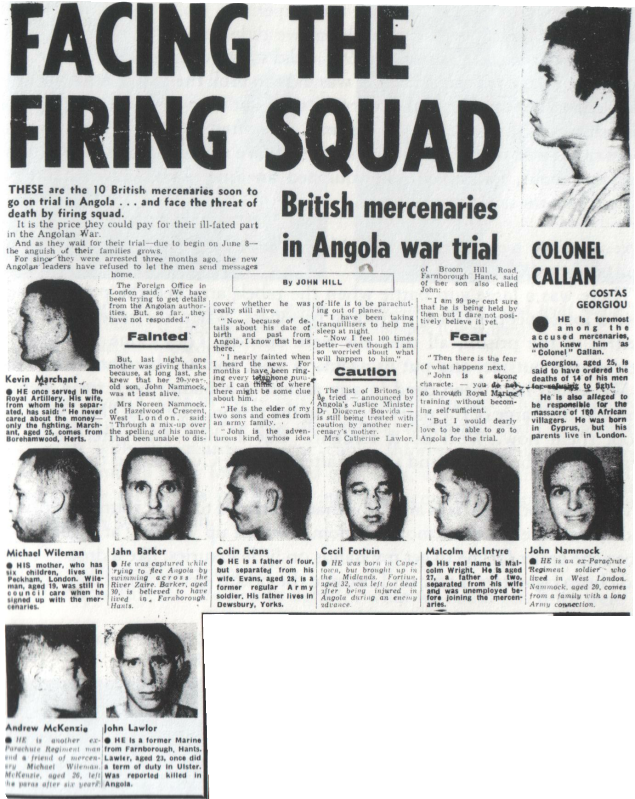
On this date in 1976, three Britons and one American were shot in Angola by a military police squad for murders committed as mercenaries earlier during the year.
Costas Georgiou.
They were among 13 foreigners sentenced at the Luanda Trial, which occurred on the pivot of Angola’s transition from generation-long anti-colonial insurrection on towards generation(s)-long civil war. Between them, more than half a million Angolans died, but this date belonged to a couple of unrepresentative Anglos.
Long story short, the immediate aftermath of Angolan independence in late 1975 was a scramble for control among the several factions who had been fighting the Portuguese … along with a scramble among interested outside states to line up their allies in this resource-rich Cold War prize.
Thirteen foreign mercenaries who were captured by MPLA-supporting Cuban troops — the other nine drew long prison sentences — were charged in a show trial with war crimes for their conduct in the field in a case that made the western gun-for-hire an emblem of colonial depravity.
The most notorious of the bunch was Costas Georgiou. A Greek Cypriot emigre to Britain, he had gone to Angola as “Colonel Callan” and was wanted by Scotland Yard for there ordering a mass execution of other British mercenaries — an act he admitted at trial. Even the inevitable London Times editorial against the trial (June 29, 1976) agreed “the proceedings against Callan, if not the rigours of the sentence may be conceded.”
The others looked much less culpable, almost arbitrarily selected for death from among the ranks of unprepossessing, sometimes barely-there mercs. American Daniel Gearhart, a Vietnam veteran drowning in debt, had apparently been in the field for a mere three days and never so much as fired a shot; that he had advertised in Soldier of Fortune magazine was held to aggravate the charges against him, and in vain did the father of four insist that being tried for his life was enough to scare him straight out of the business.
Angolan defense attorneys, while also appealing against the legality of the trial on grounds of both international and domestic law, spoke that revolutionary language of decolonization in defending their charges. Georgiou, according to Maria Teresinha Lopes, was
“a colonized man … [treated in England as] a sub-human, just a Greek, just a ‘boy’.”
Another Angolan defense attorney argued against the death penalty because
“To condemn them to death while ignoring their social origin in terms of revolutionary justice would deny the theory which guided our revolution. My clients are an integral part of the exploited class.” (Both comments from London Times, June 19, 1976)
The era of decolonization was a time for idealism, but not the sort that would shrink from bloodshed.
In denying the doomed men clemency, Angola’s first independent president Agostinho Neto denounced
Mercenarism, instrument of the aggressive designs of imperialism … a scourge of the African continent and a grave threat to the peace, freedom and independence of the peoples …
It is imperative that the practice of mercenarism be banished once and for all from our planet. It is urgent that all states and peace-loving forces fight it most energetically.
We are applying justice in Angola not only in the name of our martyred people but also for the good of the brother peoples of Namibia, Zimbabwe and all the peoples of the world against whom imperialism is already getting ready to prepare new mercenary aggressions.
(Text dated July 9, and reprinted in the July 10 London Times)
You could just about substitute the word “terrorism” for “mercenarism” and read it on today’s campaign trail.
Juridically, Angola pursued these warriors as peoples who had fought unlawfully and could therefore be placed outside the protections conferred on soldiers by the Geneva Conventions — and subjected to the liberating power of revolutionary violence.
That this ad hoc concept of “mercenarism” could be exploited to license an outrage upon humanity was a notion relentlessly denounced by British and American officials,* who had not yet fully explored the utility of the “unlawful combatant” construct in extending the reach of their own security states.
As for all that peace-loving, brother-peoples stuff in the execution order?
What actually happened after the mercenaries were shot was that the two biggest former anti-colonial guerrilla movements in Angola morphed into Cold War proxies — the MPLA of the Warsaw Pact, supported by its control of the country’s oil; UNITA of NATO, supported by its control of the country’s diamonds — and bled the country dry in a horrific civil war.
* Henry Kissinger, then President Gerald Ford’s Secretary of State, complained that Angola’s decision
to ignore both the law and the facts … cannot help but affect adversely the development of relations between the United States and Angola.
By the end of Longshanks’ life, the old king was so irate at their relationship (the prince had had the temerity to request a title and castles for Gaveston) that Gaveston was booted out of the country.
(But at least he wasn’t defenestrated, the fate of the fictional Gaveston stand-in “Phillip” in Braveheart.)
Ah, the gay-baiting.
The younger Edward immediately recalled his friend when death came for Longshanks, and Gaveston was resented both by English peers and the young Queen Isabella for the favor the new king held him in.
The purported homosexual relationship between Edward II and Piers Gaveston is commonly believed* though ultimately speculative, reading between the lines of chroniclers who are sometimes bitterly hostile towards these two. “The King loved an evil male sorcerer more than he did his wife,” for instance, is a bit of propaganda — we obviously don’t believe the “sorcery” bit — and even that’s not completely explicit.
There’s a strong circumstantial interpretation to made, but since the particulars of Edward’s behavior with his favorite behind drawn tapestries are permanently unavailable to us, it will suffice us to say that this interpretation has conditioned the “Piers Gaveston” who comes to us in later centuries as a widely-credited cultural artifact.
Whether as calumny or commendation, homosexuality is the first thing everyone “knows” about Piers Gaveston, the emblem of his life and the doomed reign of his sovereign. We meet him from the other side of Stonewall, even when we meet him in Renaissance poetry or Renaissance drama.
The historical, flesh-and-blood Piers — and there’s a very thorough biography of him here** — was certainly defined by more than gay identity, real or imputed.
The personal resentment he inspired in the likes of Lancaster and Beauchamp was political, mapped onto the timeless power struggle between nobles and crown, and within the nobility itself.
The king trusted Gaveston, who was himself just the son of a knight, with plum royal assignments like governing Ireland, and Gaveston executed them effectively; with an immoderate confidence in his own considerable talents, the favorite was not above tweaking his rivals with derisive nicknames.
The Lancaster faction progressively got the upper hand on Edward and Gaveston, and with civil war brewing, they captured the hated Gascon at Scarborough Castle while Edward scrambled unavailingly to raise an army of his own.
He was held privately for nine days before Lancaster — “a sulky, quarrelsome, and vindictive man … quick to resort to violence,” by Alison Weir’s reckoning — decided he had to go. Gaveston was beheaded without color of law at Blacklow Hill near Warwick. A monument to his memory still stands there today.
Thou executioner of foule bloodie rage,
To act the will of lame decrepit age.
The grief-stricken monarch would serve his revenge upon the Earl of Lancaster ten years’ cold, beheading him for treason in 1322 upon the verdict of the man who had by then slid into Gaveston’s place in the king’s favor, Hugh Despenser.
On this date in 193, Didius Julianus lost the rulership of Rome for which he had paid so dearly.
And his life.
Julianus‘s path to these doleful pages begins with the assassination of the notorious Emperor Commodus at the end of 192.
That man’s successor, Pertinax, was a notable bust with the Praetorian Guard, the elite imperial bodyguard whose status as the only military unit in Rome made it potential — and here, actual — kingmakers.
The Praetorians expected the payoff that had become customary for new executives, and when Pertinax proved less than liberal on that particular budget item, they turned right around and overthrew him.
To see that there would be no mistake the next time around, the Praetorians dispensed with the pretense and brazenly auctioned the purple.
Roman aristocrat and historian Cassius Dio was a witness to this hot mess.
Didius Julianus, at once an insatiate money-getter and a wanton spendthrift, who was always eager for revolution and hence had been exiled by Commodus to his native city of Mediolanum, now, when he heard of the death of Pertinax, hastily made his way to the camp, and, standing at the gates of the enclosure, made bids to the soldiers for the rule over the Romans. Then ensued a most disgraceful business and one unworthy of Rome. For, just as if it had been in some market or auction-room, both the City and its entire empire were auctioned off. The sellers were the ones who had slain their emperor, and the would-be buyers were Sulpicianus and Julianus, who vied to outbid each other, one from the inside, the other from the outside. They gradually raised their bids up to twenty thousand sesterces per soldier. Some of the soldiers would carry word to Julianus, “Sulpicianus offers so much; how much more do you make it?” And to Sulpicianus in turn, “Julianus promises so much; how much do you raise him?” Sulpicianus would have won the day, being inside and being prefect of the city and also the first to name the figure twenty thousand, had not Julianus raised his bid no longer by a small amount but by five thousand at one time, both shouting it in a loud voice and also indicating the amount with his fingers. So the soldiers, captivated by this excessive bid and at the same time fearing that Sulpicianus might avenge Pertinax (an idea that Julianus put into their heads), received Julianus inside and declared him emperor.
The ignoble achievement is the only thing Didius Julianus is now remembered for.
While Julianus and the Praetorian guard were conducting their damnable business in the capital, three Roman generals in the provinces claimed the throne for themselves.
For centuries the Roman legions had been scattered beyond the Italian peninsula as a hedge against military coups. But after decades of relative stability at the top,* Rome was about to get a bracing reminder of what civil war looked like.
Praetorians — a few cohorts worth of men not in fighting trim — were fine for bullying Senators, but in an outright civil war, they were no match for the legions. The Praetorian Guard’s power to arbitrate the succession was contingent upon the beneficiary’s capacity to cement his own legitimacy by commanding the loyalty of (most of) the state apparatus.
And it turned out that buying the sceptre on spqrBay was not the way to get folks to bend their knees to it.
Septimius Severus, the imperial claimant nearest to the capital, commenced a relentless and virtually unresisted march on Rome, co-opting the troop garrisons and towns as he swept down the peninsula and spurning Julianus’s desperate diplomatic entreaties.
Cassius Dio’s record of Julianus scrambling to defend Rome against Severus is full of black humor.
Julianus … caused the senate to declare Severus a public enemy, and proceeded to prepare against him. In the suburbs he constructed a rampart, provided with gates, so that he might take up a position out there and fight from that base. The city during these days became nothing more nor less than a camp, in the enemy’s country, as it were. Great was the turmoil on the part of the various forces that were encamped and drilling, — men, horses, and elephants, — and great, also, was the fear inspired in the rest of the population by the armed troops, because the latter hated them. Yet at times we would be overcome by laughter; for the Praetorians did nothing worthy of their name and of their promise, for they had learned to live delicately;** the sailors summoned from the fleet stationed at Misenum did not even know how to drill; and the elephants found their towers burdensome and would not even carry their drivers any longer, but threw them off, too. But what caused us the greatest amusement was his fortifying of the palace with latticed gates and strong doors. For, inasmuch as it seemed probable that the soldiers would never have slain Pertinax so easily if the doors had been securely locked, Julianus believed that in case of defeat he would be able to shut himself up there and survive.
In the end, Severus took Rome without striking a blow: the Praetorians switched sides again, and the Eternal City delivered itself from the one usurper to the other. Cassius Dio, again, in media res
the soldiers, convinced by letters of Severus that if they surrendered the slayers of Pertinax and themselves kept the peace they would suffer no harm, arrested the men who had killed Pertinax … We [the Senate] thereupon sentenced Julianus to death, named Severus emperor, and bestowed divine honours on Pertinax. And so it came about that Julianus was slain as he was reclining in the palace itself; his only words were, “But what evil have I done? Whom have I killed?” He had lived sixty years, four months, and the same number of days, out of which he had reigned sixty-six days.
(Actually, Julianus had killed someone: foreseeing that the Praetorians were liable to turn coat yet again, Julianus had the Praetorian prefect who sold him this lemon of an empire put to death for trying to cut a deal with Severus. Despite this negative feedback, the transaction took place on a strict no-refunds, no-exchanges basis.)
A harsh deal for Didius Julianus was a pretty good one for the Roman Empire. Septimius Severus cleaned up his other rival claimants, and ran the empire capably for the next generation.
Kick back with this review of the the dreadful interlude of Didius Julianus with episodes 98 and 99 of the enjoyable History of Rome podcast.
* “The period in the history of the world during which the condition of the human race was most happy and prosperous,” in the judgment of Edward Gibbon.
On this date in 1834, one day after overrunning the Alava village of Gamarra, Carlist General Tomás de Zumalacárregui had 118 of its defenders shot.
Zumalacárregui was the outstanding Carlist (read: conservative, absolute-monarchist) officer of the day. (Here‘s a public-domain memoir of his campaigns.)
We meet him on the march in 1834, adroitly reversing the grim royalist position in the First Carlist War — a liberal-vs.-conservative civil war that also mapped onto ethnicity, geography, and royal succession.
On this occasion, he overwhelmed a contingent of liberals and Basques fighting for the child-queen Isabella II. The survivors were taken prisoner and (despite objections from some of Zumalacárregui’s underlings) given a fusillade the next day in the neighboring town of Heredia.
Día 17. Permanecimos en Heredia donde se fusilaron 118 peseteros. (“Day 17: We remained in Heredia, where we shot 118 Chapelgorris.”)
The Fusilamientos de Heredia — still notorious to this day — were distinguished by their number, but they were hardly unique. Both sides in the civil war unapologetically carried out summary executions of prisoners they had no resources to detain and did not care to turn loose. (And in the more everyday interests of sowing terror, or avenging the last time the other guys sowed terror.)
An English peer eventually brokered the Lord Eliot Convention, an arrangement by which both Carlists and Cristinos agreed to stop slaughtering prisoners and exchange them so that they could properly slaughter one another on the battlefield instead.
On this date in 1865, Confederate John Yates Beall was hanged at Governors Island, New York, as a spy and saboteur.
This Virginian was knocked out of regular service through injuries early in the Civil War, but proceeded to a privateering career harassing Union shipping.
The pinpricks inflicted by Beall’s couple of ships was hardly calamitous for the North, but what he lacked in resources he made up in persistence.
Captured and exchanged midway through the war, he returned to his swashbuckling ways. But sneaking into New York from Canada in a bid to free rebel prisoners, Beall was caught again trying to derail trains — and secretly condemned by a military tribunal.
When the news of his impending execution got out, six Senators and 85 other members of Congress* appealed for leniency.
“For days before the execution,” it was said, “the President closed the doors of the executive palace against all suppliants, male or female, and his ears against all appeals, whether with the tongue of men or angels in behalf of the unfortunate prisoner. From the first Mr. Lincoln had responded to all applications for his interposition — ‘Gen. Dix may dispose of the case as he pleases — I will not interfere.’ Gen. Dix on his part replied, ‘All now rests with the President — as far as my action rests there is not a gleam of hope.’ Thus they stood as the pillars of the gallows, on which Beall’s fate was suspended and between them he died.” (Source)
Here’s the capture-trial-and-execution portions of a homemade documentary on Beall (also check the preceding parts 1, 2, and 3)
February 12 is the anniversary of Lady Jane Grey‘s beheading at the Tower of London. The Protestant teenager was the designated successor of sickly boy-king Edward VI, but popular and aristocratic support went for Mary Tudor in a landslide.
The Nine Days’ Queen landed in the Tower and copped to a treason charge on a tenuous deal for mercy (not applicable to her sponsors and allies, many of whom went to the block). But a January 1554 Protestant rebellion that had Protestant restoration as part of its programme made it a dangerous indulgence for Mary to keep her cousin’s neck attached to its shoulders.
On this auspicious anniversary, Executed Today is pleased to welcome Jane Grey expert J. Stephan Edwards, Ph.D. Dr. Edwards runs the Some Grey Matter site, and is working on a forthcoming book about our day’s famous beheadee.
ET: The conventional wisdom on Jane Grey is that she was basically destroyed by the machinations of the men around her. Is that a misapprehension? Was she more involved in events than she’s given credit for? Can one take seriously the notion that she didn’t want to be queen?
JSE: Having spent almost ten years researching the life of Lady Jane Grey Dudley and her very brief reign as Queen of England in July 1553, I am confident that she was not directly involved in the plans to make her Edward VI’s successor to the throne. At the same time, however, I am completely convinced that she was well aware of those plans at least six weeks before she actually became queen. And it is beyond question that she knew of the plan at least a week before her accession. Thus the standard mythology that portrays Jane as utterly unaware and totally innocent until the last possible second is just that … a myth.
I am similarly convinced that Jane accepted the crown after offering little more than perfunctory resistance. The crown offered a degree of personal independence that would otherwise have been unavailable to her. It also offered power. Despite Victorian-era storytelling to the contrary, Jane Grey Dudley was very much a product of her own age, and that was an age of widespread personal ambition, of duty to both family and God to advance one’s self and one’s family. It would have been a deep betrayal of her family and of social norms actually to refuse such an exalted position.
In the act of accepting, she is recorded to have asked God for some sign that she should refuse, paused for a moment, and receiving no such sign, she accepted. Further, Jane was apparently an adherent to the Calvinist doctrine of predestination, the idea that all things, including our daily lives, are preordained and known to God, and as humans we are powerless to alter God’s plan. Having prayed to God for a sign that she should refuse the crown and receiving none was no doubt to her an indication that her God’s preordained plan was for her to be Queen of England. She therefore accepted without offering further resistance of any kind.
Further, there is ample evidence to show that Jane fully embraced her new status. She signed dozens, perhaps hundreds, of documents with her own hand rather than relying on a privy secretary to sign in her stead (common practice in the reigns of Henry VIII and Edward VI before her). This indicates active and positive involvement in affairs. And on more than one occasion, she countermanded the orders of her council, imposing her own will upon them, again evidence of an intent to rule.
Was she “destroyed by the machinations of the men around her”? I think perhaps there is a better way to phrase it. Jane Grey Dudley lived in an era when women were second class citizens with few legal rights and virtually barred from public affairs. Yet the circumstances of July 1553 mandated that a woman must assume the throne, however much that contradicted 400 years of established English practice. If anything, Jane Grey Dudley was a pawn in a political chess game in which the players, all male, searched desperately for a male king, yet all they had at hand were potential queens. The male players at the chess board were simply struggling with the pieces they had available and trying to make the best of an unfamiliar and even frightening situation. They failed, and Queen Jane was one of the unfortunate pieces swept from the board.
Jane is obviously a romantic figure — small r, big R — in part because she didn’t ever have the chance to start doing the un-romantic things that rulers have to do. How has her image changed over the years? What about her would most surprise people today?
Actually, Jane did “do some of the unromantic things that rulers have to do.” She sat in daily on meetings of the Privy Council. She helped to plan military maneuvers against her cousin, the future Queen Mary … maneuvers intended to bring about the latter’s death. She sent thousands of men off to die in battle. The nine short days of the reign of Queen Jane were packed with unromantic and burdensome activity unfamiliar to a woman of not quite eighteen years of age.
If anything, the years have served to erase much of that non-romantic material and replaced it with the image of an obedient girl-child secluded in study or prayer, uninvolved in the affairs of the world. Indeed, one biographer writing in the 19th century referred to her existence as one of “splendid isolation.”
Yet she was anything but isolated. The historical evidence makes it clear that she was socially active, participating in many of the public celebrations held by her kingly cousin’s court. She traveled a great deal, visiting with relatives and friends of the family scattered across the entire realm. And she had a love of music that was intense enough to give her tutor concern that she was becoming too distracted from her intellectual studies. The picture that has emerged from my own research is of a girl who was quite “normal” for those of her social and economic status in that era, with the possible exception of a gift for languages.
Had Jane, in fact, ruled, how different might events in England been? (and elsewhere, since this was also a key period of imperial competition?)
I am not myself a huge fan of “counterfactual history,” of speculating about “what might have been.” But since a lot of people do ask this question, I will say this: Had Jane remained queen, and had Mary remained on the political periphery (or been executed), it seems to me that the British Isles would be a very different place today. Just in basic political terms, Elizabeth also would likely not have become queen, so the great Elizabethan “Golden Age” would never have happened. Also, Jane would likely have had children, so there would not have been any need to reach outside the realm in 1603 to find an heir. James VI of Scotland would never have become James I of England, and Scotland may have remained forever a separate kingdom and nation. Without a King James of England, there would not have been a Charles I of England, and thus perhaps no religious civil wars in the mid 17th century. Carried still further, James II would never have become king, and no Act of Settlement would have been necessary. The Hanoverians would never have succeeded to the English throne … no George III and perhaps no American revolution. Certainly no Queen Victoria. And the current queen would instead be a German housewife.
All of this would likely have left England as a relatively small nation. It probably would never have become “Great Britain,” either geo-politically or symbolically. It might well have remained a minor actor on the international political stage. The great “British Empire” and the modern Commonwealth might never have existed.
Religiously, England might also have been very different. The more radical strain of evangelical reformism (later called “Puritanism”) espoused by Edward VI and Jane may well have prevailed. The moderate Elizabethan religious settlement of the 1560s likely would not have happened. Thus the Church of England might have looked today more like a Presbyterian or Lutheran church, both doctrinally and physically. Anglicanism today would have been based on simple preaching, with most ritual and liturgy pared down to a bare minimum. No vestments, no decorated churches, and perhaps no bishops and archbishops. All of that would, in turn, have had a huge impact on English culture, art, literature, etc.
In short, had Jane reigned long, the world would be a very different place today, in ways that we probably cannot even begin to imagine.
How did Jane herself change over the course of her experiences in proximity to power, and then as the queen, and then in the Tower?
This is a very difficult question to answer, if not an impossible one, because we have so very little evidence about Jane herself, her character, and her personality. We know next to nothing of her innermost thoughts and attitudes during this period, especially the period during her imprisonment in the Tower. The one thing that we can perhaps say is that religion became Jane’s chief comfort during the last six months of her life, and she clung to her faith with tenacity. The evidence suggests that she was accepting of her death in the belief that she was serving her God and her faith. In fact, she seems to have carried out the activities of her last days with great care and deliberateness so as to leave a carefully constructed final impression on others. She wrote a judiciously worded letter to her sister and penned a brief note to her father, almost certainly conscious that both would be published after her death. She engaged in a semi-public theological debate with Queen Mary’s own Roman Catholic chaplain and hand signed a transcript of that debate in order to authenticate her words. And lastly, she delivered an ambiguously worded speech from the execution scaffold that declared herself simultaneously innocent and guilty. Jane was a relatively unknown private figure when she became queen, and a very public one by the time she died, well aware that she would soon be known across Europe. That transformation from private to public figure must surely have changed her profoundly, in ways we can only guess.
As a researcher, how do you deal with the sketchy documentary trail on Lady Jane?
Historians and researchers deal every day with people and groups of people for whom few written records or other evidence exists. To compensate, many modern historians take pieces of evidence from here and bits of data from there and compile them, then use that compilation to construct snapshots of groups rather than of individuals. For example, we can reconstruct from written records the amount of charity that was dispensed in certain specific regions (e.g., a single parish in London). From that amount, we can gain some idea of how extensive poverty may have been in that region. And from the list of names and ages of those to whom charity was dispensed, we can deduce what percentage of the poor were male or female, young or old … even if we know nothing more than their names and ages.
With Jane, I have reversed the process. Historians have done a great deal of work to describe aristocratic young women in England in the sixteenth century … their education, their religious beliefs and practices, their domestic lives, etc. If that group composite picture is valid, we should also be able to say that if a certain person is a member of that group of young female aristocrats, she is likely to have had similar characteristics. Thus I have proposed that in the absence of any written evidence to the contrary, Jane was probably very much like her social and economic peers in many ways. She was different only in those ways for which we have clear evidence, such as her proficiency in as many as five to seven languages.
How was her execution carried out? Was it typical for its time, place, and circumstances?
Dying was an active process in the Tudor era. It was something a person did, not something that happened to a person. Those facing death were expected to carry out certain predetermined actions and to behave in certain specific ways as demonstrations that they were destined to go to heaven. Dying was to be done with dignity, with a measure of planning (if the death was anticipated far enough in advance), and with particular tasks to be performed by the dying before they took their leave of the earthly world and moved on to the spiritual world. A large body of literature and advice books on how to die, or “the art of dying” (ars moriendi in Latin), emerged during the period. Jane Grey Dudley played her part so well that she was held up as an example to all in later years of “how to die well.”
The condemned were always afforded the opportunity to prepare themselves spiritually, with the method of preparation dependent upon the form of religion then in place. Jane was executed after Roman Catholicism had been re-instituted in England, so she was given the opportunity to confess to a Catholic priest, to be absolved, and to take final communion. Holding firm to her Protestant beliefs that confession was a private matter between penitent and God alone and not necessitating a priest’s hearing, that absolution was given only by God and not mediated by priests, and that the Roman Catholic Mass was erroneous, she instead engaged in a public theological debate with John de Feckenham. During this debate, Jane professed her faith to a sizable audience, outlining its central tenets, an action that itself served as a kind of “Protestant confession” without directly involving a priest in the process.
She then wrote letters to her sister and father bidding them farewell and offering spiritual counsel to them as well. She probably wrote letters to others, especially her mother, but they have not survived. Taking leave of the world and offering consolation to those to be left behind was part of the ars moriendi. Jane’s letter to her sister, in particular, was reproduced repeatedly over the next century as a near-perfect example of how to bid farewell to loved ones. [Available here, the last of several Jane Grey letters reproduced in this public-domain book.]
On the morning of the execution, she would have dressed appropriately in a simple gown of somber color, usually gray or black (certainly not the angelically virginal white depicted in Paul Delaroche’s famous histrionic painting of her execution). Many carried some type of religious text with them to the place of execution, often a Missal or Book of Hours (for Catholics) or a New Testament or copies of the Four Gospels (for Protestants). Jane carried a book of prayers copied from the works of St Jerome, St Ambrose, and St Austin, each a father of the early Christian church of the fourth century (Tudor-era Protestants recognized the value of the writings of these men though they denied their status as saints and intercessors in heaven). That morning, she carefully inscribed the book to her jailer in preparation for presenting it to him in her last moments. Small gifts to jailers, and even to executioners, were considered signs of humility and Christian forgiveness.
Jane was to be executed within the relatively private walls of the Tower of London rather than in the full glare of the crowds outside the walls on Tower Hill. Executions were large public spectacles that often drew huge audiences, so a private execution was considered a great favor to the condemned.
There was no permanent execution scaffold within the Tower. Scaffolds were built specifically for each execution, then immediately dismantled. The eye-witness accounts indicate that the scaffold for Jane’s execution was built against the wall of the central White Tower, at its northwest corner … the corner closest to the Chapel of St Peter-ad-Vincula. Since Jane was housed in the upper storey of the Gentleman Gaoler’s (Jailer’s) quarters, which still stands today, she would have seen the scaffold being built just a few yards across Tower Green. She would also have had a very short walk from her quarters to the scaffold, though she would have been in full view of the many permanent residents, workers, and official visitors within the Tower that busy Monday morning. She is said by eyewitnesses to have made the walk with great dignity and without any outward signs of distress.
Jane was accompanied to the scaffold by at least two of her ladies-in-waiting and by John de Feckenham, her debate opponent of the previous days. Feckenham served two purposes. Firstly, he was available should Jane wish to convert to Roman Catholicism in her final moments, and to offer whatever spiritual comfort he could should she chose not to convert. No Protestant preacher or pastor was allowed. Secondly, Feckenham served as the personal representative of Queen Mary, ready to witness the proceedings and to recount them to his mistress.
Upon reaching the scaffold, Jane, like all those condemned to die, was allowed to make a final speech. Such speeches were customarily written and memorized in advance with great care, as it was common practice for the witnesses present to write down the dying person’s last words. Scaffold speeches were often published within days of the execution and circulated widely, sometimes as political propaganda, sometimes as educational tools or warnings to others, and sometimes simply as “news of the day.” Jane would have been well aware of this practice, and her final speech, as it was published barely more than a month later, reflects a careful choice of words. She stated that she was guilty of having broken the law by accepting the crown, but that she was innocent of having sought it. She acknowledged the justice of her execution, as all condemned were expected to do. Protestations of innocence at the moment of execution were paradoxically considered signs of guilt, of lack of humility, and transgressions of God’s will.
Jane also asked those in the small audience to pray for her soul “while yet I live.” Her choice of words reflected her disagreement with the Catholic practice of saying masses for the dead. She then kneeled and asked the audience to recite along with her as she spoke the words of Psalm 51, the Miserere, which begins, “Have mercy upon me, O God.”
Those of noble or royal status who were convicted of treason were often beheaded, whereas men of lower birth were hung, drawn and quartered and women of lower birth were often burned at the stake (considered more “humane” for the “weaker sex” than hanging, drawing and quartering). The monarch’s consent was required for beheading, but it was seldom withheld. Thus Mary consented to Jane being executed by beheading with an axe. Therefore, following her recitation of Psalm 51, Jane stood again to make final preparations to meet the axe. She handed her gloves and handkerchief to one of her ladies, and gave her small prayer-book to Thomas Bridges, the brother of the Lieutenant of the Tower. The prayerbook has survived and is sometimes displayed as part of the permanent “Treasures of the Library” exhibition at the British Library in London.
After her attendants assisted her to loosen the neck of her gown, the executioner knelt in the customary request for forgiveness from the condemned. The executioner then asked her to stand upon the straw spread around the block to soak up the blood. As she began to kneel, she asked the executioner whether he would take her by surprise and strike before she was ready. Assured that he would not, she tied a cloth around her head to block her eyesight. Then, in one of the most poignant of scenes, she felt blindly for the block, and not finding it because of the cloth over her eyes, she asked, “What shall I do? Where is it?” It was against custom to assist the condemned to find the block, lest the person offering aid be accused of having an unjust part in a death. However, someone -– usually reported as Feckenham –- apparently did reach down and guide her hands to the block. (This instant is the scene depicted in Delaroche’s near-life-sized painting, though most of the details of that painting are quite inaccurate.)
Detail view of Hippolyte (Paul) Delaroche’s The Execution of Lady Jane Grey. (Click for full-size image.)
According to the gallery’s advance publicity, “For the first time, Painting History examines this iconic masterpiece in the context of Delaroche’s great historical paintings, particularly the poignant scenes from English history which made his reputation. The exhibition features seven major international loans of paintings by Delaroche including The Princes in the Tower, 1830 and Young Christian Martyr, 1854–5 (both Louvre) and Strafford on his way to Execution, 1835 (private collection). Displayed alongside are Delaroche’s expressive preparatory drawings for Lady Jane and a selection of comparative paintings and prints by his contemporaries, including Eugène Lami, Claude Jacquand and François-Marius Granet.”
The guy sure had a thingforexecutions. If this blog had a patron artist, it would be Paul Delaroche.
Finally finding the block, she laid her neck upon it and repeated Jesus’s words on the cross, “Lord, into thy hands I commend my spirit.” At those words, the executioner swung his axe and she was dead.
There is a previously unchallenged tradition that Lady Jane Grey Dudley was buried in the Chapel of St Peter-ad-Vincula (St Peter-in-Chains) within the Tower, supposedly beneath the floor just in front of the left-hand side of the altar. A plaque to that effect was placed there in the 1870s, and the modern tour guides of the Tower usually regale tourists with heavily embellished stories of the events.
My own research, however, suggests that Jane may have been buried outside the Tower. Several circumstances of the day support my conclusion. First, the chapel had been restored to service in the Roman Catholic faith by mid-February 1554. The Roman Catholic Church explicitly prohibits the burial of heretics in consecrated ground, and Jane was considered a heretic by that Church. Additionally, there is a contemporary account that tells of the bodies of Jane and her husband Guildford, who was executed the same day on Tower Hill, lying in a cart outside the chapel for several hours. The reason for the delay is given as a need to seek special permission to bury them within. None of the eyewitness accounts of the day go on to speak of the burial itself. Whether this is because none of those eyewitnesses saw the burial take place or because it was considered by them to be not worth the mentioning is unclear. However, Jane’s father Henry Grey was executed on Tower Hill two weeks later for his part in a rebellion in late January 1554, and he is reported to have been buried in the Church of Holy Trinity Minories just yards from Tower Hill. That church was a former abbey of the Order of St Clare that had been closed by Henry VIII during the Dissolution of the 1530s. Henry Grey had purchased the former abbey, together with its church, from the crown in the 1540s. During renovation work in 1851, a workman discovered a carefully preserved severed head that was later identified as the head of Henry Grey. It therefore seems probable that Henry Grey was indeed buried inside Holy Trinity Minories, one of his own properties conveniently nearest the place of his execution. It is equally possible that his daughter Jane Grey Dudley and his son-in-law Guildford Dudley were buried at Holy Trinity just days before Henry.
Holy Trinity was closed as a place of worship in 1899 and merged with the nearby Church of St Botolph’s-without-Aldgate. Henry Grey’s preserved head is now kept in a secret location somewhere on the grounds of St Botolph’s, but the remains of the Church of Holy Trinity Minories were destroyed during the London Blitz of 1940. All that remains is a small public garden in Tower Hill Terrace over the road from the north outer curtain wall of the Tower, a mere 150 yards from the site of Jane’s execution.
The executions that several of the 21st century world’s more aggressive death penalty users coincidentally carried out a year ago today testify together to the enduring place (and variegated guises) of the headsman in modernity.
China
Three prisoners were reported killed in Jinan in China on Jan. 15, 2009.
Two were men who had been serving prison terms for separate crimes when they incurred a death sentence for a violent (though seemingly non-lethal) escape attempt.
Liu Junjie, 35, and Wang Bing, 31, broke out of the prison in Zibo City on December 8, 2007 as a truck was moving out of the prison gate, according to a statement from the Shandong Provincial High People’s Court.
They hit a prison worker and two policemen with iron bars and choppers as they forced their way out. They were later caught as they fled along a road.
Former cabbie Bo Lijun shared that fate for a series of thefts, rapes, and murders.
According to the court, Bo raped and suffocated a female barber on Oct. 23, 2002 in Dongying.
Bo attempted to rape a female passenger in a wooded area near Dongying on July 29, 2006. Although he abandoned the rape attempt, he clubbed her to death for fear she would inform the police, and he buried the body at the site.
Saudi Arabia
One Mushabeb Al-Ahmari was beheaded in the province of Asir for “killing a compatriot with a machine gun” (who he killed and why was not reported).
Al-Ahmari was a minor when he was sentenced. The statement said his execution was delayed until he came of age.
United States
62-year-old James Callahan suffered lethal injection in Alabama Jan. 15, 2009, after 26 years on death row for raping and murdering a Jacksonville State University student in 1982. Callahan
requested a last meal of two corn dogs, french fries and a Coke … spent the day visiting with family and spiritual supporters … receive[d] communion at 4:30 p.m.
Callahan’s will bequeaths to his son $36.42 from his prison account, a black and white Radio Shack TV, two watches, a Walkman, some headphones, a leather belt, two pairs of boots, one pair of Nike tennis shoes, food items and legal papers.
Updated: Somalia
(This incident was not brought to our attention until after the post was already up, but in the peripatetic spirit of the entry, we thought it suitable to append.)
Perhaps the first pol executed by Islamists, Ahmed was once the spokesman for a faction in the Somali civil war. He was put to death for collaborating with the Ethiopians who invaded Somalia at U.S. behest. As the Ethiopians were Christian, this behavior qualified as “apostasy” to the militants’ sharia court.
In January 2009, Ethiopia was in the process of withdrawing its military presence in its war-torn neighbor.
I saw a site today that made me feel mity Bad I saw a man shot for deserting there was twenty fore Guns shot at him thay shot him all to pease … he went home and thay Brote him Back and then he went home again and so they shot him for that Martha it was one site that I did hate to see it But I could not helpe my self I had to do Jest as thay sed for me to doo.
This unknown soldier shot “all to pease” had just run afoul of Gen. Braxton Bragg‘s draconian anti-desertion policy meant to crack down on soldiers going AWOL for casual leave, often to help the families they had left behind keep up the farm.
As Wiley points out, our letter-writer Private Warrick was himself planning to do just that.
Bragg’s little salutary bloodbath evidently had its effect, because he didn’t go AWOL. Wiley quotes Warrick, now in a more Joe Friday mode than when he had promised to “come home Eny how”, writing his parents in 1864,
I would be glad to see you all now but I recon that I have bin home my last time till this war closes.
On this date in 1996, the man who once ruled ruled Afghanistan under the aegis of a superpower succumbed to the tender mercies of his country’s fundamentalist insurgency.
After losing the subsequent civil war, the former President was trapped for a nervous few years in Kabul — blocked from joining his family in flight to India by the offices of former Soviet client and present-day American client Abdul Rashid Dostum.
When Kabul finally surrendered to the Taliban in 1996, the hated onetime Communist viceroy — whose stepping-stone to that post was heading the hated Afghan secret police — had a problem.
At the instigation of future Taliban second-in-command Mohammad Rabbani, Najibullah and his brother were hauled out of the U.N. compound where they had taken refuge, publicly beaten, tortured and castrated, and strung up on a traffic barricade.
All spake of him, but few had seen
Except the maimed ones or the low;
Yet rumor made him every thing–
A farmer–woodman–refugee–
The man who crossed the field but now;
A spell about his life did cling —
Who to the ground shall Mosby bring?
Allegedly raging from the murder by Mosby’s troops of a surrendering northern cavalryman, the blues rounded up six captured Mosby men — actually only five, plus one 17-year-old civilian who had opportunistically joined the fray — and summarily executed them.
David Jones, Lucien Love and Thomas Anderson were shot. So was the aforementioned civilian, Henry Rhodes, under the eyes of his shrieking mother.
Then, two last unfortunates were hanged. William Thomas Overton spurned an offer of clemency in exchange for information on Mosby’s hideouts with the memorable parting, “Mosby will hang 10 of you for every one of us.”
Not quite so … but not an empty threat, either. Weeks later, Mosby would order the retaliatory executions of a like number** of randomly-selected Union prisoners of war, and communicate this intelligence to his foes along with his (successful) suit to resume more gentlemanly methods of killing one another.
* Some sources (including some cited in this post) claim September 22nd. The consensus of authoritative sources appears to be clearly September 23rd. The Gray Ghost himself may be one source of the confusion; according to Custer and the Front Royal Executions, “In his memoirs, which were published over 50 years after the event, Mosby got the date wrong, apparently based upon one of the newspaper accounts … [which] stated that the Front Royal incident occurred on September 22, not September 23, the date upon which it actually did occur.”


 62-year-old James Callahan
  Somali politician