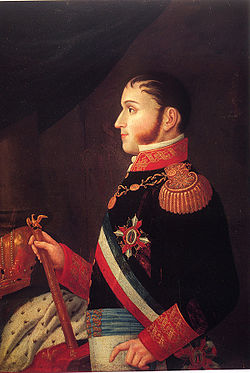
On this date in 1868, Shinsengumi commander Kondo Isami was beheaded at Itabashi as the civil war between the Tokugawa Shogunate and the rising Meiji government that would replace it unfolded.
A commoner raised to samurai, Kondo is famous for commanding the Shinsengumi, a sort of shogunate paramilitary renowned for hunting pro-imperial samurai.
This, of course, was ultimately a nonstarter, notwithstanding the Shinsengumi’s flair for dramatic success.
Kondo had little power to reverse the Tokugawa Shogunate’s deteriorating position even though his skill earned him progressively higher appointments in its service.
In the event, however, our principal lost the Battle of Koshu-Katsunuma, and was captured shortly thereafter.
From there, nature took its course.
He was brought in a cage to Itabashi, near Yedo, where he was beheaded. His head was put in spirits and sent to Kioto, where it was exposed in the dry bed of the Kamogawa near the fourth bridge. This most shameful of all punishments was inflicted upon Kondo Isami because, as chief adviser of his lord, the prince of Aidru, he had made himself especially hateful to the southern clans. (Source)
As a result, Kondo wouldn’t be around to say “I told you so” when the victorious Meiji scrapped their samurai-friendly xenophobia and replaced their former supporters in the warrior caste with a modernized army.
But he and his doomed band of upwardly-mobile swordsmen in romantic service of a historical dead-end are still with us. Shinsengumi adventures and Kondo Isami characters remain a staple of popular culture.
Ethiopia in the mid-1970’s was one of the most interesting places in the world.
After the Derg, a shadowy committee of leftist officers, toppled the monarchy in 1974, factional violence between Ethiopia’s two main Marxist parties soon came to the fore.
It was as dirty as it sounds, “one of the most systematic uses of mass murder by the state ever witnessed in Africa” according to Human Rights Watch. This was the context of Mengistu’s most notorious public appearance, at an Addis Ababa rally later this same month of April 1977 when he theatrically smashed bottles of (apparently) blood while inciting his supporters against “enemies.”
Now that is red terror.
The Derg-MEISON alliance* built up Kebeles, small neighborhood militias — “essentially a matter of arming the lumpenproletariat against members of the urban intelligentsia,” writes Christopher Clapham.
But even these MEISON-allied goon squads were liable to run afoul of revolutionary justice if their indiscriminate mayhem failed to discriminate at the most essential moment.
On two occasions, March and again in May 1977, house-to-house searches were carried out in Addis Ababa, and suspected EPRP members rounded up for execution. Attempts by the EPRP to launch a school strike were likewise countered by the execution of students who failed to attend classes. The press regularly reported the execution of ‘anarchists’ and ‘paid assassins’. Along with the conflict between the rival political factions went the settling of personal scores, and gratuitous killings by psychotics on either side. The most notorious of these, Girma Kebede, was a Meison kebelle chairman in the Arat Kilo area of Addis Ababa, and the well-educated son of a former high official; he overreached himself by taking away for execution a group of ‘reactionaries’ from the Ministry of Education who included Mengistu’s uncle, and was then shot on the charge of seeking ‘to alienate the people from the Government and incite the broad masses against the revolution’.
On this date in 1977, Girma Kebede paid the forfeit. His, er, strategy of killing scores of humans to alienate the people from the government would take many more years and bodies to succeed.
* Later that year, the Derg-MEISON alliance also fell apart, Mengistu cemented his power, and MEISON got the same treatment it had once meted out to its EPRP enemies.
On this date in 2010, six men from war-torn southern Sudan were hanged in Khartoum’s Kober prison for a deadly 2005 riot.
The protracted north-south Sudanese civil war had only just abated with a tenuous peace treaty earlier in 2005, when Sudanese security surrounded the refugee camp-cum-suburb of Soba Aradi outside Khartoum in May 2005 in a sudden bid to forcibly resettle its predominantly southern population.
The resulting riots burned down a police station and claimed around 13 policemen’s lives, along with many civilians.
“We were forced to protest when a police officer shot a seven year old boy three times in the head”, said Mr. Mile Michael, a South Sudanese living in the area since 1986.
Following the death of the young boy, the slum dwellers burnt down the police office in the area killing some of the officers with machetes and knives in a revenge attack. “We all participated in the burning of the police office because they deceived us that they would support us in resisting the soldiers but they were the first to kill our children, so we were willing to sacrifice ourselves for our children.”
While dozens were rounded up, Amnesty International charged that little save forced confessions and unfair trials distinguished the specific few marked out for hanging.
Sudan’s north-south sectional conflict is the backdrop to this month’s election, which might set the south on a path to political independence from the north.
According to a Reuters report, it was on this date last year that an al Shabaab militant was publicly shot in Somalia by a pro-government militia.
Al Shabaab — “the youth” — is an offshoot from the (now-history) Islamist alliance involved in that whole Black Hawk Down unpleasantness.
You might remember them from this summer’s World Cup: they’re the guys who bombed World Cup viewers in Uganda, killing 76. Al Shabaab (allegedly al Qaeda-linked) basically controls southern Somalia with its allies.
“We don’t normally kill al Shabaab members,” explained a spokesman for the Ahlu Sunna Waljama’a paramilitary, in cheerily chilling terms. “We arrest them and make them understand that Islam means peace.”
The unnamed character we notice this date apparently failed to “understand,” and was shot for not renouncing his affiliation.
“This commander insisted that all people were infidels except his group … We will execute al Shabaab members who insist that it can be right to kill the innocent. What else are we supposed to do to those who believe they will go to paradise for killing us and the whole human race?”
The execution nevertheless failed to quell the intractable Somali Civil War.
On this date in 1828, Argentine independence hero Manuel Dorrego was shot in Buenos Aires — a casualty of that country’s unfolding civil war.
Dorrego (English Wikipedia entry | the more detailed Spanish), the youngest son of a Portuguese merchant, became a brilliant soldier of his country with an adventuresome career in the Argentine War of Independence, at one point taking refuge in exile in Baltimore, U.S.
If one likes, that sojourn in a functioning republic firmed up Dorrego’s commitment to federalism — the principle that would animate a decades-long internal conflict over division of power in the newly independent state.
Argentina’s federalists approved a distribution of power to its constituent regions; the opposing unitarians wanted a strong central government in Buenos Aires.
And they did not confine their disputes to pamphlets.
Resistance from the provinces to overweening Buenos Aires and Argentina’s unitarian first president Bernardino Rivadavia helped precipitate that gentleman’s fall from power and the dissolution of the national government.
Dorrego became Governor of Buenos Aires in August 1827, and exercised de facto head of state powers — for instance, he formally accepted the treaty ending hostilities in the Argentina-Brazil War.*
But a rough customer of the unitarian camp, Gen. Juan Lavalle, overthrew Dorrego’s government and mounted a terrifying purge of federales.**
Beginning, of course, with Dorrego himself, who was given one hour’s advance notice of his entirely extrajudicial shooting.
Most of the detailed information available online about this martyr is in Spanish — see here, here, here, and here, for instance.
* The fruit of this treaty was the independent state of Uruguay, as each side gave up trying to take that territory from the other by force.
** Until Lavalle was ousted by the next great unitarian leader, Juan Manuel de Rosas.
Sunday, Nov. 21 in 1920 was “Bloody Sunday” in Ireland, a date begun with the IRA execution of British agents in Dublin, and concluded with three IRA men killed in British custody.
Thirty-one people lost their lives on this 1920 Bloody Sunday, a signal event of the Irish War of Independence; the thirteen of them who were British intelligence officers or assets targeted for an en masse morning liquidation suffices to qualify the affair for these grim pages.
“Executions”, assassinations or otherwise, the killings were ordered by Irish revolutionary Michael Collins in the escalating dirty war between his Irish Republican Army and the Black and Tans dispatched by London to crush the IRA.
My one intention was the destruction of the undesirables who continued to make miserable the lives of ordinary decent citizens. I have proof enough to assure myself of the atrocities which this gang of spies and informers have committed. If I had a second motive it was no more than a feeling such as I would have for a dangerous reptile. By their destruction the very air is made sweeter. For myself, my conscience is clear. There is no crime in detecting in wartime the spy and the informer. They have destroyed without trial. I have paid them back in their own coin.
-Michael Collins, on the executions
There were a couple of hitches in the plan: most particularly, that out of an initial list of 50 targets, Collins had been forced by his own government to trim to 35 … and then his hit teams “only” actually managed to get about a third of them.
And, of course, it drew a British rampage that day, most famously at a football match at Croke Park* concluding when Dirk McKee, Peadar Clancy and Conor Clune were killed that evening in a British police station — “trying to escape.”
But in all, the day was a coup for the Republicans, who crippled British intelligence in Dublin and gave any future recruits grave reason to think twice about the engagement, while reaping a public relations bonanza both domestic and international from the indiscriminate English response against civilians.
Occurring as it did while the fight for Ireland everywhereintensified — and that fight culminating in Ireland’s independence** — 1920’s Bloody Sunday is a sacred day for Irish nationalism.
Just to be clear, however, this is not the Bloody Sunday of U2 “Sunday Bloody Sunday” fame, which was an altogether different bit of carnage in 1972. “Bloody Sunday” actually has a disturbingly populous Wikipedia disambiguation page, with at least four Ireland-related entries and others from Turkey, Canada, South Africa, and points beyond.
* An England-Ireland rugby match in that stadium in 2007 grabbed headlines for its associations this date; you can see the respective anthems played before a respectful Irish crowd here.
On this date in 1865, Henry Wirz was hanged in Washington, D.C. for running a notorious Confederate prison camp.
A Swiss-born doctor (“Henrich” was the real handle) whom time and tide found practicing in Louisiana at the onset of the Civil War, Wirz apparently got into the prison-guarding ranks when a war injury left him unfit for the front lines.
But it was front-line fitness in the northern army that would set the scene for his controversial hanging.
The North’s advantage in men and materiel shaped Union strategy as the war progressed, and it eventually caused the Union to halt prisoner exchanges. Exchanging casualty for casualty was a winning strategy on the battlefield, so why return to your enemy a man for a man? Besides,
[Grant] said that I would agree with him that by the exchange of prisoners we get no men fit to go into our army, and every soldier we gave the Confederates went immediately into theirs, so that the exchange was virtually so much aid to them and none to us.
As designed, then, the South began piling up more and more POWs to maintain with its ever-straitened resources late in the war. And if exchange was out, that really only left one form of “release”.
Andersonville — officially, Camp Sumter, located near the tiny Georgia town of Andersonville — was only established in 1864, but acquired considerable notoriety in northern propaganda for the year and change that Wirz ran it. The prisoners didn’t enjoy it much, either.
Wuld that I was an artist & had the material to paint this camp & all its horors or the tounge of some eloquent Statesman and had the privleage of expresing my mind to our hon. rulers at Washington, I should gloery to describe this hell on earth where it takes 7 of its ocupiants to make a shadow.
–Union prisoner diary, July 1864. Note the prisoner’s anger at Washington — whose refusal to exchange naturally infuriated its stranded POWs
Out of some 45,000 prisoners held at Andersonville during its existence (not all at one time), nearly 13,000 succumbed to disease and malnutrition.* After the war, photos of wasted survivors inflamed (northern) public opinion, already tetchy over Abraham Lincoln’s assassination. Walt Whitman wrote of Andersonville,
There are deeds, crimes that may be forgiven but this is not among them. It steeps its perpetrators in blackest, escapeless, endless damnation.
Damnation is up to higher powers, of course, but the North wanted somebody to answer for Andersonville on this mortal coil. Lincoln’s successor Andrew Johnson overruled mooted charges against Confederate President Jefferson Davis and his Secretary of War James Seddon, leaving — in that great American tradition — Heinrich Wirz holding the bag.**
The trial had an undeniable aspect of victor’s justice.† Even at the gallows, the Union guards chanted, “Wirz, remember Andersonville!” as the condemned man was readied for the noose, and then dropped. The hanging failed to break the man’s neck, and he strangled as the chant continued.
So long as Southern leaders continue to distort history (and rekindle embers in order to make the opportunity for distorting it), so long will there rise up defenders of the truth of history … To deny the horrors of Andersonville is to deny there was a rebellion. Both are historic facts placed beyond the realm of doubt.
But of course, it does not require denying the horrors of Andersonville to notice the circumstances — the privation of the entire South late in the war — and to wonder that Wirz and Wirz alone was held to account. Plenty of people think he got a bum rap.
Pro-Wirz marker in Andersonville, Ga. (Click for easier-on-the-eyes version, reading in part, “Had he been an angel from heaven, he could not have changed the pitiful tale of privation and hunger unless he had possessed the power to repeat the miracle of the loaves and fishes”). (cc) image from Mark D L.
Recommended for general reading: the UMKC Famous Trials page on this case, several of whose pages have been linked in this entry. A number of nineteenth-century texts by (or citing) Andersonville survivors are available from Google books, including:
Since this is a controversy of the Civil War — and one that can be engaged without having to get into that whole slavery thing — there have been thousands of published pages written about it, with many more sure to come in future years.
A few books about Henry Wirz and Andersonville
As an interesting aside, Civil War POW camps including Andersonville (but not only Andersonville) gave us the term “deadline,” which had a more startlingly literal definition in the 1860s — a perimeter beyond which prisoners would be shot on sight, which policy could make a handy stand-in for walls. Gratuitously killing an insane prisoner who crossed Camp Sumter’s “dead line” was one of the atrocities laid to Wirz, who we take it would not have been at home to the word’s decreasingly urgent appropriation in the wider culture.
* Wirz’s defense showed, to no avail, that the prisoners and the guards received the same rations, with similarly deleterious effects among both, and that the commandant was on record pleading with his superiors for more.
** Wirz’s attorney claimed that his man was offered (and refused to take) a last-minute pardon on November 9 in exchange for implicating Jefferson Davis.
† Wirz and borderlands guerrilla Champ Ferguson were the only Confederates executed for their “war crimes”. There was at least one other prison guard who faced similar charges of prisoner maltreatment, John Henry Gee; Gee was acquitted and released in 1866. (For more on the latter, see “A Little-known Case from the American Civil War: The War Crimes Trial of Major General John H. Gee” by Guénaël Mettraux in the Journal of International Criminal Justice, 2010.)
Tiptoft’s calling card says he’s one of England’s first Renaissance men — literally so, because after cutting his teeth at Oxford, he spent several years in Padua, Ferrara, Rome and Florence, brushing up on Latin and law.
Besides culture and erudition, Tiptoft is supposed to have picked up from his Italianate exposure a taste for that fragmented peninsula’s barbarous political jockeying.*
Back in Britain from the start of the 1460s, Worcester aligned with the Yorkists during the War of the Roses, and made liberal use in both England and Ireland of his continental savvy in matters of torture, earning that unflattering sobriquet Butcher.
Tiptoft gave them the material, exercising,” in his constabulary post, “more extreme crueltie (as the fame wet) then princely pity.” For instance, when putting down one revolt,
the Kynge Edwarde came to Southamptone, and commawndede the Erle of Worcetere to sitt and juge suche menne as were taken … and so xx. persones of gentylmen and yomenne were hangede, drawne, and quartered, and hedede; and after that thei hanged uppe by the leggys, and a stake made scharpe at bothe endes, whereof one ende was putt in att bottokys, and the other ende ther heddes were putt uppe one; for whiche the peple of the londe were gretely displesyd; and evere afterwarde the Erle of Worcestre was gretely behatede emonge the peple, for ther dysordinate dethe that he used, contrarye to the lawe of the londe.
Too bad for the gretely behatede Erle of Worcestre that this was an era when anyone‘s uppance could be coming at any time.
This last, well, butchery was effected against supporters of the Earl of Warwick, the “kingmaker” whose fluid alliances shaped the royal jostle in the mid-15th century.
And the trouble for Tiptoft was that Warwick’s 1470 revolt against Tiptoft’s ally and kin Edward IV … worked. Okay, only temporarily, but it was long enough to do in John Tiptoft.
For a brief moment, the Yorkist cause waned and the Lancastrian waxed; during the brief moment, the Butcher of England was haled before the Lancastrian Earl of Oxford, a man who occupied that office because Tiptoft had executed his father and elder brother.
The wheel of fortune had turned. A massive, jeering crowd turned out to see Tiptoft de-topfed. He asked the executioner to do it in three strokes rather than one, in honor of the Trinity.
Prayerful: John Tiptoft’s tomb at Ely Cathedral. (He’s flanked by two of his three wives, one of whom is in the foreground.) Image used with permission.
Tiptoft [wrote Henry Pancoast] was the most learned man among the English nobility of his time … [he] reflects his age at its best and worst. He was set at a confluence of evil influences, when civil strife following the Hundred years War [sic] had debauched the English nobility. Abroad he came close to that Italy which Machiavelli called “the corrupter of the world.” Yet a new intellectual life was growing, and Tiptoft’s career alternates between scholarship and political intrigues. He shows us how early the new spirit was astir in England, and how it was retarded; is is the “butcher” and “the first fruits of the Italian Renaissance.”
You can explore a bit more about John Tiptoft in the first third of this BBC radio 4 program, with author Alison Weir. (Her Tudor books burn up the bestseller lists, but she’s also written about the War of the Roses.) Or, look up the Household of Worcester, a medieval re-enactment society that takes name and inspiration from our day’s butchered butcher.
* This supposed southern influence on our friend the Earl might well be true, but it also strikes this author as an answer in search of a question. It’s hardly necessary to posit foreign influence to explain brutality in 15th century England, nor to explain educated men with a taste for cruelty.
But Tiptoft’s “wanton ferocity,” says Pancoast, “brings to mind the Italian proverb, quoted by Ascham in proof of the brutalizing effect of Italy upon the English nature: Inglese Itilianato e un diabolo incarnato.”
Since oiled stakes up buttocks were no more characteristic of Italian jurisprudence than English, the obvious place one might inquire for an outside influence would be that better-known diabolo incarnato, Vlad the Impaler: stories of Vlad Dracula’s then-contemporary skewerings were even then circulating and magnifying in the 15th century’s fresh new media channel, the printing press.
On this date in 1936, anticlerical leftists in the Spanish Civil War allegedly subjected a monumental statue of Christ to a ritual “execution”.
“This picture, taken by a Paramount News-reel representative and received by air from Madrid yesterday, illustrates an outrage which has no parallel in the photographs published by “The Daily Mail” of the Spanish Reds’ war on religion. It shows a Communist firing squad aiming at the colossal Monument of the Sacred Heart on the Cerro de los Angeles, a hill a few miles south of Madrid which is regarded as the exact centre of Spain.” (Source)
This outstandingly incendiary image made for great recruiting for the Francoist enemies of the “firing squad” and gave credence to a “crusade” lexicology that insured the devout would break overwhelmingly against the Republic. (Nearly 7,000 men and women in religious orders whose deaths during the war are charged to the Republican account also helped.)
Maybe that was inevitable, anyway.
George Orwell, the English leftist who volunteered for the Spanish Republicans, noted in his Homage to Catalonia that
the people in this part of Spain must be genuinely without religious feeling — religious feeling, I mean, in the orthodox sense. It is curious that all the time I was in Spain I never once saw a person cross himself; yet you would think such a movement would become instinctive, revolution or no revolution. Obviously the Spanish Church will come back (as the saying goes, night and the Jesuits always return), but there is no doubt that at the outbreak of the revolution it collapsed and was smashed up to an extent that would be unthinkable even for the moribund C. of E. in like circumstances. To the Spanish people, at any rate in Catalonia and Aragon, the Church was a racket pure and simple. And possibly Christian belief was replaced to some extent by Anarchism, whose influence is widely spread and which undoubtedly has a religious tinge.
Just like its inspiration is reported to have done, this statue survived its “execution” in fine shapewas resurrected by public subscription, and can still be seen at Cerro de los Angeles outside Madrid.
On this date in 1824, the Mexican officer who had made himself emperor was shot at the village of Padilla.
Iturbide‘s military acumen saw him through a meteoric rise in the service of what was then New Spain.
Iturbide rejected an early offer of generalship from the pro-independence leader Hidalgo in favor of spending the 1810s ably quashing the insurgency.
In a bizarre twist of fate, however, it would be Iturbide who would himself cement Mexican independence.
En route to try to finish off the last major rebel leader, Vicente Guerrero, Iturbide caught wind of the recent del Riego liberal revolt back in the mother country,* which had triggered civil war in Spain.
For the conservative royalist general, heir himself to a Basque noble lineage, the potential collapse of Bourbon authority in Spain raised the frightening specter of social upheaval.
All Iturbide’s work killing guerrillas for the sake of public order could come to naught if the Spanish monarchy collapsed or ceased projecting its power overseas … and then who knew what would emerge from the resulting power vacuum in Mexico?
So Iturbide cut a deal with Guerrero to consummate the Mexican War of Independence by separating from Madrid on an essentially conservative basis — a political breakaway without a social revolution. Independent Mexico would make nice with the Spaniards already living there, keep Catholicism as the official state religion, and get itself a constitutional monarchy of its own to insulate itself from the chance outcomes of continental politics across the ocean.
And when Iturbide marched into Mexico City and encountered a crowd conveniently imploring him to take the throne, well, who was he to deny them?
And so Iturbide transitioned smoothly from scourge of the revolution to its man on horseback,** immediately splintering the coalition that lifted him to power.
Contrary to this allegorical take on Iturbide’s coronation, he crowned himself — Bonaparte-like.
Only months after his July 1822 coronation, Iturbide shuttered Congress and began arresting the opposition. Meanwhile, Ferdinand VII had emerged from the Spanish fray as the (momentary) winner, leaving his upstart former subjects without international support.
A general that the freshly-minted emperor had himself had promoted, one Antonio Lopez de Santa Anna — yes, the Alamo guy — declared against Iturbide by the end of 1822, and come the following spring, Agustin I was a European exile, in the paradoxical position of drawing a pension from Mexico while also officially considered a traitor and outlaw.
In Tuscany and then England, Iturbide published an autobiographical justification — Statement of Some of the Principal Events in the Public Life of Agustín de Iturbide — then finally took up a much-asked-for invitation from Mexican conservatives to return and become the savior of his country against internal breakdown and a potential Spanish attack.
Founded on vainglory, this expedition was destined for fiasco; within five days of touching Mexican soil, Iturbide was serenading a firing squad with the last words, “Mexicans! I die with honor, not as a traitor; do not leave this stain on my children and my legacy. I am not a traitor, no.” Apparently they were serious about that injunction never to return.
When in Mexico City, relive happier times for our day’s subject at the Palace of Iturbide where he briefly maintained himself in the purple.
And do think twice about styling yourself Emperor of Mexico, since the only other person to claim that title also ended his reign in front of a firing squad.
* Ironically, it was a body of soldiers assembled for a reconquista of Spain’s independence–minded New World possessions that enabled del Riego to mutiny.
** Iturbide paused in the revolution’s good graces just long enough to design the Mexican flag.


He was brought in a cage to Itabashi, near Yedo, where he was beheaded. His head was put in spirits and sent to Kioto, where it was exposed in the dry bed of the Kamogawa near the fourth bridge. This most shameful of all punishments was inflicted upon Kondo Isami because, as chief adviser of his lord, the prince of Aidru, he had made himself especially hateful to the southern clans. (Source)
 Dorrego (
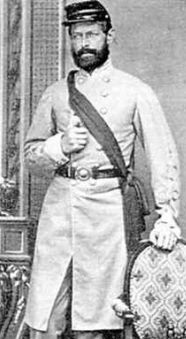 A Swiss-born doctor (“Henrich” was the real handle) whom time and tide found practicing in Louisiana at the onset of the Civil War,


 Tiptoft’s calling card says he’s one of England’s