1945: Robert Brasillach, intellectual traitor

On this date in 1945, and notwithstanding a partial outcry in French literary circles, fascist intellectual and Vichy collaborator Robert Brasillach was shot for treason in Montrouge.

Novelist, journalist and llitterateur Robert Brasillach (English Wikipedia entry | French) was the “James Dean of French fascism,” fashionable apostle of the interwar far-right movement Action Française.

A proper James Dean dies young, which fate was supplied courtesy of Brasillach’s editorship of the anti-semitic rag Je Suis Partout (“I Am Everywhere”) and enthusiastic support of the Vichy government.

Inasmuch as his collaboration had been in the form of ideas propagated, Brasillach’s case engaged the French polity in the challenging question of whether “intellectual crime” — and even “intellectual treason” — could exist categorically.

Given another year, when occupation was not so fresh a memory and the Nazis were no longer knocking at the door, the puzzle would probably not have been a life and death one.

But then, ideas are sometimes life and death matters themselves, and nowhere is that more true than in France.

Many anti-fascist intellectuals appealed to de Gaulle for Brasillach’s life — many, but not all. Death penalty opponent Albert Camus signed the petition for clemency; Jean-Paul Sartre and Simone de Beauvoir refused.

Between fellow-feeling among the literary set, ideological enmity, and the searing experience of the occupation only just lifted lay a test for the conscience of many a French thinker — aphorized by the very words de Gaulle would use in turning aside the appeal.

“Talent is a responsibility.”

On this day..

1934: Marinus van der Lubbe, for the Reichstag fire

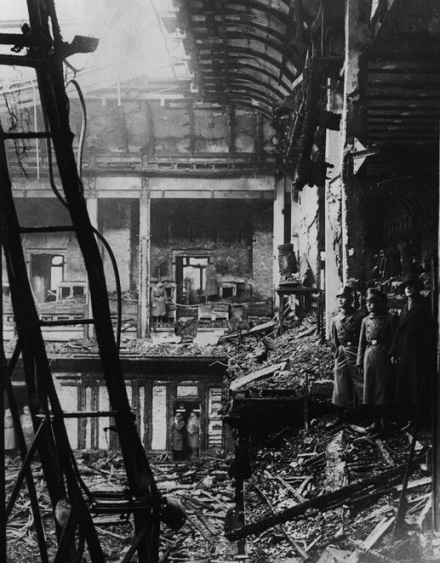
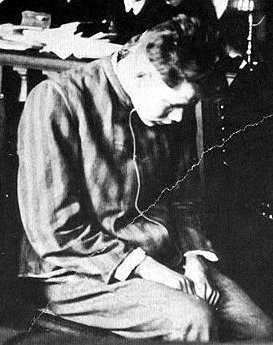
On this date in 1934, Dutch bricklayer Marinus van der Lubbe was beheaded by guillotine in Leipzig for setting the Reichstag Fire.

A watershed event* in the formation of the Nazi dictatorship, the Reichstag fire days before a parliamentary election enabled Hitler to stampede voters, suspend civil liberties, suppress left-wing parties on grounds of a suspected Communist plot, and seize “emergency” powers he would never relinquish.

Heil Hitler.

This clip from an American miniseries on Hitler with the characters chattering in unaccented English portrays the fascists’ opportunistic use of the attack on a national symbol … something not exactly unknown to later generations.

Van der Lubbe, who was arrested on the scene, suffered the predictable fate. Four other Communists charged as accomplices were acquitted, in a trial with the gratifying spectacle of Hermann Goering personally testifying, and being undressed on cross-examination by one of the reds. One is reminded here that Hitler did not yet have everything in the state apparatus at his beck and call … although he did have a great deal already, inasmuch as the arson law under which van der Lubbe died was passed after the Reichstag fire and made retroactive.

If the big-picture outcome of the Reichstag fire is pretty clear-cut, its real origin and the corresponding rightness of the judicial verdicts have remained murky ever since. The fact that the scene of the crime became Nazi ground zero for the next decade sort of obscures the evidence.

Van der Lubbe confessed, so his participation is generally taken as a given.

Whether he was really able to start the blaze acting alone, as he insisted, and the Nazis “only” exploited this fortuitous calamity; whether he was part of a larger leftist plot, as his prosecutors claimed; or whether, as Shirer and many others since have viewed him, he was a patsy in a false flag operation set up by the Nazis with an eye towards creating a politically advantageous national emergency — these possibilities remain very much up for debate.

For what it’s worth, postwar West German courts reversed and un-reversed the sentence before officially rehabilitating van der Lubbe last year on the non-specifically indisputable grounds that the legal machinery brought to bear on the Reichstag fire “enabled breaches of basic conceptions of justice.”

* From Defying Hitler: A Memoir by a writer who would soon emigrate:

I do not see that one can blame the majority of Germans who, in 1933, believed that the Reichstag fire was the work of the Communists. What one can blame them for, and what shows their terrible collective weakness of character … is that this settled the matter. With sheepish submissiveness, the German people accepted that, as a result of the fire, each one of them lost what little personal freedom and dignity was guaranteed by the constitution, as though it followed as a necessary consequence. If the Communists had burned down the Reichstag, it was perfectly in order that the government took “decisive measures”!

Next morning I discussed these matters with a few other Referendars. All of them were very interested in the question of who had committed the crime, and more than one of them hinted that they had doubts about the official version; but none of them saw anything out of the ordinary in the fact that, from now on, one’s telephone would be tapped, one’s letters opened, and one’s desk might be broken into. “I consider it a personal insult,” I said, “that I should be prevented from reading whichever newspaper I wish, because allegedly a Communist set light to the Reichstag. Don’t you?” One of them cheerfully and harmlessly said, “No. Why should I? Did you read Forwards and The Red Flag up to now?”

On this day..

1946: The treacherous Theodore Schurch

One day after William Joyce became the last Briton put to death for treason, 27-year-old Theodore Schurch hanged for treachery at London’s Pentonville Prison.

Like Joyce, Schurch had enrolled in the British Union of Fascists as a teenager in the 1930’s, and it was reputedly at the party’s direction that he joined the army as a driver.

During World War II, Schurch crossed and recrossed enemy lines, delivering operational intelligence to the Italians and Germans by helping to interrogate prisoners of war, or posing as a P.O.W. himself to gain the confidences of other captured Allied soldiers.

Scurch’s army buddies seemed to think he was alright, and there was probably more than a shred of truth to the defense’s contention, paraphrased by the London Times (September 18, 1945), that the lad

was a poor, uneducated fool who was caught young [by fascist ideology] when he knew no better and jockeyed into a position from which he could not recover.

But obviously, one makes this argument when one is in no position to contest factually the capital charges against oneself, and indeed has admitted much of it. Schurch was convicted on all nine counts of treachery, plus one of desertion. Not a big fish, maybe — but just the right size to become the last man hanged in Britain for a crime other than murder.

He’s actually listed as a war casualty, which in a way he was, on the Commonwealth War Graves Commission’s Brookwood Memorial outside of London.

On this day..

1946: William Joyce, Lord Haw-Haw

On this date in 1946, fascist William Joyce, famous by the nickname “Lord Haw-Haw” for his English-language Nazi propaganda broadcasts, was hanged at Wandsworth Prison for treason.

As a pugilistic young anti-Semite with the unusual credential of being a Unionist Irish Catholic, Joyce had been a moving spirit in the interwar British fascist party. (Since audio broadcasts would define Joyce’s life, it seems appropriate to refer the reader for a fuller biography to this recent Oxford biography podcast.)

But because time loves a good laugh, it had the guy haranguing his countrymen for insufficient patriotism marked out for the last treason execution in British history, and unrepentant about it by the time he got there.

The Brooklyn-born Joyce (he never lost his American citizenship) who naturalized as a German in 1940 had a rather tenuous claim on the patriotic high horse to begin with, and after the war, that meant the treason charge proceeded on legally doubtful grounds: speaking the King’s English didn’t mean he owed allegiance to the king. Prosecutors ultimately hung him with a British passport he’d obtained fraudulently, and the legal principle has never since sat well with jurists.

It was just the tool at hand. The British government really hated the guy.*

However limited the resources at his disposal — sparse intelligence, paltry staff, and of course, after 1942, a disastrously collapsing war effort — he had fashioned them into broadcast spin to twist the British lion’s tail in countless British homes throughout the war.

Here’s one episode, with Joyce savaging Winston Churchill, selected from archive.org’s library of Joyce broadcasts (1-7, 8-16, 17-23).

[audio:William_Joyce_Churchill.mp3]

Joyce’s star shone brightest and his invective cut deepest early in the war. Once everything at the front stopped coming up Teutons, he descended into irrelevance and self-parody, albeit without professing the slightest doubt in his fascist convictions.

This last broadcast, prepared just a few days before Germany capitulated, has our day’s principal ramblingly drunkenly from the besieged Nazi capital.

[audio:William_Joyce_final_broadcast.mp3]

Content-wise, not much had changed eight months later, but at least he managed to make his gallows statement coherently.

In death as in life, I defy the Jews who caused this last war, and I defy the power of darkness which they represent. I warn the British people against the crushing imperialism of the Soviet Union. May Britain be great once again and the hour of the greatest danger in the West may the standard be raised from the dust, crowned with the words — you have conquered nevertheless. I am proud to die for my ideals and I am sorry for the sons of Britain who have died without knowing why.

There’s a thorough, and lavishly illustrated, history of Joyce here.

* Authorities passed on prosecuting his wife Margaret, who’d also appeared on some Lord Haw-Haw broadcasts. Under the circumstances, Joyce’s daughter (by his first marriage) Heather Iandolo turned out pretty balanced.

On this day..

1943: Elfriede Scholz, Erich Maria Remarque’s sister

On this date in 1943, pacifist novelist Erich Maria Remarque lost his youngest sister to the Nazi regime — beheaded because her “brother is beyond our reach.”

Actually, Elfriede Scholz was convicted (upon the denunciation of her landlady a few weeks before) by the kangaroo People’s Court for undermining the war effort. (“Wehrkraftzersetzung” — German has a word for everything.)

Like her brother, Elfriede was a staunch opponent of the Nazi government, and in 1943 that could certainly have sufficed to get her a one-way trip to Plotzensee Prison.

But Roland Freisler‘s verdict explicitly referenced (German link) her more famous brother — upon whom the Nazis would have poured out an interwar era’s worth of fury had they been able to get to him in America.

Ihr Bruder ist uns entwischt, aber Sie werden uns nicht entwischen! (Your brother is beyond our reach, but you will not escape us!

Though Erich Maria Remarque and Adolf Hitler had served together at the Third Battle of Ypres, they didn’t quite see eye to eye after the Great War.

Remarque’s immortal anti-war novel All Quiet on the Western Front was banned and burned by war-glorifying Nazis (they also said Remarque was of Jewish descent, apparently without any factual basis).

Erna, Elfriede and Erich Remark — the author later restored an ancestral spelling of his name that had been Germanized in the 19th century — in happier times.

Remarque left Germany, an intellectual celebrity and man-about-town who rubbed shoulders with the likes of Marlene Dietrich (with whom he had a passionate affair) and Ernest Hemingway (with whom he did not).

The Nazis stripped his citizenship, and fumed that they couldn’t get their jackboots on him. (At one point, Goebbels invited Remarque to return. Sly.)

But Elfriede, they could get. She had stayed in her native Germany with her husband and family.

Not content with taking her head off, Berlin added a particularly vicious twist by billing the expatriate author 90 marks for the executioner’s trouble.

The author never said or wrote much about Elfriede, even his diaries. But years later, Erich Remarque dedicated his novel about life in a concentration camp, Spark of Life, to his late sister. Today, there’s a street named for Elfriede in the Remarques’ native Osnabruck.

More about Remarque at the German (but the site is multilingual) Erich Maria Remarque-Friedenszentrum and this online exhibit from New York University.

Better still, here’s the 1930 film version of All Quiet on the Western Front — that year’s Academy Award winner as Best Picture.

On this day..

1945: The Belsen war criminals

On this date in 1945, British hangman Albert Pierrepoint executed eleven guards of the Bergen-Belsen concentration camp and two other Nazis in occupied Hameln.

Liberated only eight months before these hangings, Belsen provided the to-us-familiar store of Nazi atrocity stories. Forty-five sat in the dock at the Belsen trial under British military authority, including the notorious camp commandante Josef Kramer — better known as the Beast of Belsen — and the “Angel of Death” Irma Grese.

Those two, and nine others less distinctively nicknamed, faced the gallows. (They were hanged together with two other war criminal convicts not connected to the Belsen trial, Georg Otto Sandrock and Ludwig Schweinberger, for a total of 13.)

On December 13, 1945, Pierrepoint hanged Grese; then, Elisabeth Volkenrath; and then, Juana Bormann, each individually. Finally, the men were then dispatched in pairs.

(Other than Kramer, the most notable was Nazi doctor Fritz Klein, who gave this reading of medical ethics when queried while the camps were still operating: “My Hippocratic oath tells me to cut a gangrenous appendix out of the human body. The Jews are the gangrenous appendix of mankind. That’s why I cut them out.”)


Of all this batch, Irma Grese, the “beautiful beast”, enjoys the liveliest afterlife.

If one finds her pretty, then she was a pretty young thing — only 16 when she hitched herself to the SS; turning 22 during her fatal postwar trial.

Stalking the camp with her whip, and (rather conveniently) cited with the ravenous sexual appetite a B-movie screenwriter would give such a character, part of her siren song is plainly the fetishistic magnetism of Nazi women.

But in the numerous discussion threads about Irma Grese, any number of her advocates will emerge.

Can we leave it at the fascination that female war criminals inspire? Certainly few 22-year-old Einsatzgruppen men have the mitigatory evidence of a coming-of-age in farming and retail so lovingly emphasized, the precise measure of complicity in genocide analyzed in such detail (pdf).

Grese, perhaps, strikes as impressionable, in the youthful sense of absorbing one’s place from the world one inhabits. Her hangman wrote that “[s]he seemed as bonny a girl as one could ever wish to meet.” As a camp guard, she wins promotions; to her interrogators, she accepts responsibility equal to Himmler’s; among those condemned at the Belsen trial, she alone is defiant.

In that guise — and whether or not it is rightly attributed to her — she presents back to her interlocutor those timeless questions of personal identity and moral responsibility: where does abnormal psychology leave off into perfectly conventional psychology that just happens to occupy an abnormal world?

On this day..

1939: The 18 corpses of the rebellion

On this date in 1939, 18 junior officers of the Thai military were shot in Bangkok.

Ostensibly condemned for being part of a coup plot to depose the adolescent King Ananda Mahidol in favor of his abdicated predecessor Prajadhipok, they were in reality the casualties of a purge by the Field Marshal-turned-Prime Minister Phibun Songkhram.

It’s alternatively transliterated “Phibun Songkhram” or “Pibunsonggram”, and familiarly abbreviated to “Por”, but by any name he dominated Thai politics for a generation.

One of the military leaders of the bloodless 1932 Siamese Revolution that made the country a constitutional rather than an absolute monarchy, Phibun had in 1938 muscled his way to the Prime Ministership.

Beset by assassination attempts linked to royal revanchists to whose purposes the young turk’s programme was deeply inimical, Phibun determined to break the back of monarchism en route to a modernized, militaristic nationalism (pdf) that would be right at home in the imminent world war.*

As 1939 opens, we join the narrative of Paul Handley’s The King Never Smiles:

Phibun swept the capital and arrested 50 royals, nobles, and soldiers in the clique of his People’s Party rival Colonel Song Suradej for plotting his overthrow …

Whatever the truth behind the cabal, its quashing came to represent the final victory of the 1932 revolutionists and the constitutionalists over the monarchists. To mark it, Phibun commissioned a huge monument to the constitution, later called Democracy Monument, in the middle of the city’s main thoroughfare, Rajadamnoen (“royal progress”) Avenue.


The Democracy Monument in Bangkok.

The eighteen officers who took it in the shorts on this date were not joined by condemned VIPs like royal blood Prince Rangsit, who copped a commutation. It’s widely thought now that the “Songsuradet Rebellion” — or aptly-named “Rebellion of 18 Corpses” — was trumped-up, if not an phantasm altogether.

The Democracy Monument was not the only bulwark of Thai nationalism thrown up by Phibun in the year between the “conspirators'” January arrest and their deaths this day.**

He dropped the old absolutist name “Siam” in favor of the more nationalistic “Thailand” in June of that year; made the date of the 1932 revolution a national holiday; stripped the language of class-distinctive structures; and pressed irredentist claims against neighboring French colonies.

And if the royal house was efficiently marginalized by Phibun, it would yet develop in the latter part of the century into one of the region’s weightiest political entities† … intertwined with the Thai military Phibun helped hoist to pride of place, a formula that has left coups and unstable governments a presistent feature of the political landscape down to the present day.

* And subsequently, too. Despite aligning with the Axis powers during World War II, Phibun was a feted anti-Communist dictator as Washington started counting dominoes in Southeast Asia in the 1950’s.

** The Wikipedia page for the rebellion claims that the executions were carried out in batches of four per day. A New York Times report of December 6, 1939 said that all 18 had been executed the previous day.

† The current King Bhumibol Adulyadej, who coincidentally turns 81 today, is the world’s longest-reigning monarch as of this writing … with no shortage of concern about the conflict his passing may unstop.

On this day..

1939: Nine Czech students

Today is International Students’ Day and a public holiday in the Czech Republic and in Slovakia thanks to the martyrdom of nine at the hands of the Nazi occupation forces this day in 1939.

The previous fall, Hitler had cowed the allied powers into ceding the mountainous Czechoslovakian Sudetenland to the Third Reich in order to avert war — leading to Neville Chamberlain‘s famously mistaken “peace in our time” speech.

In March 1939, Germany reneged its part of the bargain and gobbled up Bohemia and Moravia, essentially the modern Czech Republic.

That this would collapse Chamberlain’s vision of peace and set Europe’s powers on the road to war with Berlin was cold comfort to the occupied Czechs. They had their own problems.

On October 28, youth demonstrations in Prague against the occupation resulted in the shooting of Charles University medical student Jan Opletal

Two weeks later he succumbed to the injury, and his funeral turned into an anti-occupation riot forcibly quashed by German arms. According to the London Times account:

On November 17 at 3 a.m., the Gestapo entered all students’ colleges, men’s and women’s, without allowing them to dress, tied the students in groups of three, and dragged them away … Between 3 o’clock and 8 o’clock in the morning the Gestapo visited students’ homes and lodgings. Those opposing arrests and parents who withheld information were immediately shot at, and the wounded were refused attention. The Gestapo broke into high schools as well as into the university …

The prisoners were taken to the Ruzyn barracks and to the Sparta football stadium, where cold water was flung over them and were made to wait until the evening. Then, in the barrack yard, 124 students and teachers* were shot before their fellow-students, the first nine being presidents of students’ associations, including the brilliant young sociologist Dr. Matoushek [English Wikipedia entry | Czech], son of a former Minister of Commerce.

Universities in the cities were declared closed for three years; they would not in fact re-open until after the war.

The day, subsequently memorialized as den boje studentu za svobodu a demokracii (Day of the Students’ Fight for Freedom and Democracy), entered Czech history a second time a half-century later. A student protest at Opletal’s grave on this date in 1989 helped catalyze the Velvet Revolution that toppled Czechoslovakia’s Communist government.

* The larger figure was circulated in the days following by Czech sources. It is not clear to me whether that number proved unfounded, or whether subsequent memorials simply came to focus on the leading nine — whose executions are certain, and were even announced by German communique.

On this day..

1941: Arndt Pekurinen, conscientious objector

On this date in 1941, Finnish pacifist Arndt Pekurinen was executed at the front for refusing to fight.

Initially conscripted in the 1920’s, Pekurinen had refused to serve under arms and spent 1929-31 in prison for his troubles. He was a minor cause celebre; British MPs and big international names like Einstein and H.G. Wells pressed for his release.

A change in the Finnish conscription law — the bill was called the “Lex Pekurinen” — finally saw him freed to civilian life, but he was drafted anew to fight the Soviet Union in the “Continuation War”. When he again refused, he was shot at Suomussalmi without trial — though two men refused to do it before someone finally agreed to be the executioner.

“Kun ihmisiä ei syödä, on niitä turha teurastaa.”
(“As people are not eaten, butchering them is of no use.”)

A neglected figure during the Cold War, he’s enjoyed a latter-day rediscovery since the 1998 Erno Paasilinna book Courage: The life and execution of Arndt Pekurinen. In the decade since, Pekurinen has become a household name and a widely-admired figure. (The link is in Finnish.) A park in Helsinki was recently named for him. (Finnish again.)

Tangentially, the Nordic stock of our day’s victim and his era of militarism call to mind the hero of e.e. cummings’ “i sing of Olaf glad and big”. The allusions of this poem are American, and there’s no reason to associate it directly with Pekurinen — but it so happens that it was published in 1931, the year international pressure forced the end of Pekunin’s first prison stint:

i sing of Olaf glad and big
whose warmest heart recoiled at war:
a conscientious object-or

his wellbelovéd colonel(trig
westpointer most succinctly bred)
took erring Olaf soon in hand;
but–though an host of overjoyed
noncoms(first knocking on the head
him)do through icy waters roll
that helplessness which others stroke
with brushes recently employed
anent this muddy toiletbowl,
while kindred intellects evoke
allegiance per blunt instruments–
Olaf(being to all intents
a corpse and wanting any rag
upon what God unto him gave)
responds,without getting annoyed
“I will not kiss your fucking flag”

straightway the silver bird looked grave
(departing hurriedly to shave)

but–though all kinds of officers
(a yearning nation’s blueeyed pride)
their passive prey did kick and curse
until for wear their clarion
voices and boots were much the worse,
and egged the firstclassprivates on
his rectum wickedly to tease
by means of skilfully applied
bayonets roasted hot with heat–
Olaf(upon what were once knees)
does almost ceaselessly repeat
“there is some shit I will not eat”

our president,being of which
assertions duly notified
threw the yellowsonofabitch
into a dungeon,where he died

Christ(of His mercy infinite)
i pray to see;and Olaf,too

preponderatingly because
unless statistics lie he was
more brave than me:more blond than you.

On this day..

1945: Vidkun Quisling, who made his name as a traitor

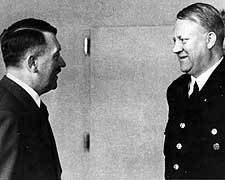
On this date in 1945, eponymous Nazi collaborator Vidkun Quisling was shot at Oslo’s Akershus Fortress for high treason.

By the time of his death, the Nazi collaborator (English Wikipedia page | Norwegian) had already given his surname to English and other languages as a synonym for traitor.

Just deserts for his efforts as chief of the fascist party Nasjonal Samling to aid the Nazi conquest of his home country. Quisling interrupted a radio broadcast on April 9, 1940 to proclaim himself Prime Minister* and order cooperation with invading Germans.

Although Quisling’s lack of popular support compromised his value even as a puppet, he remained as Minister President of Norway through the war — a crucial tool in Germany’s counter-encirclement jousting with Britain, nicely explained at the outset of Frank Capra’s American propaganda flick Why We Fight:

He enjoyed public regard commensurate with his station.


A 1944 cartoon in Sweden (which remained tenuously neutral and unoccupied during the war) indicates that Quisling had already made his name a byword for treachery. The caption reads:
“I am Quisling.”
“And the name?”

Norway had abolished capital punishment in 1905, but its government-in-exile reinstated it expressly for dealing with high-level collaborators.

Though Quisling himself may have deserved this and worse, the justice and legality of so doing has been controversial ever since.


The site of Quisling’s execution. Some other shots from his trial are in this 60-year Norwegian-language retrospective.

* Thought to be the first on-air putsch in history.

On this day..