These noble heads rolled a bare 10 weeks after the death of King Edward IV to whom Woodville was certainly quite loyal: the Earl’s sister, Elizabeth Woodville, was Edward’s queen Consort.
This marked the acme of the family’s meteoric, single-generation rise from gentleman nobodies. Anthony’s dad, Richard Woodville, vaulted the family into the nobility with an illicit marriage to the Duke of Bedford’s widow. Their pretty daughter Elizabeth scandalized Britain’s elite by conquering Edward’s heart and his hand in 1464 — though this was her second marriage: the first, to Sir John Grey of Groby, had produced two children, one of whom was the Richard Grey who went to the block with Sir Anthony Woodville.
But while heads were still attached to shoulders, Woodville employed his in literary pursuits: he’s credited with publishing (via the pioneering English printer William Caxton) some of the very first books in English: Earl Rivers’s own translation into “right good and fayr Englyssh” of Jean Mielot‘s Cordyale, or Four last thinges (image); and, the 1477 Dictes and Sayings of the Philosophers, another Rivers translation that he knocked out while on pilgrimage to Santiago de Compostela. It’s distinguished as the first English printed book that dates itself (November 18, 1477).
Earl Rivers presents Edward IV with the fruits of movable type.
But for sure, circa Regna tonat — especially here during the long-running War of the Roses for control of the English throne.
The reason that Anthony Woodville and not his father was the current Earl Rivers was because dad had his own head cut off when King Edward was temporarily deposed in 1469. (Exile to Bruges was also the reason that the second Earl Rivers met William Caxton.)
After Edward came roaring back at the Battle of Tewkesbury in 1471, the Woodville family would have been feeling pretty well set up: their Yorkist faction seemed to have won as decisive a victory as could be imagined over the Lancastrians.
But King Edward’s early death meant that Anthony’s nephew Edward V inherited all too early — which is to say that he did not truly inherit at all. The 12-year-old Edward and his younger brother Richard, Duke of York, both of them children of Elizabeth Woodville, were the boy-princes left to the care of Edward IV’s brother Richard, Duke of Gloucester.
Now, they believe it; and withal whet me
To be revenged on Rivers, Vaughan, Grey:
But then I sigh; and, with a piece of scripture,
Tell them that God bids us do good for evil:
And thus I clothe my naked villany
With old odd ends stolen out of holy writ;
And seem a saint, when most I play the devil.
The next part of the story is quite notorious, and it directly concerns the Woodvilles: the reason that Richard infamously disappeared those tragic princes into the Tower of London was because they were in Elizabeth Woodville’s own custody — and Richard, soon to seize power for himself as King Richard III, feared that if given the opportunity to gather themselves the Woodvilles and not he would dominate English politics.
Events could easily have turned out differently — even with Richard on the blade end of the Woodvilles’ executioner. In the chaotic days following Edward’s death, as news made its way ponderously around the realm, Richard raced to get ahead of the Woodvilles before they were secure in their patrimony. On April 30 of 1483, Richard intercepted the royal party traveling to London and took king into custody along with Rivers, Thomas Vaughan, and Richard Grey.
Gloucester-cum-Richard III acted with dispatch from that point. He had Elizabeth Woodville’s marriage to the late king invalidated, effectively disinheriting her children. While Gloucester made ready for his coronation, Anthony Woodville and his friends made sad poetry and last wills and testaments.
* There are some citations equivocating on Vaughan’s precise death-date. Yet another man, Sir Richard Haute (Hawte) is also sometimes numbered a fourth in the doomed party; however, a man of this name took part in Buckingham’s Rebellion against King Richard III, and received a pardon in 1485.
How happy is the blameless Vestal’s lot!
The world forgetting, by the world forgot:
Eternal sunshine of the spotless mind!
Each prayer accepted, and each wish resign’d.
June 9 in ancient Rome was the festival of the Vesta, the acme of the Vestalia festival extending until June 15.*
We hope this hearth-goddess will accept the homage Pluto‘s emissaries here propose to pay her most famous servants, the Vestal Virgins.
An ancient order of priestesses reaching back to Rome’s mythical founding period, perhaps even rooted in Rome’s matriarchal Etruscan predecessors, the Virgins by the time of the classical era numbered six — selected from among candidate girls aged 6 to 10 who would be whisked away from their families to serve for thirty years.
Vestal Virgins enjoyed great prestige and a number of social prerogatives (they had the power to pardon condemned prisoners, among other things). In exchange, they were tasked with maintaining Rome’s favor with her temperamental gods by tending diligently to the city’s most cherished religious observances.
The remains of the House of the Vestals on the Roman Forum ((cc) image from Milos Kravcik.) Here’s a reconstructed view of what the residence might have looked like in its glory.
From the moment of their selection, Vestal Virgins became a sort of personification of Rome itself — Rome’s civic virtue; Rome’s standing with the gods. Rome and the Vestals, joined by the sacred eternal hearth-flame whose perpetual kindling was the virgins’ chief ceremonial duty, drew succor from one another. Pliny wrote that they “have the power, by uttering a certain prayer, to arrest the flight of runaway slaves, and to rivet them to the spot, provided they have not gone beyond the precincts of the City” — but Rome’s greatness, too, was attributed to the citizenry’s dutiful maintenance of the Vestals through the centuries.
For such an empyreal creature to indulge the fleeting pleasures of the flesh was quite beyond question. Vesta, said Ovid,
was always unable to tolerate men.
What wonder if a virgin delights in virgin servants,
And only allows chaste hands to touch her sacred relics?
Realize that Vesta is nothing but living flame,
And you’ll see that no bodies are born from her.
She’s truly a virgin, who neither accepts seed
Nor yields it, and she loves virgin companions.
But over the centuries, not all of Vesta’s servants kept that same hard line on unchaste hands** — and in so doing risked punishment by an unusual execution of living burial. Even defiled Vestals were inviolate in their persons: their blood could not be shed, and the hands of the common executioner could not touch them. They had to be dispatched without direct violence, by immuring them alive under the earth. (Not so their seducers: getting busy with a Vestal Virgin would cost a man as many strokes of a scourge as required to kill him.)
Back to Ovid:
Now sacred flames you shine brightly under Caesar’s rule:
The fire on the Ilian hearths is there, and will remain,
It won’t be said that under him any priestess disgraced
Her office, nor that she was buried alive in the earth.
So the unchaste die, being entombed in what they
Have violated: since divine Earth and Vesta are one.
We have no specific calendar dates to go with any of these, but the British Museum antiquarian G.H. Noehdon compiled the available information about Vestals’ executions at some length in this public domain text:
a subterraneous chamber or cell of small dimension was formed, into which you descended from above. There were placed in it a couch or bed, a burning lamp, and a few necessaries of life, such as bread, water, milk, and oil. It would have been impious, according to Plutarch, to destroy by hunger, a life that had been consecrated by the most holy rites. The wretched victim, it is to be imagined, chiefly perished by suffocation. For the cell was closely shut, and overlaid with earth, as soon as she was descended.
The whole proceedings were terrific. The delinquent was conveyed to that place of horror in a litter, so fastened up and covered from without, that not even a sound or groan could escape from it. She was thus carried through the market-place, while the people, in fearful silence, made way, and followed speechless, impressed with the awe of this frightful ceremony. No sight, says Plutarch, could be more shocking, nor was there ever a day at Rome more gloomy and sorrowful.
Detail view (click for the full image) of Execution of a Vestal Virgin, by Heinrich Friedrich Fuger.
Per Noehdon, the oldest case on record was of one Pinaria, executed for impurity under Tarquin the Elder. A Vestal named Minucia suffered the same fate in the 4th century BCE; two more, Opimia and Floronia, were condemned in the 3rd century, though one committed suicide in preference to immurement. Dionysius of Halicarnassus attributes a plague to the incontinence of the Vestal Urbenia, and its abatement to her punishment. Cassius Dio credits no fewer than three Vestals with execution for unchastity in 114 BCE — but one can hardly fail to note that this is a period of deepening class tension in Rome in the aftermath of the Gracchi. One wonders if carnal indulgences were merely a pretext to purge Aemilia, Licinia, and Marcia for the wrong factional alignment.
Probably the best-attested and best-known Vestal Virgin executed was Cornelia, the Virgo Maxima (chief Vestal) entombed by order of the notorious tyrant Domitian. (Domitian had also executed three other Vestals some years prior.) Pliny the Younger recorded her going to her death effecting (as did her purported lover) a persuasive mien of indignant innocence.
Domitian generally raged most furiously where his evidence failed him most hopelessly. That emperor had determined that Cornelia, chief of the Vestal Virgins, should be buried alive, from an extravagant notion that exemplary severities of this kind conferred lustre upon his reign.
Accordingly, by virtue of his office as supreme pontiff, or, rather, in the exercise of a tyrant’s cruelty, a despot’s lawlessness, he convened the sacred college, not in the pontifical court where they usually assemble, but at his villa near Alba; and there, with a guilt no less heinous than that which he professed to be punishing, he condemned her, when she was not present to defend herself, on the charge of incest, while he himself had been guilty, not only of debauching his own brother’s daughter, but was also accessory to her death: for that lady, being a widow, in order to conceal her shame, endeavoured to procure an abortion, and by that means lost her life.
However, the priests were directed to see the sentence immediately executed upon Cornelia. As they were leading her to the place of execution, she called upon Vesta, and the rest of the gods, to attest her innocence; and, amongst other exclamations, frequently cried out, “Is it possible that Caesar can think me polluted, under the influence of whose sacred functions he has conquered and triumphed?” Whether she said this in flattery or derision; whether it proceeded from a consciousness of her innocence, or contempt of the emperor, is uncertain; but she continued exclaiming in this manner, til she came to the place of execution, to which she was led, whether innocent or guilty I cannot say, at all events with every appearance and demonstration of innocence. As she was being lowered down into the subterranean vault, her robe happening to catch upon something in the descent, she turned round and disengaged it, when, the executioner offering his assistance, she drew herself back with horror, refusing to be so much as touched by him, as though it were a defilement to her pure and unspotted chastity: still preserving the appearance of sanctity up to the last moment; and, among all the other instances of her modesty, “She took great care to fall with decency.”
Celer likewise, a Roman knight, who was accused of an intrigue with her, while they were scourging him with rods in the Forum, persisted in exclaiming, “What have I done? — I have done nothing.”
The Vestal Virgins were finally suppressed (and their eternal flame quenched) by the Christian emperor Theodosius, in 394.†
A few years later, Rome was sacked for the first time in 800 years.
* There are mixed accounts as to whether June 9 or June 7 was the first day of the Vestalia, but the 9th was unquestionably the most important.
** Legend has it that Rome’s founders, Romulus and Remus, were sons of a Vestal Virgin, Rhea Silvia: again, this tradition could well be the refracted memory of Etruscan priestesses, or princesses, or both. The man who was to kill these unholy offspring instead took pity on them and cast them adrift on the Tiber — and that’s how they ended up being famously suckled by wolves.
† Eliminating pagan holdovers was a great sport in this period for Rome’s now-Christian emperors. Theodosius also ended the Olympic Games; his son Honorius got rid of gladiatorial combat.
The fourth and last of little King James‘s regents, Morton was arguably the most able of the bunch and distinguished his span of authority by winning the raging civil war against James’s mother Mary.
Regent Morton had a reputation for avarice during his run in the 1570s. However, deriving as it does from his executive impingement on the treasures of courtiers and clans no less grasping than himself, that reputation probably ought to be taken with a grain of salt.
Rimshot
If nothing else, Regent Morton had the excuse of king and country. Sir Walter Scott, for one, favored this Red Douglas with a much more charitably statesmanlike gloss in The Monastery and The Abbott.
As one example, Morton irked divines by enforcing with a minimum of pious exceptions a pre-existing statute requiring a one-third cut of ecclesiastical revenues.
In 1578, this Argyll kidnapped King James VI and induced the 12-year-old to declare his majority and dismiss the Earl of Morton. Argyll landed a Chancellorship out of the deal: Morton — well, you know. He would eventually be accused, 14 years’ belatedly but not inaccurately, of complicity in the 1567 murder of Lord Darnley.
Argyll in the end lost his head to that distinctive Scottish proto-guillotine known as the Maiden. Though the apparatus actually dates back to 1564,* a legend as moralistic as it is specious holds that the Regent Morton was himself the man who ordered construction of the device that would eventually end his own life. Sir Walter could hardly be asked to resist that kind of material:
“Look you, Adam, I were loth to terrify you, and you just come from a journey; but I promise you, Earl Morton hath brought you down a Maiden from Halifax, you never saw the like of her — and she’ll clasp you round the neck, and your head will remain in her arms.”
“Pshaw!” answered Adam, “I am too old to have my head turned by any maiden of them all. I know my Lord of Morton will go as far for a buxom lass as anyone; but what the devil took him to Halifax all the way? and if he has got a gamester there, what hath she to do with my head?”
“Much, much!” answered Michael. “Herod’s daughter, who did such execution with her foot and ankle, danced not men’s heads off more cleanly than this maiden of Morton. ‘Tis an axe, man, — an axe which falls of itself like a sash window, and never gives the headsmen the trouble to wield it.”
“By my faith, a shrewd device,” said Woodcock; “heaven keep us free on’t!”
-Sir Walter Scott, The Abbott
When next in Edinburgh, quaff Scots engineering acumen with the friendly backpackers crashing at the High Street Hostel — the glorious stone town house that was once Regent Morton’s very own crib.
By Kim Traynor (Own work) [CC BY-SA 3.0], via Wikimedia Commons.
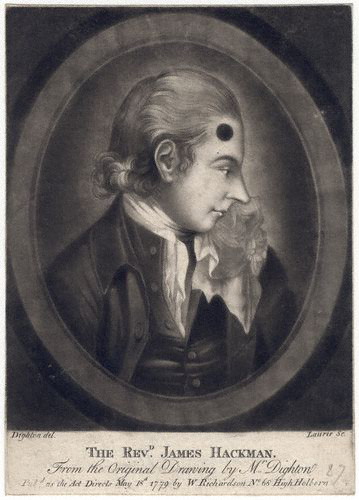
On this date in 1779, Londoners crowded Tyburn to witness the hanging of James Hackman for a sensational high-society murder.
Just twelve days before his date with the hemp, Hackman had walked up to Martha Ray at the Royal Opera and shot her in the head with a single-shot pistol. Then, he turned a second weapon on himself in a vain attempt to commit suicide.
The reader is not mistaken to detect here the mania of unrequited passion. Several years before the young Hackman was a handsome lieutenant introduced to Martha Ray’s social circle. She was a successful soprano on the London stage and though unmarried lived with the Earl of Sandwich as his wife in all but the illustrious name.
Yes, this is the very Earl of Sandwich who pioneered the eating of things stuck between bread slices.* Sandwich — John Montagu to his parents — had other interests besides the munchies; he was the capable First Lord of the Admiralty throughout the 1770s. (As a result, Captain Cook, whose seafaring explorations were occurring at that time, kept naming islands for the Earl of Sandwich).
Domestic life for the Earl and his legal Countess — not “Earless”; that’s a different thing — wasn’t quite as satisfying. Dorothy Montagu, going gradually insane, separated from Sandwich. The lord plucked 17-year-old commoner Martha Ray — a quarter-century Sandwich’s junior — in 1759 and she lived as his mistress from there on out.*
Despite their age difference and never-formalized status they had a comfortable arrangement; Ray bore Sandwich five children** and the two appeared in public as a couple. The Earl sponsored Martha Ray’s opera career and education.
James Hackman met the Earl’s mistress around 1775 and the two formed an intimacy. Just how intimate they might have been has never been firmly established but is clear that as time passed the infatuation increasingly ran in only one direction. Hackman sold his commission in the 68th Regiment of Foot to become a Church of England deacon, perhaps angling by this expedient to woo Martha Ray away from Sandwich to a wholly respectable union.
She understandably demurred on this “opportunity” — leading the greenhorn Reverend to his blackguard act.
Hackman’s pointless waste of Martha Ray’s life and his own plucked his contemporaries’ sentimental heartstrings like nothing else. “All ranks of people … pitied the murderer’s fate,” remarks the Newgate Calendar. One newspaper report of the death sentence noted that “all present were greatly affected” at Hackman’s agitations “and however we may detest the crime, a tear of pity will fall from every humane eye on the fate of the unhappy criminal.” (General Advertiser and Morning Intelligencer, Apr. 17, 1779)
James Boswell was fascinated by the crime; he attended the trial and spilled many public and private words on its subject.
Boswell empathized with Hackman: in a report of the trial for the St. James’s Chronicle (Apr. 15-17, 1779) he opined that the “natural Effect of disappointed Love, however, shocking it may appear, is to excite the most horrid Resentment against his Object, at least to make us prefer the Destruction of our Mistress, to seeing her possessed by a Rival.” Not that Boswell condoned the murder, but “I would say to all that are conscious that their Passions are violent, Think ye that htis unfortunate Gentleman’s general Character is … worse than yours? No, it is not.”
While Human Justice is to be satisfied, let us consider that his Crime was neither premeditated‡ Cruelty, nor base Greediness. He is therefore an Object neither of Abhorrence nor of Contempt … Let us unite our fervent Prayers to the Throne of Heaven, that this our Brother may obtain Forgiveness through Jesus Christ, and be admitted in another State of Being to everlasting Happiness.
The kinship so many Londoners felt for this homicidal stalker moved print copy high and low, before Martha’s body had gone quite cold. Its most notable product was the 1780 Love and Madness, an epistolary novel of tragic passion presented via the (fictitious) letters exchanged by the supposed lovers. So heavily did this understanding of events by Hackman’s contemporaries color its subsequent remembrance that Love and Madness is also the title or subtitle of two 21st century nonfiction considerations of the affair. (1, 2 | Review of both)
Hackman for his part carried off the requisite public posture of resigned tragic nobility in the few days before he satisfied human justice. The General Evening Post, April 17-20 1779 described the execution:
This unfortunate gentleman received the sacrament in the morning with all the fervency and devotion of a sincere repenting criminal: — he repeated that affecting acknowledgment of his guilt, which on his trial drew tears from the audience, and seemed in a state of composure, unruffled with the idea of punishment, which, he said, was no more than he deserved.
At nine o’clock he came into the press-yard, where a great crowd of persons assembled to gratify their curiosity. That all might have an equal share of the sight, a lane was formed by the multitude on each side, through which Mr. Hackman passed, dressed in black, leaning on the arm of his friend the Rev. Mr. Porter, whose hand he squeezed as he muttered the solemn invocation to Heaven, not to forsake a sinner of so enormous a degree, in the trying hour of death.
…
Mr. Hackman was conveyed from Newgate in a mourning coach, attended by the Rev. Mr. Porter Mr. Villette, the ordinary of Newgate, and Mr. Leapingwell, a Sheriff’s officer.
He reached Tyburn about a quarter before eleven o’clock. When he arrived at the fatal tree, a cart lined with black was under the gallows ready to receive him. Mr. Porter and Mr. Villette ascended it by a pair of steps, and he followed them unsupported. As soon as he had got into it he walked forward, and fell on his knees, (a position seldom used by persons in his circumstances at Tyburn, as they always pray standing) and the Clergymen did the like, one on each side of him, where they remained praying for about fifteen minutes, then got up, when the rope was put about his neck, and tied to the gallows.
In this manner he remained praying between the two Divines for ten minutes more, when the Rev. Mr. Porter embraced him, and Mr. Villette took his leave, and both left the cart. The convict[‘]s cap being pulled over his face, he told the executioner to leave him to himself for a few minutes, and he would drop his handkerchief as a signal when he was ready, which he did after a few minutes pause, and was thereupon launched into eternity.
His whole behaviour was manly, but not bold: his mind seemed to be quite calm, from a firm belief in the mercies of his Saviour.
He wore not hat, not any bandage on his face where he gave himself the wound, that the public curiosity might not be interrupted in looking at him; saying, “that he wished to be made a public spectacle of, and hoped his death might be of service to mankind.”
He was no ways convulsed, nor was their [sic] any motion of the body that tended to shew it experienced any pain. Nothing more was to be seen than what proceeded from the jerk on quitting the cart.
The mob was more numerous than on any other occasion since the death of Dr. Dodd. It was expected Mr. Hackman would suffer at Covent-garden, and preparations were made by some speculating carpenters, who met with a mortifying disappointment.
After hanging the usual time, his body was put into a hearse, and taken to Surgeons-hall in the Old Bailey, where it was prepared for the inspection of the public.
Mr. Harkman expressed a wish to his friends, that the ceremony of anatomizing his body might be dispensed with; and that his corpse might be treated in the same manner as that of Lord Ferrers.
Mr. Hackman intimated to a particular friend, that if his remains could be deposited near those of Miss Ray he should feel inexpressible happiness in the hour of death.
A man who was standing near a dray in Oxford-street to see Mr. Hackman pass, was thrown down under one of the horses by the crowd; the horse being frightened, stamped on the man, and beat out his brains.
* Allegedly so that the Earl wouldn’t have to leave his beloved gambling table to dine.
** There is a wonderful bon mot that has enlivened compendia of anecdotes through the years, consisting of more or less the following exchange:
First speaker: You will either die on the gallows or of some social disease.
Second speaker: That depends upon whether I embrace your principles or your mistress.
Though it’s been variously attributed, it appears that the retort was originally delivered by the comic Samuel Foote to Lord Sandwich — about Martha Ray.
† Notable among the five children of Sandwich and Martha Ray: jurist Basil Montagu.
‡ Hackman had to be talked off simply pleading guilty but in the end he hung his trial hopes on arguing that he intended to kill himself, in Martha’s presence, and was overwhelmed by a momentary “phrensy”. A letter in his pocket meant to be delivered posthumously to his brother-in-law supported this claim; the fact that he brought two guns to meet her rebutted it.
Trial judge William Blackstone pointed out to Hackman’s jurors that the composure of the accused before and after the crime did not suggest a madman and that accepting Hackman’s claim of only an instant’s insanity could present a very slippery slope indeed for future murder prosecutions.
In honor of Good Friday (in 2015), we pay tribute today to the Diocletian-era Christian martyrs Agape, Chionia and Irene.
The three virgin sisters whose names mean Love, Purity, and Peace in Greek were not, per tradition, actually martyred all together. However, they do share an April 3 feast date.
They are said to have made their illicit faith conspicuous to the governor of Macedonia by refusing to eat meat that had been burned as a pagan sacrificial offering. Agape and Chionia suffered immediate martyrdom, while Irene escaped to the mountains only to be captured and burned later with her Christian books.
The remarkable medieval canoness and playwright Hrotsvitha of Gandersheim — by some reckonings the West’s first known dramatist since antiquity — made the women the focus of her 10th century play Dulcitius, which is available online in English here:
IRENA. You wretched Sisinnius! Do you not blush for your shameful defeat? Are you not ashamed that you could not overcome the resolution of a little child without resorting to force of arms?
SISINNIUS. I accept the shame gladly, since now I am sure of your death.
IRENA. To me my death means joy, but to you calamity. For your cruelty you will be damned in Tartarus. But I shall receive the martyr’s palm, and adorned with the crown of virginity, I shall enter the azure palace of the Eternal King, to Whom be glory and honour for ever and ever!
Bad Gandersheim‘s Roswitha Prize is awarded (nearly) annually in Hrosvita’s honor. It’s the oldest German literary laurel that’s conferred exclusively upon women.
On this date in 1601, Queen Elizabeth’s last great favorite became the last man beheaded in the Tower of London.
Vain and dashing Robert Devereux rolled into the royal court in 1584 around age 19 and immediately established himself as the new favorite of the monarch, 30-some years his senior. They spent long walks and late nights in enchanted private company, and Devereux “commeth not to his owne lodginge tyll the birdes singe in the morninge.” Ye olde walke of shayme.
In becoming the (presumed) lover* of the aging Virgin Queen, the Earl of Essex was only following the family** trade: his stepfather Robert Dudley was the younger Elizabeth’s longtime intimate.
It is up to the artists to postulate the relative measures of passion and cynicism in these dalliances; many have tried, inspired by the scaffold sundering of one of history’s great May-December affairs. The Essex-Elizabeth drama was a popular topic for broadsides, ballads, and stage treatments from the 17th century to the present day.
He was wildly popular in London, but Essex was also afflicted by the follies of youth. Rash, temperamental, vainglorious; he aspired to leverage the favor of his sovereign into statesmanship and he achieved heroic repute for his swashbuckling raid on Cadiz.
Yet Essex reads like a whelp who never quite grew into a man’s boots. Every sketch of Essex includes, because it seems so starkly illustrative of his unstable character, the story of the time his impertinence led the queen to box his ears publicly — and the hothead’s hand flew instinctively to his sword-hilt. Everyone reconciled over this brush with lese-majeste, but only after Essex scribbled some skulking reproaches (“What, cannot princes err? cannot subjects receive wrong? is an earthly power or authority infinite?”) that he had the petulance to actually send to Elizabeth.
Essex chased martial glory with mixed results. His last great enterprise was an ill-starred 1599 offensive in Ireland to bring Gaelic rebels to heel in the Nine Years’ War.
Not for the last time an Englishman found this conquest more easily aspired than achieved. Essex liberally overused his authority to knight men as a reward for their service, but his soldiers mostly slogged to and fro with little headway to show for it. After a frustrating campaign season chasing his tail, Essex defied the increasingly strident directives to attack issuing from Elizabeth’s irate pen, and made terms with the Irish commander Hugh O’Neill, Earl of Tyrone. Then he defied Elizabeth’s order to remain in Ireland and hastened back to London to justify himself. It was said of him that he “never drew sword but to make knights.”
This was the beginning of Essex’s end. Elizabeth’s fury at the aimless military campaign was compounded when her churlish captain turned up from Ireland unbidden and burst into her private chambers while she was still dressing to report on his unauthorized summit. Cecil et al, whose ascendance Essex had meant to reverse with the triumph of his arms, now murmured that the earl had strayed near outright treason to parley with the rebel whom he was supposed to be routing. The Privy Council put him under house arrest.
Heaped in debt and deprived of the prestigious proximity to power he had enjoyed literally throughout his adulthood, the man’s turbulent spirit stirred strangely in York House. We have seen that Robert Devereux, Earl of Essex, was a man to abhor an indignity even past the point of self-preservation. He unwisely sent secret missives to try to turn the ongoing succession negotiations‡ against Robert Cecil; when the Privy Council caught wind of this intrusion, he refused its demand that he present himself to account for his actions. Instead, he made matters worse by mounting a pathetic march through London with his supporters.
This “Essex Rebellion” was meant to rally the citizenry to him and turn some sort of coup against Robert Cecil. It seems so foolhardy and ill-considered that it’s difficult to think what was in the earl’s head. If you squint at it just so, it perhaps had a big-R Romantic quality, a gallant band of brothers saving the nation from its duplicitous ministers; the night before the rebellion, Essex (a liberal arts patron in his time) splurged to have William Shakespeare’s company§ stage a special performance of Richard II — a play wherein the English monarch is deposed. Presumably this was his inspirational pregame speech.
Thinking much more clearly than Essex, Londoners vigorously ignored his summons and the marching party trudged alone — and surely increasingly frightened — through the city until it was stopped by a barricade. Its participants then fled back to Essex House where they soon found themselves surrounded.
Whatever the fancy that led the Earl of Essex on his fatal February 8 march, and whatever the extent of his ambitions for that occasion, the careless threat to the public peace went several bridges beyond a boyish foible that Elizabeth could overlook in her impulsive courtier. He was prosecuted for treason within days and Elizabeth signed his death warrant on February 20th. The only mercy extended the ex-favorite was to suffer the noble execution of beheading, rather than a traitor’s drawing and quartering. Essex also successfully appealed for a private execution within the walls of the Tower, away from the gawks of those London masses who had so signally failed to rebel along with him.
My sins are more in number than the hairs on my head. I have bestowed my youth in wantonness, lust and uncleanness; I have been puffed up with pride, vanity and love of this wicked world’s pleasures. For all which, I humbly beseech my Saviour Christ to be a mediator to the eternal Majesty for my pardon, especially for this my last sin, this great, this bloody, this crying, this infectious sin, whereby so many for love of me have been drawn to offend God, to offend their sovereign, to offend the world. I beseech God to forgive it us, and to forgive it me — most wretched of all.
He prayed a Psalm. Then, stretching out his neck on a low block and thrusting his arms from his sides, he bid the headsman strike. The executioner had to oblige his patient in triplicate in order to sever the puffed-up head.
The Earl of Essex has the distinction of being the last person beheaded on the Tower Green, within the walls off the Tower of London — the last name on the little placard of headless notables photographed by tour groups. Note that Essex was not the last person beheaded at the Tower, when the adjacent Tower Hill is included (that distinction belongs to Jacobite rebel Simon Fraser); nor was he the last person executed within the Tower (that distinction belongs to World War II spy Josef Jakobs, who was not beheaded but shot).
Weary and depressed, Elizabeth died little more than two years afterwards.
* There’s a mind-bending speculative hypothesis out there — cousin to the Shakespeare-focused Prince Tudor theory — that Essex was actually Elizabeth’s secret, illegitimate son. This secret history is obviously more congenial with the queen’s early favoritism for Essex than with her eventually chopping off his head.
** Essex was also a distant cousin of Elizabeth herself: his maternal great-grandmother was Mary Boleyn, sister of Anne Boleyn — who was Elizabeth’s mother.
† Walter Raleigh was a notable Cecil ally in this factional conflict. Raleigh attended Essex’s execution … and, of course, shared that fate many years afterwards.
‡ Elizabeth was nearing age 70; her childless death was imminent. James VI of Scotland was being vetted by Robert Cecil as the successor. Essex tried to stick his thumb in the pie by warning James that the Cecil faction would conspire to foist the English crown on the Spanish infanta — daughter of the Spanish king who had been the Catholic Mary Tudor’s husband. (The infanta was not Mary’s own daughter.) This was no idle threat, as at this point it was only a few years since the Spanish Armada had sallied for English seas.
§ Another noteworthy Shakespeare connection: one of the participants in the Essex Rebellion was the Earl of Southampton (he was spared execution). Southampton, whose given name was Henry Wriothesley, is often identified as the “Fair Youth” to whom Shakespeare dedicated numerous love sonnets. (Some of those are directly addressed to a Mr. “W.H.”)
Niccolo Machiavelli‘s exile from Florentine politics — and subsequent entry into the intellectual canon — was cinched this date in 1513 when two of his friends (or possibly co-conspirators) were executed for a plot against the Medici.
Days after that stern friar burned to ashes on the Piazza della Signoria, Machiavelli was named the secondo segretario fiorentino,* alongside a primo segretario counterpart, the older and more cautious Marcello Virgilio Adriani.
What a moment this was to be a Florentine! The mighty Medici had been chased out of Florence and with the fall of Savonarola and his grim morals police the humanist dream of a classical republic suddenly seemed within grasp.
Machiavelli was just 29 years old when he reached this office, bursting with a patriot’s reckless exuberance — and a virile young man’s hedonism. He delighted in whores and in boozing around with his Chancery cronies Agostino Vespucci** and Biagio Buonaccorsi.
The correspondence of these indiscreet young Turks fill with profane and cutting takes on the leading citizens of Florence; Machiavelli, who was known in his own time as a playwright and not a political philosopher, was even bold enough to put such ridicule in print. The 1504 play Le Maschere is tragically lost, but by surviving accounts it lampooned “under feigned names, many citizens who were still living.”†
A few books about Niccolo Machiavelli
While not scribbling pasquinades and getting laid, the Second Secretary had matters of state to attend to. We have met him in these pages, as the Florentine ambassador to the court of Cesare Borgia; Machiavelli could not help but admire the condottiero‘s ruthlessness. Machiavelli also represented Florence in Rome, Spain and France.
Showing an equal aptitude for politics by other means, Machiavelli moved the Florentine military muscle towards a citizen militia, presciently replacing its dependence on mercenaries. In 1509 this force captured Pisa.
But Machiavelli’s excessive regard for this strategic advance married to his excessive affinity for the republic of Piero Soderini undid him in the end. While the First Secretary, Adriani, quietly cultivated contacts of various political persuasions, Machiavelli went all in against the stirring Medicean party. This became a problem when the fortunes of peninsular war drove Florence’s French allies away, leaving the city ripe for recapture by Giuliano de’ Medici, who also happened to be the brother of the pope in waiting.
In 1512, a hastily-assembled city militia of about three or four thousand infantry and 100 men-at-arms met an overwhelming Spanish-Papal-Medicean force at Prato. Scrambling to defend a lost cause, Machiavelli had mustered about a third of the militia and was trying to organize the city’s defenses. Florence’s crushing defeat in this battle and the ensuing civic massacre in Prato (with “countless murders, sacrileges and rapes”) convinced the Florentines to depose Piero Soderini and throw open the gates to Giuliano de’ Medici.
This was the end of Machiavelli the statesman … and, of course, the birth of Machiavelli the philosopher. The ensuing 15 years’ frustrating exile left him no other outlet for his political passions save his pen; needless to say, works like The Prince and Discourses on Livy retain exalted seats in the canon down to the present day. (They made little impression on Machiavelli’s contemporaries; Florentines still knew him for the plays he kept writing.)
A few books by Niccolo Machiavelli
When evening comes, I return home and enter my study; on the threshold I take off my workday clothes, covered with mud and dirt, and put on the garments of the court and palace. Fitted out appropriately, I step inside the venerable courts of the ancients, where I nourish myself on that food that alone is mine and for which I was born; where I am unashamed to converse with them and to question them about the motives for their actions, and they, out of their human kindness, answer me. And for four hours at a time I feel no boredom, I forget all my troubles, I do not dread poverty, and I am not terrified of death. I metamorphose into them completely.
-Machiavelli, December 10, 1513
The cautious primo segretario Adriani, who could better see where the winds were blowing, survived the transition by having the wisdom not to align himself with the losing party. Whatever the verdict of posterity, the 1510s were Adriani’s time to bask in the center of events while Machiavelli did his work of ages in obscurity.
But what cinched Machiavelli’s unhappy permanent banishment from Florentine politics — notwithstanding unctuous expedients like dedicating The Prince to the Medici ruler — were the events culminating in two February 23, 1513 beheadings.
Machiavelli had been dismissed in November 1512. Four months later, a nascent (or wildly exaggerated) anti-Medici conspiracy led by a republican named Pietro Boscoli came to light. Its chief, and paltry, evidence was little more than a written list of around 20 fellow-travelers, upon which appeared the name of Niccolo Machiavelli. It’s more than likely that the “treason” comprised merely to the idle chatter of some disaffected republicans, but after a generation in exile the newly restored Medici dynasty wasn’t taking any chances.
For the onetime Second Secretary, this meant prison and torture by the strappado. Three months on, he was released to his estate with no political succor save the haunts in his head.
But the head he got to keep — and that was better than one could say for Pietro Boscoli.
Boscoli and one Agostino Capponi were beheaded early in the morning of February 23, a bare eight hours after their death sentences were announced. Their last hours were recorded as a Recitazione by a young friend named Luca della Robbia: the tender Passion scene of Boscoli in particular struggling to come to grips with his shockingly sudden fate. The full narrative can be found in translation by Alison Knowles Frazier in The Art of Executing Well: Rituals of Execution in Renaissance Italy. We excerpt a little taste below:
At about 8 o’clock, having had his supper, Boscoli was brought with his legs in irons to the chapel where … he was told that he had to die …
Pietro Paolo cried out “Oh Pietro Paolo, oh poor Pietro Paolo! What has become of you!”
Then I, moved by the greatest compassion, seeing my beloved friend in such great distress, went first to him as lovingly as I could, with a gesture full of mercy, and greeted him like this: “God save you, dearest friend. ‘Do not fear those who kill the body, for they cannot kill the soul.’“
Poor Pietro Paolo struggles on here for 15-odd pages in evident anguish, veering between practical considerations of the family he is leaving behind and whom to rustle up as his last-minute confessor, and his uncertain spiritual readiness for death (he was particularly upset at being told of his fate after dinner, for “I am too loaded down with food, and I have eaten salty things, so that I don’t feel able to join my spirit to God”). Della Robbia stays with him the whole time; in the latter’s introduction, he says he “noted diligently all his words, both questions and replies, and kept them in my memory … that such a great and well-formed example of strength and spiritedness would not be lost” and recorded them faithfully later on.
By the end, Boscoli has reconciled his mind to the scaffold.
He is escorted down the stairs from the chapel of the Bargello to its interior courtyard where
leaving the first step, he encountered the Confraternity’s‡ crucifix.
“What am I to do?” [Boscoli] said.
“This is your captain, who comes to arm you,” the friar responded. “Greet him, honor him, ask him to make you strong.”
Then he said, “Greetings, Lord Jesus. I adore you, hanging on the cross. Make me, I beg you, like to your Passion. True Lord, I ask you for peace.”
“Okay, yes,” the friar replied, “Your ear heard the preparations …,” and told him once again the three things.§
And he answered, and said, “‘Let your ear hear the preparation of my heart, Lord Jesus.'”
Then the executioner, because he wanted to put a kerchief over his eyes, asked his forgiveness and offered to pray to God for him.
“Go ahead and do your duty,” Pietro Paolo said. “And when you have put me at the block, leave me like that for a bit and then finish me off, and that you pray God for me, I accept.”
The reason why he asked for a little time at the block, was that he had all night long always desired a great joining with God and he didn’t feel that he had achieved it as he desired, so that he hoped in that last moment to make a great effort and so to offer himself wholly to God …
And placing himself down, and the executioner, giving him the shortest time, cleanly removed his head, which, so cut, continued to move its mouth for a time.
Agostino Capponi, whom della Robbia has seen only glancingly over his long narrative, follows Boscoli. Although Capponi required two blows of the executioner’s blade, he perhaps went into the hereafter with a soul better at peace — for he “retained on his face a certain wry expression, perhaps not distant from true sincerity.”
** Machiavelli’s clerk Agostino Vespucci — a cousin of the explorer Amerigo Vespucci for whom the American continents were named — made the headlines recently when discovery of a scribble he left in the margin of a 16th century text established the identity of the long-mysterious first lady of Renaissance art, Mona Lisa: she was Lisa del Giocondo, the wife of a Florentine cloth merchant.
† Landon says the primo segretario Adriani encouraged Machiavelli to publish this play, even though Adriani himself is one of its targets — in Landon’s view, because Adriani was playing a long game for power, and revenge: quietly encouraging Machiavelli’s excesses while positioning himself politically to profit from his consequent fall.
§ Shortly before proceeding to execution, Boscoli steeled himself for the ordeal by resolving that “In this journey I have to have three things. I have to believe the faith. I have to have firm hope that God will pardon me. And the third is that I have to suffer this death for love of Christ and not for others.”
On this date in 1943, days before their city was liberated, five members of the anti-occupation resistance were shot in Krasnodon in the Donbass.
That eastern Ukrainian city* had fallen under German-Italian-Romanan occupation in July 1942.
In response, some 100 local teens banded together into an anti-fascist underground — the Molodaya Gvardiya, or Young Guard. (English Wikipedia entry | Russian) Most of their number would give their lives in resistance.
During the few months of occupation, the Young Guards managed an impressive record of sabotage operations and propaganda coups. It busted 90 people out of the Germans’ concentration camp, and got the hammer and sickle hung up on government buildings to mark the silver anniversary of Red October. In December, the Young Guards managed to destroy the labor bureau (and its list of intended conscripts) on the eve of a planned deportation, sparing 2,000 people that dreadful fate.
The Germans finally got their hooks into the Young Guards and started mass arrests at the start of January. They brought in most of the Young Guards for torture and execution — smashing up the organization in their very last weeks in town.
The five put to death this date were the last of those martyrs, and the more tragic in that the occupiers were even then gearing up to evacuate as the Red Army closed in. (The Soviets took the city on February 15.) They were:
Oleg Koshevoy’s interrogation. Image from MolodGuard.ru’s stupendous images collection.
In September 1943, three Soviet citizens were publicly executed in the liberated city on charges of having aided the Germans in suppressing the Young Guards.
The Young Guards’ youth and intrepidity made them extremely congenial to the Soviets’ wartime demand for martyrs. At the urging of his Ukrainian deputy Nikita Khrushchev — who himself hailed from the Donbass — Stalin approved a number of the Young Guards (including this date’s Koshevoy and Shevtsova) as Heroes of the Soviet Union.
The Guards valorized in a 1945 novel, and then a 1948 film based on that novel. (Russian links, both.)
They’ve featured in postage stamps, public artwork, and every manner of patriotic commemoration ever since. They’ve even come in for a bit of post-Soviet “ownership” conflict (over the Guards’ degree of Communist Party affiliation) between Ukraine’s Russian- and Soviet-leaning east and the nationalist-sympathizing west.
Today the “Molodaya Gvardiya” brand might be most immediately recognizable as a youth organ of Vladimir Putin’s party — no connection to the young partisans, of course.
* Not to be confused with the Russian city of Krasnodar.
On this date in 1601, Serbian-Romanian hajdukStarina Novak was slow-roasted in Cluj with two of his captains.
The hajduk in the Balkans was a romantic figure who mixed traits of the “social bandit” outlaw with those of anti-Ottoman guerrilla. Colorful characters answering the archetype persisted into the 20th century.
Novak, who was around 70 by the time of his death, is still celebrated for his feats of arms on the soldiering side of the ledger in a running conflict with the Ottomans. Most of the sites about Starina Novak are in Serbian, like this one.
He emerges as a commander of Serbian and Bulgarian auxiliaries fighting with Michael the Brave in the 1590s to carve out of the Ottoman realm a kingdom of Wallachia, Transylvania, and Moldavia — roughly, present-day Romania plus Moldova. The enterprise was as glorious as its destiny was tragic.
By 1601 an Italian officer aptly christened Giorgio Basta had had enough of his erstwhile allies and double-crossed hajduk and upstart king alike.
The former he shopped as a traitor to Michael’s Hungarian allies, who put him to the stake in Cluj and made sure to throw water on the burning partisan throughout in order to prolong the ordeal. (The charred corpses of Novak and his associates were then impaled.) A few months later, Basta had Michael the Brave assassinated, and placed himself at the head of Michael’s hard-won kingdom.
A statue of Starina Novak keeps vigil in the city where he died. (cc) image from Bogdan Pop.
Being a national hero means your prior career in brigandage gets a little Robin Hood elbow grease.
In the Serbian epic “Starina Novak and Knez Bogosava” — translated here by polyglot friend of the site Sonechka — Novak attributes his turn to banditry to the impositions of his rulers, specifically (and ahistorically) blaming the 15th century despot’s wife Jerina for overtaxing him.
Novak and Radivoj are imbibing wine
By the brisk waters of Bosna,
At a certain Prince Bogosav’s.
And having sated themselves with wine,
Prince Bogosav began to talk:
“Brother, Old Novak,
Tell me straight, as if confessing,
Why did you, brother, become a hajduk?
What compels you
To break your neck, to wander the forest
As a brigand, pursuing your ignoble employ,
Unto your senescence, when your time has passed?”
Replies Old Novak:
“Brother, Prince Bogosav,
When you ask, I answer in earnest —
It was truly not my wish.
If you could recollect
The time when Jerina was building Smederevo
And ordered me to toil.
I labored for three years,
I pulled the trees and carried stones,
All on my own cart and oxen.
And in three years term,
I gained not a dinar,
Not even opanci to put on my feet.
But that, brother, I would have forgiven!
Having built Smederevo,
She began to mount towers,
To engild the gates and windows,
And imposed the duty on the vilayet,
For each house – three measures of gold,
Which is three hundred ducats, brother!
Those who had, gave her the treasure;
Those who gave, stayed.
I was a pauper,
With nothing to give,
I took my pickax, which I toiled with,
And with this pickax I turned to banditry,
No longer could I linger anywhere
In the domain of cursed Jerina,
But ran away to the icy Drina,
Then reached stony Bosnia.
And when I neared Romania,
I met a Turkish wedding party –
Escorting a noble girl,
All passed in peace,
Save for the Turkish groom.
On the great dark brown steed,
He did not want to pass in peace.
He pulls his three-tail whip
(encumbered with three bolts of weight)
And lashes me across my shoulders.
I begged him thrice in the God’s name:
‘I beg you, Turk,
So blessed you with fortune and heroism,
And happy joviality,
Go on, proceed along your way with peace —
Do you see that I am a poor man!’
Withal the Turk would not budge.
And ache had grasped me,
And the anger grew,
I pulled my pickax from my shoulder
And struck the Turk, mounting on his brown steed.
The blow was so light
That it threw him off his horse,
I came upon him,
Hit him twice, and then again three times
While rending him asunder.
I rummaged through his pockets,
And found there three bags of treasure;
I stashed them in my bosom;
Untied his sword,
Having untied it from his belt, I have attached it to my own;
In place I left the pickax,
So that the Turks will have a tool with which to bury,
And thenceforth I mounted his brown steed,
And headed straight to the Romanian forest.
This all was witnessed by the wedding party
That dared not pursue me.
They wanted not or dared not.
It happened forty years back.
I grew more fond of my Romanian forest
Than, brother, of a palace;
Because I guard the mountenous road,
I wait for young Sarajevans
And take their gold, and silver,
And finer cloth, and satin;
I dress myself and the gang;
So I can come and flee,
And stay in horrid places —
I fear nothing but God.”
For Bosnian-Serbian-Croatian speakers with a lot of time on their hands, here’s a reading of the original:
On this date in 1502, Ramiro d’Orco (Ramiro de Lorqua or de Lorca) was put to death in the main square of the city he had governed mere days before.
In 1498, Cesare Borgia, the bastard son of Pope Alexander VI, resigned his cardinalate* to pursue a conqueror’s laurels.
Dynastically allied with France and backed by il papa‘s ducats and decrees, Cesare seized control of Romagna after Alexander helpfully pronounced his vicars there deposed.
As Borgia extended his sword up and down the peninsula, he left his Spanish steward Ramiro d’Orco in Romagna’s capital of Cesena as his governor. D’Orco was a capable, cruel ruler. But his fall likely owed as much to his master’s gifts for the condotierro racket as to d’Orco’s overeager resort to torture and public executions .
Borgia’s conquests multiplied his rivals, fellow condotierri who feared that he could soon come to dominate Italy. The discovery of one plot by former allies against him might have inspired Borgia to consider the damage that the captain of Romagna could do, should he shift his loyalties.
Borgia, not present for events, had d’Orco arrested by surprise on December 22. He was on Christmas condemned to death for graft, and by the next day’s light his black-bearded head surmounted a bloody pike. Borgia also thereby reaped the benefits of d’Orco’s brutality while also dissociating his own person from the resentment those methods had engendered.
Niccolo Machiavelli, Florentine emissary to the Borgia court, watched Cesare’s career closely. In The Prince, Machiavelli is full of skepticism for rulers who come to power through the “fortune” of inheritance or another ruler’s patronage — but Cesare Borgia rates an exception. The conqueror “laid sufficiently good foundations to his power.”
When the duke occupied the Romagna he found it under the rule of weak masters, who rather plundered their subjects than ruled them, and gave them more cause for disunion than for union, so that the country was full of robbery, quarrels, and every kind of violence; and so, wishing to bring back peace and obedience to authority, he considered it necessary to give it a good governor. Thereupon he promoted Messer Ramiro d’Orco, a swift and cruel man, to whom he gave the fullest power. This man in a short time restored peace and unity with the greatest success. Afterwards the duke considered that it was not advisable to confer such excessive authority, for he had no doubt but that he would become odious, so he set up a court of judgment in the country, under a most excellent president, wherein all cities had their advocates. And because he knew that the past severity had caused some hatred against himself, so, to clear himself in the minds of the people, and gain them entirely to himself, he desired to show that, if any cruelty had been practised, it had not originated with him, but in the natural sternness of the minister. Under this pretense he took Ramiro, and one morning caused him to be executed and left on the piazza at Cesena with the block and a bloody knife at his side. The barbarity of this spectacle caused the people to be at once satisfied and dismayed.
* In fact, he was the first cardinal ever to resign the position.

 These noble heads rolled a bare 10 weeks after the death of King Edward IV to whom Woodville was certainly quite loyal: the Earl’s sister, Elizabeth Woodville, was Edward’s queen Consort.



 If nothing else, Regent Morton had the excuse of king and country.

 James Hackman met the Earl’s mistress around 1775 and the two formed an intimacy. Just how intimate they might have been has never been firmly established but is clear that as time passed the infatuation increasingly ran in only one direction. Hackman sold his commission in the
 Vain and dashing
 Novak, who was around 70 by the time of his death, is still celebrated for his feats of arms on the soldiering side of the ledger in a running conflict with the Ottomans. Most of the sites about Starina Novak are in Serbian,


