1792: Three of the H.M.S. Bounty mutineers

On this date in 1792, three men were hanged from the yardarms of the H.M.S. Brunswick in Portsmouth Harbor.

Their crime was participating in that famous or infamous act of seaborne resistance, the Mutiny on the H.M.S. Bounty.

There are so many excellent resources already for enthusiasts of this adventure that a generalist site such as this one can scarcely hope to contribute. Much of the commentary through the years has gravitated towards asserting (by implication at least) the ought between the allegedly oversensitive first mate Fletcher Christian and his allegedly tyrannous captain William Bligh.

Their confrontation is too well mythologized to require commentary here. We only wish to note that this workplace spat occurred in furtherance of a mission whose purpose was the application of the lash to other laborers than the Bounty‘s Able Seamen.

Lord Byron fictionalized Bligh’s and other mariners’ accounts to render “The Island”, a poem surprisingly sympathetic (given Byron’s radical proclivities) to the officers mutinied upon. In it, he depicts the Eden-like plenty of Otaheiti

The gentle island, and the genial soil,
The friendly hearts, the feasts without a toil,
The courteous manners but from nature caught,
The wealth unhoarded, and the love unbought;
Could these have charms for rudest sea-boys, driven
Before the mast by every wind of heaven?

The Bread-tree, which, without the ploughshare, yields
The unreaped harvest of unfurrowed fields,
And bakes its unadulterated loaves
Without a furnace in unpurchased groves,
And flings off famine from its fertile breast,
A priceless market for the gathering guest …

Those fertile-breasted breadtrees were the object of Bligh’s voyage: they were to be acquired, potted, and sailed onward to the Caribbean where they’d be transplanted in hopes of providing a cornucopia … of profits to sugar plantations whose slaves’ hands an “unreaped harvest of unfurrowed fields” would free for an added margin in the export economy.*

The Bounty bartered for and potted up over 1,000 specimens during a protracted five-week layover Tahiti, a literal Bounty that the crew would prove to prefer to the floating despotism under Capt. Bligh.

Those mutineers turned the breadfruit-ship ’round and settled themselves back on Tahiti or on Pitcairn Island,* burning the Bounty in hopes of simply disappearing from imperial Britain’s circuits of maritime accumulation.

Cast adrift in the Pacific, Bligh somehow guided the 7-meter open launch 6,700 kilometers to Timor, losing only one of his 18 loyal passengers along the way — a feat of seamanship Bligh himself told all about in a first-person account. From the East Indies, Bligh caught a ride back to England and reported the insurrection to the Admiralty in March 1790, more than two years after his ill-starred voyage had set sail from Spithead.

So in 1791, a 24-gun ship called Pandora set out carrying a box of evils for the mutineers. The latter had, in this time, found the comforts of the South Pacific at least somewhat less congenial now that they proposed to make themselves permanent residents and moreover anticipated native deference to their race despite having opted themselves out of the authority that underwrote said privilege. Fletcher Christian himself is thought to be among the mutineers who died in conflicts with the natives.†

Still, the Pandora found 14 of the Bounty‘s former crew to round up and return for British judgment. (The Pitcairn settlement escaped notice altogether; it was only chanced upon by an American ship in 1808 by which time nobody had any interest in persecuting the last remaining mutineer.)

The three featured today were, perhaps surprisingly, the only ones to pass through all the filters from detention to execution, filters that one might have thought would winnow only fleetingly in the case of such an impudent rebellion.

  • To begin with, the Pandora ran aground on the Great Barrier Reef on its return voyage. Only at the last moment did a boatswain unlock the cell where the prisoners were being held — and only 10 of the 14 managed to escape being swallowed up by the seas.
  • The ensuing court-martial acquitted outright four of those remaining ten — men whom Bligh himself described as innocent loyalists who had been forced to remain with the mutineers.

The Admiralty court-martial had a job to fix the six other sailors in their right spots along the spectrum from “enthusiastic mutineer” to “passive participant” to “had to go along with events outside of their control.” It took a good deal of testimony from Bligh’s loyalists about who was armed, who gave a sharp word, and so forth, during the critical moments of Fletcher Christian’s coup. (Legal proceedings in the Bounty case are collected in their entirety here, part of a rich trove of primary sources related to the incident.)

In the end, all six whom Bligh did not vouch for got the same sentence — death — but the court endorsed several for royal mercy. The three who eventually hanged on October 29, 1792 were:

  • Able Seaman Thomas Burkitt or Burkett. Multiple witnesses made him an armed and active member of the mutiny from its very first stroke, assisting Fletcher Christian’s nighttime seizure of the sleeping captain.
  • Able Seaman John Millward. He too was placed among the armed mutineers by witnesses; in fact, prior to the mutiny, he had attempted with two other crewmates to abscond from the Bounty and spent three weeks hiding out in Tahiti before recaptured.
  • Able Seaman Thomas Ellison. Just 16 or 17 years old at the time of the mutiny, Ellison was made to hand over his watch at the helm to a mutineer. His efforts at court to portray himself as loyal to Bligh and only unwillingly swept up in events were contradicted by one of the men set adrift with the ex-captain, but have been favorably received by many later interlocutors. The Charles Nordhoff-James Hall novelization Mutiny on the Bounty presents Ellison as an innocent.

Three others condemned with this trio at the same court-martial who might have shared their execution date were spared that fate.

  • Able Seaman William Muspratt copped a stay and eventually a commutation of sentence based on having been prevented from calling his desired witnesses. He returned to active duty at sea.
  • James Morrison, notable for having built a schooner on Tahiti with which he attempted unsuccessfully to sail for the East Indies, was recommended for mercy by the court which condemned him. While incarcerated, Morrison wrote a journal giving his account of the mutiny; he too returned to active service as a gunner.
  • Midshipman Peter Heywood, the only officer charged, was like Morrison pardoned at the court’s recommendation. He put in many years of respectable service at sea, eventually retiring with the rank of post-captain. Anticipating his being tongue-tied when the pardon was announced to him, he had a note ready-written to hand the angel of his deliverance: “when the sentence of the law was passed upon me, I received it, I trust, as became a man; and if it had been carried into execution, I should have met my fate, I hope, in a manner becoming a Christian … I receive with gratitude my Sovereign’s mercy; for which my future life shall be faithfully devoted to his service.” (London Times, Oct. 30, 1792)

* This breadfruit scheme was the brainchild of Joseph Banks, an empire-minded botanist who was also a leading advocate of diverting the convict labor formerly exported to America to Australia instead.

After all the mutiny business had been sorted out, Bligh commanded a second, do-over voyage to dump breadtrees on Jamaica. Slaves’ distaste for the delicacy caused the voyage’s immediate objectives to fail; however, the imported fruit would eventually become a Jamaican culinary staple.

** Descendants of the Bounty mutineers and native women still inhabit Pitcairn to this day. It’s the smallest self-governing national jurisdiction in the world.

† The last mutineer on Pitcairn gave vague and contradictory accounts of Christian’s death. It was long rumored that he might actually have escaped Pitcairn and secretly returned to England: if so, he was never exposed.

On this day..

1441: Margery Jourdemayne, the Witch of Eye

There was a Beldame called the wytch of Ey,
Old mother Madge her neyghbours did hir name
Which wrought wonders in countryes by heresaye
Both feendes and fayries her charmyng would obay
And dead corpsis from grave she could uprere
Suche an inchauntresse, as that tyme had no peere

On this date in 1441, a Westminster folk magician went to the stake.

The “Witch of Eye” had meddled with powers beyond her control — not the Satanic for which her sentence condemned her, but those of the royal court.

This local wise woman had been arrested as a sorceress once a number of years before. But medieval Europe, before the Reformation and Counter-Reformation and the attendant gloom of existential danger from within, was usually not eager to pursue a local shaman for serving a community’s demand for everyday magick — just so long as the charms and incantations purveyed were not being turned to any apparently injurious purpose. The Witch of Eye, Margery Jourdemayne by name, spent several months imprisoned in Windsor Castle and was released with a pledge to stop with the hocus-pocus.

In her fatal last affair this broken promise would augur very ill. But barring that extraordinary case, this was actually one of those little social regulations that could usually just be ignored in the breach. Our cowherd’s wife returned to purveying salves, potions, and elixirs, perhaps a bit more quietly.

Despite her humble rank, the Witch of Eye seems to have enjoyed a sizable client base among the great lords and ladies.

Such august persons of course had interests outside of love tonics. At the start of the 1440s, the royal court was absorbed by the affairs of the teenage king Henry VI.

In Late June of 1441, three servants of Eleanor, Duchess of Gloucester were accused of compassing the death of the king by using astrological divination to forecast the date of his death — which looked especially treasonable since the result reported is supposed to have been soon.

Though a Peerress by marriage, Eleanor was only the daughter of a knight. A sort of proto-Anne Boleyn, she had raised herself (and not a few eyebrows) by starting off as a lady in waiting of the Duke’s previous wife, and (once dynastic machinations sent that Duchess packing for her native Low Countries) advancing herself into the master’s bed.

A cultivated humanist, Humphrey, Duke of Gloucester gave every impression of having found a satisfying domestic union — but Eleanor’s social-climbing set her up for some resentment. It was even said by a chronicle, laying a retrospective interpretation on events, that only occult arts could account for Eleanor’s boudoir triumph:

And this same tyme was take a womman callid the wicche of Eye, whoos sorcerie and wicchecraft the said dame Alienore hadde longe tyme usid; and be suche medicines and drynkis as the said wicche made, the said Alienore enforced theforsaid duke of Gloucestre to love her and to wedde her.

The rank of the figures involved elevated such gossip beyond the court’s everyday palaver.

Humphrey had claimed the Regency for a brief period before Henry VI declared his own majority in 1437, at age 16. More than that, Humphrey was the most senior uncle to the unmarried* Henry, which made him the heir presumptive. He was a heartbeat away from having the crown on his own head.

And that made it a very colorable accusation that Eleanor’s servants — and those henchmen soon accused Eleanor herself, too — took interest in the prospective imminent death of a king in the springtime of his youth.**

Henry’s alarmed response was twofold. First, he commissioned a horoscope reading of his own; no surprise, this improved horoscope predicted a long, healthy life.† Second, he kicked off the judicial processes that would ruin all concerned — although some ruinations were more final than others.

The servants pointed the finger at Eleanor, and the Duchess desperately fled to the sanctuary of Westminster Abbey. This proved not to help her that much when an ecclesiastical court handed down charges of witchcraft and heresy. One of Eleanor’s three busted cronies, Roger Bolingbroke, had already been forced to publicly abjure his devilries amid a display of his necromancing tools.

Just as Bolingbroke claimed that “he wroughte the said nygromancie atte stiryng of the forsaid dame Alienore, to knowe what sholde falle of hir and to what astat she sholde come,” Eleanor implicated her old magic-vendor, the Witch of Eye for building some of the illicit charms. By now it was pratically beside the point that Eleanor said Bolingbroke’s damning wax figurines were meant to inflict children upon Eleanor rather than injury upon His Majesty. Margery Jourdemayne had shaped the wretched dolls, and nobody caught in the storm of charges had less pull than she. Plus, of course, she was now a repeat offender.

How she in waxe by counsel of the witch,
An image made, crowned like a king,
… which dayly they did pytch
Against a fyre, that as the wax did melt,
So should his life consume away unfelt.

Condemned by a court presided by the Archbishop of Canterbury, she was burned at Smithfield.

Two of the three courtiers died violently, too: Roger Bolingbroke was hanged, drawn, and quartered on November 18, while Thomas Southwell died suddenly in prison around the time of Jourdemayne’s execution. He might have poisoned himself. The third man, John Home, was only shown to have known what his fellows were up to and not to have taken part himself: he skated on a royal pardon.

The Duchess of Gloucester did well to confine her own juridical guilt to ecclesiastical charges only — heresy and witchcraft — and beat the much more dangerous treason charge that was leveled at her. (In another century, Britons would be much more used to the idea of executing elite nobility.) Her marriage was annulled (she procured it by witchcraft, remember?) and she was forced to perform a humiliating, Cersei Lannister-like‡ public penance on foot around Westminster and London before being shunted off into a forced and closely-watched retirement.


The Penance of Eleanor, by Edwin Austin Abbey (1900)

The scandal didn’t directly touch the Duke of Gloucester, but it essentially forced him out of public life. Six years later he was arrested for treason, but he died (possibly of a stroke, or possibly poison) within days.

The sensational fall of this household excited literary interlocutors almost before Margery Jourdemayne’s ashes were cold — such as this nearly-contemporary “Lament of the Duchess of Gloucester” which dwells on the titular character’s self-destruction by dint of her own vanity: “who wille be high, he shalle be low / the whele of fortune, who may it trow.”

The verses excerpted above in this post come from the following century’s “Mirror for Magistrates”, which makes use of historical figures who met terrible fates not unlike this very site. She might also have helped inspire a lost play from the late 16th or the 17th century.

Shakespeare too stages this entire affair in Henry VI, Part 2, representing Gloucester as an innocent tragically bearing the disaster his enemies visit on him through his wife.

In Act I, Scene 2, Eleanor arranges her divination — and we learn that her enemies are in the process of framing her.

Eleanor. While Gloucester bears this base and humble mind.
Were I a man, a duke, and next of blood,
I would remove these tedious stumbling-blocks
And smooth my way upon their headless necks;
And, being a woman, I will not be slack
To play my part in Fortune’s pageant.
Where are you there? Sir John! nay, fear not, man,
We are alone; here’s none but thee and I.

[Enter HUME]

Father John Hume. Jesus preserve your royal majesty!

Eleanor. What say’st thou? majesty! I am but grace.

Father John Hume. But, by the grace of God, and Hume’s advice,
Your grace’s title shall be multiplied.

Eleanor. What say’st thou, man? hast thou as yet conferr’d
With Margery Jourdain, the cunning witch,
With Roger Bolingbroke, the conjurer?
And will they undertake to do me good?

Father John Hume. This they have promised, to show your highness
A spirit raised from depth of under-ground,
That shall make answer to such questions
As by your grace shall be propounded him.

Eleanor. It is enough; I’ll think upon the questions:
When from St. Alban’s we do make return,
We’ll see these things effected to the full.
Here, Hume, take this reward; make merry, man,
With thy confederates in this weighty cause.

[Exit]

Father John Hume. Hume must make merry with the duchess’ gold;
Marry, and shall. But how now, Sir John Hume!
Seal up your lips, and give no words but mum:
The business asketh silent secrecy.
Dame Eleanor gives gold to bring the witch:
Gold cannot come amiss, were she a devil.
Yet have I gold flies from another coast;
I dare not say, from the rich cardinal
And from the great and new-made Duke of Suffolk,
Yet I do find it so; for to be plain,
They, knowing Dame Eleanor’s aspiring humour,
Have hired me to undermine the duchess
And buz these conjurations in her brain.
They say ‘A crafty knave does need no broker;’
Yet am I Suffolk and the cardinal’s broker.
Hume, if you take not heed, you shall go near
To call them both a pair of crafty knaves.
Well, so it stands; and thus, I fear, at last
Hume’s knavery will be the duchess’ wreck,
And her attainture will be Humphrey’s fall:
Sort how it will, I shall have gold for all.

In Act I, Scene 4, the enthusiasts summon a shade from the underworld and our day’s principal is favored with a few lines from the bard:

Margaret Jourdain. Asmath,
By the eternal God, whose name and power
Thou tremblest at, answer that I shall ask;
For, till thou speak, thou shalt not pass from hence.

But the entire party is arrested and Gloucester’s attempts to note the meaningless vagueness of the predictions supplied by the alleged demon are overruled abruptly.


The conjuration scene in Henry VI, Part 2, illustrated by John Opie.

In Act II, Scene 3 the Duke and Duchess are destroyed politically, and their hirelings destroyed bodily.

Henry VI. Stand forth, Dame Eleanor Cobham, Gloucester’s wife:
In sight of God and us, your guilt is great:
Receive the sentence of the law for sins
Such as by God’s book are adjudged to death.
You four, from hence to prison back again;
From thence unto the place of execution:
The witch in Smithfield shall be burn’d to ashes,
And you three shall be strangled on the gallows.
You, madam, for you are more nobly born,
Despoiled of your honour in your life,
Shall, after three days’ open penance done,
Live in your country here in banishment,
With Sir John Stanley, in the Isle of Man.

Eleanor. Welcome is banishment; welcome were my death.

Duke of Gloucester. Eleanor, the law, thou see’st, hath judged thee:
I cannot justify whom the law condemns.
[Exeunt DUCHESS and other prisoners, guarded]
Mine eyes are full of tears, my heart of grief.
Ah, Humphrey, this dishonour in thine age
Will bring thy head with sorrow to the ground!
I beseech your majesty, give me leave to go;
Sorrow would solace and mine age would ease.

Henry VI. Stay, Humphrey Duke of Gloucester: ere thou go,
Give up thy staff: Henry will to himself
Protector be; and God shall be my hope,
My stay, my guide and lantern to my feet:
And go in peace, Humphrey, no less beloved
Than when thou wert protector to thy King.

Queen Margaret. I see no reason why a king of years
Should be to be protected like a child.
God and King Henry govern England’s realm.
Give up your staff, sir, and the king his realm.

Duke of Gloucester. My staff? here, noble Henry, is my staff:
As willingly do I the same resign
As e’er thy father Henry made it mine;
And even as willingly at thy feet I leave it
As others would ambitiously receive it.
Farewell, good king: when I am dead and gone,
May honourable peace attend thy throne!

[Exit]

Queen Margaret. Why, now is Henry king, and Margaret queen;
And Humphrey Duke of Gloucester scarce himself,
That bears so shrewd a maim; two pulls at once;
His lady banish’d, and a limb lopp’d off.
This staff of honour raught, there let it stand
Where it best fits to be, in Henry’s hand.

Earl of Suffolk. Thus droops this lofty pine and hangs his sprays;
Thus Eleanor’s pride dies in her youngest days.

See also: Jessica Freeman, “Sorcery at Court and Manor: Margery Jourdemayne, the Witch of Eye Next Westminster,” Journal of Medieval History, vol. 30, pp. 343-357.

* Henry married Margaret of Anjou in 1445. Despite the Shakespeare portrayal, she had no part in the proceedings against Eleanor or the Witch of Eye.

** It has long been supposed that part or all of the real impetus for these charges was an opportunistic attack by the Duke’s political rivals, specifically around the question of making peace with France in the Hundred Years’ War. Gloucester, who fought at Agincourt (Shakespeare’s Henry V name-checks him in the great Crispin’s Day pre-battle oration), opposed the growing pro-peace faction.

† It did not predict that Henry would end up murdered in prison.

‡ Game of Thrones author George R.R. Martin unquestionably mines historical atrocities for inspiration and the notorious Walk of Shame scene is no exception; however, the specific public penance he’s cited as the fountainhead for Cersei’s ritual humiliation was not Lady Gloucester’s, but a similar walk endured some years afterward by Edward IV mistress Jane Shore, for which affair we may digressively endorse this History of England podcast episode.


The Penance of Jane Shore, by William Blake (1780).

On this day..

1771: Matthias Klostermayr, the Bavarian Hiasl

On this date in 1771, the German outlaw Matthias Klostermayr was broken on the wheel in Dillingen.

The “Bavarian Robin Hood” (English Wikipedia entry | German) led a band of poachers (their merriness or lack thereof is unrecorded) who in the 1760s did a famous business, exploiting the jigsaw of tiny statelets in the region to keep the heat off by ducking across a border every few weeks.

Their exploits zestily raiding the hated private hunting preserves of haughty lords elevated them in the popular imagination to social bandits. They’re really said to have distributed a portion of their booty to the poor. They were slated with nine homicides during their run, of game wardens or soldiers whom they did not hesitate to handle much less generously. The gang’s long run proliferated legends multiplying their prowess, even crediting them with supernatural powers like invulnerability to bullets.

Klostermayr was the subject of folk songs even in his lifetime, and that exposure meant that he eventually became the subject of multilateral coordination among the principalities whose limited jurisdictions he so expertly exploited. A 1769 mutual-assistance arrangement permitted authorities to cross the border in hot pursuit; by the end of 1770, an outright military expedition with 300 troops had been arranged. They took Klostermayr by storm on January 14, 1771 in the town of Osterzell; the theater and the shooting club still carry Klostermayr’s name in Osterzell, a small testament to the robber’s enduring popularity two and a half centuries on from his death.

That death was bound to be a demonstrative one, revenging all the offenses Klostermayr had done to his superiors.

The agonizing public shattering of his bones on the breaking wheel, preserved for us in graphic drawings, did no disfavors to the bandit’s fame. Buttressed by his thinly-veiled appearance a few years later as the protagonist of Schiller‘s first play, The Robbers, Klostermayr’s renown persists in Germanophone Europe right down to the present day.


Detail view (click for a larger image) of the terrifying device on which Bavarian outlaw Matthias Klostermayr was stretched out to have his limbs crushed with a breaking-wheel on September 6, 1772.

Detail view (click for a larger image) of Matthias Klostermayr being broken on the wheel.

On this day..

1530: Francesco Ferruccio, victim of Maramaldo

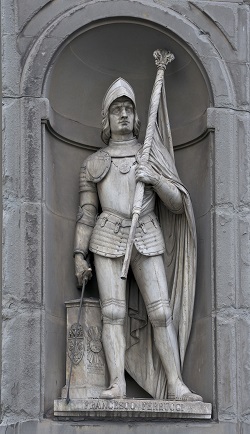
On this date in 1530, Francesco Ferruccio (or just Ferrucci) and his executioner Fabrizio Maramaldo clinched their immortality at the Battle of Gavinana.

The battle was the tragic final scene of the War of the League of Cognac, in which an alliance of Italian city-states tried to expel the Habsburg Holy Roman Emperor Charles V from the peninsula. Charles had already in effect decided matters by forcing the French out of the fight, which also brought about the capitulation of the Vatican.

Left alone in the fray, doughty Florence — ever so briefly at this moment restored as a Republic, having given the Medici the boot — continued to hold out against impossible odds. A vast imperial army swollen by landsknechts whose mercenary arms were now unnecessary elsewhere in Italy besieged Florence on October 24, 1529.


The Siege of Florence, by Tuscan Renaissance Man Giorgio Vasari.

The intrepid Florentine commander Francesco Ferruccio (English Wikipedia entry | Italian) strove to take his hopeless fight to the enemy. After a plan to coerce papal support by striking Rome was vetoed, Ferruccio mounted a march through the Apennines to threaten the Imperials’ rear.

He was intercepted at Gavinana, a battle decided by the arrival of landsknecht reinforcements under the command of the notoriously cruel condottiere Fabrizio Maramaldo.

Maramaldo would elevate himself for posterity out of the ranks of his merely brutal brethren by finding Ferruccio, badly wounded, his prisoner, and putting him to immediate death by his own hand — an execution that resulted in Florentine capitulation one week later, and the installation of Alessandro de’ Medici as Duke of the now ex-Republic.*

While admittedly borderline as an “execution” suitable for this here site, Ferruccio’s defiance in the face of his killer and his last denunciation of Maramaldo — “Coward, you kill a dead man!” — became the stuff of legend in a later Italy. (It also helped Ferruccio’s case for the nationalist pantheon that he died fighting against the Germans, not against the next city-state over.)

The romantic novelist Francesco Domenico Guerrazzi** made Ferruccio the subject of his magnum opus L’Assedio di Firenze, and before you knew it the name was on the lips of every risorgimento Tom, Dick and Francesco. Garibaldi invoked him in speech; Goffredo Mameli wrote him into the national anthem.


Every man has the heart
and hand of Ferruccio …

Under the Italian state those men helped to make, Ferruccio was appropriated as the name of a battleship; fascist Italy especially found Ferruccio congenial to the national-pride project and valorized the martyr relentlessly.


1930 Fascist Italy stamp depicting — for the 400th anniversary of the occasion — Fabrizio Maramaldo murdering his prisoner Francesco Ferruccio. Other Februccio stamps from the same period can be found on the man’s Italian Wikipedia page.

For Maramaldo, a less flattering but possibly more durable legacy: Italian gained the noun maramaldo, the adjective maramaldesco, and the verb maramaldeggiare to signify bullying or cruel domineering.

* Alessandro had a reputation for despotism, and was assassinated a few years later by his cousin Lorenzino de’ Medici in a tyrannicide that was Brutus-like in both its motivation and effect. That later affair is the subject of the 19th century play Lorenzaccio.

** Guerrazzi also did his bit for the legend of Beatrice Cenci.

On this day..

1938: Vladimir Kirshon, Bulgakov antagonist

On this date in 1938, Soviet playwright Vladimir Kirshon was shot at the Kommunarka “special object” shooting range outside Moscow.

Kirshon (English Wikipedia entry | Russian), purged as a “Trotskyist counter-revolutionary” as one might assume from the date and place. And like many peers in those terrible years, it was Kirshon’s to suffer the martyr’s fate without the merit of the martyr’s service.

In his day — which ran up to the spring 1937 fall of his patron, NKVD chief Genrikh Yagoda — Kirshon had distinguished himself with servility.

In his capacity as a Soviet writer’s guild bigwig, the ideologically rigorous Kirshon had been a point man in the depressing 1929-1932 campaign against the early Soviet Union’s rich literary heterodoxy. (Sample slogan: “For the hegemony of Proletarian literature! Liquidate backwardness!”)

This chilly period drove dystopian novelist Yevgeny Zamyatin to exile, and futurist poet Vladimir Mayakovsky to suicide.* The novelist and playwright Mikhail Bulgakov, a writer whose manuscripts from the furnace of Stalinism were forged for immortality, was also long harried by Kirshon. Kirshon’s pull nearly ruined Bulgakov’s career at what should have been its peak.

Bulgakov returned the contempt of his persecutor from a position of considerable literary superiority. Kirshon’s own work tended to the glorification of doctrinaire communism — he produced a verse celebrating the Civil War’s martyred 26 Baku commissars; Bulgakov has on his c.v. perhaps the signal achievement of 20th century Russian letters, The Master and Margarita. Little wonder to find Bulgakov complaining in private correspondence of the waste Kirshon has made of a trip to Europe, churning out the sort of tendentious and formulaic Soviet-man-abroad literature that any loyal commissar could have written without setting foot from Moscow. But despite the very real injuries Kirshon had done to him, Bulgakov found the baying denunciation theater so distasteful that he declined to say a public word against Kirshon when the latter fell.

The diary of Bulgakov’s wife Elena is not quite so diplomatic.

21 April 1937

A rumour that Kirshon and [Alexander] Afinogenov are in trouble. They say that [Leopold] Averbakh has been arrested. Is it possible that Nemesis has been visited upon Kirshon?

23 April 1937

Yes, Nemesis has come. There are very bad stories in the press about Kirshon and Afinogenov.

(These entries, quoted via J.A.E. Curtis’s Manuscripts Don’t Burn: Michael Bulgakov: a Life in Letters and Diaries, refer only to Kirshon’s professional fall. He was not arrested until that August.)

Kirshon was posthumously rehabilitated in the Khrushchev era and some of his work has even been performed in post-Communist Russia. But according to this Russian-language Bulgakov trove, that old foe made perhaps Kirshon’s lasting literary monument by using him as the model for the character Polievkt Eduardovich in Bulgakov’s short story “It Was May” (Russian link): it’s a story about a foppish critic who returns from abroad with specious critiques that force the narrator to ruin his own play by diverting the story to the arrest and purging of its principal character.

Thanks to friend of the blog Sonechka for translation and background.

* Mayakovsky shot himself at age 37; there’s also a popular hypothesis that he did this to check out at the same age as Pushkin.

On this day..

1651: Wilhelm Biener, faithful counsellor

On this date in 1651, Wilhelm Biener, late the chancellor of Tyrol, lost his head to the rancor of Tyrol’s landed aristocracy.

A barrister by training and eventually a judge, Biener or Bienner (English Wikipedia entry | German) transitioned into a court position under Leopold V, Archduke of Austria. Leopold’s death in 1632 left a four-year-old heir, Ferdinand Charles; the boy’s mother, Claudia de’ Medici, leaned increasingly on Biener’s counsel as she ably kept Tyrol in order (and out of the devastating Thirty Years’ War) while little Ferdinand aged towards his majority.

As a commoner, no dynastic entanglements of his own divided his attentions from the state’s own interest, a fact that Claudia de’ Medici recognized in elevating Biener to the chancellorship in 1638, and that the land’s magnates recognized in the strictly levied taxes Biener extracted from their resentful purses.


Detail view (click for full image) of Karl Anrather’s 1891 painting of Wilhelm Biener holding forth against the Tiroler Landtag, from the Ferdinandeum at Innsbruck.

We’ve seen quite often enough in these pages that the danger undertaken by such figures should their enemies ever find power over them mitigates the honors and emoluments they are like to enjoy while in office. One gets a sense of the undercurrent of biding violence from the remark of the Bishop of Brixen, directed to forward the required revenues in a letter less deferential than a senior cleric thought he was due: “The man deserves to lose the fingers that could write such an intemperate effusion!”

For Biener, the volcano opened under him with the death of his patron Claudia de’ Medici on Christmas Day 1648. Her boy Ferdinand Charles was all of 20 years old now, wet behind the ears and enamored of courtly profligacy. Despite his affection for Biener and his long service to his mother, the young prince would vacillate on sparing the consigliere until it was too late.

Biener’s enemies struck with a secret trial accusing him of wetting his own beak on the imposts he had imposed on Tirol; the account below of what followed from a travelogue probably reflects the posthumous myth of Biener more faithfully than it does the real man.

[Biener] was ultimately condemned, in 1651, to lose his head. Biener sent a statement of his case to the Archduke Ferdinand Karl; and the young prince, believing the honesty of his mother’s faithful adviser, immediately ordered a reprieve. The worst enemy and prime accuser of the fallen favourite was Schmaus, President of the Council … and he contrived by detaining the messenger to make him arrive just too late in Rattenberg, then still a strong fortress, where he lay confined, and where the sentence was to be carried out.

Biener had all along steadfastly maintained his innocence; and stepping on to the scaffold, he had again repeated the assertion, adding, “So truly as I am innocent, I summon my accuser before the Judgment-seat above before another year is out.” When the executioner stooped to lift up the head before the people, he found lying by its side three fingers of his right hand, without having had any knowledge that he had struck them off, though he might have done so by the unhappy man having raised his hand in the way of the sword in the last struggle. [more likely they were folded in prayer. -ed.] The people, however, saw in it the fulfilment of the words of the bishop, as well as a ghastly challenge accompanying his dying message to President Schmaus. Nor did they forget to note that the latter died of a terrible malady some months before the close of the year.

Biener’s wife lost her senses when she knew the terrible circumstances of his death; the consolations of her director and of her son, who lived to his ninetieth year in the Franciscan convent at Innsbruck, were alike powerless to calm her. She escaped in the night, and wandered out into the mountains no one knows whither. But the people say she lives on to be a witness of her husband’s innocence, and may be met on lonely ways proclaiming it, but never harming any. Only, when anyone is to die in Büchsenhausen, where her married life passed so pleasantly, the ‘Bienerweible’ will appear and warn them.

Living on in Tyrol folk tradition, Biener took a leap into the Romantic-era national consciousness thanks to writer Hermann Schmid, who popularized Biener’s legend with a 19th century historical novel, The Chancellor of Tyrol; public domain versions can be read online in two volumes (1, 2); a theatrical adaptation by Josef Wenter is still staged to this day. It’s possible that this imprint on the Zeitgeist led a Bohemian writer to christen his fictional executed outlaw “Vilem” in the Czech poem Maj.


Marker honoring Wilhelm Biener in the Austrian Tyrol town of Rattenberg, where Biener was executed on July 17, 1651.

On this day..

756: Yang Guifei, favored concubine

On this date in 756, the imperial consort Yang Guifei was expediently executed during the An Lushan Rebellion.

The Tang dynasty Emperor Xuanzong, whose beloved concubine Yang was, undertook this cruel extremity only in great duress. Initially married to one of the emperor’s sons, Yang so enamored the emperor that he usurped the prince’s place and got the kid a different wife. In the c. 800 classic poem “Song of Everlasting Sorrow” the poet Bai Juyi mused on the smitten sovereign rushing headlong into waiting tragedy.

The emperor neglected the world from that moment,
Lavished his time on her in endless enjoyment.
She was his springtime mistress, and his midnight tyrant.
Though there were three thousand ladies all of great beauty,a
All his gifts were devoted to one person.

Indeed, over the 740s Yang’s relations rose at court on the strength of her hold over the emperor, causing no few resentments among courtiers now obliged to flatter them. She’s been cast as a femme fatale, a siren whose chords called the emperor to capsize his own ship of state.

The general An Lushan was the rock of his ruin. Though An Lushan’s revolt would one day claim Yang’s life, he was a great favorite of hers and eventually adopted as Yang’s son; it was whispered that the imperial gifts showered on this commander might reflect favor with the concubine quite surpassing the bounds of propriety.

The most important favor was command of all northern China’s garrisons, with 150,000-plus troops.

His influence (and the fact that he was not ethnically Han, but of Turkic and Iranic extraction) made him rivals at the imperial court, even including the concubine Yang’s cousin, chancellor Yang Guozhong.

One can speculate as to who suspected whom first, but as we’ve seen with the Roman Empire a sufficiently strong inducement to treachery inevitably becomes tantamount to the real thing: eventually one’s intemperate supporters or implacable enemies will cast the die for even the most retiring general. An Lushan was Caesar enough to cross the Tang’s Rubicon, which for him was the Yellow River, above which his armies had been confined.

In the winter of 755-756, An crossed this river and marched towards Chang’an (Xi’an, then the imperial capital and the world’s most populous city), styling himself the Emperor of Yan. This aspirant state proved far from durable, and vanished by 763 — but by the time that long term had come into view, all of our principal characters were dead.

Yang Guifei was the first of them. (Plenty of secondary characters — generals, eunuchs, rivals and family of rivals — were being put to death all along and well before Yang, of course.) As the rebel army advanced on the capital, Xuanzong and his court fled in panic, Yang included. One day’s march further inland towards Chengdu, the royal guards themselves rebelled. Embittered like many others by the sway Yang and her family held — and blaming the consort for the ignominious retreat they were embarked upon — the soldiers refused to proceed without Yang’s execution. Xuanzong had little choice under the circumstances but to assent to her summary strangulation.

The Son of Heaven made good his escape, and his kingdom prevailed in the fight. (An was assassinated in 757.) Xuanzong himself, however, had to abdicate in favor of his son before the chaotic summer was out, and lived out his last five years as Taishang Huang, “Retired Emperor”.

One can only guess at the regrets he had in those days for the beloved mistress sacrificed to the safety of his person and throne. It’s a circumstance that has become a staple of Chinese literature over the centuries since, from the aforeentioned Bai Juyi right down to the present day, in every medium imaginable.

In Bai’s “Song of Everlasting Sorrow”, the bereft former emperor at last sends a Taoist priest to the heavens in search of his lost love, whose spirit has not even appeared to him in a dream. Yang Guifei sends the messenger back with a last pledge of sundered love:

“Our spirits belong together, like these precious fragments,
Sometime, in earth or heaven, we shall meet again.”
And she sent these words, by the Taoist, to remind him
of their midnight vow, secret between them.
“On that Seventh night, of the Herdboy and the Weaver,
In the silent Palace we declared our dream was
To fly together in the sky, two birds on the same wing,
To grow together on the earth, two branches of one tree.”

Earth fades, Heaven fades, at the end of days.
But Everlasting Sorrow endures always.

Yang Guifei’s tomb remains a popular tourist destination to this date.

On this day..

1578: Ivan Pidkova, Cossack hetman

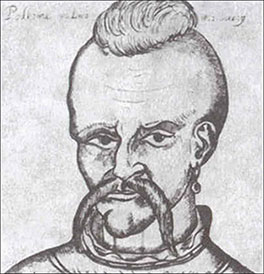
On this date in 1578, Cossack hetman Ivan Pidkova lost his head in Lviv.

Pidkova* — the name means “horseshoe” and alludes to the horsemanship that would be de rigueur for a Cossack leader — had risen by his aptitude to leadership of the Zaporozhian Cossacks in present-day Ukraine.

His death was a bid to promote himself from the steppe to power over neighboring Moldavia, and in fairness to Ivan Moldavia was worth a go.

Its throne was held at that time by a new guy named Peter the Lame, and although the nickname just referred to Peter’s physical deformity, he was a creature of the Ottoman court who scarcely knew Moldavia before he became its vassal ruler in 1574. He was twice temporarily deposed before finally voluntarily resigning in 1591 so that he could retire to the comforts of Italy.

The first deposition came courtesy of our man Pidkova.

Claiming kinship with Peter’s late predecessor Ivan III,** Pidkova seized Iasi and proclaimed himself hospodar of Moldavia until the arrival of Ottoman reinforcements refuted the conceit.

This whole border region between the Polish-Lithuanian Empire to the north and the Ottomans to the south was a perennial trouble spot. Putatively subjects of the Polish crown, the refractory Cossacks were known to raid Ottoman territory illicitly and provoke diplomatic headaches on both sides of the border.

At this particular moment — 1578, that is — the Polish king Stephen Batory had only just concluded a truce with the Ottomans. As Batory had war with Russia to worry about, he was more than keen to keep his southern frontier calm; Polish troops captured the Cossack pretender and had him put to an exemplary death.


Monument to Ivan Pidkova in present-day Lviv. Image (c) stacy2005ua, a prolific photographer of Lviv’s environs whose work can be enjoyed at FaceAndHeart.com or on Flickr, and used with permission.

Ukraine’s national bard Taras Shevchenko celebrated Ivan Pidkova in an eponymous 1839 poem:

There was a time in our Ukraine
 When cannon roared with glee,
A time when Zaporozhian men
 Excelled in mastery!
They lived as masters — freedom’s joy
 And glory were their gain:
All that has passed, and what is left
 Is grave-mounds on the plain!
High are those ancient tumuli
 In which were laid to rest
The Cossacks’ fair white bodies
 In silken cerements dressed.
High are those mounds, serene and dark
 Like mountains they appear,
Their gentle whispers in the wind
 Of freedom’s fate we hear.
These witnesses of ancient fame
 Hold converse with the breeze;
The Cossacks’ grandson reaps the grass
 And sings old memories.
There was a time when in ukraine
 Even distress would dance,
And sorrow in a tavern drank
 In honeyed brandy’s trance.
There was a time when life was good
 In that Ukraine of ours …
Recall it then — perhaps the heart
 May briefly bathe in flowers.

II.

A murky cloud from Liman’s shore
 Covers the sun from sight;
The sea is like an angry beast
 That groans and howls with might.
It floods the mighty Danube’s mouth.
 “My fellows, come with me
Within our barks! The waves are wild.
 Let’s have a merry spree!”
The Zaporozhians rushed out;
 The stream with ships was roiled.
“Roar on, O sea!” they all sang out,
 As waves beneath them boiled.
Billows like mountains round them surged,
 They saw no land, no sky.
Yet not a Cossack heart grew faint,
 Their eagerness ran high.
A bold kingfisher flies o’erhead
 As on they sail and sing;
The brave otaman in the van
 Leads on their mustering.
He strides the deck, and in his mouth
 His pipe grows cold from thought;
He casts his glances here and there
 Where exploits may be wrought.
He curled his long black whiskers,
 He twirled his forelock free,
Then raised his cap — the vessels stopped:
&nbsp:”Death to the enemy!
Not to Sinope, comrades,
 Brave lads beyond all doubt!
We’ll drive on full to Istanbul
 To seek the Sultan out!”
“Well spoken, our fine chieftain!”
 They roared in chorus back.
“I thank you, lads!” He donned his cap.
 Again the seaward track
Beneath their keels began to boil;
 And once more thoughtfully
He paced the deck in mute content
 And gazed upon the sea.

That translation is via The Poetical Works of Taras Shevchenko; the original in Ukrainian can be enjoyed here. The exact text of that poem also comprises the lyrics of this jam:

* Or Ioan Potcoava, as Ivan came from Romanian stock.

** Moldavia’s own “Ivan the Terrible” — no relation to his Russian contemporary, of course.

On this day..

1942: Vladislav Vancura, “Marketa Lazarova” author

On this date in 1942, leftist Czech novelist Vladislav Vancura was executed at Prague’s Kobylisy shooting range.

An “unsung giant” of European letters, the Bohemian doctor burst onto the literary scene in the 1920s with Pekar Jan Marhoul (Baker Jan Marhoul) and Pole orná a válecná (Fields to Plough, Fields of War). But he was notable for a remarkable perspicacity in style, genre, and artistic perspective throughout his career. He’s often referred to as a poet in prose, and maybe for this reason was equally keen on writing for and directing cinema.

Milan Kundera credited Vancura with “probably the richest vocabulary that any Czech writer has ever had; a vocabulary in which the language of every era is preserved, in which words from the Bible of Kralice [the first complete translation of the Bible into Czech] stand humbly side by side with modern argot.”

His greatest commercial success and possibly his crowning achievement was Marketa Lazarova, a short novel (120 pages in the original Czech) set amid a feud of nobles in he Middle Ages. Only tranlated into English in 2013, it “does for Czech literature something akin to what James Joyce did for English-language literature with Ulysses: breaking with the realism that previously dominated to open up a new frontier in the realm of style.”

Here’s an excerpt (via):

Folly scatters without rhyme or reason. Lend an ear to this tale of a place in the county of Mladá Boleslav, in the time of the disturbances, when the king strove for the safety of the highways, having cruel troubles with the nobles, who conducted themselves downright thievishly, and what is worse, who shed blood practically laughing out loud. You have become truly too sensitive from musing upon our nation’s nobility and fair manners, and when you drink, you waste the cook’s water, spilling it ‘cross the table, but the men of whom I speak were an unruly and devilish lot. A rabble which I cannot compare to anything else than stallions. Precious little cared they of that which you account as important. Comb and soap! Why, they did not heed even the Lord’s commandments.

‘Tis said that there were countless such ruffians, but this story concerns itself with none save the family whose name most surely calls to mind Václav unjustly. Shifty nobles they were! The eldest amidst this bloody time was baptized with a graceful name, but forgot it and called himself Kozlík till the time of his beastly death.

Vancura’s death was plenty beastly too, albeit not particularly surprising: Communist avant-garde artists in German-occupied Slavic countries didn’t usually fare the best during the war years, and Vancura compounded his risk by taking active part in the resistance. He was among hundreds of Czechs arrested, tortured, and executed in the bloody German crackdown that followed the May 27, 1942 assassination of Reinhard Heydrich.

On this day..

1864: Nikolay Chernyshevsky’s “civil execution”

On this date in 1864, the Russian writer Nikolay Chernyshevsky was publicly executed in St. Petersburg.

Then he was shipped to Siberia.

Chernyshevsky’s punishment was only a pantomime “civil execution,” somewhat akin to the symbolic executions by effigy elsewhere in Europe. In this case, the faux death penalty was imposed not upon a peeling portrait but on Chernyshevsky’s actual person: “The hangmen led Chernyshevsky to the scaffold on Mytninskaya Square in St. Petersburg, made him kneel down, broke a sword over his head and then chained him to the pillory. Chernyshevsky stood calmly under the rain waiting for this mockery to come to an end.” (Source)

The pillory, exposed to the hoots and brickbats of an offended populace, was supposed to be a humiliation to its sufferer; occasionally, it even proved lethal. Not so for Chernyshevsky: the crowd stood silently. Someone threw a bouquet of flowers.

This ludicrous theater was enacted to punish Chernyshevsky for his leadership of the St. Petersburg intellectual circle that gave birth to the Narodnik movement. Literally “going to the people,” this was a peasant-focused populist-democratic-socialist philosophy paradoxically germinated among Russia’s small coterie of intellectual elites.

Think Marxism for a feudal society here: the Narodnik adaptation was the hope that Russia’s vast peasantry could be roused to serve the part of a revolutionary working class, and skip Russia directly to a socialism still preserving communal traditions unsullied by that interim period wherein (per Marx in the Communist Manifesto) capitalism had “pitilessly torn asunder the motley feudal ties … [and] left remaining no other nexus between man and man than naked self-interest.”

This is why Chernyshevsky and the Narodniks viewed the “emancipation” of serfs of 1861 with a gimlet eye: it was a shift towards capitalist property relations, in which the feudal shackles were merely replaced with new, and heavier irons. Chernyshevsky subversively urged his “emancipated” countrymen to view the move as a heist.

It is of course unlikely that many of the actual peasant malcontents stirred up in the wake of the emancipation perused Chernyshevsky’s “To the Manorial Peasants from Their Well-Wishers, Greetings”. But other bourgeois radicals who did read that sort of thing would in due time — after the suppression of the Narodniki in the 1860s and 1870s drove its underground remnants to terrorism — spawn the revolutionary network Narodnaya Volya, and assassinate the tsar who enacted that emancipation, Alexander II.

Chernyshevsky was more a writer than a fighter. He spent his pre-“execution” imprisonment in Peter and Paul Fortress forging his definitive contribution to the movement — the novel What Is To Be Done?.*

(Our own Sonechka regards What Is To Be Done? as quite possibly Russia’s single worst literary product, but the didactic novel imagined (in the dreams of its principal character, Vera Pavlovna) an egalitarian future, including for women. Chernyshevsky himself wrote that he “possess[ed] not one bit of artistic talent … any merit to be found in my tale is due entirely to its truthfulness.”)

Whatever its artistic shortcomings, What Is To Be Done? entered the revolutionary literary canon. Vladmir Ilyich Ulyanov — better known as Lenin — wasn’t even born until 1870 but as a young man he admired What Is To Be Done? In 1902 Lenin himself published a political pamphlet under that same title.

Far less impressed were the likes of Dostoyevsky, himself a former radical who also underwent mock execution in his time. Unlike Chernyshevsky, Dostoyevsky apostasized from his revolutionary credo; Dostoyevsky’s 1864 Notes from the Underground is “a bitter artistic answer” to (and in several spots a direct parody of) Chernyshevsky’s magnum opus.

* What Is To Be Done? responds to Turgenev‘s Fathers And Sons. A previous Narodnik classic by Alexander Herzen asked the parallel question Who Is To Blame?.

On this day..