1726: James Stephens and Patrick Barnel, broadsided

On this date in 1726, two men hanged on Dublin’s St. Stephen’s Green.

We meet these men, as we often do in this period, through the cheap hang-day publications that were hurried to press to sell for the occasion, and since in this instance we have two such brochures for the same event, it is a handy occasion to turn our gaze upon these ubiquitous ephemera.

Then as now, publishing was a perilous hustle forever beckoning its practitioners to shady expedients further to enhancing narrow margins.

Public executions — especially those of particularly notorious offenders — were pretty much the clickbait of broadside printers, and this one weird trick they could resort to was hawking rival pages each purporting to be the “last words and confession” of the poor sap on the gallows. Competition for access to a condemned fellow was intense, and where there could be the least question as to authenticity (for formulaic plausibilities could easily be hung around the handful of publicly discoverable facts) printers made free to use these solemn partings to take astonishingly vituperative shots at their commercial rivals* — a sure irreverence entirely in keeping with the carnivalesque orgies for which public hangings became infamous. Here a huckster whose main purpose is to use a dying man’s last passion to retaliate a rival scribbler’s previous libel, there a future gallows-bird relieving a gawker’s pocket of the penny he meant to waste on the tabloid.

Well might we latter-day ghouls thank these unprincipled pushers: their scandalous documents, be they ever so compromised and artless, constitute a rare and precious glimpse into the criminal class of the early modern world.

We are indebted in this instance to James Kelly’s fascinating Gallows Speeches From Eighteenth-Century Ireland, a book we have previously cited, for the two rival, contradictory, and mutually recriminatory broadsides recounting this execution. As Kelly’s own introduction notes, the mere existence of multiple competing reports — which we here humbly present for the reader’s discretion — does underscore “that public demand could sustain this volume of publication in individual instances.” And that fact alone would surely make the list of 26 secrets to make it as a printer in the the 18th century.


The True Last Speech, Confession, and Dying Words of
Mr. James Stevens and Account of Patrick Barnwell

who are to be executed at St. Stephen’s Green, on Wednesday the 25th Inst. May, 1726, being condemn’d for feloniously taking from Mr. Philip Kennersly of Dame-street, a Glas-case, Value 50l.

GOOD PEOPLE

If it were not usual for Men of every Degree, in my unfortunate Circumstances to make a Kind of Declaration at their Death of their past Behaviour, I shou’d not, as at this Day, nor even should the above mention’d Considerations move me to make this, my Only and Last, were I not sensible of the many Villanous [sic] Falsities, which might be publish’d concerning my unhappy Fate, by Persons of the vilest Characters themselves; such as one Hoy in Pembroke-Court, who publish’d a scandalous and wicked Paper on the last poor Wretches that suffer’d, under the name of G.F. or George Faulkner, a Person known to have no Being in this Kingdom, this long Time past, altho’ make his Tool and Screen for scandalizing the Chiefest of our Just and Good Governours, as vilely as the poor undone Wretches: Beside him, there is another as notorious for the like Villainy, living at the Rein Deer in Montrath-Street, unworthy, and noted for the above named wicked Practice. On these Considerations only, then I say, I the unhappy and unfortunate James Stephens, have thought fit to tender to Richard Dickson of Dame Street, Printer, THIS, for Publication, as he thinks proper.

FIRST, Then, since I see it is the Will of the most High God, whose Name be for ever Blessed, That in this World I should be brought from my Former happy, to this Wretched state, I submit, beseching [sic] humbly for his most Gracious mercy and Forgiveness for my manifold Transgressions in the Follies of my youth, and misspent Time, which began in the City of London, where I first Drew my Breath, being an entire Stranger here, of Creditable and Honest Parents, who Bred me Tenderly and well, till I was able to go Apprentice, which Time I serv’d to an Image-maker, after I had done with him, I Work’d for my self, and growing worth money, after I had spent some of my untainted Youth, in the Service abroad, belonging to the Ordnance, I set up to keep Hire-Horses, for the Court, in Nature of the great Mr. Blount, in the Parish of St. James, having Licenc’d coaches, and dealing for upwards of 500l, a year, till many Misfortunes comming [sic] on me, I was oblidg’d to leave my Native Country, and on a Woful [sic] Day, I came for Ireland with some small matter of Money, about a year since, where I follow’d making Images, till I came acquainted with the vile Woman Eleanour Fenly, who to save her Life at Tryal falsly [sic] said she was my Wife, Poverty forceing me to keep first with her, she pretending to have Friends who would make my Fortune, which alas! they have, it being her Brother, Fernando Fenly, and his Accomplice who swore my Life away, in declaring That about the 25th of March, last I have a Box of Goods, which were Mr. Kennersly’s, afterwards found in his Custody, and that I paid him 2 Shillings for carryage from the Sun Inn, in Francis Street, to Ross, which I vow all False, nor was I e’er Guilty of what was sworn, tho’ for it I must dye, having no Friend to appear for me, yet with the Constancy of a Christian who can accuse himself, of no great Crimes I go to meet my Fate, Dying in Charity with the World.

But this I further for my Innocency declare, I ne’er had Intention to rob Mr. Kennersly, nor e’er sold any of his Goods, but going into the Country with the Aforemention’d Eleanor Fenly to her Brother’s in Loghreagh, where he lives well; she came in Company with one Byrn, a Fellow [I] did not like and who resolv’d I suppose to do us an Injury, upon which I quarrel’d, and happening to be damag’d by some People in Caterlogh. I resolv’d to get Justice of which, being by ’em suspected, they got me apprehended on Suspicion of an idle Person, and Nell Fenly getting some Toys to sell there, she was discover’d at that time, on which her Brother made the Examination aforesaid, against me, which caused me to be transmitted and tryed upon it, to save his own Life; she as I before said, escaping by alledging she was my Wife &c. I may likewise add, that had not my Fellow Sufferer hop’d to have sav’d his Life, he cou’d have clear’d me, for which I pray God forgive him, And now Dear Christians, I have nought to say, but heartily beg that some of you, who shall see me dye, out of mere Pity to my unhappy State, (an entire and poor Stranger) will cover me with Earth, an Hindrance to those Men whose Business it is, to keep forlorn Wretches from their Graves, for private Practice o’er their mangled Bodies. I now conclude begging your Prayers to God for my Forgiveness, being about 37 Years of Age, A Protestant Member of the Church of England.

James Stephens.

PATRICK BARNEL Who is to dye with Mr. Stephens, on the Persuasion of some Friends has declin’d making further Confession, than to his Ghostly Father, which he desires so might be forth, lest any imprudent Person should pretend he had made any Speech, giving no further Account of himself, than that he was pritty [sic] well educated, and when young, that he serv’d Major Arthur, to whom he owns great obligation, that after he left him, he went to serve a Weaver, whose Business he after, follow’d, dating his Misfortunes to begin in being concern’d in Mr. Kenerslys Robbery; to whom he afterwards gave up several Things in hopes to save his Life. He Dies a Roman Catholick, begging the Prayers of All good Christians.

Mr. Gray having by Gracious Mercy, obtained a Reprieve, ’tis hop’d no notice will be taken of the absurd Pieces, design’d and publish’d, by the said Hoy in Pembroke Court, or under any feign’d Name whatever, which is notoriously known to be intended by Hoy, who surely will cheat the Publick with some scandalous and lying Paper, intitled a Speech to the abovenamed unfortunate Men, in prejudice and defamation to the Printer hereof, who unwittingly gall’d hiim, in saying th’other Day, He look’d like Death, when a Person affirm’d to his Face, in the open street, he said he was a MOLLY, (term well known for Sodomite) a charge so bold, that it might be wished, before he strives to taint another’s, he’d clear his own Character, from that Aspersion, if so it may be term’d.

Printed by Richard Dickson, and Gwyn Needham in Dames-Street.


The Last Speech, Confession and Dying Words, of
Patrick Barnel, and James Stephens

who are to be executed at St. Stephens Green, this present Wednesday, the 25th of this Inst. May, 1726. For the Robbery of Mr. Kinnersly in Dames-Street.

The Speech of James Stephens.

Good People,

I James Stephens, was born at Cheswick, about five Miles from London: my Parents put me to a free School to learn to write, where I had the Character of an unlucky Boy. At 14 Years of Age, I was entertained by the celebrated Jonathan Wilde, under whom I arrived to such Dexterity in Picking Pockets and Impudence in bare-fac’d Robberies, that I robb’d on a Play Night in Drury Lane Edward Martin, Esq, of 75 Guineas and a Gold Watch. My honest Master for the sake of a Reward of ten Pounds for the Discovery of the Persons who committed the Robbery, made Oath that I was the Person.

But I having Timely notice of it, fled to France, where I with some others Rob’d and Murder’d Mr. Lock, and the English Gentlemen in his Company, then I took Shipping at Calais, and landed at Cork, where Information in a little Time was given against Me, for several Robberies; this obliged me to come to Dublin, where I most impudently perform’d that unparalleled Roguery of Stealing a Glass Case with Rings, Silver Spoons, Snuff-Boxes, &c. to the Value of Seventy Pounds from Mr. Kinnersly Goldsmith in Dame Street. I heartily and sincerely repent of my horrid Crimes, and desire the Prayers of all my Fellow Christians. I dye an unworthy Member of the Church of England.

James Stephens.

The Speech of PATRICK BARNWELL

Good Cristians, [sic]

I Patrick Barnel was born in the County of Dublin of Poor, but Honest Parents; their mean Circumstances was in a great Measure, the Cause of my Present Misfortune, for they could not give me any Education, and I was often obliged to take away from the little Children of the same Town their Victuals to satisfie my Hunger, when I was a Boy, I stole several little Things, and escaped without Punishment.

I was induced to commit great Rogueries; I became acquainted with a Gang of Tories who kept their Rendevouz [sic] in the County of Kerry with whom I committed such Cruel and Barbarous Actions, that we were all Obliged to disperse and shift every one for himself, it was my Fate to come to this City where I had not been above Six Months, before I introduced into the Company of my ellow-Sufferer, who was the Head of a Gang of about a Dozen, having no Manner of Subsisting myself.

I committed several petty Thefts with him and others, and at last that most notorious one for which I now die, I cannot deny that I am guilty, but having a true sence of my Crimes, I repent of them, and I desire your Prayers for my soul, I die a Member of the Church of Rome in which I was bred, and the Lord have mercy on my poor Soul.

N.B. On Sunday last, one Dickson a Printer who publishes Papers under the Name of G Needham, came to us in Newgate, and we not thinking him a proper Person to make any thing publick from us. We desire the publick be aware buying any Speech of ours from him, for whatever is printed by him is an Imposition of the Town, and can only be excused by his saying, He is a poor Boy, and must endeavour to better his miserable Circumstances, and maintain himself and his little Family. He had already advertised, that he has the Speech of one who is not to die.

Dublin: Printed by G.F. in Castle Street.

* The emoluments available for intermediating the sentiments of the hanged become quite obvious through the lucrative quasi-monopoly the Ordinary of Newgate was able to establish around his privileged access to London’s condemned.

On this day..

1841: Peter Robinson, Tell-Tale Heart inspiration?

On this date in 1841, Peter Robinson hanged for a New Jersey murder. Little could he have imagined that he was on his way to the literary canon.

A wealthy merchant and banker named Abraham Suydam had disappeared, and suspicion quickly settled on Robinson — one of his debtors, who suddenly seemed to be a little bit flush with cash and a timepiece too rich for his station in life.

Robinson was arrested and examined before the Mayor of New Brunswick, and from his confused manner and contradictory statements, it was determined that his house should be searched. Accordingly the Mayor, accompanied by several constables, and a number of citizens, proceeded to Robinson’s house for the purpose of searching it. Every room, nook and corner in the upper stories of the house were searched, but without success. At last one of the constables proposed to adjourn to the cellar and see what could be discovered there. This proposition caused the greatest trepidation on the part of Robinson, who strongly remonstrated against it.

He stated that if the floor of his cellar was removed, it would endanger the safety of the building, and there was no telling what would be the consequences. This only made the party feel the more convinced of Robinson’s guilt, and they immediately commenced operations removing the plank of the cellar. A few boards and the earth underneath only had been removed, when the dead body of the unfortunate Mr. Suydam, to the astonishment of all present, was found. His skull was found to be dreadfully fractured, and his head was horribly disfigured by the marks of blows which had been inflicted on it. From the state of his body, it is supposed that he was murdered eight or nine days ago. (New York Commercial Advertiser (Dec. 15, 1840.)

It is commonly thought — thought there does not appear to be any direct evidence for it — that this nationally infamous body-under-the-floorboards murder helped to inspire Edgar Allan Poe‘s classic short story “The Tell-Tale Heart”.*

Published in January 1843, “The Tell-Tale Heart” features a young man who murders an old man, stashes his body under the floor, then pleasantly dissipates the suspicions of the police until a sensation of the victim’s heart noisily throbbing overwhelms him into a confession:

Was it possible they heard not? Almighty God! — no, no! They heard! — they suspected! — they knew! — they were making a mockery of my horror! — this I thought, and this I think. But anything better than this agony! Anything was more tolerable than this derision! I could bear those hypocritical smiles no longer! I felt that I must scream or die! — and now — again! — hark! louder! louder! louder! louder! —

“Villains!” I shrieked, “dissemble no more! I admit the deed! — tear up the planks! — here, here! — it is the beating of his hideous heart!”

Poe’s nameless character denies a motive for the crime, attributing it only to the victim’s “eye” — a mythologizing device which has surely aided the story’s longevity.

Object there was none. Passion there was none. I loved the old man. He had never wronged me. He had never given me insult. For his gold I had no desire. I think it was his eye! — yes, it was this! He had the eye of a vulture — a pale blue eye, with a film over it. Whenever it fell upon me, my blood ran cold; and so, by degrees — very gradually — I made up my mind to take the life of the old man, and thus rid myself of the eye forever.

But if Robinson was the source material, the occult power of the old man’s “eye” was nothing but the oldest motive in the world: plain old luchre.

In 1839, Robinson had borrowed $400 from Abraham Suydam to buy a lot and begin construction of a home upon it, but soon found himself (to use a familiar but anachronistic parlance) underwater.

“Every one to whom I owed a few dollars was after me to sue or get me to give my furniture for the debt,” Robinson recounted in a tearful confession 48 hours before his hanging. (We excerpt it here from the April 17, 1841 Baltimore Sun.) “I did so; I did all that I could; I was driven nearly crazy by these debts … I let them take my furniture until there was scarcely any thing left in the house; and I was ashamed to let any one come into it to see how very poor we really was, and how bad off.”

The dunning of creditors and the passion of the crime left the murderer’s mind awash in dollars and cents.

Even facing a far more considerable penalty than bankruptcy, Robinson’s confession is obsessed with the winnowing margins of his former debts; scarcely a paragraph elapses without citation of a meticulous mental ledger-book. Robinson recalled the bills incurred to construct his home (“I bought about $250 worth of lumber … The mason work was done for me by Mr. Chessman; for this I was to pay Mr. C. $210. I paid him $110 in cash, and gave him a mortgage for $100 … I had bought some sash frames for my house of a man, and they came to $22.25” …). He dwelt on his negotiations with Suydam and complained of the lender’s tightfistedness; he recalled the precise value of what he was able to steal from Suydam’s body (“$10 in money, not a cent more … [in] his pantaloons pockets … only two shillings and a penknife”) and the expenses incurred to evade justice (he offered his brother $50 to burn his house down for the insurance, then took a bath unloading Suydam’s gold watch — it “was worth double what I got for it”); yet even so, he was still a little proud of his diligence assailing his debt, in contrast with “Thorne who bought a lot close by mine” and with whom “Mr. Suydam got out of patience.” The killer even had the brass to pat himself on the back for not destroying the papers Suydam had on him: thus, “the relations of Suydam, and his friends, can’t say that they lose any money by the murder.”

So, about that murder.

Luring Suydam to his house to make a payment on Thanksgiving Day, Robinson invited him down to the creepy basement to do business, having prepared his instrument like Patrick Bateman.

At this time I took up a mallet, which I had placed in the basement ready to knock him over with. I then went into the front basement, Mr. Suydam in front of me. I followed behind with the mallet in my hand, he not noticing the same. My intention then was to murder him in the front basement — but my heart failed me. We then went up stairs again in the back room, I carrying the mallet against the palm of my hand. We stood by the fire talking about the house. He was there nearly fifteen minutes. I stated that my wife staid a long time.

He told me that he would go out and take a wall, and return again. He started to go, and I followed, until he got just through the doorway of the back room, which is within three or four feet of the back door, in the entry. I then knocked him down on his knees with the mallet, by striking him n the back of his head, through his hat. He undertook to rise, when I struck him again on the head, and he fell over, and laid still and senseless. I then supposed he was dead, and laid the mallet down; I then went and turned the button of the front door, which all this time was unfastened; and I went down into the front basement. I then went to work and began to dig a small hole; after I had been digging for two minutes, I thought I would not leave the body up stairs; so I went up stairs to bring him down. I saw him on his hands and knees, with his face and hands all bloody. He cried out, “Oh! Peter!” once or twice. Had he begged for his life then, I believe I should have let him off; but I did not want to drag him down stairs alive, and I didn’t want to see him linger there in misery; so I seized the mallet, and again struck him on the head, which knocked him perfectly dead, as I supposed. …

I discovered a chain hanging out of his pocket, and drew from it his gold watch, and put it in my own pocket. I then dug the hole larger, and in throwing out the dirt I threw about half a load of it on his body and head, which completely covered it. He then groaned a little, but I shuddered to hear him, and so I got out and stood upon the dirt and on his head to smother him! He then groaned so hard that I got off from him and struck him with the edge of the spade upon the head, which sunk completely to the brain, and which killed him instantly! …

I now felt as if my heart was completely black, and I was so hardened and callous, and yet so cool and deliberate, that I could have murdered many more. I could, without flinching or hesitating, have killed twenty men if they had come on me one by one.

I don’t believe that I was over a half hour doing the whole exercises of the whole thing! For I had a kind of knack of doing work somehow that others hadn’t. And why, sir, I’ve took hold of floor plank before now, and done forty-five of them in one day, that is, planed and ploughed and grooved them; whereas from sixteen to eighteen is a day’s work for some men.**

As if to complete the American Gothic quality of the crime, Robinson fell through the rope on the first attempt to hang him, then painfully strangled to death on the second try.

* Poe took up a very similar theme — the criminal psychology of a domestic murder concealed by subterranean immurement — later that year in “The Black Cat” (published in August 1843).

** His last wish in this confession: “whatever you do, don’t let the doctors get hold of me and make medicine of me.”

On this day..

1781: Diego Corrientes Mateos, Spanish social bandit

On this date in 1781, the Spanish social bandit Diego Corrientes Mateos was hanged and quartered in Seville.

A robber who plied the roads from Portugal to his native Seville, Corrientes (English Wikpedia entry | Spanish) was said to be of farmworker stock himself. His consequent good treatment of the rural common folk enabled him to operate with great freedom and situated him as a Robin Hood character; folklore has consequently inflated the valor of his exploits and the bile of Sheriff of Nottinghamesque pursuers like the lieutenant governor of Seville. For example, surprising his adversary on one occasion, Corrientes is supposed to have remarked, “I have learned that you boast you will be able to capture me.”

“Yes, and hang you,” shot back Francisco de Bruna.

“Then I must spare your life so you can fulfill your promise,” the sporting Corrietes allowed. (The reader will discern that Francisco de Bruna soon made good his threat.)

By the 19th century, he’d become a positive fixture of romantic and nationalist literature.

On this day..

Unspecified date: Mariotto Mignarelli, proto-Romeo

On a never-specified date in 15th century Siena, the tragic lover Mariotto Mignarelli was beheaded in Masuccio Salernitano‘s story Mariotto and Ganozza — the apparent wellspring (via an English interlocutor) for Shakespeare’s Romeo and Juliet.


Mid-16th century translation of Romeus and Juliet by Arthur Brooke. (via)

Masuccio’s tale is itself an Italian Renaissance gloss on an old Ovid story; its outline will be instantly recognizable to devotees of the Capulets and Montagues. But instead of dueling suicides, Masuccio ends one of the star-crossed lovers with an executioner’s blade.

In Mariotto and Ganozza, which can be enjoyed for free in the original Italian here or here, the young lovers secretly wed only to find “that wicked and hostile fortune reversed all their present and future desires.”


These violent delights have violent ends
And in their triumph die, like fire and powder …

“Fortune’s” inscrutable hand turns out to be that of Mariotto himself, who gets into a fight with some other nobleman and, slaying him, must flee into exile. Posterity must excuse Mariotto/Romeo his hotheadedness, for were he not the type to wreck his own life by murdering a guy in a street fight he also wouldn’t be the type to pursue forbidden tragic romance. That’s art.


Fortune’s fool …

“How great was the supreme grief of the two most wretched lovers, so lately wed, and how bitter their tears at the thought of what they believed to be their endless separation, he alone who has been pricked by such wounds can truly tell.” (Translation source.)

“So deep and bitter it was, that at their last parting, they seemed for a long while to have died in each other’s arms.”

It next comes to pass that Gianozza’s father, ignorant of her secret marriage to the town fugitive, arranges a match for her. This development leads our Juliet figure to seek out the aid of the friar who has secretly wed them in a scheme that is precisely Shakespearean.

The friar “made up a certain water with certain concoctions of various powders that, when the draught was ready and she had drunk it, it would not only make her sleep for three days, but seem to be really dead.” With this potion they stage Gianozza’s death; then, the friar secretly steals her hibernating “corpse” from its tomb, revives her, and packs her off to find her beloved.

He, of course, has separately received word of Gianozza’s death — and (also of course) the courier that had been dispatched pre-death elixir to clue him into the plan has been waylaid by pirates and left his essential plot spoilers at the bottom of the sea.

Disconsolate, Mariotto returns to Siena with the unproductive object of mooning over Gianozza’s grave and “weep[ing] as if their lives were ended.” Don’t worry, he has a backup plan! “If by misfortune he was recognized, he thought he would gladly be condemned as a murderer, knowing that she was already dead whom he loved more than himself and who loved him with equal love.”

This works as well as you expect, albeit with less panache than Shakespeare’s crypt climax: Mariotto gets caught in a transport of the macabre trying to break into Gianozza’s sepulcher, and is recognized as a condemned outlaw.

Before dawn, all Siena was full of the news, which reached the ears of the Court, who ordered the mayor to go and arrest him and quickly do that which the laws and the State commanded.

So, a prisoner in fetters, Mariotto was led to the palace of the mayor. When he was flogged, without needing long tortures, he faithfully confessed the cause of his desperate return. Though all alike had the greatest pity for him, and amongst the women he was bitterly wept for and thought the only perfect lover in the world, and each of them would have willingly redeemed him with her own life, yet he was at once condemned by the law to be beheaded. When the time arrived, without his friends or parents being able to aid him, the sentence was carried out.

Three days later, Gianozza — having reached Mariotto’s former refuge of exile and there learned of his misapprehension — turns up in Siena again only to discover that she is too late. Rather than stabbing herself to death right then and there as the Bard’s heroine would do, she shuts herself up in a convent “with intense grief and tears of blood and little food and no sleep, continually calling for her dear Mariotto, [and] in a very short time ended her wretched days.”


Prokofiev’s unwilling balletic finale

On this day..

1638: Stepan Ostryanin, Cossack hetman

(Thanks to friend of the blog Sonechka for research, translation, and background information touching this post. -ed.)

October 14 (October 1 O.S.) is a liturgical feast celebrating the protective intercession of the Virgin Mary, a date of particular significance in Russia and Ukraine. Indeed, Red Square’s St. Basil’s Cathedral is actually the Cathedral of the Intercession of the Most Holy Theotokos [i.e., Mary] on the Moat, just one of many Orthodox churches so named.

Also known as Pokrov — a quaint Slavic term for covering, denoting safeguarding — the holiday celebrates an incident from 10th century Byzantium when a saint beheld Mary descend through the dome of the church, then spread her garment protectively over the entire congregation.

It is of special significance in Ukraine where the ecclesiastical celebration pulls double duty as the Day of the Ukrainian Cossacks. And it is in honor of Pokrov that we dedicate this post.


17th century icon of the Madonna’s broad cloak protecting Ukrainians.

On an unspecified date in 1638, a Cossack named Ostryanin was broken on the wheel in Warsaw … maybe.

The Ostryanin Uprising of 1638 was one of the ongoing cycle of Cossack disturbances in the southern reaches of the Polish-Lithuanian Empire — modern-day Ukraine. Like many of these, it was a short-lived affair considered on its own, but the pattern of disaffected Cossacks struggling against the Polish crown for some combination of recognition, largesse, and autonomy was an ongoing pattern in the 17th century — and by the 1650s it would begin tearing apart the formerly mighty Polish-Lithuanian realm and transferring Ukrainian territory from Polish to Russian domination.

Tradition held that after the rising was stamped out in the summer of 1638, Stepan Ostryanin himself was treacherously seized and taken to Warsaw for execution. A late 18th century chronicle* of a distinctly patriotic bent called Istoriya Russov embroiders upon that death by breaking-wheel with racist gusto:

in accord with their treachery, insidious and duplicitous, having learned through their Jew spies that hetman Ostryanin’s would travel unguarded … the Lyakhs [term for “Poles”; it’s derogatory in present-day Russian but may have been less so at the time -ed.] surrounded him in Kanev monastery with a host of men. They, having tied the hetman and his men, altogether thirty seven people, … prepared an execution for them in Warsaw unprecedented in its cruelty, which posterity will scarcely believe to be true, because it would not occur to even the most barbarous and ferocious Japanese (!) and the reality of which would terrify the very beasts and monsters.

On the other hand, a Cossack named Yakiv Ostryanin was to be found on Russian soil in the subsequent years, until he was murdered in 1641. Some historians think that he was the very same namesake Cossack rebel escaped from Polish vengeance, and the story about him being broken on the wheel in Poland is pure sentimental folklore; alternatively, Stepan and Yakiv might have just been two different Cossacks named Ostryanin who met two different fates.

Quite a difference for our supposed Stepan Ostryanin, but a minor mystery from this distance in time. Nevertheless, our man, whoever he was, had a posthumous contribution yet to make to the letters of his Slavic brethren.

Polish historian Szymon Okolski rode along with the Polish commander Mikolaj Potocki in Potocki’s successful campaign of the spring-summer 1638 to suppress this rebellion. Okolski’s field diaries of the campaign are a key historical source on the Cossacks and are thought to have been used extensively by the Cossack-descended writer Nikolai Gogol in composing his short story Taras Bulba.

A product of Gogol’s youth, Taras Bulba has a rough romanticism — and a romanticism for the Cossack (read: national Ukrainian) cause specifically that nonplussed Russian authorities at the time. (And probably now, too.)

Taras Bulba‘s title character is a mature Cossack patriot who with his two sons joins the Cossack risings against Poland. Its location in time is indeterminate, not unlike the unending cycle of risings themselves. Taras Bulba is a nearly eternal character, almost a fixture of nature, because his war seemed eternal too.

And of course it contains some cracking execution scenes. The execution by breaking-wheel of Taras Bulba’s son might have been inspired by the Istoriya Russov‘s outraged account of that full Japanese barbarism. The excerpt below hails from this public-domain English translation.


Ostap had been seized and bound before his very eyes, and that he was now in the hands of the Lyakhs. Grief overpowered him. He pulled off and tore in pieces the bandages from his wounds, and threw them far from him; he tried to say something, but only articulated some incoherent words. Fever and delirium seized upon him afresh, and he uttered wild and incoherent speeches. Meanwhile his faithful comrade stood beside him, scolding and showering harsh, reproachful words upon him without stint. Finally, he seized him by the arms and legs, wrapped him up like a child, arranged all his bandages, rolled him in an ox-hide, bound him with bast, and, fastening him with ropes to his saddle, rode with him again at full speed along the road.

“I’ll get you there, even if it be not alive! I will not abandon your body for the Lyakhs to make merry over you, and cut your body in twain and fling it into the water. Let the eagle tear out your eyes if it must be so; but let it be our eagle of the steppe and not a Polish eagle, not one which has flown hither from Polish soil. I will bring you, though it be a corpse, to the Ukraine!”

Thus spoke his faithful companion. He rode without drawing rein, day and night, and brought Taras still insensible into the Zaporozhian Setch itself. There he undertook to cure him, with unswerving care, by the aid of herbs and liniments. He sought out a skilled Jewess, who made Taras drink various potions for a whole month, and at length he improved. Whether it was owing to the medicine or to his iron constitution gaining the upper hand, at all events, in six weeks he was on his feet. His wounds had closed, and only the scars of the sabre-cuts showed how deeply injured the old Cossack had been. But he was markedly sad and morose. Three deep wrinkles engraved themselves upon his brow and never more departed thence. Then he looked around him. All was new in the Setch; all his old companions were dead. Not one was left of those who had stood up for the right, for faith and brotherhood. And those who had gone forth with the Koschevoi in pursuit of the Tatars, they also had long since disappeared. All had perished. One had lost his head in battle; another had died for lack of food, amid the salt marshes of the Crimea; another had fallen in captivity and been unable to survive the disgrace. Their former Koschevoi was no longer living, nor any of his old companions, and the grass was growing over those once alert with power. He felt as one who had given a feast, a great noisy feast. All the dishes had been smashed in pieces; not a drop of wine was left anywhere; the guests and servants had all stolen valuable cups and platters; and he, like the master of the house, stood sadly thinking that it would have been no feast. In vain did they try to cheer Taras and to divert his mind; in vain did the long-bearded, grey-haired guitar-players come by twos and threes to glorify his Cossack deeds. He gazed grimly and indifferently at everything, with inappeasable grief printed on his stolid face; and said softly, as he drooped his head, “My son, my Ostap!”

The square on which the execution was to take place was not hard to find: for the people were thronging thither from all quarters. In that savage age such a thing constituted one of the most noteworthy spectacles, not only for the common people, but among the higher classes. A number of the most pious old men, a throng of young girls, and the most cowardly women, who dreamed the whole night afterwards of their bloody corpses, and shrieked as loudly in their sleep as a drunken hussar, missed, nevertheless, no opportunity of gratifying their curiosity. “Ah, what tortures!” many of them would cry, hysterically, covering their eyes and turning away; but they stood their ground for a good while, all the same. Many a one, with gaping mouth and outstretched hands, would have liked to jump upon other folk’s heads, to get a better view. Above the crowd towered a bulky butcher, admiring the whole process with the air of a connoisseur, and exchanging brief remarks with a gunsmith, whom he addressed as “Gossip,” because he got drunk in the same alehouse with him on holidays. Some entered into warm discussions, others even laid wagers. But the majority were of the species who, all the world over, look on at the world and at everything that goes on in it and merely scratch their noses. In the front ranks, close to the bearded civic-guards, stood a young noble, in warlike array, who had certainly put his whole wardrobe on his back, leaving only his torn shirt and old shoes at his quarters. Two chains, one above the other, hung around his neck. He stood beside his mistress, Usisya, and glanced about incessantly to see that no one soiled her silk gown. He explained everything to her so perfectly that no one could have added a word. “All these people whom you see, my dear Usisya,” he said, “have come to see the criminals executed; and that man, my love, yonder, holding the axe and other instruments in his hands, is the executioner, who will despatch them. When he begins to break them on the wheel, and torture them in other ways, the criminals will still be alive; but when he cuts off their heads, then, my love, they will die at once. Before that, they will cry and move; but as soon as their heads are cut off, it will be impossible for them to cry, or to eat or drink, because, my dear, they will no longer have any head.” Usisya listened to all this with terror and curiosity.

The upper stories of the houses were filled with people. From the windows in the roof peered strange faces with beards and something resembling caps. Upon the balconies, beneath shady awnings, sat the aristocracy. The hands of smiling young ladies, brilliant as white sugar, rested on the railings. Portly nobles looked on with dignity. Servants in rich garb, with flowing sleeves, handed round various refreshments. Sometimes a black-eyed young rogue would take her cake or fruit and fling it among the crowd with her own noble little hand. The crowd of hungry gentles held up their caps to receive it; and some tall noble, whose head rose amid the throng, with his faded red jacket and discoloured gold braid, and who was the first to catch it with the aid of his long arms, would kiss his booty, press it to his heart, and finally put it in his mouth. The hawk, suspended beneath the balcony in a golden cage, was also a spectator; with beak inclined to one side, and with one foot raised, he, too, watched the people attentively. But suddenly a murmur ran through the crowd, and a rumour spread, “They are coming! they are coming! the Cossacks!”

They were bare-headed, with their long locks floating in the air. Their beards had grown, and their once handsome garments were worn out, and hung about them in tatters. They walked neither timidly nor surlily, but with a certain pride, neither looking at nor bowing to the people. At the head of all came Ostap.

What were old Taras’s feelings when thus he beheld his Ostap? What filled his heart then? He gazed at him from amid the crowd, and lost not a single movement of his. They reached the place of execution. Ostap stopped. He was to be the first to drink the bitter cup. He glanced at his comrades, raised his hand, and said in a loud voice: “God grant that none of the heretics who stand here may hear, the unclean dogs, how Christians suffer! Let none of us utter a single word.” After this he ascended the scaffold.

“Well done, son! well done!” said Bulba, softly, and bent his grey head.

The executioner tore off his old rags; they fastened his hands and feet in stocks prepared expressly, and—We will not pain the reader with a picture of the hellish tortures which would make his hair rise upright on his head. They were the outcome of that coarse, wild age, when men still led a life of warfare which hardened their souls until no sense of humanity was left in them. In vain did some, not many, in that age make a stand against such terrible measures. In vain did the king and many nobles, enlightened in mind and spirit, demonstrate that such severity of punishment could but fan the flame of vengeance in the Cossack nation. But the power of the king, and the opinion of the wise, was as nothing before the savage will of the magnates of the kingdom, who, by their thoughtlessness and unconquerable lack of all far-sighted policy, their childish self-love and miserable pride, converted the Diet into the mockery of a government. Ostap endured the torture like a giant. Not a cry, not a groan, was heard. Even when they began to break the bones in his hands and feet, when, amid the death-like stillness of the crowd, the horrible cracking was audible to the most distant spectators; when even his tormentors turned aside their eyes, nothing like a groan escaped his lips, nor did his face quiver. Taras stood in the crowd with bowed head; and, raising his eyes proudly at that moment, he said, approvingly, “Well done, boy! well done!”

But when they took him to the last deadly tortures, it seemed as though his strength were failing. He cast his eyes around.

O God! all strangers, all unknown faces! If only some of his relatives had been present at his death! He would not have cared to hear the sobs and anguish of his poor, weak mother, nor the unreasoning cries of a wife, tearing her hair and beating her white breast; but he would have liked to see a strong man who might refresh him with a word of wisdom, and cheer his end. And his strength failed him, and he cried in the weakness of his soul, “Father! where are you? do you hear?”

“I hear!” rang through the universal silence, and those thousands of people shuddered in concert. A detachment of cavalry hastened to search through the throng of people. Yankel turned pale as death, and when the horsemen had got within a short distance of him, turned round in terror to look for Taras; but Taras was no longer beside him; every trace of him was lost.


Despite his cunning escape on this occasion, Taras Bulba himself is also in the end put to death: the story ends with him going to the stake as his soul summons the brethren he can still see in the distance to resume the fight, again and again.


[A] band of Lyakhs suddenly rushed up, and seized him by the shoulders. He struggled with all might; but he could not scatter on the earth, as he had been wont to do, the heydukes who had seized him. “Oh, old age, old age!” he exclaimed: and the stout old Cossack wept. But his age was not to blame: nearly thirty men were clinging to his arms and legs.

“The raven is caught!” yelled the Lyakhs. “We must think how we can show him the most honour, the dog!” They decided, with the permission of the hetman, to burn him alive in the sight of all. There stood hard by a leafless tree, the summit of which had been struck by lightning. They fastened him with iron chains and nails driven through his hands high up on the trunk of the tree, so that he might be seen from all sides; and began at once to place fagots at its foot. But Taras did not look at the wood, nor did he think of the fire with which they were preparing to roast him: he gazed anxiously in the direction whence his Cossacks were firing. From his high point of observation he could see everything as in the palm of his hand.

“Farewell, comrades!” he shouted to them from above; “remember me, and come hither again next spring and make merry in the same fashion! What! cursed Lyakhs, have ye caught me? Think ye there is anything in the world that a Cossack fears? Wait; the time will come when ye shall learn what the orthodox Russian faith is! Already the people scent it far and near. A czar shall arise from Russian soil, and there shall not be a power in the world which shall not submit to him!” But fire had already risen from the fagots; it lapped his feet, and the flame spread to the tree…. But can any fire, flames, or power be found on earth which are capable of overpowering Russian strength?

Broad is the river Dniester, and in it are many deep pools, dense reed-beds, clear shallows and little bays; its watery mirror gleams, filled with the melodious plaint of the swan, the proud wild goose glides swiftly over it; and snipe, red-throated ruffs, and other birds are to be found among the reeds and along the banks. The Cossacks rowed swiftly on in the narrow double-ruddered boats—rowed stoutly, carefully shunning the sand bars, and cleaving the ranks of the birds, which took wing—rowed, and talked of their hetman.

* The Istoriya Russov had a great influence on young writers in the early 19th century. The text can be read as advancing a nationalism of all the Russias, or as speaking in a more specifically Ukrainian voice. See The Cossack Myth: History and Nationhood in the Age of Empires.

On this day..

1685: Krystof Alois Lautner, Witch Hammer victim

On this date in 1685, Catholic priest Kryštof* Alois Lautner was degraded from the clergy and burnt at the stake as a sorcer — but his real crime was standing athwart a witch hunt.

The term “witch craze” doesn’t quite seem the just one for the Northern Moravian witch trials since they spanned 18 terribly systematic years until the gouty main inquisitor mercifully retired in 1696, having put about 100 people to the sword and stake.

Generally understood in the context of Catholic hostility to reform denominations on the soil of the present-day Czech Republic, this dreadful affair started when a Vernirovice woman was caught sneaking the Host out of Easter Mass in 1678, intending to use it as a charm for a folk spell to enhance the fertility of her cows.

By 1679, that woman was burned at the stake — along with two others whom she was induced to accuse by the threat of torture.

These executions were the fruit of a witchcraft commission that had been empaneled to pursue the original desecration of the communion bread, but now that the witch team was an institution it began finding more and more necromancers, in a self-justifying spiral of accusations.

Lautner, a well-liked deacon of Sumperk, spoke against the witch hunt when it came to that city and for his pains he was arrested there in 1680 … then leisurely broken by torture over a period of four years until he was at last undone by accusations wrenched from the torture of the wealthy Sattler family. (Whose valuables the commission did not neglect to appropriate.) It was standard witchcraft fare: black sabbaths, incestuous orgies, pacts with Satan.

Milder tortures were used against him initially” the records say. “But those he admirably resisted, and remained obdurate. Then came harsher steps. Lautner began to confess, but when he was removed from the devices he recanted his admissions. So he was put to torture again and again, to defeat the devil’s secrecy. He was interrogated in June 1684 — twelve days in a row, except Sunday.” The case progressed so deliberately in part because the prosecution of a clergyman required the signoff of church heirarchy** … and in part because Lautner’s own friends intervened to try to free him. (One such ally, the priest Tomáš König, wrote a letter to the bishop on Lautner’s behalf and thereby became an object for investigation himself; it’s thought that he was about to be arrested by the witchsmellers when he fortuitously died in 1682.)

In the end the cleric could not hope to withstand the pressure. 20,000 people are reported to have swelled Sumperk for his execution by fire.

His case — which has latterly been commemorated by public monuments celebrating Lautner as a hero of conscience — was dramatized in the historical novel Witch Hammer by Vaclav Kaplicki. Otakar Vavry adapted the story for the silver screen; Kladivo na Carodejnice is available online in its entirety, but you’ll need to be up on your Czech.

* Hacek courtesy of Jan Hus!

** Pope Innocent XI ultimately signed off on proceedings, on the sententious grounds that clergy can’t be above the law when they traffic with devils.

On this day..

1824: Johann Christian Woyzeck, non compos mentis?

Johann Christian Woyzeck was publicly beheaded on this date in 1824 for fatally daggering his lover in a jealous wrath.

He was a rudderless orphan to whom the Napoleonic Wars gifted the stopgap profession of soldiering, but once the fighting stopped, Woyzeck wandered back to his native Leipzig and gave rein to his many vices.

Suicidal, drinking heavily, and unable to hold down steady work, Woyzeck frequently abused his special lady friend, the widow Johanna Christiane Woost. He would later say that he was often urged by voices in his mind to slay her — and on the night of June 21, 1821, after she canceled a rendezvous, he did so at last.

A pathetic exit from life turned out to be an entrance into judicial and literary history.

There was no question but that Woyzeck’s hand had taken Woost’s life, but proceedings against the killer dragged on for three years as courts vacillated on his mental competence. Woyzeck had been wildly depressed and owned to hallucinations and unbalanced moods that his contemporaries could readily recognize as falling near the pall of madness.

Nevertheless, Woyzeck had initially been slated for execution in November 1822 based on the evaluation of celebrated Leipzig physician Johann Christian August Clarus, but another doctor — academics will recognize the irksome intervention of reviewer no. 2 here — horned in with a missive questioning the conclusion.

That stay invited an 11th-hour stay and five more examinations worth of billable hours for Dr. Clarus, who studied up his man again and came to the same conclusion: that Woyzeck, though disturbed, was cogent enough to bear responsibility for his actions. It was in the end by this verdict that the executioner’s sword-arm swung.

The lost soul’s end on a Leipzig scaffold on this date would eventually inspire the writer Georg Buchner to pen the play Woyzeck. Though left unfinished when Buchner died young, the play has been frequently staged down to the present day, and even adapted for the silver screen by Werner Herzog:

On this day..

1990: Sam Cayhall in Grisham’s “The Chamber”

In John Grisham’s The Chamber, it is on August 8, 1990 that the titular enclosure receives its victim in a cloud of lethal gas.

In The Chamber, Sam Cayhall, a Ku Klux Klansman who had long avoided conviction for bombing a Jewish civil rights lawyer in 1967, has at last been condemned in Mississippi twenty years later.

The action centers around the futile and increasingly hopeless efforts of Cayhall’s grandson Adam Hall to save the old man working pro bono for a Chicago law firm.

Adam comes to learn that his grandfather has a long and bloody Klan history, even killing children. (We also find that the missing link in this generational drama, Adam’s father, committed suicide after Sam was sent to death row.)

But Sam is in no way a good guy: still an unreconstructed racist, he refuses to inform on any ex-confederates. As grandpa wends his way towards his date with the executioner, Adam’s torrent of judicial appeals go nowhere and the politically sensitive nature of the case makes executive clemency a non-starter. (When The Chamber was published in 1994, the death penalty was at an acme of popularity.) This is to be expected, of course; as Chekhov might observe, you can’t call the book The Chamber if someone isn’t going to go sit in said chamber by the end.

This bestseller was made into a 1996 film starring Gene Hackman as the grizzled Klansman. (In the film version’s execution scene, the date is changed to April 13, 1996.)

There’s an excerpt of the novel available on Grisham’s site here.

On this day..

1934: Not Walter Lett, To Kill a Mockingbird inspiration

July 20, 1934 was the third and last of Walter Lett’s scheduled execution dates for raping a white woman in Monroeville, Alabama.

A thirty-something ex-convict, Lett’s protestations of innocence stood little chance against the word of a white woman named Naomi Lowery, herself a penniless drifter.

Lett was almost lynched but despite his certain condemnation there was something wrong about this case — something discomfiting even for Monroeville’s worthies. We have seen elsewhere in these pages that a rape accusation was a powerful weapon on the ambiguous fringes of the color line. Just three years before this story, nine black teens had been accused of a rape on an Alabama train, and the legal odyssey of these Scottsboro Boys would dominate headlines during the Depression.

“It may have been that [Lett] and Lowery were lovers, or that she was involved with another Negro man,” one author put it. “If a white woman became pregnant under those circumstances, it was not uncommon for her to claim rape, or accuse someone other than her lover.”

Records of this trial seem to have gone missing, but Lett’s claims had enough weight (and Lowery’s had little enough) to induce Monroeville’s elders to petition Gov. Benjamin Miller* against carrying out the electrocution. Miller reprieved Lett ahead of May 11 and June 20 execution dates: “I am of the opinion and conviction that there is much doubt as to the man being guilty,” Miller told the Montgomery Advertiser. Gov. Miller was so sure that Lett didn’t do it that before the man went to the chair on July 20, Miller decided instead to let him spend the rest of his life in prison for the thing he didn’t do.

We don’t have Walter Lett’s side of this story because the strain of his position drove him mad; when the sentence was commuted, he was transported from death row directly to a mental hospital, where he died of tuberculosis in 1937.

In his stead, we have a different voice: a Monroeville schoolgirl at the time of Lett’s trial named Harper Lee** would later channel the case’s undertones of racial injustice for her legendary (and, until recently, only) novel, To Kill a Mockingbird.

In one of the famously retiring Lee’s few public comments on the book, she cited the Lett case as her model for the book’s fictional, and manifestly unjust, rape trial.

Lee’s father, A.C. Lee was the editor-publisher of the Monroeville Journal at the time of l’affaire Lett. But as a young lawyer, before Harper’s birth, Lee himself had once defended in court two men who wound up being hanged. An idealized† version of this man is the clear foundation for the defense attorney Atticus Finch in Lee’s book.

Charles Shields, whose 2006 biography of Harper Lee is quoted above on the indeterminate reason for the rape allegation, writes that the author “had a free hand to retell this macabre episode in her father’s life, which he always referred to in vague terms, no doubt because of the pain it caused him. (He never accepted another criminal case.) This time, under his daughter’s sensitive hand, A. C. Lee, in the character of Atticus Finch, could be made to argue in defense of Walter Lett, and his virtues as a humane, fair minded man would be honored.”

* Miller was an anti-Ku Klux Klan politician, a fact of possible relevance to his actions.

** Harper Lee’s childhood friend was Truman Capote, future author of In Cold Blood. (Lee traveled to Kansas with Capote and helped him research the murder case in question.) Alabama’s legislature has recognized Monroeville as the state’s literary capital.

† According to Shields, the real A.C. Lee was more of a gentleman, establishment segregationist: more like the warts-and-all Atticus Finch of Lee’s Go Set a Watchman than the saintly character played by Gregory Peck. In 1952-53, A.C. Lee helped to force out the pastor of the local First Methodist church over controversial pro-integration remarks from the pulpit. Rev. Ray Whatley’s post-Monroeville assignment took him to Montgomery, where he was president of a chapter of the Alabama Council on Human Relations while the young Rev. Martin Luther King was vice-president. Whatley was forced out of his Montgomery congregation, too: called “a liar, a communist, and a few other things” (Whatley’s words) for supporting the Montgomery Bus Boycott. They tried to reassign him to tiny Linden, Alabama, but townspeople there immediately rejected him and many stopped paying church tithes until he was shipped onward to Mobile.

See When the Church Bell Rang Racist by Donald Collins, who notes that Whatley’s anathema had a chilling effect on other white Methodist clergy — now clearly given to understand that there would be “a great price to be paid if a minister chose to speak out for racial justice.”

On this day..

1948: Tessie Hutchinson, Lottery winner

June 27 — of 1948, implicitly — was the setting for Shirley Jackson‘s classic short story “The Lottery”.


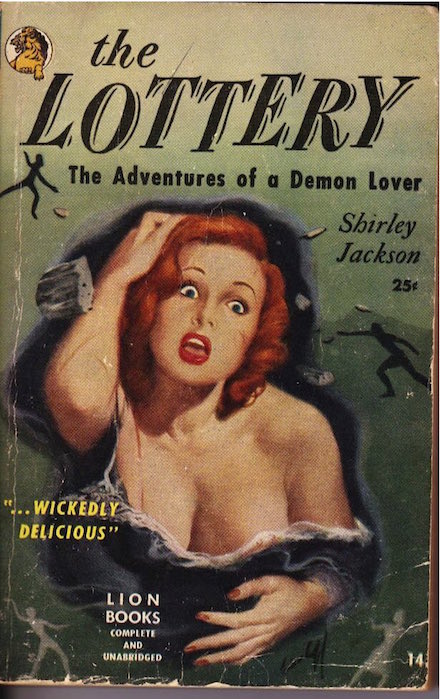
Before we dive into the grim stuff, here’s a hilariously campy pulp cover (mis)interpretation.

Less an “execution” than a human sacrifice — the village old feller’s folksy “Lottery in June, corn be heavy soon,” evokes a primal flash of blood trickling off the maize-god’s altar — the titular event is an annual tradition for a tiny American town. Though unnamed, the town and some of its denizens were patterned on North Bennington, Vermont, where Jackson was living as the wife of a professor at Bennington College.

The setting was entirely contemporary to the story’s publication, right down to the day: it hit print in the June 26, 1948 edition of The New Yorker magazine. And what took Jackson two hours to write has continued to disturb and perplex generations of readers.

In “The Lottery” (available online here (pdf)), friendly townsfolk gather “in the square, between the post office and the bank” to enact a curious civic ritual dating to a time and purpose they no longer even remember.

We see each household’s father draw a slip of paper from a battered old box and although we do not understand the reason we grasp from the dark atmosphere afoot in the crowd that something ominous is unfolding.

After the last slip is drawn,

there was a long pause, a breathless pause, until Mr. Summers. holding his slip of paper in the air, said, “All right, fellows.” For a minute, no one moved, and then all the slips of paper were opened. Suddenly, all the women began to speak at once, saving. “Who is it?,” “Who’s got it?,” “Is it the Dunbars?,” “Is it the Watsons?” Then the voices began to say, “It’s Hutchinson. It’s Bill,” “Bill Hutchinson’s got it.”

“Go tell your father,” Mrs. Dunbar said to her older son.

People began to look around to see the Hutchinsons. Bill Hutchinson was standing quiet, staring down at the paper in his hand. Suddenly. Tessie Hutchinson shouted to Mr. Summers. “You didn’t give him time enough to take any paper he wanted. I saw you. It wasn’t fair!”

“Be a good sport, Tessie.” Mrs. Delacroix called, and Mrs. Graves said, “All of us took the same chance.”

“Shut up, Tessie,” Bill Hutchinson said.

Tessie has good cause to fear. A second drawing now ensues among the five members of the Hutchinson family — Tessie and Bill, plus their three children.

And as soon as Tessie reveals the slip of paper with the black spot, her friends and even her family (“someone gave little Davy Hutchinson a few pebbles”) immediately turn on her and stone her to death.

“I hoped, by setting a particularly brutal ancient rite in the present and in my own village to shock the story’s readers with a graphic dramatization of the pointless violence and general inhumanity in their own lives,” Jackson explained.

On this day..