1927: Sacco and Vanzetti (and Celestino Madeiros)

America Sacco & Vanzetti must not die

-Allen Ginsberg, “America” (mp3)

We have now reached a stage of the case the details of which shake one’s confidence in the whole course of the proceedings and reveal a situation which undermines the respect usually to be accorded to a jury’s verdict.

-Felix Frankfurter in The Atlantic

America our nation has been beaten by strangers who have turned our language inside out who have taken the clean words our fathers spoke and made them slimy and foul

their hired men sit on the judge`s bench they sit back with their feet on the tables under the dome of the State House they are ignorant of our beliefs they have the dollars the guns the armed forces the powerplants

they have built the electricchair and hired the executioner to throw the switch

all right we are two nations

. . .

but do they know the old words of the immigrants are being renewed in blood and agony tonight do they know the old American speech of the haters of oppression is new tonight in the mouth of an old woman from Pittsburgh of a husky boilermaker from Frisco who hopped freights clear from the Coast to come here …

the men in the deathhouse made the old words new before they died.

John Dos Passos, The Big Money (part of the U.S.A. trilogy)

Let us abandon then our gardens and go home
And sit in the sitting room.
Shall the larkspur blossom or the corn grow under this cloud?
Sour to the fruitful seed
Is the cold earth under this cloud,
Fostering quack and weed, we have marched upon but cannot conquer;
We have bent the blades of our hoes against the stalks of them.

Let us go home, and sit in the sitting room.
Not in our day
Shall the cloud go over and the sun rise as before,
Beneficent upon us
Out of the glittering bay,
And the warm winds be blown inward from the sea
Moving the blades of corn
With a peaceful sound.
Forlorn, forlorn,
Stands the blue hay-rack by the empty mow.
And the petals drop to the ground,
Leaving the tree unfruited.
The sun that warmed our stooping backs and withered the weed uprooted
We shall not feel it again.
We shall die in darkness, and be buried in the rain.

What from the splendid dead
We have inherited —
Furrows sweet to the grain, and the weed subdued —
See now the slug and the mildew plunder.
Evil does overwhelm
The larkspur and the corn;
We have seen them go under.

Let us sit here, sit still,
Here is the sitting-room until we die;
At the step of Death on the walk, rise and go;
Leaving to our children`s children this beautiful doorway,
And this elm,
And a blighted earth to till
With a broken hoe.

-Edna St. Vincent Millay, “Justice Denied in Massachusetts”

If it had not been for these things, I might have lived out my life talking at street corners to scorning men. I might have died, unmarked, unknown, a failure. Now we are not a failure. This is our career and our triumph. Never in our full life could we hope to do such work for tolerance, for justice, for man’s understanding of man as now we do by accident. Our words — our lives — our pains — nothing! The taking of our lives — lives of a good shoemaker and a poor fish-peddler — all! That last moment belongs to us — that agony is our triumph.

-Bartolomeo Vanzetti


Ben Shahn, The Passion of Sacco and Vanzetti

A recently discovered letter indicates that Upton Sinclair was convinced of his subjects’ guilt.

“Alone in a hotel room with Fred [Moore], I begged him to tell me the full truth … He then told me that the men were guilty, and he told me in every detail how he had framed a set of alibis for them … I faced the most difficult ethical problem of my life at that point … I had come to Boston with the announcement that I was going to write the truth about the case.”

But Sinclair had reasons beyond the “ethical” to tell what he saw as the larger truth. From a different letter:

“My wife is absolutely certain that if I tell what I believe, I will be called a traitor to the movement and may not live to finish the book … Of course, the next big case may be a frame-up, and my telling the truth about the Sacco-Vanzetti case will make things harder for the victims … It is much better copy as a naïve defense of Sacco and Vanzetti because this is what all my foreign readers expect, and they are 90% of my public.”

Well, the dying time came, the legal midnight hour,
The moment set by law for the Chair to be at work,
To substantiate the majesty of the State of Massachusetts
That hour was at hand, had arrived, was struck by the clocks,
The time for two men to be carried cool on a cooling board
Beyond the immeasurably thin walls between day and night,
Beyond the reach of airmail, telegrams, radiophones,
Beyond the brotherhoods of blood into the fraternities
Of mist and foggy dew, of stars and ice.
 The time was on for two men
 To march beyond blood into dust —
 A time that comes to all men,
 Some with a few loved ones at a bedside,
 Some alone in the wilderness or the wide sea,
 Some before a vast audience of all manking.

 Now Sacco saw the witnesses
 As the straps were fitted on
 Tying him down in the Chair —
 And seeing the witnesses were
Respectable men and responsible citizens
And even though there had been no introductions,
 Sacco said, “Good-evening, gentlemen.”
And before the last of the straps was fastened so to hold
Sacco murmured, “Farewell, mother.”

Then came Vanzetti.
He wished the vast audience of all mankind
To know something he carried in his breast.
This was the time to tell it.
He had to speak now or hold his peace forever.
The headgear was being clamped on.
The straps muffling his mouth were going on.
He shouted, “I wish to forgive some people
  for what they are now doing.”
 And so now
 the dead are dead????

-Carl Sandburg, “Legal Midnight Hour”


(The executions took place just after midnight Aug. 22-23)

THE names of the “good shoe-maker and poor fish-peddler” have ceased to represent merely two Italian workingmen. Throughout the civilised world Sacco and Vanzetti have become a symbol, the shibboleth of Justice crushed by Might. That is the great historic significance of this twentieth century crucifixion, and truly prophetic, were the words of Vanzetti when he declared, “The last moment belongs to us–that agony is our triumph.”

Vanzetti was right when he declared that his execution was his greatest triumph, for all through history it has been the martyrs of progress that have ultimately triumphed. Where are the Caesars and Torquemadas of yesterday? Who remembers the names of the judges who condemned Giordano Bruno and John Brown? The Parsons and the Ferrers, the Saccos and Vanzettis live eternal and their spirits still march on.

-Alexander Berkman and Emma Goldman, “Sacco and Vanzetti”

Starting points for the many Sacco and Vanzetti resources online: Famous American Trials | Wikipedia | Massachusetts Supreme Court virtual tour | American Writers and the Sacco-Vanzetti Case

On this day..

1792: Jacob Johan Anckarström, assassin of Gustav III

On this date in 1792, Jacob Johan Anckarström lost his right hand and his center head for murdering Gustav III.

Like some other nobles, this officer considered the “theater king” and enlightened despot Gustav III a, well, despot.

Times being what they were, regicide was in order, to usher in an age of constitutional liberalism.

A conspiracy of Swedish nobles surrounded the royal victim at a masquerade ball on March 16, 1792, and shot him in the back. Alas for them, the scene was immediately sealed and the attendees unmasked before the gang could get away.

Although in the confusion nobody knew whodunit among those disguised revelers, it was only a matter of time before the discarded murder weapon was identified as Anckarström’s.

(Actually, it was a much longer matter of time before it became a “murder” weapon. The king only succumbed to the infection 13 days later.)

Five were condemned to death, but the four who hadn’t pulled the trigger were commuted to exile instead. Exile for regicide? Maybe that’s making you wonder why they all thought it was such an oppressive regime they all lived under.

Jacob Johan Anckarström could give them the answer. He was said to have met his beheading joyfully, which would only be natural after he’d been flogged in chains in three different parts of the city over the preceding three days.*

For readers of Swedish (or exploiters of online translation), there’s much more about Jacob and his dastardly plot here and here.

Appropriately, given the murder’s stagey venue, the Anckarstrom assassination was great performance art material in the 19th century. Verdi based Un Ballo in Maschera on it, although he’s given the principals a generic love-triangle relationship — and because of mid-19th century censorship, the iteration of it below is set in colonial Boston with “Anckarstrom” sporting the very New England name “Rennato”.

Although this particular plot didn’t achieve the revolutionary thing its authors intended, it didn’t have the opposite effect either. The king’s teenage son Gustav IV Adolf succeeded the throne, with an unsurprising hatred of Jacobinism. But in the tumult of the Napoleonic Wars (that also cost Sweden its dominion over Finland), Gustav IV was deposed and a liberal constitution adopted.

* He wasn’t handled with kid gloves in prison, either, but you can take in the scene over the libation of your choice at the present-day cafe that occupies Anckarstrom’s onetime dungeon. The joint is named for another Swedish political martyr, Sten Sture.

On this day..

1803: Johannes Bückler, “Schinderhannes”

On this date in 1803, the famous German bandit “Schinderhannes” and 19 others of his gang were efficiently guillotined in French-occupied Rhineland.

Schinderhannes with mistress Juliana Blasius and their child.

As low-born as they come, Johannes Bückler (English Wikipedia link | German) hailed from a family of executioners and knackers (his appellation means “John the Knacker”).

But this outcast was born to command, and in the wild Rhineland at the close of the 18th century, his audacity, charisma, and deft cruelty made him a legendary bandit king.

He stole, he blackmailed, he slipped his fetters … “he seemed to contest French authority” recently projected by the revolutionary citizen-army, and he preyed heavily on unpopular Jewish merchants, all of which gave Bückler purchase on folk hero status with the boldness to hold a public “robber’s ball” at the ruined castle his band occupied.

His legend grew in his own lifetime, and as such things do, it inflated quite past any capacity of its originator’s character to support.

When things got too hot on the French side of the Rhine, he ducked over the frontier to the Holy Roman Empire in the east, but was nabbed attempting to lay low in the imperial army under an assumed name, and handed back to the French.

The authorities turned his outlaw gallantry to good effect (or at least, that’s the cover story his apologists have made for his stool pigeoning) by threatening to come down on the mistress who bore him a child, leading Schinderhannes to get her off with a slap on the wrist by giving up his bandit brethren.

And with French law came French execution technology, whose proliferation in the train of Napoleon’s Grande Armee would bequeath the German condemned death by the “falling axe” down to Hitler’s time and even after.

A spectacle here as it was in France, tens of thousands turned up in Mainz this date in 1803 for what sounds like an anticlimactic six-minute show of a score of Schinderhannes’ gang losing their heads to the mechanical contraption.

Scottish scribbler Leitch Ritchie helped convey to posterity the legend with Schinderhannes, the robber of the Rhine, which romantically celebrates a knave who must have been less lovable to those who knew him from the business end of his blade. These, nevertheless, are all long gone, and Ritchie has the authority of historical mythologizing to vindicate his text’s last eulogy with its hero’s foot upon the scaffold:

The bandit-chief preserved his intrepidity to the last, and left to other times, unsullied by many of the basenesses of his tribe, the name of SCHINDERHANNES, THE ROBBER OF THE RHINE.

He sure did. From the practically mandatory ballad …

… to the stage …

… to the screen

… to vicious-looking Cambrian anomalocarid Schinderhannes bartelsi

… the outlaw has long outlived his guillotining, to the profit of the tourist trade in his former stomping-grounds.

On this day..

1355: Marino Faliero, Doge of Venice

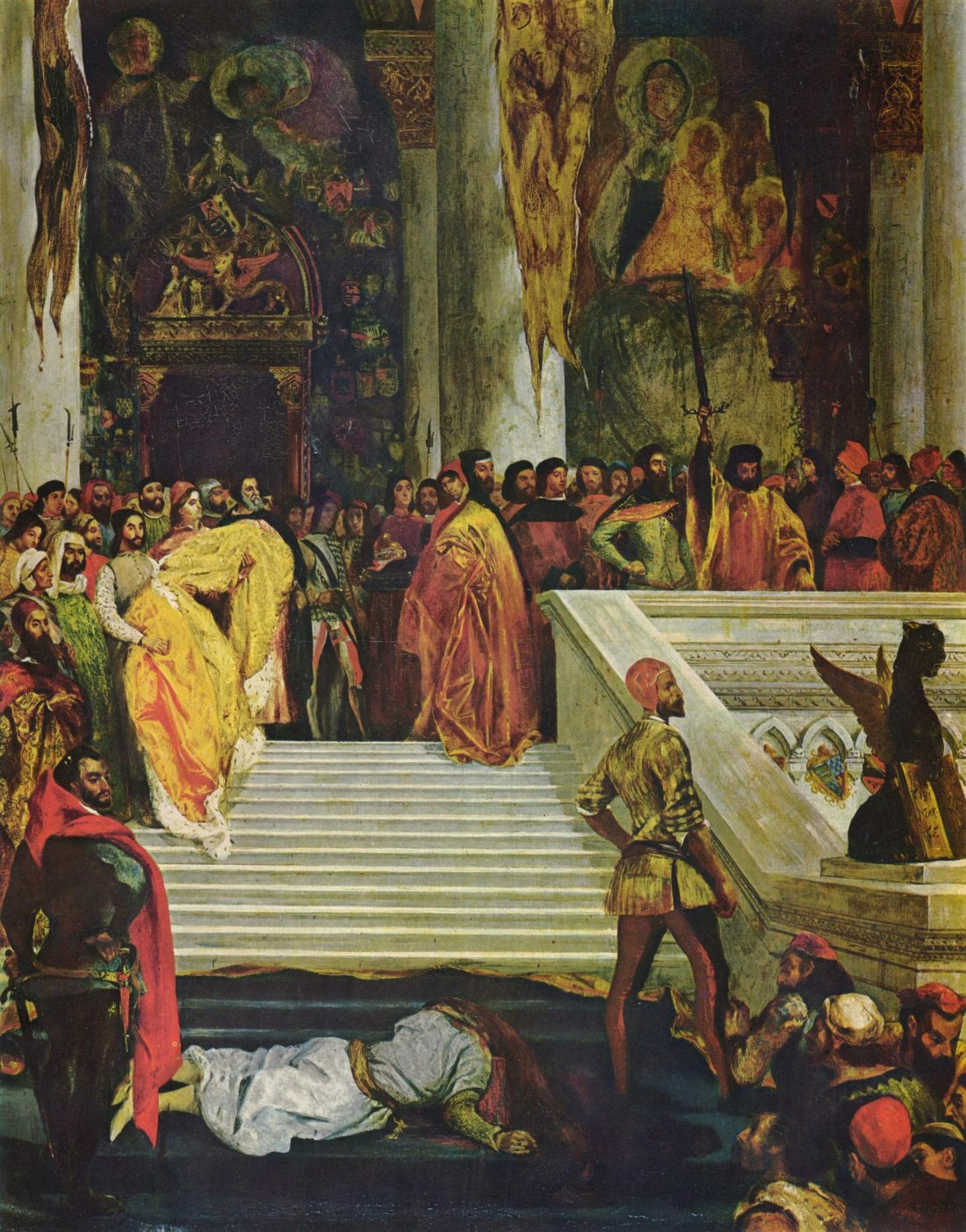
On this date in 1355, Marino Faliero* was escorted to the spot where he had been crowned Doge of Venice scant months before. There, he was ceremoniously relieved of his robes of state … and then his head.


The Execution of Marino Faliero, by Eugene Delacroix (1827).

Some fog surrounds the day’s proceedings, product not only of time but of the Doge’s executioners’ damnatio memoriae upon their victim. What was written was circumspect; even Faliero‘s portrait in the great hall of the Doge’s Palace was veiled.

What is known — or at any rate, was admitted by the elderly first citizen — is that the ruler attempted a coup against the overweening power of Venice’s great families.

The putsch was supposed to occur on April 15, with the bell of St. Mark’s Cathedral tolling on a fabricated hue and cry. In the tumult, the Doge’s supporters meant to cut down the nobles who flexed the real political muscle in the maritime republic and consolidate ducal power.

Why?

The salacious version has the old goat in a tiff with a noble, who made fun of his May-December marriage —

Marino Faliero of the beautiful wife,
Others enjoy her while he maintains her

A tribunal of fellow-nobles let the rascal off with a slap on the wrist.

Power being what it is, and princes and nobilities being born for conflict with one another across the centuries in Europe, one may as well discern a straightforward political intent — heightened, perhaps, by the then-dire state of Venice’s naval contest with Genoa.

Downright Byronic under either scenario … and Byron wrote a play about Faliero. The doomed ruler gives throat to quite a magnificent curse upon his city, with all the foresight of Byron’s half-millennium of hindsight:

I perish, but not unavenged; far ages
Float up from the abyss of time to be,
And show these eyes, before they close, the doom
Of this proud city, and I leave my curse
On her and hers for ever! —

          — She shall be bought
And sold, and be an appanage to those
Who shall despise her! — She shall stoop to be
A province for an empire, petty town
In lieu of capital, with slaves for senates,
Beggars for nobles, panders for a people!

Amidst thy many murders, think of mine!
Thou den of drunkards with the blood of princes!
Gehenna of the waters! thou sea Sodom!
Thus I devote thee to the infernal gods!
Thee and thy serpent seed!
[Here the Doge turns, and addresses the executioner.]
          Slave, do thine office!
Strike as I struck the foe! Strike as I would
Have struck those tyrants! Strike deep as my curse!
Strike — and but once!

This sort of thing knocking about among litterateurs in the 19th century practically guarantees an opera.

* Or simply “Marin Falier”, in the Venetian dialect.

On this day..

1613: Ivan Susanin, a life for the tsar

On an uncertain date in February (perhaps) 1613 — so says a cherished Russian national legend — a villager met a Polish army intent on deposing the Russian tsar, offered to guide it on a “shortcut,” and proceeded to lead it into a forest or fen where it succumbed to the elements.

A monument to Ivan Susanin in Kostroma. Image courtesy of Barbara Partee (Barbara adds: to help prevent future executions of the wrongly convicted, check out the Innocence Project.)

That peasant, Ivan Susanin, is supposed to have been put to death as the army realized its folly and imminent doom — the fate one would expect, although also not the sort that would leave a lot of corroborating witnesses.

Though the particulars are of doubtful veracity, Susanin’s son-in-law was awarded estates for the man’s tortures by enemy armies seeking the tsar — so the story is not completely baseless.

It was tsarist public relations, however, that gave us Susanin in his dramatic, familiar* form with the trackless wilderness.

This Susanin embodies the Russian people’s sacrificial love for their autocrat … and more specifically, since this was the Time of Troubles when the Russian crown’s succession was contested, for the Romanov dynasty whose first scion chosen in February 1613 would have been the Poles’ target.**

Thus, Glinka’s 19th century opera A Life for the Tsar.

But Glinka and Ivan proved up to the shifting needs of authority as the tsar gave way to the Politburo, and that to the post-Soviet state.

In a fascinating 2006 academic disquisition,† Marina Frolova-Walker dissects A Life for the Tsar‘s transmutation into Ivan Susanin, a Stalin-era opera with the same score but a libretto altered to expunge the tsar — and the success this adaptation of a national classic enjoyed vis-a-vis Soviet artists’ original creations under the impossible aesthetic and political restrictions of official censorship.

Not only did this now-nationalist composition thrive in the USSR, it has been successfully re-staged in its Soviet form, or as a fresh amalgamation of Stalin and Glinka, in the Putin era.‡

From the days of serfdom via the days of the gulag past the fall of the Iron Curtain, here’s Ivan Susanin‘s stirring finale performed by the Russian army at the Vatican, and broadcast on Russian television.

* Familiar to Russians, certainly, and you can call one who gets you lost “susanin”.

** And we all know how they left the throne.

† Marina Frolova-Walker, ‘The Soviet opera project: Ivan Dzerzhinsky vs. Ivan Susanin’, Cambridge Opera Journal (2006), 18:2:181-216

‡ In the Yeltsin era, the opera was staged in its pre-Soviet form. Frolova-Walker argues that the version incorporating Stalinist edits actually speaks to contemporary Russia more aptly than the original, an operatic mirror of the state’s re-adopting the Stalinist national anthem after having used a tsarist piece (written by Glinka!) during the 1990’s.

The reappearance of these cultural tokens is occurring because high Stalinism provides the most easily assimilable model for Russian nationalism today: it is less remote than its nineteenth-century counterpart … The eclectic and confident nationalist of the new Susanin contains the appropriate message for those Russian citizens wealthy enough to attend the Bolshoi today.

On this day..

1573: Matija Gubec, peasant revolt leader

On February 15, 1573, the brief but scintillating career of insurrectionary Matija Gubec came to a brutal end when he was publicly tortured to death in Zagreb.


You know what they say about the size of a man’s feet: Matija Gubec about to be crowned with a red-hot iron ringlet and quartered.

Gubec emerged from (to us, at least) obscurity to leadership of a short-lived peasant uprising in Croatia against Franjo Tahi (Croatian Wikipedia link), your basic feudal tyrant.

Although put down inside of two weeks, this revolt and its personification in Gubec have endured as potent national symbols in Croatia.

In the revolutionary 20th century, both left and right claimed Gubec’s standard as their own: a multiethnic company of Yugoslav volunteers fought under his name in the Spanish Civil War, as did multiple partisan units during World War II who took inspiration in his peasant class uprising. By contrast, the Ustasha conceived Gubec as

one man, who was not the exponent of any class, but … a reflection of an entire nation’s beliefs.*

Fascist and communist alike can jam to the rock opera Gubec Beg.**

* See Pavlakovic, Vjeran (2004) ‘Matija Gubec Goes to Spain: Symbols and Ideology in Croatia, 1936-1939’, The Journal of Slavic Military Studies, 17:4, 727 — 755.

** According to Pavlakovic, Gubec’s real given name is unknown and birth records suggest it might have been “Ambroz”. He was known as “Gubec called Beg,” using the Turkish term for a lord.

On this day..

1794: Andre Chenier, poet

On this date in 1794, proto-Romantic poet Andre Chenier went to the guillotine the unfortunate victim of his father’s love.

In the operatic version of this Istanbul-born poet‘s life story, Chenier is accused by a rival in love, convicted, and guillotined the next day together with his beloved Maddalena, who effects a Sydney Carton-like swap into the lot of the condemned in order to share his fate.

Chenier’s real end was both more mundane, and far more tragic.

A revolutionary of the constitutional monarchist variety and an open opponent of the Jacobins bold enough to compose an ode to Marat’s murderess, Chenier had spent a year staying out of sight when the police picked him up almost accidentally.

Prisoners suffocating in the Paris jails were suspended horribly between life and death, but the anonymity of this living tomb offered — as with Tom Paine — a measure of occasional safety.

When Chenier’s father blunderingly appealing to the authorities for his son, he accidentally stripped away that anonymity. Chenier had been under lock and key for three-plus months — writing, the whole time, in minuscule letters on scraps of paper he arranged to have smuggled out to his father — but once reminded of the writer’s existence, the authorities promptly had it snuffed out. (A friend and fellow poet, Jean-Antoine Roucher, shared his tumbril.)

Chenier’s prison verses are among the most affecting of his 32 years — like the acidic Iambes blistering his persecutors, and the heartbreaking “La Jeune Captive”, in which he gives voice to the young fellow-prisoner who has smitten him, excerpted here:

Mon beau voyage encore est si loin de sa fin!
Je pars, et des ormeaux qui bordent le chemin
J’ai passé les premiers à peine.
Au banquet de la vie à peine commencé,
Un instant seulement mes lèvres ont pressé
La coupe en mes mains encor pleine.

Je ne suis qu’au printemps, je veux voir la moisson;
Et comme le soleil, de saison en saison,
Je veux achever mon année.
Brillante sur ma tige et l’honneur du jardin,
Je n’ai vu luire encor que les feux du matin:
Je veux achever ma journée.

Chenier was not broadly published or extremely well-known in his own lifetime; many critics think he was pinched out while still maturing. The poet himself told a friend in parting, “I leave nothing for posterity; and yet, (touching his forehead) I had something there.” In the backstory to one of the tales in Balzac’s La Comedie Humaine, a grocer who annoys one of Robespierre‘s associates is also among this day’s batch and arouses more notice than the man of letters:

Though Descoings died, he had the honour, at any rate, of going to the scaffold with Andre de Chenier. There, no doubt, grocery and poetry embraced for the first time in the flesh; for they have always had, and will always have, their private relations. Descoings’ execution made a far greater sensation than Andre de Chenier’s. Thirty years elapsed before it was recognised that France had lost more by Chenier’s death than by that of Descoings.

Robespierre’s sentence had this good result — until 1830 grocers were still afraid of meddling in politics.

The salutary effect upon grocers has long faded, but Chenier’s reputation has steadily ripened like wine since his demise. And the title part of the late-19th century opera Andrea Chenier — however scant its resemblance to the man who inspired it — is one of the most gorgeous tenor roles in opera.

Part of the Themed Set: Thermidor.

On this day..

Unspecified Year: Faust’s Gretchen

In Goethe’s Faust (original German | English), the title character’s lover on this date spurns his rescue and is put to death for killing their illegitimate child.

In the text, Faust and Mephistopheles celebrate Walpurgisnacht. The next day — “dreary day,” Goethe has it — the hero realizes his Faustian bargain is coming due, to the indifference of his infernal patron. (This is the work’s only scene in prose.)

FAUST

In misery! In despair! Long wretchedly astray on the face of the earth, and now imprisoned! That gracious, ill-starred creature shut in a dungeon as a criminal, and given up to fearful torments! To this has it come! to this!—Treacherous, contemptible spirit, and thou hast concealed it from me!—Stand, then,—stand! Roll the devilish eyes wrathfully in thy head! Stand and defy me with thine intolerable presence! Imprisoned! In irretrievable misery! Delivered up to evil spirits, and to condemning, unfeeling Man! And thou hast lulled me, meanwhile, with the most insipid dissipations, hast concealed from me her increasing wretchedness, and suffered her to go helplessly to ruin!

MEPHISTOPHELES

She is not the first.

Faust nevertheless browbeats the devil into infiltrating him that night into the prison where Gretchen (a German nickname for Margaret, Margarethe, or Marguerite), terrified, mistakes him at first for the executioner who will come for her in a few hours:

Risen at Dawn, Gretchen Discovering Faust’s Jewels — a scene from Gretchen’s seduction by Pre-Raphaelite painter Dante Gabriel Rossetti.

GRETCHEN (on her knees)

Who, headsman! unto thee such power
Over me could give?
Thou’rt come for me at midnight-hour:
Have mercy on me, let me live!
Is’t not soon enough when morning chime has run?

(She rises.)

And I am yet so young, so young!
And now Death comes, and ruin!
I, too, was fair, and that was my undoing.
My love was near, but now he’s far;
Torn lies the wreath, scattered the blossoms are.
Seize me not thus so violently!
Spare me! What have I done to thee?
Let me not vainly entreat thee!
I never chanced, in all my days, to meet thee!

Yet she refuses to flee with him — sensing the change in his character, fearful of living as a fugitive, resigned to a death incurred by her own culpability.

Day? Yes, the day comes,—the last day breaks for me!
My wedding-day it was to be!
Tell no one thou has been with Gretchen!
Woe for my garland! The chances
Are over—’tis all in vain!
We shall meet once again,
But not at the dances!
The crowd is thronging, no word is spoken:
The square below
And the streets overflow:
The death-bell tolls, the wand is broken.
I am seized, and bound, and delivered—
Shoved to the block—they give the sign!
Now over each neck has quivered
The blade that is quivering over mine.
Dumb lies the world like the grave!

Faust has had innumerable interpretations in performance, typically omitting the intervening “dreary day” scene, which makes the prison sequence appear to take place at the conclusion of Walpurgisnacht. The prison confrontation, for instance, caps a Gounod opera:

In F.W. Murnau‘s masterful 1926 silent adaptation, the sentence is carried out by burning rather than beheading. This film is in the public domain and available in its entirety free online:

On this day..

1741: Jenny Diver, a Bobby Darin lyric?

On this date in 1741,* at Tyburn‘s largest mass-execution of the mid-18th century, renowned cutpurse Jenny Diver was hanged along with 19 others.

Born Mary Young in Ireland around 1700, the girl was abandoned as a child but deserted a benefactor’s household to take passage to London where she meant to work as a seamstress.

What the Newgate Calendar reads as ingratitude, the modern reader might more sympathetically see as the allure of a burgeoning city for a teenager full of dreams.

Dreams may nurture the spirit, but flesh must have bread. Like countless others through time — indeed, like countless other clients of Tyburn — Jenny found metropolis less than convivial to aspirations of honest labor.

Unable to live on her stitching, Jenny found more lucrative employment for her manual dexterity in a sizable gang of thieves — of which her uncovered criminal puissance gave her mastery.

The Newgate Chronicle bursts with almost doting memoirs of her agile fingers, like this one:

[S]he procured a pair of false hands and arms to be made, and concealing her real ones under her clothes she repaired on a Sunday evening to the place of worship above mentioned in a sedan-chair, one of the gang going before to procure a seat among the more genteel part of the congregation, and another attending in the character of a footman.

Jenny being seated between two elderly ladies, each of whom had a gold watch by her side, she conducted herself with seeming great devotion; but when the service was nearly concluded she seized the opportunity, when the ladies were standing up, of stealing their watches, which she delivered to an accomplice in an adjoining pew.

Not neglecting also to celebrate the gang’s more Sting-like ruses, like this hilarious turn of the tables on a credulous cuckolder:

Jenny dressed herself in an elegant manner, and went to the theatre one evening when the king was to be present; and during the performance she attracted the particular attention of a young gentleman of fortune from Yorkshire, who declared, in the most passionate terms, that she had made an absolute conquest of his heart, and earnestly solicited the favour of attending her home. She at first declined a compliance, saying she was newly married, and that the appearance of a stranger might alarm her husband. At length she yielded to his entreaty, and they went together in a hackney-coach, which set the young gentleman down in the neighbourhood where Jenny lodged, after he had obtained an appointment to visit her in a few days, when she said her husband would be out of town.

The day of appointment being arrived, two of the gang appeared equipped in elegant liveries, and Anne Murphy [another thief] appeared as waiting-maid. The gentleman came in the evening, having a gold-headed cane in his hand, a sword with a gold hilt by his side, and wearing a gold watch in his pocket, and a diamond ring on his finger.

Being introduced to her bed-chamber, she contrived to steal her lover’s ring; and he had not been many minutes undressed before Anne Murphy rapped at the door, which being opened, she said, with an appearance of the utmost consternation, that her master was returned from the country. Jenny, affecting to be under a violent agitation of spirits, desired the gentleman to cover himself entirely with the bed-clothes, saying she would convey his apparel into another room, so that if her husband came there, nothing would appear to awaken his suspicion: adding that, under pretence of indisposition, she would prevail upon her husband to sleep in another bed, and then return to the arms of her lover.

The clothes being removed, a consultation was held, when it was agreed by the gang that they should immediately pack up all their moveables, and decamp with their booty, which, exclusive of the cane, watch, sword, and ring, amounted to an hundred guineas.

The amorous youth waited in a state of the utmost impatience till the morning, when he rang the bell, and brought the people of the house to the chamber-door, but they could not gain admittance, as the fair fugitive had turned the lock, and taken away the key; when the door was forced open the gentleman represented in what manner he had been treated; but the people of the house were deaf to his expostulations, and threatened to circulate the adventure throughout the town, unless he would indemnify them for the loss they had sustained. Rather than hazard the exposure of his character, he agreed to discharge the debt Jenny had contracted; and dispatched a messenger for clothes and money, that he might take leave of a house of which he had sufficient reason to regret having been an inhabitant.

Alas to say, they all can’t come off like clockwork. Jenny was caught a couple of times, dodging the noose in 1733 and 1738, sentenced on both occasions to transportation to the American colonies.

Finding little to recommend colonial Virginia, she returned illegally from both sentences at the risk of her life (she only survived her second arrest by passing herself off under an alias). The third time broke the charm, however: one is saddened to find her in her last adventure nabbed like a tyro trying to pick a younger woman’s pocket of a few shillings. The victim snatched Jenny’s wrist in the act: perhaps those nimble hands, now pushing 40, had finally slowed down.

Jenny Diver’s hands, in their time, had profited her far more than needlework could have; they had given her a life of some comfort to compensate its perils; and at the end, they afforded their owner the last indulgence of a “mourning coach,” an enclosed carriage separate from the carts that hauled this day’s other 19 (unrelated) victims.

It was a rowdy hanging day with an unusual guard detail of soldiery: one of the prisoners had reported a pending rescue attempt, and for her resources and gang affiliations, Jenny was thought to be its intended beneficiary. (If the stool pigeon was hoping his own tattling would reprieve him, he was disappointed.) For reasons related or not, the crowd was in an ugly mood, as reported by the Newgate Ordinary:

In this Manner were they convey’d through a vast Multitude of People to Tyburn, some of whom, notwithstanding the Guard of Soldiers, were very rude and noisy, hallooing, throwing Brickbats, Mud, &c. at the unhappy Prisoners, as they passed.


Her notoriety would live on in cheap publications hawked by itinerant peddlers — 18th century precursors of the penny dreadful — that in Jenny’s case helpfully doled out tips on foiling pickpockets.

About That Name

We also have a modern context** for the name “Jenny Diver” as one of several women mentioned in the song “Mack the Knife”:

This song is an English riff on a German tune from The Threepenny Opera, concerning its principal male character, the highwayman Macheath. (Possibly inspired by the recently-executed Jack Sheppard.)

The Threepenny Opera updated the 18th-century Beggar’s Opera, a satiric (and extraordinarily popular) production setting operatic tropes among society’s whores, criminals and castoffs.

The sequence of female names Bobby Darin rattles off in this version of “Mack the Knife” all draw from these operas: Suky (sometimes Sukey or Sukie) Tawdry and Jenny Diver are underworld women in The Beggar’s Opera who set Macheath up for arrest; Lucy Brown is The Threepenny Opera‘s version of the original character Lucy Lockit, who under either name is the daughter of a law enforcement officer in love with Macheath who helps him escape.†

One might suppose such a fortuitous connection of Jenny Divers was a calculated one, but it seems both the character’s name and the thief’s were independently and coevally drawn from the rich vein of English thieves’ cant.

Strictly coincidental.

“Diver” as street slang for a pickpocket dated back 150 years, according to Philip Rawlings, so it was a natural sobriquet for an expert thief … and for an author (whose script is chock full of suggestively-named characters — Wat Dreary, Molly Brazen, Jemmy Twitcher) conjuring such a character. There’s no direct evidence indicating that either the cutpurse or the dramatist knowingly cribbed from the other.

A pity it was for the real Jenny that art and life couldn’t imitate one another more strongly.

PLAYER. But, honest Friend, I hope you don’t intend that Macheath shall be really executed.

BEGGAR. Most certainly, Sir.—-To make the Piece perfect, I was for doing strict poetical Justice—-Macheath is to be hang’d; and for the other Personages of the Drama, the Audience must have suppos’d they were all hang’d or transported.

PLAYER. Why then Friend, this is a downright deep Tragedy. The Catastrophe is manifestly wrong, for an Opera must end happily.

BEGGAR. Your Objection, Sir, is very just, and is easily remov’d. For you must allow, that in this kind of Drama, ’tis no matter how absurdly things are brought about—-So—-you Rabble there—-run and cry, A Reprieve!—-let the Prisoner be brought back to his Wives in Triumph.

* 1740, according to the original documentation; 1741 by modern reckoning, since the new year’s onset was at the time not recognized on January 1.

** There’s still another Jenny Diver reference in the literate comic book series The League of Extraordinary Gentlemen.

† The fourth name of the sequence originally was Polly Peachum, Lucy’s rival for Macheath’s affections — but when Louis Armstrong made the first popular recording of Mack the Knife, he ad-libbed the line “Look out for Miss Lotte Lenya!” referring the actress who played Polly Jenny in both the original German production and the then-current Broadway importation, and who also happened to be present at Armstrong’s recording. Darin’s subsequent (and eventually canonical) version followed that lead and replaced the original name outright.

On this day..