1538: John Lambert, “none but Christ”

On this date 470 years ago, John Lambert was burned to death at London’s Smithfield market for heresy.

One possible way to read the early progress of the English Reformation is as an initial flowering of Protestantism followed — after the execution of Anne Boleyn — by a reactionary crackdown by the monarch.

In this telling, John Lambert (born John Nicolson or Nicholson) marks the turning point, the man in whose blood Henry VIII etched his warning against doctrinal liberality.

John Lambert cooked his goose by picking a theological dispute with a pastor in London. He didn’t buy into transubstantiation, the Catholic doctrine (still extant today) that the bread blessed on the altar became the literal body of Christ.

Though the Anglican church would ditch this belief soon thereafter, it came down hard on Lambert in a show trial attended by Thomas Cromwell, Thomas Cranmer, and all the Tudor big wheels whose heads were at that point attached to their shoulders.

The king himself — who here reminds one of the the stout defense of the sacraments that in his early Catholic period had earned him the papal honorific “defender of the faith” — debated theology with the accused, though mostly he left it to his august councilors.


John Lambert disputing before Henry VIII. Early 19th c. illustration.

But the crowned head made his doctrine as plain to the audience as the consequences of crossing it.

The pro-Lambert account from which this extract is drawn is available free on Google books:

At length [Lambert] was worn out with fatigue, having been kept five hours standing …

Night coming on, the King being desirous to break up this pretended disputation, said to Lambert, “What sayest thou now, after all this pains taken with thee, and all the reasons and instructions of these learned men? Art thou not yet satisfied? Wilt thou live or die? What sayest thou? Thou has yet free choice.” Lambert answered, “I yield and submit myself wholly unto the will of your Majesty.” Then said the King, “Commit thyself into the hands of God, and not unto mine.” Lambert replied, “I commend my soul unto the hands of God, but my body I wholly yield and submit unto your clemency.” Then said the King, “If you do commit yourself unto my judgment, you must die, for I will not be a Patron unto heretics.” And then turning to Lord Cromwell he said, “Cromwell, read the sentence of condemnation against him:” which was accordingly done.

A few months later, Henry induced Parliament to pass the Act of the Six Articles, essentially establishing Catholic doctrine — sans Pope, obviously — as the basis for the Church of England and criminalizing dissent.

What to make of this trial and the policy it represented is open to dispute. In a simple telling, Henry realizes his Reformation is running away from him, or becomes wise to discomfiting reforms that Cranmer or Cromwell are pushing. Too, the ebb and flow of Henry’s “Reformation” has sometimes been seen as a product of the shifting balance between reformers and conservatives advising the crown; Protestant martyrologist John Foxe favored this approach since it enabled him to celebrate a John Lambert without indicting the monarch by blaming advisors.

Lambert’s death is also sometimes interpreted in light of the international situation, as the Catholic powers of France and the Holy Roman Empire had made peace, potentially (along with Scotland) encircling England with Popish foes who might conceivably be less belligerent with a move towards traditional doctrine.*

But maybe that’s all a good deal more explanation than is needed for the old defender of the faith. G.W. Bernard’s consideration of The King’s Reformation argues that Lambert isn’t so pivotal after all:

[H]istorians who see … the trial of Lambert as some sort of turning point are greatly mistaken. There was absolutely nothing new in Henry’s policy in November 1538. Ever since radical — Zwinglian — notions on the mass had come to influence some within England, Henry had reacted firmly and boldly. This was not something that only came late in the 1530s, when he supposedly woke up to what Cromwell and Cranmer had been doing in his name but without his knowledge. It was there from the start. As early as March 1535 a proclamation fiercely denounced strangers who had presumptuously rebaptised themselves and who denied that the blessed and most holy sacrament of the altar was really the body of Christ. If there was a novelty in autumn 1538, it was the perception that such heresies were spreading through the realm and that heretics with a high profile, such as Lambert, needed to be dealt with publicly so that others might learn from their unhappy example. … Henry surely blasted against sacramentarians for the straightforward reason that he sincerely believed them to be wicked.

As for Lambert himself, he met an especially cruel version of the none-too-pleasant sentence of burning alive, allegedly being lifted by pikestaffs from the flame when his legs were burned off to prolong his suffering. He is said to have continued to call out the inspirational last words, “None but Christ! None but Christ!”

* It was against this alliance that Cromwell would arrange the king’s ill-fated marriage to German princess Anne of Cleves, a debacle that helped Cromwell lose his own head.

On this day..

1535: Thomas More, the king’s good servant but God’s first

On this date in 1535, Sir — later Saint — Thomas More kept his conscience at the expense of his head on Tower Hill.

For all More‘s greatness — as intellectual, polemicist, lawyer, statesman, father — none of his many gifts at the end could avail him beside his commitment to Catholicism at the dawn of the English Reformation.

Yet it is for those gifts that he cut such a commanding presence in his times, for those very reasons that his sovereign hounded his first citizen to assent to the divorce and remarriage he was fixed upon.

A devotee and friend of Erasmus from years before, More was in Henry’s more orthodox youth the king’s very scourge of Protestantism. His scatological invective against Martin Luther in Responsio ad Lutherum — much in the impolite tenor of Catholic-Protestant rhetoric continent-wide, it should be noted — is of the sort to crimson the cheeks of the milquetoast modern:

Since he has written that he already has a prior right to bespatter and besmirch the royal crown with shit, will we not have the posterior right to proclaim the beshitted tongue of this practitioner of posterioristics most fit to lick with his anterior the very posterior of a pissing she-mule until he shall have learned more correctly to infer posterior conclusions from prior premises?

Over that hairshirt, he wore the robes of state. But his engagement with the world had a selective bent that must have exasperated his colleague and predecessor as Lord Chancellor, Cardinal Wolsey. Orson Welles and Paul Scofield spar here in the definitive More hagiography A Man for All Seasons over the intellectual’s delicate refusal to dirty his gloves with the great matter of state before them — the annulment the king demanded of his marriage to the Queen (and More’s friend) Catherine of Aragon:

Peas in a pod, these two: Wolsey, the cleric grounded in realpolitik; More, the barrister who trusts to God. (More considered holy orders as a young man.)

Our man’s reputation for honesty in a den of hypocrites has certainly outrun Wolsey’s. Still, all More’s disdain for the deal-making that invests the sovereign majesty and all his foreboding for the relationship he had with his dangerous king were not quite enough to stop him accepting the Chancellorship and the opportunity to stamp out Lutheranism … knowing perfectly well the simultaneous thrust of Henry’s boudoir policy.

It all cuts quite a contrast to More’s (barely) pre-Reformation text, Utopia (available free from Project Gutenberg), which named a literary genre and described an imagined society of tolerant primitive communism that surely would have blanched at its inventor’s coming role in the state’s machinations:

I can have no other notion of all the other governments that I see or know, than that they are a conspiracy of the rich, who, on pretence of managing the public, only pursue their private ends, and devise all the ways and arts they can find out; first, that they may, without danger, preserve all that they have so ill-acquired, and then, that they may engage the poor to toil and labour for them at as low rates as possible, and oppress them as much as they please

[E]very man might be of what religion he pleased, and might endeavour to draw others to it by the force of argument and by amicable and modest ways, but without bitterness against those of other opinions; but that he ought to use no other force but that of persuasion, and was neither to mix with it reproaches nor violence* …

It’s not a given that More himself agrees with every (or even any) sentiment expressed in Utopia, but his most famous work’s criticism of the death penalty too liberally applied makes interesting reading.

[E]xtreme justice is an extreme injury: for we ought not to approve of those terrible laws that make the smallest offences capital … God has commanded us not to kill, and shall we kill so easily for a little money [i.e., execute petty thieves]? But if one shall say, that by that law we are only forbid to kill any except when the laws of the land allow of it, upon the same grounds, laws may be made, in some cases, to allow of adultery and perjury: for God having taken from us the right of disposing either of our own or of other people’s lives, if it is pretended that the mutual consent of men in making laws can authorise man-slaughter in cases in which God has given us no example, that it frees people from the obligation of the divine law, and so makes murder a lawful action, what is this, but to give a preference to human laws before the divine? and, if this is once admitted, by the same rule men may, in all other things, put what restrictions they please upon the laws of God.

This insistence on the supremacy of divine law over human institutions forms the basis of his objection to parliament’s overthrowing the papacy — which he expressed openly only after he was convicted by obviously perjured “jailhouse snitch” testimony

[Y]ou have no authority, without the common consent of all Christians, to make a law or Act of Parliament or Council against the union of Christendom.

Paul Scofield bears enjoying in the role in A Man for All Seasons:

More is sometimes suspected of desiring martyrdom since he marched so unerringly into it, but he also made every attempt to survive Henry’s demand the he affirm the royal remarriage and the king’s ecclesiastical supremacy by withdrawing silently from the public sphere rather than openly opposing it. More had by every account an enviable, downright happy life at his own hearth, and a tender and intellectual relationship with his favorite daughter Meg. (Meg corresponded with her father in prison, collected his works, and retrieved his head from London Bridge.)

But by his way of thinking — Meg tried to talk him out of it — he couldn’t swear to the Act of Succession acknowledging the king’s right to divorce Queen Catherine and disinherit her daughter Mary if Henry decided to force the choice. And in the king’s eyes, there was no middle ground for someone of the ex-Chancellor’s stature.

Henry could see to it, though, to cut his old friend a break and commute the sentence from drawing and quartering to “mere” beheading, here depicted in the past season of the Showtime series The Tudors.

More’s last moments as rendered here — the ironic remark at the foot of the scaffold, “See me safe up: for my coming down, I can shift for myself”;** his generous answer to the headsman’s plea for forgiveness — are well-documented. Undoubtedly, his sturdy martyr’s bearing, the extension of a life of joyful piety, helped cement for posterity the fame he held in life.

And that dying address — “I die the King’s good servant, but God’s first” — gathers in one sentiment free of bombast or self-pity the irreconcilable demands of conscience that would lead many thousands besides More to Henry VIII’s scaffolds, and rings equally true to less lethal challenges to the conscience in every land and time since.

Anne Boleyn, who caused More’s fate, shared it less than a year afterwards.

Thomas More was canonized by the Catholic Church in 1935 — the patron saint of politicians. Rather bizarrely, July 6 is also his feast day on the Anglican calendar, a tribute to the nearly universal regard his memory enjoys.

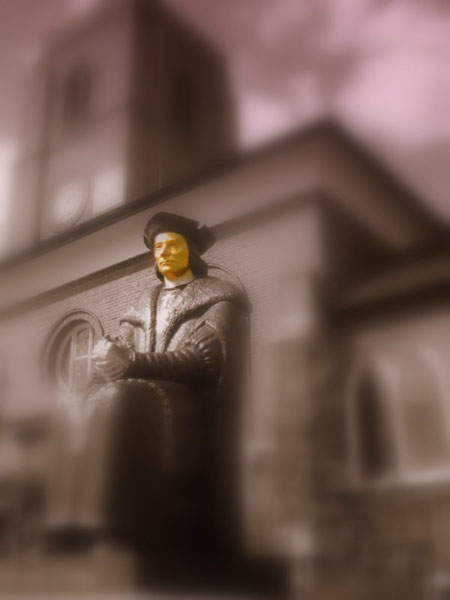
Thomas More's statue at the Chelsea Old Church

Chelsea resident Thomas More’s statue at the (Anglican) Chelsea Old Church.

* Despite its religious tolerance, More’s Utopia — anticipating Dostoyevsky — maintains:

a solemn and severe law against such as should so far degenerate from the dignity of human nature, as to think that our souls died with our bodies, or that the world was governed by chance, without a wise overruling Providence … since a man of such principles must needs, as oft as he dares do it, despise all their laws and customs: for there is no doubt to be made, that a man who is afraid of nothing but the law, and apprehends nothing after death, will not scruple to break through all the laws of his country, either by fraud or force, when by this means he may satisfy his appetites.

** According to the biography published by More’s son-in-law — who married More’s favorite, Margaret — the jest was occasioned by the rickety look of the scaffold. The Mirrour of Vertue in Worldly Greatness; Or, The Life of Sir Thomas More is available free on Google Books.

On this day..

1594: Rodrigo Lopez, Shylock inspiration?

On this date in 1594, a 70-year-old Portuguese physician was torn apart at Tyburn before a jeering London mob for attempting to poison Queen Elizabeth I.

Born around 1525 to a family of conversos — Jewish converts forcibly converted to Christianity — Rodrigo Lopez (alternatively, Lopes) went abroad because the Spanish Inquisition menacingly suspected him of secretly maintaining the faith of Abraham.*

For us, the man’s true doctrines might be a matter for his god. In the 16th century, Lopez never could outrun his Jewishness.

Establishing himself in London in 1559, nearly the precise midpoint of his life, Lopez built a thriving medical practice, eventually rising in 1586 to the attendance of Her Majesty herself. England in those days was scrapping with the mighty Spanish empire, one front of which was endlessly byzantine diplomatic intrigue. It happened that Elizabeth gave harbor to a Portuguese pretender (Lopez had attended him, too), whose circles the Spanish were naturally endeavoring to infiltrate.

Some nefarious machinations in this ambit that came to light in 1593 opened an investigation characteristically heavy on the torture, and Lopez’s name came up. Allegedly, the doctor was negotiating to take Spanish gold for slipping the Queen a mickey.

Lopez doesn’t seem to be any less capable of greed or intrigue than anyone else at court, but poison? It was doubted at the time, the prosecution itself a product of the courtly rivalry between Essex and Cecil.** Despite a confession (extracted by torture, like the accusations), even Elizabeth never seems to have really bought the charge: she held Lopez more than three months after his sentence before finally permitting the punishment to go forward, and pensioned his family when the treason conviction entitled her to confiscate their property.

The London mob entertained no such nuance. When Lopez was hauled to the scaffold this day for his public butchery — still protesting that he “loved the Queen as he loved Jesus Christ,” derisively taken as a backhanded confession by spectators who didn’t doubt the practicing Protestant was really a Jew — it elevated popular anti-Semitism to fever pitch.

Hath not a Jew eyes?

Lopez, or at least the popular mood of Jew-baiting current after his trial, is thought to have helped inspire William Shakespeare’s use of the Shylock character in The Merchant of Venice — one of the most controversial and captivating of all the Bard’s creations, a villain far more compelling (and sympathetic) than the play’s lightweight good guys and one whose place in the Shakespeare canon and the fabric of Elizabethan England is still vigorously debated.

Is Shylock a vicious caricature? A sublimely three-dimensional human? Both? Wherever the “real” William Shakespeare stood on the matter of religious equality, he put one of literature’s great apologias for it in Shylock’s mouth:

* Insincerely converted Muslims and Jews were a choice target of the Inquisition in the 16th century; many thousands were driven to emigrate. For the fate of some other crypto-Jews who fled to Spain’s possessions in the New World, see here.

** Lopez’s Javert, the Earl of Essex, lost the power struggle a few years later … and with it, his own head.

On this day..

1536: Anne Boleyn

On this date in 1536, Anne Boleyn lost her head.

Any queen decapitated by her king would of course rate an entry in these grim pages. But this does not quite explain Anne Boleyn‘s enduring appeal, relevance and recognizability for the most casual of modern observers, and her concomitant footprint in popular culture, even with the “Greek tragedy” quality of her life.

Anne stands at the fulcrum of England’s epochal leap into modernity. Whether she was that fulcrum might depend on the reader’s sympathy for the Great Man theory of history, but little more do we injure our headless queen to regard her as the woman for her time and place — the accidental hero (or villain) raised up and thrown down by the tectonic forces of her milieu.

Through Anne was born — for reasons of momentary political arrangements of long-forgotten dynasts, which seems a shockingly parochial proximate cause — the English Reformation, and through the Reformation was born the crown’s decisive triumph over the nobility, the broad middle class nurtured on the spoils of Catholic monasteries, the rising Britannia fit to rule. Most would take as an epitaph historical accidents of such magnitude.

Of course, by those same accidents, Anne was the instrument of thousands of deaths herself, and little did she appear troubled in life by the corpses upon which she ascended the throne.

Her own family maps the change wrought on England. An ancestor was beheaded in the Wars of the Roses, medieval England’s last great breakdown; her uncle Thomas Howard was one of the throwback scheming Dukes, mastered by his sovereign to the extent of issuing Anne’s capital sentence from his own lips;* the beheaded woman’s daughter, Queen Elizabeth I, set a recognizably centralized English state on the path of empire.

Fitting tribute that, from the Tower where she met her end** to lands undreamt-of in her time, people still, like Henry, find her captivating.

[audio:http://www.bl.uk/whatson/podcasts/podcast95533.mp3]

* Anne’s father also declared for her guilt. Unprincipled as these men undoubtedly were, it cannot have been a pleasant responsibility; the question of whether she was actually guilty of adultery-cum-treason, the fatal charge extracted from a supposed lover by torture, has been hotly and inconclusively disputed by posterity.

** With a solemn speech submissive to Henry but not admitting any guilt — in an earlier moment of levity, she had famously remarked of the French swordsman hired to do the job, “I heard say the executioner was very good, and I have a little neck.”

On this day..

1582: John Payne, snitched out

On this date in 1582, the Jesuit priest John Payne suffered drawing and quartering at Chelmsford for his forbidden faith.

This blog tips its cap to any fellow who prefers that awful punishment to a timely change of doctrine. Payne (or Paine) is accordingly one of the Forty Martyrs of England and Wales recognized by the Catholic church.

But at our present distance, Payne hardly stands out from the slew of 16th century Catholic martyrs in the way an Edmund Campion does.

We pause instead to take note of a small continuity between Payne and Campion, a secondary character whose shadow we observe but fleetingly, but whose presence suggests the condition of a community under siege — and whose character seems not unknown to our time.

Campion was apprehended by a police informant named George Eliot (“Judas Eliot”, Protestants as well as Catholics would call him).* A Catholic himself, Eliot took to collecting bounties on fugitive priests — to relieve himself, the Catholics said, of a murder charge pending against him. Eliot attended Campion’s last service, excused himself, and returned with a posse.

Later, he would meet his prize in prison:

“If I had thought that you would have had to suffer aught but imprisonment through my accusing of you, I would never have done it,” [Eliot] said, “however I might have lost by it.”

“If that is the case,” replied Campion, “I beseech you, in God’s name, to do penance, and confess your crime, to God’s glory and your own salvation.”

But it was fear for his life rather than for his soul that had brought the informer to the Tower; ever since the journey from Lyford,** when the people had called him “Judas,” he had been haunted by the specter of Catholic reprisal.

“You are much deceived,” said Campion, “if you think the Catholics push their detestation and wrath as far as revenge; yet to make you quite safe, I will, if you please, recommend you to a Catholic duke in Germany, where you may live in perfect security.”

But it was another man who was saved by the offer. Eliot went back to his trade of spy; Delahays, Campion’s jailer, who was present at the interview, was so moved by Campion’s generosity that he became a Catholic.

In fact, not long after Campion met his death, Eliot testified against Payne:

The said priest Payne went about once to persuade me to kill (Jesus preserve her) the Queen’s Majesty, and said that there were divers matters from the Pope published against her, that it was lawful to kill her Highness without any offence to Godward … the Pope would yield as much allowance of money as would fully furnish fifty men, to every man a good horse, an arming sword, a privy coat, and a pocket-dagge.

Which Payne answered:

For Eliot I forgive his monstrous wickedness and defy his malicious inventions; wishing that his former behaviour towards others being well known, as hereafter it will, were not a sufficient reproof of these devised slanders.

Reviled to posterity — to the extent he is not utterly obscure — Eliot enjoyed the material rewards of his labors. The Catholic source we have been citing reports that “he had been made a yeoman of her Majesty’s guard, and had come flaunting into court with his red coat.”

On this date, when John Payne was hanged, drawn and quartered still professing his innocence of treason and adherence to the Roman church, Eliot pocketed £4 for his service.

* The informants themselves became public figures who not only had to defend their integrity from the impeachments of their victims but contend with one another for pride of place. Eliot and fellow-informant Anthony Munday, later to make himself a name less blackened as a minor playwright, wrote competing pamphlets each asserting (and justifying) their own contributions to Campion’s arrest. (Source)

** Eliot arrested Campion at Lyford; on the journey to prison, Catholic tradition has it that Campion was supported by the crowd and Eliot openly jeered.

On this day..

1556: Thomas Cranmer, architect of Anglicanism

[audio:John_Merbecke_Creed.mp3]
(Part of John Merbecke‘s plainsong rendition of the Book of Common Prayer, as performed by the Virginia Theological Seminary motet choir. Via.)

Good Friday falls early this year, and gives pause to recollect the burning this date of Thomas Cranmer, Henry VIII’s Archbishop of Canterbury, author of this gentle prayer for Holy Week:

Almighty and everliving God, who, of thy tender love towards mankind, hast sent thy Son our Savior Jesus Christ to take upon him our flesh, and to suffer death upon the cross, that all mankind should follow the example of his great humility: Mercifully grant that we may both follow the example of his patience, and also be make partakers of his resurrection; through the same Jesus Christ our Lord, who liveth and reigneth with thee and the Holy Spirit, one God,for ever and ever. Amen.

Thomas Cranmer was an obscure middle-aged priest when happenstance acquainted him with the circle then endeavoring to engineer Anne Boleyn‘s elevation from Henry VIII‘s enamored to Queen of England.

Cranmer enthusiastically supported Henry’s position that his first marriage to Catherine of Aragon should be annulled, and the perspicacity of the doctrinal case he developed to that effect saw him admitted into the inner circle of royal theologians.

The papal case foundered because Catherine’s kinsman Charles V happened, in the course of politics on the Italian peninsula, to be holding the pope a virtual hostage in Rome. On such accidents of history do faiths arise — and the faithful burn.

The Break With Rome

The 16th century, yeasty with religious disputation widely circulated by the printing press, is thick with folk who are one sect’s martyrs and the other sect’s villains.

Cranmer is just such a character.

One could charge him — and Catholic partisans have, many times — with blowing with the wind, granting theological license to the whims of his sovereign. Henry pressed through Cranmer’s appointment as Archbishop of Canterbury in 1533, just in time for Cranmer to annul Henry’s marriage to Catherine and validate the secret vows he had taken with Anne, earning both bishop and king excommunication.

That Cranmer rose with Anne but was ready to hold against her when she fell from favor, that he authorized the king’s famous pattern of discarding his past wives, that he signed off on the crown’s seizure of monasteries — that, in the end, he navigated Henry’s bloody reign with his position intact and even enhanced puts the whiff of opportunism about him. As Cranmer expert Ashley Null says (the link is a .pdf):

Like his first royal master, Cranmer did not make himself easy to love. In an era noted for the fervent courage of many martyrs for faith, Cranmer’s very survival under a king as unprincipled, or at least unpredictable, as Henry VIII has made him suspect. His late vacillation under Mary has only seemed to confirm the image of a man ruled more by the grip of fear than the assurance of the faith.

Whatever kernel of truth one might discern in such a charge, the fact remains that the church Cranmer built has by the test of centuries proven itself far more spiritually significant than mere opportunism could have admitted.

The Archbishop truly came into his own after Henry’s death.

For six years during the regency of Henry’s sickly, doomed son Edward VI, Cranmer hammered together the Anglican liturgy, wrote prolifically and beautifully, and assembled the Book of Common Prayer, a text which still guides Anglican services to this day.

His words still retain their power, and in some cases, their recognizability:

One can read Cranmer, especially in this mature stage, through many prisms — the competing threads of Catholicism, Lutheranism and Calvinism in his developing thought; the attempt to steer his institutional church towards his vision of the Reformation; and certainly as an inconstant individual — for his recantation when the Catholic Mary Tudor took the throne shows us a man as prone as any to folly and weakness.*

It is not the headsman’s purpose, and certainly not on this day, to render judgment on Cranmer’s soul; still less to unpack his theology. If we find him a man of flaws to compensate his genius, we must do him the justice of remembering also his firmness at the last hour, dramatically abjuring the recantation that had been forced upon him and thrusting the offending right hand that had signed it first into the flames.

* Cranmer had endorsed Mary’s rival Lady Jane Grey in the contentious succession that followed Edward VI; for this, he was convicted of treason in a trial managed by his old friend and fellow-survivor Thomas Howard. (Source) The Queen spared him execution on this charge in order to have him up on heresy instead, and it was this that Cranmer attempted to avoid by submission to the pope.

On this day..

1547: Not Thomas Howard, because Henry VIII died first

On this date in 1547, the Duke of Norfolk was to have been beheaded.

But thanks to the previous day’s death of the corpulent 55-year-old King Henry VIII, the duke’s death warrant was never signed, and the condemned noble died in bed … seven years later.

A force in the gore-soaked arena of English politics for two generations, Thomas Howard had steered two nieces into the monarch’s bed. Both girls had gone to the scaffold,* and the disgrace of the second, Catherine Howard, brought a collapse in the whole family’s fortunes. Thomas Howard’s son Henry was not as lucky as the father: Henry was beheaded just a few days before the king succumbed, on the same charge of treason that almost claimed Thomas this day.

Though Howard pere would survive long enough to see his title restored, this day was far from the last chapter of his grasping family’s encounter with that classic Tudor denouement, the chopping-block. Thomas, his executed son, and his executed grandson today stock the family tombs at St. Michael, Framlingham — itself a sort of late monument to the aristocracy unmade by Henry’s reforms more than by his executioners.

* “She has miscarried of her savior,” Howard famously remarked of the male heir his niece Anne Boleyn delivered stillborn. A few months later, the Duke presided over Anne’s trial and voted to condemn her to death. (Hat tip: Fiz.)

Part of the Themed Set: The English Reformation.

On this day..