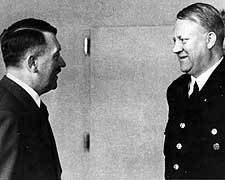
1946: William Joyce, Lord Haw-Haw

On this date in 1946, fascist William Joyce, famous by the nickname “Lord Haw-Haw” for his English-language Nazi propaganda broadcasts, was hanged at Wandsworth Prison for treason.

As a pugilistic young anti-Semite with the unusual credential of being a Unionist Irish Catholic, Joyce had been a moving spirit in the interwar British fascist party. (Since audio broadcasts would define Joyce’s life, it seems appropriate to refer the reader for a fuller biography to this recent Oxford biography podcast.)

But because time loves a good laugh, it had the guy haranguing his countrymen for insufficient patriotism marked out for the last treason execution in British history, and unrepentant about it by the time he got there.

The Brooklyn-born Joyce (he never lost his American citizenship) who naturalized as a German in 1940 had a rather tenuous claim on the patriotic high horse to begin with, and after the war, that meant the treason charge proceeded on legally doubtful grounds: speaking the King’s English didn’t mean he owed allegiance to the king. Prosecutors ultimately hung him with a British passport he’d obtained fraudulently, and the legal principle has never since sat well with jurists.

It was just the tool at hand. The British government really hated the guy.*

However limited the resources at his disposal — sparse intelligence, paltry staff, and of course, after 1942, a disastrously collapsing war effort — he had fashioned them into broadcast spin to twist the British lion’s tail in countless British homes throughout the war.

Here’s one episode, with Joyce savaging Winston Churchill, selected from archive.org’s library of Joyce broadcasts (1-7, 8-16, 17-23).

[audio:William_Joyce_Churchill.mp3]

Joyce’s star shone brightest and his invective cut deepest early in the war. Once everything at the front stopped coming up Teutons, he descended into irrelevance and self-parody, albeit without professing the slightest doubt in his fascist convictions.

This last broadcast, prepared just a few days before Germany capitulated, has our day’s principal ramblingly drunkenly from the besieged Nazi capital.

[audio:William_Joyce_final_broadcast.mp3]

Content-wise, not much had changed eight months later, but at least he managed to make his gallows statement coherently.

In death as in life, I defy the Jews who caused this last war, and I defy the power of darkness which they represent. I warn the British people against the crushing imperialism of the Soviet Union. May Britain be great once again and the hour of the greatest danger in the West may the standard be raised from the dust, crowned with the words — you have conquered nevertheless. I am proud to die for my ideals and I am sorry for the sons of Britain who have died without knowing why.

There’s a thorough, and lavishly illustrated, history of Joyce here.

* Authorities passed on prosecuting his wife Margaret, who’d also appeared on some Lord Haw-Haw broadcasts. Under the circumstances, Joyce’s daughter (by his first marriage) Heather Iandolo turned out pretty balanced.

On this day..

1900: En Hai, the murderer of von Ketteler

On the last day of the 19th century, a Chinese officer was beheaded on the public street where he had precipitated western* military intervention in the Boxer Rebellion by killing a German diplomat.

Foreign commercial penetration — and domination — was generating domestic turmoil in China. As liberal reforms foundered in the late 1890’s, a more radical anti-foreigner movement blending spiritualism and martial arts launched the Boxer Rebellion (or Yihetuan Qiyi, in the local coinage).

In addition to massacring hated missionaries, the Boxers besieged foreign diplomatic missions in Peking … and veteran German ambassador Klemens von Ketteler was killed in a firefight on a crowded street. (The particular circumstances of the killing seem highly confused, and were immediately colored by the various interested parties’ axe-grinding; it’s sometimes called an “assassination,” but there’s no proof von Ketteler was specifically targeted, and the ambassador himself managed to get a shot off in the fray.)

Given the financial interests at stake, it would be far too much to say that von Ketteler’s death caused the military intervention that ensued, but it certainly catalyzed the conflict. The next day, China’s Dowager Empress declared war against the Eight-Nation Alliance. Within two months, Peking (Beijing) was under foreign occupation.

The man detained as von Ketteler’s murderer — En Hai, or Enhai, or Su-Hai — was proud to claim the act himself, and intimations of the Chinese government’s official blessing for anti-foreigner activities were carefully massaged since the Eight-Nation powers would have need of the Qing dynasty to keep order locally.


On the afternoon of this day in 1900, En Hai was brought out from German custody to the street where von Ketteler had met his end and handed over to the Chinese for beheading. Notice the substantial foreign attendance in both the photograph and the drawing. A German officer’s diary entry cited in The Origins of the Boxer War: A Multinational Study recounted the scene.

Ketteler’s murderer was executed at last — for months past the unfortunate wretch has been begging for his execution. It took place in one of the busiest thoroughfares but there were only a few curious onlookers. Scarcely fifty yards away the usual business was being quietly transacted in the streets, people who were eating did not suffer themselves to be interrupted, and a teller of fairy-tales who was recounting his absurd stories had interested his numerous audience much more than the execution.

And to see that the lesson would not be lost on future generations of Chinese, the humiliating peace imposed upon China that December (and formally signed the following year) required China to expiate its guilt by

erect[ing] on the spot of the assassination of his Excellency the late Baron von Ketteler, commemorative monument worthy of the rank of the deceased, and bearing an inscription in the Latin, German, and Chinese languages which shall express the regrets of His Majesty the Emperor of China for the murder committed

Having been made an offer it couldn’t refuse, China honored the intersection (German link) where both the victim and his killer had died in their turns with a massive pailou archway, inscribed

This monument has been erected by order of His Majesty the Emperor of China for the Imperial German Minister Baron von Ketteler, who fell on this spot by heinous murder on the 20th of June, 1900, in everlasting commemoration of his name, as an eternal token of the Emperor’s wrath about this crime, as a warning to all.


A historical postcard of Ketteler monument.

“Everlasting commemoration,” in this case, lasted 15 years.

The national aspirations that had fired the Boxers reared up again in 1911-12 to topple the Qing. Days after Germany’s surrender in World War I, the Chinese Republic began removing the von Ketteler monument.

Visitors will need to look sharp to catch it now, in Zhongshan Park (aka Sun Yat-Sen Park or Central Park), where it has been rededicated to abstractions that age a little better than our German civil servant.

But this was still not quite the last the name von Ketteler was heard in the consular world. A relative (German link) of the man slain in Peking was a conservative diplomat of the Weimar and early Nazi period who opposed the national socialist government. Wilhelm Emmanuel von Ketteler was abducted by the Gestapo in 1938 and murdered thereafter in unclear circumstances, possibly for involvement in a very early plot to kill Hitler.

* “Western” in this case includes Japan, the regional industrial power that also flanked the Russian Empire to the east — very much a player on the European balance-of-power chessboard. Germany (obviously), France, Italy, Russia, the U.K., and the U.S.A. were the other nations involved in the intervention, along with the Austro-Hungarian Empire, whose naval deployment to China included future Sound of Music character Georg Ritter von Trapp.

A fair amount of detail on China’s foreign relations during this period is available free in the (dry, and sometimes dated) public-domain 1918 work The International Relations of the Chinese Empire.

On this day..

1943: Elfriede Scholz, Erich Maria Remarque’s sister

On this date in 1943, pacifist novelist Erich Maria Remarque lost his youngest sister to the Nazi regime — beheaded because her “brother is beyond our reach.”

Actually, Elfriede Scholz was convicted (upon the denunciation of her landlady a few weeks before) by the kangaroo People’s Court for undermining the war effort. (“Wehrkraftzersetzung” — German has a word for everything.)

Like her brother, Elfriede was a staunch opponent of the Nazi government, and in 1943 that could certainly have sufficed to get her a one-way trip to Plotzensee Prison.

But Roland Freisler‘s verdict explicitly referenced (German link) her more famous brother — upon whom the Nazis would have poured out an interwar era’s worth of fury had they been able to get to him in America.

Ihr Bruder ist uns entwischt, aber Sie werden uns nicht entwischen! (Your brother is beyond our reach, but you will not escape us!

Though Erich Maria Remarque and Adolf Hitler had served together at the Third Battle of Ypres, they didn’t quite see eye to eye after the Great War.

Remarque’s immortal anti-war novel All Quiet on the Western Front was banned and burned by war-glorifying Nazis (they also said Remarque was of Jewish descent, apparently without any factual basis).

Erna, Elfriede and Erich Remark — the author later restored an ancestral spelling of his name that had been Germanized in the 19th century — in happier times.

Remarque left Germany, an intellectual celebrity and man-about-town who rubbed shoulders with the likes of Marlene Dietrich (with whom he had a passionate affair) and Ernest Hemingway (with whom he did not).

The Nazis stripped his citizenship, and fumed that they couldn’t get their jackboots on him. (At one point, Goebbels invited Remarque to return. Sly.)

But Elfriede, they could get. She had stayed in her native Germany with her husband and family.

Not content with taking her head off, Berlin added a particularly vicious twist by billing the expatriate author 90 marks for the executioner’s trouble.

The author never said or wrote much about Elfriede, even his diaries. But years later, Erich Remarque dedicated his novel about life in a concentration camp, Spark of Life, to his late sister. Today, there’s a street named for Elfriede in the Remarques’ native Osnabruck.

More about Remarque at the German (but the site is multilingual) Erich Maria Remarque-Friedenszentrum and this online exhibit from New York University.

Better still, here’s the 1930 film version of All Quiet on the Western Front — that year’s Academy Award winner as Best Picture.

On this day..

1945: The Belsen war criminals

On this date in 1945, British hangman Albert Pierrepoint executed eleven guards of the Bergen-Belsen concentration camp and two other Nazis in occupied Hameln.

Liberated only eight months before these hangings, Belsen provided the to-us-familiar store of Nazi atrocity stories. Forty-five sat in the dock at the Belsen trial under British military authority, including the notorious camp commandante Josef Kramer — better known as the Beast of Belsen — and the “Angel of Death” Irma Grese.

Those two, and nine others less distinctively nicknamed, faced the gallows. (They were hanged together with two other war criminal convicts not connected to the Belsen trial, Georg Otto Sandrock and Ludwig Schweinberger, for a total of 13.)

On December 13, 1945, Pierrepoint hanged Grese; then, Elisabeth Volkenrath; and then, Juana Bormann, each individually. Finally, the men were then dispatched in pairs.

(Other than Kramer, the most notable was Nazi doctor Fritz Klein, who gave this reading of medical ethics when queried while the camps were still operating: “My Hippocratic oath tells me to cut a gangrenous appendix out of the human body. The Jews are the gangrenous appendix of mankind. That’s why I cut them out.”)


Of all this batch, Irma Grese, the “beautiful beast”, enjoys the liveliest afterlife.

If one finds her pretty, then she was a pretty young thing — only 16 when she hitched herself to the SS; turning 22 during her fatal postwar trial.

Stalking the camp with her whip, and (rather conveniently) cited with the ravenous sexual appetite a B-movie screenwriter would give such a character, part of her siren song is plainly the fetishistic magnetism of Nazi women.

But in the numerous discussion threads about Irma Grese, any number of her advocates will emerge.

Can we leave it at the fascination that female war criminals inspire? Certainly few 22-year-old Einsatzgruppen men have the mitigatory evidence of a coming-of-age in farming and retail so lovingly emphasized, the precise measure of complicity in genocide analyzed in such detail (pdf).

Grese, perhaps, strikes as impressionable, in the youthful sense of absorbing one’s place from the world one inhabits. Her hangman wrote that “[s]he seemed as bonny a girl as one could ever wish to meet.” As a camp guard, she wins promotions; to her interrogators, she accepts responsibility equal to Himmler’s; among those condemned at the Belsen trial, she alone is defiant.

In that guise — and whether or not it is rightly attributed to her — she presents back to her interlocutor those timeless questions of personal identity and moral responsibility: where does abnormal psychology leave off into perfectly conventional psychology that just happens to occupy an abnormal world?

On this day..

1942: Partisans by the Sonderbataillon Dirlewanger

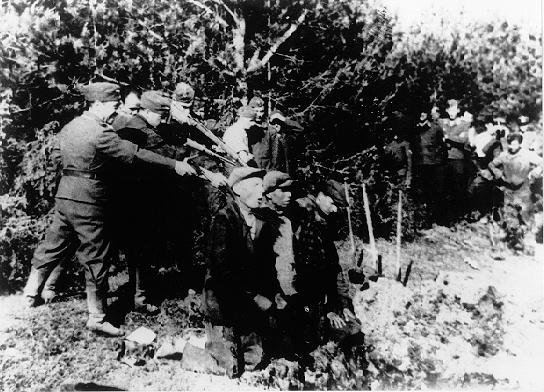
On an uncertain date in November 1942, this photograph of an SS unit executing anti-Nazi partisans in Belarus was taken.

Behind this striking but all too typical image of brutal field executions on the eastern front lies the sordid story of one of the strangest military formations in the Nazi service.

The Dirlewanger brigade was formed under a man whose fortuitous early enrollment in the NSDAP had enabled him to pull strings to get himself out of Dachau, where he had been sent after his second molestation conviction, and where unfolding events could have easily seen him on the other end of the firing squad.

Instead, Oskar Dirlewanger formed a unit of criminals and reprobates: poachers at first, and eventually, as it grew into the SS-Sonderbatallion Dirlewanger, men culled from the camps or soldiers condemned by the army, some literally trading the likelihood of execution themselves for service under one of the most disreputable commanders in the field.

Oh, and, just incidentally — it stuck them into a lawless environment where they could probably practice and refine their pathologies unchecked. Some “rehabilitation.”

As of this relatively early date, the convict floodgates weren’t yet entirely open, and the existing German volunteers were supplemented by a goodly portion of Soviet citizens recruited in the occupied territories. From 1942 to 1944, they hung around Belarus hunting guerrillas and doing to them — well, you know. (The original notion of using poachers was to exploit their ranger-like woodsman talents for anti-partisan warfare.)

Oh, and civilians. Tens of thousands of civilians. That almost goes without saying.

Sadly for Dr. Dirlewanger, events further south were undoing all his bloody work, for it was also in the November 1942 that the Red Army decisively turned the tide of the war with its counterattack at Stalingrad — in fact, it was this very date in 1942 that it completed its encirclement, stranding a quarter-million freezing Wehrmacht regulars on the banks of the Volga, only a handful ever to see Germany again.

The Dirlewanger brigade would have its own turn being minced by the Soviet war machine, though not before it had a notorious hand in drowning the Warsaw Uprising in blood.

Dirlewanger himself was tortured to death by Polish guards a few weeks after the war ended.

Part of the Themed Set: The “Ex” Stands For “Extrajudicial”.

On this day..

1939: Nine Czech students

Today is International Students’ Day and a public holiday in the Czech Republic and in Slovakia thanks to the martyrdom of nine at the hands of the Nazi occupation forces this day in 1939.

The previous fall, Hitler had cowed the allied powers into ceding the mountainous Czechoslovakian Sudetenland to the Third Reich in order to avert war — leading to Neville Chamberlain‘s famously mistaken “peace in our time” speech.

In March 1939, Germany reneged its part of the bargain and gobbled up Bohemia and Moravia, essentially the modern Czech Republic.

That this would collapse Chamberlain’s vision of peace and set Europe’s powers on the road to war with Berlin was cold comfort to the occupied Czechs. They had their own problems.

On October 28, youth demonstrations in Prague against the occupation resulted in the shooting of Charles University medical student Jan Opletal

Two weeks later he succumbed to the injury, and his funeral turned into an anti-occupation riot forcibly quashed by German arms. According to the London Times account:

On November 17 at 3 a.m., the Gestapo entered all students’ colleges, men’s and women’s, without allowing them to dress, tied the students in groups of three, and dragged them away … Between 3 o’clock and 8 o’clock in the morning the Gestapo visited students’ homes and lodgings. Those opposing arrests and parents who withheld information were immediately shot at, and the wounded were refused attention. The Gestapo broke into high schools as well as into the university …

The prisoners were taken to the Ruzyn barracks and to the Sparta football stadium, where cold water was flung over them and were made to wait until the evening. Then, in the barrack yard, 124 students and teachers* were shot before their fellow-students, the first nine being presidents of students’ associations, including the brilliant young sociologist Dr. Matoushek [English Wikipedia entry | Czech], son of a former Minister of Commerce.

Universities in the cities were declared closed for three years; they would not in fact re-open until after the war.

The day, subsequently memorialized as den boje studentu za svobodu a demokracii (Day of the Students’ Fight for Freedom and Democracy), entered Czech history a second time a half-century later. A student protest at Opletal’s grave on this date in 1989 helped catalyze the Velvet Revolution that toppled Czechoslovakia’s Communist government.

* The larger figure was circulated in the days following by Czech sources. It is not clear to me whether that number proved unfounded, or whether subsequent memorials simply came to focus on the leading nine — whose executions are certain, and were even announced by German communique.

On this day..

1944: Hannah Szenes, who gambled on what mattered most

On this date in 1944, Hannah Szenes was shot by the Nazis in her native city of Budapest — a city she had left five years before, and to which she had returned as a British special operative.

Hannah Szenes (alternatively, “Chana Senesh” or “Hannah Senesh”) grew up in interwar Hungary.

Reaching adulthood in a period of rising anti-semitism in the late 1930’s, she became a Zionist and emigrated to British-controlled Palestine.

But with the onset of war, she signed up with the British Special Operations Executive and was parachuted behind German lines in March 1944.

Her brief: to save both Jews and downed Allied pilots. It is often described as the only military expedition to relieve European Jewry during World War II.

And it was as dangerous as it sounds.

[flv:http://www.blessedisthematch.com/BITMclip4.flv 425 344]

Hannah was nabbed crossing into Hungary on a mission that her colleagues (rightly, it seems) deemed too perilous to attempt, and withstood months of torture without divulging her codes.

By the time she went in the dock for treason, Nazi control of Hungary was collapsing and judicial administration itself was breaking down to the timpani of falling shells. Her sentencing November 4 was postponed; on November 7, an officer peremptorily informed her that she had been condemned to death. It’s believed that she was actually never formally sentenced, merely mopped up ahead of the unstoppable Red Army, which on this very day first entered Budapest’s suburbs.

A writer as well as a fighter, Szenes’ poetry survived as her monument to life — like the present-day Israeli standard “Blessed is the Match”, also the title of the documentary excerpted above; and, her “Halikha LeKesariya” (“A Walk to Caesarea”), also known as “Eli, Eli” (“My God, My God”). Here it is sung by Regina Spektor.

These lines were reportedly her last-known verses from prison:

One – two – three … eight feet long
Two strides across, the rest is dark …
Life is a fleeting question mark
One – two – three … maybe another week.
Or the next month may still find me here,
But death, I feel is very near.
I could have been 23 next July
I gambled on what mattered most, the dice were cast. I lost.

On this day..

1945: Vidkun Quisling, who made his name as a traitor

On this date in 1945, eponymous Nazi collaborator Vidkun Quisling was shot at Oslo’s Akershus Fortress for high treason.

By the time of his death, the Nazi collaborator (English Wikipedia page | Norwegian) had already given his surname to English and other languages as a synonym for traitor.

Just deserts for his efforts as chief of the fascist party Nasjonal Samling to aid the Nazi conquest of his home country. Quisling interrupted a radio broadcast on April 9, 1940 to proclaim himself Prime Minister* and order cooperation with invading Germans.

Although Quisling’s lack of popular support compromised his value even as a puppet, he remained as Minister President of Norway through the war — a crucial tool in Germany’s counter-encirclement jousting with Britain, nicely explained at the outset of Frank Capra’s American propaganda flick Why We Fight:

He enjoyed public regard commensurate with his station.


A 1944 cartoon in Sweden (which remained tenuously neutral and unoccupied during the war) indicates that Quisling had already made his name a byword for treachery. The caption reads:
“I am Quisling.”
“And the name?”

Norway had abolished capital punishment in 1905, but its government-in-exile reinstated it expressly for dealing with high-level collaborators.

Though Quisling himself may have deserved this and worse, the justice and legality of so doing has been controversial ever since.


The site of Quisling’s execution. Some other shots from his trial are in this 60-year Norwegian-language retrospective.

* Thought to be the first on-air putsch in history.

On this day..

1952: George Muldowney, for loving and killing the original Bond girl

On this date in 1952, Irish steward George Muldowney was hanged at Pentonville Prison for the rather pathetic murder of a dashing Polish spy who had survived much greater villains.

Allowing that nobody ought to die on the floor of the Shelbourne Hotel with a sheath knife stuck in their chest, Christine Granville in particular really deserved a better exit.

Before the outbreak of World War II, she was Krystyna Skarbek, daughter of a Polish aristocrat sinking into poverty. After Germany overran Poland, she went off the marriage meatmarket and on Her Majesty’s Secret Service for a stunning career as a stunning spy that still has ’em sighing today.

Rechristened “Christine Granville” by Britain’s Special Operations Executive, she spent most of the war carrying out feats of cloak-and-dagger derring-do, with a Bond-like aplomb for extricating herself from tricky situations.

If only half the stories they tell about her are true …

  • Commuting between Hungary and Poland by skiing over the Tatra Mountains to gather intelligence and pull other agents out of harm’s way.
  • Getting herself and a fellow agent released from arrest by feigning tuberculosis by chewing her tongue until it bled.
  • Escaping capture at a checkpoint by pulling the pins on two grenades and daring the guards to shoot her.
  • Marching alone into a not-yet-liberated concentration camp to have POW’s reprieved from execution — by telling the Nazi commandante that he’d get the same treatment unless he spared them.
  • Snatching spymaster Francis Cammaerts from the Gestapo ahead of his execution.

And the love affairs! Or that’s what they say — including fellow agent Ian Fleming.

Granville earned the French Croix de Guerre, the George Medal for Special Services, the Order of the British Empire and other decorations, although merely surviving so much time in the field might have been her greatest achievement … but when the war ended, she was just another unwelcome Polish refugee, scrounging for service work in a recovering economy with no welcome waiting for her in her Soviet-dominated homeland.

From here on in, the trite and the tawdry eclipse the heroic.

A stewardess gig on a cruise ship attracted the attentions of her eventual murderer; his crush unreciprocated, and her companionship with another man jealously noticed, Muldowney stalked her and — on the very eve of Granville’s departure to reunite with a wartime confederate/lover — murdered her at her Kensington hotel.

To read the London Times‘ accounting the last moments of this woman so recently outfoxing the Nazis is to behold the face of banality triumphant.

Mr. Ian Smith, for the prosecution, said that, in a written statement at Kensington police station, Muldowney …

“describes how he waited outside the hotel and saw her go in. He went in after her and asked her for some letters he had exchanged with her. She said she had burned them. He did not believe her, and then says: ‘She told me she did not want anything to do with me and was off to the Continent and would see me in two years’ time.’

He then says: ‘Then I took the knife from the sheath which I had in my hip pocket and stabbed her in the chest, and then somebody came up.'” It was a deep stab wound up to the hilt of the knife, and penetrated the heart.

Muldowney didn’t fight the charge; he’d been planning to poison himself after the murder, and tried it when he was in custody. He declined legal aid and pleaded guilty at trial, seemingly eager to expiate his sin or join his would-be lover in death. It was less than 16 weeks after the crime that he stood on the gallows.

While Muldowney moulders in well-deserved obscurity, his victim reportedly inspired her former lover to create the character of Vesper Lynd — the original femme fatale secret agent in the original James Bond novel, Casino Royale. (And the smashing cocktail named for her in the same volume.)

She — Christine, not Vesper — is buried under a spadeful of symbolic Polish soil in St. Mary’s Roman Catholic Cemetery in London.

On this day..

1946: Amon Göth, Schindler’s List villain

On this date in 1946, Plaszow concentration camp commandante Amon Göth was hanged near the camp site by Poland’s postwar Communist government.

Göth is most widely recognizable as Ralph Fiennes’ fiendish character in Schindler’s List, one of the American Film Institute’s top movie villains of all time. (And, naturally, a first-class bastard in real life, too.)

A short-drop strangulation is not the way you’d want to go. It turns out, though, that Steven Spielberg (ever the sentimentalist) seriously tidied up the proceedings.

As you watch the video of the real Amon Goeth’s exit below — and it’s a snuff film, so proceed advisedly — consider the following:

  • Amon Goeth does bear a passing fair resemblance to Ralph Fiennes.

  • To judge by their getup — dig the masks! — the executioners might have been Batman and Robin.
  • To judge by the discharge of their duties, the executioners might have been Larry, Moe and Curly. Goeth survived two drops (notice the executioner on the right gesticulating in frustration as the second try fails) before they finally got it right:

On this day..